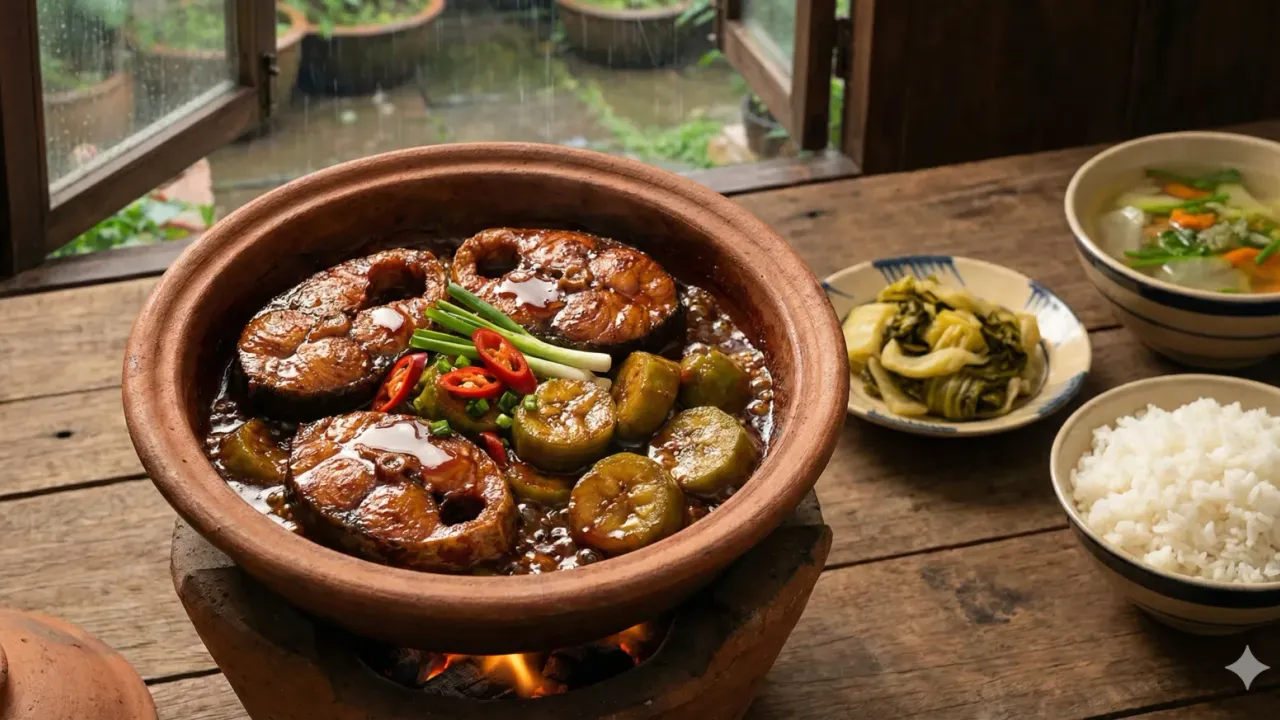
This Vietnamese braised black carp with green banana recipe captures the soul of Northern Vietnamese home cooking. With deeply savory, fall-apart fish, creamy banana rounds that absorb every drop of the rich braising sauce, and a gloss of caramelized fish sauce that coats every piece, cá trắm kho chuối xanh is the kind of dish that defines comfort food in the North. It’s the dish your grandmother made on gray, rainy afternoons — deeply fragrant, intensely flavored, and utterly unforgettable with a bowl of steamed rice.
Prep Time: 30 minutes | Cook Time: 2.5–3 hours | Total Time: ~3 hours | Servings: 4–5
Difficulty: Intermediate | Calories: ~2,312 kcal total
What Makes Cá Trắm Kho Chuối Xanh Special?
Cá trắm kho chuối xanh belongs to the great Vietnamese tradition of kho — the slow-braising technique in which proteins are cooked down in a savory, caramel-darkened sauce until the liquid reduces to a clinging, intensely flavored glaze. Unlike the lighter kho dishes of the South, the Northern Vietnamese style tends to be deeper in color, more pronounced in its saltiness, and often features the distinctive earthiness of tương bần, the traditional fermented soybean paste from Hưng Yên province.
What elevates this recipe above a simple braised fish is the green banana. As the firm, starchy bananas cook low and slow alongside the fish, they transform completely — softening into creamy, almost buttery pieces with a gentle natural sweetness that rounds out the rich, salty braising sauce. They soak up flavor from every direction and become just as essential to the dish as the fish itself. This is Vietnamese cooking philosophy in its purest form: every ingredient earns its place.

Choosing the Best Fish for This Recipe
Traditional cá trắm kho calls for black carp (cá trắm đen), prized for its especially firm, meaty, and flavorful flesh. Black carp has more fat running through its muscles than grass carp, giving it a richer taste and the ability to withstand the long braising time without falling apart. When shopping, look for fresh fish with bright, clear eyes, firm flesh that springs back when pressed, and bright red gills. A whole fish around 1 kg is ideal.
If black carp is not available in your market, grass carp (cá trắm cỏ) is the most common substitute and works very well. Snakehead fish (cá lóc) or large catfish (cá trê) are also suitable — they all have the firm texture necessary for long braising. Avoid delicate white fish like tilapia or basa, which will disintegrate during the extended cooking time.
Ingredients for Vietnamese Braised Black Carp with Green Banana
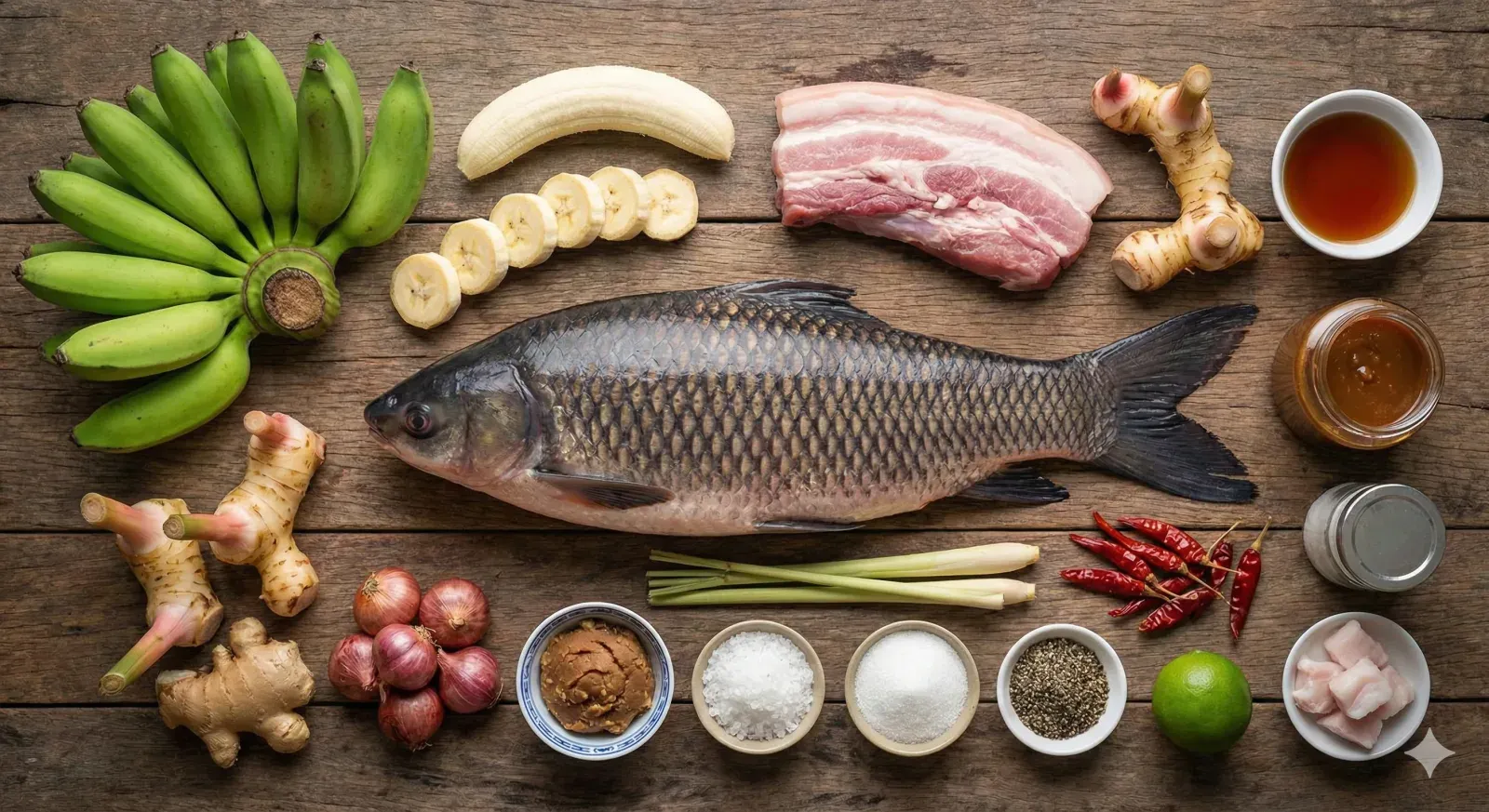
Main Ingredients:
- 1 kg black carp (ca tram den), gutted and cleaned — cut into thick steaks or left as large portions
- 4 green bananas (unripe), peeled and cut into coins or short sections
- 200g pork belly (thit ba chi), cut into bite-sized matchsticks
Aromatics:
- Galangal (rieng) — several thin slices
- Fresh ginger — several thin slices
- Dried shallots (hanh kho) — a handful, rinsed, outer skins reserved for pot lining
- Dried red chilies (ot kho) — 2–3, rinsed
- Lemongrass (sa) — 2–3 stalks, cut into sections and bruised
For the Braising Sauce:
- 3 tablespoons premium fish sauce (nuoc mam ngon)
- 3 tablespoons Vietnamese caramel sauce (nuoc hang / nuoc mau)
- 1–2 tablespoons fermented soybean paste (tuong ban) — optional but traditional
- 2 teaspoons sugar
- 1 teaspoon coarse salt
- 1 teaspoon ground black pepper
- 1/2 teaspoon MSG or seasoning powder
- A squeeze of lime juice — optional, helps tenderize and deodorize
- Pork lard — a small drizzle for finishing gloss (optional but traditional)
Pro tip: Vietnamese caramel sauce (nước hàng) is not sweet caramel — it is a deeply bitter, dark caramel used purely for color and a subtle bittersweet depth. Look for it in Vietnamese or Asian grocery stores, or make your own by cooking sugar until very dark amber before adding a little water.
Step-by-Step Instructions
Step 1: Clean and Prepare the Fish
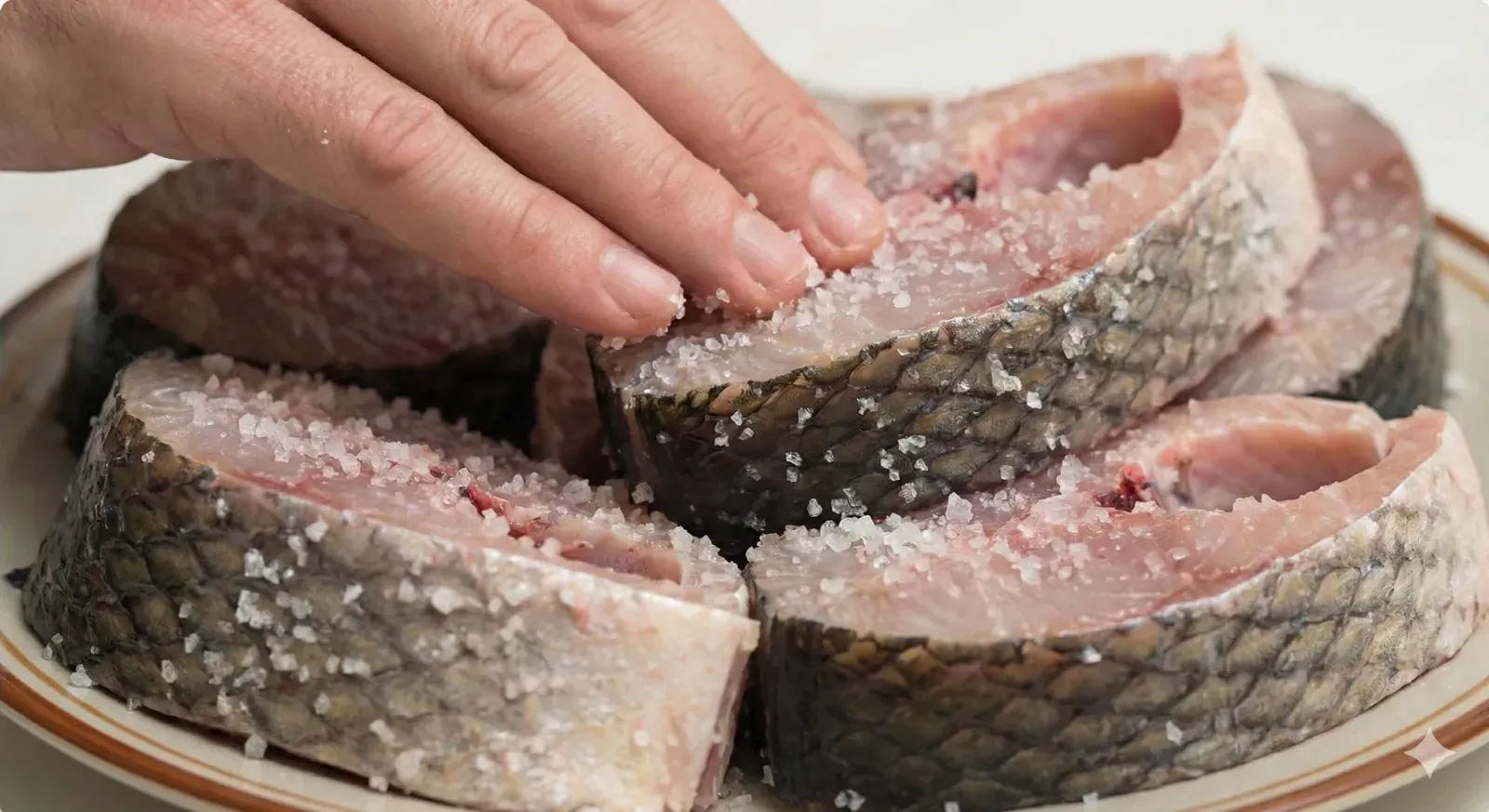
1Gut the black carp and thoroughly scrape away the dark black membrane that lines the inside of the belly cavity — this membrane is responsible for most of the fishiness, and removing it completely is the single most important step in preparing a clean-tasting cá kho. Rinse the fish well; if possible, use rice-washing water (nước vo gạo) for the final rinse, as its mild starchiness is excellent at neutralizing fish odor. Pat dry, then generously rub with coarse salt all over. Let sit for 5–10 minutes — the salt draws out moisture, firms the flesh, and seasons the fish from the surface inward.
Cut the fish into thick steaks or leave in large bone-in sections. Thin cuts may fall apart during the long braise; thicker pieces hold their form and texture beautifully.
Step 2: Prepare the Green Banana and Aromatics
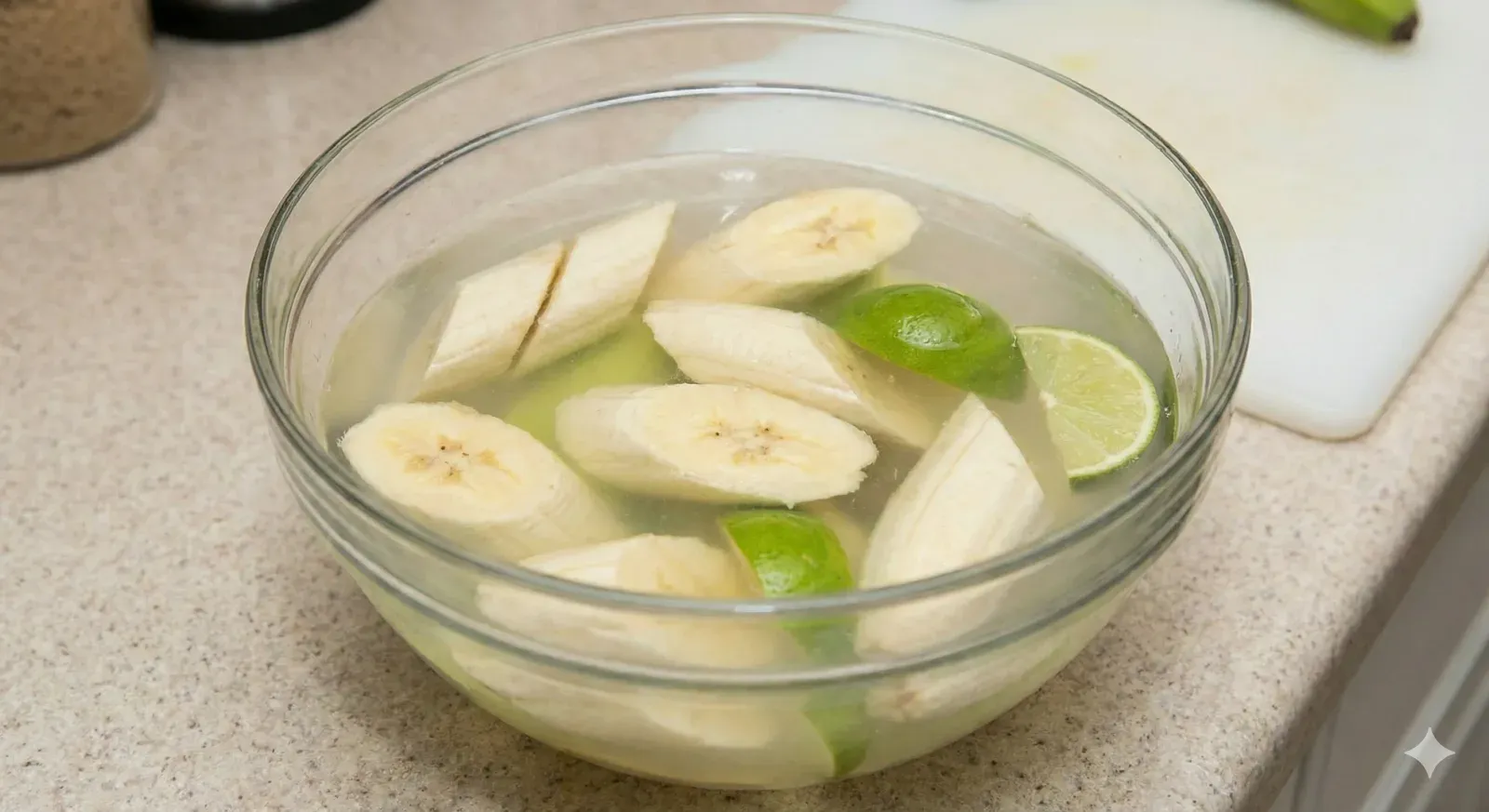
2Peel the green bananas — use gloves if possible, as the sap stains fingers. Cut into diagonal coins or short sections roughly 3–4 cm thick. Immediately transfer to a bowl of cold water with a splash of vinegar or a few squeezes of lemon juice. This acidulated water prevents the banana from oxidizing and turning an unappetizing gray. Let soak for 10 minutes, then drain and rinse clean.
Note: Some traditional cooks in certain regions leave the banana skin on during braising — the skin adds a slightly tannic, earthy note to the sauce. Try it both ways to find your preference.
Meanwhile, slice the galangal and ginger into thin coins. Rinse the dried shallots and set aside their papery outer skins — you will use these to line the bottom of the braising pot. Rinse the dried chilies. Cut lemongrass into 5 cm sections and bruise firmly with the flat of a knife to release the aromatic oils.
Step 3: Mix the Braising Sauce
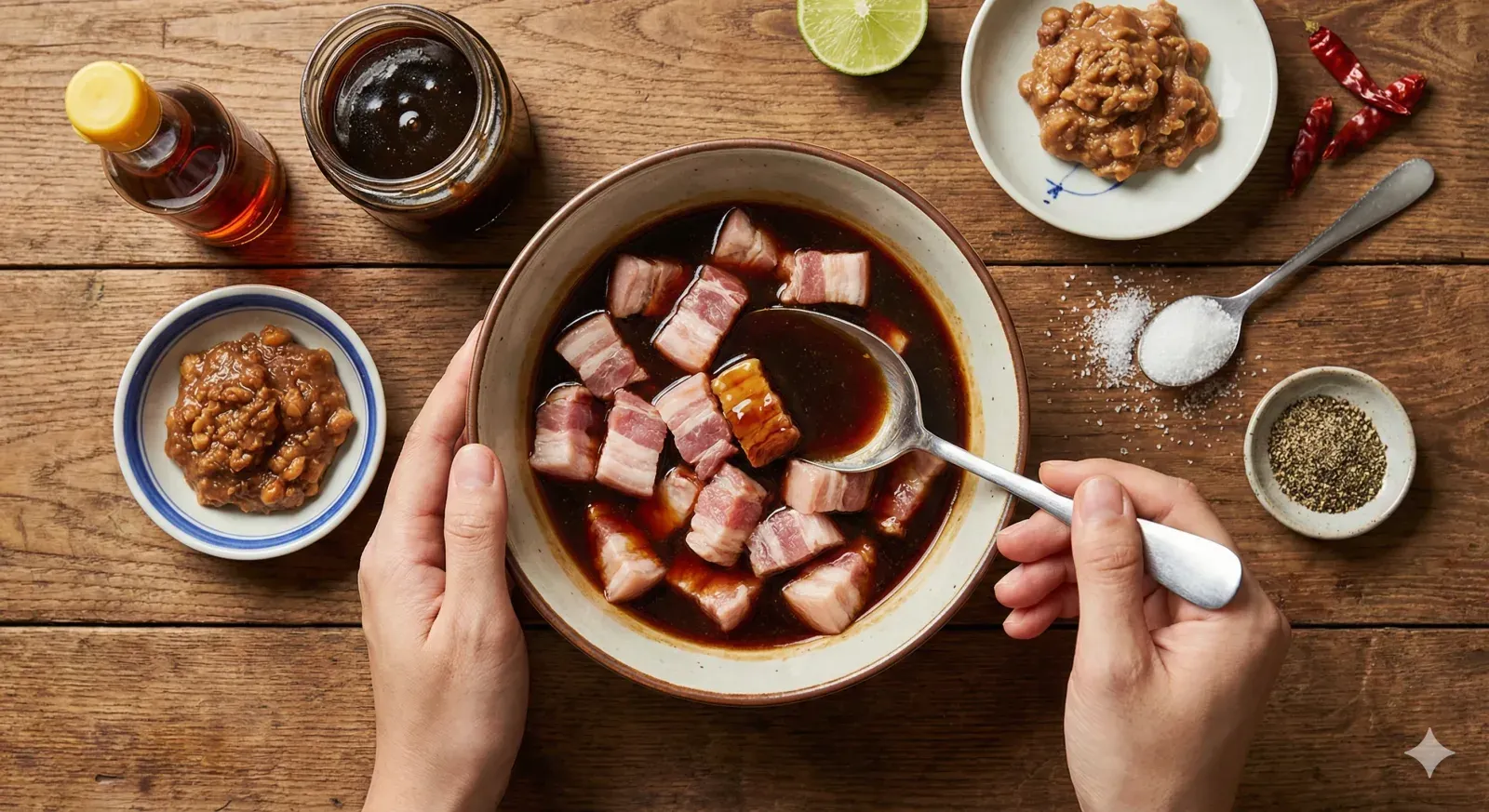
3In a bowl, combine 3 tablespoons fish sauce, 3 tablespoons caramel sauce (nước hàng), the fermented soybean paste if using, 2 teaspoons sugar, 1 teaspoon coarse salt, 1 teaspoon ground black pepper, and 1/2 teaspoon MSG or seasoning powder. Stir well until everything dissolves. Taste the sauce — it should be intensely savory, pleasantly bitter from the caramel, and slightly sweet. Optionally add a squeeze of lime juice; its acidity will help the fish fibers tenderize during the braise and further neutralize any remaining fishiness.
Add the pork belly strips to the sauce now as well. The pork fat bastes the fish during cooking, keeping it moist and adding a rich depth to the braising liquid.
Step 4: Marinate
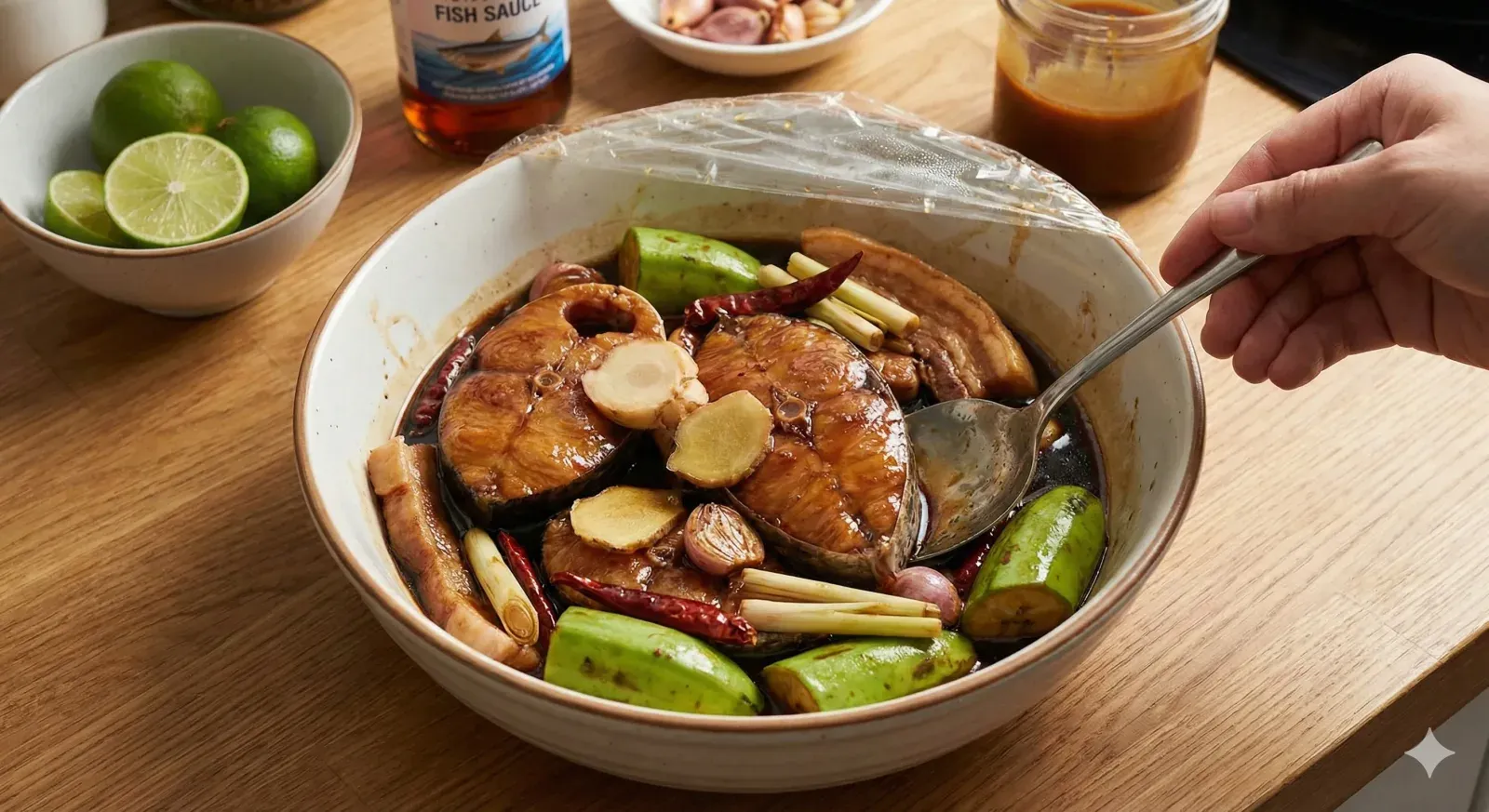
4Combine the fish and pork with the sliced aromatic spices (galangal, ginger, lemongrass sections, dried shallot flesh, dried chilies) and pour the entire braising sauce over everything. Turn gently to coat. Cover with plastic wrap and refrigerate for at least 1 hour — though overnight marinating rewards you with noticeably more complex, deeply penetrated flavor. The longer the fish sits in this sauce, the more complete and developed the final dish will be.
Step 5: First Braise — Building the Foundation
5This is where the two-stage braise begins, and this traditional technique is what separates a mediocre cá kho from a truly magnificent one.
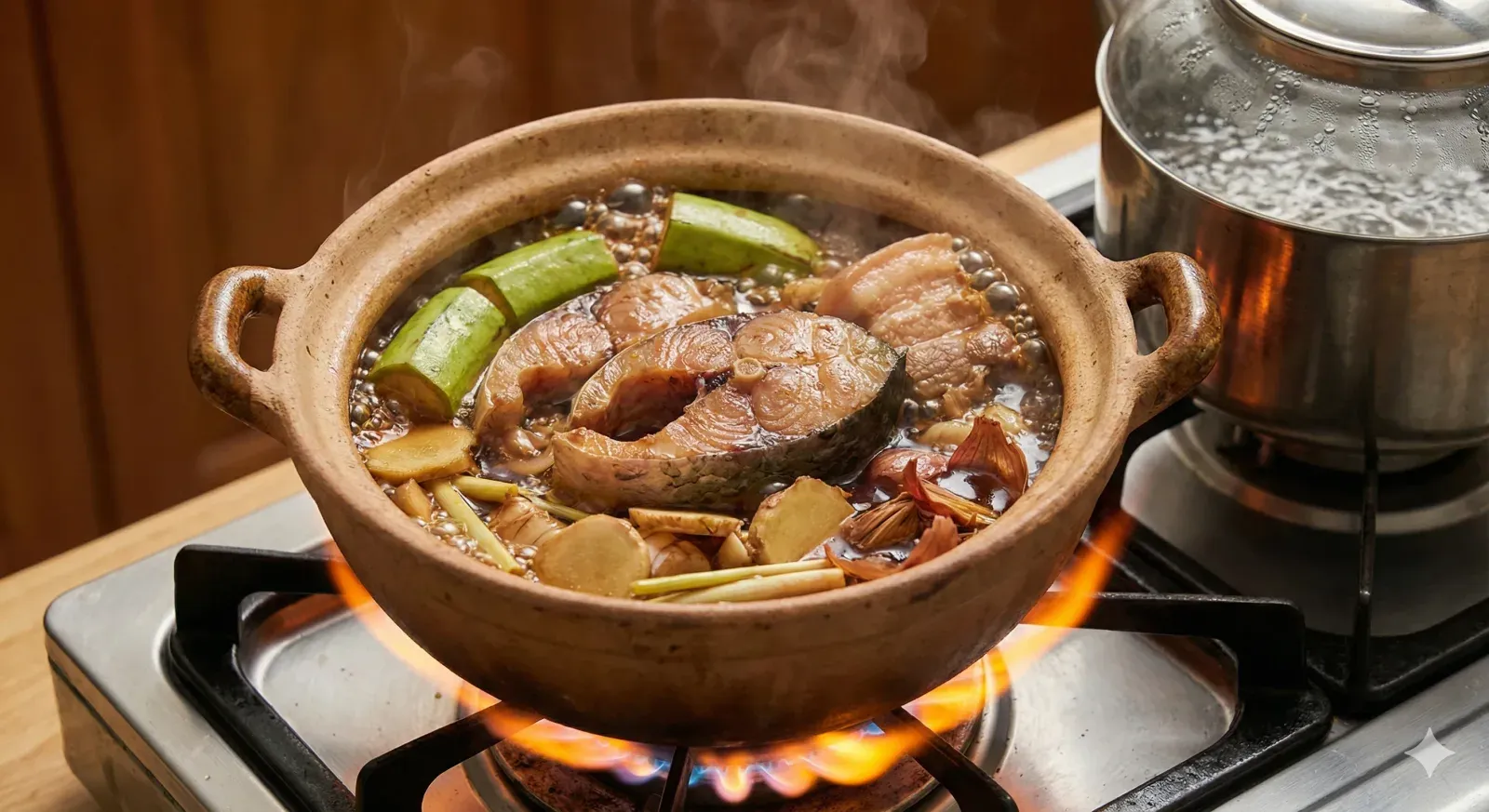
Begin by lining the bottom of a heavy braising pot (ideally a clay pot or thick-bottomed pot) with the reserved shallot skins, plus the sliced galangal, ginger, and lemongrass. This aromatic cushion does two things: it prevents the fish from sticking to the pot and burning on the bottom, and it continuously perfumes the braising liquid from below.
Arrange the fish pieces, green banana sections, and pork belly in the pot, interleaving them. Pour all of the marinating sauce over the top. Turn the heat to high and bring everything to a vigorous boil, letting it bubble hard for 2–3 minutes. This initial blast of heat opens the fish flesh, causing it to expand and draw in the surrounding sauce. You will see the fish pieces plump slightly as they absorb the flavors.
Now add one bowl of boiling water — always boiling, never cold, as cold water at this stage would make the fish smell fishy again — until the liquid just barely covers the surface. Return to a boil so the sauce coats everything evenly, then immediately reduce heat to the lowest possible setting. Braise uncovered, barely simmering (just a few lazy bubbles), for 40–45 minutes.
After 40–45 minutes, turn off the heat completely and allow the pot to rest undisturbed. This resting phase is critical: as the temperature drops, the fish flesh relaxes and “recovers,” becoming springier, more cohesive, and denser in flavor. Do not rush this step.
Step 6: Second Braise — The Long, Slow Finish
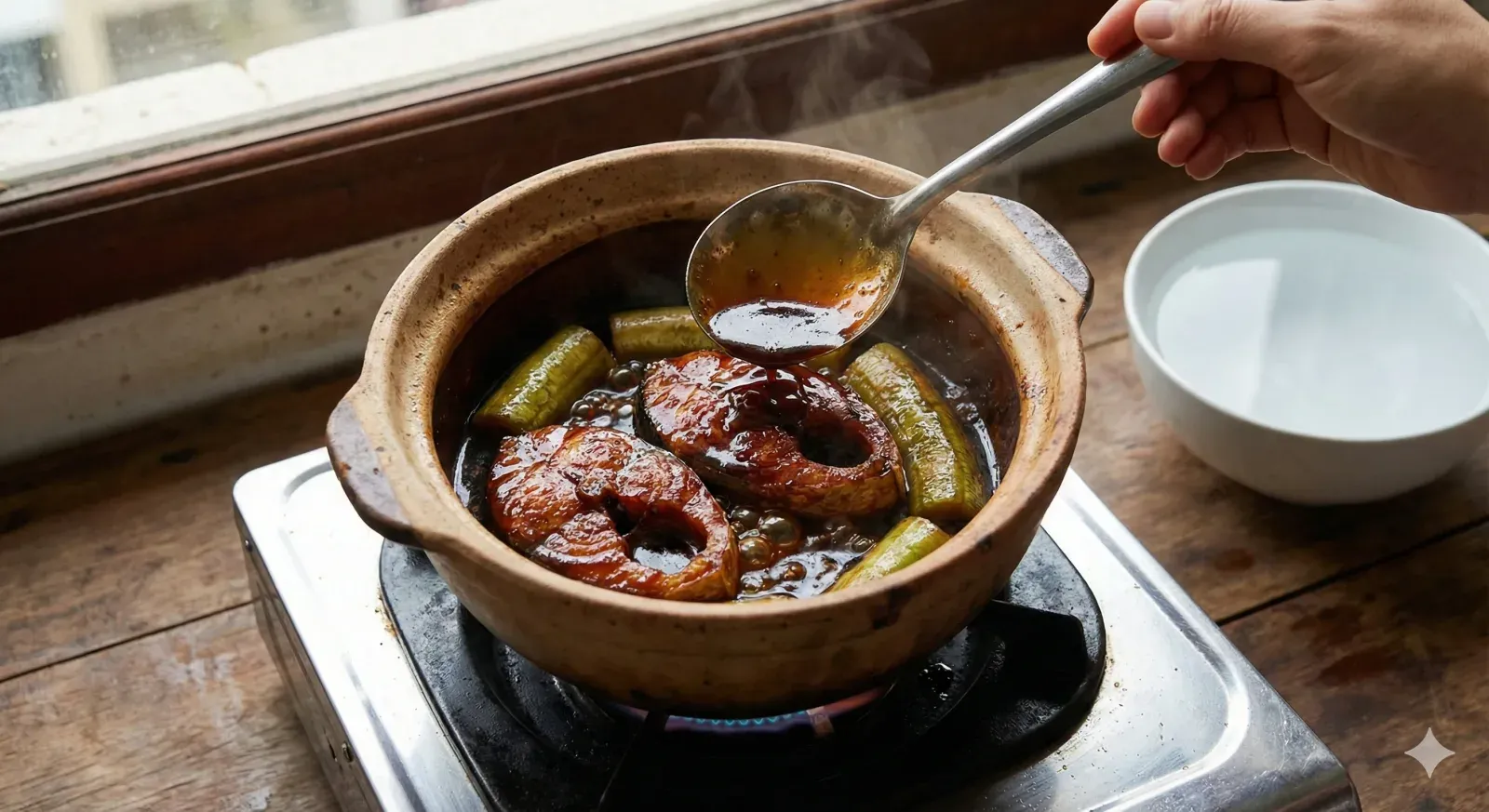
6After the fish has rested and cooled, return the pot to the stove over the lowest possible heat. This second braise is where all the magic happens. Braise uncovered, gently and patiently. Every 15–20 minutes, tilt the pot carefully or use a large spoon to ladle the braising liquid up and over the fish to distribute color and flavor evenly.
Monitor the liquid level closely. If it threatens to run dry before the fish is done, add small ladlefuls of boiling water only. After a total of approximately 3 hours of combined braising time, the fish will be deeply flavored, firm, and beautifully glazed. If you prefer the bones completely soft — a traditional Northern Vietnamese goal — continue braising for longer, up to 4–5 hours, adding water as needed.
When the fish and banana are done to your liking and only about one-third of the braising liquid remains in the pot as a thick, dark, glossy sauce, finish with a small drizzle of pork lard. This traditional step adds a beautiful sheen and a subtle richness to the final presentation. Serve directly from the pot, or transfer carefully to a serving dish.
Expert Tips for Perfect Cá Trắm Kho Chuối Xanh
Deodorizing the Fish Thoroughly
Vietnamese cooks have developed many time-tested techniques for removing fishiness from fresh carp. The most important is removing the dark abdominal membrane entirely. Beyond that, traditional methods include rubbing with lemon and coarse salt, rinsing with rice-washing water, washing with diluted rice wine and bruised ginger, or marinating with a small amount of lime juice. Using two or three of these methods together gives the cleanest result.
Why Only Boiling Water for Topping Up
This rule is non-negotiable in Vietnamese kho cooking. Adding cold water to a braising pot containing fish disrupts the cooking process, causes the fish flesh to contract and toughen, and — critically — reactivates the fishy odor compounds that were driven off by the initial heat. Always keep a small kettle of water just off the boil nearby when making cá kho.
The Role of Tương Bần
Tương bần is a Northern Vietnamese fermented soybean paste from Bần Yên Nhân in Hưng Yên province. Its thick, complex, slightly funky umami flavor is an irreplaceable element in truly traditional Northern cá kho. If you cannot find it, the dish will still be delicious without it — but if you want that authentic “old Northern taste” (vị xưa), it is worth seeking out at Vietnamese specialty stores or online.
Optional Aromatics to Elevate the Dish
Traditional Northern Vietnamese cooks sometimes add a few guava leaves (lá ổi), green tea leaves (lá chè xanh), or dried tai chua (dried garcinia) to the braise. Guava and tea leaves contain tannins that are excellent at neutralizing fishy odors, while tai chua adds a gentle fruity acidity that brightens the overall flavor. These additions are optional but well worth trying.
Clay Pot vs. Regular Pot
A traditional Vietnamese clay pot (nồi đất) is the ideal vessel for cá kho. Its porous walls allow gentle, even heat distribution, and it retains heat exceptionally well at the lowest flame settings. The clay also subtly influences the flavor. However, a heavy-bottomed stainless steel pot or enameled cast-iron pot are perfectly acceptable modern substitutes.
The Two-Stage Braise Explained
The technique of braising fish in two separate sessions over heat is one of the most important traditional techniques in Northern Vietnamese cooking, and it is what makes cá kho so vastly superior to simply simmering fish until done. Here is why it matters:
| Stage | What Happens | Why It Matters |
|---|---|---|
| First Braise (40–45 min) | Fish flesh opens and absorbs sauce; proteins begin to set | Deep flavor penetration; fish is seasoned to the bone |
| Resting Period | Muscle fibers relax; residual heat equalizes | Fish becomes springy, denser, more cohesive — not mushy |
| Second Braise (1.5–2+ hrs) | Sauce reduces to a glaze; collagen breaks down; bones soften | Concentrated flavor; beautiful color; soft edible bones |
You can also extend this to three sessions of heat if you have the time — traditional grandmothers sometimes started cá kho in the afternoon, rested it overnight, and finished it the next morning. The result after 8–12 total hours of gentle braising is fish with bones that dissolve on the tongue and a sauce reduced to an almost jam-like intensity.
What to Serve With Cá Trắm Kho Chuối Xanh
In the Northern Vietnamese tradition, cá trắm kho chuối xanh is served as a central dish in a multi-dish family meal. The rich, salty, deeply savory fish pairs best with contrasting elements that refresh the palate between bites.
Essential Accompaniments:
- Steamed white rice — non-negotiable; the plain rice soaks up the incredible braising sauce
- Vietnamese clear vegetable soup (canh) — a light, clean-tasting soup provides refreshing contrast to the rich fish
- Stir-fried water spinach (rau muong xao toi) — simple, garlicky greens cut through the richness beautifully
- Pickled mustard greens (dua cai chua) — sour, crunchy pickles are the classic Northern Vietnamese counterpart to kho dishes
- Fresh cucumber slices — the cooling simplicity provides welcome relief
Storage and Reheating
Refrigerator: Cá trắm kho chuối xanh keeps beautifully for 3–4 days in an airtight container in the refrigerator. Like all Vietnamese kho dishes, it genuinely improves with time — the flavors deepen and meld overnight, and many people consider leftover cá kho even more delicious than it was freshly made.
Reheating: Always reheat gently on the stovetop over low heat, adding a small splash of boiling water if the sauce has thickened too much in the refrigerator. Never microwave cá kho — the uneven heat will make the fish rubbery. A slow, covered reheat on the lowest flame setting restores the dish to nearly its original quality.
Freezing: Not recommended. The delicate texture of the braised fish changes unpleasantly after freezing and thawing. This dish is best enjoyed fresh or within a few days.
Frequently Asked Questions
What is cá trắm kho chuối xanh?
It is a classic Northern Vietnamese braised fish dish: black carp slow-cooked with green banana, pork belly, and traditional spices in a deeply savory caramel-fish sauce braise. The long cooking time results in intensely flavored, deeply colored fish and creamy, sauce-soaked banana pieces. It is one of the most comforting and beloved dishes of the Northern Vietnamese kitchen.
Why do you braise the fish twice?
The two-stage braise is a time-honored Vietnamese technique. The first braise opens the fish flesh and allows it to absorb the braising sauce. The resting period between sessions allows the meat fibers to relax and recover, resulting in a firmer, more textured result. The second, longer braise concentrates the sauce into a glaze and — if continued long enough — softens the bones to the point where they can be eaten. Fish braised only once in a single long session cannot achieve the same depth of flavor or texture.
Can I substitute another fish for black carp?
Yes. Grass carp (cá trắm cỏ), snakehead fish (cá lóc), and large catfish (cá trê) are all suitable substitutes with the firm texture needed for long braising. Avoid delicate fileted fish, which will fall apart.
Is tương bần essential?
No, but it contributes a distinctive earthy, old-school Northern Vietnamese flavor that is hard to replicate otherwise. The dish is excellent without it — simply omit it if unavailable. If you can find it at a Vietnamese grocery, it is worth adding for that truly traditional vị xưa (old-time flavor).
Why must I only add boiling water, never cold?
Cold water disrupts the cooking process, toughens the fish flesh, and reactivates fishy odor compounds that the heat had already driven away. Always keep a small pot of just-boiled water nearby when making any Vietnamese cá kho.
How do I know when the fish is ready?
After about 3 hours of total braising time, the fish will be deeply flavored, firm, and richly glazed — ready to eat. For fully softened bones, continue braising for longer. The fish is done when the sauce has reduced to roughly one-third of its original volume and clings to the fish in a thick, glossy coat.
The Cultural Meaning of This Dish
In Northern Vietnam, cá trắm kho chuối xanh is more than a recipe — it is a sensory memory. The image of a clay pot sitting over a low flame for hours, filling the kitchen with the deep, fragrant aroma of fish sauce caramelizing with galangal and ginger, is one of the defining images of Northern Vietnamese home life. It is the smell of a rainy afternoon, of a grandmother’s kitchen, of a meal that takes time because it is worth the time.
The inclusion of green banana is particularly meaningful. Banana trees grow everywhere in rural Northern Vietnam, and the unripe fruit has long been used in cooking — not for sweetness, but for its starchy firmness and its remarkable ability to absorb surrounding flavors. In cá kho, the banana becomes a vehicle for the braising sauce, transforming over hours into something completely its own: creamy, savory-sweet, and deeply satisfying.
This dish also reflects the Northern Vietnamese philosophy of patience in cooking. Nothing here is rushed. The marination takes time. The braise takes time. The resting takes time. But the result — fish with bones soft enough to eat, sauce reduced to an almost jammy intensity, banana pieces that seem to hold the entire soul of the braise in every bite — is something that only patience can produce.
Conclusion
Making authentic Vietnamese braised black carp with green banana (cá trắm kho chuối xanh) is a commitment — but one that pays back every hour invested many times over. With careful preparation, the traditional two-stage braise, and the right aromatics, you will produce a dish that genuinely captures the depth and complexity of Northern Vietnamese home cooking at its finest.
The beauty of this recipe lies in its patience and purpose. Every step exists for a reason: the salt rub firms the fish, the aromatic lining prevents sticking, the first blast of heat opens the flesh, the resting period builds texture, and the long slow second braise concentrates everything into a glaze of extraordinary depth. Vietnamese cuisine’s magic is exactly this — transforming humble ingredients through careful technique into something that transcends the sum of its parts.
Serve it with steamed white rice, a light vegetable soup, and some sour pickles on a rainy afternoon, and you will understand exactly why this dish has been at the center of the Northern Vietnamese family table for generations.
Ready to explore more authentic Vietnamese recipes? Browse our collection of traditional Vietnamese dishes — each recipe comes with detailed technique explanations and cultural context to help you master the full depth of Vietnamese home cooking.