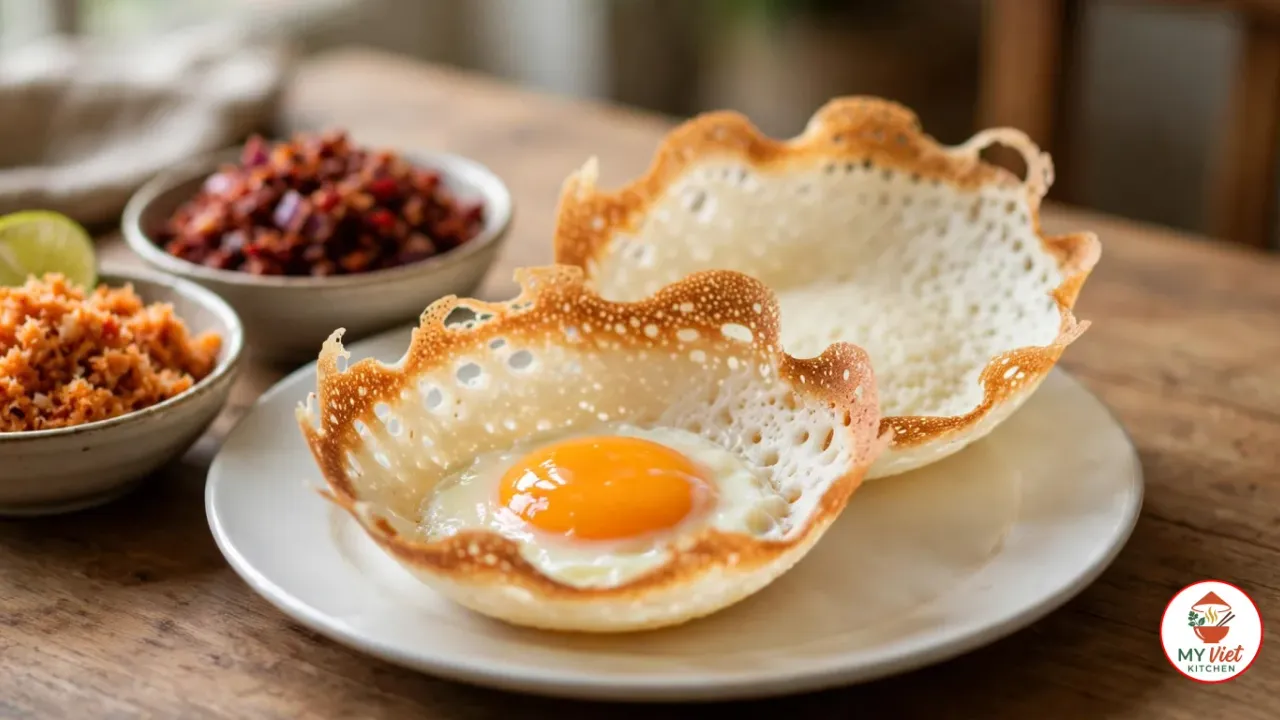
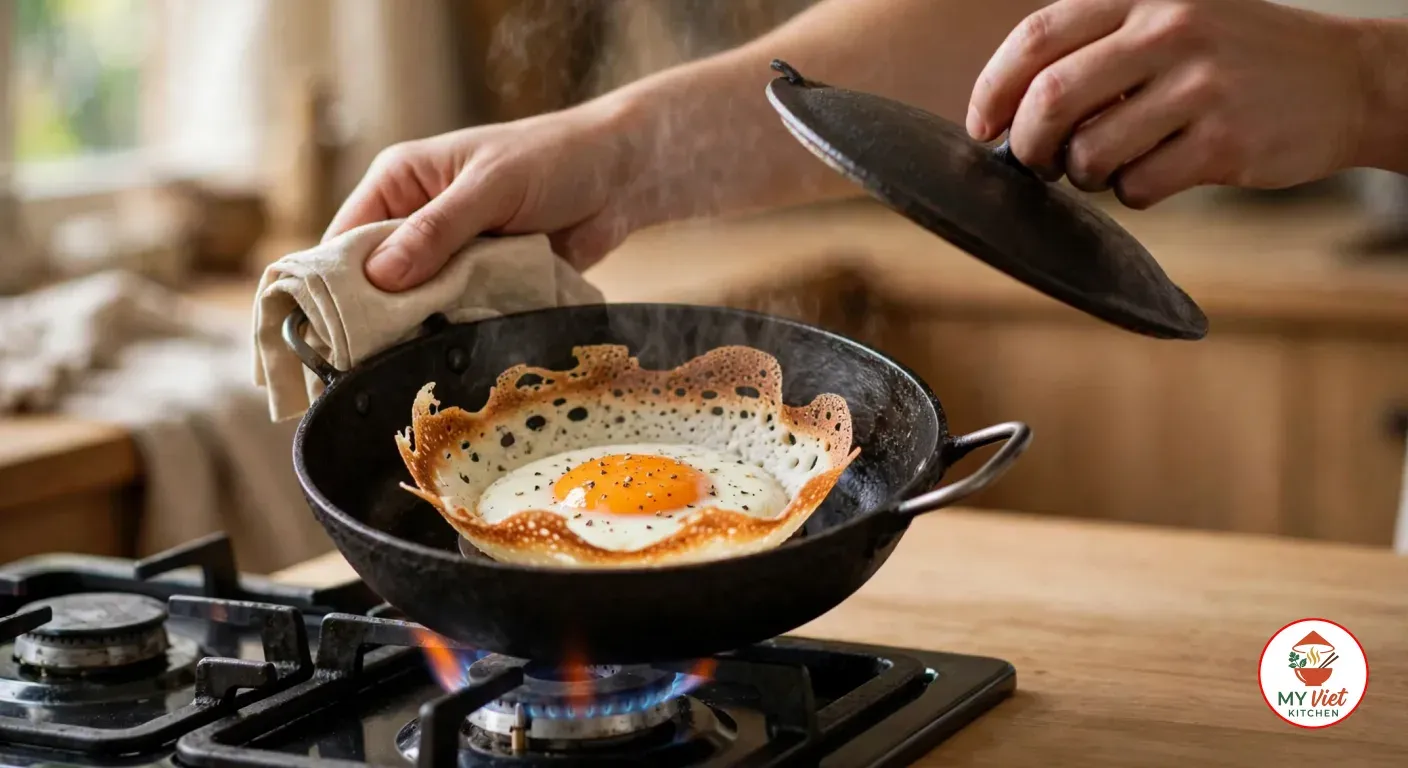
Hoppers are bowl-shaped Sri Lankan pancakes made from a fermented batter of rice flour and coconut milk: thin and crisp at the rim, soft and spongy in the middle. Sri Lanka’s Sinhalese majority call them appa (Sri Lanka by Ish). This recipe ferments store-bought rice flour with a little yeast overnight, finishes the batter with coconut milk, and cooks each hopper under a lid in a small, deep hopper pan.
Prep Time: 20 minutes | Cook Time: 40 minutes | Total Time: 9 hours 30 minutes, including 8 hours of fermenting and a 30-minute rest | Servings: 4 (about 12 hoppers)
Difficulty: Medium | Calories: ~480 per serving (3 plain hoppers)

Are Hoppers the Same as Appam?
Broadly, yes: Wikipedia treats hopper as the usual Sri Lankan name for appam. It describes appam as a thin pancake made with fermented rice batter and coconut milk, traditionally cooked in an appachatti, a deep pan similar in shape to a wok. It is popular in the Indian states of Tamil Nadu and Kerala and in Sri Lanka, where it is usually called a hopper (Wikipedia).
Ishanthi of Sri Lanka by Ish writes that it is almost impossible to say definitively where the hopper began. The Sinhala word appa probably derives from the Sri Lankan Tamil word appam, which is also the name used in parts of South India such as Kerala and Tamil Nadu. English colonialists in Sri Lanka, she adds, turned appa into “hopper” (Sri Lanka by Ish).
The old leavening shows in one Kerala name. Kallappam comes from kallu, Malayalam for palm toddy, which traditionally fermented the rice flour; in modern versions yeast has replaced the toddy (Wikipedia).
String hoppers share the name but not the method. For idiyappam, a rice flour dough is forced through a mould, much like a pasta press, and the strings are steamed (Wikipedia). Nothing on this page applies to them.
How Long Should Hopper Batter Ferment?
From about 4 hours to more than a day, depending on the yeast and the warmth of your kitchen. Published recipes spread widely. Dan Toombs of The Curry Guy rises a rice flour and coconut milk dough for about 4 hours. He says the batter can be used then, but that 24 more hours of fermenting gives a stronger flavour (The Curry Guy). Peter Kuruvita’s SBS recipe rests its batter for 6 hours, or until doubled (SBS Food).
Roshani Wickramasinghe of Hungry Lankan works at the slow end. She mixes 200 g of rice flour, a pinch of yeast and water into a thick paste, with no sugar or salt, and leaves it for 18 to 20 hours. Quick recipes she tried, she writes, lacked the fermented flavour she loves (Hungry Lankan).
Ishanthi ferments her batter, made from soaked raw rice, for 8 hours. She says conditions should ideally be around 30°C; near a warm stove or a sunny window, it can be ready in about 5 or 6 hours (Sri Lanka by Ish).
This recipe sits in the middle, with 1/2 teaspoon of yeast and 8 hours. Mix the starter at bedtime for a breakfast batch, or in the morning for dinner. Judge by the starter, not the clock: it should have risen and show bubbles. When a reader’s paste showed no bubbles, Wickramasinghe replied that this happens when the weather is colder. She suggested a little more water and an oven with the light on (Hungry Lankan).
What Pan Do You Need for Hoppers?
A hopper pan, or appachatti, gives the classic shape. Gourmet Traveller describes it as specially made, with two handles and high, rounded edges that form each hopper into a bowl (Gourmet Traveller). Without one, Toombs says a small wok or even a frying pan works; the hoppers will look different, but the flavour will be the same (The Curry Guy). Whatever you use needs a lid, because the centre steams while the sides crisp.
A plain metal pan, unlike a non-stick one, needs seasoning first so the hoppers don’t stick (Sri Lanka by Ish). Wickramasinghe heats a generous amount of oil in hers and, if it is sticky, cooks an egg yolk in it and rubs it around with a spoon. She keeps that oil for wiping the pan before each hopper and skips the step for a non-stick pan (Hungry Lankan).
Swirling is the part that takes practice; Ishanthi calls it a skill. Her advice is not to be afraid to swirl two or three times, and to add a tablespoon of batter to the centre if too little runs back down (Sri Lanka by Ish). To loosen a cooked hopper, the SBS recipe lightly taps the sides of the pan (SBS Food). In the video above, Peter Kuruvita makes egg hoppers and explains his technique.
Ingredients for Hoppers
For the Starter Dough:
- 2 cups (270 g) fine white rice flour (not glutinous rice flour)
- 1/2 teaspoon instant or active dry yeast
- 1 teaspoon sugar
- 1 cup (240 ml) lukewarm water
For the Batter:
- 1 can (400 ml) full-fat coconut milk
- 1 teaspoon sugar
- 1/2 teaspoon salt
For Cooking:
- Neutral cooking oil, for wiping the pan
- 4 eggs, for egg hoppers (optional)
- Salt and black pepper, for the eggs
Step-by-Step Instructions
Step 1: Mix the Starter Dough
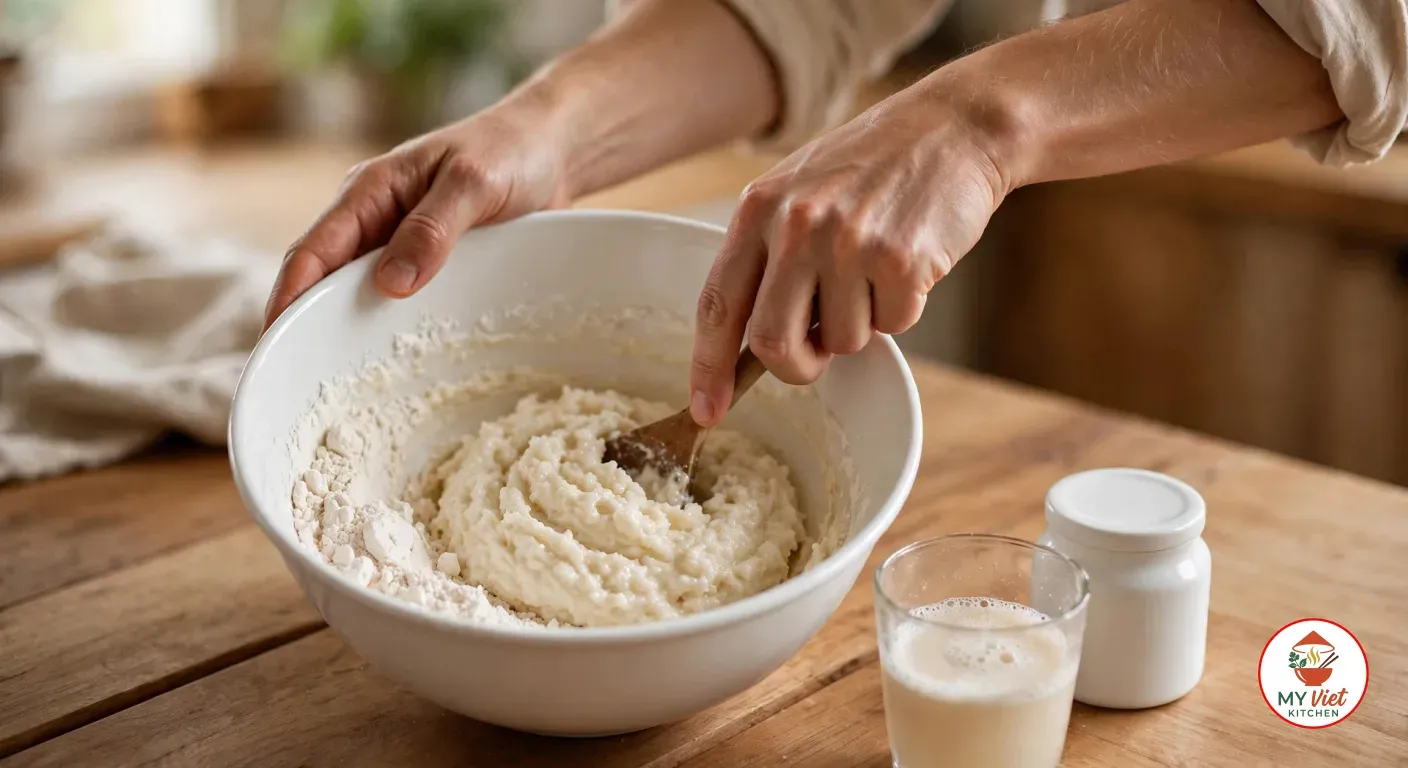
1Mix the yeast and 1 teaspoon of sugar into the lukewarm water; after 10 minutes a foam should cover the top. Put the rice flour in a large bowl, since the starter will rise. Pour in the yeast water and stir with a spoon into a thick, sticky paste with no dry flour left. Don’t add salt or coconut milk yet. Cover the bowl with a plate or a tea towel.
Step 2: Ferment Overnight
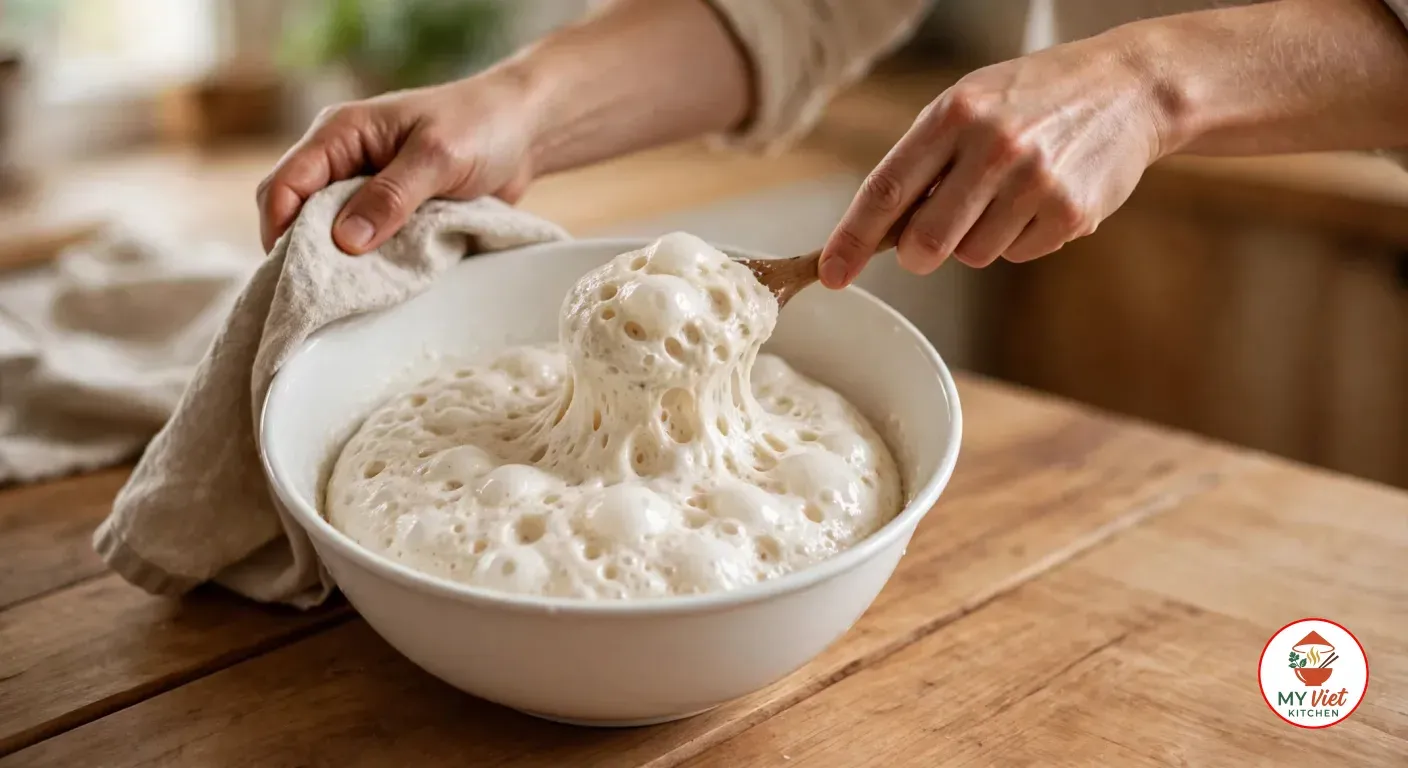
2Leave the covered bowl somewhere warm, such as an oven with only the light on, for 8 hours or overnight. The starter is ready when it has risen, feels softer and puffier, and shows bubbles on the surface and inside when you lift some with a spoon. It should smell faintly sour and yeasty. If it hasn’t risen at all, stir in 1 to 2 tablespoons of water and move it somewhere warmer for a few more hours.
Step 3: Finish the Batter
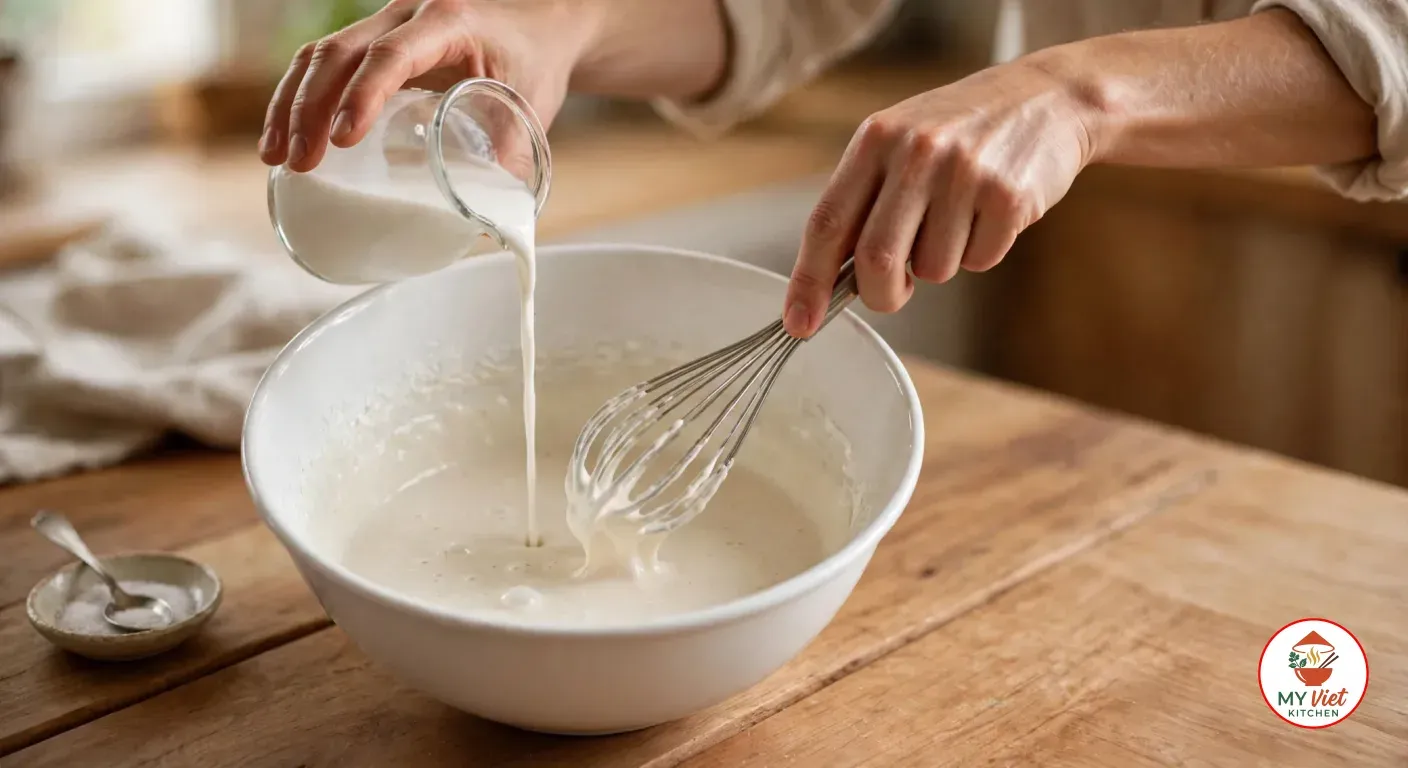
3Shake the can of coconut milk. Add the second teaspoon of sugar and about 1 1/4 cups (300 ml) of the coconut milk to the starter and whisk until no lumps remain. Add the rest of the coconut milk a little at a time, stopping when the batter pours like heavy cream and coats the whisk thinly. You may not need the whole can; if the batter is still thick once the can is empty, add water a tablespoon at a time. Cover and rest for 30 minutes, then stir in the salt just before you start cooking.
Step 4: Swirl and Steam the Hoppers
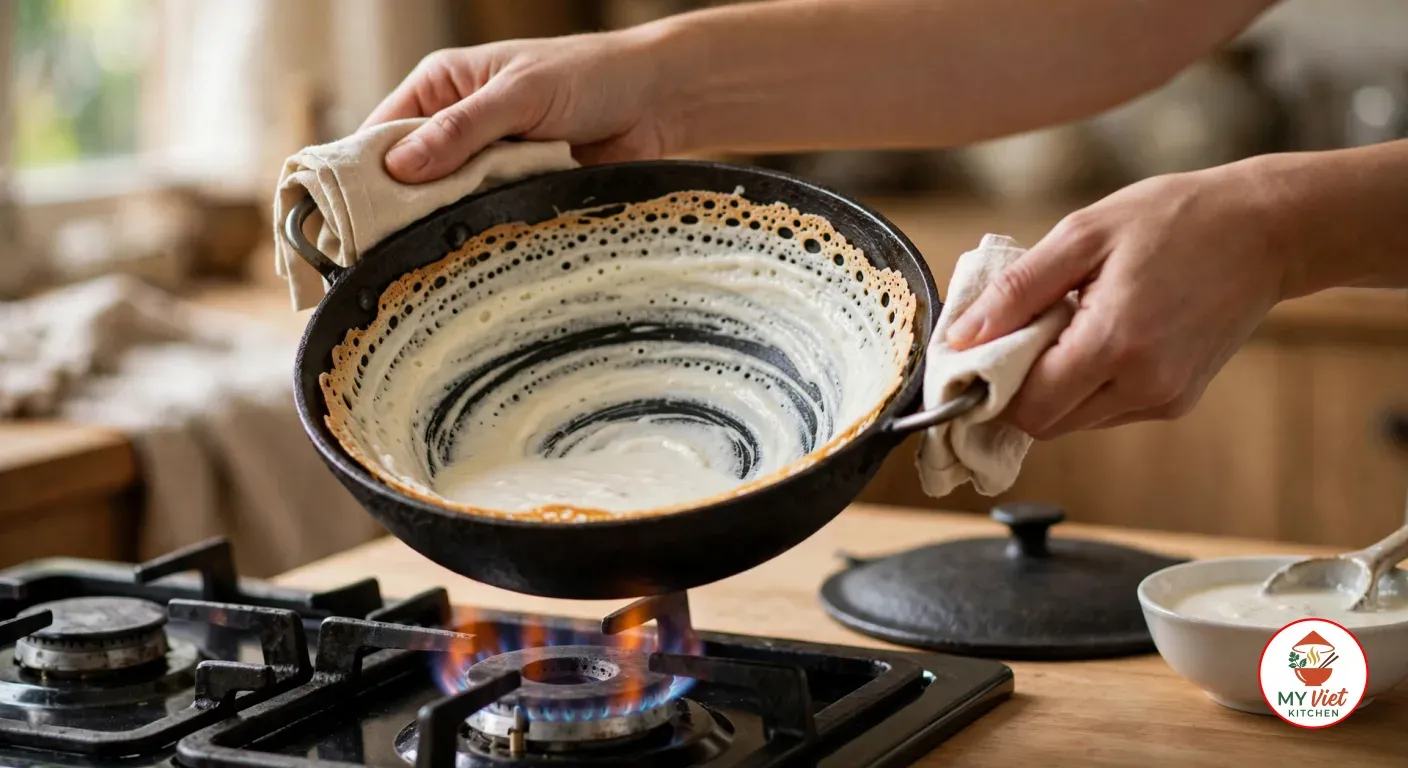
4Warm the hopper pan on a medium-high burner until a drop of water sizzles on it, 2 to 3 minutes. Wipe the inside with a folded paper towel dipped in oil. Pour about 1/4 cup (60 ml) of batter into the centre, lift the pan by both handles and roll it in a full circle so the batter climbs to the rim in a thin film, then let the extra run back to the bottom. Put the pan back on the burner and put the lid on. After 2 to 3 minutes the edges should be golden brown and lacy and pulling away from the pan, with the centre set and spongy. Tap the pan’s sides, ease the hopper out with a thin spatula and oil the pan before the next one.
Step 5: Make Egg Hoppers and Serve
5For an egg hopper, swirl a little less batter, about 3 tablespoons, then crack an egg straight into the centre and sprinkle it with salt and pepper. Cover and cook for 4 minutes over medium-high heat, then 1 minute over medium, until the white is set and the edges are brown. Serve every hopper as soon as it leaves the pan, with pol sambol, lunu miris, dhal or a curry.
Frequently Asked Questions
Can you make hoppers without yeast?
Yes. Toddy, beer and bread have all been used in place of yeast. Ishanthi of Sri Lanka by Ish lists yeast, toddy or even beer among the leavening agents she found in hopper recipes (Sri Lanka by Ish). Peter Kuruvita’s SBS recipe from Mrs Amarasakara’s kitchen uses a 2 cm thick piece of sourdough bread and 1/4 teaspoon of bicarbonate of soda. Its batter rests for 6 hours or until it has doubled in size (SBS Food). Follow such a recipe as written rather than swapping it into this one.
Why aren’t my hopper edges crisp?
Check the batter first: it should be about as thick as cream. Gourmet Traveller’s note to Travin de Hoedt’s recipe asks for the consistency of thickened cream, and says to add a little more lukewarm water or coconut milk if the hoppers are lacking around the edges (Gourmet Traveller). Ishanthi notes that some recipes add more sugar for a brown, crispy crust, and that adjusting the cooking time keeps a hopper from turning into a “flopper” as soon as it leaves the pan (Sri Lanka by Ish).
What do you eat with hoppers?
Sambols and curry. Gourmet Traveller lists pol sambol, made with fresh coconut; lunu miris, with raw onion, chilli and lime; seeni sambol, a spicy jam with pandan and red onions; and regional curries. “The best way to eat hoppers is fresh off the hopper pan with some sambol and curry,” says Travin de Hoedt of Kurumba in Sydney (Gourmet Traveller).
Can you keep hopper batter in the fridge?
Yes, for at least a day. Asked whether batter could be refrigerated and used the next day, Roshani Wickramasinghe of Hungry Lankan said yes, adding that it may need a little more liquid if it has thickened (Hungry Lankan). Dan Toombs of The Curry Guy writes that leftover batter keeps in the fridge for at least three days (The Curry Guy). Stir it well and check the consistency before you swirl the first hopper.
Sources
- Appam, Wikipedia
- The perfect hopper, Ishanthi, Sri Lanka by Ish, September 2019
- Sri Lankan Hoppers, Roshani Wickramasinghe, Hungry Lankan, July 2020
- Hopper Recipe, Dan Toombs, The Curry Guy, updated April 2026
- Mrs Amarasakara’s hoppers, Peter Kuruvita, SBS Food, December 2016
- Sri Lankan hoppers, Travin de Hoedt, Gourmet Traveller, October 2024
- How to Make Sri Lankan Egg Hoppers by Peter Kuruvita, Peter Kuruvita, YouTube, August 2016