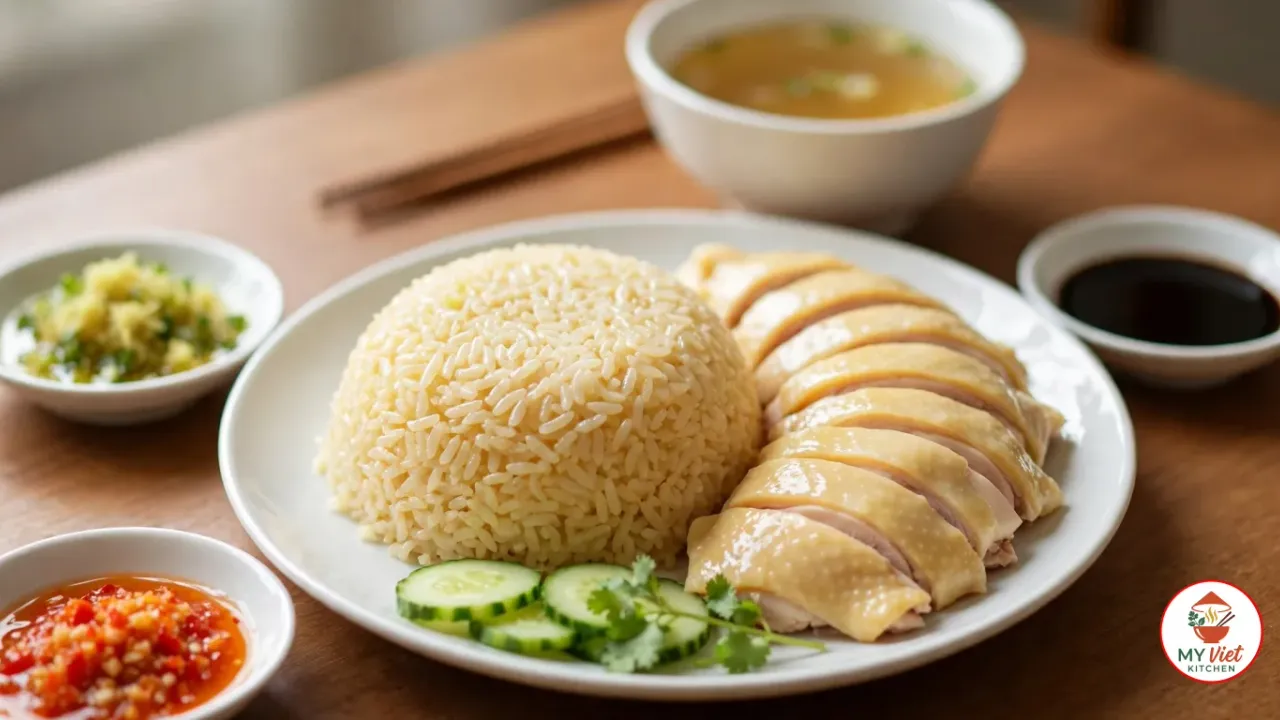
Hainanese chicken rice is a whole chicken poached at a bare simmer, served cool with rice cooked in the bird’s own fat and stock, plus chilli, ginger and dark soy sauces. This recipe feeds four. You poach a 3 1/2-pound chicken, chill it in ice water, fry the rice with garlic, ginger and rendered fat, then cook it in the poaching liquid with a pandan knot. The stock left in the pot becomes the soup.
Prep Time: 30 minutes | Cook Time: 1 hour 30 minutes | Total Time: 2 hours | Servings: 4
Difficulty: Medium | Calories: ~900 per serving

How Do You Keep the Breast Moist and Cook the Thighs Through?
Poaching the chicken for Hainanese chicken rice comes down to the gentlest heat you can hold. The Woks of Life brings the water to a boil and lowers the chicken in breast side up. It sets the level so the breast just pokes above the surface, so the white meat doesn’t dry out. Once the pot boils again, the lid goes on and the heat goes to its lowest setting. You want very little movement in the water, but not none (The Woks of Life).
The cavity needs attention too. A whole bird traps cooler water inside, so The Woks of Life lifts the chicken once the pot is back at a boil, pours that water out and lowers it in again. SBS Food Safari steeps its chicken in just-boiled water off the heat for an hour instead, bringing it back to almost boiling halfway. It lifts and drains the bird 2 or 3 times so there is enough hot water inside to cook it through (SBS Food).
Don’t trust the clock alone. The Woks of Life gives about 30 to 35 minutes for a 3 to 3 1/2-pound chicken, roughly 10 to 11 minutes per pound, and 40 to 50 minutes for a larger one. Its test is a toothpick pushed into the thickest part of the thigh, down to the bone: clear juices mean it’s done (The Woks of Life).
This recipe allows 35 to 45 minutes and uses a thermometer. Health Canada says to check a bird with a digital food thermometer kept off the bone. The thickest part of the breast should reach 82°C (180°F) for a whole bird, or 74°C (165°F) for pieces (Health Canada). If the breast is there but the thigh joint still runs pink, give the bird 5 more minutes in the pot.
The video above comes from The Woks of Life. Going by its chapter list, it covers prepping the aromatics and the chicken, the three sauces, the rice, how to tell when the poached chicken is cooked, and cutting and serving (The Woks of Life). Its written recipe cooks the rice in a rice cooker, with a stovetop option; this one uses a saucepan.
Why Does the Chicken Go Into Ice Water?
In Singapore the whole chicken is poached below boiling point, then dipped in ice to give the skin a jelly-like finish (Wikipedia). The Woks of Life leaves its bird in the ice bath for 15 minutes. Its three reasons: the bath stops the cooking, locks in the juices and gives the skin a better texture (The Woks of Life).
Shu Han Lee, a Singapore-born cook and food writer, moves her poached chicken straight into a large bowl of iced water. She says it gives the meat a nice springy texture (Broadsheet).
Not every recipe uses ice. SBS Food Safari rubs its chicken with soy sauce, sesame oil and salt and simply leaves it to cool (SBS Food). Either way the meat ends up cool: in Singapore the chicken is usually served at room temperature, with light soy sauce and a dash of sesame oil (Wikipedia).
Move the bird gently. The Woks of Life drains the hot water from the cavity before the chicken goes into the ice, and warns you not to break the skin (The Woks of Life).
Where Does the Rice Get Its Flavour?
From the chicken. In Singapore the stock is skimmed of fat, and some of that fat and liquid go into the rice with ginger, garlic and pandan leaves. The result is sometimes called “oily rice”. Wikipedia quotes one verdict: in Singapore “the most important part of chicken rice is not the chicken, but the rice” (Wikipedia).
The Woks of Life starts with the piece of fat set aside from the cavity. It renders the fat with a little oil until there is about 1 tablespoon in the pan, cooks the garlic briefly and stirs the raw rice for about two minutes. Poaching stock then replaces the usual water. While the chicken cools, the family leaves the stock simmering uncovered so it reduces and concentrates (The Woks of Life).
Pandan is the Singapore touch. Shu Han Lee names pandan leaves or lemongrass, along with a punchy chilli sauce, as the Singaporean twist on the original Hainan dish (Broadsheet). SBS Food Safari ties each leaf in a knot and lists it as optional (SBS Food). Pandan leaves are long, narrow, bright green blades, and a knot keeps them in one piece to lift out.
Where Did the Dish Come From?
Immigrants from Hainan, in southern China, created it from the Hainanese dishes of Wenchang chicken and Wenchang chicken rice. In Hainan the dish traditionally used a breed also called Wenchang chicken, and cooks made rice with the leftover stock. In Hainanese homes in Singapore, Wenchang chicken rice stayed a special-occasion dish until the 1940s (Wikipedia).
The first chicken rice restaurants in Singapore opened during the Japanese occupation in World War II, when Hainanese servants of the British lost their income. Yet Con, one of the first, opened in the early 1940s. Moh Lee Twee popularised the dish in the 1950s through his Swee Kee Chicken Rice Restaurant, open from 1947 to 1997. The dish is now widely considered one of Singapore’s national dishes. Malaysia and Singapore have both laid claim to inventing it, in a debate that goes back to their split in 1965 (Wikipedia).
Ingredients for Hainanese Chicken Rice
For the Chicken:
- 1 whole chicken, about 3 1/2 pounds (1.6 kg)
- 1 tablespoon coarse salt
- 12 cups (2.8 liters) water
- 2-inch (5 cm) piece fresh ginger, sliced
- 3 green onions, halved
- Ice cubes and cold water, for the ice bath
- 1 teaspoon toasted sesame oil
For the Rice:
- 2 oz (55 g) chicken fat from the cavity, or 2 tablespoons neutral oil
- 1 teaspoon neutral oil
- 4 cloves garlic, minced
- 1-inch (2.5 cm) piece fresh ginger, finely grated
- 2 cups (400 g) jasmine rice, rinsed until the water runs clear and drained
- 2 2/3 cups (640 ml) chicken poaching stock
- 1 teaspoon salt
- 2 pandan leaves, tied in a knot (optional)
For the Chilli-Garlic Sauce:
- 4 fresh red chillies, medium heat, roughly chopped
- 3 cloves garlic
- 1-inch (2.5 cm) piece fresh ginger, roughly chopped
- 1 tablespoon lime juice
- 1/2 teaspoon sugar
- 1/2 teaspoon salt
- 2 tablespoons chicken poaching stock
For the Ginger-Scallion Sauce:
- 3-inch (7.5 cm) piece fresh ginger, finely grated
- 2 green onions, finely chopped
- 1/2 teaspoon salt
- 3 tablespoons (45 ml) neutral oil
For the Dark Soy Sauce:
- 3 tablespoons dark soy sauce
- 1 tablespoon sugar
- 1 tablespoon hot chicken poaching stock
To Serve:
- 1 tablespoon light soy sauce
- 1 small cucumber, sliced
- Small handful fresh cilantro
- Ground white pepper, to taste
Step-by-Step Instructions
Step 1: Prepare and Poach the Chicken
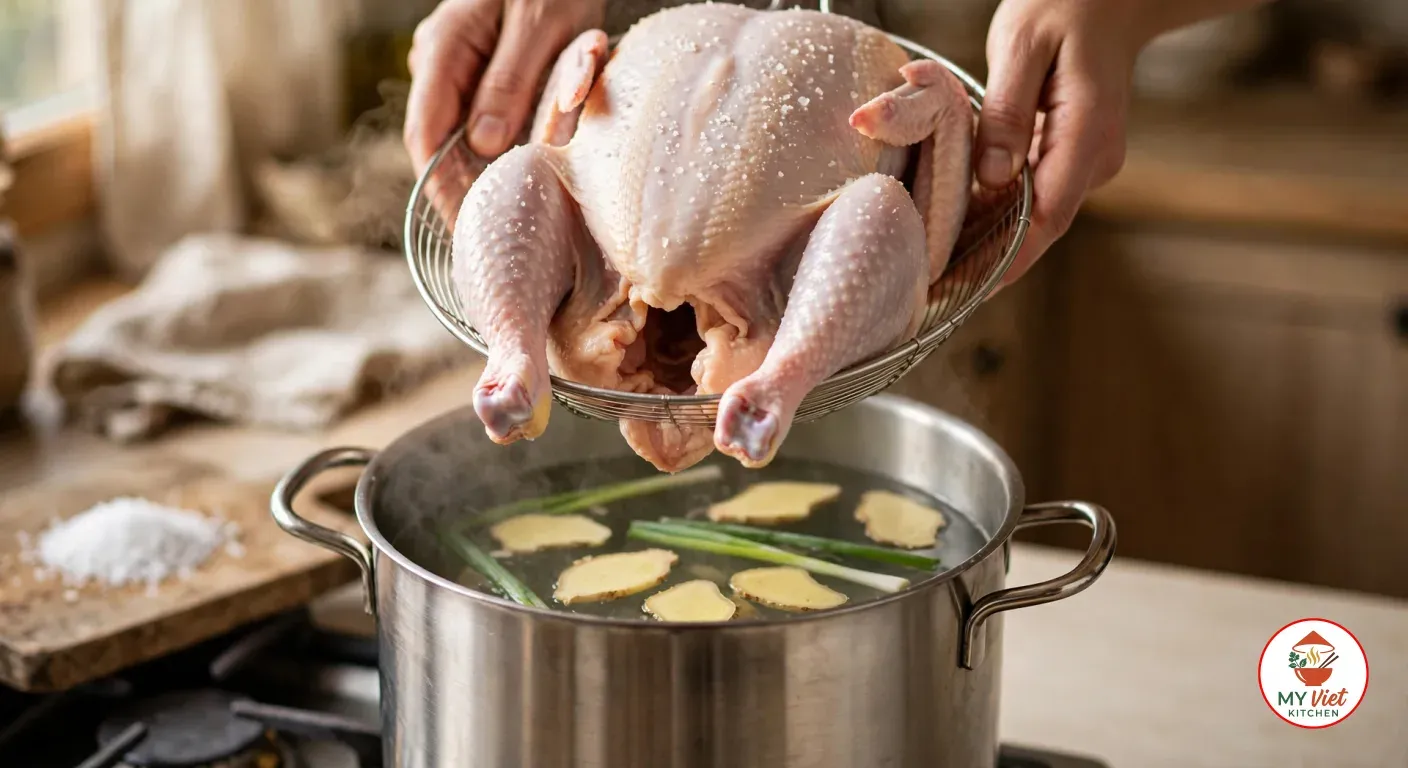
1Pull the loose fat from inside the chicken’s cavity and set it aside for the rice. Pat the chicken dry and rub the coarse salt all over the skin. Bring the water, sliced ginger and halved green onions to a boil in a stockpot of at least 8 quarts (7.5 liters). Lower the chicken in breast side up and adjust the water so the top of the breast just shows above it. When the water boils again, lift the chicken, tip the cooler water out of its cavity and lower it back in. As soon as the pot returns to a boil, cover it and turn the heat to its lowest setting, so only a few small bubbles rise. Poach for 35 to 45 minutes. The chicken is done when a digital thermometer pushed into the thickest part of the breast, clear of the bone, reads 82°C (180°F).
Step 2: Ice Bath the Chicken
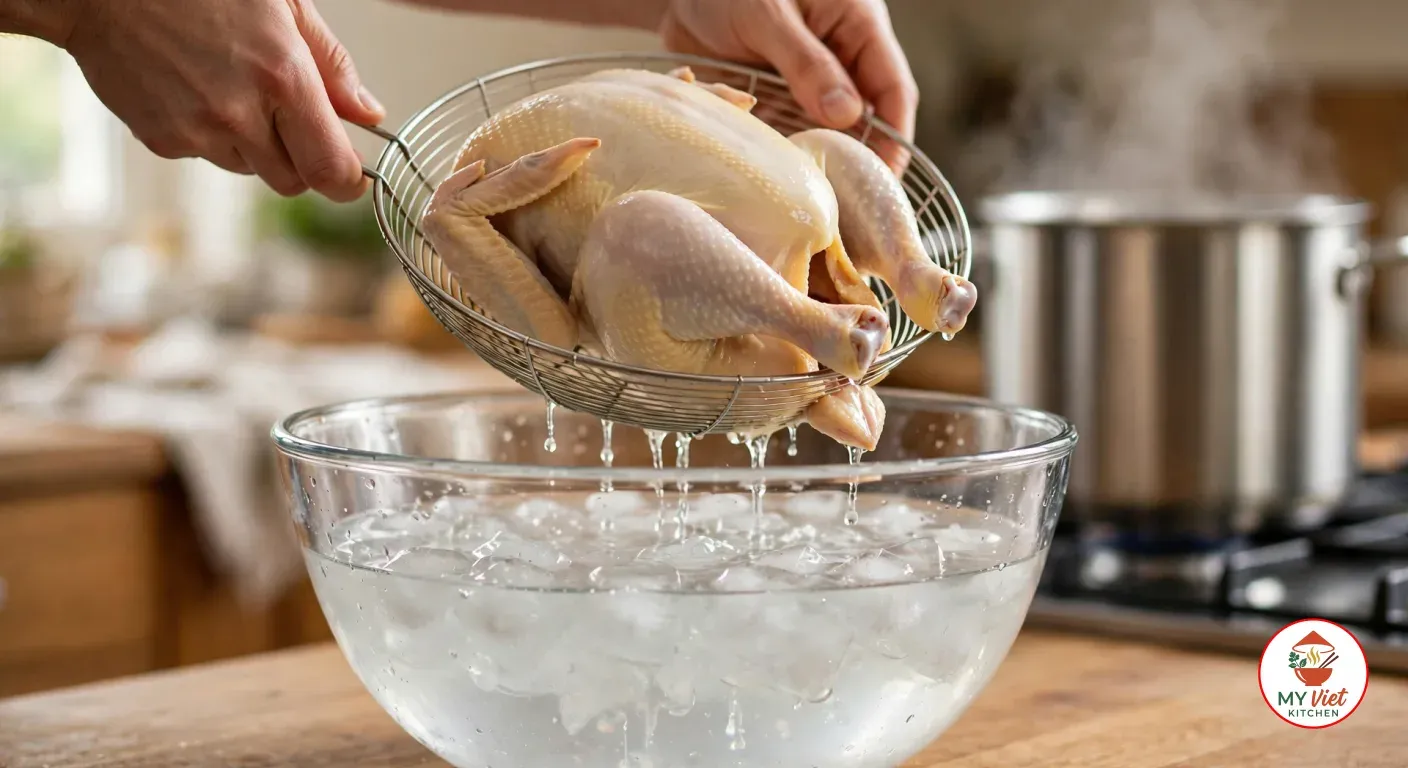
2A few minutes before the chicken is done, fill a large bowl with ice and cold water. Lift the chicken out on a spider strainer, tip the hot water from its cavity back into the pot, and lower the bird into the ice bath without tearing the skin. Leave it for 15 minutes, until cooled through. Drain it, pat it dry and rub the skin with the sesame oil. Meanwhile, keep the stock at a gentle simmer, uncovered.
Step 3: Cook the Rice in the Stock
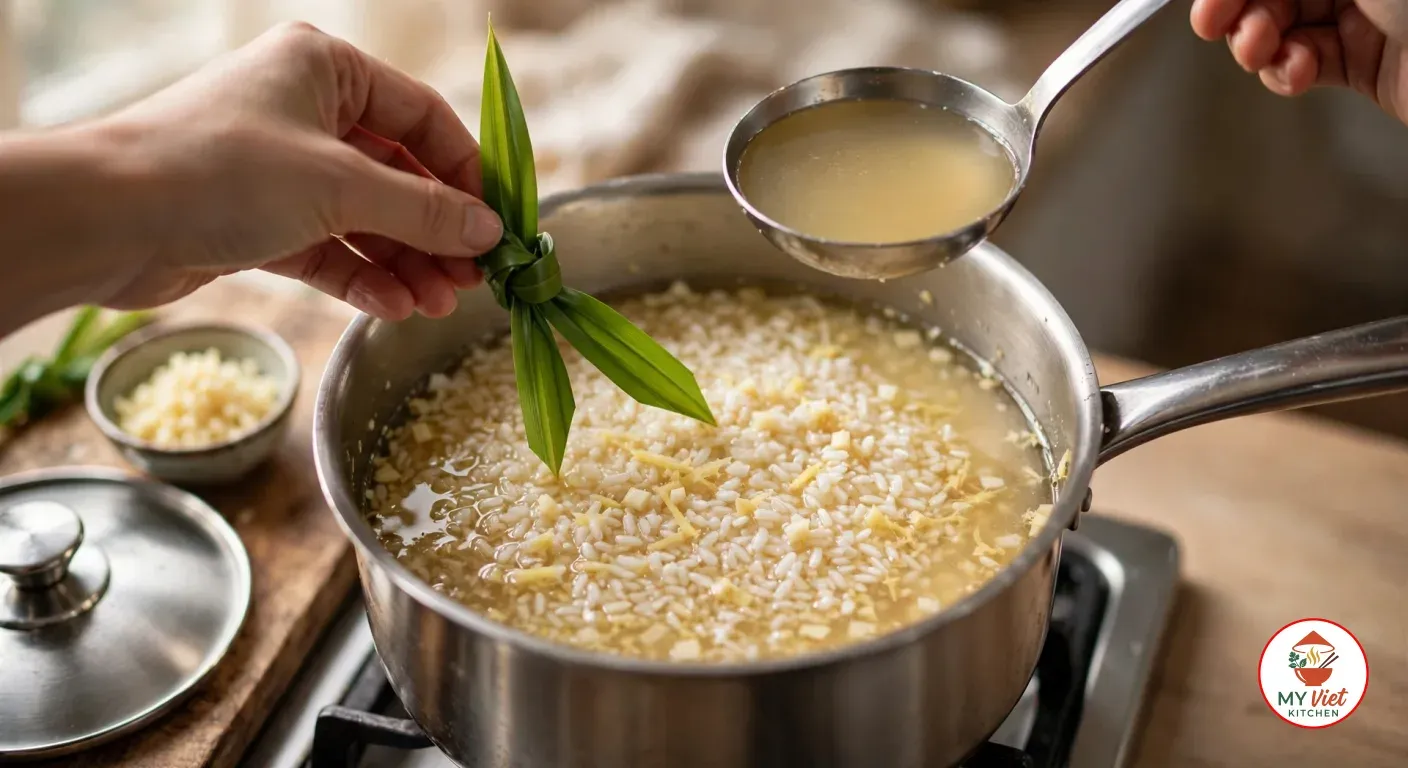
3Warm the chicken fat and neutral oil in a heavy 3-quart (3-liter) saucepan on medium heat until about 1 tablespoon of fat has melted out, 2 to 3 minutes, then lift out the solid bits. Stir in the garlic and grated ginger for 30 seconds without letting them brown. Add the drained rice and stir for 2 minutes, until every grain is coated. Pour in 2 2/3 cups (640 ml) of the hot stock, add the salt and the pandan knot, and bring to a boil. Cover, turn the heat to its lowest setting and cook for 15 minutes. Off the heat, let the rice stand covered for 10 minutes, then pull out the pandan and fluff the grains.
Step 4: Make the Three Sauces
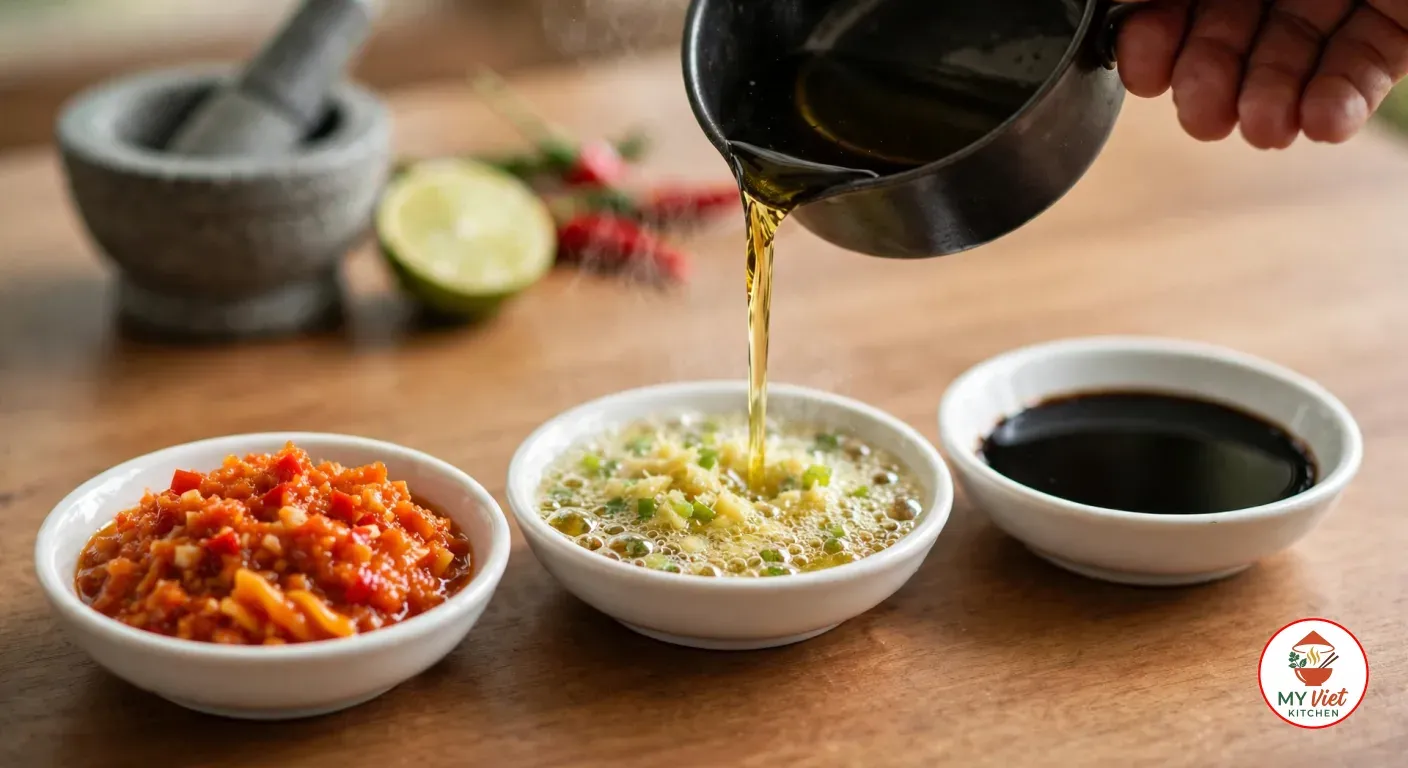
4While the rice cooks, pound or blend the chillies, garlic and the 1-inch piece of ginger to a fine paste, then stir in the lime juice, sugar, salt and 2 tablespoons of stock. For the ginger-scallion sauce, put the grated ginger, chopped green onions and salt in a small heatproof bowl. Heat the oil in a small saucepan until it shimmers and pour it over; it will sizzle. For the dark soy sauce, stir the sugar into the dark soy sauce with 1 tablespoon of hot stock until it dissolves.
Step 5: Carve and Serve
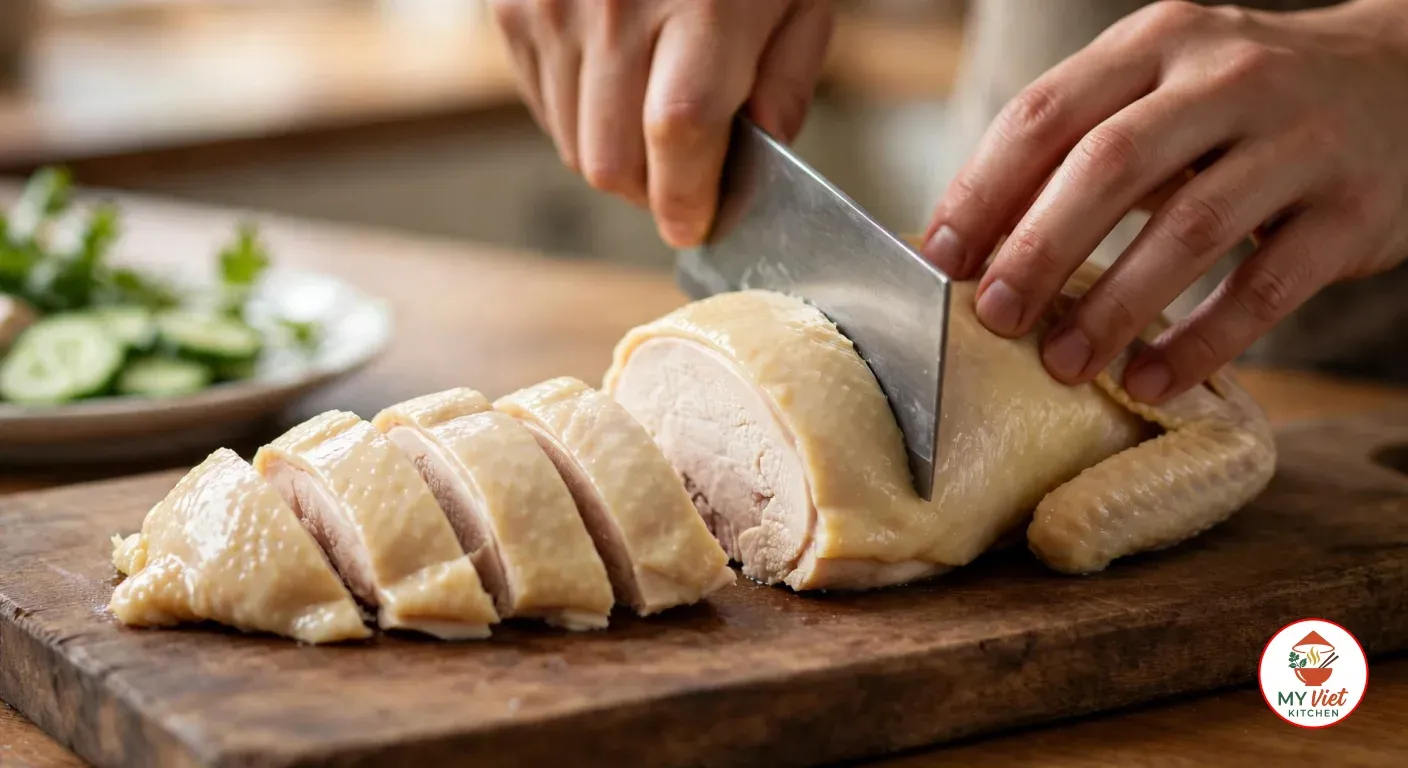
5Cut off the legs and wings, then lift each breast off the bone. Chop the legs through the bone into 1-inch (2.5 cm) pieces with a heavy cleaver and slice the breasts across, keeping the skin on. Lay the chicken on a platter with the cucumber and cilantro and drizzle it with the light soy sauce. Season the remaining stock with salt and white pepper and serve it hot in small bowls, with the rice, the chicken and the three sauces.
Frequently Asked Questions
Can you make the rice in a rice cooker?
Yes, as long as you fry the rice in the fat, garlic and ginger in a pan first. The Woks of Life scrapes the toasted rice into the rice cooker, adds poaching stock instead of water up to the cooker’s line for that amount of rice, stirs in the salt and presses start (The Woks of Life). Shu Han Lee also gives the cook a choice of rice cooker or stovetop (Broadsheet). Add the pandan knot before you close the lid.
What can you use instead of pandan leaves?
Lemongrass, or nothing at all. Shu Han Lee lists 2 lemongrass stalks, lightly bashed, as the alternative to 2 knotted pandan leaves (Broadsheet). SBS Food Safari marks pandan as optional (SBS Food), and The Woks of Life’s rice uses none, relying on chicken fat, garlic and the poaching stock (The Woks of Life).
What are the three sauces served with chicken rice?
A chilli-garlic sauce, a ginger sauce and a sweet dark soy sauce. In Singapore the dish comes with a dipping sauce of freshly minced red chilli and garlic, usually alongside dark soy sauce and freshly ground ginger (Wikipedia). The Woks of Life makes its sweet dark soy by stirring dark soy sauce into a syrup of rock sugar and water (The Woks of Life). This recipe’s ginger sauce adds green onions and has hot oil poured over it.
Can you use chicken thighs instead of a whole chicken?
Yes, and Shu Han Lee says it takes about half the time. She trims and saves the fat from 4 skin-on, bone-in thighs (about 600 g) and brings them to a rolling boil with the aromatics. They get 10 minutes at a bare simmer, then another 15 covered off the heat (Broadsheet). Health Canada’s figure for poultry pieces is 74°C (165°F) (Health Canada).
Sources
- Hainan Chicken Rice, Judy, The Woks of Life, updated September 2024 (first published August 2015)
- Hainan Chicken Rice | One of our all-time most popular recipes! | The Woks of Life, The Woks of Life, YouTube, September 2024
- Recipe: Singapore-Style Hainanese Chicken Rice That’s So Much More Than the Sum of Its Parts, Shu Han Lee (extract from Agak Agak: Everyday Recipes from Singapore), Broadsheet, June 2024 (updated December 2024)
- Food Safari’s Hainanese chicken rice, SBS Food, March 2026
- Poultry safety, Health Canada, February 2019
- Hainanese chicken rice, Wikipedia