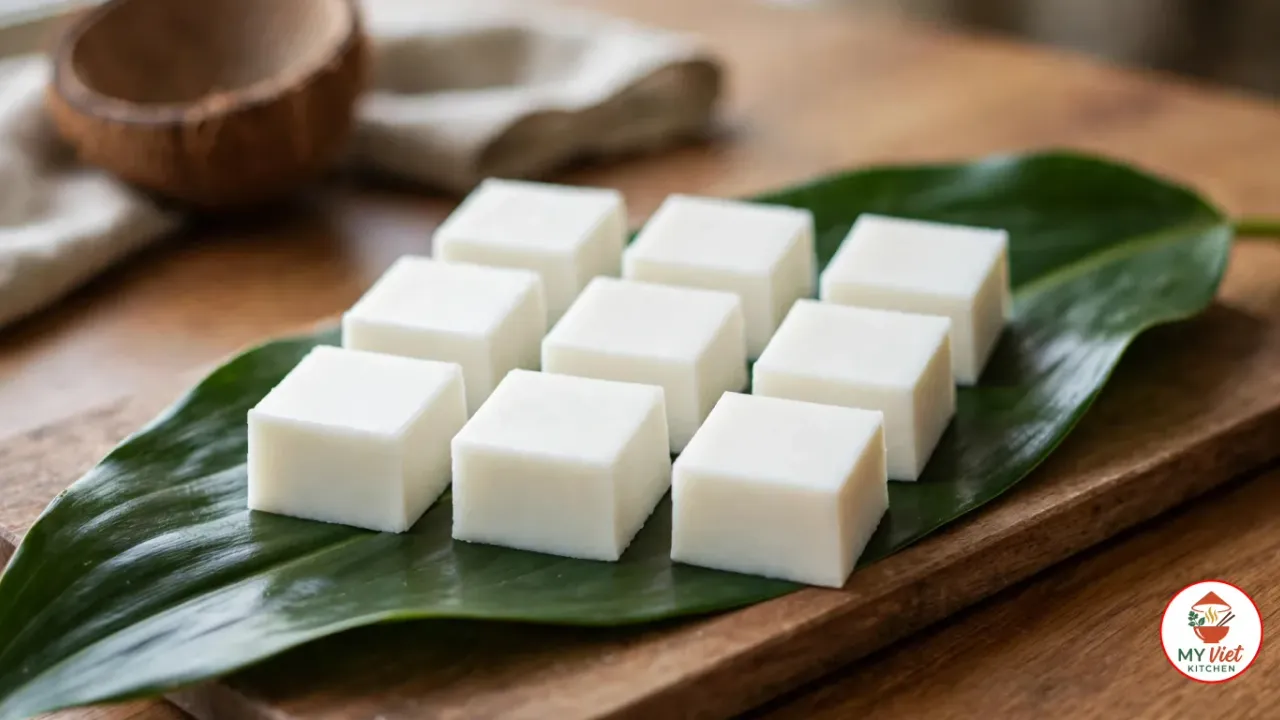
Haupia is a Hawaiian coconut pudding made from coconut milk, sugar, salt and a starch thickener (Ke Ola Magazine). This haupia recipe uses two cans of coconut milk and 10 tablespoons of cornstarch, enough to set an 8-inch pan into 16 firm squares that hold their edges. You whisk it on the stove for about 15 minutes, cool it for half an hour, then chill it for at least two hours.
Prep Time: 10 minutes | Cook Time: 15 minutes | Total Time: 2 hours 55 minutes | Servings: 16
Difficulty: Easy | Calories: ~130 per serving

What Did Hawaiian Cooks Use Before Cornstarch?
The traditional thickener was pia, Tacca leontopetaloides, also called Polynesian arrowroot. Early Polynesian voyagers carried its tubers in their canoes, so it counts as a “canoe plant.” Making the starch took days. Cooks grated and pounded the root and put it in a calabash with water, where the starch sank. They changed the water every day for several days to take out the bitterness. Then they dried the pulp in the sun on a flat rock and ground it to a powder (Ke Ola Magazine).
A plant record from the National Tropical Botanical Garden, quoting a 1979 book by Beatrice Krauss, says haupia was originally made with pia flour, coconut cream and sugar. Corn starch has since largely replaced Polynesian arrowroot (National Tropical Botanical Garden). The swap changed the texture. Wikipedia describes the old puddings as more mucilaginous and the cornstarch versions as closer to gelatin (Wikipedia).
Ke Ola Magazine says haupia has been a staple in Hawaiʻi since World War II, and that today it is usually made with cornstarch (Ke Ola Magazine). This recipe follows that modern habit; the FAQ below covers arrowroot.
How Much Cornstarch Does Haupia Need to Hold a Square?
Published recipes disagree more than you might expect, and the starch for each cup of liquid decides whether you get clean squares or something closer to a spoon pudding. Kathy YL Chan of Onolicious Hawaii puts it plainly: more cornstarch makes a firmer haupia, less makes it more pudding-like (Onolicious Hawaii).
Count a 13.5-ounce can as about 1 2/3 cups and the ratios line up. Ono Hawaiian Recipes uses 5 tablespoons with one can and 1 cup of water, just under 2 tablespoons per cup. It says to add up to 2 more for a firmer haupia (Ono Hawaiian Recipes).
The Hawaiian Can Cook video above lists 6 tablespoons with one 13.5-ounce can and 3/4 cup of water, about 2 1/2 per cup (Hawaiian Can Cook). Honolulu chef Mark Noguchi’s version in Tasting Table is firmer still at about 2 2/3, with the same starch and water but a smaller 12-ounce can (Tasting Table).
This recipe lands at about 2 1/2 tablespoons per cup: 10 tablespoons for two cans and 1/2 cup of water. That matches Ono Hawaiian Recipes at its firmest and sits just under Noguchi. It is doubled from the single-can recipes, so it fills an 8-inch pan about an inch deep. Single-can versions spread the same way come out thinner.
Cooking time matters as much as the amount. Chan turns the heat to low and whisks for 10 to 15 minutes. Her sign of doneness: the haupia gets much thicker, almost “gluey,” and starts to pull away from the side of the saucepan (Onolicious Hawaii). Faraway Worlds warns that the pudding can burn if it gets too hot, so don’t walk away from the stove (Faraway Worlds).
How Is Haupia Served?
Ke Ola Magazine says that if you have been to a lūʻau or a local-style wedding, you have probably eaten haupia. Its own recipe ends with 1-inch squares on trays lined with ti leaves (Ke Ola Magazine). Cut this slab that small and you get 64 bites instead of 16 squares.
The Daily Meal says haupia is most commonly found as solid white rectangles and squares, though some people like it closer to a runny custard (The Daily Meal). It also turns up inside other desserts. Wikipedia lists layers on chocolate pudding pie and sweet potato pie, and fillings for cakes and malasadas (Wikipedia).
Ingredients for Haupia
For the Pan:
- 1/2 teaspoon neutral oil, such as canola
For the Slurry:
- 1/2 cup plus 2 tablespoons (80 g) cornstarch
- 1/2 cup (120 ml) cold water
For the Coconut Milk:
- 2 cans (13.5 fl oz / 400 ml each) full-fat coconut milk
- 1/2 cup (100 g) granulated sugar
- 1/4 teaspoon fine salt
Step-by-Step Instructions
Step 1: Line the Pan and Mix the Slurry
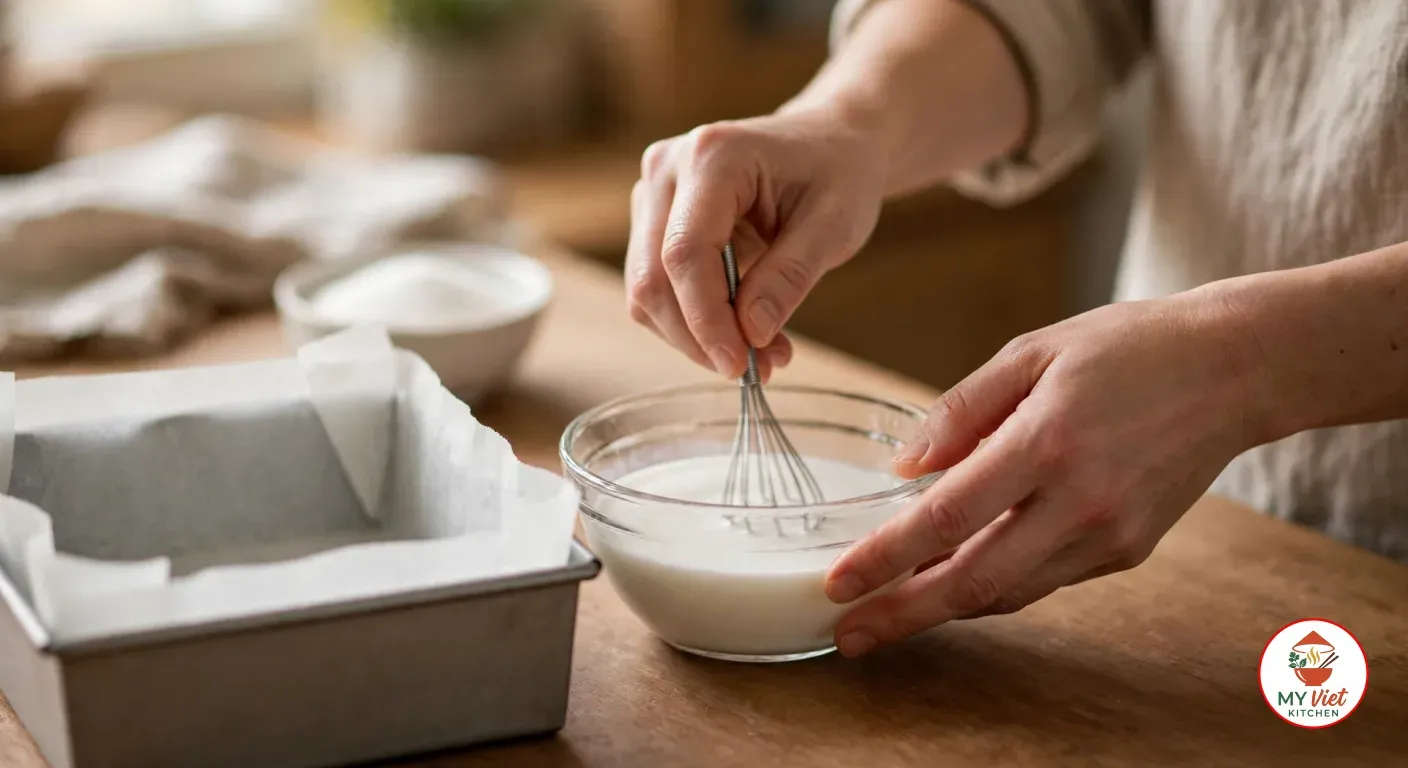
1Brush an 8-inch (20 cm) square pan with the oil and line it with parchment, leaving about 1 inch (2.5 cm) standing up over the sides. In a small bowl, whisk the cornstarch into the cold water until no lumps remain. Set the slurry next to the stove; the starch sinks to the bottom as it sits.
Step 2: Heat the Coconut Milk
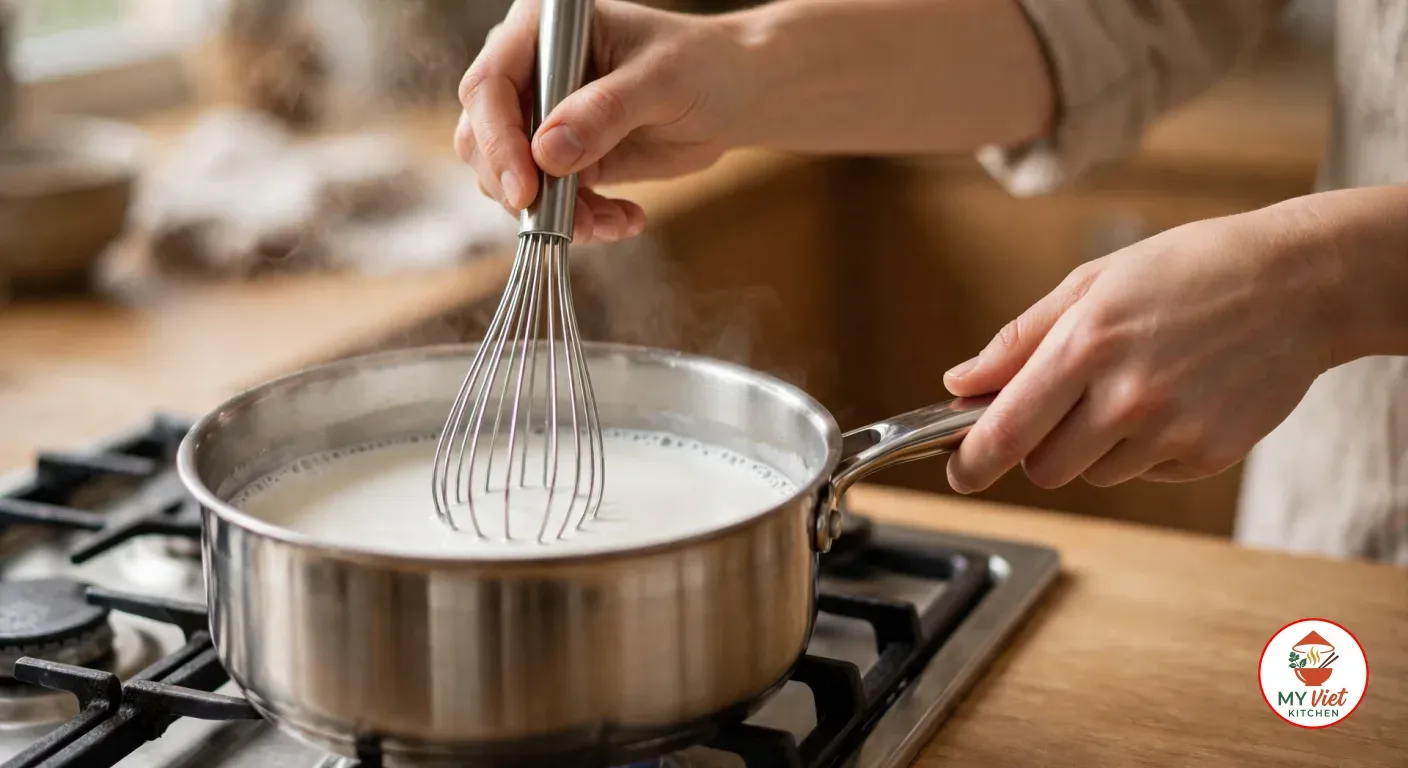
2Shake the cans well, then pour the coconut milk into a medium saucepan and add the sugar and salt. Set it over medium heat and whisk often until the sugar dissolves and the milk steams, with small bubbles around the edge, about 3 minutes. Don’t let it come to a full boil.
Step 3: Whisk In the Slurry and Thicken
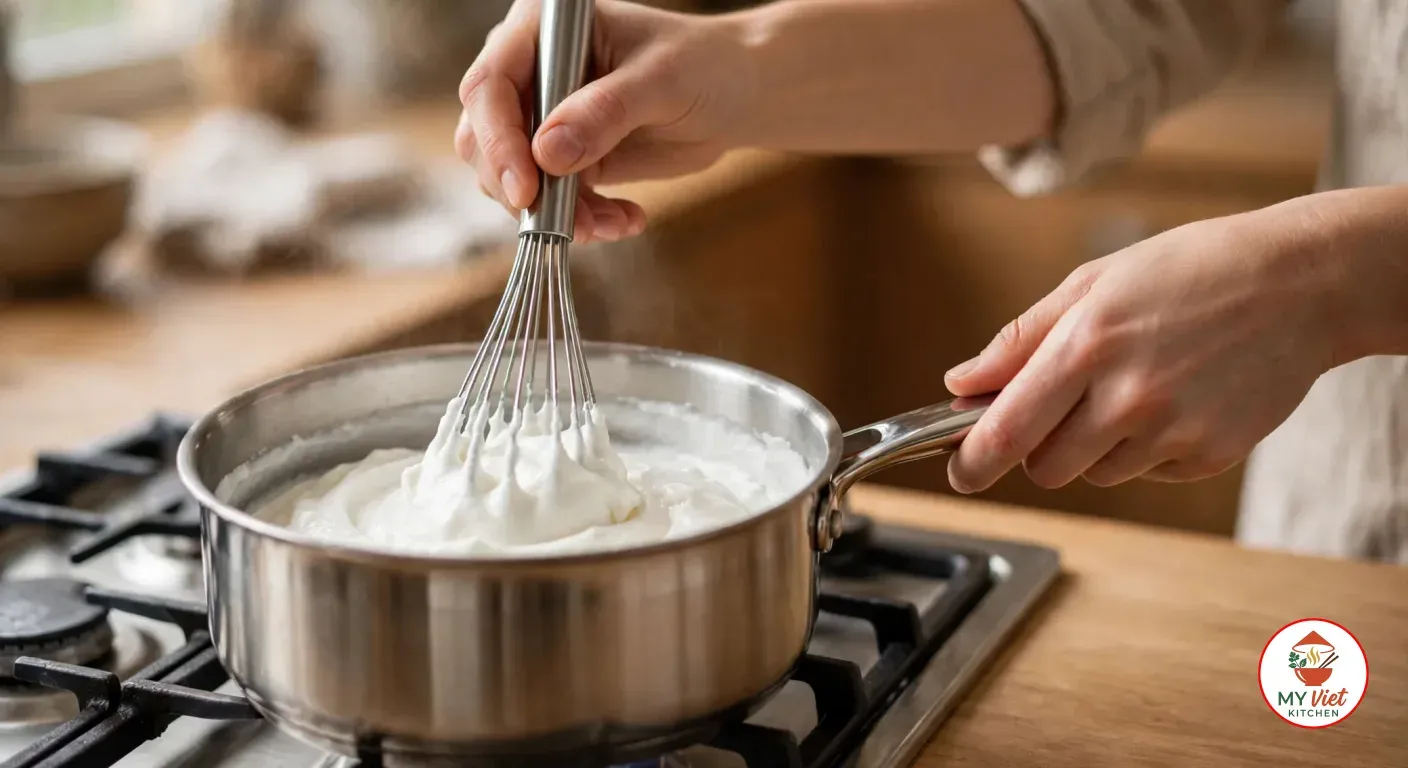
3Whisk the slurry again, then pour it into the hot coconut milk in a slow stream, whisking the whole time. Turn the heat down to medium-low and keep whisking for 10 to 12 minutes, reaching into the corners of the pan so nothing catches. It is ready when it is much thicker, almost gluey, keeps the tracks of the whisk and comes away from the saucepan walls as you stir.
Step 4: Pour, Chill and Cut
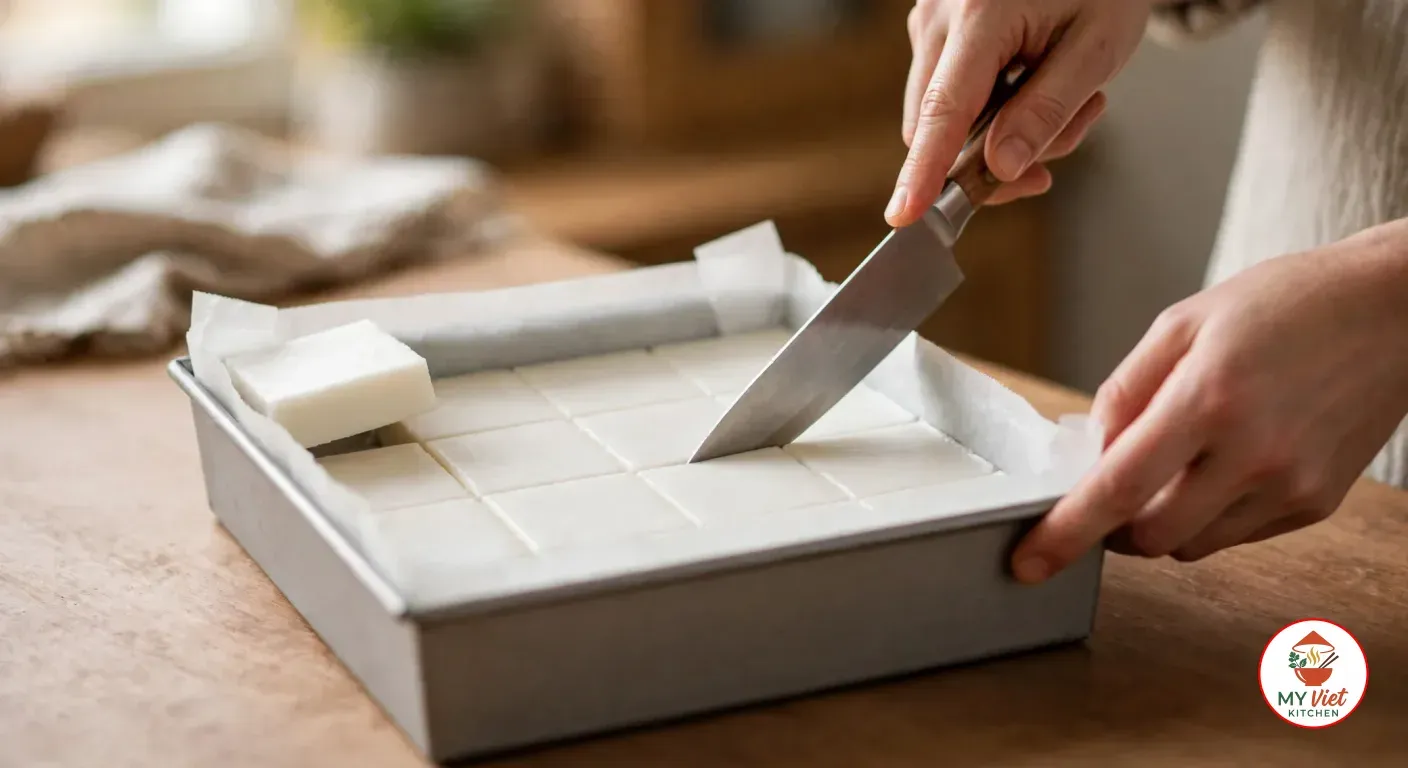
4Scrape the hot mixture into the lined pan and smooth the top with a spatula. Let it stand uncovered on the counter for 30 minutes, then cover the pan and chill it for at least 2 hours, until the slab is firm and cold right through. Cut it into 16 two-inch (5 cm) squares with a long knife, wiping the blade between cuts, then lift them out and serve cold.
Frequently Asked Questions
Can you make haupia with arrowroot instead of cornstarch?
Yes, and you can use the same amount. Faraway Worlds says arrowroot powder can replace cornstarch one for one (Faraway Worlds). Pia, the original thickener, is itself called Polynesian arrowroot (Ke Ola Magazine). Wikipedia suggests another root starch, such as potato starch or tapioca, as a stand-in for arrowroot (Wikipedia).
Why didn’t my haupia set firm?
It was most likely taken off the heat too early, or made with too little starch for the liquid. Keep whisking until the mixture turns almost gluey and leaves the sides of the pan, then give it the full two hours in the fridge. For your next batch, Onolicious Hawaii’s tip is one more tablespoon of cornstarch for a firmer haupia, or one less for a looser one (Onolicious Hawaii).
How long does haupia keep in the fridge?
Two to three days. Onolicious Hawaii and Ono Hawaiian Recipes both give 2 to 3 days in the refrigerator, and Kathy YL Chan adds that the fresher it is, the better (Onolicious Hawaii) (Ono Hawaiian Recipes). Leave the slab whole and wrapped in its pan, and cut only the squares you are about to serve.
Is haupia vegan?
Yes: Wikipedia notes that traditional haupia contains no gelatin, eggs or dairy (Wikipedia). This recipe uses only coconut milk, sugar, salt, cornstarch and water. The description of the Hawaiian Can Cook video above notes that some coconut dessert recipes use unflavored gelatin in place of the cornstarch, and says it would be erroneous to call them haupia (Hawaiian Can Cook).
Sources
- Healing Plants: Pia, Barbara Fahs, Ke Ola Magazine, January–February 2015
- Tacca leontopetaloides, National Tropical Botanical Garden
- Haupia, Wikipedia
- Haupia (Hawaiian Coconut Pudding), Kathy YL Chan, Onolicious Hawaii, July 2019 (updated May 2020)
- Haupia (Hawaiian Coconut Pudding), Tani Nakamitsu, Ono Hawaiian Recipes, June 2025 (updated March 2026)
- Recipe: Haupia (Coconut Pudding), Tasting Table, October 2015
- Hawaiian haupia squares: the flavour of the islands, Maysie Dee, Faraway Worlds, July 2023
- The Trendy Hawaiian Coconut Pudding Cubes You Should Know About, Haldan Kirsch, The Daily Meal, December 2022
- Hawaiian Haupia I Coconut Pudding Recipe I Hawaiian Can Cook, Hawaiian Can Cook, YouTube, January 2019