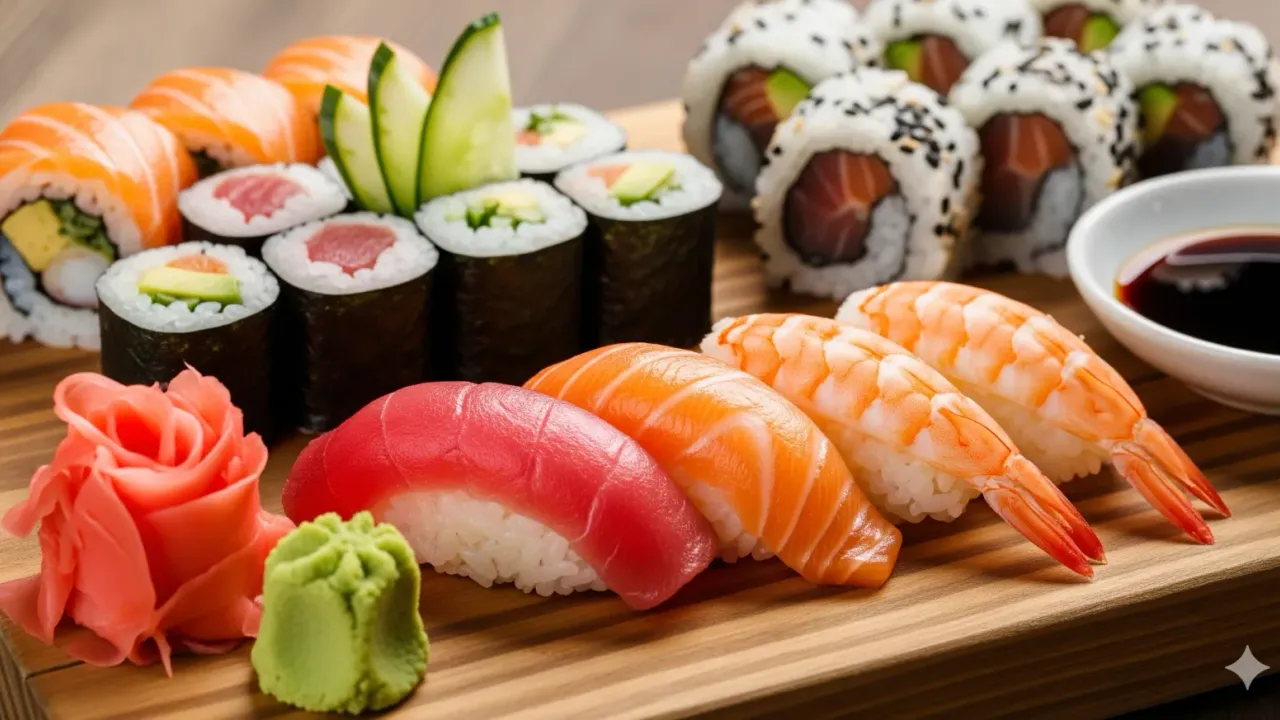
Sushi is the defining culinary art of Japan — vinegared rice paired with the freshest seafood, shaped by hand into bites of extraordinary precision and restraint. Far more than a simple combination of raw fish and rice, sushi (literally “sour-tasting” in reference to the vinegared rice) represents centuries of Japanese culinary philosophy. Every grain of rice, every slice of fish, and every gesture of the chef’s hands carries meaning.
In this recipe, you will learn how to make authentic nigiri and maki rolls at home. We cover everything from perfectly seasoned sushi rice to expertly sliced fish, using the same foundational techniques that Japanese kitchens have practiced for generations.
Prep Time: 60 minutes | Cook Time: 25 minutes | Servings: 4
Difficulty: Medium | Calories: ~450 per serving
What Makes Sushi Special?
The Rice Is the Soul of Sushi
Sushi is one of the most misunderstood foods in the world. Most people outside of Japan think of sushi as raw fish. However, the word sushi actually refers to the rice — specifically, short-grain rice seasoned with a mixture of rice vinegar, sugar, and salt. The fish, the nori, and the vegetables are all accompaniments. The rice is the soul.
In fact, a sushi chef in Japan trains for years on rice alone before handling fish. A truly great piece of sushi begins and ends with the quality of the rice: its temperature, its seasoning, its texture, and the way each grain holds together while still feeling loose and airy on the tongue. The chef chooses the fish to complement the rice, not the other way around.
A Brief History of Sushi
The history of sushi stretches back over a thousand years to a preservation technique called narezushi. In this method, cooks packed fish in rice and salt and left it to ferment for months. Originally, they discarded the rice — it served merely as a fermentation medium.
Then, during the Muromachi period (1336-1573), cooks began eating the rice alongside the fish. By the early 19th century in Edo (modern-day Tokyo), a street food vendor named Hanaya Yohei revolutionized the concept. He placed slices of fresh fish on top of hand-pressed vinegared rice, creating what we now know as nigiri-zushi. This was fast food — sushi you could eat standing at a stall, without months of fermentation. It became an instant sensation. Within decades, it had spread across Japan and eventually the world.
Technique Over Ingredients
What separates truly excellent sushi from mediocre sushi is not expensive ingredients but careful technique. First, you must wash the rice until the water runs clear. Next, cook it with the precise ratio of water, season it while hot, and cool it rapidly to develop a glossy sheen.
Similarly, you must slice the fish with a single, clean pull of the knife — never sawing — to preserve the delicate cellular structure. You should shape the nigiri with just enough pressure to hold together, but not so much that the rice becomes a dense block. Finally, serve everything at room temperature. Cold rice turns hard and flavorless, and cold fish becomes muted and dull. Sushi is a study in restraint, and its brilliance lies in how few ingredients it uses and how perfectly you handle each one.

Choosing the Right Rice for Sushi
The rice you choose will determine the success or failure of your sushi more than any other single decision. You need a Japanese short-grain rice — the kind with plump, nearly round grains that cook up sticky, slightly chewy, and cohesive.
This stickiness comes from the high ratio of amylopectin to amylose starch in the grain. As a result, the cooked rice clings together naturally while still maintaining individual grain integrity. Without this specific starch profile, you cannot shape nigiri, you cannot roll maki, and you cannot make sushi.
- Koshihikari (best choice): The premier sushi rice variety and the standard in Japanese restaurants worldwide. Koshihikari has a perfect balance of stickiness, firmness, and a subtle natural sweetness that complements the vinegar seasoning beautifully. It holds its shape when molded into nigiri but yields gently when you bite. If you can find it, use it.
- Calrose: A medium-grain rice developed in California that has become the most widely available substitute for Japanese short-grain rice in Western supermarkets. Calrose is slightly less sticky and less nuanced in flavor than Koshihikari, but it produces excellent sushi at a fraction of the cost and is significantly easier to find. For home sushi making, Calrose is a very strong choice.
- Sasanishiki: Another Japanese short-grain variety prized for its clean, neutral flavor and slightly firmer texture compared to Koshihikari. Sasanishiki is favored by some traditional sushi chefs who prefer a rice that does not compete with the flavor of delicate white-fleshed fish. It is harder to source outside of Japan but worth seeking out if you find it.
Ingredients for Sushi
For the Sushi Rice (Shari):
- 400g (2 cups) Japanese short-grain sushi rice (Koshihikari or Calrose)
- 480ml (2 cups) water
- 60ml (1/4 cup) rice vinegar
- 2 tablespoons granulated sugar
- 1 teaspoon fine sea salt
- 1 piece kombu, about 5cm (2 inches) square (optional, for added umami)
For the Fish and Toppings (Neta):
- 200g (7 oz) sushi-grade salmon (sake), sliced into thin pieces
- 200g (7 oz) sushi-grade tuna (maguro), sliced into thin pieces
- 150g (5.3 oz) sushi-grade shrimp (ebi), cooked and butterflied
- 1 Japanese cucumber, cut into thin matchstick strips
- 1 ripe avocado, sliced thin
For Assembly and Serving:
- 4 full sheets nori (roasted seaweed)
- 2 tablespoons wasabi paste
- 80ml (1/3 cup) soy sauce (shoyu) for dipping
- 60g (about 3 tablespoons) pickled ginger (gari)
- 1 tablespoon toasted sesame seeds
- Tezu (hand water): equal parts water and rice vinegar for wetting hands
Pro tip: Always buy your fish from a trusted fishmonger who specifically sells sushi-grade or sashimi-grade products. The fish should smell like the ocean — clean, briny, and faintly sweet — never fishy. If you cannot find sushi-grade fish locally, consider ordering online. Many specialty retailers ship flash-frozen sushi-grade fish packed in dry ice. In many cases, this fish is fresher than what sits in a supermarket display case.
Step-by-Step Instructions
Step 1: Wash and Cook the Sushi Rice
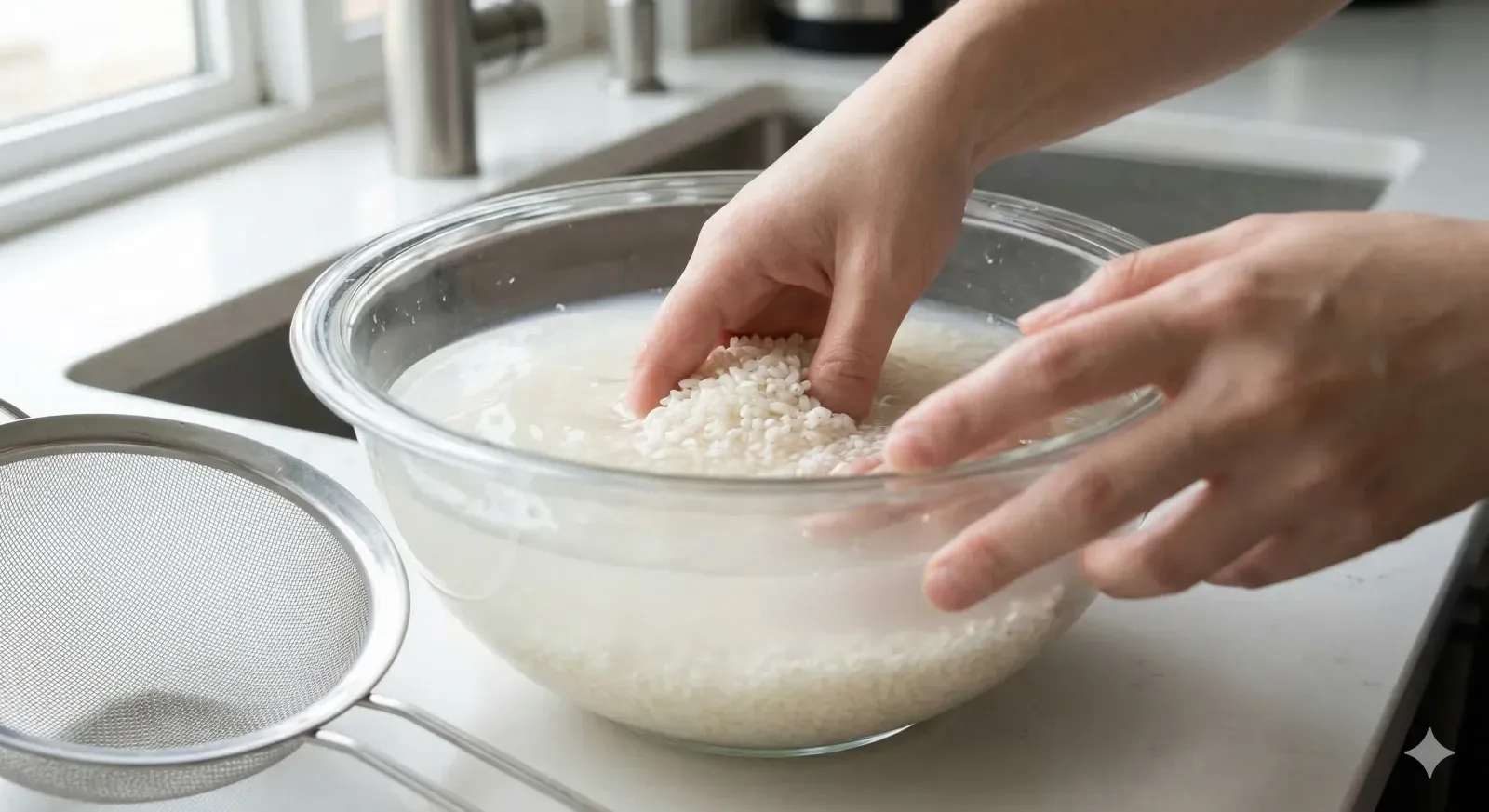
1Place the rice in a large bowl and cover with cold water. Submerge your hand and gently swirl the grains in circular motions — you are not scrubbing, you are coaxing the loose surface starch away from the grains. The water will turn milky white. Drain it. Then repeat this washing process 4 to 5 times until the water runs nearly clear with only the faintest haze.
This step is non-negotiable. Unwashed rice retains excess amylopectin on its surface, and that starch will make your cooked rice gummy, pasty, and impossible to work with. Instead of the light, airy cohesion that defines proper sushi rice, the grains will clump into a dense mass.
After the final wash, drain the rice in a fine-mesh sieve and let it rest for 30 minutes. This resting period allows the grains to absorb residual surface moisture evenly, which promotes uniform cooking.
Next, transfer the rice to a rice cooker or a heavy-bottomed pot with a tight-fitting lid. Add the measured water and the optional kombu, which will infuse the rice with a subtle, savory umami depth. If using a pot, bring it to a boil over medium-high heat. Then immediately reduce to the lowest possible setting, cover tightly, and cook for exactly 15 minutes without lifting the lid. Finally, turn off the heat and let the rice steam undisturbed for another 10 minutes. The trapped steam finishes cooking the top layer and ensures every grain is tender from center to surface.
Step 2: Season the Rice with Sushi Vinegar
2While the rice cooks, prepare the sushi vinegar (sushi-zu). Combine the rice vinegar, sugar, and salt in a small saucepan. Warm over low heat, stirring gently until the sugar and salt dissolve completely. Do not boil — you want the vinegar to retain its bright acidity. Then remove from heat and let it cool to room temperature.
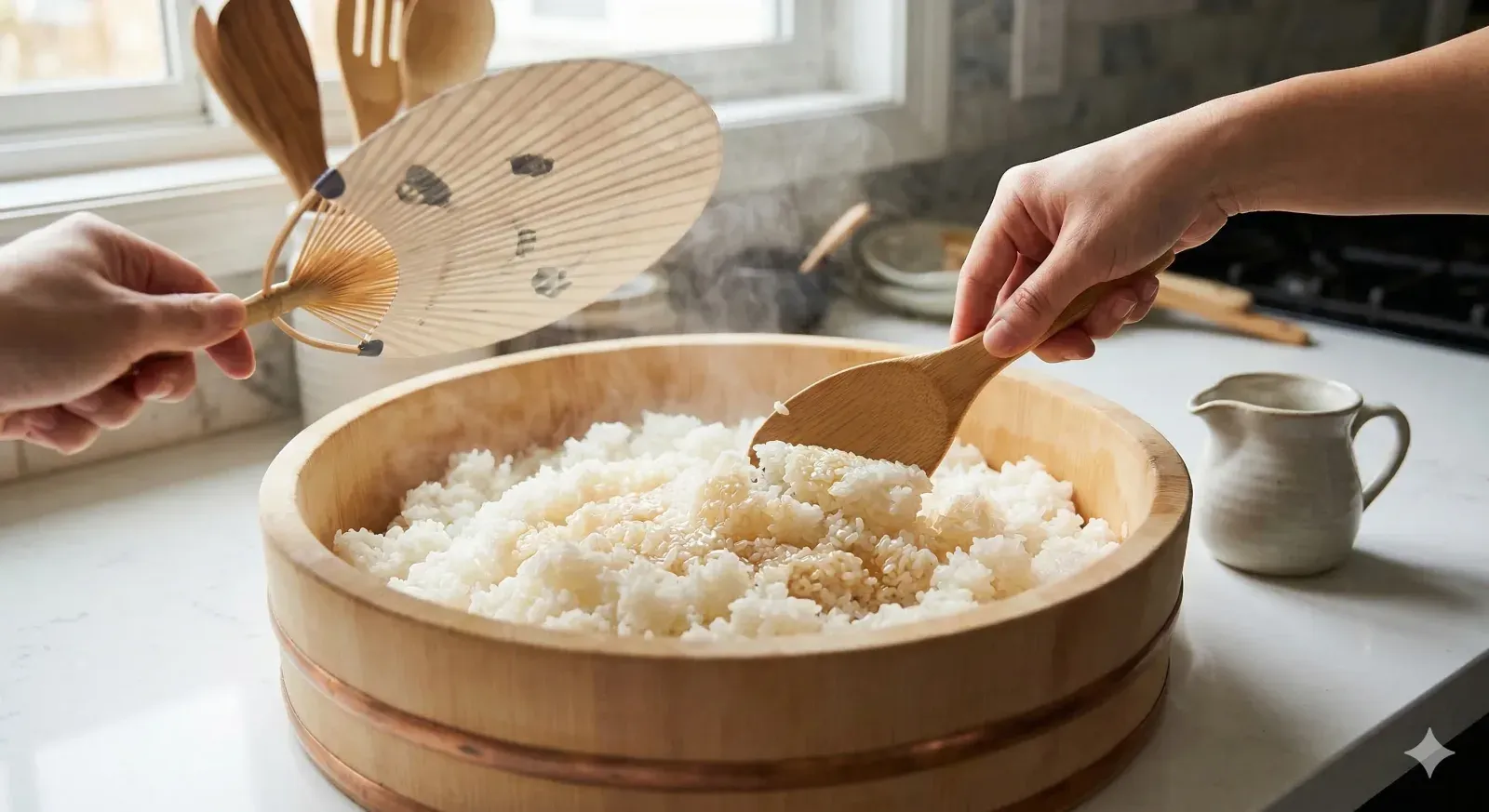
When the rice is ready, remove the kombu and transfer the hot rice to a hangiri (a wide, flat-bottomed wooden tub designed for seasoning sushi rice). If you do not have one, use a large, wide non-metallic bowl instead. The wood of a hangiri absorbs excess moisture from the rice, contributing to the ideal texture. However, a ceramic or glass bowl works well enough.
Now drizzle the sushi vinegar evenly over the surface of the hot rice. Use a shamoji (rice paddle) or a flat wooden spatula to incorporate the vinegar with a specific technique: slice through the rice at a 45-degree angle, fold it over gently, then slice again. You are cutting and folding, not stirring. Stirring will crush the grains and turn the rice into a starchy paste.
Meanwhile, have someone fan the rice — or use a folded newspaper, a magazine, anything that moves air — to cool it rapidly. This rapid cooling gives sushi rice its distinctive glossy, almost lacquered appearance. The evaporation tightens the surface starch of each grain, creating a sheen that catches the light. Continue cutting, folding, and fanning until the rice reaches body temperature — roughly 35 to 37 degrees Celsius (95 to 99 degrees Fahrenheit). Finally, cover with a damp cloth to prevent drying out and use within 1 hour.
Step 3: Prepare the Fish and Toppings
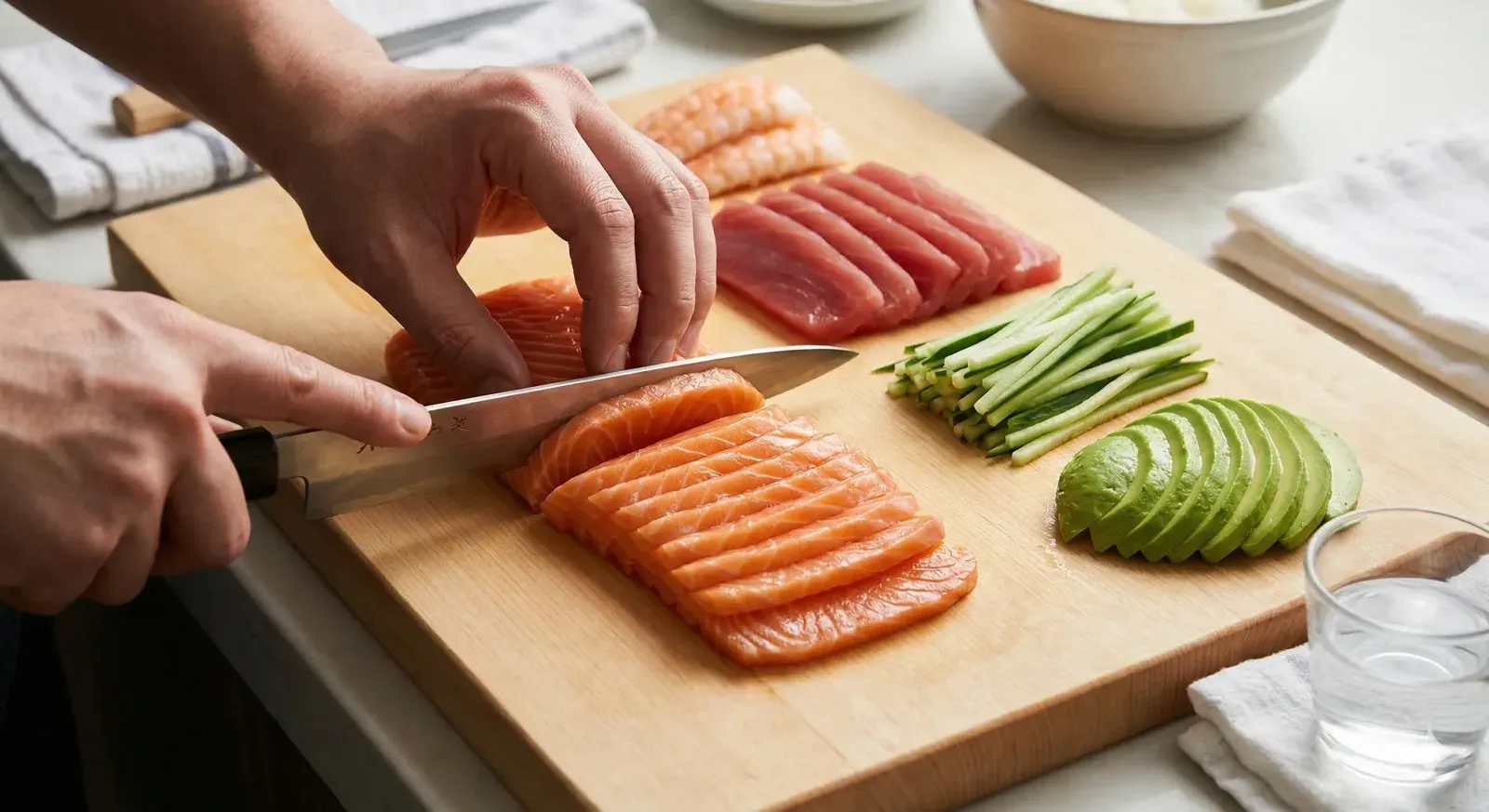
3The way you cut fish for sushi matters as much as the fish itself. You need a very sharp, long-bladed knife — ideally a yanagiba, the single-bevel sushi knife that Japanese chefs use. However, any sharp, thin-bladed knife will serve.
The key principle is this: make every cut in a single, smooth, pulling motion. Draw the knife toward you through the fish in one long stroke, letting the weight of the blade do the work. Never push the knife forward, never saw back and forth, and never use a short, choppy stroke. Sawing tears the muscle fibers, releases moisture, and creates a ragged surface. In contrast, a clean, single-pull cut produces a slice with a smooth, almost glossy surface that drapes over the rice and melts in the mouth.
For nigiri, slice the salmon and tuna against the grain into pieces roughly 7cm (3 inches) long, 3cm (1 inch) wide, and 5mm (1/4 inch) thick.
For the shrimp, first peel and devein them. Then insert a bamboo skewer along the belly to keep them straight. Poach them in gently salted simmering water for 1 to 2 minutes until just pink and opaque. Immediately transfer to ice water to stop the cooking. Once chilled, remove the skewers and butterfly each shrimp by slicing along the belly without cutting all the way through. Press them flat.
Additionally, cut the cucumber into thin matchstick strips about the length of a nori sheet. Slice the avocado thinly and brush with a small amount of lemon juice to prevent oxidation.
Step 4: Shape Nigiri Sushi
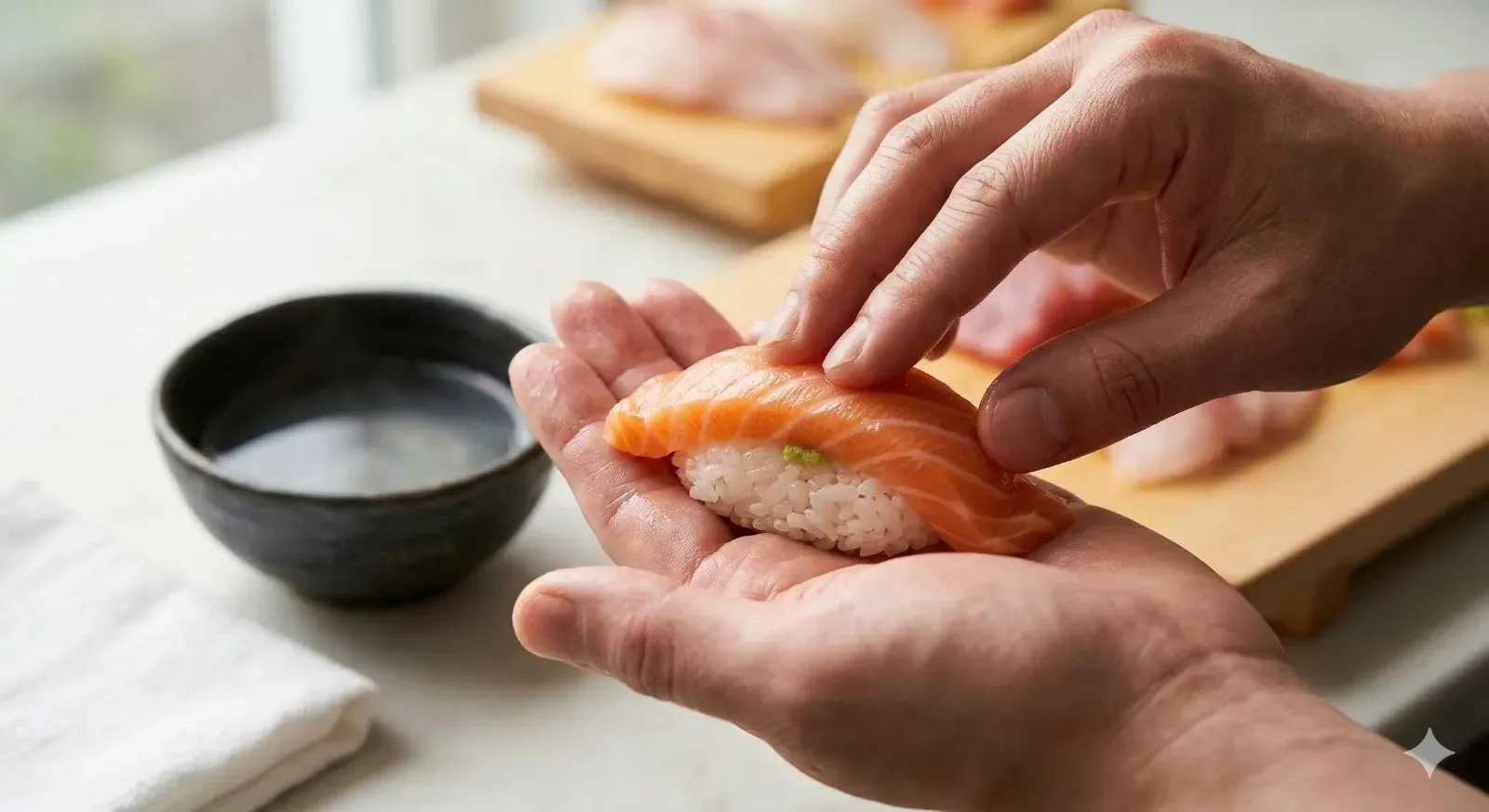
4Nigiri is the purest form of sushi — nothing but rice and a single slice of fish — and shaping it properly is the skill that sushi apprentices in Japan spend years perfecting. First, prepare your tezu (hand water) by mixing equal parts water and rice vinegar in a small bowl. Dip your fingers into the tezu before handling each piece. This prevents the rice from sticking to your skin while adding a faint layer of vinegar that enhances the seasoning.
Next, pick up about 20g (roughly 1 heaping tablespoon) of seasoned rice. With your working hand, gently cup the rice and press it into a compact oval shape using your fingertips and the curve of your palm. The pressure should be gentle but deliberate — firm enough that the rice holds together as a single unit. At the same time, keep it loose enough that the individual grains remain distinct. This is the paradox of sushi rice: it must hold together and fall apart at the same time.
With your other hand, pick up a slice of fish and lay it across your fingers. Place a tiny dab of wasabi — no more than a pea-sized amount — on the center of the fish. Then set the rice oval on top of the fish and press gently with two fingers to mold the fish over the contour of the rice. Flip the entire piece over so the fish is on top, and press once more on the sides and top to refine the shape. The finished nigiri should be a smooth, elongated mound with the fish draped elegantly over the rice, roughly the size that fits comfortably in a single bite.
Step 5: Roll Maki Sushi
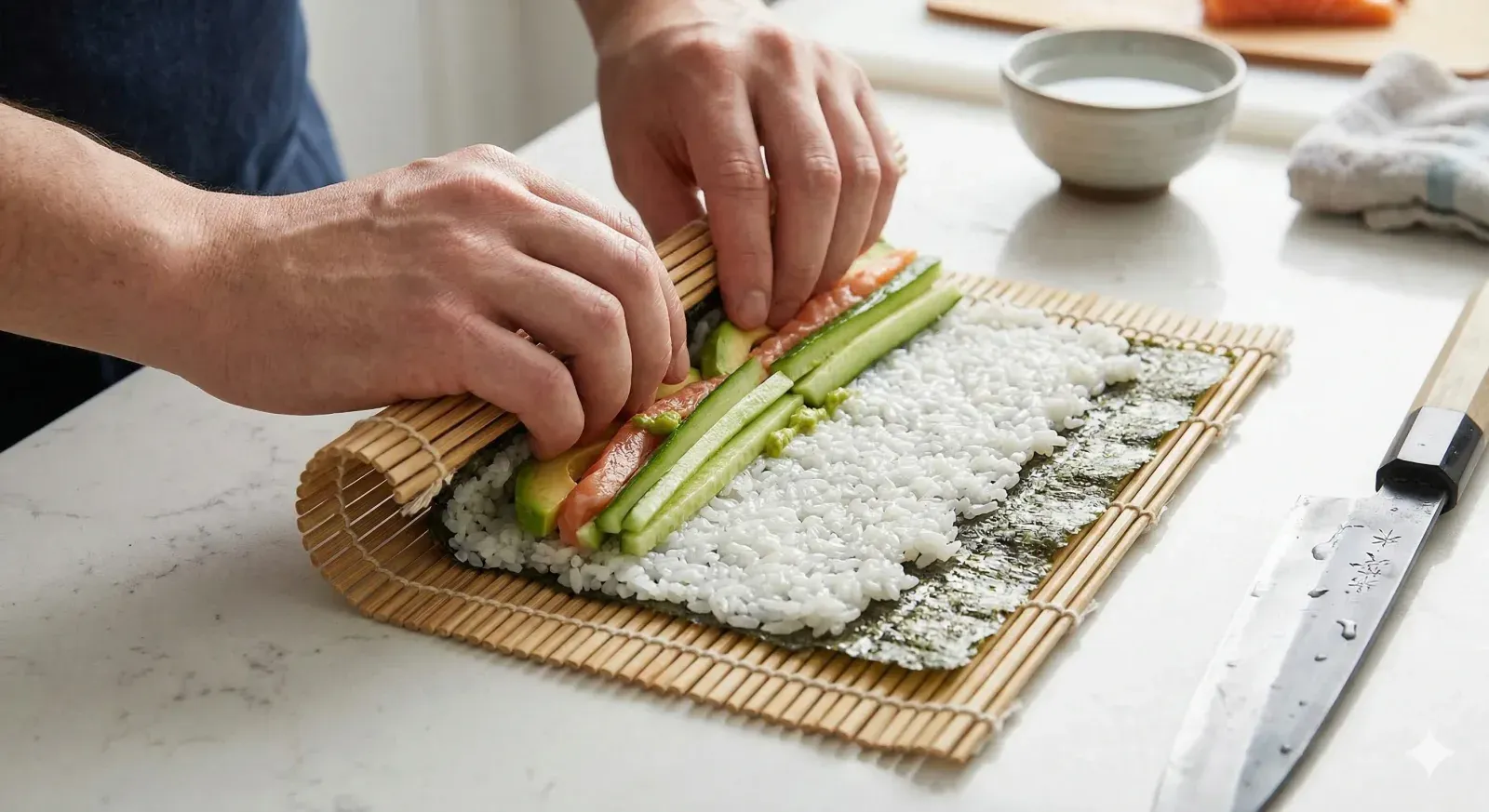
5Place your bamboo rolling mat (makisu) on a clean, dry work surface with the bamboo slats running horizontally, parallel to the edge of the counter. Lay a full sheet of nori on the mat with the rough side facing up — the rough surface grips the rice better.
Next, dip your hands in the tezu and take about 150g (3/4 cup) of sushi rice. Spread it evenly across the nori in a thin, uniform layer, pressing gently with your fingertips. Leave a 2cm (3/4 inch) strip of bare nori along the far edge. This empty strip serves as your seal, and the moisture from the rice will activate the natural glue in the nori to close the roll.
Then spread a thin line of wasabi across the center of the rice with your finger. Lay your chosen fillings — cucumber strips, avocado slices, and a strip of salmon or tuna — in a neat, compact line across the center of the rice. Make sure they run parallel to the bamboo slats. Do not overfill. This is the most common mistake home sushi makers make. Too much filling makes the roll impossible to close tightly, and it will fall apart when you try to cut it. Remember, less is always more.
Now lift the edge of the mat closest to you with your thumbs, keeping your fingers on the fillings to hold them in place. Roll the mat forward until the front edge of the rice meets the far side of the fillings. Pause here. Apply firm, even pressure along the length of the roll by squeezing the mat with both hands. Continue rolling forward until the bare strip of nori sits underneath the roll. Give the mat one final squeeze along the entire length to compact and shape the cylinder.
Finally, remove the mat. Wet a very sharp knife with water and cut the roll in half. Then cut each half into 3 or 4 even pieces. Wipe the blade clean with a damp cloth between every cut — rice residue on the blade will drag and tear the nori.
Step 6: Plate and Serve
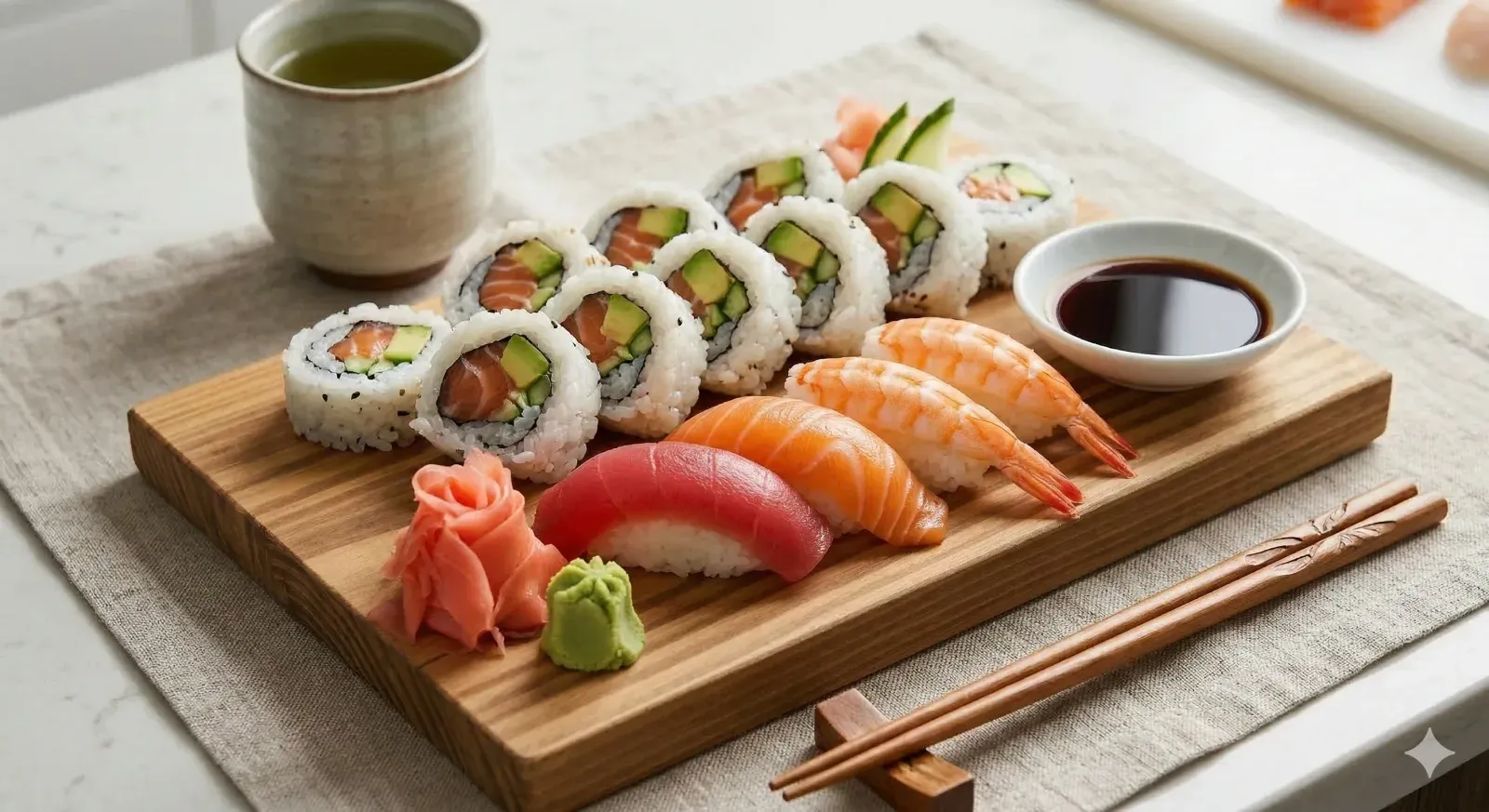
6Arrange the nigiri and sliced maki on a clean plate, a lacquered tray, or a traditional wooden sushi board (geta). In Japanese presentation, odd numbers are preferred — so arrange pieces in groups of 3, 5, or 7. Place a small mound of pickled ginger (gari) on one corner of the plate and a small dish of soy sauce alongside.
If desired, place a small dab of wasabi on the plate. However, in proper sushi tradition, the chef has already placed the ideal amount between the fish and rice. Also, sprinkle a few toasted sesame seeds over the maki rolls for a subtle nutty fragrance.
Most importantly, serve sushi immediately and eat it at room temperature. Refrigerating sushi hardens the rice through starch retrogradation, turning the tender, glossy grains into a firm, chalky mass. The fish also loses its buttery suppleness when chilled, becoming dense and waxy. Eat sushi the way it was meant to be eaten: freshly made, at room temperature, one piece at a time.
Expert Tips for Perfect Sushi
Rice Temperature Is Everything
You should serve sushi rice at body temperature — roughly 35 to 37 degrees Celsius (95 to 99 degrees Fahrenheit). At this temperature, the rice is at its most flavorful, most aromatic, and most pliable. Cold rice loses its vinegar fragrance, turns firm and chalky, and refuses to hold the delicate shape of nigiri.
If your rice has cooled too much, simply cover it with a damp cloth and let it sit at room temperature. Never microwave it, as uneven heating will create pockets of dried, hardened grains. For reference, professional sushi chefs keep their rice in a wooden container covered with a damp cloth throughout service and shape each piece to order.
Use Tezu Constantly
The hand-water mixture of equal parts water and rice vinegar is your most important tool when shaping sushi. Without it, the starchy rice will bond to your fingers instantly, making it impossible to handle or shape. Therefore, dip your hands into the tezu before every single piece of nigiri and before spreading rice for every roll. However, do not over-wet your hands — a light coating is sufficient. Excessively wet hands will make the rice waterlogged and dilute the carefully balanced vinegar seasoning.
The Single-Pull Knife Cut
Whether you are slicing fish for nigiri or cutting a finished maki roll, the same principle applies: one smooth, pulling stroke. Draw the knife toward you in a single motion, letting the sharp edge glide through the ingredient. For cutting rolls, wet the blade with water before each cut and wipe it clean afterward. A dry knife drags against the sticky rice and tears the nori, producing ragged, messy pieces. A clean, wet blade passes through effortlessly and produces cuts so clean they look machine-made.
Less Filling, Tighter Roll
The most common mistake when making maki at home is overfilling the roll. It feels counterintuitive to use so little filling, but a thin line of ingredients across the center of the rice is all you need. Too much filling prevents the roll from closing, causes the nori to tear, and results in a bulging, lopsided cylinder that falls apart when sliced. The rice should dominate. The filling should be an accent — a ribbon of color and flavor running through the center of each piece.
Sushi Styles Compared: Nigiri vs. Maki vs. Sashimi
The word “sushi” encompasses a family of preparations that differ in shape, structure, and technique. Understanding these distinctions helps you choose the right style for your ingredients, your skill level, and your occasion. Below is how the major sushi styles compare.
| Feature | Nigiri-zushi | Maki-zushi | Sashimi |
|---|---|---|---|
| Rice | Hand-pressed oval of vinegared rice | Vinegared rice spread on nori and rolled | No rice (fish only) |
| Wrapping | None (fish draped on top) | Nori seaweed sheet | None |
| Typical filling/topping | Single slice of fish or seafood | Fish, vegetables, or combination | Sliced raw fish |
| Shape | Elongated oval mound | Cylindrical roll, cut into rounds | Individually sliced pieces |
| Difficulty | High (hand-shaping technique) | Medium (rolling with mat) | Medium (knife skills) |
| Eating method | One bite, fish-side dipped in soy sauce | One bite, dipped lightly in soy sauce | Dipped in soy sauce with wasabi |
| Origin | Early 1800s, Edo (Tokyo) | 1700s, various regions | Ancient Japan |
Serving Suggestions
In Japan, chefs serve sushi with deliberate simplicity. The focus falls entirely on the quality of the rice and the fish, and the accompaniments exist only to enhance and cleanse. A traditional sushi meal is a sequential experience — each piece arrives one at a time. You eat it immediately, with pickled ginger between pieces to reset the palate.
At home, you can present a platter of assorted nigiri and maki. However, honor the Japanese principle of restraint by keeping the accompaniments minimal and letting the sushi itself be the centerpiece.
The Perfect Accompaniments:
- Pickled ginger (gari): Thinly sliced young ginger pickled in sweetened vinegar. Eat a small piece between different types of sushi to cleanse the palate. It is not a topping — placing ginger on top of sushi is a common Western mistake that masks the flavor of the fish.
- Soy sauce (shoyu): Use sparingly. Dip the fish side of nigiri lightly into the soy sauce, not the rice side. The rice absorbs too much soy sauce and falls apart, and the saltiness overwhelms the delicate fish.
- Miso soup: A small bowl of warm miso soup served alongside sushi is traditional in Japanese dining. The savory, umami-rich broth complements the vinegared rice without competing with the clean flavors of the fish.
- Edamame: Steamed and salted young soybeans make an excellent starter or side while you prepare sushi. Their mild, sweet, nutty flavor and satisfying pop of texture complement the lightness of the meal.
- Seaweed salad (wakame): A light, slightly sweet salad of rehydrated wakame seaweed dressed in sesame oil and rice vinegar. Its oceanic flavor and silky texture echo the marine character of the sushi.
Beverage Pairings:
- Junmai Daiginjo sake: The premium grade of sake, served chilled, with a delicate floral aroma, subtle sweetness, and a clean finish that elevates the flavor of fresh fish without overwhelming it. This is the classic pairing.
- Japanese beer (Asahi, Sapporo, Kirin): A cold, crisp Japanese lager is the casual, crowd-pleasing pairing. The clean bitterness and carbonation refresh the palate between bites of rice and fish.
- Green tea (agari): Hot green tea — specifically a strong, slightly bitter brew — is the traditional beverage served at sushi restaurants in Japan. The tannins cut through the fat of rich fish like salmon belly and tuna, cleansing the palate completely.
- Champagne or dry sparkling wine: The acidity and effervescence of Champagne or Cava pair beautifully with sushi. The bubbles cleanse the palate and the crisp acidity matches the vinegar in the rice.
- Sparkling water with yuzu: For a non-alcoholic option, cold sparkling water with a squeeze of fresh yuzu (or lemon as a substitute) provides the citrusy brightness and carbonation that refreshes between pieces.
Storage and Reheating
Refrigerator: Eat sushi with raw fish within 2 hours at room temperature, or store it in the refrigerator and eat it within 24 hours. However, refrigeration significantly degrades the quality — the rice hardens, the nori loses its crispness, and the fish loses its silky texture. If you must refrigerate, wrap each piece tightly in plastic wrap to minimize moisture loss. Then allow the sushi to sit at room temperature for 15 to 20 minutes before eating.
Freezer: Do not freeze assembled sushi, as the texture of both the rice and the fish will suffer upon thawing. However, you can freeze sushi-grade fish before preparing it. In fact, most suppliers have already flash-frozen sushi-grade fish for food safety. Store fish tightly wrapped at minus 18 degrees Celsius (0 degrees Fahrenheit) for up to 3 months. Thaw it slowly in the refrigerator overnight before slicing.
Reheating: Sushi is not meant to be reheated. If you have leftover sushi rice (without fish), you can repurpose it by making onigiri (rice balls), fried rice, or rice bowls. Keep in mind, though, that refrigerated rice will no longer work for sushi. Therefore, plan to make only as much sushi as you will eat in one sitting.
Common Mistakes to Avoid
1. Skipping the Rice Washing
Unwashed rice has a thick coating of loose surface starch that turns into a gluey paste when cooked. The result is rice that sticks together in a dense, gummy mass rather than the tender, individual-grain cohesion that sushi requires. Wash the rice 4 to 5 times until the water runs nearly clear. This step takes 5 minutes and is the single most impactful thing you can do for the quality of your sushi rice. There is no shortcut and no substitute.
2. Stirring Instead of Folding the Sushi Vinegar
When you add the sushi vinegar to the hot rice, your instinct will be to stir it in with circular motions. Resist that instinct completely. Stirring crushes the tender grains, releases their internal starch, and turns the rice into a sticky, paste-like mass. Instead, use a cutting and folding motion with a flat paddle. Slice through the rice at a 45-degree angle, then fold it over gently. This technique distributes the vinegar evenly while preserving the integrity of every grain.
3. Using Cold Rice
Keep sushi rice at body temperature when you shape and serve it. Cold rice undergoes starch retrogradation — the same process that makes day-old bread stale — and becomes firm, chalky, and flavorless. Moreover, cold rice does not adhere properly, making nigiri impossible to shape and maki rolls prone to cracking. If your rice has cooled below body temperature, cover it with a warm, damp cloth for 10 minutes to gently bring it back up. Never refrigerate sushi rice before using it.
4. Overfilling Maki Rolls
More filling does not mean better sushi. Overfilled rolls cannot be closed tightly, and they burst or crumble when you attempt to slice them. The filling should be a thin, neat line across the center of the rice — about the thickness of a pencil. The rice is the star of sushi, and the filling is a supporting character. A properly made maki roll holds together cleanly, slices without resistance, and stays intact when picked up with chopsticks.
5. Drowning Sushi in Soy Sauce
Soy sauce is a condiment, not a dipping pool. A light touch is all you need — just enough to add a whisper of salt and umami. Submerging an entire piece of sushi in soy sauce obliterates the delicate flavor of the fish, the carefully balanced vinegar seasoning of the rice, and the faint heat of the wasabi. Dip only the fish side of nigiri, and for maki, a brief, partial dip of one edge is sufficient.
Frequently Asked Questions
What makes sushi rice different from regular rice?
Sushi rice is Japanese short-grain rice that you cook and season with a mixture of rice vinegar, sugar, and salt. The short-grain variety is essential because it contains higher levels of amylopectin starch. This starch gives the cooked grains a sticky, slightly chewy texture that holds together when shaped. In contrast, regular long-grain rice like basmati or jasmine lacks this starch structure and will fall apart when you try to form nigiri or rolls.
Moreover, the vinegar seasoning adds a subtle acidity that preserves the rice, balances the richness of the fish, and gives sushi its characteristic clean, bright flavor.
Can I make sushi without raw fish?
Absolutely. Many traditional and modern sushi varieties use cooked or vegetarian ingredients. For example, popular options include cooked shrimp (ebi), grilled eel (unagi), tamago (Japanese egg omelet), crab sticks, cucumber, avocado, pickled daikon radish, shiitake mushrooms, and cooked salmon. In fact, some of the most prized sushi toppings in Japan, including eel and shrimp, are always cooked. Vegetable maki rolls are also a staple in Japanese sushi restaurants and make an excellent starting point for beginners.
What does sushi-grade fish mean?
Sushi-grade or sashimi-grade fish refers to fish that suppliers have handled, stored, and often flash-frozen to standards safe for raw consumption. In the United States, the FDA recommends freezing fish at minus 20 degrees Celsius (minus 4 degrees Fahrenheit) for 7 days. Alternatively, you can freeze it at minus 35 degrees Celsius (minus 31 degrees Fahrenheit) for 15 hours to eliminate parasites. Since the term is not formally regulated, always buy from a reputable fishmonger who specializes in fish for raw consumption. Also, ask when they received the fish and how they stored it.
Why is my sushi rice too sticky or mushy?
Three common mistakes usually cause mushy sushi rice: not washing the rice thoroughly enough (leaving excess surface starch), using too much water during cooking, or stirring the rice instead of using the proper cutting and folding technique. To avoid this, always wash the rice 4 to 5 times until the water runs nearly clear. Also, measure the water precisely. Finally, fold the seasoning in with slicing motions using a flat paddle rather than circular stirring.
How long does homemade sushi last?
Eat sushi with raw fish within 2 hours at room temperature, or within 24 hours if you refrigerate it. However, refrigeration degrades the quality significantly — the rice hardens and the fish loses its silky texture. Sushi with cooked or vegetarian ingredients lasts slightly longer, but the rice still deteriorates in the fridge. For the best experience, always make sushi fresh and eat it immediately in the same sitting.
What is the correct way to eat sushi?
In traditional Japanese etiquette, pick up nigiri sushi with chopsticks or fingers — both are acceptable. Turn it upside down and dip the fish side into the soy sauce. Never dip rice-side down, as the rice absorbs too much soy sauce and will fall apart. Eat each piece in one bite.
Additionally, use pickled ginger as a palate cleanser between different types of sushi. Do not place it on top. If the chef has not already applied wasabi, place a small amount directly on the fish rather than dissolving it into the soy sauce. However, the latter practice has become common and accepted outside of Japan.
Variations and Adaptations
Temaki (Hand Rolls):
Temaki are cone-shaped sushi rolls made by wrapping a piece of nori around a handful of rice and fillings, shaped like an ice cream cone. They are the most casual and forgiving form of sushi — no bamboo mat required, no precise rolling technique, no careful slicing. Simply hold a half-sheet of nori in your hand, spread rice on one side, add fillings diagonally across the center, and roll the nori into a cone. Temaki are meant to be eaten immediately while the nori is still crisp. They are the ideal format for a sushi party where guests assemble their own.
Uramaki (Inside-Out Rolls):
Uramaki, or inside-out rolls, gained popularity in the United States during the 1960s and 1970s. Chefs designed them to make sushi more appealing to Western diners unfamiliar with seaweed. In this style, the rice sits on the outside, with the nori wrapped around the fillings on the inside.
To make uramaki, spread rice on a nori sheet as usual. Then flip the entire thing over so the rice faces down on the bamboo mat (cover the mat with plastic wrap first). Add fillings on the nori and roll as usual. You can coat the exterior rice with sesame seeds, tobiko (fish roe), or thinly sliced avocado. For example, both the California roll and the rainbow roll are uramaki.
Chirashi-zushi (Scattered Sushi):
Chirashi is the simplest form of sushi and the best option when you want sushi flavors without the shaping or rolling. Simply fill a bowl with a generous portion of sushi rice. Then arrange an assortment of sliced sashimi, tamago, shrimp, cucumber, and pickled vegetables on top. Drizzle with a touch of soy sauce and wasabi. Japanese home cooks love chirashi, particularly for celebrations like Hinamatsuri (Girls’ Day). As a result, it is also spectacularly easy to prepare for a crowd.
Vegetarian and Vegan Sushi:
Sushi adapts beautifully to plant-based diets. Simply replace fish with avocado, cucumber, pickled daikon, seasoned shiitake mushrooms, blanched asparagus, sweet potato tempura, marinated tofu, or umeboshi (pickled plum). Additionally, try inari-zushi — pouches of sweet, soy-simmered tofu skin stuffed with sushi rice. This traditional Japanese vegan sushi is deeply satisfying and requires no knife skills or rolling. For a richer plant-based option, use roasted beet or marinated watermelon as a visual and textural stand-in for tuna.
The Cultural Significance of Sushi
The Artisan Spirit Behind the Counter
Sushi is not merely a food in Japan — it is a cultural institution, a codified art form, and one of the most powerful symbols of Japanese aesthetics in the world. The principles that govern sushi-making mirror those of Japanese culture itself: precision, restraint, respect for materials, mastery through repetition, and the pursuit of perfection in simplicity.
A sushi chef (itamae, literally “in front of the cutting board”) does not simply cook. He or she undergoes a grueling apprenticeship that traditionally lasts a decade. The apprentice spends the first years washing dishes, observing, and preparing rice. Only after years of rice mastery does the apprentice begin handling fish. This hierarchy reflects the Japanese value of shokunin kishitsu — the artisan spirit. It embodies the belief that mastery comes not from talent but from an obsessive devotion to repeating a craft until every gesture becomes flawless and unconscious.
From Street Stall to Michelin Star
The history of sushi is also a history of Tokyo itself. Street vendors created nigiri-zushi in the early 1800s in Edo (modern Tokyo). They served quick bites of vinegared rice topped with fresh fish from Tokyo Bay. This was fast food — eaten standing at outdoor stalls, not seated at tables. It was food for the working class, for fishermen and laborers who needed a quick, satisfying meal.
The transformation of sushi — from humble street stall to Michelin-starred omakase counter — is one of the great culinary stories of modern history. Today, the best sushi restaurants in Tokyo, such as Sukiyabashi Jiro and Sushi Saito, charge hundreds of dollars per person. The meal consists of nothing more than rice and fish. However, you are paying for decades of practice, a lifetime of knowledge about fish seasonality, and the ability to season a grain of rice so perfectly that it needs nothing else.
Eating With the Seasons
Sushi also embodies the Japanese concept of shun — eating ingredients at their peak season. In traditional edomae sushi, the fish changes with the calendar. Spring brings hirame (flounder) and sayori (halfbeak). Summer is for aji (horse mackerel) and uni (sea urchin). Autumn delivers sanma (Pacific saury) and ikura (salmon roe). Winter is the season of buri (yellowtail) and fugu (blowfish).
Consequently, a great sushi chef does not offer a fixed menu. Instead, the chef responds to what the ocean provides. Each morning, the chef selects the finest fish at the Tsukiji (now Toyosu) market and builds the day’s offerings around what is at its absolute peak of flavor. To eat sushi in Japan is to eat in harmony with the seasons, with the ocean, and with a tradition that is at once ancient and perpetually alive.
Conclusion
Making authentic sushi at home is not about expensive equipment or rare ingredients — it is about respecting the fundamentals. Wash the rice until the water runs clear. Season it while hot and fan it to a glossy sheen. Cut the fish in a single, clean stroke. Shape the nigiri with gentle hands, understanding that sushi rice must hold together while still feeling loose on the tongue. Roll the maki with restraint, not excess. Above all, serve everything at room temperature, immediately, without delay.
These are not difficult techniques. They are simple techniques executed with care. The result — glossy, perfectly seasoned rice draped with butter-soft slices of fresh fish, or tight, clean-cut maki rolls revealing a spiral of rice, nori, and filling — is one of the most elegant and satisfying things you will ever make in your own kitchen.
Once you have mastered the fundamentals, explore the full spectrum of Japanese sushi. Try the casual joy of hand-rolled temaki, the artistry of chirashi bowls, and the dramatic inside-out uramaki that have become a global phenomenon. Each variation teaches you something new about the interplay of rice, fish, and seaweed.
Furthermore, explore more Asian recipes from our collection, including Japanese Ramen, Crispy Tempura, and Classic Miso Soup.