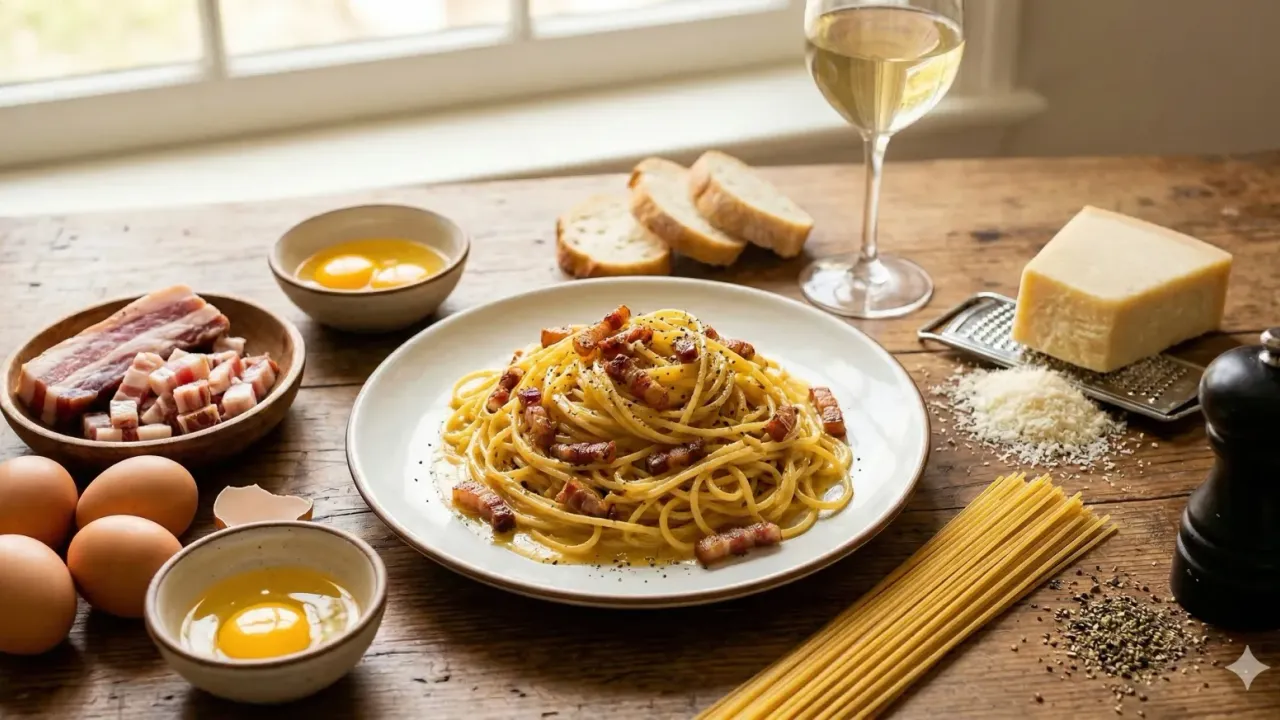
Carbonara is the crown jewel of Roman pasta. This legendary Italian dish transforms just five humble ingredients into something extraordinary. A proper carbonara recipe relies on guanciale, egg yolks, Pecorino Romano, black pepper, and perfectly cooked pasta. There is no cream. There are no shortcuts. Instead, technique and timing create the silky, golden sauce that clings to every strand. Whether you are cooking this for the first time or perfecting your method, this guide walks you through every detail.
Prep Time: 10 minutes | Cook Time: 20 minutes | Servings: 4
Difficulty: Medium | Calories: ~550 per serving
What Makes Carbonara Special?
Carbonara stands apart from every other pasta dish because of its minimalism. Five ingredients do all the work. The magic lies not in a long ingredient list but in precise execution. When the hot pasta meets the cold egg mixture, a gentle emulsion forms. Rendered pork fat, starchy pasta water, and melted cheese bind together into a sauce of remarkable richness. No flour thickens it. No cream dilutes it. As a result, every bite delivers pure, concentrated flavor.
The origins of carbonara remain hotly debated. Some food historians trace it to charcoal workers in the Apennine Mountains, known as carbonari. Others believe it emerged after World War II when American soldiers brought bacon and eggs to Rome. Regardless of its true birth story, carbonara became a fixture in Roman trattorias by the 1950s. Today, it ranks among Italy’s most iconic pasta dishes alongside cacio e pepe and amatriciana.
What truly sets carbonara apart is its temperamental nature. The sauce demands respect. Too much heat scrambles the eggs. Too little leaves them raw. This narrow window of perfection is exactly what makes a well-executed carbonara so rewarding. Furthermore, the contrast between crispy guanciale and silky sauce creates a textural experience that few pasta dishes can match.
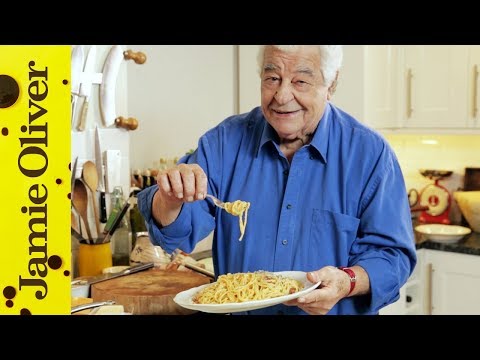
Choosing the Right Cured Pork
The cured pork drives the flavor of carbonara. Your choice here shapes the entire dish. Therefore, selecting the right cut matters more than any other decision you make.
- Guanciale (best choice): This is cured pork jowl, and it is the traditional pick in Rome. Guanciale has a high fat-to-meat ratio that renders into a silky, flavorful base. Its taste is rich, slightly sweet, and more nuanced than bacon. Italian delis and specialty stores carry it, and many online retailers ship it nationwide.
- Pancetta: Cured pork belly serves as the most common substitute. It has a similar fat content but a milder, more uniform flavor. Pancetta works well and is easier to find. However, it lacks the distinctive depth that guanciale provides.
- Thick-cut bacon: This is the most accessible option. Choose an unsmoked or lightly smoked variety. Strong smokiness can overpower the delicate egg sauce. In contrast, a mild bacon still delivers good crispiness and enough rendered fat to coat the pasta.
- Speck or lardo: For adventurous cooks, speck adds a subtle smoky note from its juniper-cured process. Lardo, on the other hand, is almost pure fat. It melts completely and contributes extraordinary richness. Consequently, these options produce a carbonara with a unique personality.
Ingredients for Carbonara
For the Pasta:
- 1 pound spaghetti or rigatoni
- Salt for pasta water (about 2 tablespoons per gallon)
For the Sauce:
- 6 ounces guanciale, cut into small strips or cubes
- 4 large egg yolks
- 2 whole eggs
- 1 cup finely grated Pecorino Romano
- 1/2 cup finely grated Parmigiano-Reggiano
- Freshly cracked black pepper, generous amount
Optional Garnish:
- Extra Pecorino Romano for serving
- Additional cracked black pepper
- Fresh parsley for color (non-traditional but popular)
Pro tip: Grate your Pecorino Romano and Parmigiano-Reggiano on the finest setting of a Microplane or box grater. Finely grated cheese melts faster and integrates more smoothly into the egg mixture. Pre-grated cheese from a bag often contains anti-caking agents that prevent proper melting. As a result, freshly grated cheese produces a noticeably creamier sauce.
Step-by-Step Instructions
Step 1: Prepare the Egg and Cheese Mixture
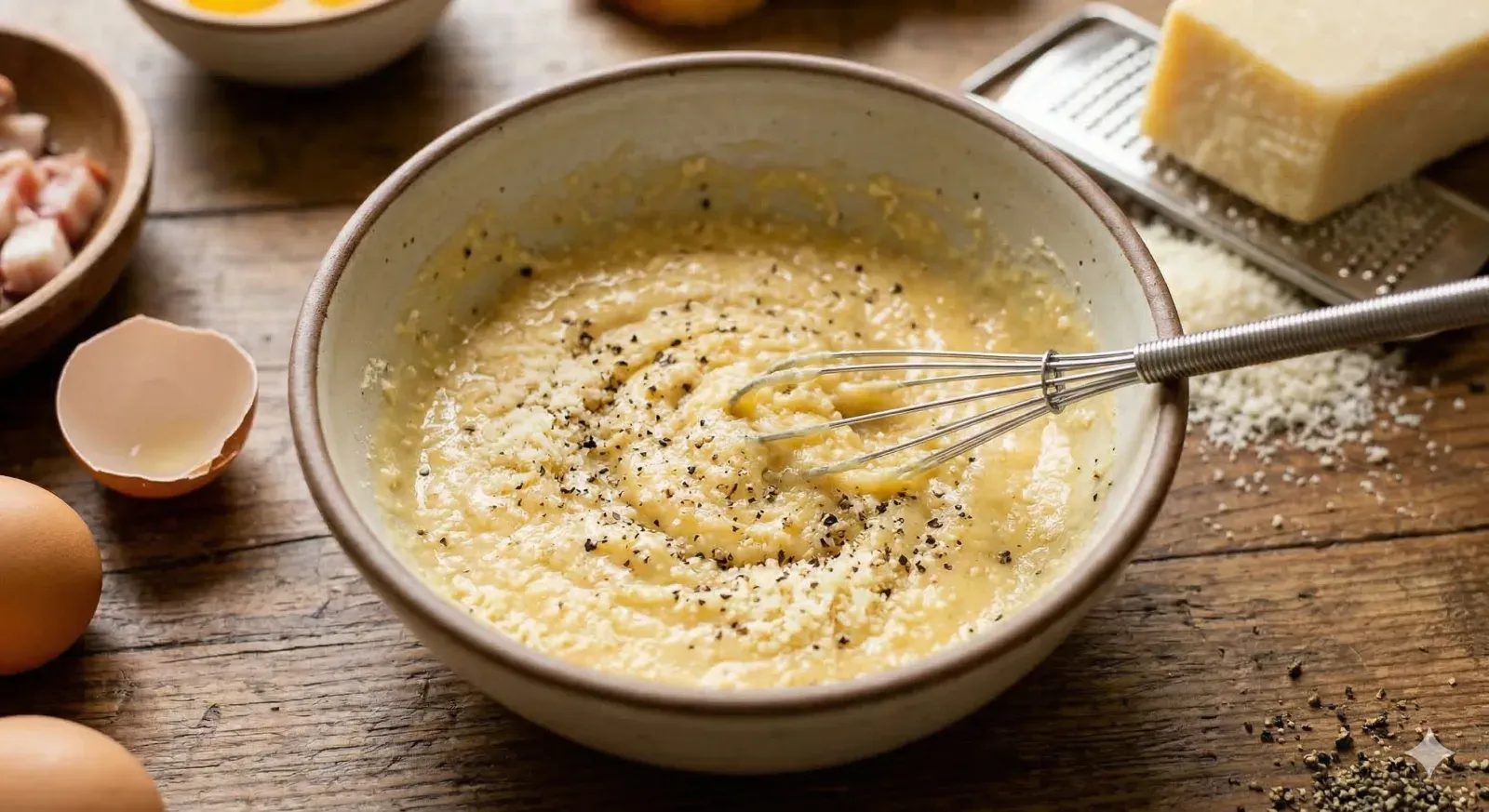
1 Crack 4 egg yolks and 2 whole eggs into a medium bowl. Then add the finely grated Pecorino Romano and Parmigiano-Reggiano. Whisk everything together until the mixture is smooth and uniform. It should look like a thick, pale yellow paste. Furthermore, grind a generous amount of black pepper directly into the bowl. This pepper blooms in the warmth of the sauce later, releasing its aromatic oils.
Set this mixture aside at room temperature while you prepare the other components. Cold eggs straight from the fridge can seize when they hit the hot pasta. Allowing them to warm slightly reduces that risk. Meanwhile, the cheese continues to hydrate in the egg, which consequently helps it melt more evenly during the final toss.
Step 2: Render the Guanciale
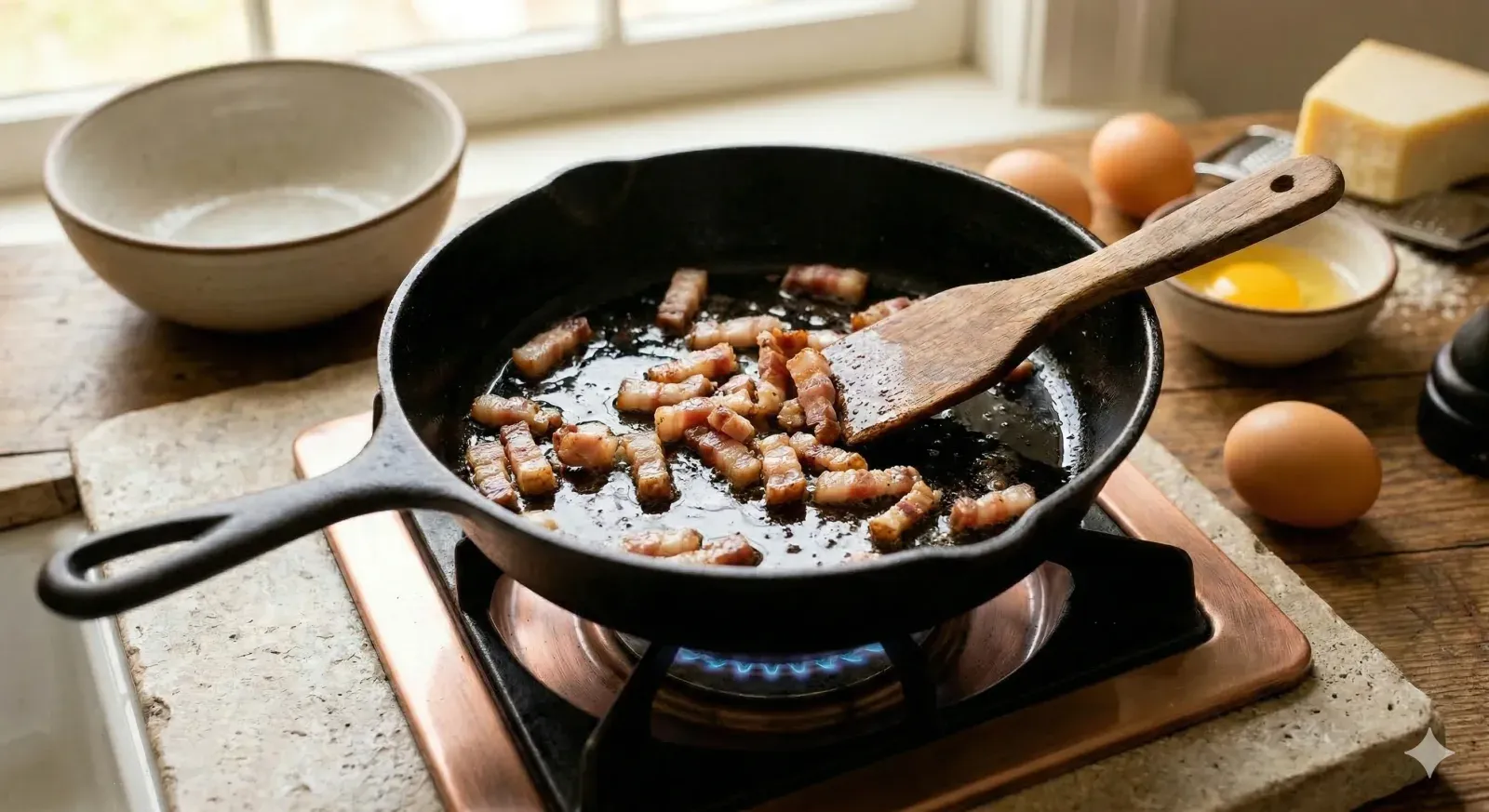
2 Place the guanciale strips in a cold, dry skillet. Starting from a cold pan is essential. Then turn the heat to medium-low. As the pan heats gradually, the fat renders out slowly and evenly. This patient approach takes 8 to 10 minutes. In contrast, rushing with high heat crisps the outside while leaving the interior fatty and chewy.
Watch for the guanciale to turn golden and slightly translucent at the edges. The rendered fat in the pan should be clear and fragrant. At this point, remove the skillet from the heat. Do not drain the fat. In fact, this liquid gold is the backbone of your carbonara sauce. It carries flavor and helps emulsify the egg mixture into a silky coating. Leave the crispy guanciale in the pan as well.
Step 3: Cook the Pasta to Just Under Al Dente
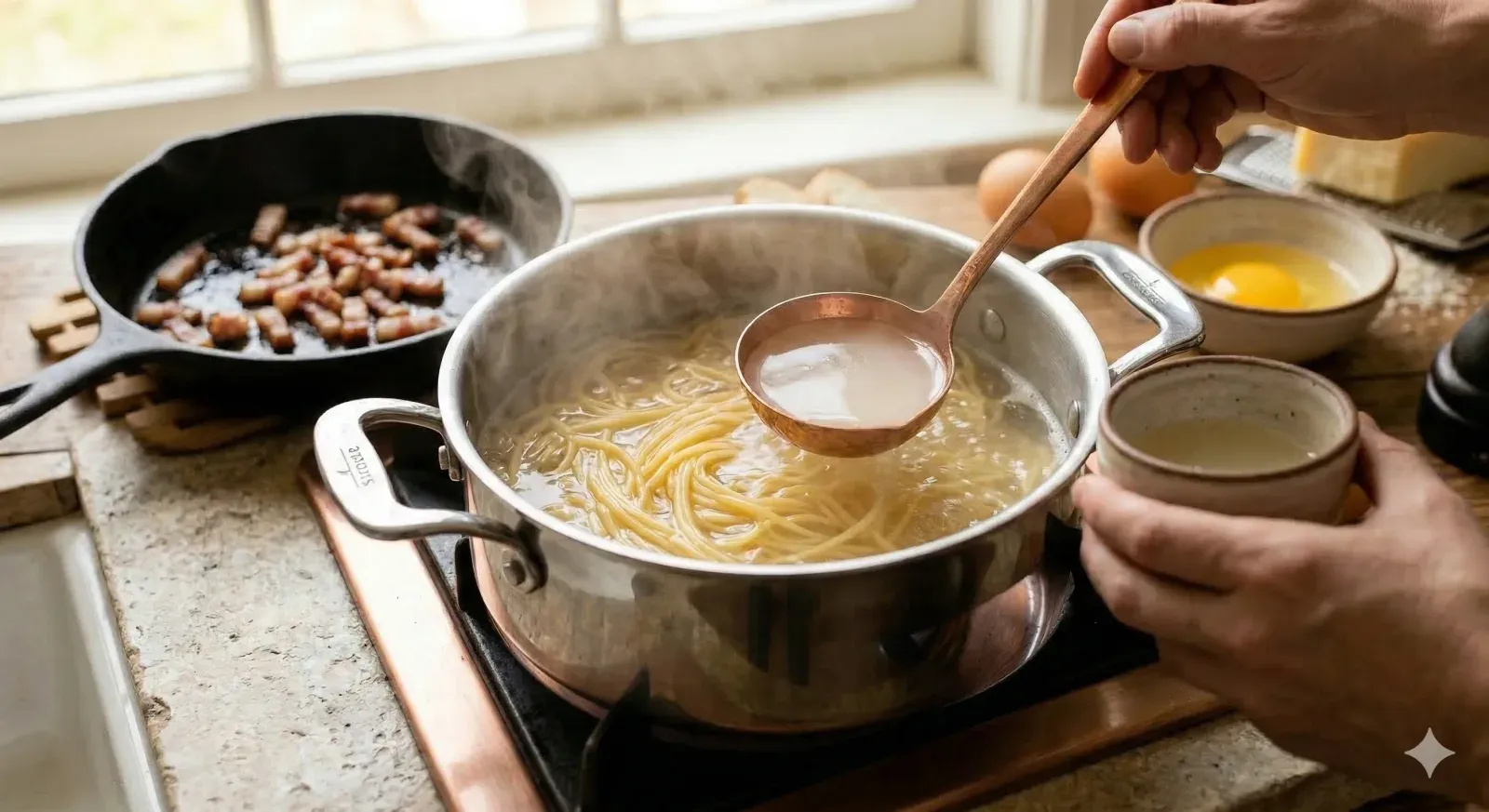
3 Bring a large pot of water to a rolling boil. Salt it generously until it tastes like the sea. Then add your spaghetti. Cook it for 1 minute less than the package directions suggest. The pasta finishes cooking in the skillet with the guanciale fat. Pulling it early keeps it firm enough to absorb the sauce without turning mushy.
Before you drain the pasta, scoop out at least 1 full cup of the starchy cooking water. This cloudy liquid is your secret weapon. The dissolved starch acts as an emulsifier, binding fat and egg into a cohesive sauce. Therefore, without it, carbonara often turns greasy or clumpy. Keep the reserved water close at hand during the final step.
Step 4: Combine Everything and Emulsify the Sauce
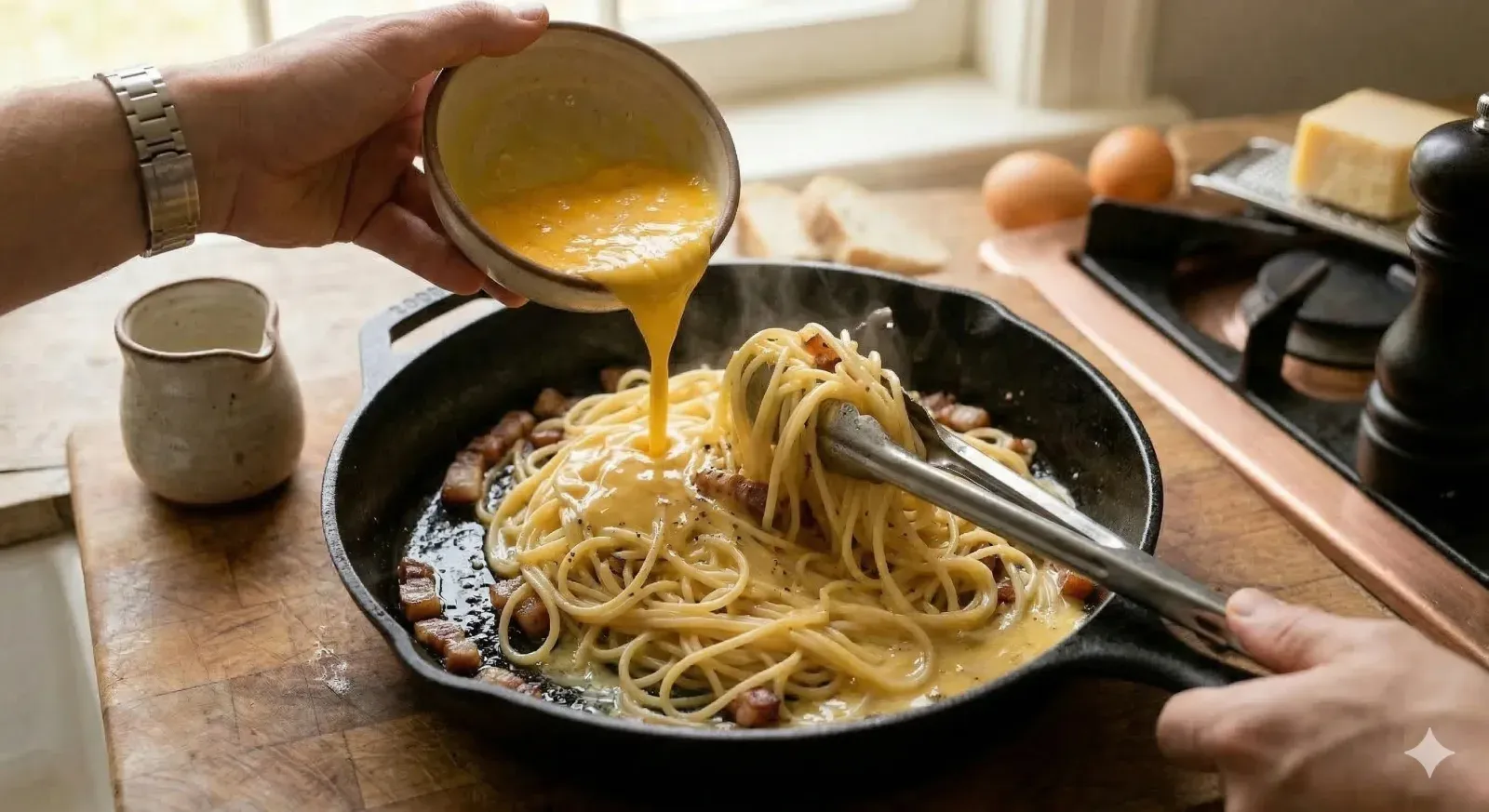
4 Transfer the drained pasta directly into the skillet with the guanciale and rendered fat. Toss vigorously for 30 seconds over low heat. Every strand should glisten with pork fat. Then remove the skillet completely from the burner. This step is critical. The pan must be off direct heat before the egg mixture goes in.
Pour the egg and cheese mixture over the hot pasta. Toss immediately and continuously using tongs or a fork. The residual heat gently cooks the eggs into a creamy, custard-like coating. Add splashes of reserved pasta water, one tablespoon at a time, as you toss. The sauce should be silky, glossy, and fluid enough to pool slightly on the plate. If it looks too thick, add more pasta water. Conversely, if it seems too thin, toss for a few more seconds to let the cheese thicken it.
Serve immediately on warmed plates. Finish with an extra shower of Pecorino Romano and a final crack of black pepper. Carbonara waits for no one. The sauce begins to tighten as it cools, so speed from skillet to table is essential.
Expert Tips for Perfect Results
Control the Temperature Precisely
Temperature is the single most important factor in carbonara. Eggs begin to scramble at around 160 degrees Fahrenheit. Your goal is to keep the sauce below that threshold. Removing the pan from heat before adding the egg mixture gives you a safety margin. The hot pasta and fat provide enough warmth to cook the eggs gently. In contrast, adding eggs to a pan on a live flame almost guarantees scrambled bits.
Use Plenty of Pasta Water
Starchy pasta water is the unsung hero of carbonara. It loosens the sauce, prevents clumping, and creates the signature glossy sheen. Always reserve more than you think you need. In fact, start with a quarter cup and add more in small splashes. The sauce thickens as it sits, so aim for a consistency slightly thinner than your ideal. It will tighten perfectly by the time it reaches the table.
Grate the Cheese Extremely Fine
Coarsely grated cheese does not melt evenly. It can form stubborn clumps in the sauce. Instead, use a Microplane for a snow-like texture. Fine cheese dissolves almost instantly into the warm egg mixture. Moreover, Pecorino Romano is a hard, aged cheese that resists melting. The finer you grate it, the smoother your carbonara will be.
Toss Without Stopping
Constant motion distributes heat evenly and prevents the eggs from cooking in one spot. Therefore, use tongs or a large fork to lift and turn the pasta repeatedly. Keep the other hand ready with pasta water. This aggressive tossing is what transforms raw egg and hard cheese into a unified, velvety sauce. Stopping even briefly can cause the eggs to set unevenly.
Carbonara Around Italy: A Regional Comparison
Although carbonara is a Roman dish, interpretations vary across Italy and beyond. Each version reflects local ingredients and tastes. Here is how the major variants compare.
| Style | Pork Used | Cheese | Key Differences |
|---|---|---|---|
| Roman (Traditional) | Guanciale | Pecorino Romano | The original; egg yolks only for richest sauce; no cream ever |
| Neapolitan Variation | Pancetta | Pecorino and Parmigiano blend | Slightly milder; sometimes uses a touch of white wine in the pan |
| American-Style | Bacon | Parmesan | Often includes cream and garlic; divisive but widely popular |
| Japanese Yoshoku | Bacon or ham | Parmesan | Adds heavy cream and sometimes mushrooms; served in Japanese-Italian cafes |
| Vegetarian | Smoked tofu or mushrooms | Pecorino or vegan alternative | Replaces pork with umami-rich smoked ingredients; extra egg yolks for body |
Serving Suggestions
Carbonara is a rich, satisfying dish that works best alongside lighter accompaniments. In Rome, it often arrives as a primo course before a second dish. At home, it serves perfectly as the main event with a simple side.
The Perfect Accompaniments:
- Arugula salad with lemon: Peppery arugula tossed with fresh lemon juice and olive oil cuts through the richness of the egg sauce. Furthermore, its bitter notes create a refreshing contrast.
- Roasted artichokes: A Roman classic that pairs naturally with carbonara. The nutty, charred flavor of artichokes complements the savory pork. Season them simply with olive oil, garlic, and lemon.
- Crusty Italian bread: Warm ciabatta or a rustic pane di casa is ideal for wiping up every last trace of sauce from the plate. In fact, Italians call this fare la scarpetta, and it is considered a compliment to the cook.
- Grilled zucchini: Lightly charred zucchini strips dressed with olive oil and fresh mint offer a clean, vegetal side. Their mild sweetness balances the salty Pecorino.
- Bruschetta with fresh tomatoes: A light starter that sets the stage without overwhelming the palate. The acidity of tomatoes primes the appetite for the rich pasta to follow.
Beverage Pairings:
- Frascati or Verdicchio (white wine): These crisp Italian whites have enough acidity to cut through the richness. Frascati comes from the hills near Rome, making it a geographically perfect match for carbonara.
- Barbera d’Asti (red wine): If you prefer red, this medium-bodied Piedmont wine has bright acidity and low tannins. It complements the pork without overpowering the egg sauce.
- Italian lager (Peroni or Moretti): A cold, light beer refreshes the palate between bites. The carbonation lifts the richness, and the mild bitterness echoes the black pepper.
- Sparkling water with lemon: For a non-alcoholic option, lightly sparkling water with a lemon wedge cleanses the palate. It keeps the focus squarely on the pasta itself.
Storage and Reheating
Refrigerator: Leftover carbonara keeps for up to 2 days in a sealed container. The sauce thickens considerably as it cools. However, the flavors remain intact. Cover tightly and refrigerate within one hour of cooking.
Reheating: Carbonara is notoriously tricky to reheat. The egg-based sauce can break or scramble under direct heat. Instead, use a double boiler method. Place the pasta in a heatproof bowl over simmering water. Add a splash of pasta water or whole milk. Then toss gently until the sauce loosens and warms through. Alternatively, eat leftover carbonara cold. Many Italians enjoy it this way, straight from the fridge.
Freezing: Carbonara does not freeze well. The egg sauce separates and becomes grainy upon thawing. Therefore, it is best enjoyed fresh. If you anticipate leftovers, cook less pasta and store extra egg mixture and guanciale separately. Consequently, you can assemble a fresh batch quickly the next day.
Common Mistakes to Avoid
1. Adding Cream to the Sauce
Cream is the most common deviation from authentic carbonara. While it produces a pleasant pasta dish, it masks the clean egg-and-cheese flavor that defines the original. Traditional Roman carbonara achieves its creaminess through technique alone. Trust the emulsion. The eggs, cheese, fat, and pasta water create all the richness you need.
2. Scrambling the Eggs
This happens when the pan is too hot during the final toss. Always remove the skillet from the burner before adding the egg mixture. Work quickly and toss constantly. If you see small curds forming, immediately add a generous splash of pasta water. As a result, the extra moisture lowers the temperature and rescues the sauce.
3. Using Pre-Grated Cheese
Pre-grated cheese contains cellulose or cornstarch to prevent clumping in the bag. These additives prevent the cheese from melting smoothly into the sauce. Consequently, you end up with a gritty, lumpy carbonara instead of a silky one. Always grate fresh blocks of Pecorino Romano and Parmigiano-Reggiano.
4. Forgetting to Save Pasta Water
Draining the pasta without reserving cooking water leaves you with no way to adjust the sauce. The starchy water is essential for achieving the right consistency. Instead, set a measuring cup near the stove before you begin cooking. Scoop the water just before draining. This simple habit prevents the most frustrating carbonara failures.
Frequently Asked Questions
What is the difference between carbonara and alfredo?
Carbonara uses egg yolks, cured pork, and Pecorino Romano to build its sauce. Alfredo, in contrast, relies on butter and Parmigiano-Reggiano. Authentic carbonara never contains cream. American-style alfredo typically does. The textures are different as well. Carbonara has a glossy, custard-like coating, while alfredo tends to be thicker and more butter-forward.
Can I use bacon instead of guanciale for carbonara?
Yes, bacon works as a substitute. However, the flavor profile changes. Guanciale has a richer, more delicate taste from the cured jowl. Pancetta is actually a closer match than bacon. If you do use bacon, opt for thick-cut with minimal smokiness. Strong smoke flavor can overpower the subtle egg sauce. Meanwhile, the rendered fat from any of these options still creates a good base.
Why did my carbonara turn into scrambled eggs?
The pan was too hot when the egg mixture went in. Eggs begin to scramble at around 160 degrees Fahrenheit. Always remove the skillet from the burner first. The residual warmth from the pasta and rendered fat gently cooks the eggs into a creamy sauce. Tossing constantly is equally important. Letting the pasta sit still allows heat to concentrate and curdle the eggs in one spot.
Does authentic carbonara contain cream?
No. Traditional Italian carbonara never includes cream. The creamy texture comes entirely from the emulsion of egg yolks, rendered pork fat, starchy pasta water, and finely grated cheese. Adding cream actually dilutes this balance. Moreover, it masks the distinct savory-sweet flavor of Pecorino Romano. In Rome, suggesting cream in carbonara can start a passionate debate.
What pasta shape is best for carbonara?
Spaghetti is the most traditional choice in Rome. Rigatoni and mezze maniche are also popular because their ridges and tubes capture the creamy sauce. Bucatini, a thick hollow spaghetti, works beautifully too. Avoid thin, delicate pastas like angel hair or capellini. They cannot hold enough sauce and overcook too easily during the final toss.
How many calories are in a serving of carbonara?
A standard serving of carbonara contains roughly 550 calories. Most of those come from the pasta and rendered pork fat. Using whole eggs instead of extra yolks reduces the calorie count slightly. Portion size plays the biggest role. After all, carbonara is a rich dish, so a moderate plate satisfies without overindulging. Pairing it with a light salad keeps the overall meal balanced.
Variations and Adaptations
Carbonara with Zucchini (Carbonara di Zucchine):
This lighter variation adds sliced zucchini sauteed in olive oil alongside the guanciale. The zucchini softens and absorbs the pork fat, adding a sweet, vegetal note. It is especially popular during Italian summers when zucchini is abundant. Furthermore, the added vegetable stretches the dish without changing the fundamental technique.
Vegetarian Carbonara:
Replace the guanciale with smoked mushrooms or crispy fried shallots. Smoked mushrooms provide umami depth that mimics cured pork. Alternatively, sun-dried tomatoes add a tangy, concentrated punch. Keep the egg and cheese base the same. Add an extra yolk to compensate for the missing pork fat. As a result, the sauce stays rich and coating.
Truffle Carbonara:
A drizzle of truffle oil or a shaving of fresh black truffle elevates carbonara into luxury territory. The earthy, musky truffle aroma amplifies the egg-and-cheese base. Add the truffle at the very end, after plating, so the heat does not destroy its volatile aromatics. This variation appears on high-end restaurant menus across Italy and beyond.
Spicy Carbonara with Chili:
Add dried chili flakes or a fresh Calabrian chili pepper to the pan while rendering the guanciale. The fat absorbs the heat, distributing it evenly through the sauce. This adaptation is popular in southern Italy. The chili does not overpower the dish. Instead, it adds a warm tingle that plays against the richness of the egg and cheese.
The Cultural Significance of Carbonara
Carbonara is more than a recipe in Italy. It is an identity. Romans treat it with a reverence usually reserved for sacred traditions. Arguments about cream, garlic, and onion in carbonara have fueled dinner table debates for decades. This passion reveals something important: carbonara belongs to the people who created it. It represents a philosophy of cooking that values simplicity, quality ingredients, and precise technique above all else.
Every year on April 6th, the world celebrates International Carbonara Day. Italian food organizations, chefs, and home cooks share their versions on social media. The hashtag trends globally. This annual celebration shows how a dish born in mid-20th century Rome has captured hearts worldwide. From Tokyo to New York, Buenos Aires to Sydney, cooks attempt to master the five-ingredient miracle.
What makes carbonara culturally enduring is its democracy. The ingredients are few and affordable. The technique requires practice, not expensive equipment. A student in a tiny apartment can make carbonara just as well as a Michelin-starred chef. This accessibility, combined with the dish’s extraordinary flavor, ensures that carbonara will remain one of the world’s most beloved pasta dishes for generations to come.
Conclusion
This carbonara recipe gives you everything you need to master a true Italian classic. The keys are simple: render the guanciale slowly, prepare a smooth egg-and-cheese mixture, cook the pasta just short of al dente, and toss everything off the heat. With practice, you will develop the instinct for temperature and timing that separates a good carbonara from a great one.
Whether you follow the strict Roman tradition or explore one of the variations, carbonara rewards attention and respect. It proves that extraordinary food does not require a long ingredient list. Start with quality guanciale, real Pecorino, and fresh eggs. The rest is pure technique. For more iconic European recipes, explore our full collection of European dishes, including cacio e pepe, risotto alla Milanese, and coq au vin.