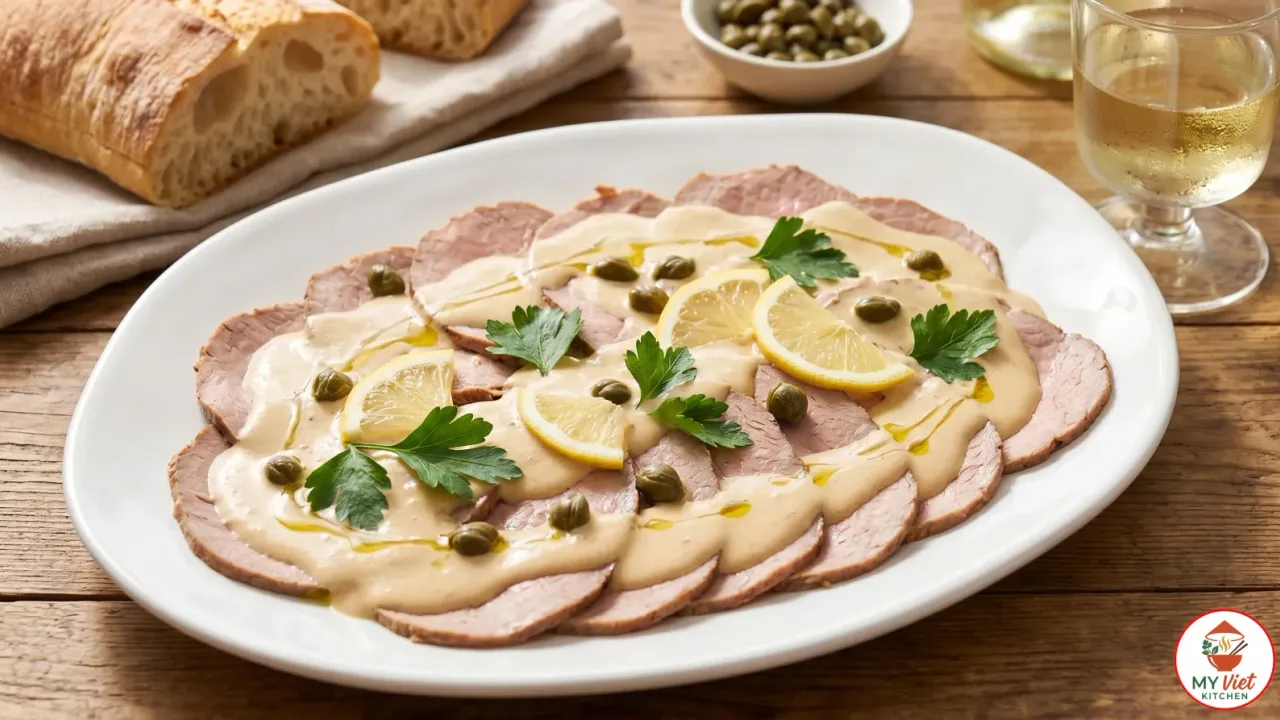
Vitello tonnato is the elegant Italian cold dish that pairs impossibly thin slices of poached veal with a silky, umami-rich tuna sauce. This vitello tonnato recipe walks you through every detail, from gently poaching the veal to building the creamy tonnato sauce from scratch using oil-packed tuna, anchovies, capers, and egg yolks. Born in the Piedmont region of northern Italy, this dish has graced summer tables and holiday feasts for centuries, and once you master it, you will understand why Italian cooks consider it one of the finest cold preparations in their repertoire.
Prep Time: 30 minutes | Cook Time: 60 minutes | Total Time: 4 hours 30 minutes (including cooling and chilling) | Servings: 6
Difficulty: Medium | Calories: ~340 per serving
What Makes Vitello Tonnato Special?
The genius of vitello tonnato lies in its audacious pairing of two proteins that seem like they have no business sharing a plate. Cold veal, with its mild, clean flavor and buttery texture, meets a sauce built from canned tuna, anchovies, and capers. On paper, it sounds peculiar. On the palate, it is revelatory. The tonnato sauce clings to each paper-thin veal slice like a savory veil, delivering layers of umami, brine, and citrus that transform the delicate meat into something far greater than the sum of its parts.
This dish belongs to the piatti freddi tradition of Italian cooking. These are cold dishes made for warm weather and leisurely meals. Unlike most Italian dishes that rely on heat and speed, vitello tonnato rewards patience. The veal poaches slowly, cools in its own broth, chills overnight, and rests under the sauce for hours. Every step builds flavor and tenderness. Yet the dish requires no last-minute cooking. It sits on the table, composed and beautiful, while the cook enjoys the party.
This classic vitello tonnato recipe has roots stretching back at least to the eighteenth century, and it remains a cornerstone of northern Italian summer cooking. In Turin, Asti, and the towns of Langhe, it appears on nearly every restaurant menu from June through September. It anchors the antipasto course at family celebrations, and no serious Christmas Eve spread in Piedmont would omit it. The dish has also migrated across Italian borders to Argentina, where Italian immigrants brought the recipe and adapted it with local ingredients. Today, vitello tonnato stands as one of the most sophisticated yet approachable dishes in the Italian canon.

Choosing the Right Veal for Vitello Tonnato
Your choice of veal cut determines everything about the finished dish. Because vitello tonnato is served cold and sliced thin, you need a lean, compact cut. It must hold its shape during poaching and slice cleanly. The wrong cut produces ragged, crumbly slices that no amount of sauce can rescue.
- Eye of round (best choice): This cylindrical cut is lean, tender, and perfectly shaped for producing uniform round slices. It has minimal connective tissue and a fine, tight grain that slices beautifully when cold. Ask your butcher to tie it with kitchen twine to maintain its shape during poaching. This is the cut most Piedmontese cooks prefer for vitello tonnato.
- Top round: Slightly larger than the eye of round, the top round is another excellent option. It is lean and slices well, though the shape may be less uniform. The flavor is virtually identical to the eye of round, and the texture works perfectly in this dish. It is also generally easier to find at most butcher shops.
- Veal loin: More tender and more expensive than round cuts, the loin produces melt-in-your-mouth slices. However, it can be too soft and may not hold its shape as well during thin slicing. If you choose the loin, freeze it for 20 minutes before slicing to firm it up. Reserve this cut for special occasions when you want the most luxurious texture possible.
Ingredients for Vitello Tonnato
For Poaching the Veal:
- 1.5 pounds (700g) boneless veal eye of round, tied with kitchen twine
- 1 medium carrot, peeled and halved
- 1 celery stalk, halved
- 1 small onion, halved
- 2 bay leaves
- 5 whole black peppercorns
- 1 cup (240ml) dry white wine (such as Pinot Grigio or Arneis)
- Cold water to cover
- 1 teaspoon fine sea salt
For the Tonnato Sauce:
- 1 can (5 oz / 140g) oil-packed Italian tuna, drained
- 4 anchovy fillets, drained
- 2 tablespoons capers, drained
- 2 large egg yolks, at room temperature
- 1 tablespoon fresh lemon juice
- 1 teaspoon Dijon mustard
- 3/4 cup (180ml) extra virgin olive oil
- 2-3 tablespoons reserved poaching liquid
- Salt and white pepper to taste
For Garnish:
- Extra capers
- Thin lemon slices
- Fresh flat-leaf parsley leaves
- Extra virgin olive oil for drizzling
Pro tip: Use oil-packed Italian tuna, not water-packed tuna. Oil-packed tuna has a richer, more concentrated flavor and a silkier texture that blends into a smoother sauce. Brands like Tonnino, Callipo, or Ortiz produce the quality of tuna that makes the tonnato sauce truly exceptional. The tuna is the soul of this vitello tonnato recipe, so do not compromise on quality.
Step-by-Step Vitello Tonnato Recipe Instructions
Step 1: Poach the Veal
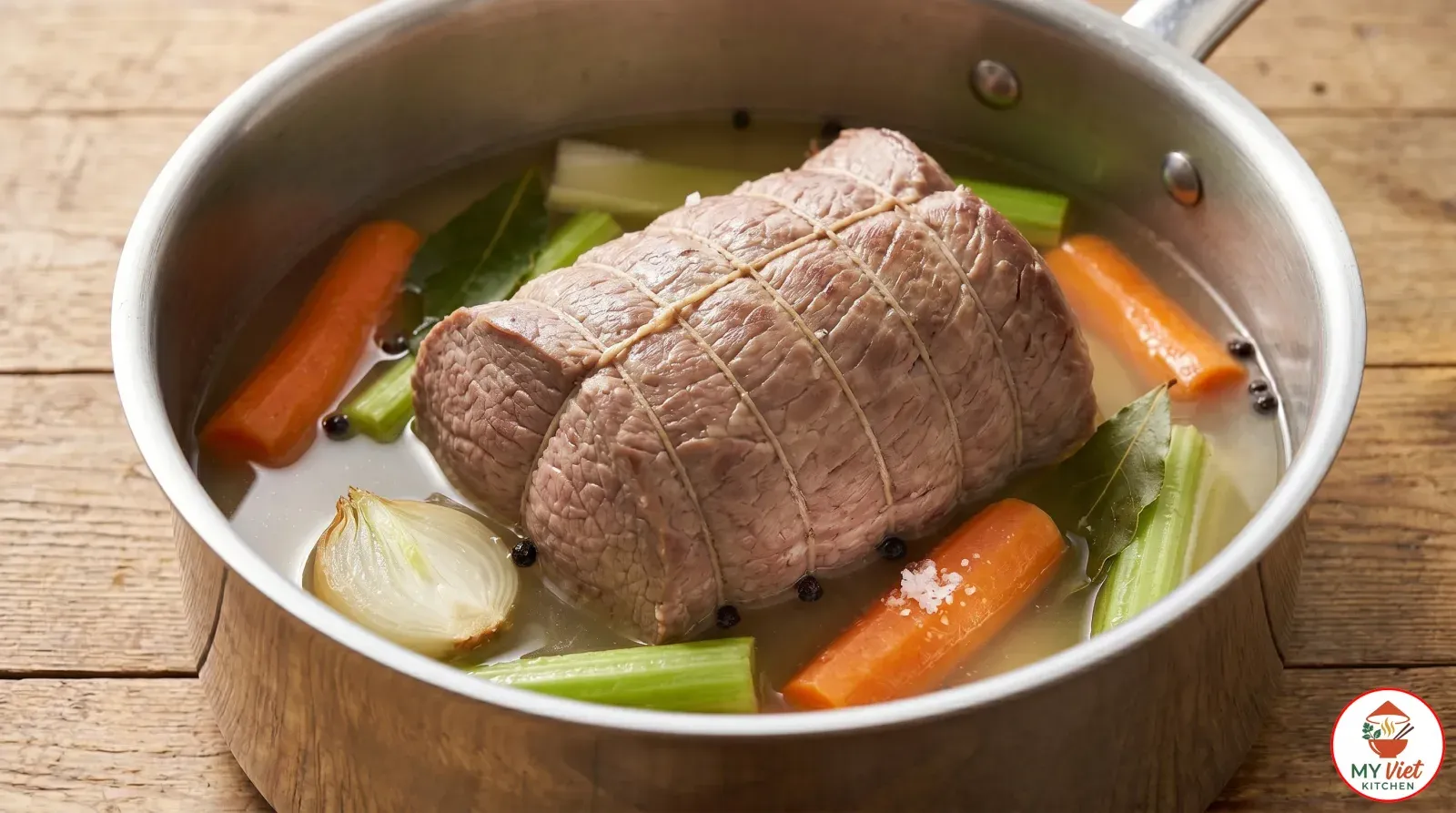
1 Place the tied veal roast in a snug pot. A tight fit matters. A pot that is too large needs too much water, which dilutes the flavor. Add the carrot, celery, onion, bay leaves, peppercorns, and salt. Pour in the white wine. Then add enough cold water to cover the meat by about an inch. Start with cold liquid. This lets the aromatics release flavor slowly as the heat rises, infusing the veal from the start.
Place the pot over medium heat and bring to a gentle simmer. You want small bubbles breaking the surface lazily, not a rolling boil. A hard boil toughens the veal’s exterior proteins. The result is dry, stringy meat. Reduce the heat to low, partially cover the pot, and poach for 50 to 60 minutes until a meat thermometer inserted into the thickest part reads 145 degrees Fahrenheit. The veal should feel firm but yield to gentle pressure.
Step 2: Cool the Veal in Its Broth
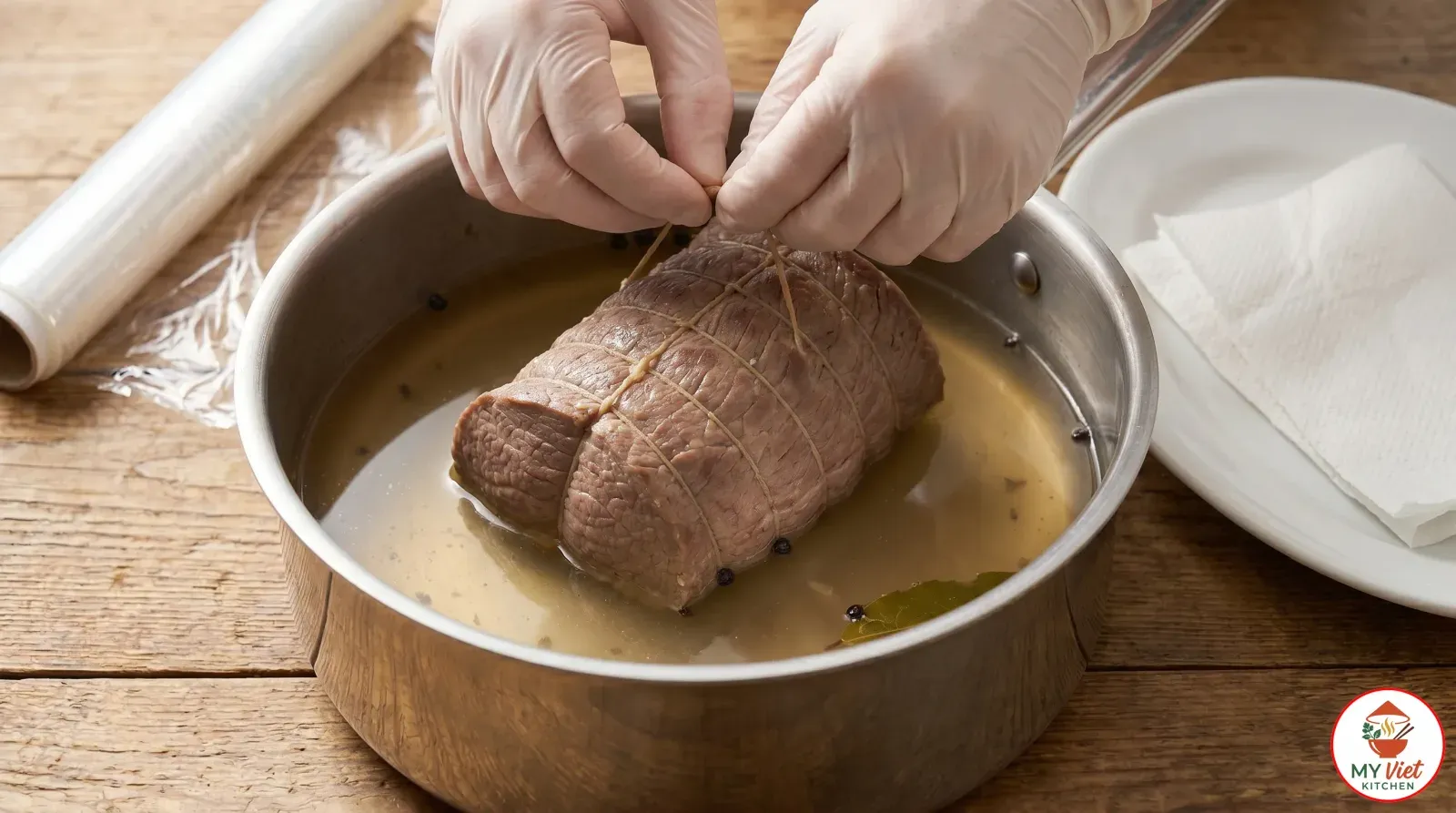
2 Remove the pot from the heat. Let the veal cool fully in the poaching liquid. Do not rush this step. As the liquid cools, the veal soaks up moisture and flavor from the wine, vegetables, and bay leaves. This slow cooling is what makes the slices juicy and rich. Skip it, and the meat turns dry and bland. The process takes 1 to 2 hours.
Once the veal is fully cool, remove it from the liquid and pat dry with paper towels. Wrap tightly in plastic wrap and chill for at least 2 hours, or overnight. Cold veal slices much more cleanly than warm meat. Strain the poaching liquid through a fine-mesh sieve. Reserve at least half a cup. You will use some to thin the tonnato sauce. The rest makes great broth for risotto or soup.
Step 3: Make the Tonnato Sauce
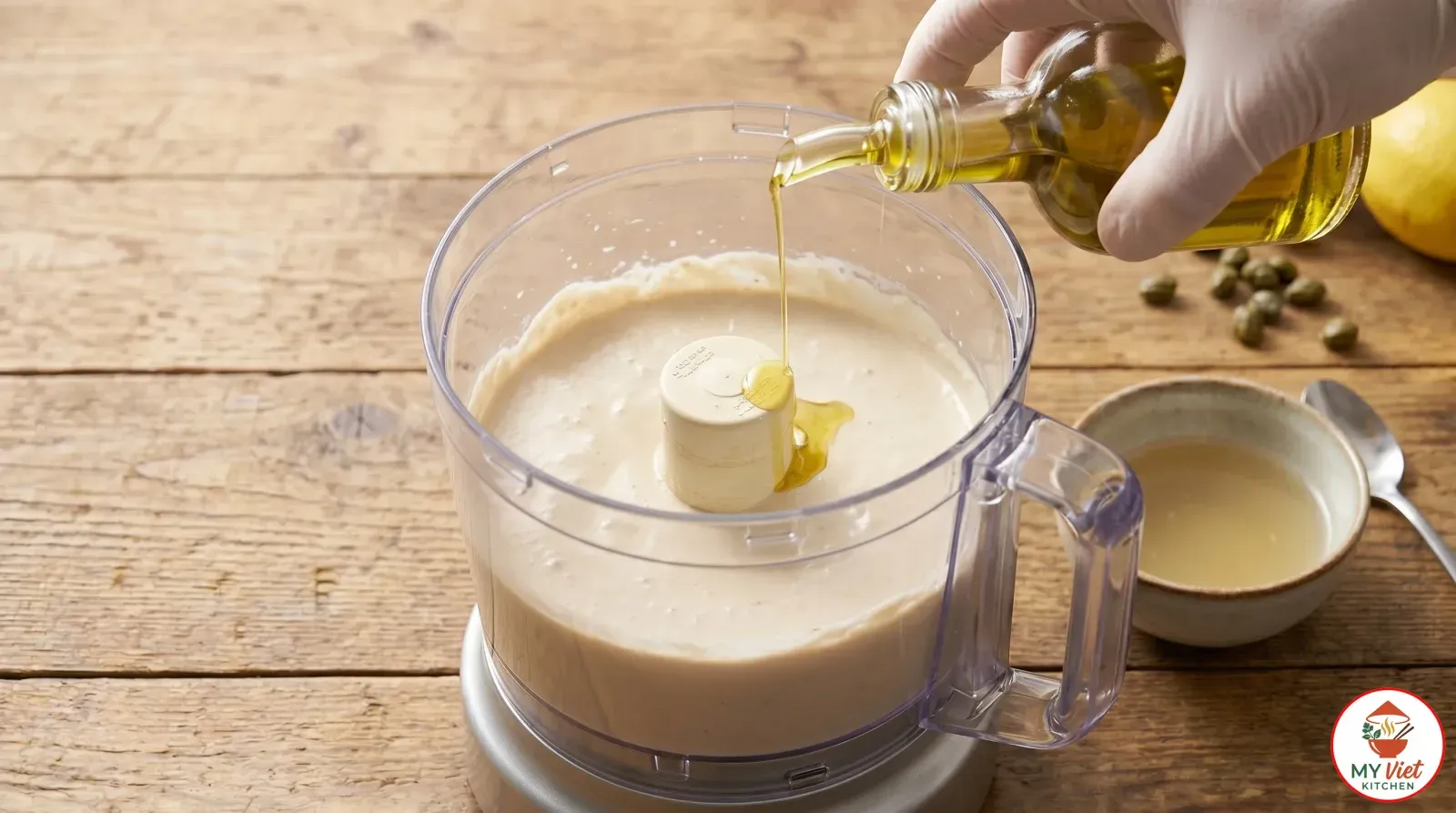
3 Place the drained tuna, anchovy fillets, capers, egg yolks, lemon juice, and Dijon mustard in a food processor. Pulse a few times to break it all down. Then blend until the mix becomes a smooth paste. No visible chunks should remain. This base gives the tonnato sauce its deep, briny backbone.
With the motor running on low speed, drizzle in the olive oil in a very thin, steady stream. This step is identical to making mayonnaise. Add oil too quickly and the emulsion breaks, leaving you with a greasy, separated mess. The sauce should thicken gradually and develop a pale, creamy appearance similar to aioli. Once all the oil is incorporated, add 2 to 3 tablespoons of the reserved poaching liquid to thin the sauce to a pourable consistency. It should coat the back of a spoon but flow when tilted. Season with salt and white pepper, tasting carefully because the anchovies and capers already contribute significant saltiness.
Step 4: Slice and Assemble the Vitello Tonnato
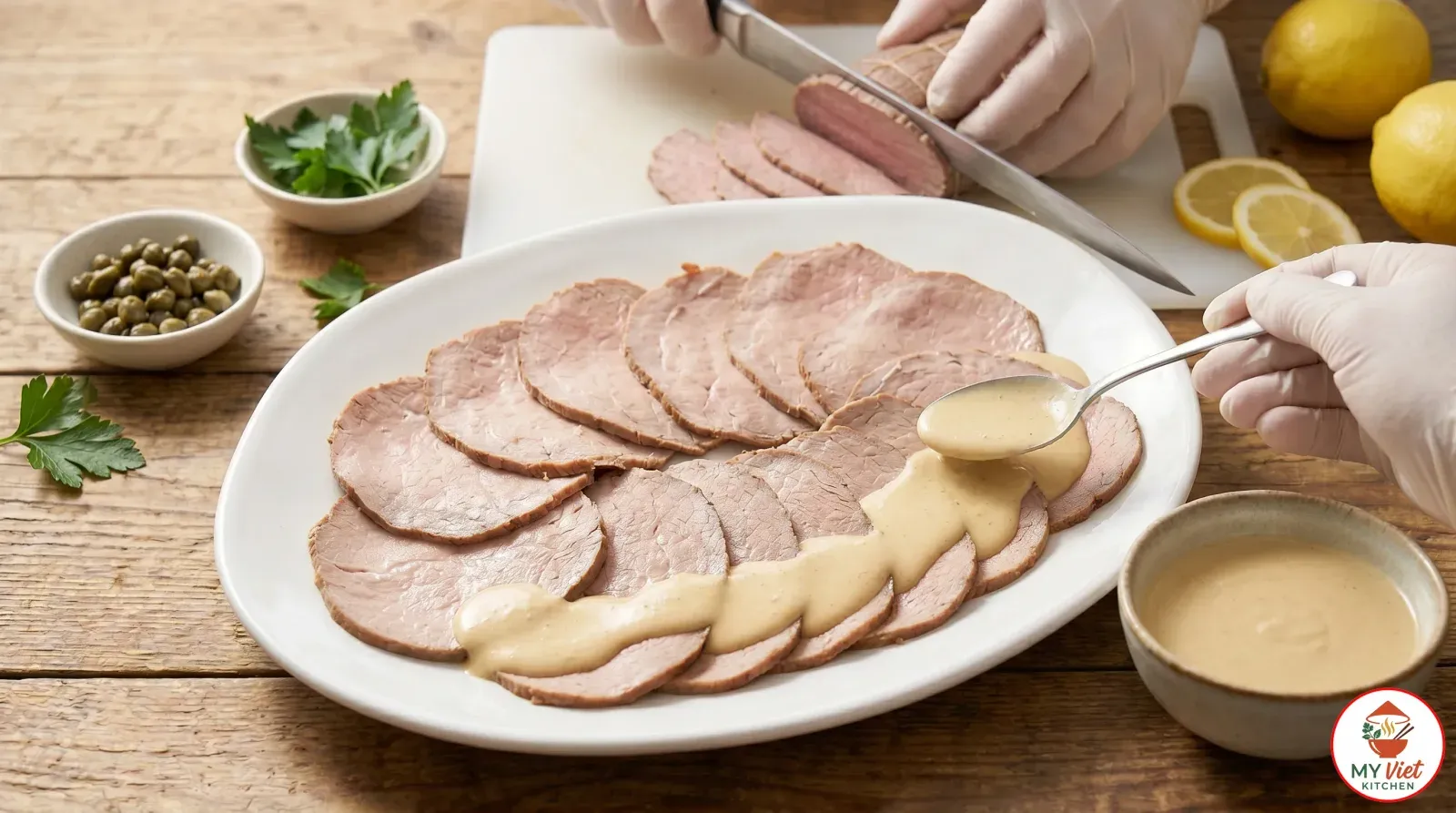
4 Unwrap the chilled veal and remove the kitchen twine. Use the sharpest knife you own, ideally a long carving knife. Cut the veal against the grain into slices no thicker than 3 millimeters. Thin slicing is critical. Thick slices of cold veal are chewy and hard to eat. If you struggle to cut thin enough, place the veal in the freezer for 15 to 20 minutes to firm it up. Some cooks use a deli slicer for uniform results.
Arrange the slices on a large platter in a single layer, overlapping slightly like fallen dominoes. Spoon the tonnato sauce over the veal. Make sure every slice gets a coating. You want the sauce to pool between the slices, forming a smooth, creamy blanket. Then cover the platter with plastic wrap and chill for at least 1 hour. This resting time lets the sauce set and the flavors marry. For the best results, assemble the night before and let it rest overnight.
Step 5: Garnish and Serve
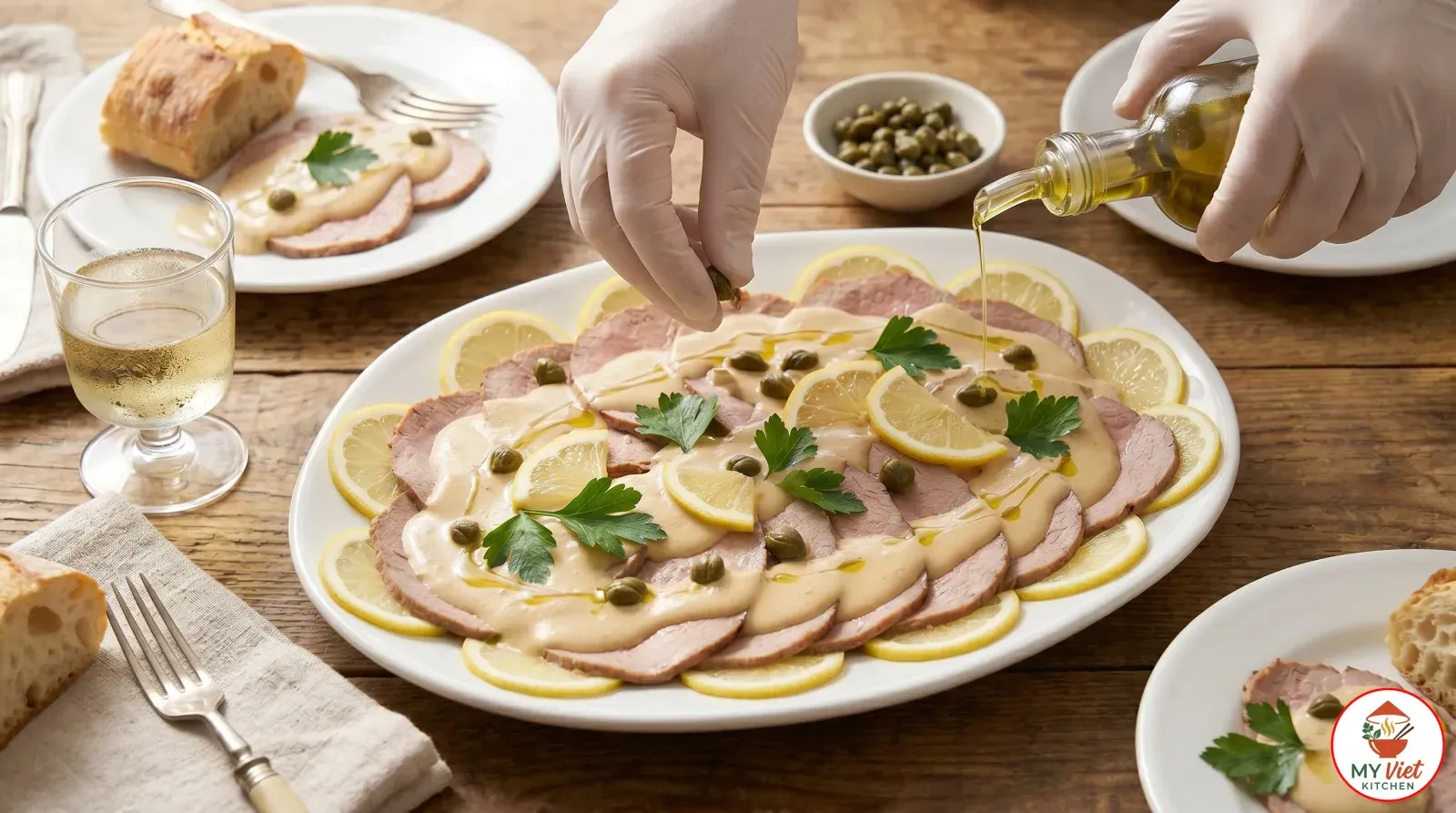
5 Remove the platter from the fridge 15 to 20 minutes before serving. Let the dish lose its deep chill. Ice-cold food mutes the palate, and this vitello tonnato recipe deserves to be tasted fully. Scatter extra capers across the top. Arrange thin lemon slices around the edges. Place fresh parsley leaves here and there for color. Finish with a fine drizzle of olive oil.
Present the platter whole at the table before you portion it out. This is one of those dishes that wows visually. Pale veal slices under creamy sauce with bright garnishes look stunning. Serve it as a first course with crusty bread. It also works as a light main dish with a simple green salad. In Piedmont, it often opens a multi-course meal and sets the tone for what follows.
Expert Tips for Perfect Vitello Tonnato
Keep the Poaching Liquid Below a Boil
The key technique in this vitello tonnato recipe is a gentle simmer, never a rolling boil. Boiling squeezes moisture out of the meat and makes it tough. Instead, keep the heat low. Small bubbles should rise lazily to the surface. This cooks the veal evenly and keeps it juicy. If you see hard bubbling, lower the heat right away. Some Piedmontese cooks bring the liquid to a simmer, turn off the heat, and let leftover warmth finish the job.
Emulsify the Sauce Slowly
The tonnato sauce is really just a flavored mayonnaise. So the same patience applies. Pour the olive oil in a thin stream while the motor runs. If you dump it all in at once, the emulsion breaks. You end up with oily liquid instead of creamy sauce. Should the sauce break, start over with a fresh egg yolk in a clean bowl. Drizzle the broken mix in slowly, and it will reform. Also, use room-temperature egg yolks. They emulsify more easily than cold ones.
Slice Against the Grain
First, identify the direction of the muscle fibers on the veal. Then cut perpendicular to them. Slicing against the grain shortens the fibers. As a result, each bite is tender and easy to chew. Slicing with the grain, on the other hand, produces long, stringy pieces. Since vitello tonnato is served cold, the meat does not benefit from heat to soften tough fibers. Therefore, clean against-the-grain cuts are essential for the best texture.
Vitello Tonnato: Traditional vs. Modern Preparations
The dish has evolved considerably since its origins, and today you will encounter both classic and contemporary versions. Understanding the differences helps you decide which approach suits your taste and occasion.
| Aspect | Traditional Piedmontese | Modern Restaurant Style |
|---|---|---|
| Sauce base | Egg yolks emulsified with oil, like homemade mayo | Often uses store-bought mayonnaise as a shortcut |
| Tuna type | Oil-packed Italian tuna (ventresca preferred) | Sometimes fresh seared tuna for a refined twist |
| Slicing | Hand-sliced, slightly thicker | Deli-slicer thin, nearly transparent |
| Presentation | Large platter, family style | Individual plates with artistic drizzles |
| Resting time | Overnight for best flavor | Often served same day |
| Garnish | Capers, lemon slices, parsley | Microgreens, caper berries, edible flowers |
Serving Suggestions
Vitello tonnato is traditionally served as an antipasto, the opening course of an Italian meal. Its richness and protein content also make it suitable as a light summer main course. The cold preparation means no last-minute cooking, which makes it ideal for entertaining when you want to spend time with guests rather than standing at the stove.
The Perfect Accompaniments:
- Crusty Italian bread: A slice of ciabatta or a piece of focaccia is essential for soaking up the extra tonnato sauce on the plate. The bread adds textural contrast to the silky veal and sauce.
- Green salad: A simple arugula salad dressed with lemon juice and olive oil cuts through the richness of the tonnato sauce. The peppery greens complement the briny flavors of the dish.
- Roasted vegetables: Room-temperature roasted peppers, zucchini, or artichoke hearts make excellent side dishes that stay in the Italian flavor profile without requiring additional last-minute cooking.
- Caprese salad: The fresh mozzarella, tomatoes, and basil in a classic caprese create a beautiful Italian antipasto spread when paired with vitello tonnato on the same table.
Beverage Pairings:
- Arneis or Gavi (Piedmontese white wines): These crisp, mineral-driven whites from the same region as vitello tonnato are the classic pairing. Their bright acidity balances the richness of the tonnato sauce while echoing the dish’s northern Italian roots.
- Vermentino or Soave: Light-bodied Italian whites with floral notes and clean finishes that complement the delicate veal without overpowering it. These are widely available and affordable alternatives to Piedmontese wines.
- Prosecco or dry sparkling wine: The bubbles cut through the richness of the sauce and refresh the palate between bites. Prosecco’s slight sweetness pairs nicely with the briny capers and anchovies in the sauce.
- Chilled Aperol Spritz: A light, bitter-sweet cocktail that is a natural companion for Italian antipasto dishes. The orange bitterness complements the savory depth of the tonnato sauce beautifully.
Storage and Reheating
Refrigerator: Assembled vitello tonnato keeps well in the refrigerator for up to 3 days when covered tightly with plastic wrap. The flavor actually improves during the first 24 hours as the sauce penetrates the veal. After 3 days, the texture of the meat begins to deteriorate. Store the poached veal and sauce separately if you plan to assemble portions over several days.
Freezer: The poached veal freezes well for up to 2 months when wrapped tightly in plastic wrap and then foil. Thaw in the refrigerator overnight before slicing. The tonnato sauce does not freeze well because the emulsion can break when thawed. Always make the sauce fresh for the best texture and flavor.
Serving note: Since vitello tonnato is a cold dish, there is no reheating involved. Simply remove from the refrigerator 15 to 20 minutes before serving. This brief rest at room temperature brings out the full complexity of the tonnato sauce and makes the veal more tender to the bite.
Common Mistakes to Avoid
1. Boiling the Veal
This is the most common error and the most damaging. Boiling drives moisture out of the veal. It leaves the meat dry, tough, and gray. Instead, keep the liquid at a bare simmer. You should see only gentle bubbles now and then. If the heat creeps too high, lower it or slide the pot off the burner. A meat thermometer helps a lot. Pull the veal at 145 degrees Fahrenheit and let carryover heat do the rest.
2. Using Water-Packed Tuna
Water-packed tuna produces a thin, bland sauce. It lacks the body and richness that vitello tonnato demands. In contrast, oil-packed tuna has a denser texture and a more savory flavor. Moreover, the oil helps the sauce emulsify more smoothly. Spend a few extra dollars on quality oil-packed Italian tuna. You will taste the difference in every spoonful of the tonnato sauce.
3. Slicing the Veal Too Thick
Thick slices of cold veal are chewy and hard to enjoy. Instead, aim for paper-thin slices that drape over the plate and absorb the sauce. Keep them no thicker than 3 millimeters. A sharp knife is essential. In addition, chilling the veal well before slicing helps a great deal. If you own a deli slicer or a mandoline with a meat blade, use it. As a result, you get thinner, more elegant slices every time.
4. Skipping the Resting Time
Serving your vitello tonnato recipe immediately after assembly is a missed opportunity. The dish needs at least one hour in the refrigerator for the sauce to set and the flavors to meld into one cohesive taste. Overnight resting is even better. During this time, the sauce gently penetrates the veal, and the briny, savory, citrusy elements harmonize. Patience is the invisible ingredient that separates a good vitello tonnato from a great one.
Frequently Asked Questions
What does vitello tonnato taste like?
Vitello tonnato has a delicate, multilayered flavor. The veal itself is mild and clean, almost neutral, which allows the tonnato sauce to take center stage. Imagine a rich, savory mayonnaise with distinct notes of tuna, anchovy brine, and capers, brightened by fresh lemon juice. Overall, the impression is umami-forward with a pleasant salinity. Despite containing fish products, the sauce does not taste overtly fishy. Instead, it produces a deep savory quality that enhances the veal beautifully.
Can I make vitello tonnato with chicken or turkey?
Yes. Poached chicken breast or turkey breast are widely accepted substitutes. Outside Italy, quality veal can be harder to find. The tonnato sauce carries most of the flavor, so the swap works well. Poach chicken to 165 degrees Fahrenheit, cool it in broth, then chill and slice thinly. Some restaurants also use roasted pork loin, calling it maiale tonnato. The sauce complements any mild, lean protein.
Is vitello tonnato served hot or cold?
Vitello tonnato is always served cold or at cool room temperature. It is never heated. Cold temperature keeps the tonnato sauce creamy and set, and lets the veal hold its clean, delicate texture. Heating would break the emulsion. Warm veal also has a completely different mouthfeel. Remove the dish from the fridge about 15 minutes before serving for the best flavor.
How far in advance can I make vitello tonnato?
Any vitello tonnato recipe benefits from advance preparation, and this one is no exception. Poach the veal up to 2 days before serving. Make the sauce a day ahead. Once assembled with sauce over the veal, the dish improves for up to 24 hours in the refrigerator as the flavors meld. Simply add the garnishes just before serving. This make-ahead quality is precisely why it remains so popular for entertaining and holiday meals in Italy.
What is the best cut of veal for vitello tonnato?
Veal eye of round is the preferred cut. Its cylindrical shape produces uniform slices, and its lean, fine-grained texture slices cleanly when cold. Top round is an excellent alternative that is slightly easier to find. Avoid cuts with heavy marbling or connective tissue, as they produce uneven slices and can have an unpleasant fatty texture when served cold. Ask your butcher to tie the roast with kitchen twine so it holds its shape during poaching.
Variations and Adaptations
Pollo Tonnato (Chicken Version):
Simply replace the veal with 1.5 pounds of boneless, skinless chicken breast. Then poach the chicken in the same aromatic broth until it reaches 165 degrees Fahrenheit. This version is lighter in flavor and more affordable. As a result, it works well for weeknight dinners. The tonnato sauce pairs just as well with chicken. In fact, many modern Italian trattorias now serve this alongside the traditional veal version.
Tonnato Sauce with Mayonnaise Shortcut:
For a faster version, replace the egg yolks and olive oil with 3/4 cup of good mayonnaise. Then blend it with the tuna, anchovies, capers, lemon juice, and mustard until smooth. Thin with poaching liquid to the desired consistency. The result is slightly less nuanced. However, it eliminates the emulsification step and the risk of a broken sauce. This shortcut is perfectly fine for casual meals.
Vitello Tonnato Carpaccio Style:
Instead of poaching the veal, sear a veal tenderloin quickly on all sides. Then chill it and slice paper-thin, like carpaccio. The center stays rare to medium-rare, with a rosy look and delicate texture. Drizzle the tonnato sauce lightly over the slices rather than blanketing them. This modern take is popular in upscale Italian restaurants. It also makes for a striking visual on individual plates.
Vegetable Tonnato:
For a vegetarian adaptation, replace the veal with thickly sliced roasted eggplant, zucchini, or cauliflower steaks. You will find that tonnato sauce works remarkably well over roasted vegetables. Its creamy, briny character against smoky, caramelized vegetables creates a compelling contrast. This variation has gained popularity in contemporary Italian cooking and proves that the sauce is versatile enough to stand on its own.
The Cultural Significance of Vitello Tonnato
The origins of vitello tonnato trace back to Piedmont in the 1700s, though food historians still debate the exact story. Some scholars point to the House of Savoy. Their courtly kitchens regularly combined meat and fish in elaborate dishes. Others argue that the recipe emerged from peasant ingenuity. Cooks stretched costly veal by pairing it with preserved tuna, a pantry staple in a region with no coastline. Whatever the truth, the earliest written recipes appear in Italian cookbooks from that era. By the 1800s, vitello tonnato was firmly part of the Piedmontese culinary canon.
In Italy today, this vitello tonnato recipe carries a strong association with celebration and summer. It appears on Christmas Eve buffets in Turin, at wedding receptions in Langhe, and at outdoor lunches across Piedmont. Canned tuna and cold veal become, through careful preparation and patient resting, a dish worthy of fine dining. This transformation mirrors Italian cooking philosophy, where technique and quality matter far more than complexity.
A Global Journey from Piedmont
Vitello tonnato has also traveled far beyond its homeland. In Argentina, where millions of Italian immigrants settled in the late nineteenth and early twentieth centuries, vitel tone is a beloved Christmas tradition. Argentine versions often use store-bought mayonnaise and sometimes substitute beef for veal, but the spirit remains intact. A cold, make-ahead dish that improves overnight and looks spectacular on a platter is welcome at any table, in any country. The rich history of vitello tonnato continues to evolve as new cooks discover this Piedmontese masterpiece.
Conclusion
This vitello tonnato recipe delivers one of Italian cuisine’s most sophisticated cold dishes using straightforward techniques and accessible ingredients. Poach the veal gently, build the tonnato sauce with patience, slice the meat as thin as your knife allows, and then give the assembled dish time to rest. The reward is a platter of silky veal draped in a creamy, briny, utterly addictive sauce. It tastes better than most restaurant versions, and it is make-ahead cooking at its finest.
Ready to explore more Italian classics? Browse our European dishes collection for favorites like focaccia, arancini, and osso buco. Each vitello tonnato recipe and Italian classic on our site features the same detailed, step-by-step approach to bring authentic flavors to your home kitchen.