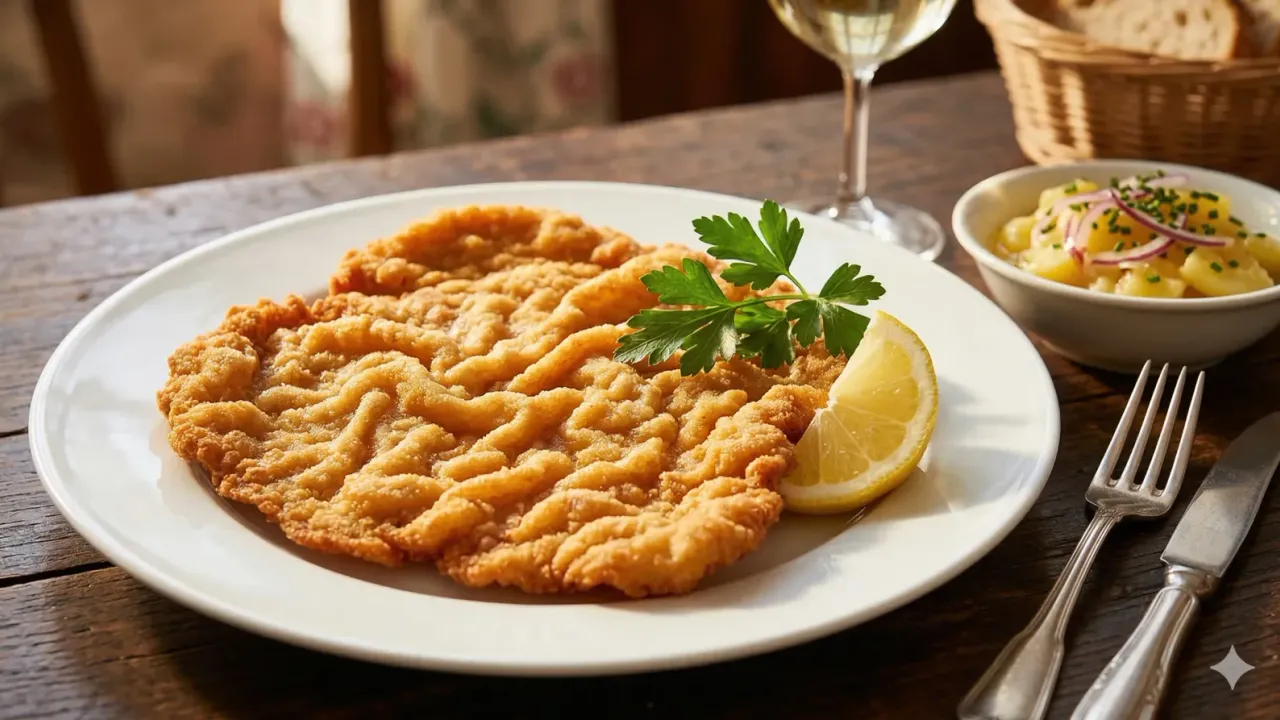
Wiener Schnitzel is Austria’s most iconic dish — a veal cutlet pounded paper-thin, coated in a delicate triple layer of flour, egg, and golden breadcrumbs, then pan-fried in shimmering clarified butter until the crust turns shatteringly crisp and puffs away from the meat in beautiful, wavy ripples. Simple in concept yet demanding in technique, this classic Viennese recipe has been perfected over centuries and remains one of Europe’s most celebrated dishes. Here is exactly how to make it at home with restaurant-quality results.
Prep Time: 25 minutes | Cook Time: 10 minutes | Servings: 4
Difficulty: Medium | Calories: ~480 per serving
What Makes Wiener Schnitzel Special?
Wiener Schnitzel is the undisputed king of Austrian cuisine — a dish so important that it is legally protected by name. In Austria, the term “Wiener Schnitzel” can only be used for a breaded cutlet made from veal. Use pork or chicken, and it must be called “Schnitzel Wiener Art” (Viennese-style schnitzel). This is not snobbery — it is a mark of deep national pride in a dish that has defined Viennese cooking for centuries.
What makes an exceptional Wiener Schnitzel unforgettable is the contrast of textures. The breading should be gossamer-thin yet shatteringly crisp, with a signature puffy, wavy surface where the coating has separated slightly from the meat during frying. Beneath that golden shell, the veal is tender, juicy, and delicate — mild enough to let the buttery crunch of the crust take center stage. A squeeze of fresh lemon cuts through the richness, and that is all you need. No sauce, no gravy, no embellishments. The beauty of Wiener Schnitzel is in its disciplined simplicity.
The origins of Wiener Schnitzel are debated. One popular theory traces it to the Italian cotoletta alla milanese, supposedly brought to Vienna by Field Marshal Radetzky in the 19th century. Austrians fiercely contest this, claiming their version evolved independently. Regardless of its origin, Wiener Schnitzel has become synonymous with Vienna itself — served in grand coffeehouses, traditional Gasthäuser (taverns), and humble home kitchens across the country. It is comfort food elevated to an art form.

Choosing the Right Meat
The choice of meat is the foundation of your schnitzel. While the breading and frying technique are critical, starting with the right cut ensures the best texture and flavor.
- Veal Top Round (best choice): The traditional and authentic cut for Wiener Schnitzel. Veal top round is lean, mild-flavored, and extremely tender when pounded thin. It produces the most delicate, refined result and is what you will find in every proper Viennese restaurant.
- Pork Loin: The most popular substitute, especially outside Austria. Pork is more affordable, slightly more flavorful, and widely available. It produces a firmer bite with a richer taste. Pound it thin and the results are excellent — this is how most Austrian home cooks make schnitzel on a regular basis.
- Chicken or Turkey Breast: The leanest option, perfect for a lighter meal. Chicken schnitzel is popular across Germany and Austria as an everyday version. The flavor is milder, so consider adding a pinch of paprika to the flour for extra depth.
Ingredients for Wiener Schnitzel
Main Ingredients:
- 4 boneless veal cutlets, about 150 grams (5 oz) each
- Salt and freshly ground black pepper
For the Breading Station:
- 100 grams (3/4 cup) all-purpose flour
- 3 large eggs, lightly beaten
- 200 grams (2 cups) fine dry breadcrumbs from white bread
For Frying and Serving:
- 250 milliliters (1 cup) clarified butter or lard for frying
- 1 fresh lemon, cut into wedges
- Fresh parsley sprigs for garnish
Pro tip: Use breadcrumbs made from day-old white bread with the crusts removed, grated finely. Pre-packaged breadcrumbs work, but fresh-grated white bread crumbs produce a lighter, more delicate crust with better puff. Never use panko — the coarse Japanese-style crumbs create entirely the wrong texture for an authentic Wiener Schnitzel.
Step-by-Step Instructions
Step 1: Prepare the Veal Cutlets
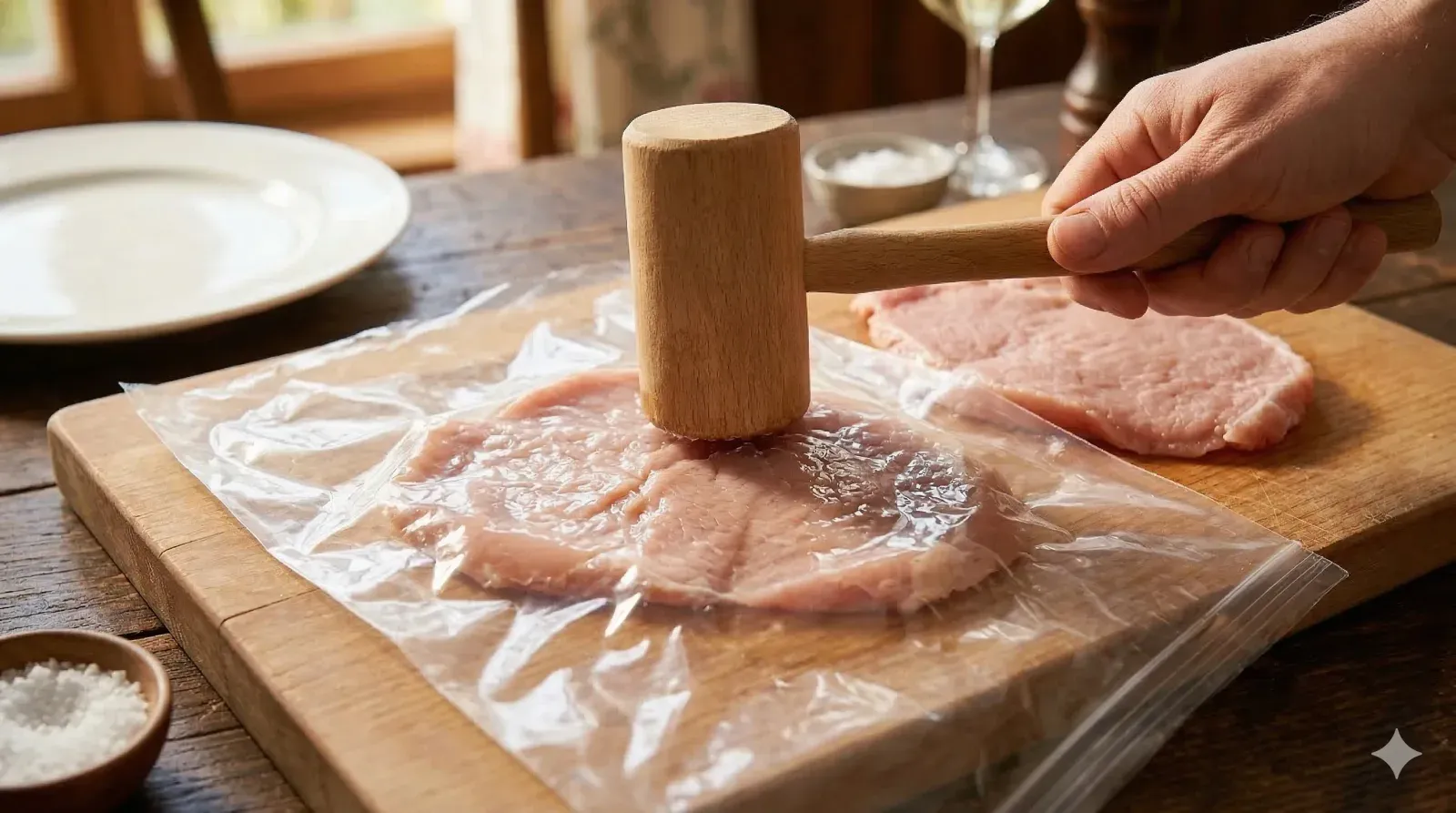
1Place each veal cutlet between two sheets of plastic wrap or inside a resealable bag. Using the flat side of a meat mallet (or a heavy rolling pin), pound the cutlets firmly and evenly until they are about 3 to 4 millimeters thick — roughly the thickness of a heavy coin. Work from the center outward to ensure even thickness. This step is non-negotiable: thin cutlets cook quickly and evenly, ensuring the breading becomes perfectly golden before the meat overcooks. Season both sides generously with salt and a light dusting of freshly ground black pepper.
Step 2: Set Up the Breading Station
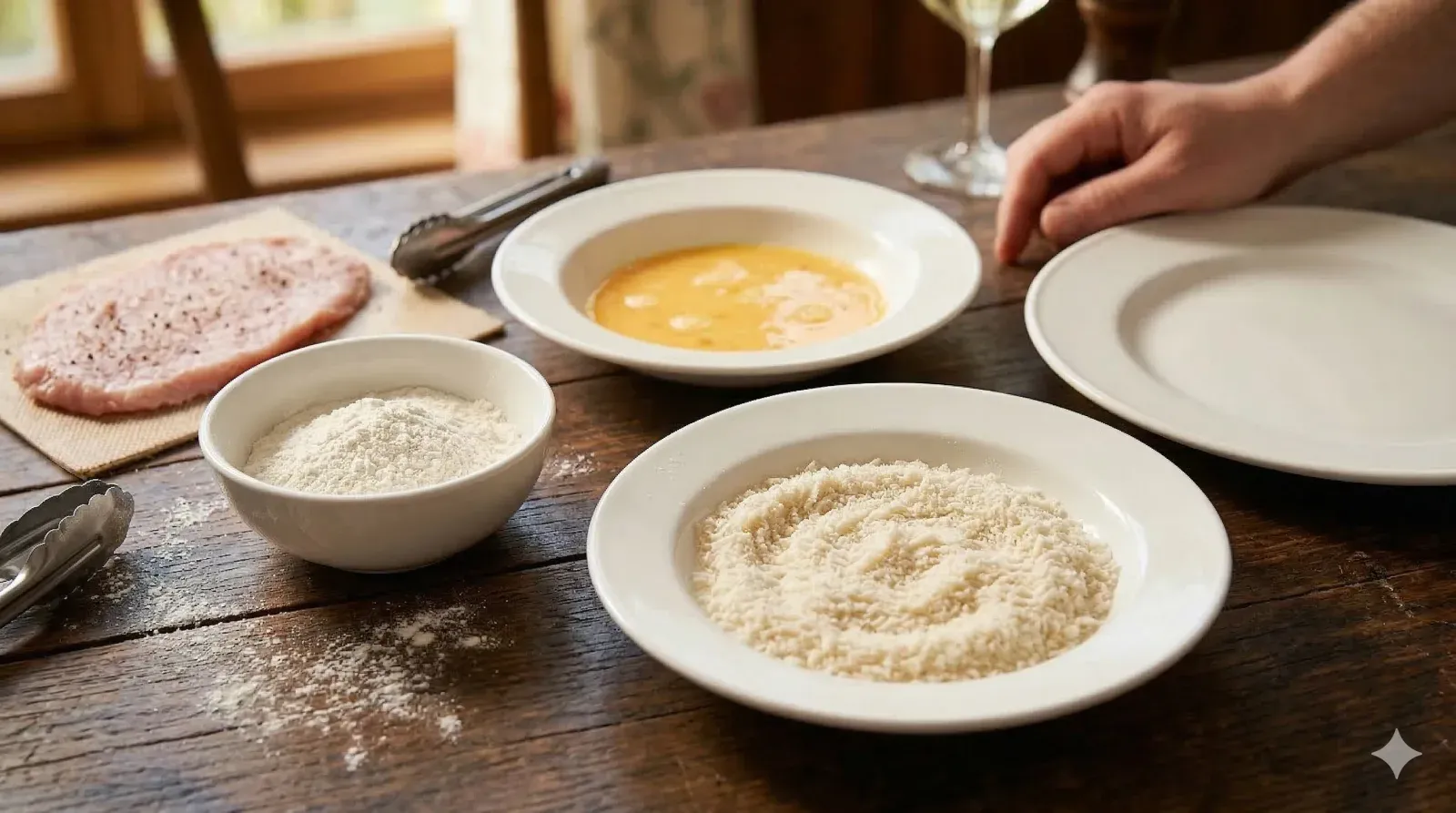
2Arrange three shallow dishes or rimmed plates in a row. Place the flour in the first dish, the beaten eggs in the second, and the fine breadcrumbs in the third. This assembly-line setup keeps the process clean and efficient. Make sure each dish is wide enough to lay the cutlet flat — you want full, even coverage at every stage. Have a clean plate or baking sheet ready at the end of the line for the breaded cutlets.
Step 3: Bread the Cutlets
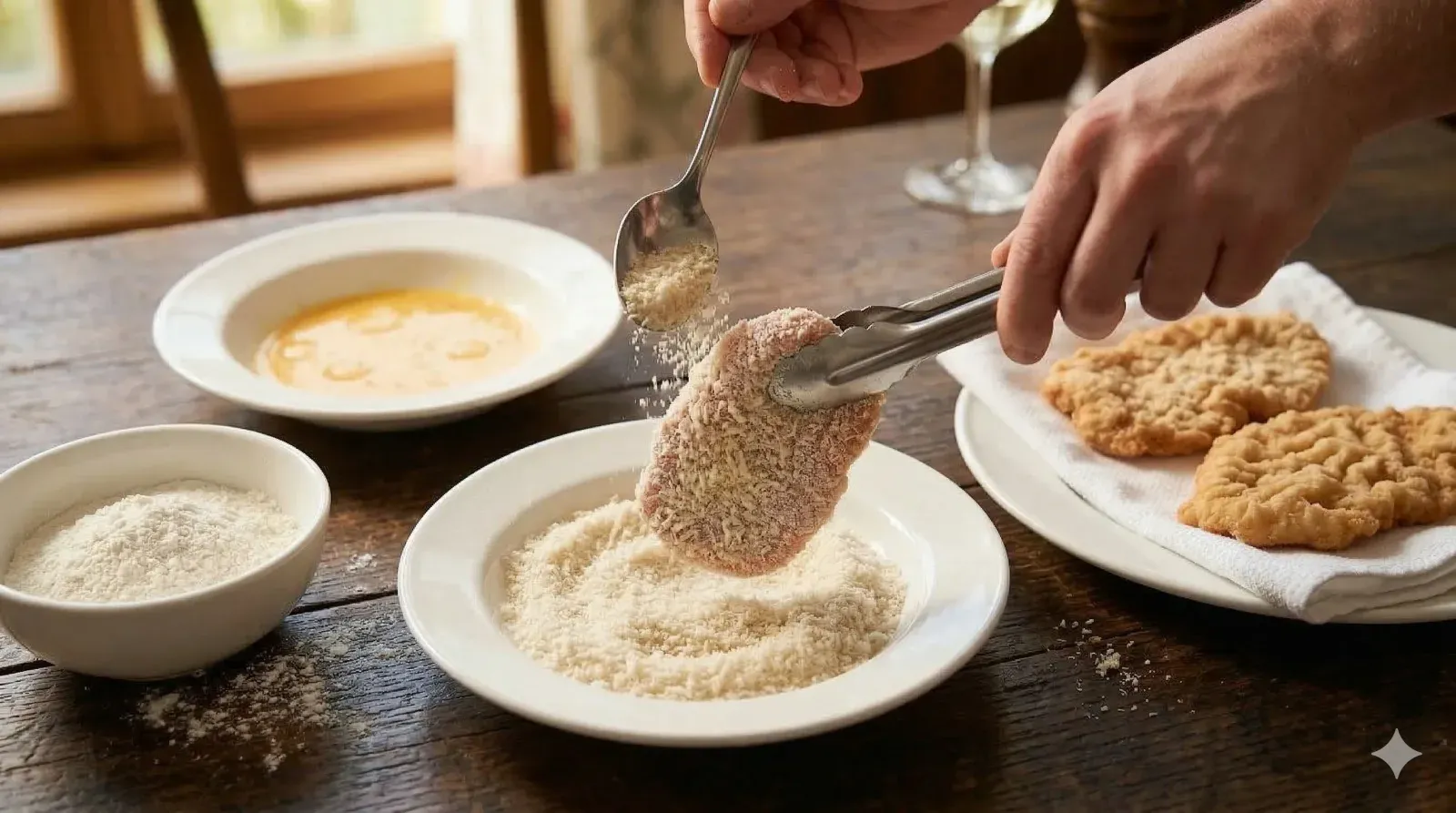
3Working with one cutlet at a time, dredge it in the flour, turning to coat both sides evenly, then shake off any excess. Next, dip it into the beaten egg, letting the excess drip off for a moment. Finally, lay the cutlet in the breadcrumbs, spooning crumbs over the top to coat completely. Here is the critical technique that separates good schnitzel from great: do not press the breadcrumbs down. Simply let them adhere loosely. This creates tiny air pockets between the coating and the meat, which will puff up beautifully during frying. Fry the cutlets within 5 minutes of breading — if the coating sits too long, it absorbs moisture and will not crisp properly.
Step 4: Heat the Clarified Butter
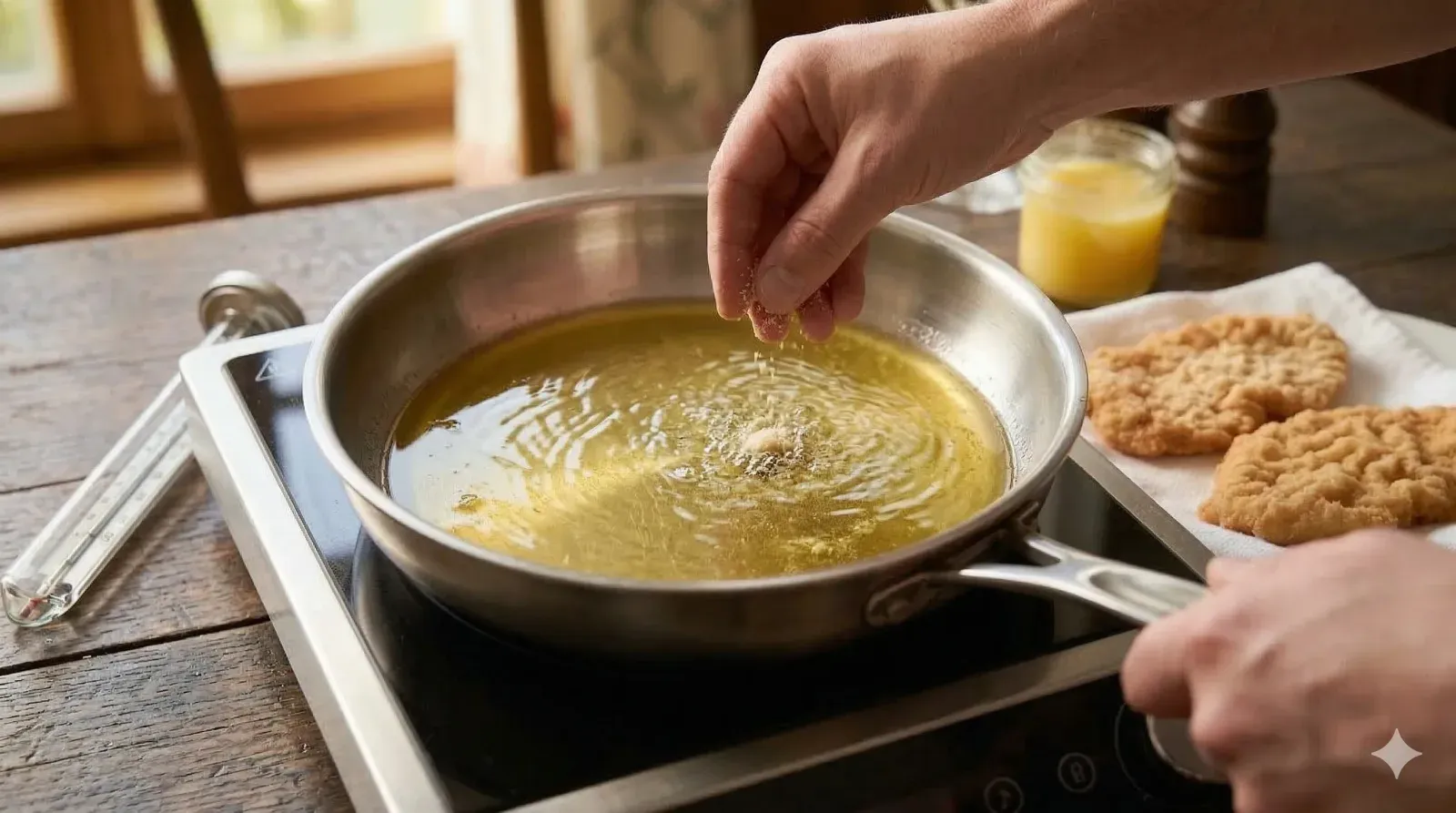
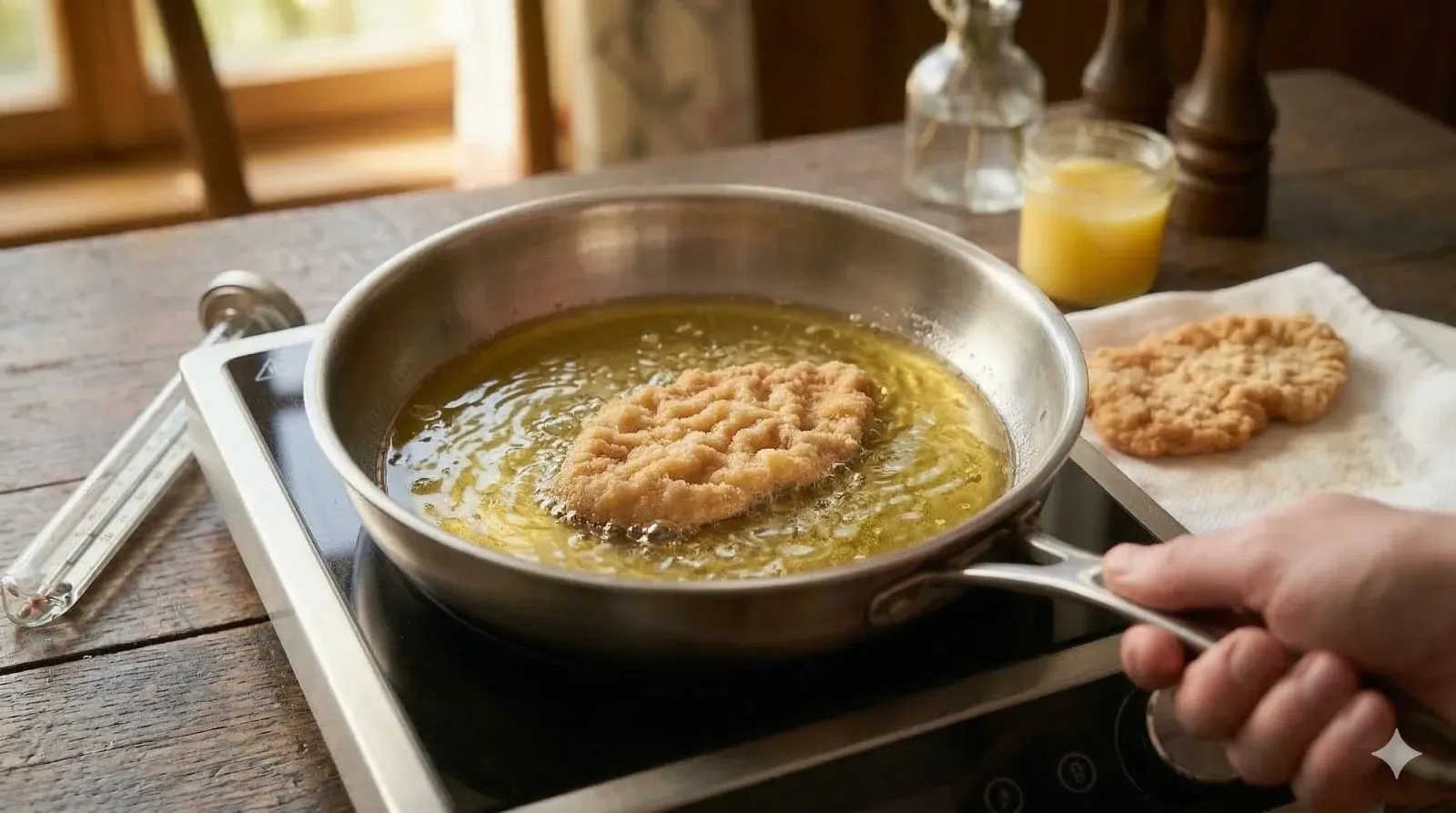
4Pour clarified butter (or lard) into a large, heavy-bottomed skillet to a depth of about 1.5 to 2 centimeters — the schnitzel should swim in the fat, not just sit in a shallow film. Heat over medium-high heat until the fat reaches 170 to 180 degrees Celsius (340 to 355 degrees Fahrenheit). If you do not have a thermometer, drop a small breadcrumb into the fat: it should sizzle vigorously and float to the surface immediately. If it browns instantly, the fat is too hot — reduce the heat slightly. The temperature of the fat is everything. Too cool and the coating absorbs grease and turns soggy; too hot and it burns before the meat cooks through.
Step 5: Fry the Schnitzel to Golden Perfection
5Carefully slide one or two breaded cutlets into the hot fat — do not overcrowd the pan, as this drops the temperature and prevents proper crisping. Now, here is the signature Austrian technique: gently swirl and shake the pan in a circular motion throughout frying. This causes waves of hot fat to wash continuously over the top surface of the schnitzel, cooking the breading from above and below simultaneously. This is what creates the legendary puffy, wavy, slightly separated crust that distinguishes a real Wiener Schnitzel from an ordinary breaded cutlet. Fry for 2 to 3 minutes per side until the coating is a deep, even golden brown. Use a spatula or tongs to flip — never pierce the schnitzel with a fork, which releases juices.
Step 6: Drain and Serve Immediately
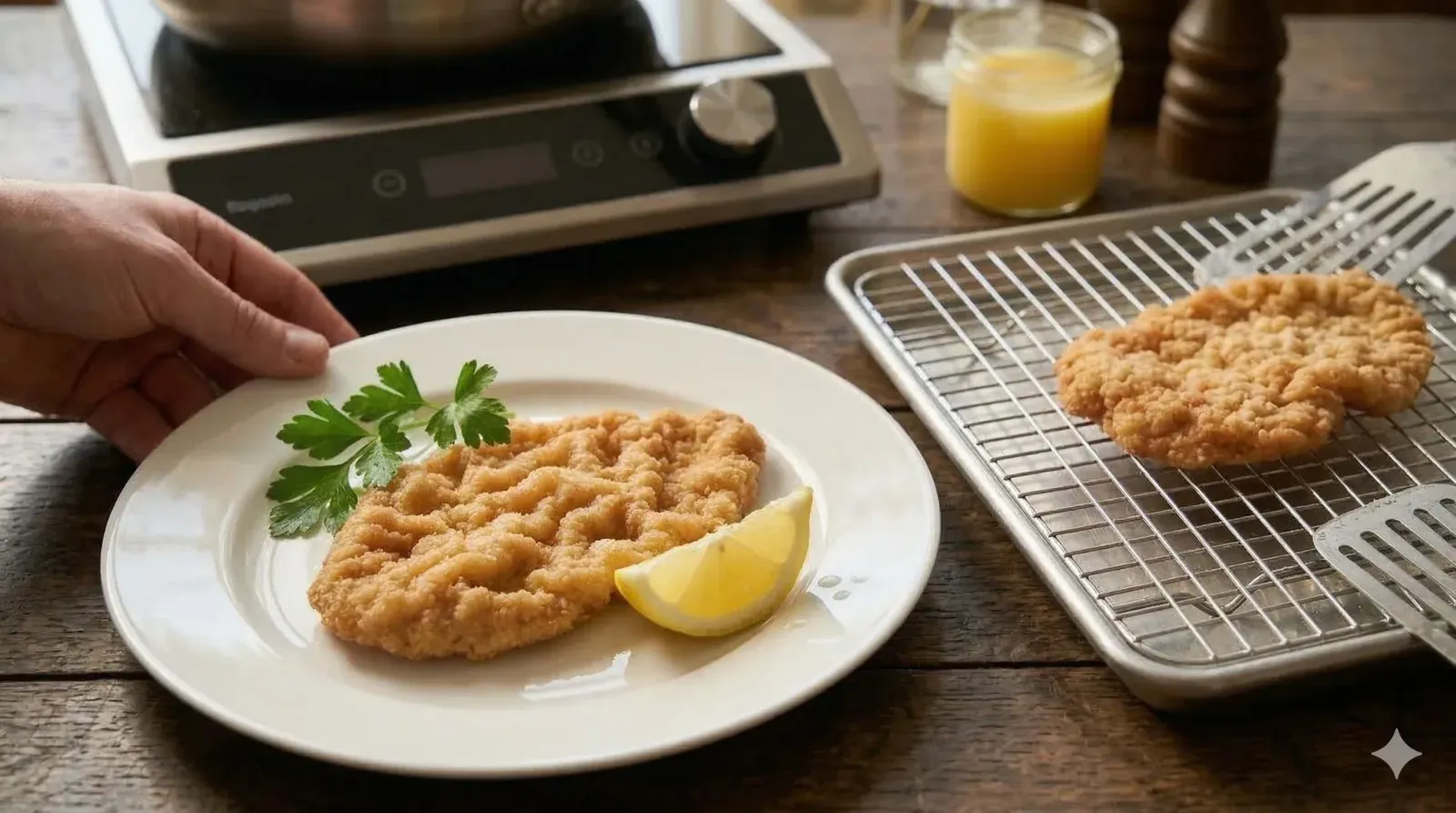
6Lift the finished schnitzel from the fat and place it on a wire rack set over a baking sheet — never on paper towels, which trap steam underneath and make the bottom crust soggy within seconds. The wire rack allows air to circulate freely, keeping the entire coating crisp. Serve the Wiener Schnitzel immediately while the crust is still crackling-hot and at peak crispness. Place a generous wedge of fresh lemon alongside and a sprig of parsley on top. Squeeze the lemon over the schnitzel just before the first bite — the bright acidity is essential and cuts beautifully through the rich, buttery coating.
Expert Tips for Perfect Wiener Schnitzel
The Swirling Technique Is Non-Negotiable
The gentle swirling of the pan during frying is not optional — it is the single most important technique for achieving an authentic Wiener Schnitzel. As hot fat washes over the surface of the breaded cutlet, it creates steam between the meat and the coating. This steam causes the breadcrumb layer to puff away from the meat, forming those distinctive wavy ripples. Without the swirl, you get a flat, tight coating that clings to the meat — perfectly fine, but not the real thing.
Use Enough Fat — the Schnitzel Must Swim
A common mistake is using too little fat, treating schnitzel like a pan-fry rather than a shallow-fry. The fat should come at least halfway up the side of the cutlet — ideally the schnitzel should float freely. This ensures even cooking, uniform golden color, and proper puffing of the crust. Skimping on fat produces a patchy, unevenly browned coating and eliminates any chance of achieving the signature puffy texture.
Pound Evenly and Thoroughly
An unevenly pounded cutlet means some parts overcook while thicker areas remain underdone. Take your time with the meat mallet and work systematically from the center outward. The finished cutlet should be uniformly thin — about 3 to 4 millimeters throughout. If the edges are much thinner than the center, the edges will overcook and dry out while waiting for the center to finish.
Wiener Schnitzel vs. Cotoletta alla Milanese
These two legendary European breaded cutlets are often compared, and understanding their differences reveals the unique character of each tradition.
| Feature | Wiener Schnitzel (Austria) | Cotoletta alla Milanese (Italy) |
|---|---|---|
| Traditional Meat | Boneless veal top round | Bone-in veal rib chop |
| Thickness | Pounded very thin (3-4 mm) | Thicker, about 1-1.5 cm with bone |
| Breadcrumbs | Fine, dry white breadcrumbs | Coarse breadcrumbs, sometimes with Parmesan |
| Frying Fat | Clarified butter or lard | Butter (often a mix of whole and clarified) |
| Crust Character | Puffy, wavy, separated from meat | Tighter, crunchier, firmly attached |
| Serving Style | Lemon wedge, no sauce | Often with arugula salad and cherry tomatoes |
Serving Suggestions
In Vienna, Wiener Schnitzel is traditionally served on a warm plate with the lemon wedge placed directly on top. It arrives uncut — the diner slices it at the table, and the first knife cut through the crackling crust is a moment of pure satisfaction. The schnitzel often overhangs the edges of the plate, a visual promise of generosity that is central to Austrian hospitality.
The Perfect Accompaniments:
- Potato salad (Erdäpfelsalat): The classic Viennese pairing. A warm, tangy potato salad dressed with beef broth, white wine vinegar, mustard, and oil. The acidity of the salad balances the richness of the fried cutlet perfectly.
- Parsley potatoes: Simply boiled small potatoes tossed in butter and fresh parsley. A lighter, cleaner side that lets the schnitzel remain the star of the plate.
- Cucumber salad (Gurkensalat): Thinly sliced cucumbers in a sweet-sour dressing with dill. The cool, refreshing crunch is a wonderful contrast to the hot, crispy schnitzel.
- Lingonberry jam (Preiselbeeren): A small dollop of tart-sweet lingonberry jam on the side is a beloved Austrian tradition. The fruity acidity cuts through the richness in a way that surprises and delights.
Beverage Pairings:
- Austrian Grüner Veltliner: The quintessential Austrian white wine — crisp, peppery, and slightly herbal. Its bright acidity mirrors the lemon squeeze and cuts through the buttery richness.
- Austrian lager or pilsner: A cold Stiegl Goldbräu or Ottakringer is the everyday Austrian choice — clean, refreshing, and perfect with fried food.
- Sparkling water with lemon: The classic non-alcoholic option that cleanses the palate between bites and keeps the focus on the schnitzel.
- Riesling: A dry Austrian Riesling from the Wachau region offers more aromatic complexity — stone fruit and minerality that complement the delicate veal beautifully.
Storage and Reheating
Refrigerator: Store leftover schnitzel in an airtight container for up to 2 days. Be aware that the crispy coating will soften in the fridge — this is unavoidable, but proper reheating can restore much of the texture.
Freezer: Wiener Schnitzel freezes surprisingly well for up to 1 month. Place individual pieces on a baking sheet to flash-freeze, then transfer to a freezer bag. Separate pieces with parchment paper to prevent sticking. Reheat directly from frozen for best results.
Reheating: The oven is the best method. Place the schnitzel on a wire rack set over a baking sheet and reheat at 200 degrees Celsius (400 degrees Fahrenheit) for 8 to 10 minutes until the coating is crisp and hot throughout. The wire rack is essential — it allows hot air to circulate underneath, re-crisping the bottom. Avoid the microwave at all costs, as it turns the golden crust into a rubbery, soggy disappointment.
Common Mistakes to Avoid
1. Pressing the Breadcrumbs Too Firmly
This is the most common mistake and the one that ruins the signature texture of Wiener Schnitzel. When you press the breadcrumbs tightly against the meat, you eliminate the tiny air gaps that allow the coating to puff up during frying. Instead, let the breadcrumbs sit loosely on the surface. They will adhere well enough through the egg wash — trust the process.
2. Using Too Little Fat
Wiener Schnitzel is not a pan-fry — it is a shallow-fry. The cutlet needs to float in the fat, not stick to the bottom of the pan. Using too little fat produces uneven browning, a flat coating without any puff, and often a greasy result (counterintuitively, more fat means less grease absorbed, because the schnitzel cooks faster and more evenly).
3. Not Pounding the Meat Thin Enough
Thick cutlets take longer to cook through, which means the breading is exposed to heat for too long and can burn or become overly dark before the center is done. Pound the veal to 3 to 4 millimeters — it should be almost translucent in places. The thin cutlet cooks in just 2 to 3 minutes per side, which is the ideal window for achieving deep golden color without overcooking.
4. Letting Breaded Cutlets Sit Too Long Before Frying
Once the cutlets are breaded, they should go into the hot fat within 5 minutes. The moisture from the egg wash begins to soak into the breadcrumbs immediately, and the longer they sit, the denser and less crispy the final coating will be. Bread and fry in small batches to keep everything moving quickly.
5. Draining on Paper Towels
Paper towels seem logical, but they are the enemy of crispy schnitzel. The moment the hot schnitzel touches the paper towel, steam gets trapped between the crust and the towel, turning the bottom soggy. Always use a wire rack set over a baking sheet. The air circulating underneath keeps the coating perfectly crisp on all sides.
Frequently Asked Questions
What is the difference between Wiener Schnitzel and regular schnitzel?
True Wiener Schnitzel is made exclusively with veal. In Austria, the term is legally protected and can only refer to a breaded, pan-fried veal cutlet. If pork or chicken is used, it must be labeled “Schnitzel Wiener Art” (schnitzel Viennese style). The distinction matters because veal produces a more tender, delicate result with a milder flavor that allows the crispy breading to shine.
Why does my schnitzel coating not puff up?
The signature puffy, wavy crust comes from two techniques: not pressing the breadcrumbs too firmly onto the meat, and gently swirling the pan during frying so hot fat washes over the top. The fat creates steam between the meat and the coating, causing it to puff and separate. If your coating is pressed too tightly, there is no space for the steam to form, and the coating stays flat.
Can I use pork instead of veal?
Absolutely. Pork loin is the most common and affordable substitute, producing a slightly firmer, more flavorful schnitzel. In Austria, this would be called “Schnitzel Wiener Art” rather than true Wiener Schnitzel. Chicken breast is another popular option and is the leanest choice. Regardless of the meat, the key is to pound it very thin for even cooking and maximum crispiness.
What fat is best for frying?
Clarified butter is the traditional and preferred choice. It has a high smoke point and adds a rich, nutty flavor to the crust that regular butter or oil cannot match. Lard is another authentic option that was historically the most common frying fat in Austrian kitchens. Vegetable oil works as a neutral alternative but lacks the distinctive buttery flavor.
How thin should the veal be pounded?
About 3 to 4 millimeters thick — roughly the thickness of a stack of three coins. This is thinner than most people expect, but it is essential. The thin cutlet cooks through in just 2 to 3 minutes per side, ensuring the breading reaches perfect golden crispness before the meat overcooks. If the cutlet is too thick, the outside burns before the inside is done.
Why should I not drain schnitzel on paper towels?
Paper towels trap steam between the schnitzel and the surface, which immediately softens the bottom of the crispy coating. Instead, drain on a wire rack set over a baking sheet. The elevated rack allows air to circulate freely underneath, keeping the entire coating crisp and golden on all sides. This is a small detail that makes a significant difference.
Variations and Adaptations
Schnitzel Holstein:
A decadent Berlin-inspired variation where the finished schnitzel is topped with a fried egg, capers, anchovies, and a squeeze of lemon. The runny egg yolk breaks over the crispy crust, creating a rich sauce that soaks into the breading. It is indulgent, dramatic, and absolutely delicious — perfect for a weekend brunch or a special dinner.
Jägerschnitzel (Hunter’s Schnitzel):
A hearty German adaptation where the schnitzel is served with a creamy mushroom gravy. Sauté sliced mushrooms with onions, deglaze with white wine, and finish with cream and fresh thyme. Purists may cringe at saucing a schnitzel, but the combination of crispy breading and earthy mushroom cream is deeply satisfying comfort food.
Rahmschnitzel (Cream Schnitzel):
An unbreaded variation where the veal cutlet is pan-seared and then finished in a silky cream sauce flavored with white wine and a hint of mustard. No breading means a different experience — the focus shifts entirely to the tender veal and the rich, tangy sauce. Serve over buttered spaetzle for the full Austrian experience.
Air Fryer Wiener Schnitzel:
For a lighter version, bread the cutlets as usual but spray generously with cooking oil. Air fry at 200 degrees Celsius (400 degrees Fahrenheit) for 4 to 5 minutes per side. The result will not have the traditional puffy crust, but it produces a respectably crispy coating with significantly less fat. A practical weeknight shortcut that still delivers great flavor.
The Cultural Significance of Wiener Schnitzel
Wiener Schnitzel is far more than a recipe in Austria — it is a national symbol, a point of cultural pride, and an edible piece of history. In Vienna, the schnitzel is as much a part of the city’s identity as its coffee houses, Baroque architecture, and the Wiener Philharmoniker. Every Austrian family has their own version, their own techniques, and their own fiercely held opinions about what makes the perfect schnitzel.
The dish has deep roots in Austrian Gasthaus culture — the traditional taverns and inns where working families, students, and aristocrats all gathered around the same tables. A properly made Wiener Schnitzel, hanging over the edges of the plate and served with a simple potato salad, represents Austrian generosity and warmth. It is unpretentious, satisfying, and democratic. Whether served in a Michelin-starred restaurant or a corner tavern, the Wiener Schnitzel remains fundamentally the same dish, and that is part of its enduring power.
Today, Wiener Schnitzel continues to top polls as Austria’s favorite dish and is recognized worldwide as one of Europe’s great culinary contributions. The Viennese take their schnitzel so seriously that heated debates over proper technique — veal versus pork, clarified butter versus lard, the correct thickness, the ideal shade of gold — are a beloved national pastime. Making it at home connects you to this rich tradition and to the Austrian philosophy that the simplest dishes, done with care and precision, are often the most rewarding.
Conclusion
Making authentic Wiener Schnitzel at home is simpler than you might think — it requires just a handful of ingredients, basic kitchen tools, and about 35 minutes from start to plate. The keys to success are pounding the veal thin for quick, even cooking, keeping the breadcrumb coating loose for maximum puff, using plenty of clarified butter at the right temperature, and swirling the pan gently throughout frying. Master those four fundamentals, and you will produce a schnitzel that rivals anything served in the grand restaurants of Vienna.
Looking for more European classics? Explore our collection of European dishes or discover Asian-inspired recipes from around the world.