My Viet KitchenMy Viet Kitchen
HomeVietAsianEuropeanAfricanAmericanAustralianAboutContact
More
FAQPrivacy Policy
HomeVietAsianEuropeanAfricanAmericanAustralianAboutContactFAQPrivacy PolicySearch

Follow us

Home › Asian Dishes › Gado-Gado: Indonesian Salad with Peanut Sauce

My Viet Kitchenmyvietkitchen.com/gado-gado/

Gado-Gado: Indonesian Salad with Peanut Sauce

Asian DishesOctober 26, 20269 min read

Share
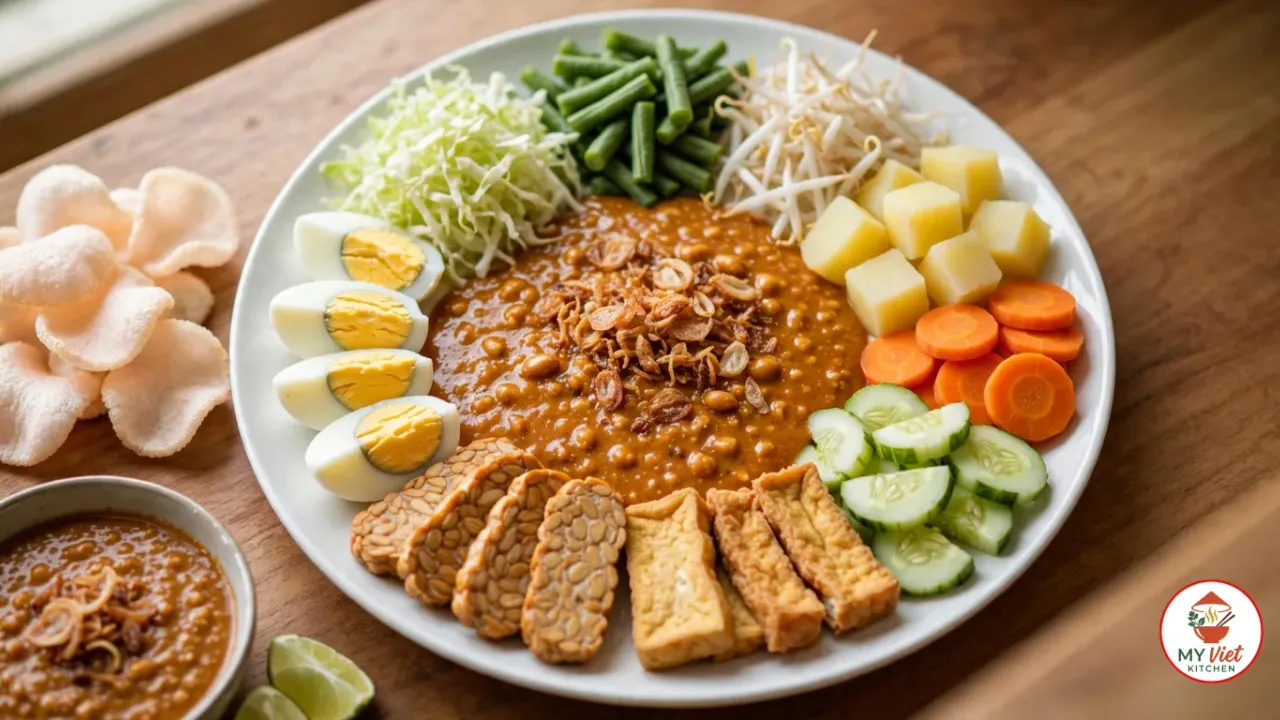
A white plate of gado-gado with separate piles of shredded cabbage, green beans, bean sprouts, cubed boiled potato, carrot rounds and cucumber slices around a mound of coarse peanut sauce topped with fried shallots, with four boiled egg halves and slices of fried tempeh and tofu, beside prawn crackers, a bowl of extra sauce and lime wedges on a wooden table

Prep 20 minutesCook 40 minutesTotal 1 hourYield 4 servings

Ingredients

  • 1 cup (150 g) unsalted roasted peanuts
  • 3 cloves garlic
  • 4 small red chilies (or to taste)
  • 2 tablespoons kecap manis (Indonesian sweet soy sauce)
  • 1 tablespoon tamarind paste
  • 1 tablespoon palm sugar or brown sugar
  • 3/4 cup (200 ml) warm water, plus more to loosen
  • 1/2 teaspoon salt
  • 1 tablespoon lime juice
  • 2 medium potatoes, peeled and cut into 1-inch (2.5 cm) cubes
  • 2 medium carrots, sliced into rounds
  • 7 oz (200 g) green beans, trimmed and cut into 2-inch (5 cm) pieces
  • 7 oz (200 g) green cabbage, shredded
  • 7 oz (200 g) bean sprouts
  • 1 small cucumber, sliced
  • 4 large eggs
  • 5 oz (150 g) firm tofu
  • 5 oz (150 g) tempeh
  • 1/4 cup (60 ml) neutral oil, such as sunflower, for frying
  • 2 tablespoons fried shallots
  • Prawn crackers (krupuk), to serve
  • 1 lime, cut into wedges

Method

  1. Make the Peanut Sauce. Pound or pulse the roasted peanuts, garlic and chilies in a mortar or food processor until coarsely ground, not smooth. Scrape into a small saucepan and add the kecap manis, tamarind paste, palm sugar, salt and 3/4 cup (200 ml) warm water. Stir over low heat for about 5 minutes, until smooth and thick. Take it off the heat, stir in the lime juice and taste for salt, sweetness and sourness.
  2. Boil the Eggs and Potatoes. Lower the eggs into a saucepan of cold water, bring it to a boil and give them 10 minutes. Cool them in a bowl of iced water, then peel and halve them. While they cook, heat a large pot of salted water and boil the potato cubes and carrot rounds for about 8 minutes, until a knife slides easily into the potato. Scoop them out with a slotted spoon; the same water blanches the greens next.
  3. Blanch the Green Vegetables. In the same boiling water, blanch the green beans for 3 minutes, until bright green but still crisp, and lift them into a bowl of iced water. Blanch the cabbage for 1 minute and the bean sprouts for 1 minute, then drain both in a colander. Drain the beans and slice the cucumber.
  4. Fry the Tofu and Tempeh. Pat the tofu dry and cut the tofu and tempeh into slices about 1/2 inch (1 cm) thick. Heat the oil in a wide frying pan over medium heat. Fry them a batch at a time, about 3 minutes a side, until both faces are golden brown, and drain on paper towels.
  5. Assemble and Serve. Rewarm the peanut sauce over low heat, beating in warm water a tablespoon at a time until it falls from a spoon in a thick ribbon. Arrange the potatoes, carrots, green beans, cabbage, bean sprouts, cucumber, tofu, tempeh and egg halves on a large plate or four plates. Pour the warm sauce over the middle, scatter with fried shallots and serve with prawn crackers and lime wedges.

Nutrition 710 calories per serving, protein 35g, fat 40g, carbohydrates 55g, fiber 10g, sodium 1050mg

In this recipe

  1. Should You Grind Peanuts or Use Peanut Butter?
  2. How Thick Should the Peanut Sauce Be?
  3. What Goes on the Plate?
  4. Ingredients for Gado-Gado
  5. Step-by-Step Instructions
  6. Frequently Asked Questions
  7. Sources

Gado-gado is an Indonesian salad of raw and blanched vegetables, boiled potato, hard-boiled eggs and fried tofu and tempeh, served with a peanut sauce dressing (Wikipedia). This version grinds roasted peanuts with garlic and chilies, then simmers them with kecap manis, tamarind and palm sugar. The vegetables cook one batch at a time in the same pot of salted water, and the sauce goes on warm, just before you eat.

Prep Time: 20 minutes | Cook Time: 40 minutes | Total Time: 1 hour | Servings: 4

Difficulty: Easy | Calories: ~710 per serving

Should You Grind Peanuts or Use Peanut Butter?

Either works. Wikipedia puts ground fried peanuts first among the sauce ingredients. The traditional tools are the cobek and ulekan, a mortar-and-pestle set with a flat, rounded stone. The dry ingredients are ground first, then tamarind liquid goes in until the sauce is as thick as you want it (Wikipedia).

Lara Lee, author of Coconut and Sambal, starts from 150 g of raw peanuts, preferably with skins on. She cooks them in oil at 160°C for 4 to 5 minutes, stirring the whole time because they burn easily, until golden. Her alternative is 150 g of unsweetened, unsalted smooth peanut butter, so the swap is gram for gram (VICE).

This recipe starts from unsalted roasted peanuts, so there is no frying. Grind them with the garlic and chilies to a coarse paste, stopping well short of butter. A few visible bits of peanut are what you want on the plate.

Peanut butter needs more care. Tom Pepinsky stirs 4 tablespoons of smooth, natural-style peanut butter into a fried paste of shallot, garlic, ginger or galangal and chilies. He warns that the sauce can separate, and if it does you either start over or eat it lumpy (Tom Pepinsky). Keep the heat low and add water a little at a time.

How Thick Should the Peanut Sauce Be?

Thicker than a salad dressing. Wikipedia points out that the sauce is a larger part of gado-gado than a dressing is in a Western salad, and the vegetables should be well coated with it (Wikipedia). Pepinsky adds that Indonesians leave it thick (Tom Pepinsky).

Lara Lee aims for pourable. She adds about 125 ml of water a splash at a time and warns that the sauce keeps thickening as it sits, so it needs more water when you serve it (VICE). Here the target sits between the two: the sauce should fall from a spoon in a thick ribbon and stay put on a green bean. If it has set stiff by Step 5, beat in warm water one tablespoon at a time.

Kecap manis sets the sweetness. Pepinsky calls it sweet soy sauce and says most Asian grocery stores stock it, with the other soy sauces or with Indonesian, Malaysian and Filipino foods. If you can’t find it, he uses more regular soy sauce and caramelized sugar to taste (Tom Pepinsky). For tamarind paste, Lara Lee’s stand-in is 4 teaspoons of lime juice mixed with 4 teaspoons of brown sugar (VICE).

Heat is the other dial. In Indonesia gado-gado is generally made fresh, sometimes in front of the customer, so the cook can match the heat they want, and that comes down to the number of chilies (Wikipedia). Two small red chilies make a mild sauce; four or more make a hot one.

What Goes on the Plate?

Gado-gado has no fixed list of vegetables. Wikipedia’s covers blanched cabbage, water spinach (kangkung), spinach, bean sprouts, young jackfruit, chayote, string beans, bitter melon and corn. It adds boiled potatoes, raw sliced cucumber and salad vegetables, boiled eggs, and fried tofu and tempeh. Outside Indonesia, it says, cooks improvise with whatever vegetables they can get (Wikipedia).

Pepinsky’s recipe for two treats only chayote, carrots, bean sprouts and cucumber as required; cabbage, potato and eggs are optional (Tom Pepinsky). Lara Lee’s plate holds baby potatoes, tenderstem broccoli, green beans, carrot, bean sprouts, cucumber, cherry tomatoes, tofu, tempeh and eggs (VICE).

Starch and crunch come with it. In Indonesia the plate is commonly mixed with chopped lontong or ketupat (rice cakes), or served with steamed rice. It nearly always comes with krupuk, tapioca crackers, or emping, crackers made from melinjo. Fried shallots, bawang goreng, are a common garnish (Wikipedia). This recipe uses prawn crackers and fried shallots; add sliced lontong if your Asian grocer sells it.

Ingredients for Gado-Gado

For the Peanut Sauce:

  • 1 cup (150 g) unsalted roasted peanuts
  • 3 cloves garlic
  • 4 small red chilies (or to taste)
  • 2 tablespoons kecap manis (Indonesian sweet soy sauce)
  • 1 tablespoon tamarind paste
  • 1 tablespoon palm sugar or brown sugar
  • 3/4 cup (200 ml) warm water, plus more to loosen
  • 1/2 teaspoon salt
  • 1 tablespoon lime juice

For the Vegetables:

  • 2 medium potatoes, peeled and cut into 1-inch (2.5 cm) cubes
  • 2 medium carrots, sliced into rounds
  • 7 oz (200 g) green beans, trimmed and cut into 2-inch (5 cm) pieces
  • 7 oz (200 g) green cabbage, shredded
  • 7 oz (200 g) bean sprouts
  • 1 small cucumber, sliced

For the Eggs, Tofu and Tempeh:

  • 4 large eggs
  • 5 oz (150 g) firm tofu
  • 5 oz (150 g) tempeh
  • 1/4 cup (60 ml) neutral oil, such as sunflower, for frying

To Serve:

  • 2 tablespoons fried shallots
  • Prawn crackers (krupuk), to serve
  • 1 lime, cut into wedges

Step-by-Step Instructions


Step 1: Make the Peanut Sauce

1Pound or pulse the roasted peanuts, garlic and chilies in a mortar or food processor until coarsely ground, not smooth. Scrape the paste into a small saucepan and add the kecap manis, tamarind paste, palm sugar, salt and 3/4 cup (200 ml) warm water. Stir over low heat for about 5 minutes, until smooth and thick. Take it off the heat, stir in the lime juice and taste for salt, sweetness and sourness.
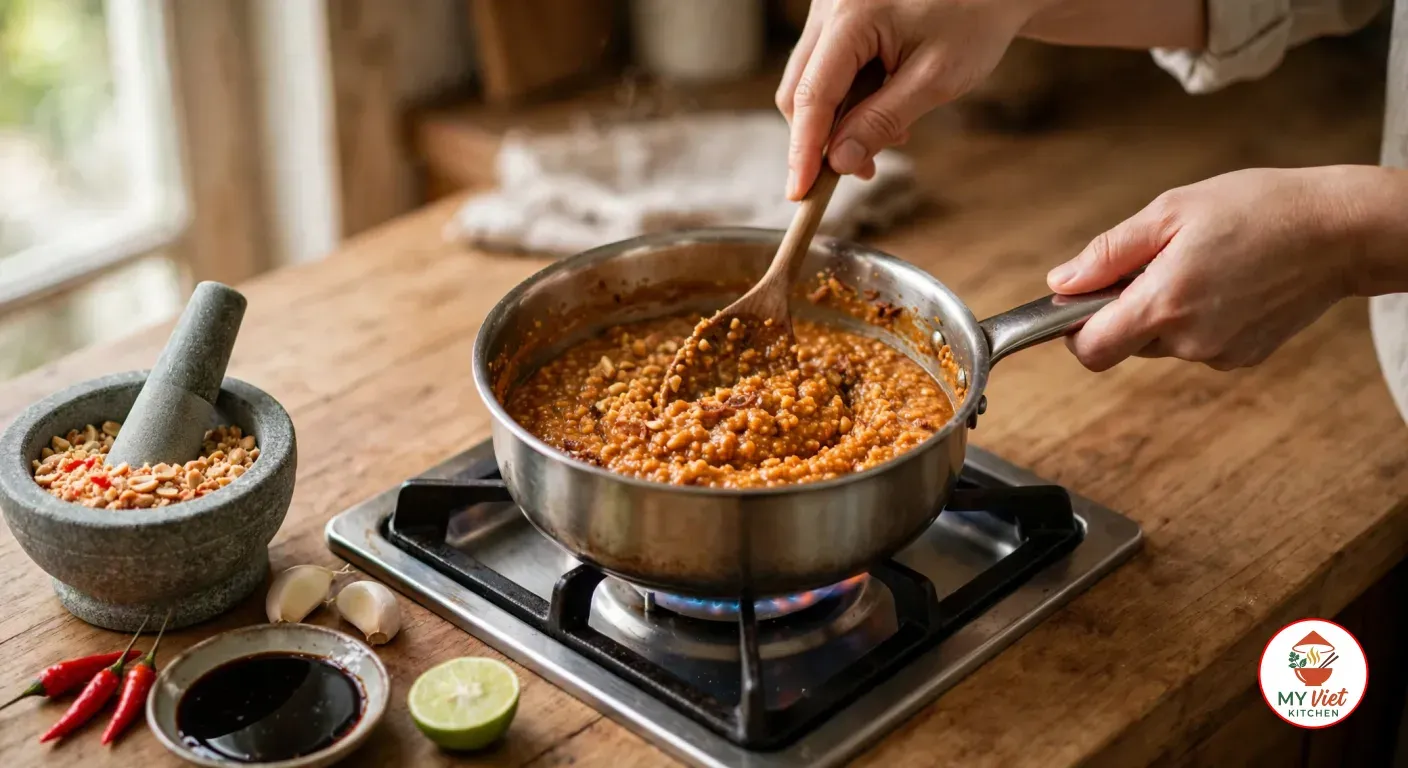
Hands stirring coarse orange-brown peanut sauce with a wooden spoon in a small stainless steel saucepan on a gas burner, beside a stone mortar of crushed peanuts and chili, two garlic cloves, three red chilies, a dish of dark kecap manis and half a lime
Step 1- Make the Peanut Sauce

Step 2: Boil the Eggs and Potatoes

2Lower the eggs into a saucepan of cold water, bring it to a boil and give them 10 minutes. Cool them in a bowl of iced water, then peel and halve them. While they cook, heat a large pot of salted water and boil the potato cubes and carrot rounds for about 8 minutes, until a knife slides easily into the potato. Scoop them out with a slotted spoon; the same water blanches the greens next.
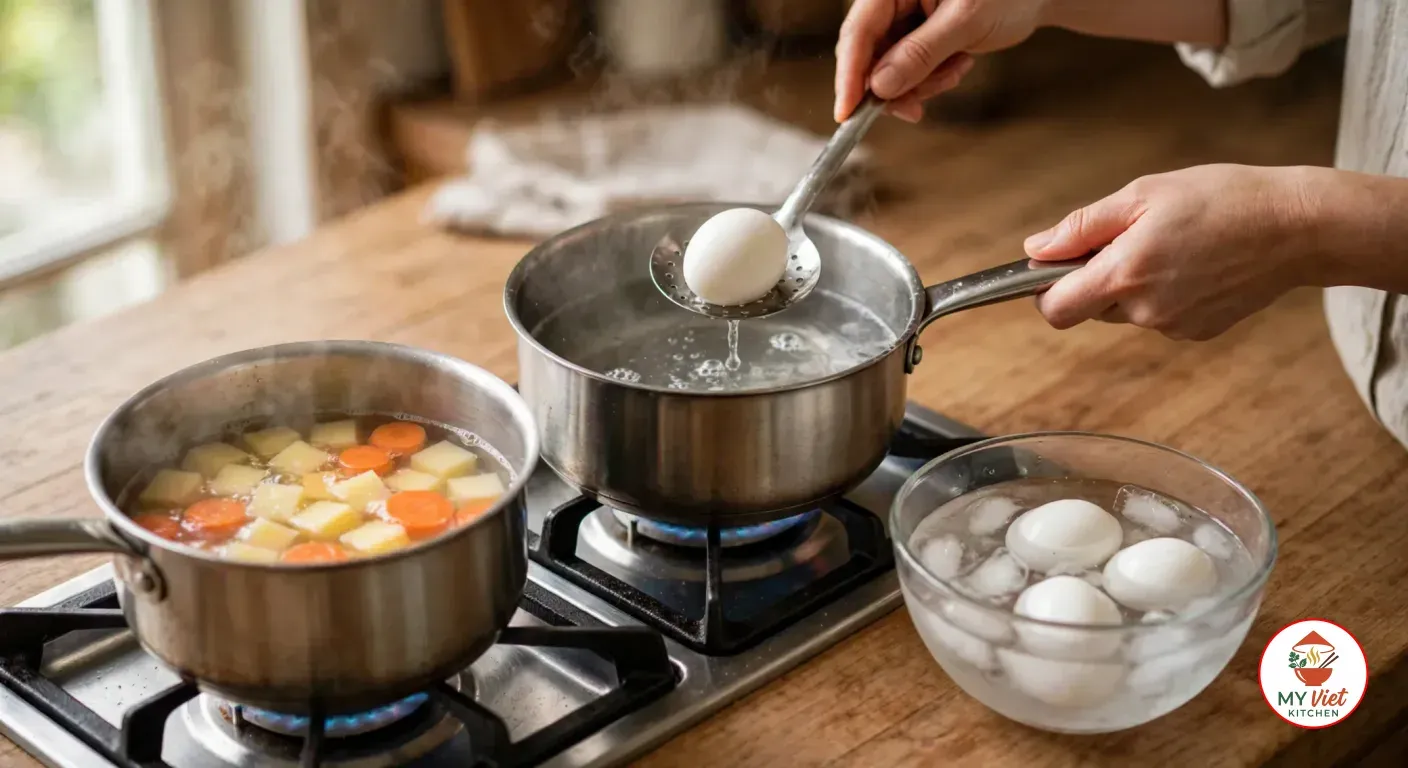
A hand lifting a boiled egg on a slotted spoon from a pan of water toward a glass bowl of iced water holding three more eggs, next to a pan of potato cubes and carrot rounds boiling on a gas hob
Step 2- Boil the Eggs and Potatoes

Step 3: Blanch the Green Vegetables

3In the same boiling water, blanch the green beans for 3 minutes, until bright green but still crisp, and lift them into a bowl of iced water. Blanch the cabbage for 1 minute and the bean sprouts for 1 minute, then drain both in a colander. Drain the beans and slice the cucumber.
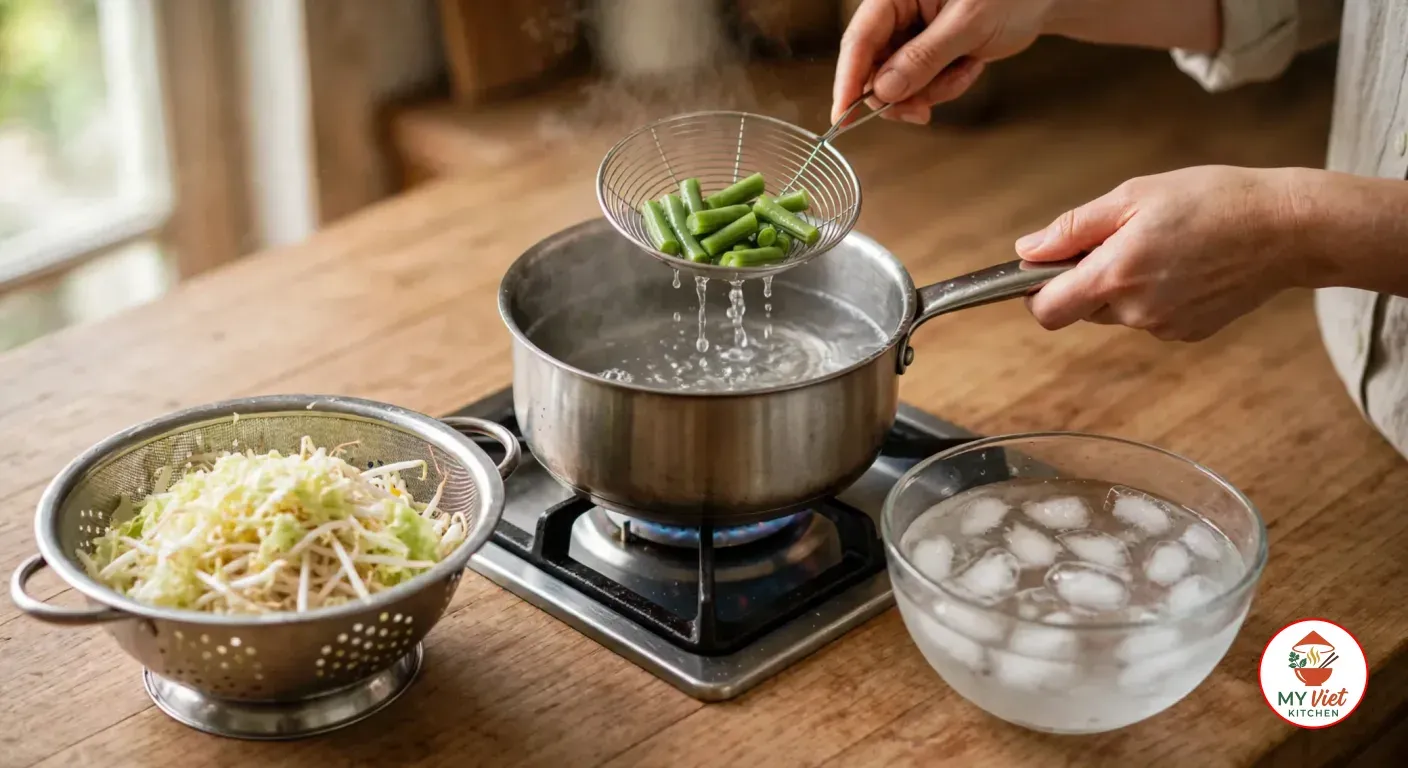
A hand lifting blanched green beans in a wire spider strainer over a pan of boiling water, with a colander of drained shredded cabbage and bean sprouts and a glass bowl of iced water on the wooden counter
Step 3- Blanch the Green Vegetables

Step 4: Fry the Tofu and Tempeh

4Pat the tofu dry and cut the tofu and tempeh into slices about 1/2 inch (1 cm) thick. Heat the oil in a wide frying pan over medium heat. Fry them a batch at a time, about 3 minutes a side, until both faces are golden brown, and drain on paper towels.
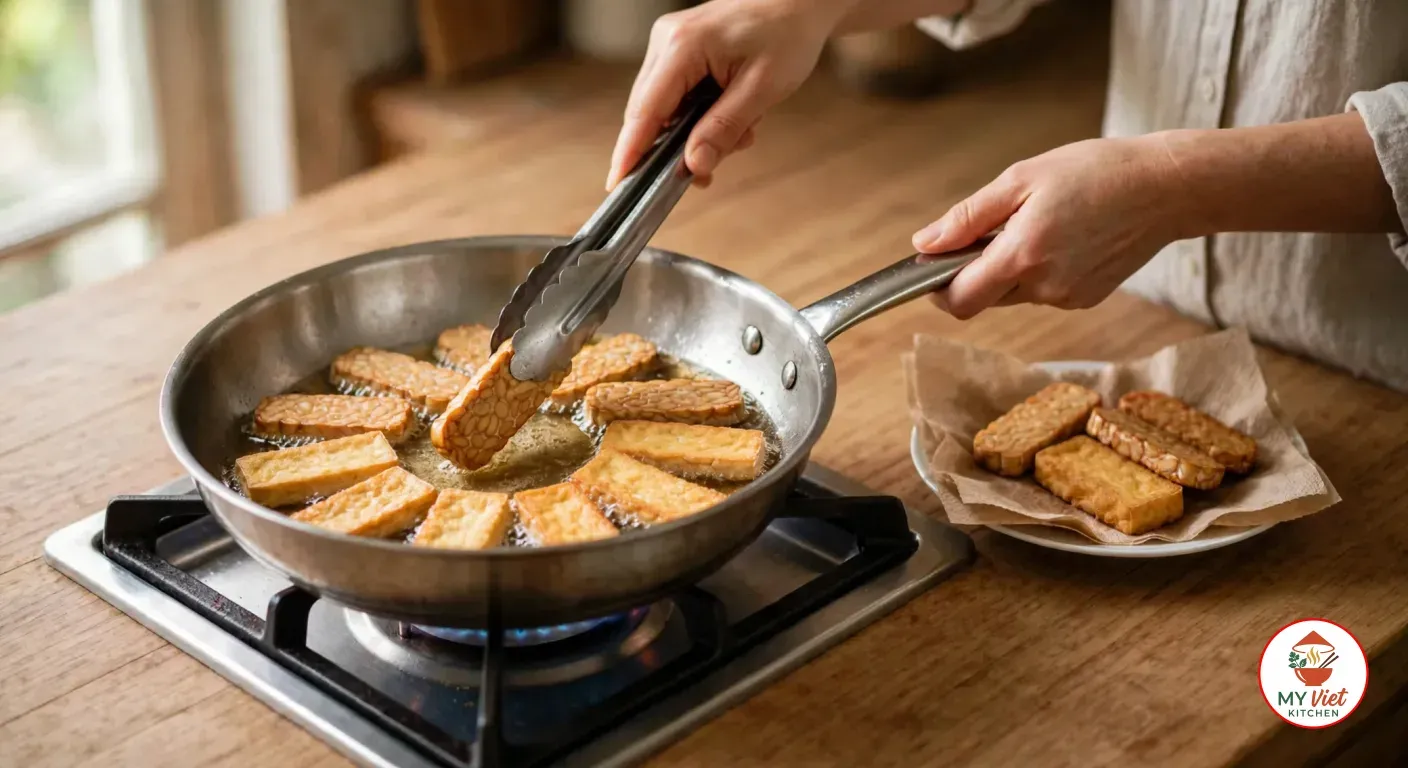
A hand turning a slice of tempeh with tongs in a stainless steel frying pan of golden tofu and tempeh slices in shallow oil, with a paper-towel-lined plate of fried slices beside the hob
Step 4- Fry the Tofu and Tempeh

Step 5: Assemble and Serve

5Rewarm the peanut sauce over low heat, beating in warm water a tablespoon at a time until it falls from a spoon in a thick ribbon. Arrange the potatoes, carrots, green beans, cabbage, bean sprouts, cucumber, tofu, tempeh and egg halves on a large plate or four plates. Pour the warm sauce over the middle, scatter with fried shallots and serve with prawn crackers and lime wedges.
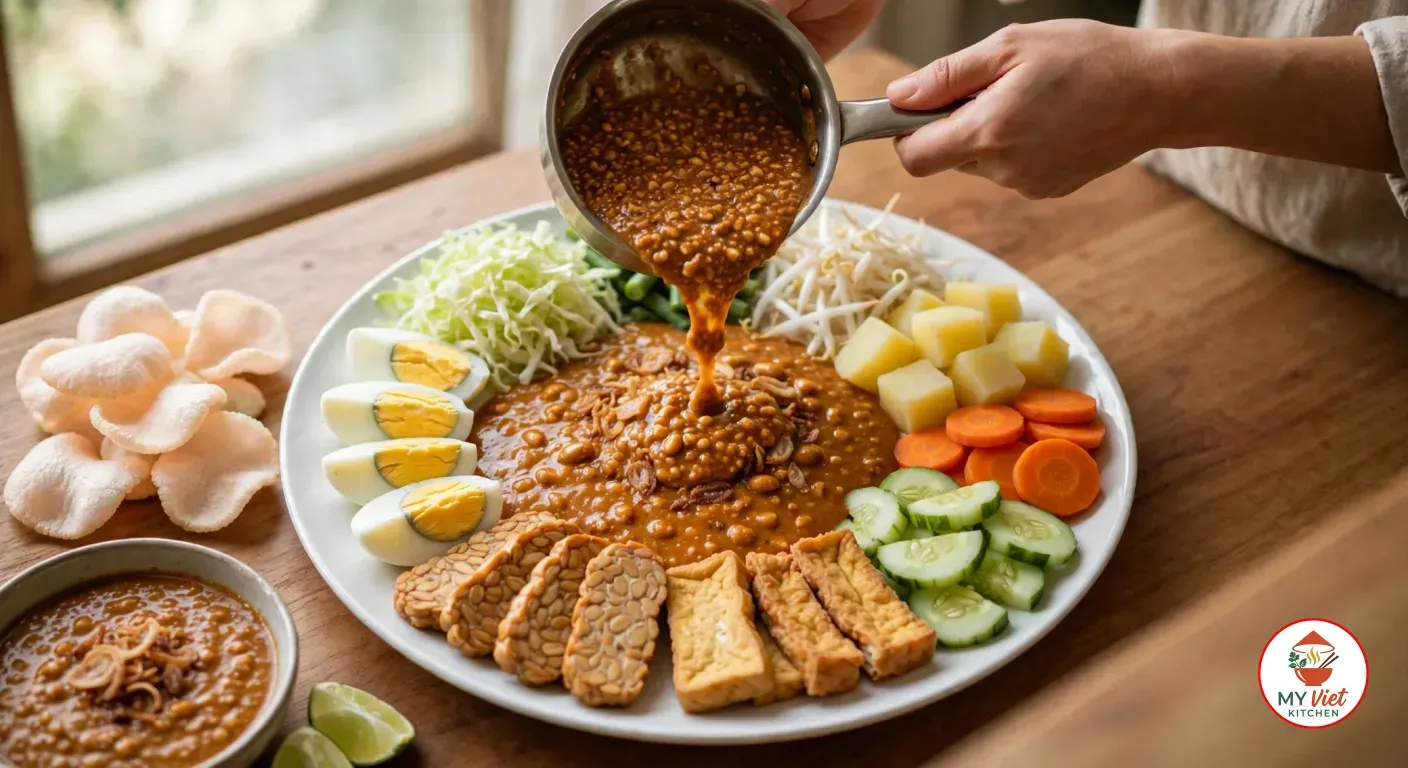
A hand pouring coarse peanut sauce from a small saucepan onto the centre of a white plate of cabbage, bean sprouts, potato cubes, carrot rounds, cucumber, egg halves, tempeh and tofu, with prawn crackers, a bowl of extra sauce and lime wedges on the table
Step 5- Assemble and Serve

Frequently Asked Questions

Where does gado-gado come from?

Nobody knows for sure: Wikipedia says the dish has no fixed historical background, only competing theories. One traces the name to the Betawi word digado, to eat without rice, which is why gado-gado comes with lontong rather than plain rice. Others credit Portuguese settlers who founded Tugu village in the early 1700s, or Chinese residents of Betawi reworking Javanese pecel. Wikipedia also says it is thought to have begun as a Sundanese dish, since it is most common in western Java (Wikipedia). The Munchies video description gives its meaning as “mix-mix” (Munchies).

Is gado-gado vegetarian or vegan?

Without the prawn crackers this recipe is vegetarian, and without the eggs as well it is vegan. Tom Pepinsky calls true gado-gado vegetarian, with meat only as an optional extra (Tom Pepinsky). Many sauces are not, though: Wikipedia lists terasi, a dried paste of shrimp, among the common sauce ingredients (Wikipedia). This version leaves terasi out. Check the labels on your kecap manis and crackers.

Can you make the peanut sauce ahead?

Yes. Wikipedia notes that outside Indonesia the sauce is often made ahead of time and in bulk (Wikipedia). Lara Lee warns that it thickens as it sits, so add water to keep it pourable when you use it (VICE). Chill it covered, and when you need it, warm it gently in a small pan with a spoonful or two of hot water. Pour it on only at the table so the vegetables stay crisp.

Is the video recipe the same as this one?

Close, but Lara Lee starts from fried raw peanuts and finishes her sauce in a food processor. The Munchies video description lists tomatoes, broccolini, green beans and potatoes, with pan-fried tempeh, firm tofu, hard-boiled eggs and a rich and spicy chili peanut sauce (Munchies). Her written recipe softens the garlic and chilies in oil and blends them with the peanuts, kecap manis and tamarind paste (VICE). This page starts from roasted peanuts, simmers the sauce, adds palm sugar and lime, and swaps cabbage for broccolini.

Sources

  • Gado-gado, Wikipedia
  • Gado-Gado Salad with Peanut Sauce Recipe, Lara Lee, VICE (Munchies), January 2021, reprinted from Coconut and Sambal
  • gado gado, Tom Pepinsky, October 2004
  • Make Gado Gado with Chef Lara Lee | Quarantine Cooking, Munchies, YouTube, January 2021
Love This Recipe?

Click on a star to rate it!

☆☆☆☆☆No votes so far! Be the first to rate this recipe.

Share

Tags: gado-gadogado-gado recipeIndonesian peanut sauce saladpeanut saucebumbu kacangIndonesian saladtempeh

A white oval platter of grilled LA galbi, flanken-cut short rib strips with oval bone cross-sections and charred, glossy edges, scattered with sesame seeds and spring onion, beside leaf lettuce, napa cabbage kimchi, a dish of ssamjang, a bowl of rice and metal chopsticks on a wooden table← PreviousGalbi (LA-Style Korean Short Ribs) with Asian Pear MarinadeNext →Green Curry (Gaeng Kiew Waan) with Chicken and Thai EggplantA white bowl of Thai green curry, a thin pale-green coconut sauce beaded with green oil, holding chicken thigh pieces, Thai eggplant wedges with streaked green skin and seeded white flesh, bamboo shoot strips, red pepper, sliced red chili, Thai basil and torn makrut lime leaves, beside a bowl of jasmine rice, a spoon and basil sprigs on a wooden table

More Asian Dishes

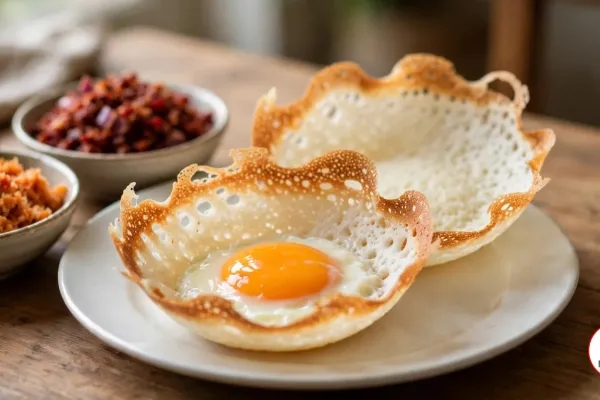
An egg hopper with a set white and a glossy orange yolk in its centre and a plain hopper behind it on a white plate, both thin golden bowls with lacy, holey edges, beside small bowls of orange-red pol sambol with a lime wedge and dark red lunu miris on a wooden table
Asian Dishes

Hoppers (Appa): Sri Lankan Bowl Pancakes from an Overnight Batter

November 1, 2026

A white plate of Hainanese chicken rice, a dome of pale golden rice beside slices of poached chicken with smooth, glossy, pale yellow skin, cucumber slices and cilantro, with small dishes of red chilli-garlic sauce, ginger and green onion sauce and dark soy sauce and a bowl of clear broth on a wooden table
Asian Dishes

Hainanese Chicken Rice with Poached Chicken and Three Sauces

October 30, 2026

A white oval plate of about ten gyoza in an overlapping row, turned crisp side up to show blistered golden-brown fried bottoms, beside a small speckled dish of dark soy and vinegar sauce dotted with red chili oil and a pair of wooden chopsticks on a wooden table
Asian Dishes

Gyoza: Crispy Japanese Pan-Fried Dumplings

October 29, 2026

Recent recipes

  • Homemade Tim Tam-style biscuits on a speckled white plate on a wooden table, rectangular sandwich biscuits coated in glossy milk chocolate with wavy ridges on top, one broken in half at the front to show two thin cocoa biscuits around a chocolate cream filling, with a cup of coffee behindHomemade Tim Tam Recipe: Copycat Malted Chocolate BiscuitsNovember 1, 2026
  • An egg hopper with a set white and a glossy orange yolk in its centre and a plain hopper behind it on a white plate, both thin golden bowls with lacy, holey edges, beside small bowls of orange-red pol sambol with a lime wedge and dark red lunu miris on a wooden tableHoppers (Appa): Sri Lankan Bowl Pancakes from an Overnight BatterNovember 1, 2026
  • Nine white squares of haupia with clean, straight edges set out in three rows on a glossy green ti leaf over a wooden board, with an empty half coconut shell and a linen napkin behindHaupia: Hawaiian Coconut Pudding Firm Enough to CutOctober 31, 2026
  • Three scoops of pale vanilla ice cream in a shallow white bowl, flecked with golden-amber honeycomb toffee nuggets and thin amber toffee streaks, beside four bubbly chunks of hokey pokey and a steel ice cream scoop on crumpled baking paper on a wooden tableHokey Pokey Ice Cream with Homemade Honeycomb ToffeeOctober 31, 2026

Follow us

Where shall we eat today?

  • Vietnamese
  • Asian
  • European
  • African
  • Americas
  • Australia
  • Drinks
  • Surprise me

Recently updated

  • Homemade Tim Tam Recipe: Copycat Malted Chocolate Biscuits
  • Hoppers (Appa): Sri Lankan Bowl Pancakes from an Overnight Batter
  • Haupia: Hawaiian Coconut Pudding Firm Enough to Cut
  • Hokey Pokey Ice Cream with Homemade Honeycomb Toffee
  • Hainanese Chicken Rice with Poached Chicken and Three Sauces

Categories

  • Vietnamese Dishes
  • Asian Dishes
  • European Dishes
  • African Dishes
  • American Dishes
  • Australian Dishes
  • Beverages

Pages

  • About Us
  • Contact Us
  • FAQ
  • Privacy Policy
  • RSS

Tags

European dishescomfort foodAfrican recipesLatin American foodWest African recipesAsian recipesAustralian cuisineEast African foodSouth American foodCaribbean cuisineAfrican dishesEastern European foodMexican foodSouth African foodvietnamese cuisineFrench cuisineBalkan foodCaribbean foodeasy dinner recipeItalian cookingMexican cuisinePeruvian foodBalkan cuisinefamily dinnerisland foodLatin American recipesNigerian cuisineNorth African recipessummer grillingAuthentic Vietnamese

All tags

Follow us
© 2026 My Viet KitchenAuthentic Vietnamese flavors, made simple