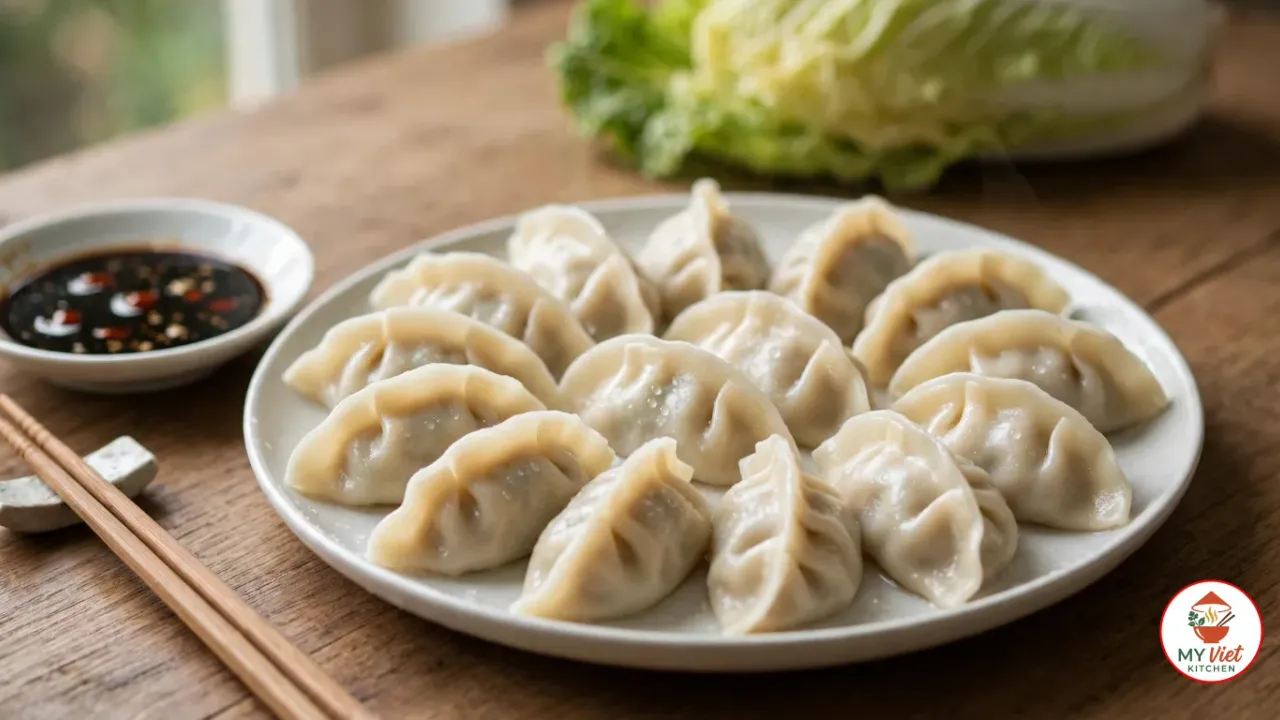
Jiaozi are Chinese dumplings: a ground meat or vegetable filling sealed inside a thin round of dough, then boiled, steamed or pan-fried, and traditionally dipped in black vinegar and soy sauce (Wikipedia). This recipe makes the boiled kind, shuijiao. You knead a firm cold-water dough, roll 40 wrappers, fill them with pork, napa cabbage and ginger, and boil them in two batches.
Prep Time: 1 hour 15 minutes | Cook Time: 25 minutes | Total Time: 2 hours 10 minutes, including 30 minutes of resting the dough | Servings: 4 (about 10 jiaozi each)
Difficulty: Medium | Calories: ~640 per serving

Where Do Jiaozi Come From?
Dumplings much like these were buried in the Astana Cemeteries near Turpan, in Xinjiang, a field of thousands of tombs dating from the 3rd to the 9th centuries. Turpan’s dry climate kept the food from decaying. A 2012 study in PLOS ONE says that, with their thin skin and stuffing, it is “surprisingly difficult to distinguish them from their modern counterpart”, and calls the cemeteries the earliest physical evidence of dumplings. Under the microscope, the dumpling the authors sampled proved to be made from a blend of wheat and foxtail millet flour, while wheat is the main grain in jiaozi today (PLOS ONE).
A folk story gives the dish a founder. In the version People’s Daily printed, Zhang Zhongjing, a physician of the late Eastern Han dynasty, came home in winter to find poor villagers with frostbitten ears. He boiled mutton, chili and herbs meant to drive out cold, chopped them, wrapped the mix in ear-shaped pieces of dough and cooked them (People’s Daily).
Each patient got two “jiao’er” and a bowl of broth, right up to New Year’s Eve. On New Year’s Day, the story goes, people copied the shape to celebrate (People’s Daily). Wikipedia lists it among several folk stories about where jiaozi and their name came from (Wikipedia).
In northern China jiaozi are eaten all year and are one of the main dishes of Chinese New Year. Their shape recalls the gold and silver ingots of imperial China, so they stand for wealth (Wikipedia). Maggie Zhu of Omnivore’s Cookbook calls boiled dumplings “the most important dish for celebrating Chinese (Lunar) New Year in northern China” (Omnivore’s Cookbook).
Cold Water or Hot Water: Which Dough Suits Boiled Jiaozi?
Dumpling dough is just flour and water, but the water’s temperature changes the wrapper. Boiling water partly cooks the flour, which reduces gluten and adds moisture, so the skin comes out tender. Zhu uses that hot-water dough for steamed dumplings and potstickers. For boiled dumplings she uses cold water, the method she calls the most popular in northern China (Omnivore’s Cookbook).
Elaine of China Sichuan Food draws the same line: she uses boiling water when the dumplings will be steamed, because the dough turns out much softer and easier to steam (China Sichuan Food).
This recipe uses cold water, at about 53 ml for every 100 g of flour. That sits between Elaine’s 155 ml to 300 g and Zhu’s 150 ml to 240 g. Weigh the flour if you can. Zhu counts about 120 g per cup and warns that a cup scooped by hand often holds more flour than the recipe intends (Omnivore’s Cookbook). Too much flour for the water gives a stiff dough that cracks as you fold.
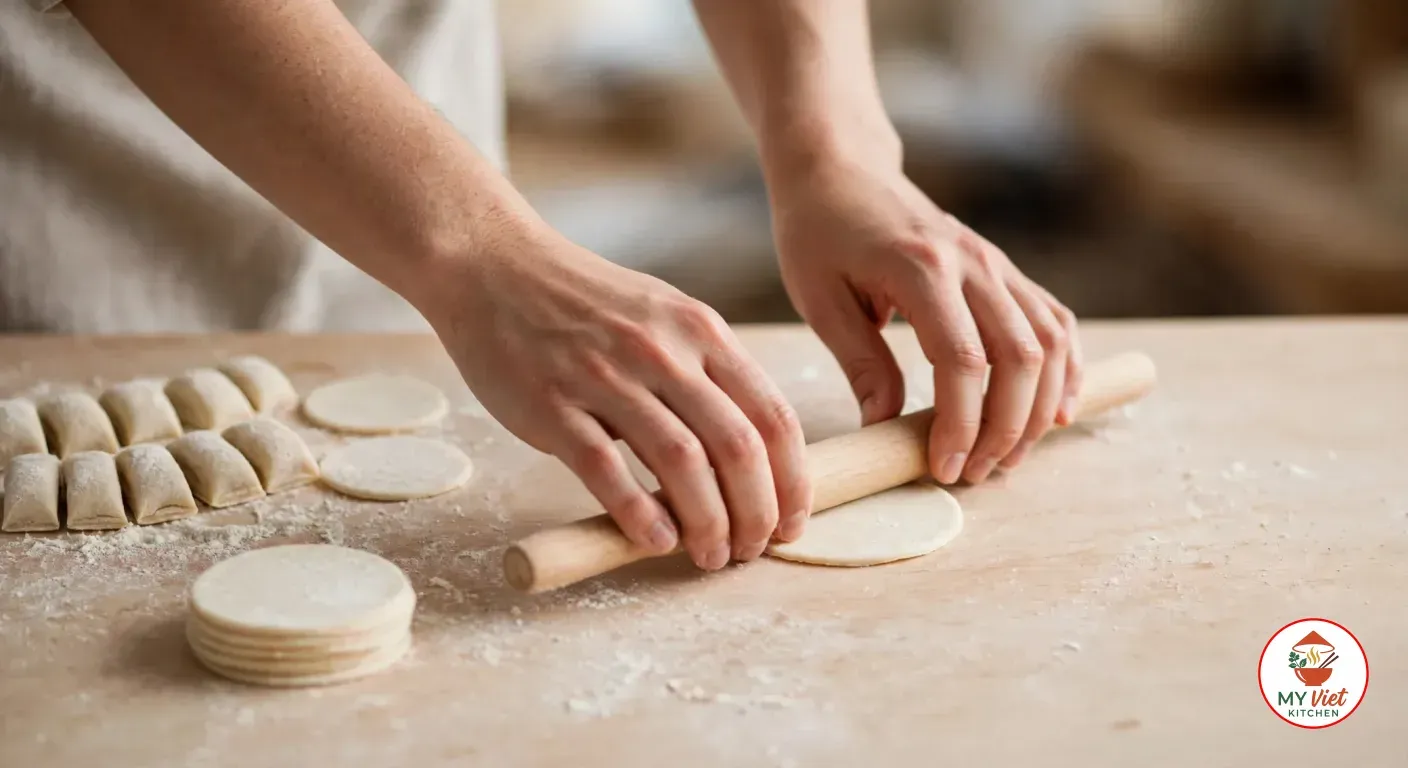
Roll each wrapper thinner at the rim than in the middle. Zhu’s are about 7 to 8 cm across and about 2 mm thick at the centre. The thicker middle holds the filling without breaking, and the thin edges are easier to fold (Omnivore’s Cookbook).
How Do You Keep the Filling Juicy and Cook It Through?
Start with pork that has some fat. Elaine’s recipe card asks for ground pork with at least 20% fat (China Sichuan Food); extra-lean meat sets into a dry, crumbly ball.
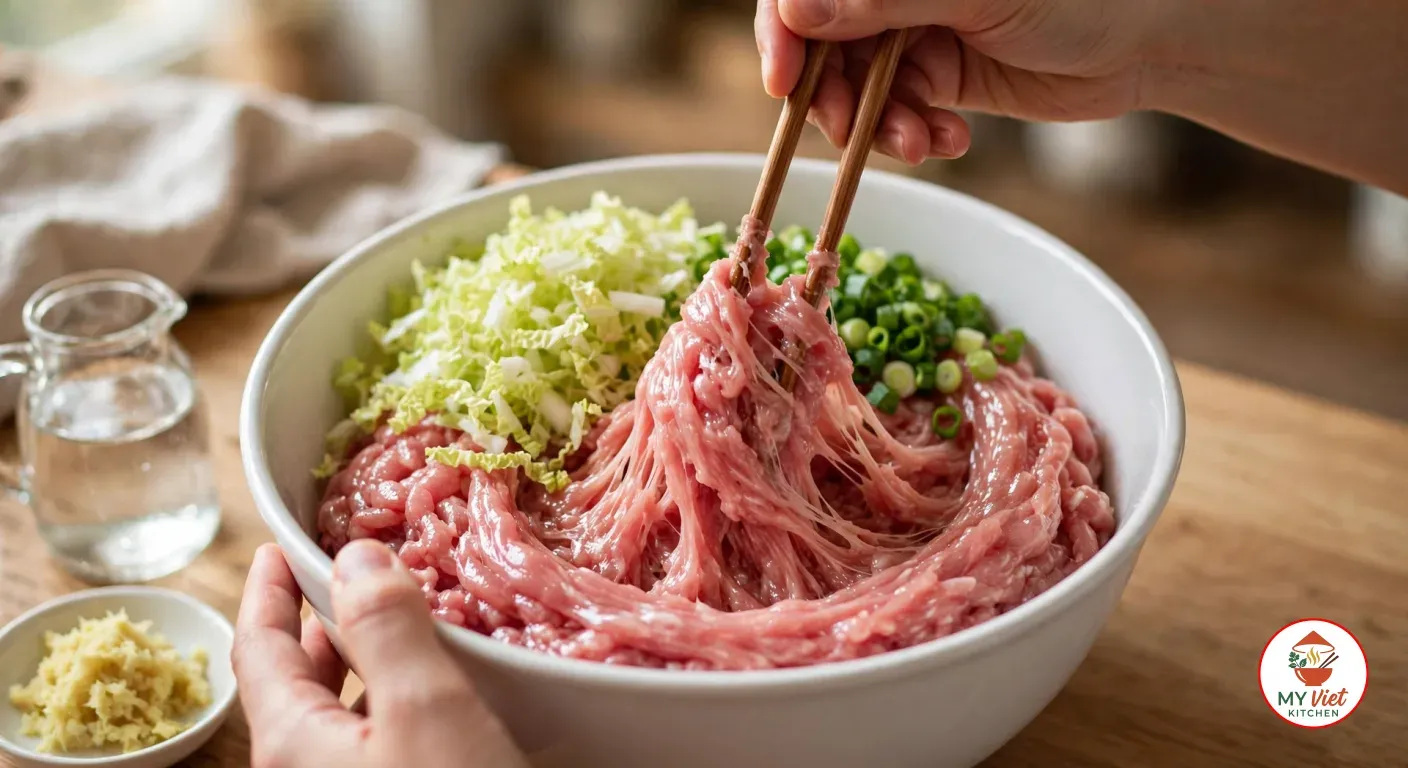
Napa cabbage is mostly water. Elaine salts chopped cabbage for 10 to 15 minutes and squeezes out the liquid before it goes into the meat. Then she beats the filling, always the same way round, for 2 to 3 minutes, and stops once it has become a sticky paste (China Sichuan Food). Here the pork also takes 3 tablespoons of water, a spoonful at a time, while you stir. Squeezing out cabbage juice and then adding plain water sounds odd, but the stirred meat holds the water it absorbs, while loose cabbage liquid runs out onto the wrapper and makes the edges hard to seal.
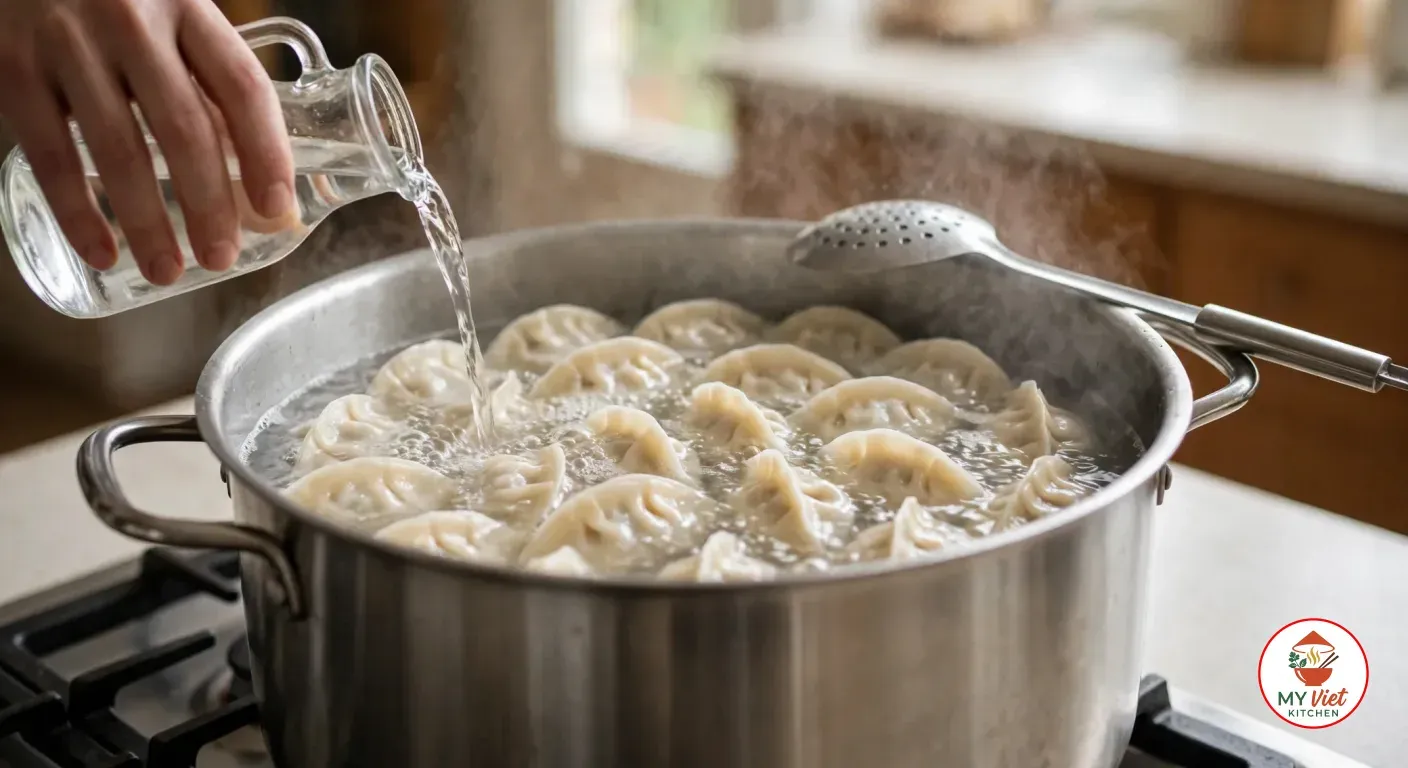
Boiled jiaozi are cooked in water that is brought back to the boil and then calmed with cold water. Elaine adds about 1/4 cup of cold water when the pot returns to a boil, does it once more, and takes the dumplings out once they turn transparent and puff up with the air inside (China Sichuan Food). This recipe uses 1/2 cup each time because 20 dumplings go into 4 litres of water at once. The pauses give the filling time to cook before the skin goes soft and splits.
Floating is a good sign but not proof. Health Canada’s safe internal temperature for ground pork is 71 °C (160 °F) (Health Canada). Push an instant-read thermometer into the filling of one dumpling from each batch. Without one, cut a dumpling open: the pork should be firm and opaque right through, with clear juices.
Ingredients for Jiaozi
For the dough
- 300 g (about 2 1/2 cups) all-purpose flour, plus more for dusting
- 160 ml (2/3 cup) cold water, plus 1 to 2 teaspoons if needed
- 1/4 teaspoon salt
For the filling
- 300 g (10 ounces) napa cabbage, about 1/4 of a medium head, finely chopped
- 1/2 teaspoon salt, for the cabbage
- 450 g (1 pound) ground pork, at least 20% fat
- 1 tablespoon finely grated fresh ginger
- 1 1/2 tablespoons light soy sauce
- 1 tablespoon Shaoxing wine
- 1/2 teaspoon salt
- 1/4 teaspoon ground white pepper
- 3 tablespoons cold water
- 3 scallions, finely sliced
- 1 tablespoon toasted sesame oil
For the dipping sauce
- 3 tablespoons Chinese black vinegar (Chinkiang)
- 1 tablespoon light soy sauce
- 1 teaspoon chili oil, with some of its flakes
- 1/2 teaspoon toasted sesame oil
- 1 small clove garlic, minced
Step-by-Step Instructions
Step 1: Make the Dough
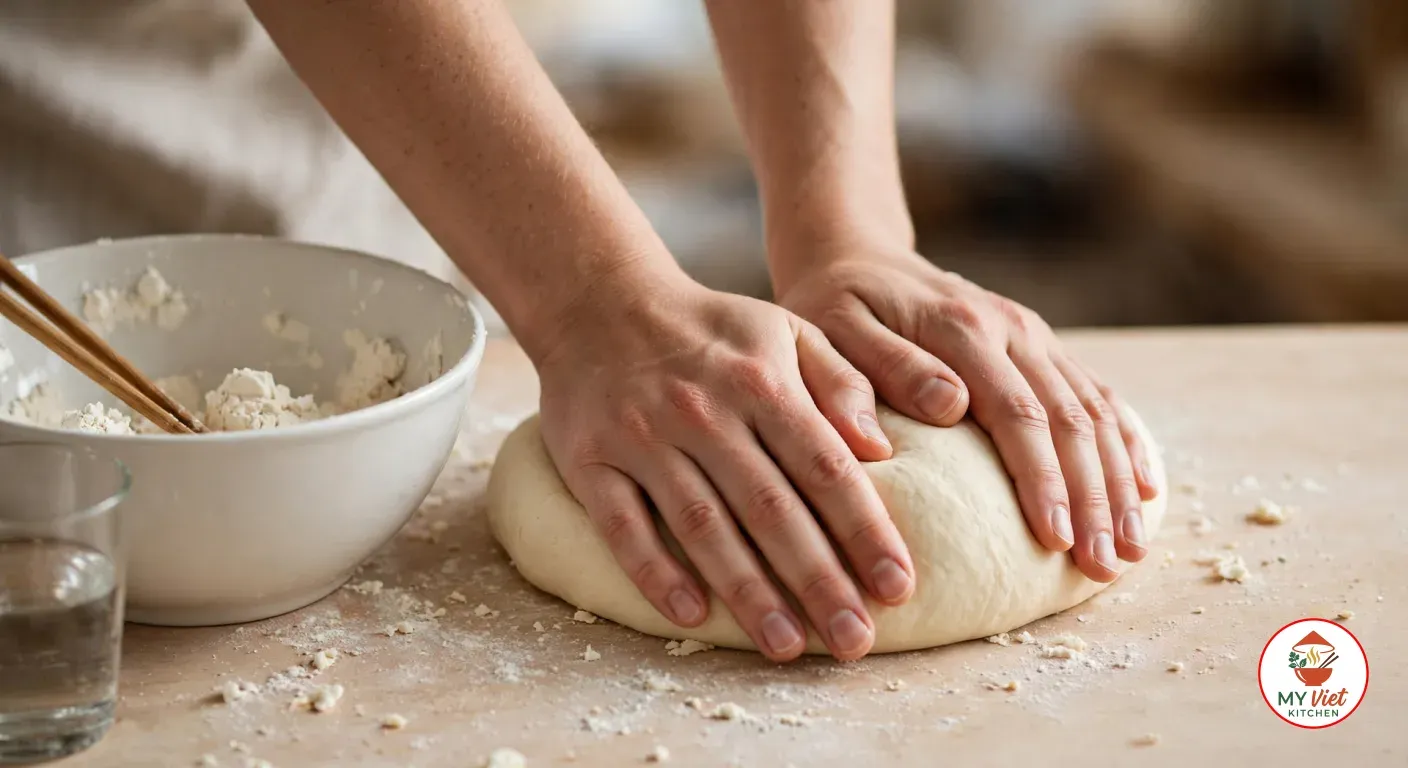
1Mix the flour with 1/4 teaspoon of salt in a large bowl. Drizzle in the cold water a little at a time, stirring with chopsticks, until no dry flour is left and the dough forms shaggy flakes. Squash the flakes together and knead the rough mass by hand, 8 to 10 minutes in all. It is ready when the surface looks smooth and a fingertip dent fills back in slowly. If it cracks, wet your hands and knead in 1 to 2 teaspoons more water; if it sticks, dust it with flour. Return it to the bowl under a damp towel for 30 minutes.
Step 2: Make the Filling
2While the dough rests, sprinkle the chopped cabbage with 1/2 teaspoon of salt, toss and set it aside for 10 to 15 minutes. In a large bowl, combine the pork, ginger, soy sauce, Shaoxing wine, the other 1/2 teaspoon of salt and the white pepper. Beat the mixture with chopsticks, always circling the same way, for 2 to 3 minutes, working in the 3 tablespoons of water a spoonful at a time, until the pork turns pale, sticky and stringy. Wring the cabbage out a handful at a time, or bundled in a clean towel, until it barely drips. Pile it into the bowl with the scallions and sesame oil and fold everything together.
Step 3: Roll the Wrappers
3Knead the rested dough for a few seconds, cut it in half and keep one half covered. Roll the other half into a rope about 2.5 cm (1 inch) thick and cut it into 20 pieces of roughly 11 g each. Dust the pieces with flour and press each one flat with your palm. Roll each disc with a small rolling pin, pushing from the edge toward the centre and back while your other hand turns the disc a little after every stroke. Aim for wrappers about 8 cm (3 1/4 inches) across, thinner at the rim than in the middle. Repeat with the second half of the dough.
Step 4: Fill and Fold the Jiaozi
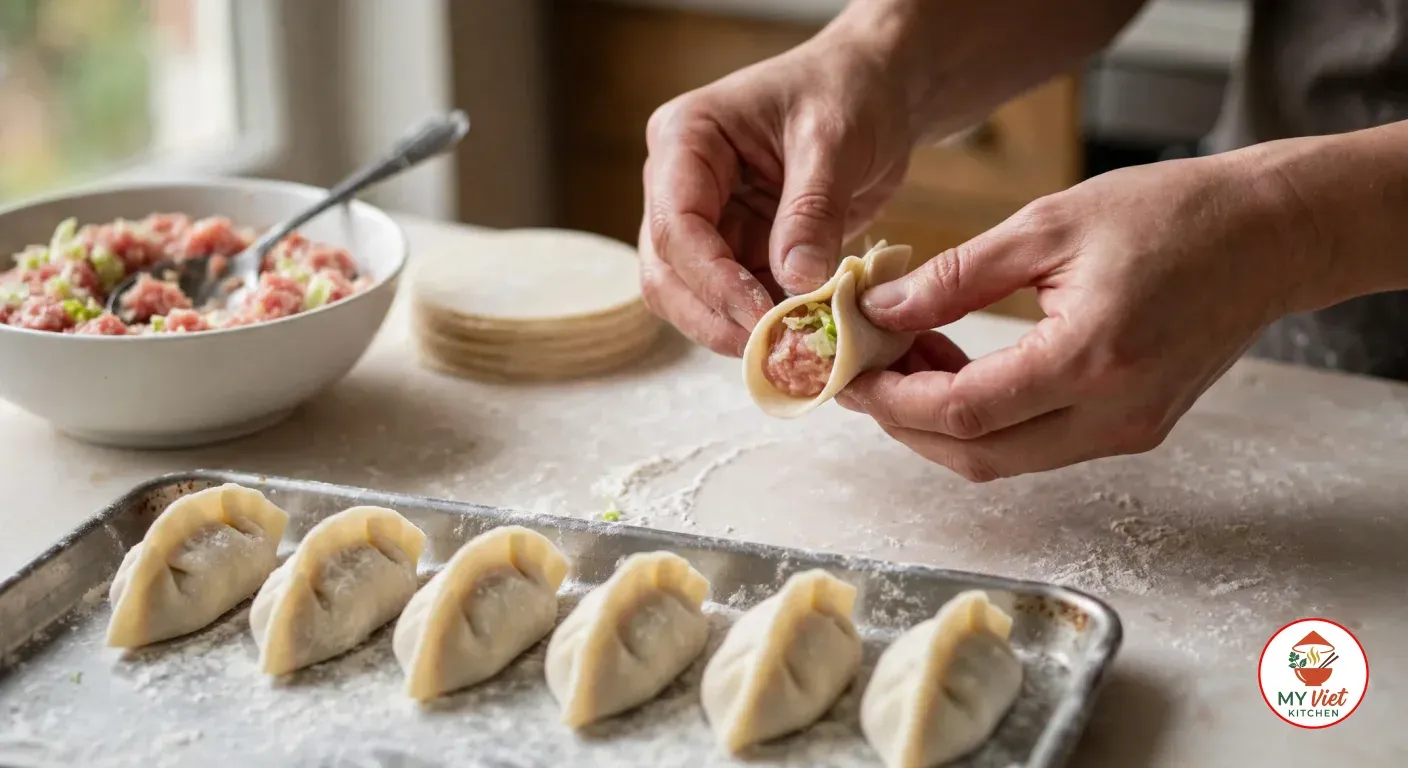
4Spoon about 1 tablespoon of filling onto the centre of a wrapper. Fold it into a half-moon and pinch the top centre closed. Working from the centre toward one corner, make 2 or 3 small pleats in the edge facing you, pressing each one against the flat back edge, then do the same toward the other corner so the dumpling sits up on its base. Press along the whole seam to seal it and push out any trapped air. Set the jiaozi on a floured tray without touching and keep them under a towel while you fold the rest.
Step 5: Boil the Jiaozi
5Heat about 4 litres (4 quarts) of water in your largest pot until it boils hard. Meanwhile, stir the black vinegar, soy sauce, chili oil, sesame oil and garlic together in a small bowl. Slide in half the jiaozi and nudge them with a skimmer so none stick to the bottom. When the water returns to a full boil, pour in 1/2 cup (120 ml) of cold water; when it boils again, add another 1/2 cup. Cook until the dumplings float, puff up and the wrappers look slightly translucent, 6 to 8 minutes in all. Check one with an instant-read thermometer or cut it open, then lift the batch out with the skimmer and serve it with the sauce while you cook the second half.
Frequently Asked Questions
Can you use store-bought wrappers for jiaozi?
Yes. The Woks of Life moved its pork and chive dumplings to store-bought wrappers in a newer version of that recipe (The Woks of Life). Packaged wrappers lack the tackiness of fresh dough, so run a wet fingertip around the rim before you pleat, or the seam may open in the pot. Cook them exactly as in Step 5 and check the filling the same way.
How do you freeze jiaozi?
Freeze them uncooked, as soon as they are folded. Maggie Zhu of Omnivore’s Cookbook always freezes dumplings raw, spaced apart on a tray dusted with flour, and keeps them for up to 2 months (Omnivore’s Cookbook). Once they are hard, tip them into a freezer bag. Health Canada allows raw ground meat 2 to 3 months at −18 °C (0 °F) or colder (Health Canada). Boil them straight from frozen: Zhu covers the pot and cooks them for 3 minutes, then about 1 minute more (Omnivore’s Cookbook). Test one for 71 °C (160 °F) before serving. Boiled leftovers keep 3 to 4 days in the fridge; fry them in a little oil until hot through, 74 °C (165 °F) (Health Canada).
Can you pan-fry jiaozi instead of boiling them?
Yes. Pan-frying is one of the standard ways to cook jiaozi, alongside boiling, steaming, deep-frying and baking, and the fried ones are called jianjiao. English speakers usually know them as potstickers, from the Mandarin guōtiē, though northern Chinese cooks treat guotie as a separate, longer dumpling (Wikipedia). Fry the jiaozi flat side down in 1 tablespoon of oil over medium heat for 2 minutes, add 1/3 cup (80 ml) of water, cover and steam for 6 to 8 minutes, then uncover and cook until the pan is dry and the bottoms are crisp. Expect a chewier skin than you get from hot-water dough, which Maggie Zhu prefers for potstickers (Omnivore’s Cookbook).
Are jiaozi and gyoza the same thing?
Gyoza grew out of jiaozi. Wikipedia describes them as a Japanese version, developed from recipes that colonists carried home from Manchukuo in northeast China after World War II. In its account the Japanese style leans harder on garlic and usually comes in thin, machine-made wrappers. Jiaozi vary so much from region to region in China, though, that thin skins turn up there too (Wikipedia).
Sources
- Jiaozi, Wikipedia
- Archaeobotanical Study of Ancient Food and Cereal Remains at the Astana Cemeteries, Xinjiang, China, Tao Chen et al., PLOS ONE, September 2012
- 你知道冬至为什么吃饺子吗? 医圣张仲景发明 (Why do we eat dumplings at the winter solstice?), People’s Daily Online, Shandong channel, December 2015 (archived copy)
- How to Make Chinese Dumplings from Scratch, Maggie Zhu, Omnivore’s Cookbook, December 2024
- Dumpling Wrappers Recipe (饺子皮), Maggie Zhu, Omnivore’s Cookbook, August 2025
- How to Make Chinese Chive and Pork Dumplings (Jiaozi), Elaine, China Sichuan Food, November 2024
- Pork and Chive Dumplings, Judy, The Woks of Life, October 2026
- Safe internal cooking temperatures, Health Canada, June 2024
- Safe food storage, Health Canada, April 2024
- Pork & Cabbage Dumplings Made From Scratch (猪肉白菜水饺), Wei’s Red House Kitchen, YouTube, April 2021