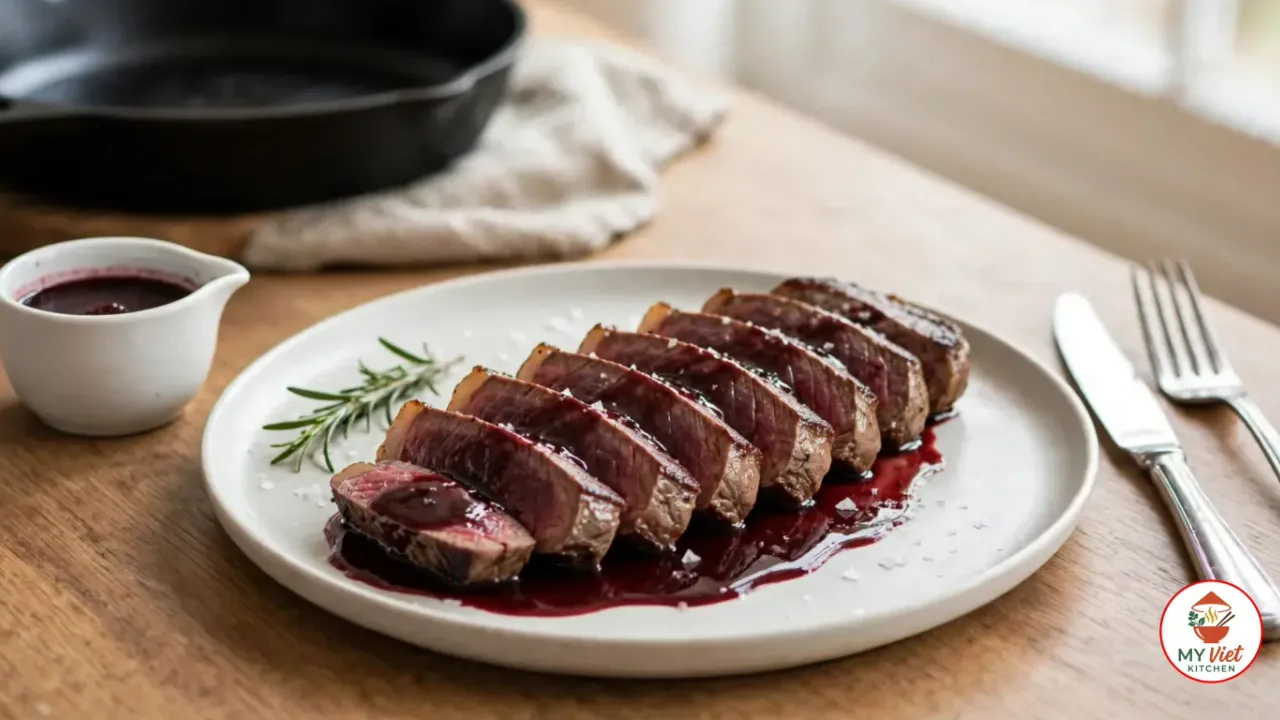
Kangaroo steak is a cut of lean red meat from wild kangaroos, which in Australia are shot by licensed harvesters in designated zones rather than farmed (Wikipedia). In this version, loin fillets are rubbed with rosemary and thyme, browned fast in cast iron, then basted with garlic butter. They rest while a Shiraz sauce reduces in the same pan. Use a thermometer: with so little fat, a minute too long shows.
Prep Time: 10 minutes | Cook Time: 20 minutes | Total Time: 1 hour, including 30 minutes at room temperature | Servings: 2
Difficulty: Easy | Calories: ~430 per serving

Which Cut Should You Buy for Kangaroo Steak?
Look for loin fillet. The Australian food composition database keeps separate raw entries for kangaroo loin fillet, rump and “steak, as purchased” (FSANZ). Supermarket brand K-ROO sells both a “Kangaroo Fillet” and a “Kangaroo Steak” through Coles, Woolworths and independent supermarkets (K-ROO). Game supplier Gamekeepers labels the same long muscle “Kangaroo Sirloin - Backstrap” (Gamekeepers). Any of those names will do. Choose pieces about 3 cm thick, so the outside can brown before the middle overcooks.
Raw kangaroo is a dark burgundy red, with no fat cap and no white flecks running through it. The FSANZ figures explain why. Per 100 g raw, kangaroo loin fillet carries 0.9 g fat, 21.4 g protein and 3.4 mg iron. The same weight of lean beef rump, raw, has 2.8 g fat and only 2.1 mg iron (FSANZ). Under a gram of fat leaves nothing to keep the centre juicy once it passes medium. That is the reason for the butter in Step 2 and the short cooking time.
Four species are harvested commercially: the red kangaroo, the western grey, the eastern grey and the common wallaroo. South Australia legalised kangaroo meat for human consumption in 1980; in New South Wales, Queensland and Victoria it could only be sold as pet food until 1993 (Wikipedia).
How Long Should You Sear Kangaroo, and How Rare Is Safe?
Recipes from Australian cooks agree on a short, hot cook, and differ on the minutes:
- SBS Food’s seared loin: a 250 g piece over medium-high heat for about 2 minutes a side, which it calls medium-rare, then 5 minutes’ rest (SBS Food).
- Gamekeepers: 2 minutes in a hot pan, then a further 2 to 3 minutes on medium to low heat after turning; it says kangaroo “is best served rare” (Gamekeepers).
- Justine Schofield on SBS: 3 to 4 minutes a side over medium-high heat for medium, then 4 to 5 minutes’ rest (SBS Food).
- K-ROO: 4 to 5 minutes a side at medium-high for medium-rare, then 10 minutes under foil (K-ROO).
Thickness and stoves vary that much, so judge by temperature. The Food Safety Information Council names kangaroo on its chart next to beef and lamb. For steaks, chops and roasts, it says food-poisoning contamination sits only on the outside, so brown the surface well. Its medium-rare figure for the centre is 63°C, followed by 3 to 5 minutes’ rest. It also cautions that rare or raw whole cuts may carry a risk of parasitic infection such as toxoplasmosis (Food Safety Information Council).
One published outbreak shows how uncertain the link is. A 1995 report by Jenny Robson and a colleague described a probable foodborne toxoplasmosis outbreak among guests at a function. Two Queensland public-health doctors replied that no food had shown a statistically significant link, and that no evidence had been presented of tissue cysts in kangaroo meat. Robson answered that undercooked red kangaroo meat, which most attendees noticed, was still the most likely source (Communicable Diseases Intelligence). Flinders University researchers say cooking meat to 66°C, or freezing it before cooking, kills Toxoplasma (Flinders University).
Health Canada does not list kangaroo. It puts medium-rare beef and lamb steaks at 63°C (145°F) and wild game such as deer and elk at 74°C (165°F) (Health Canada). This recipe stops at the Australian council’s 63°C. If you want the dark red centre the cooks above aim for, you are taking the risk the council describes.
Ingredients for Kangaroo Steak
For the Steaks:
- 2 kangaroo loin fillet steaks, about 200 g (7 oz) each and 3 cm (1 1/4 inches) thick, thawed if frozen
- 1 tablespoon (15 ml) olive oil, plus 1 teaspoon for the pan
- 1 teaspoon finely chopped fresh rosemary
- 1 teaspoon fresh thyme leaves
- 3/4 teaspoon flaky sea salt
- 1/2 teaspoon cracked black pepper
- 1 tablespoon (15 g) butter
- 2 garlic cloves, lightly crushed
- 1 sprig fresh rosemary
For the Red Wine Sauce:
- 1 small shallot, finely chopped
- 3/4 cup (180 ml) dry red wine, such as Shiraz
- 1/2 cup (125 ml) beef stock
- 1 teaspoon Dijon mustard
- 1 teaspoon honey
- 2 tablespoons (30 g) cold butter, cut into 4 cubes
- Salt and pepper to taste
Step-by-Step Instructions
Step 1: Season the Kangaroo Fillets
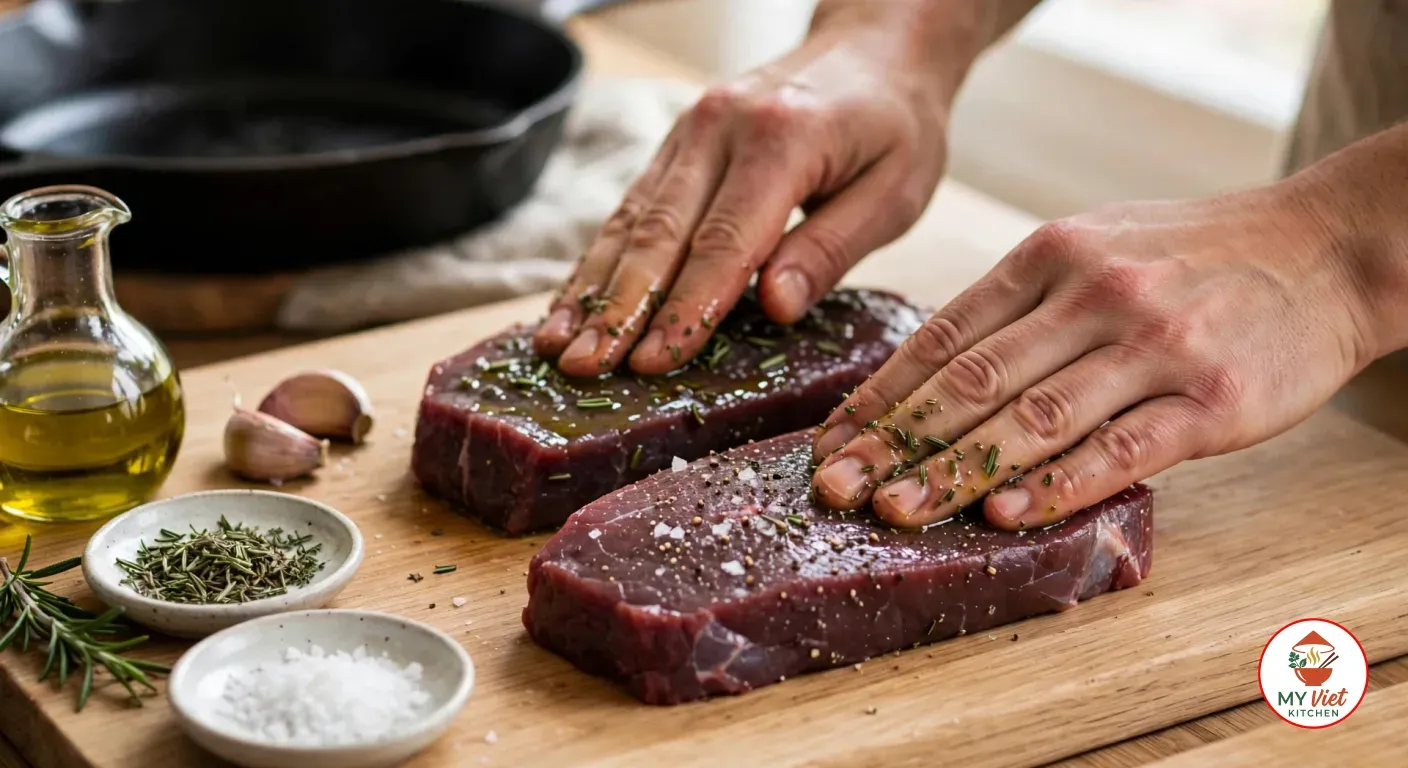
1Half an hour before you cook, lift the kangaroo out of the fridge and blot both sides dry with paper towels. Rub them all over with the tablespoon of olive oil, the chopped rosemary and the thyme, then season both sides with the flaky salt and cracked pepper. Leave them on a plate at room temperature while you chop the shallot and measure out the sauce ingredients.
Step 2: Sear and Baste
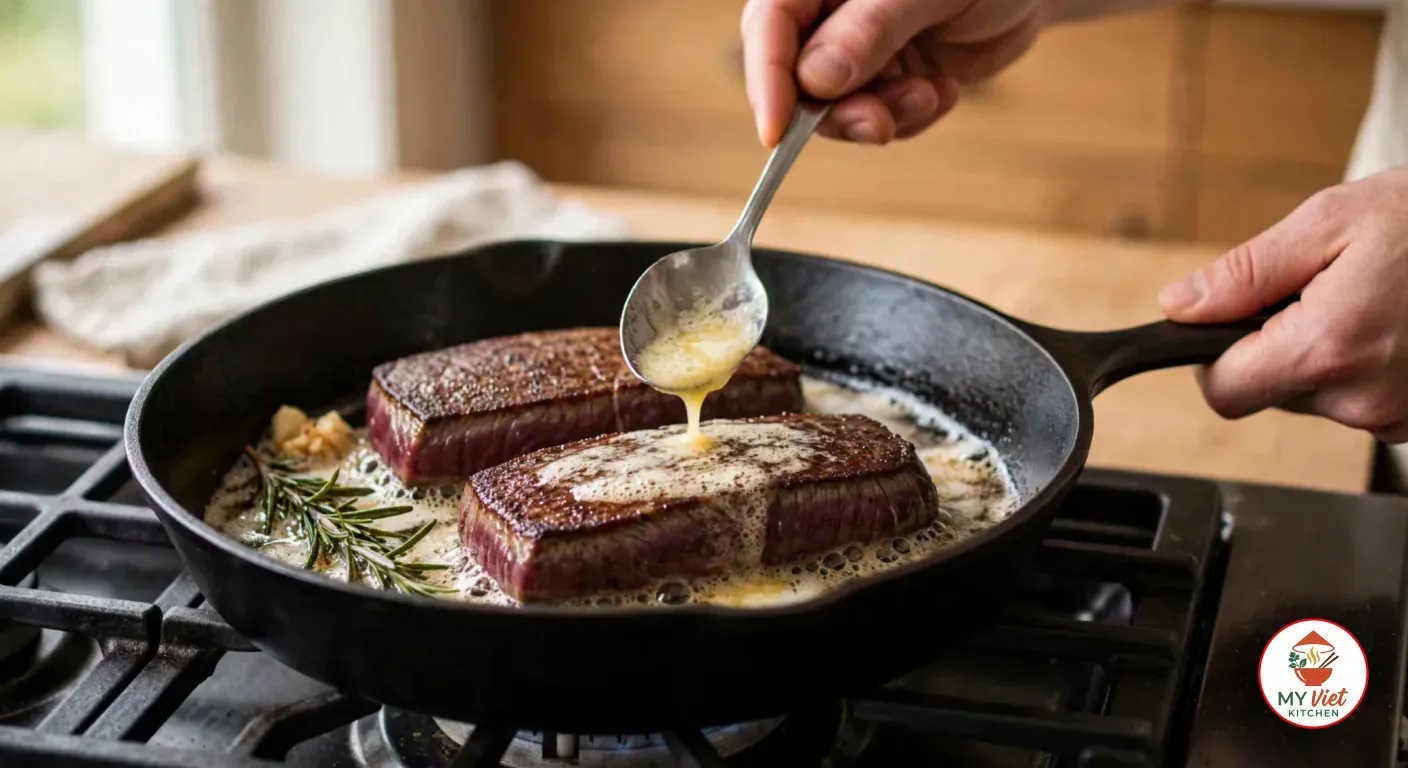
2Set a 25 cm (10-inch) cast-iron skillet over high heat until it smokes faintly, then add the teaspoon of oil. Lay in the steaks and leave them untouched for 2 minutes, until the underside is dark brown. Turn them and give the second side 2 minutes. Lower the heat to medium, add the butter, garlic and rosemary sprig, tilt the pan and spoon the foaming butter over the meat, turning the steaks every minute. Check the thickest part with an instant-read thermometer and take them off at 63°C (145°F), usually 2 to 4 minutes after the butter goes in. Rest them on a warm board for 5 minutes.
Step 3: Make the Red Wine Sauce
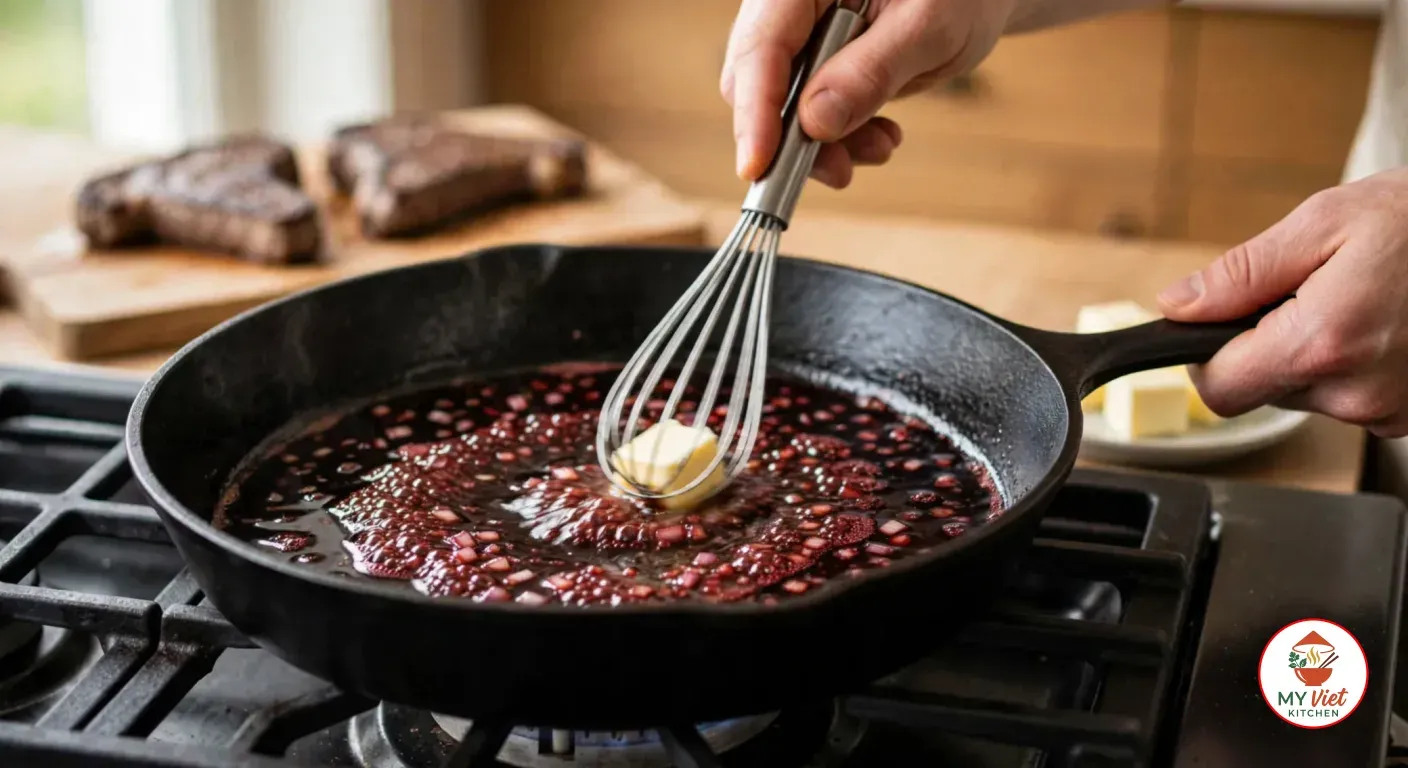
3While the steaks rest, lift the garlic and rosemary out of the skillet and pour off all but about 1 tablespoon of the fat. Return the pan to medium heat, add the shallot and stir for 1 minute until soft. Pour in the wine, scrape up the browned bits and boil until it has reduced by about half, 3 to 4 minutes. Add the stock, mustard and honey and boil 3 to 4 minutes more, until about 1/3 cup (80 ml) is left and it lightly coats a spoon. Take the pan off the heat, whisk in the cold butter one cube at a time, and season with salt and pepper.
Step 4: Slice Across the Grain
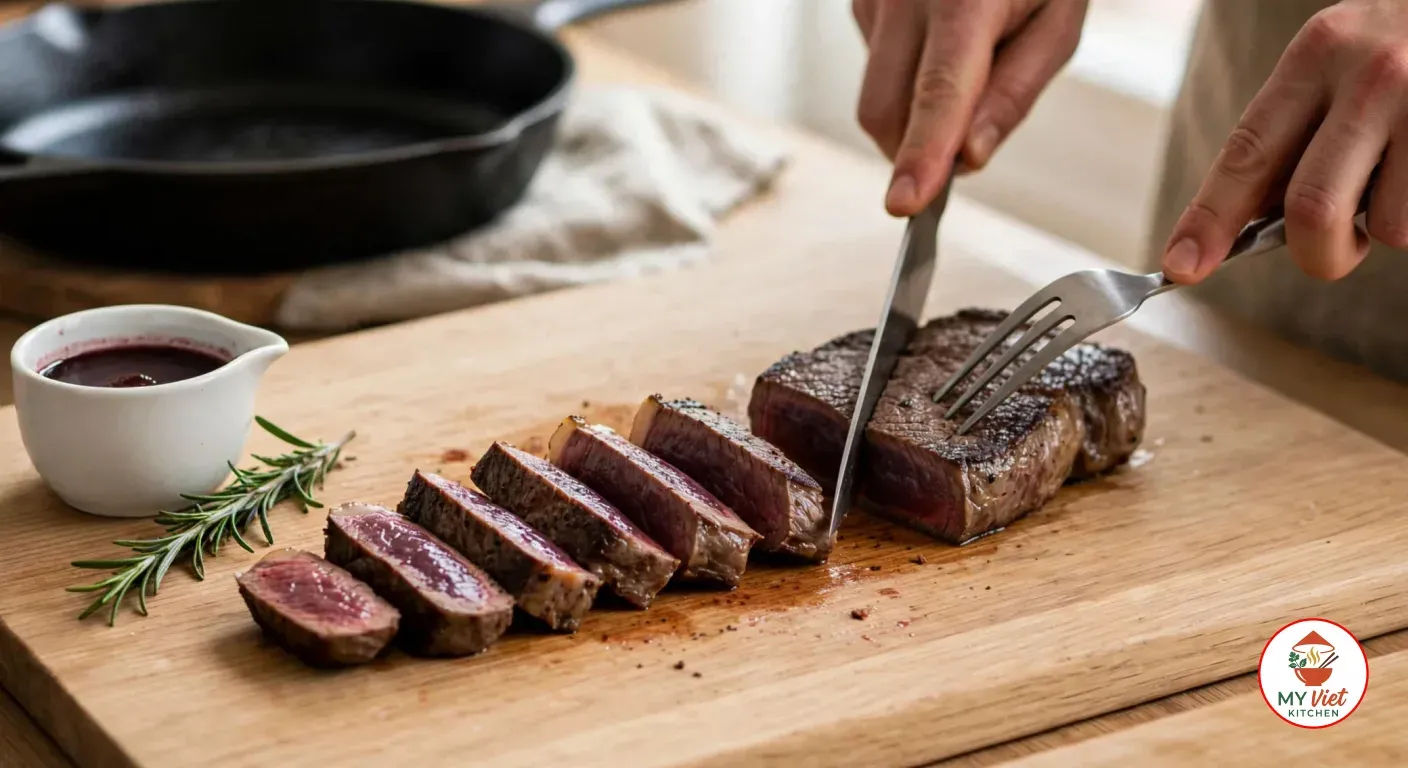
4Tip any juices from the resting board into the sauce. Find the direction of the muscle fibres on each steak and cut across them with a sharp knife into slices about 1 cm (1/2 inch) thick. Fan the slices on warm plates, spoon the sauce over and serve at once.
Frequently Asked Questions
What does kangaroo steak taste like?
Stronger than beef or lamb, with a gamey edge, according to Wikipedia’s article on kangaroo meat (Wikipedia). Justine Schofield, writing for SBS Food, calls kangaroo “a great alternative to beef” (SBS Food). Andy Cooks seasons his loins with nothing more than salt and wattleseed (Andy Cooks).
Can you cook kangaroo steak on a barbecue?
Yes. In the video above, Andy Cooks brushes 200 g loins with a high-temperature oil and grills them over very high heat. They get 2 to 3 minutes a side or until they reach 45°C inside, then rest for at least 6 minutes (Andy Cooks). K-ROO gives one method for a frying pan or barbecue at medium-high heat, 4 to 5 minutes a side for medium-rare, with a 10-minute rest under foil (K-ROO). Andy’s 45°C is a rare steak, well below the council’s 63°C.
Can you buy kangaroo meat outside Australia?
In many countries, yes. Wikipedia says about 70 percent of Australia’s kangaroo meat is exported, to over 61 overseas markets, much of it to Europe and particularly Germany and France. California is the exception in the United States, having banned kangaroo products outright since 1971 (Wikipedia). If yours arrives frozen, thaw it on a plate in the fridge the day before.
How long do cooked kangaroo steaks keep?
Up to 4 days chilled or about 3 months frozen. Health Canada sets cooked meat at 3 to 4 days chilled at 4 °C (40 °F) or less. In a freezer kept at −18 °C (0 °F), it gives 2 to 3 months (Health Canada). Keep the sauce in a separate container. Leftover slices are best eaten cold over salad leaves, because warming them to Health Canada’s 74 °C (165 °F) for leftovers will cook a pink centre through (Health Canada).
Sources
- Kangaroo meat, Wikipedia
- Australian Food Composition Database, Release 3, Food Standards Australia New Zealand, December 2025
- Safe cooking temperatures, Food Safety Information Council
- Correspondence: Toxoplasmosis and kangaroo meat, Rod Davison, Ossama El-Saadi and Jenny Robson, Communicable Diseases Intelligence, February 1996
- Toxoplasma in undercooked meat, Yaz Dedovic, Flinders University, December 2019
- Safe internal cooking temperatures, Health Canada, June 2024
- Safe food storage, Health Canada, April 2024
- Seared kangaroo loin, Sam Bourke, SBS Food, February 2024
- Kangaroo with red wine sauce and wild rosella, Justine Schofield, SBS Food, March 2019
- Kangaroo Sirloin, Gamekeepers
- Kangaroo Fillet and Kangaroo Steak, K-ROO
- Have you ever tried Kangaroo steak?, Andy Cooks, YouTube, February 2023