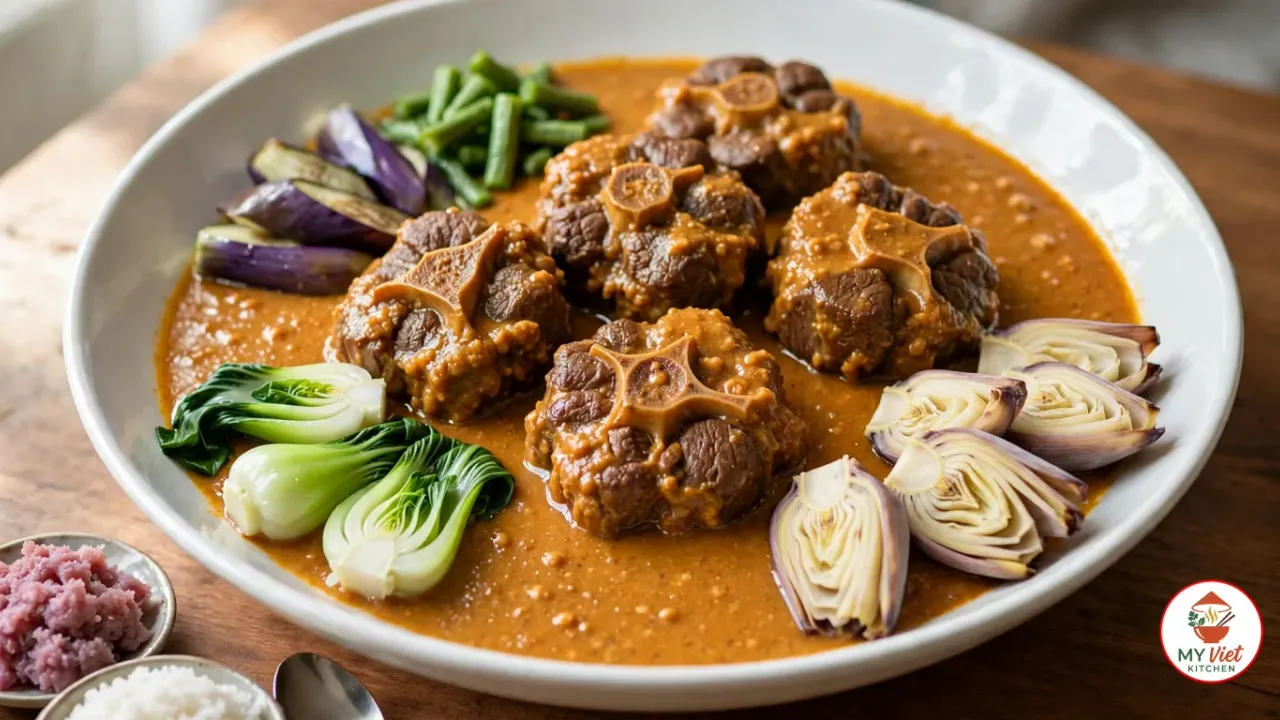
Kare-kare is a Filipino stew of oxtail, often with tripe, in a thick sauce of ground roasted peanuts. Annatto colours it orange, toasted ground rice thickens it, and it is often eaten with bagoong, a shrimp paste (Wikipedia). Here the oxtail simmers for up to 3 hours while you build the peanut sauce in a separate pan. The vegetables are blanched on their own so they stay bright and firm.
Prep Time: 30 minutes | Cook Time: 3 hours 30 minutes | Total Time: 4 hours | Servings: 6
Difficulty: Medium | Calories: ~600 per serving

Where Does Kare-Kare Come From?
Nobody can say for certain. Wikipedia’s article calls the origin disputed because definitive primary sources are lacking. It also notes that peanuts reached the Philippines from Mexico in the 16th century, on the Spanish galleon trade (Wikipedia).
SBS Filipino sets out three stories. In the first, Kapampangan cooks in Pampanga made a curry called kari, commonly of mudfish with ginger, turmeric and safflower. In the second, Tagalogs in Pasig copied it with substitutes such as annatto seeds for colour, and their attempt was mocked as kari-kari, a poor imitation (SBS Filipino).
The third story credits Indian sepoys who arrived with the British in 1762. They stayed on in Cainta and sold their own kari, with achiote and peanuts, from huts along the Pasig River. SBS calls it the more believable version (SBS Filipino).
Ruston Banal, an artist who specialises in culinary history, looked into the Pampanga claim for KainCon 2024, a conference run with the National Commission for Culture and the Arts. The Philippine Information Agency reports that he found no proof in the archives that kari-kari began in Pampanga (PIA).
Banal traced the dish instead to sepoys of the East India Company’s Madras army, who joined the British attack of 1762. They stayed after the British left and set up curry stalls called karihan (PIA). Each story ties the name to kari, a curry, but which one is true remains open.
How Long Does Oxtail Take to Get Tender?
Plan on 2 to 3 hours of gentle simmering. Filipino recipes land in the same range:
- Panlasang Pinoy: 2 1/2 to 3 hours, or 35 minutes in a pressure cooker (Panlasang Pinoy).
- Hungry Huy: 2 to 3 hours, covered, for oxtail and beef shank together (Hungry Huy).
- Pepper.ph: 2 1/2 hours for oxtail, shank and tripe in one pot (Pepper.ph).
Thick pieces from the base of the tail take longest, so test one of those. Start checking at 2 1/2 hours: the meat should slide off the bone when you push it with a fork. Hold the pot at a bare simmer, with only a bubble or two breaking the surface. A rolling boil churns the fat into the broth and clouds it.
Oxtail gives off a lot of fat. The lamb shank kare-kare in Anna Manlulo’s SBS Filipino article cooks the meat a day ahead, so the solid fat can be removed after an overnight rest (SBS Filipino). The same trick works here. Chill the strained broth and the oxtail separately after Step 1, scrape off the hard yellow layer the next day, and go on with Step 3.
What Gives the Sauce Its Colour and Body?
Peanuts give the flavour. Pepper.ph toasts raw peanuts until their edges brown, then grinds them into its own peanut butter (Pepper.ph). MG Sanchez at Hungry Huy grinds them for about 10 seconds in short bursts. Grinding too long, the recipe warns, leaves you with peanut butter instead of fine grounds (Hungry Huy). Panlasang Pinoy uses both: 1 cup of ground peanuts and 1/2 cup of peanut butter (Panlasang Pinoy). If you go with jarred peanut butter alone, pick an unsweetened one.
Annatto gives the orange. Pepper.ph steeps 3/4 cup of the small rust-red seeds in boiling water for 20 minutes, then strains them out (Pepper.ph); Hungry Huy uses 1 tablespoon of annatto powder instead (Hungry Huy).
Toasted rice gives the body. Hungry Huy browns raw white rice in a dry pan for about a minute, lets it cool and blends it to a powder (Hungry Huy). Rice flour toasted in a pan saves the blending. This recipe uses 1/4 cup of it for 4 cups of broth; Pepper.ph thickens its pot with 5 tablespoons of rice flour (Pepper.ph). In the video above, Vanjo Merano thickens with cornstarch and simmers the vegetables in the pot rather than blanching them (Panlasang Pinoy).
How Do You Prepare Banana Heart and the Other Vegetables?
The usual vegetables are banana heart (puso ng saging), eggplant, string beans and pechay (Wikipedia). Banana heart is the least familiar. Hungry Huy notes that Asian supermarkets sell the whole flower. Its recipe peels off the tough purple outer leaves until you reach the lighter yellow centre, a job it compares to preparing artichokes. Then it quarters the heart and soaks it in lemon or lime water to stop it changing colour (Hungry Huy).
Pepper.ph soaks its pieces in salted cold water for 10 to 15 minutes (Pepper.ph). Cut the heart just before soaking, because the cut faces brown fast. If you can’t find one, use more beans and bok choy.
For the eggplant, choose the long, slim Asian kind; Hungry Huy uses Japanese eggplants. Its cook blanches every vegetable on its own and cools it in an ice bath, so the beans and the eggplant don’t have to finish at the same moment (Hungry Huy). That is the method in Step 4. Pepper.ph does the opposite, adding the eggplant, beans and pechay to the pot just before serving (Pepper.ph). That way is faster, but the vegetables pick up the orange of the sauce.
Ingredients for Kare-Kare
For the Oxtail:
- 1.5 kg (3 1/4 lb) oxtail, cut into 5 cm (2-inch) pieces
- 500 g (1 lb) cleaned beef tripe, cut into 5 cm pieces (optional)
- 10 cups (2.4 litres) cold water
- 1 large onion, quartered
- 1 head garlic, cloves crushed
For the Peanut Sauce:
- 1/4 cup annatto seeds
- 3/4 cup (180 ml) hot water, for the annatto
- 1/4 cup (40 g) rice flour
- 1/2 cup (120 ml) cold water, for the rice flour
- 2 tablespoons vegetable oil
- 1 large onion, diced
- 4 garlic cloves, minced
- 1 1/2 cups (220 g) unsalted roasted peanuts, finely ground, or 1 cup (250 g) unsweetened smooth peanut butter
- 2 tablespoons fish sauce
- 1 tablespoon sugar
- Salt and black pepper to taste
Vegetables and to Serve:
- 1 small banana heart (puso ng saging), about 400 g
- Juice of 1 lime
- 1 tablespoon salt, for the blanching water
- 200 g (7 oz) yard-long beans (sitaw), cut into 7 cm (3-inch) lengths
- 2 long Asian eggplants, about 300 g, cut on the diagonal into 2 cm slices
- 300 g (10 oz) baby bok choy or pechay, halved lengthwise
- 1/2 cup bagoong alamang (sautéed shrimp paste), for serving
- Steamed white rice, for serving
Step-by-Step Instructions
Step 1: Boil and Tenderize the Oxtail
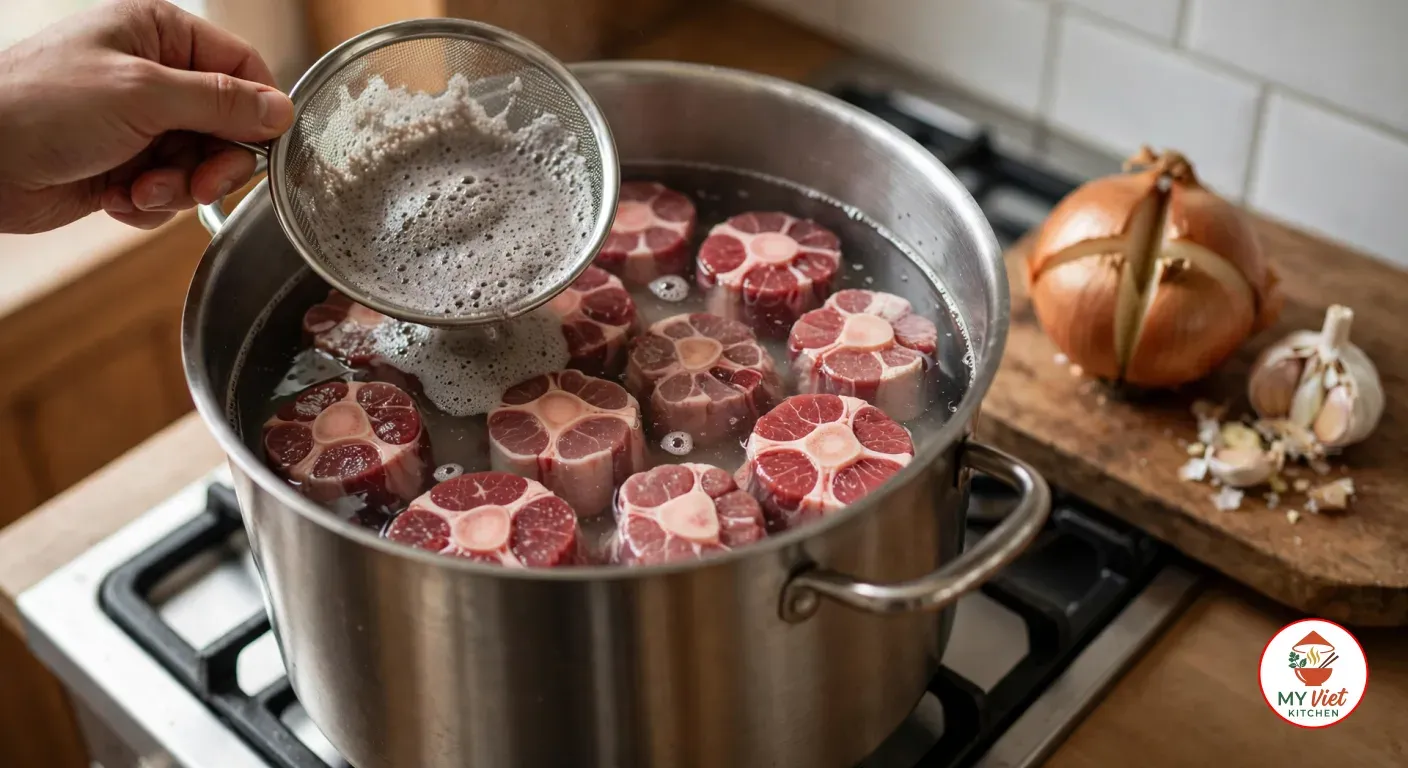
1Rinse the oxtail, and the tripe if using, under cold water. Cover it with the 10 cups (2.4 litres) of cold water in a large, heavy stockpot and set it over high heat. Once it boils, spend 5 to 10 minutes skimming off the grey foam that rises. Add the quartered onion and crushed garlic, turn the heat down until the surface barely bubbles, and cover with the lid slightly ajar. Simmer for 2 1/2 to 3 hours, topping up with hot water if the meat starts to show above the liquid. The oxtail is done when the meat slides off the bone at the push of a fork.
Step 2: Prepare the Peanut Sauce Base
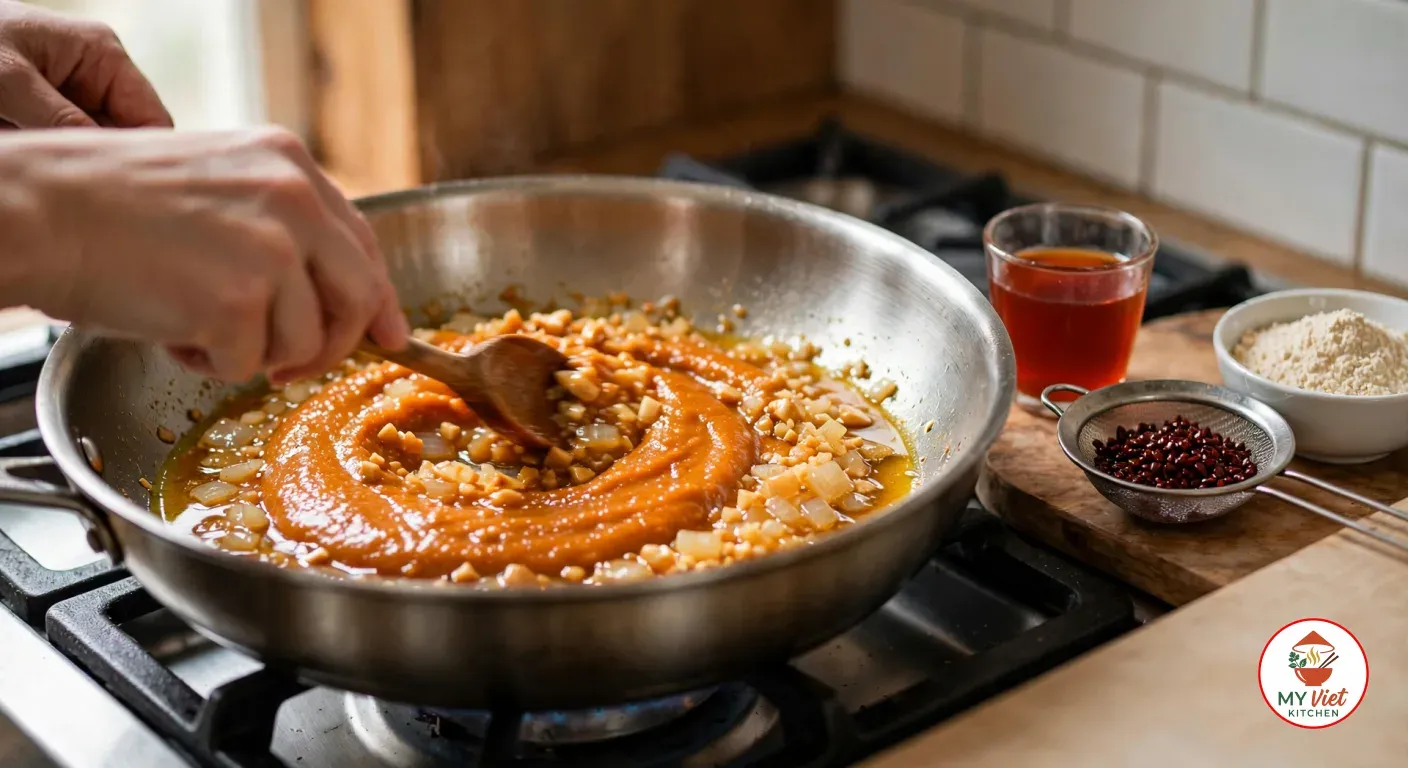
2While the oxtail simmers, cover the annatto seeds with the 3/4 cup (180 ml) of hot water and leave them for 20 minutes. Rub the seeds between your fingers, strain the deep orange water into a cup and throw the seeds away. Toast the rice flour in a dry, wide pan over medium-low heat, stirring all the time, for 4 to 6 minutes, until it turns light beige and smells nutty; tip it into a bowl. Heat the oil in the same pan over medium heat, cook the diced onion for 3 minutes, then add the minced garlic for 1 minute, until both are soft but not brown. Stir in the ground peanuts or peanut butter and the annatto water and cook, stirring, for 2 minutes into a thick orange paste.
Step 3: Combine the Sauce with the Broth
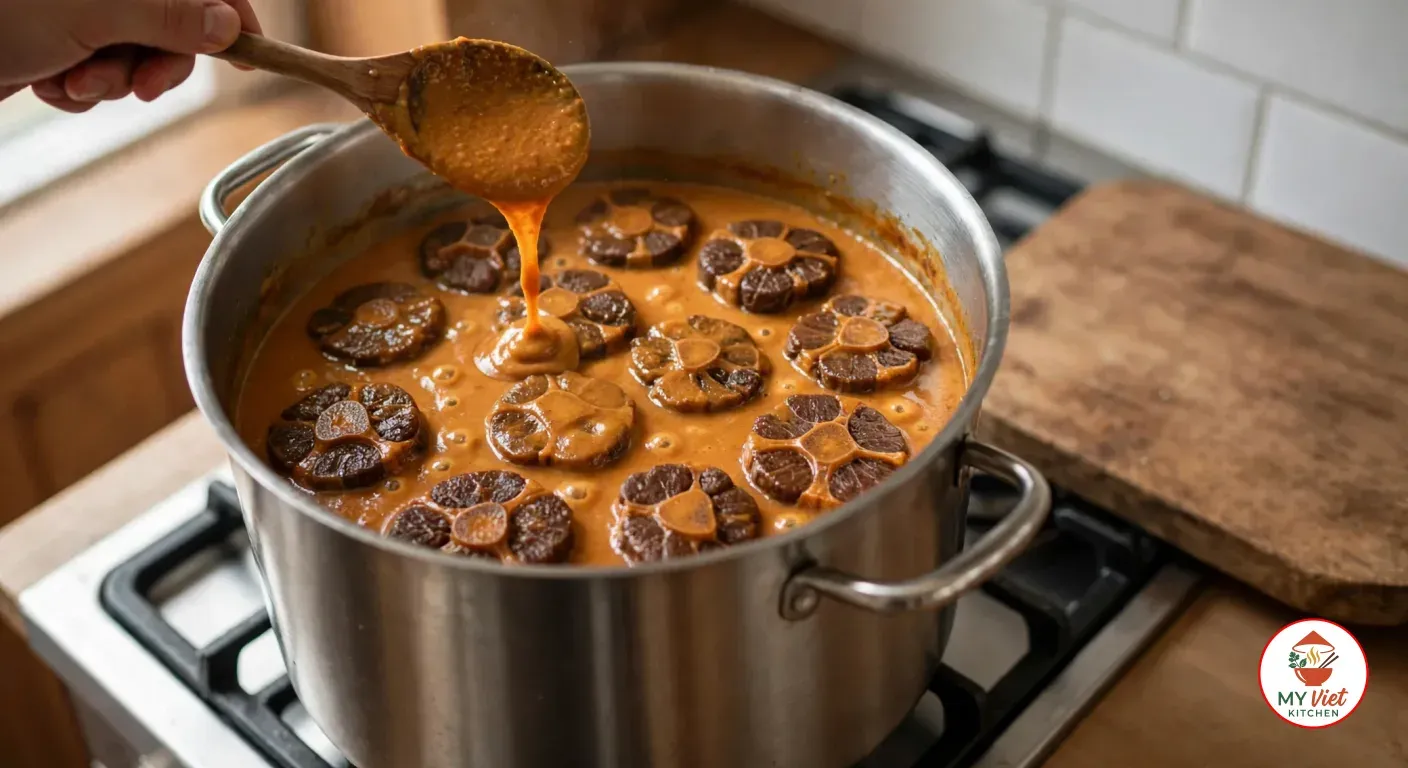
3Lift the oxtail out of the stockpot with a slotted spoon. Strain the broth into a bowl, spoon off as much of the yellow fat as you can, and measure 4 cups (1 litre); add water if you are short, and keep any extra for thinning. Rinse the pot, pour in the measured broth and bring it to a simmer. Whisk in the peanut paste until smooth. Stir the toasted rice flour into the 1/2 cup (120 ml) of cold water, then pour it in with the fish sauce and sugar. Return the oxtail and simmer gently for 15 minutes, scraping the bottom often so the peanuts don’t catch, until the sauce is thick enough to cling to a spoon. Season lightly with salt and pepper, because the bagoong at the table is salty.
Step 4: Blanch the Vegetables
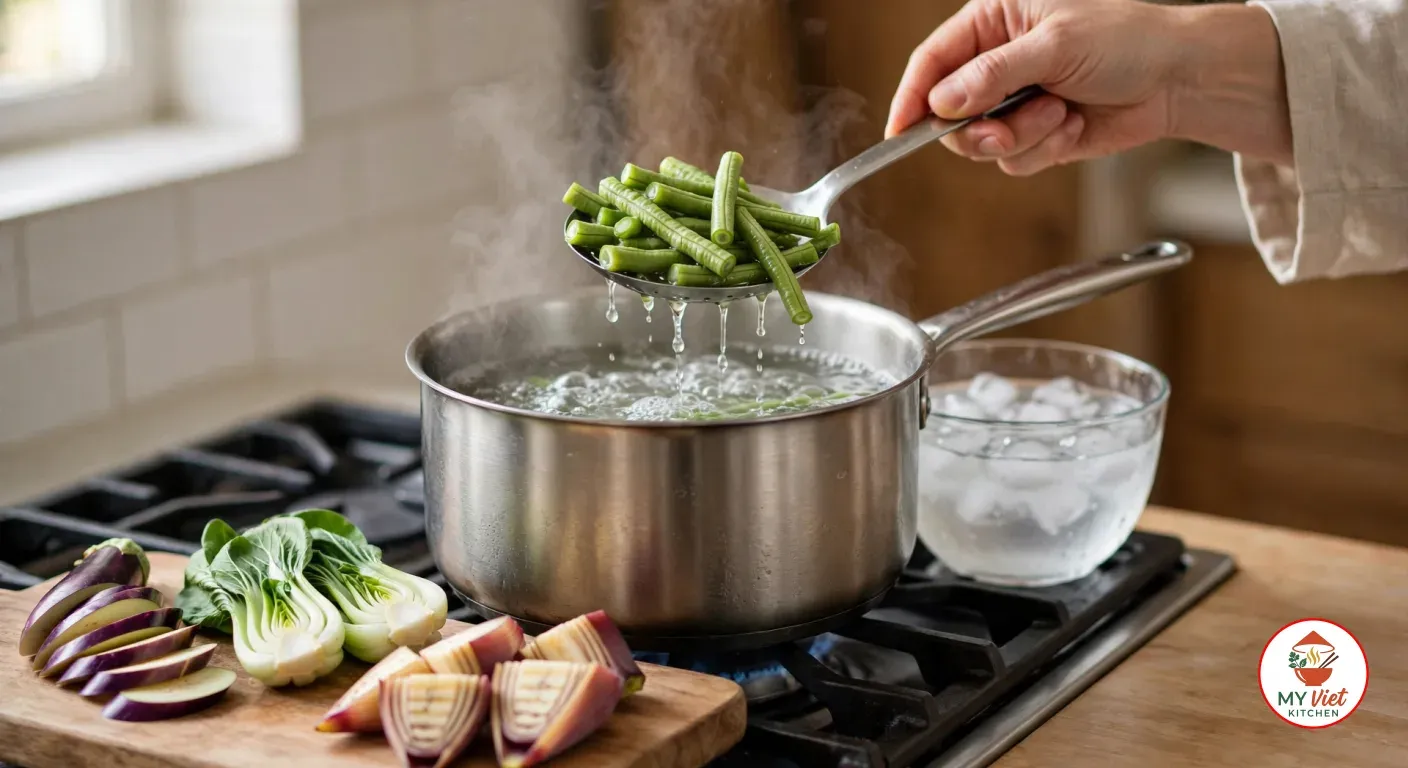
4About 30 minutes before the oxtail is done, stir the lime juice into a bowl of cold water. Peel the tough reddish-purple outer layers off the banana heart until you reach the pale, tightly packed core, cut it lengthwise into quarters and drop the pieces straight into the lime water for 10 minutes. Bring a saucepan of water with the tablespoon of salt to a boil and set a bowl of iced water beside it. Blanch the vegetables one kind at a time, moving each batch to the iced water when it is just tender. Give the banana heart 8 to 10 minutes, until a knife slides in, the beans 3 minutes, the eggplant 2 and the bok choy 1. Drain them well and set aside.
Step 5: Assemble and Serve
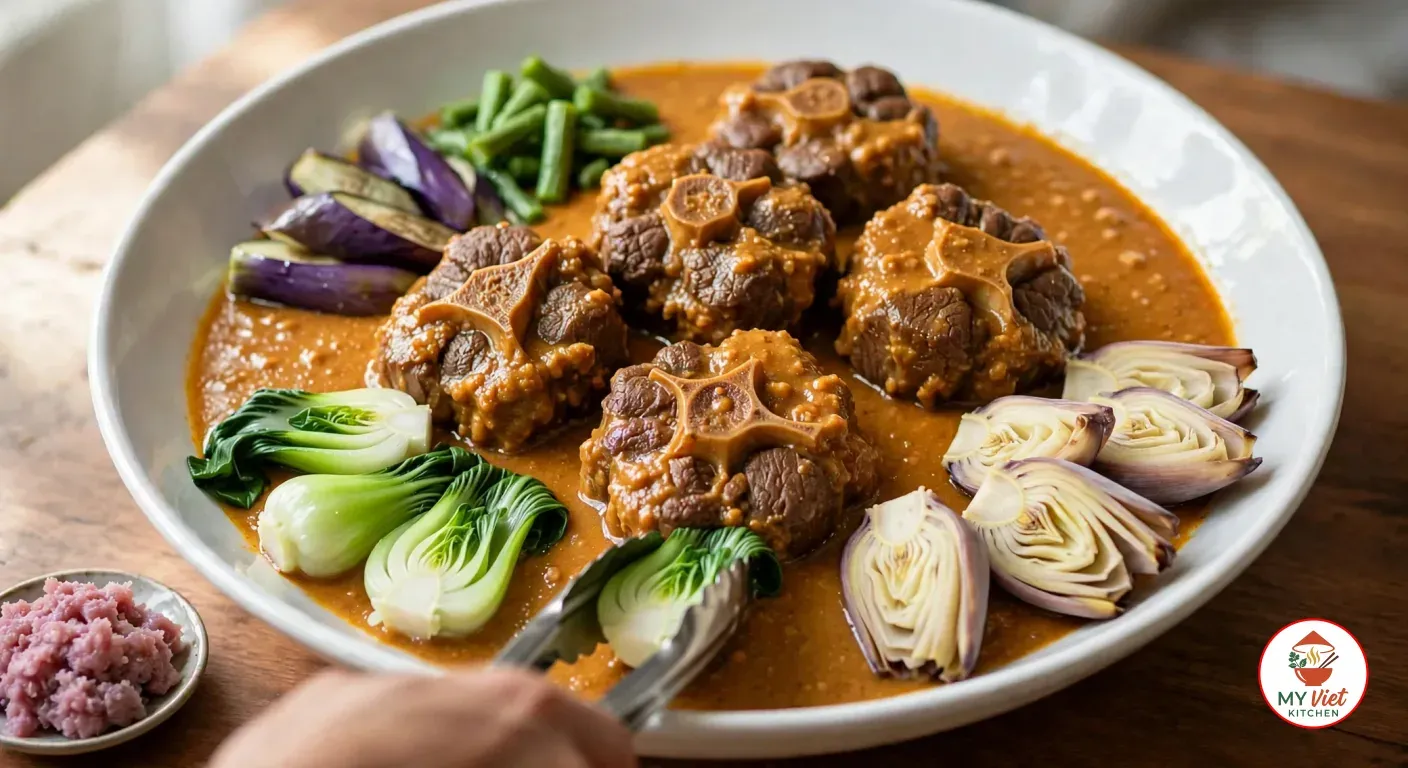
5Spoon the oxtail and sauce into a wide serving bowl. Arrange the drained vegetables in groups around the edge, so each one keeps its colour. Serve hot with the white rice and the bagoong alamang in a small dish, and let everyone add a little to each mouthful.
Frequently Asked Questions
What bagoong goes with kare-kare?
Bagoong alamang, a paste of krill or tiny shrimp fermented with salt. Wikipedia gives the usual mix as 25 percent salt to 75 percent shrimp by weight. The paste ferments pale grey to white; jars that are pink or red get their colour from angkak, rice grown with a red mould (Wikipedia). For kare-kare it is often sautéed first, as ginisang bagoong, sometimes with chilli, and calamansi juice may go on at the table (Wikipedia). Panlasang Pinoy seasons its sauce with only salt and pepper and serves shrimp paste alongside (Panlasang Pinoy).
Can you make kare-kare with something other than oxtail?
Yes. Wikipedia lists beef tripe, pork hocks, calves’ feet, pig’s trotters, other cuts of pork and beef stew meat, with goat and, rarely, chicken as variants. Leftover roast pork is often used too: the meats most commonly repurposed for it are lechon and crispy pata (crispy pork shank) (Wikipedia). Beef shank is the easiest swap: MG Sanchez’s recipe on Hungry Huy braises 1 lb of oxtail and 1 lb of beef shank together for 2 to 3 hours (Hungry Huy). Fry crisp pork separately and add it at the table, so the skin stays crunchy.
Can you cook kare-kare in a pressure cooker?
Yes, and it cuts the oxtail’s time to well under an hour. Panlasang Pinoy’s recipe card gives 35 minutes in a pressure cooker against 2 1/2 to 3 hours on the stove (Panlasang Pinoy). The notes under Vanjo Merano’s video say 30 to 40 minutes (Panlasang Pinoy). Skim the foam before you lock the lid, and add only enough water to cover the meat, keeping the cooker no more than two-thirds full. If the meat still clings to the bone, give it 10 more minutes under pressure, then go on to Step 3.
How long does kare-kare keep?
Three to four days in the fridge, or two to three months in the freezer. That is Health Canada’s guidance for cooked meat and stews, kept in a refrigerator at 4 °C (40 °F) or below or a freezer at −18 °C (0 °F) (Health Canada). Store the blanched vegetables in a separate container, since eggplant and banana heart go limp after a night in the sauce. Cold peanut sauce sets thick; loosen it with the spare broth or a little water as it reheats.
Sources
- Kare-kare, Wikipedia
- Bagoong, Wikipedia
- The three origins of kare-kare and a lamb shank recipe, Anna Manlulo, SBS Filipino, October 2024
- ‘Kari kari’ takes over Filipino cuisine, Gelaine Gutierrez, Philippine Information Agency NCR, April 2024
- Kare Kare, Vanjo Merano, Panlasang Pinoy, November 2018
- Kare Kare (Filipino Oxtail, Vegetable & Peanut Sauce Stew), MG Sanchez, Hungry Huy, September 2020
- Best Beef Kare-Kare with Tripe, Shank, and Oxtail, Ally Estrada, Pepper.ph, June 2022
- Safe food storage, Health Canada, April 2024
- How to Cook Oxtail Kare Kare, Panlasang Pinoy, YouTube, November 2017