Hangi is a traditional Māori way of cooking for a crowd, spelled hāngī in te reo. Hot rocks and water make steam in a shallow pit, and soil goes back on top to trap it for a few hours (Te Ara). This hangi recipe puts one down in a backyard for 10 people. You heat volcanic stones for three hours, steam two baskets of meat and vegetables for up to three more, then check the chicken with a thermometer.
Prep Time: 1 hour 30 minutes | Cook Time: 6 hours 30 minutes | Total Time: 8 hours | Servings: 10
Difficulty: Hard | Calories: ~920 per serving

Where Can You Safely Dig a Hāngī Pit?
Pick the spot before you gather a single stone. New Zealand Food Safety’s hāngī guide puts the pit at least three metres from the property boundary and from any building or structure. Keep it away from septic tank outflows, drains and ground water, and away from dry foliage that could start a scrub fire. The guide also tells you to check your local council’s rules (NZ Food Safety).
Then find out what runs under the lawn. In New Zealand, beforeUdig is a free online service that tells anyone planning to dig, homeowners included, where cables, pipes and other utility assets lie around the site (beforeUdig).
Fire and Emergency New Zealand gave its advice in December 2022. Cultural cooking such as hāngī needs no permit in a restricted fire season, but only if you meet its conditions. The fire must be under two square metres. It must sit at least three metres from buildings, hedges, shelter belts or anything else likely to catch fire. Clear grass and dry leaves from around the pit and keep a hose within five metres (Fire and Emergency NZ via Scoop). The pit in this recipe is one metre square, well inside that limit.
Don’t light any fire on a windy day, whatever the season. Tell your neighbours too, so they know not to call the Fire Brigade. For the current fire danger where you live, the agency points to checkitsalright.co.nz (Fire and Emergency NZ via Scoop).
Which Stones Are Safe for a Hāngī?
The stones hold all the heat, and the wrong ones can burst. New Zealand Food Safety warns that river stones tend to explode when they are heated too hard. Its test is to fire your stones as you would for a hāngī at least 24 hours before the day, so they can cool again, and keep the ones that come through whole. Iron bars are the other choice: they carry no risk of exploding and hold heat for a long time (NZ Food Safety).
Wikipedia names andesite or basalt as the usual rocks and mānuka or kānuka as the usual logs, burned for 3 to 4 hours (Wikipedia). The government guide sets a minimum of three hours, until the stones are white-hot or iron bars red-hot, so they can cook the food through. Burn slow wood such as mānuka, and never treated timber (NZ Food Safety).
Good stones are kept for years. Rewi Spraggon of Hāngi Master writes that some of the rocks he uses today have been in his family for generations and have fed thousands of people (Hāngi Master). He leads the hāngī in the video above: its description says Andy of Andy Cooks went home to New Zealand to let Spraggon take charge and lead them through the steps (Andy Cooks).
How Do You Know a Hāngī Is Cooked and Safe?
Once the pit is sealed you can’t see the food for three hours, so safety comes from what you do before and after. Buy meat from registered food premises and carry it in chilly bins. Keep raw meat covered at the bottom of a fridge running at 0 to 5°C, and thaw anything frozen in the fridge, never at room temperature. Every piece must be fully thawed before cooking starts (NZ Food Safety).
Wash your hands with soap and warm water for 20 seconds after handling raw meat, and keep one set of boards and knives for raw food only (NZ Food Safety).
In the pit, heat is the safeguard. The same guide warns against pouring on too much water: it can cool the stones too quickly and leave the food undercooked. Someone has to watch the sealed pit for the whole 2.5 to 3 hours, because escaping steam means escaping heat. Seal any leak with soil straight away (NZ Food Safety).
Then measure. Food Standards Australia New Zealand says to cook chicken until the juices run clear and the inside reaches 75°C, checked with a food thermometer (Food Standards Australia New Zealand). Put the probe in the thickest part, such as the thigh, without touching bone or gristle. Whole pieces of lamb and pork can be cooked to taste, as long as the outside is fully cooked (Food Safety Information Council). So the chicken is what you test here, several thighs from different parts of the basket.
Serve the food hot as soon as you can, or hold it at 60°C or above in a preheated bain marie. Without one, don’t let it sit at room temperature for longer than two hours (NZ Food Safety).
Ingredients for Hangi
For the Meat Basket:
- 3 1/4 pounds (1.5 kg) bone-in chicken thighs and drumsticks
- 2 2/3 pounds (1.2 kg) lamb shoulder chops
- 2 2/3 pounds (1.2 kg) boneless pork shoulder, cut into 4-inch (10 cm) pieces
- 1 tablespoon fine salt
- 1 teaspoon ground black pepper
For the Vegetable Basket:
- 3 1/4 pounds (1.5 kg) kūmara (sweet potato), scrubbed and cut into 2-inch (5 cm) rounds
- 3 1/4 pounds (1.5 kg) potatoes, scrubbed and halved
- 2 1/4 pounds (1 kg) pumpkin, unpeeled, cut into 8 wedges
- 2 green cabbages, outer leaves kept whole, hearts quartered
For the Pit:
- Enough volcanic hāngī stones or iron bars to cover the base of the pit in one layer
- Mānuka or other slow-burning, untreated firewood, enough to burn for 3 hours
- Newspaper and dry kindling
- 2 wire baskets, about 24 x 16 inches (60 x 40 cm)
- Heavy-duty aluminium foil
- 1 large plain white cotton cloth (not bed linen)
- 4 to 6 clean hessian sacks
- 1 tarpaulin
Step-by-Step Instructions
Step 1: Dig the Pit and Lay the Fire
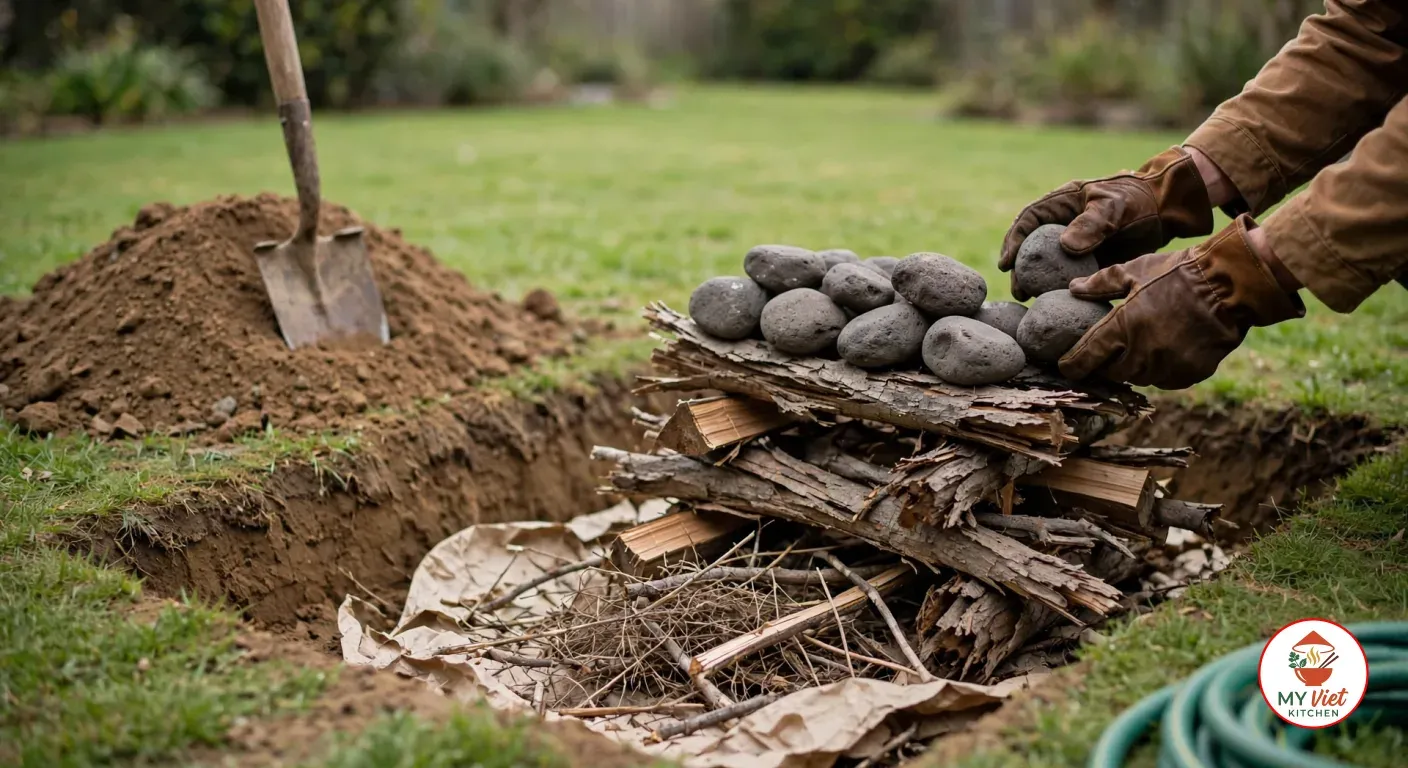
1Choose a spot at least 10 feet (3 m) from the property boundary, buildings, hedges and anything else that could catch fire, and check it for buried cables and pipes first. Clear the grass and dry leaves around it. Dig a pit about 3 feet (1 m) square and 2 feet (60 cm) deep, and pile the soil close by to seal the pit later. Crumple newspaper over the bottom, add the kindling, then stack two or three criss-crossed layers of mānuka logs. Set the stones on top in one layer that covers the base of the pit. Run a garden hose to within 16 feet (5 m) of the pit.
Step 2: Heat the Stones
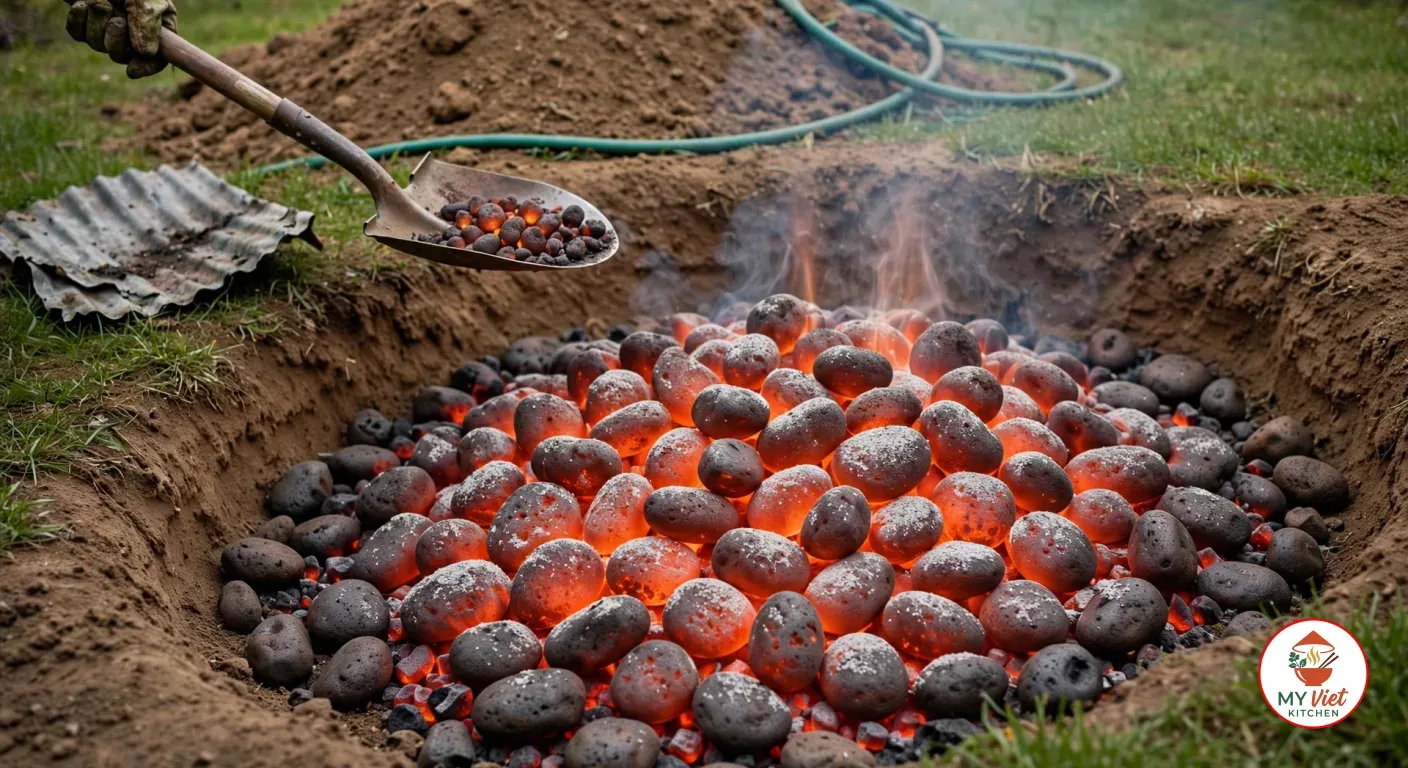
2On a still day, light the paper and let the fire burn for at least 3 hours, until the logs have burned down and the stones glow white-hot. Someone stays with the fire the whole time. Wearing heavy gloves, shovel the embers and ash out onto a sheet of corrugated iron, carry it to a safe spot and hose it down. Rake the hot stones into an even layer across the bottom of the pit.
Step 3: Prepare the Baskets
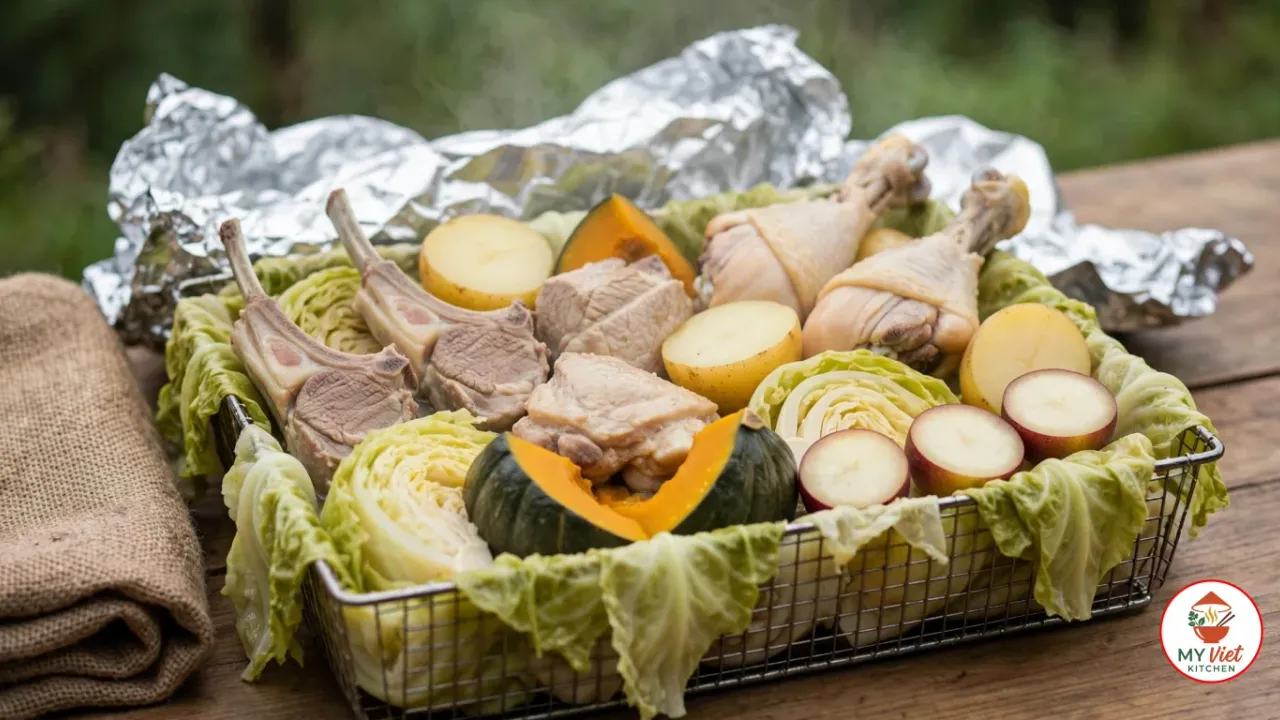
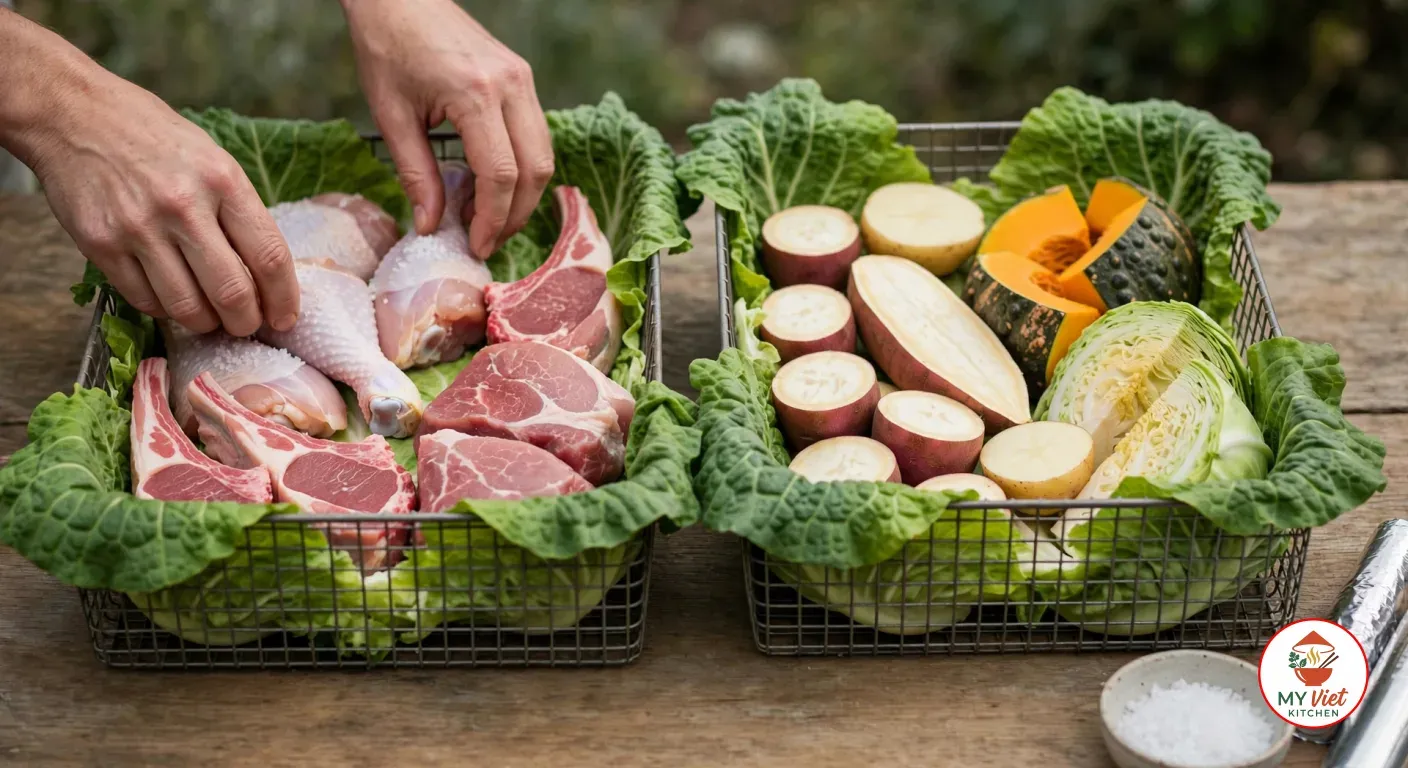
3While the stones heat, keep the meat in the fridge or a chilly bin with ice packs until you fill the baskets. Soak the white cloth and the sacks in a tub of water. Line both wire baskets with the outer cabbage leaves. Using a board and knife kept for raw meat, season the chicken, lamb and pork with the salt and pepper and lay them in one basket in a single layer. Put the kūmara, potatoes, pumpkin and cabbage quarters in the second basket, also in a single layer. Cover each basket with foil.
Step 4: Load and Seal the Pit
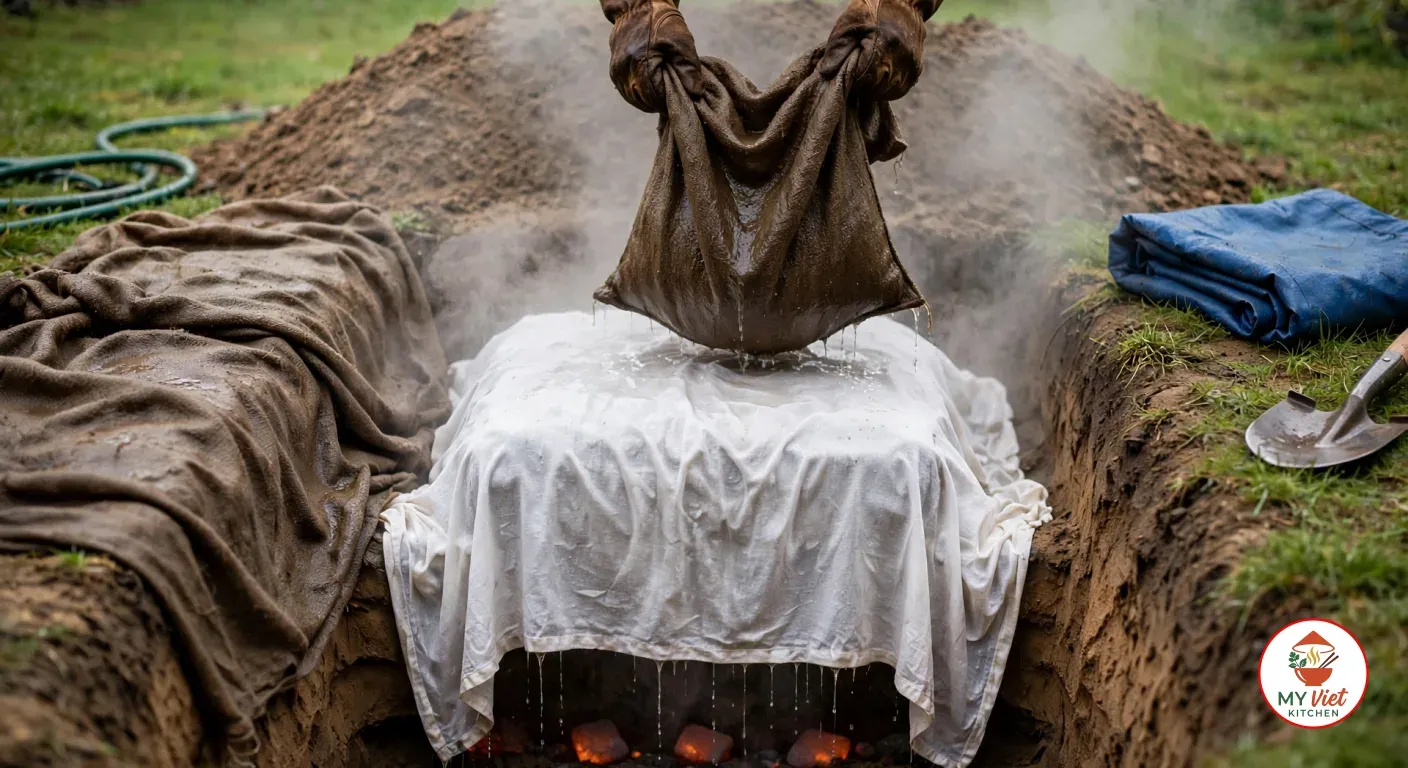
4Working quickly in heavy gloves, set the meat basket on the hot stones and the vegetable basket on top of it. Wring out the white cloth so it is wet but not streaming, spread it over both baskets, then cover it with the wet sacks, tucking them down the sides. Lay the tarpaulin over the whole pit and shovel soil over its edges and top until no steam escapes. Leave the hāngī for 2 1/2 to 3 hours, staying nearby and packing on more soil wherever steam leaks out.
Step 5: Lift, Check and Serve
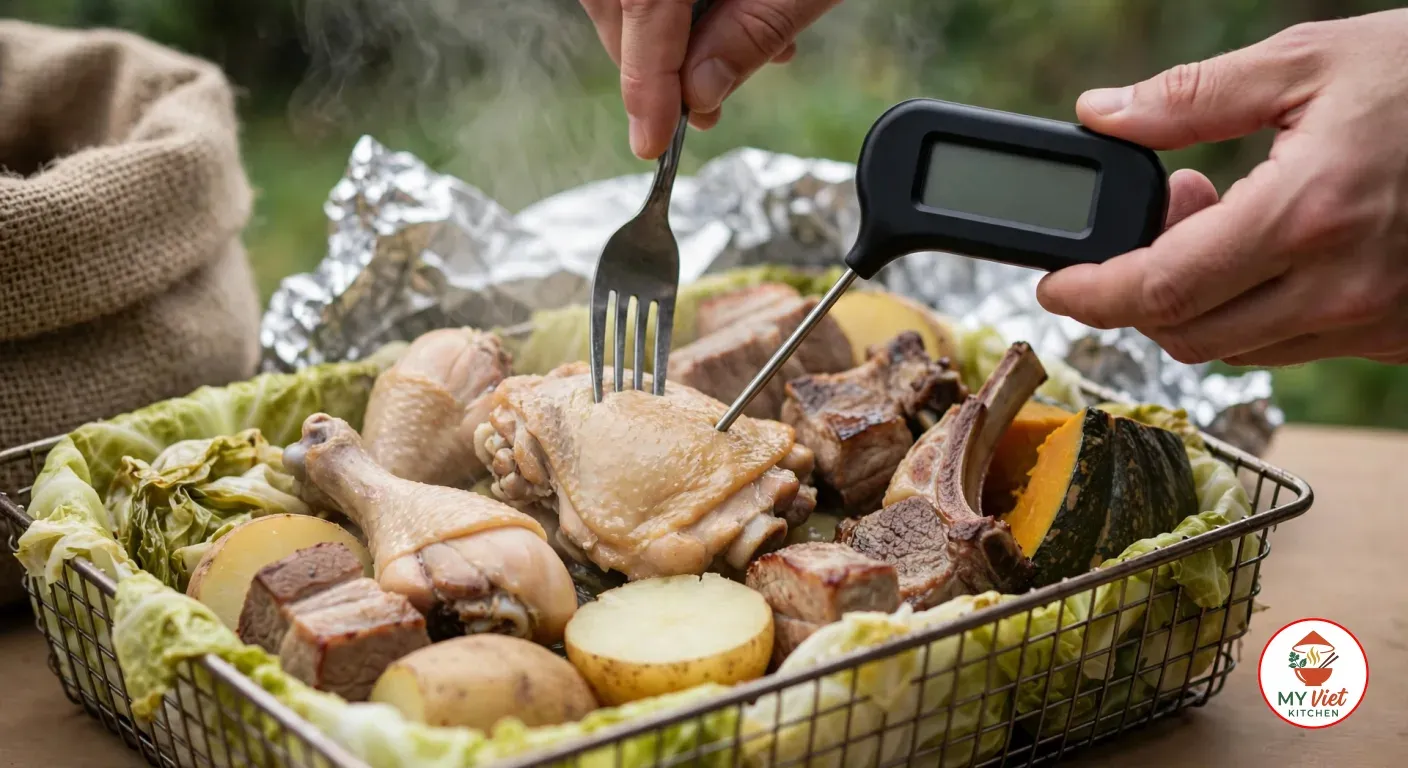
5Scrape the soil off the tarpaulin and roll it back away from the pit. Lift off the sacks one at a time, then the cloth, keeping soil out of the baskets. Lift both baskets out and carry them to the table. Push a food thermometer into the thickest part of several chicken thighs, away from the bone; each must read 167°F (75°C). Finish any piece that falls short in a 350°F (180°C) oven until it does. Serve hot straight away.
Frequently Asked Questions
Can you make a hāngī without digging a pit?
Yes: cook it in the oven. Cookbook author Christall Lowe layers meat, vegetables and stuffing on cabbage leaves in a deep roasting dish, adds water and seals it with two layers of foil. It bakes for 1 hour at 200°C, then 2 hours at 150°C. Her nana used a piece of sacking normally kept for the in-ground hāngī to get its earthy flavour (Sauce). Gas-heated steel hāngī machines are sometimes used to copy the method without a fire, rocks or a pit (Wikipedia).
How long does a hangi take?
Plan on about eight hours for this recipe: 90 minutes to dig and lay the fire, three hours to heat the stones, then up to three hours in the ground. New Zealand Food Safety’s guide says three hours of burning is generally enough to heat the stones, and 2.5 to 3 hours of cooking once the pit is sealed (NZ Food Safety). Wikipedia gives 3 to 4 hours for the fire and about 2 to 4 hours of cooking (Wikipedia). Te Ara says the timing depends on how big the hāngī is (Te Ara).
What foods go in a hangi?
Meat goes at the bottom and vegetables on top. Wikipedia lists lamb, pork, chicken and kaimoana, with potato, kūmara, oca (called yams in New Zealand), pumpkin, squash, taro and cabbage; kaimoana sits above the vegetable basket (Wikipedia). If you add shellfish, New Zealand Food Safety says to gather it only from growing areas your local council has approved, and to keep live shellfish wet at a steady 5 to 7°C (NZ Food Safety). Christall Lowe’s oven version adds handfuls of stuffing (Sauce).
What should you do with hāngī leftovers?
Cool them quickly, refrigerate them and eat them within two days. New Zealand Food Safety suggests spreading the food on open trays and slicing big pieces of meat so they cool faster. Send guests home with leftovers in chilly bins with ice packs. Anything still in the fridge after two days gets thrown out, and reheated food should be steaming hot all the way through (NZ Food Safety).
Sources
- Māori foods – kai Māori: Traditional cooking and preserving, Charles Royal and Jenny Kaka-Scott, Te Ara – the Encyclopedia of New Zealand, September 2013
- Food Safety practices in preparing and cooking a hāngi, New Zealand Food Safety, Ministry for Primary Industries, reprinted March 2023
- Preparing and cooking food, Food Standards Australia New Zealand
- Meat thermometers – How to cook meat and poultry safely, Food Safety Information Council, May 2016 (updated September 2017)
- Safely Cooking Hāngī, Umu, Braai Or Lovo This Holiday Season, Fire and Emergency NZ press release on Scoop, December 2022
- What is beforeUdig?, beforeUdig New Zealand
- Hāngī, Wikipedia
- About, Rewi Spraggon, Hāngi Master
- Three KAI recipes from cookbook author Christall Lowe, Sauce, June 2025
- I learnt one of the oldest cooking methods - the Hāngī (aka earth oven), Andy Cooks, YouTube, April 2023