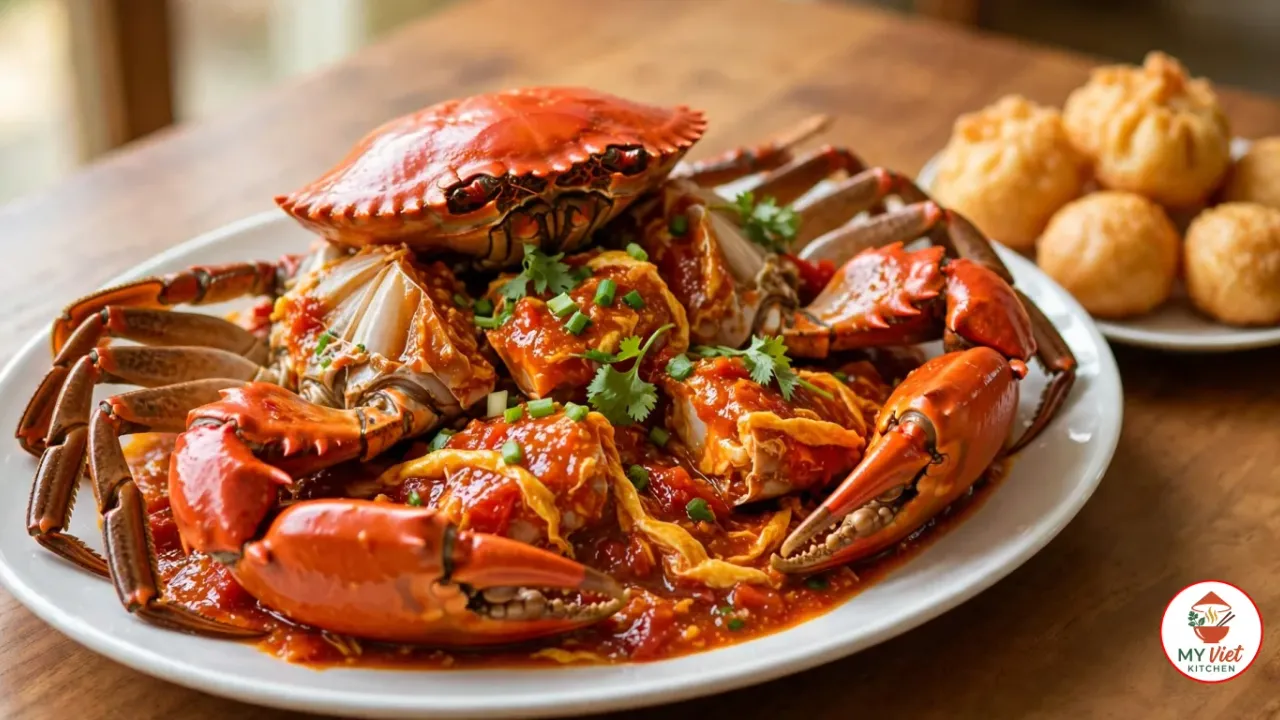
Chili crab is a Singaporean dish of mud crab, cut into pieces in the shell and cooked in a thick, sweet and tangy sauce of chili, tomato and beaten egg. You eat it with your hands and mop up the sauce with mantou buns. Here, a paste of fresh chilies, shallots, garlic and ginger is fried in a wok. A 1 kg (2¼ lb) crab then simmers in it for about 12 minutes.
Prep Time: 30 minutes | Cook Time: 25 minutes | Total Time: 1 hour 40 minutes, including 45 minutes in the freezer for a live crab | Servings: 2
Difficulty: Medium | Calories: ~500 per serving

What Goes Into the Sauce?
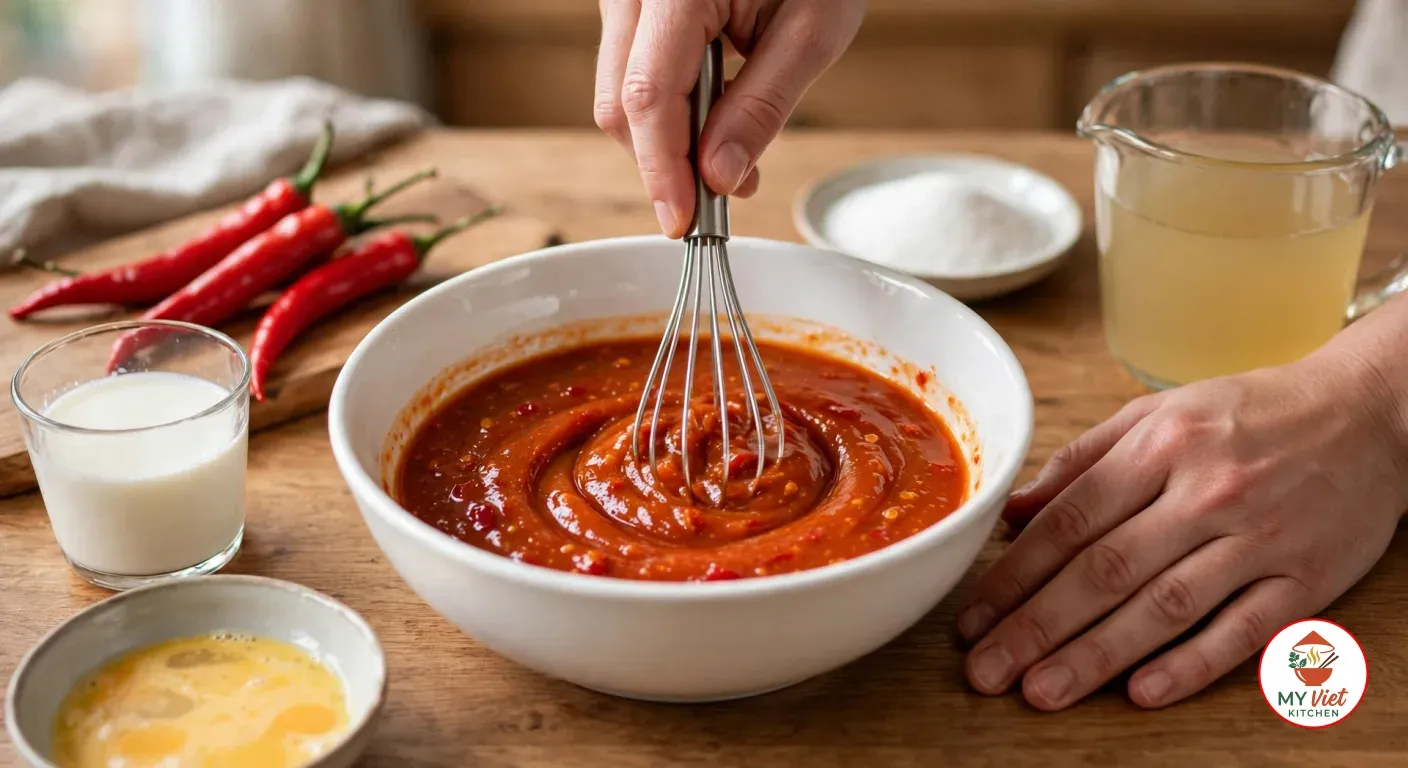
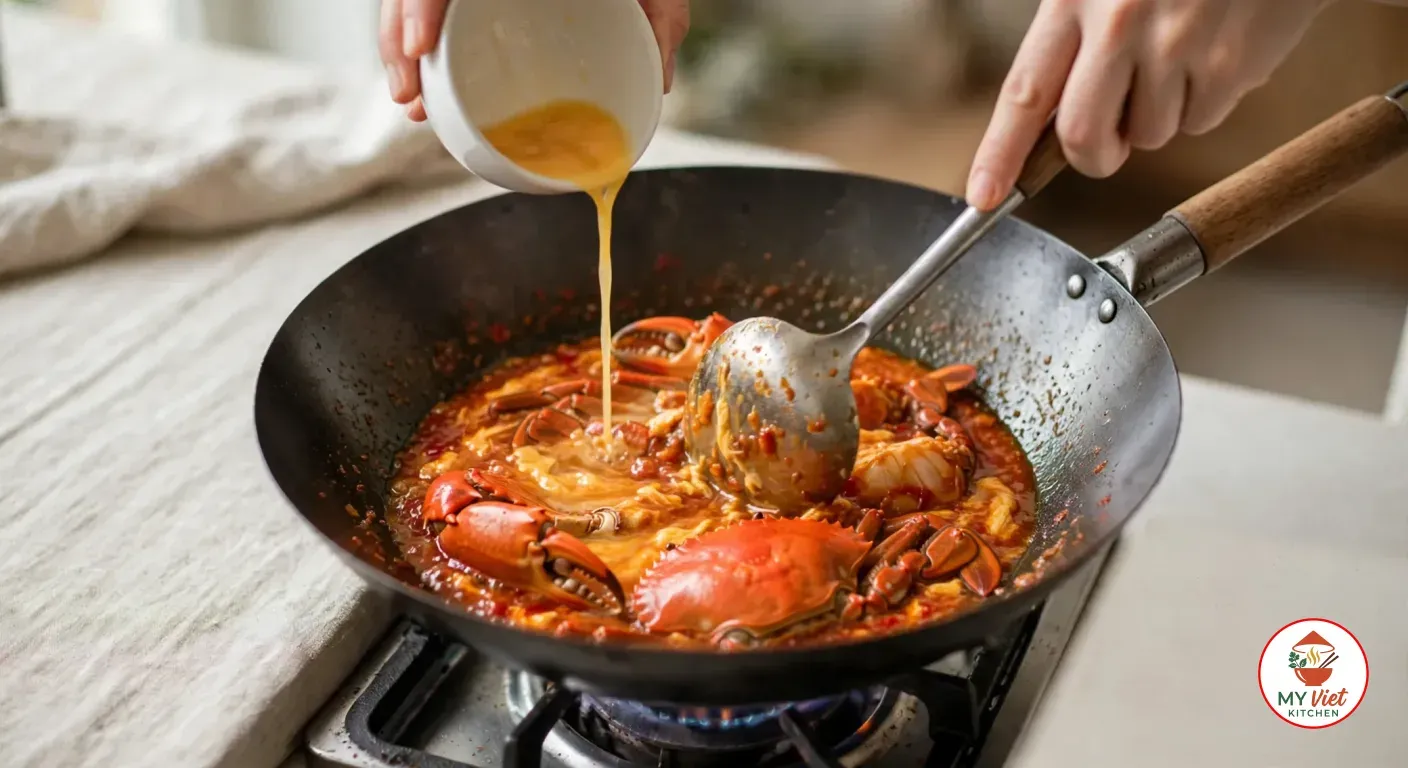
Three parts make the sauce. The base is a fried paste of fresh red chilies, shallots, garlic and ginger, with a teaspoon of belacan (fermented shrimp paste) if you have it. A bowl of bottled sauces brings the sweetness and tang: ketchup, sweet chili sauce, sambal oelek, a little sugar, rice vinegar and light soy sauce. Beaten egg goes in last and sets into soft ribbons that thicken the sauce.
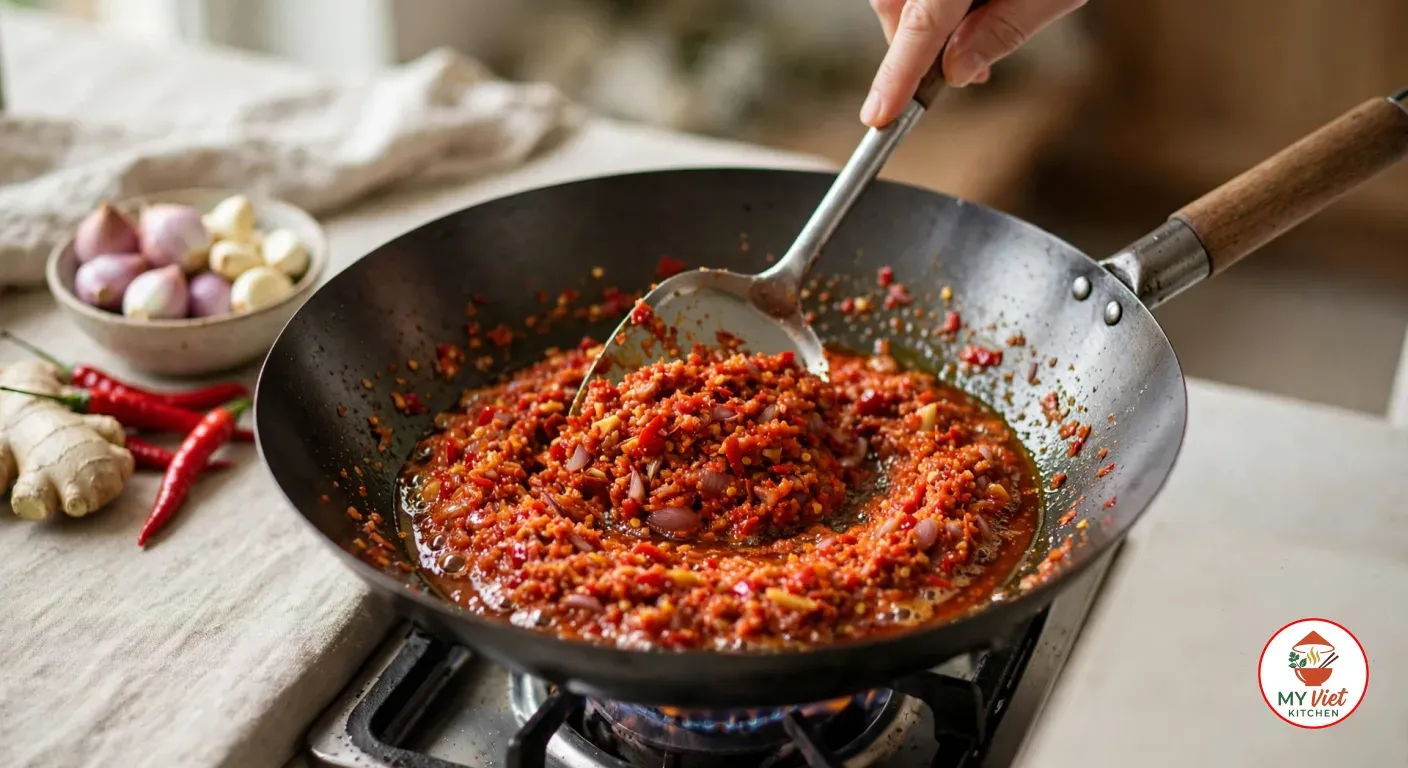
The paste needs time in the wok. Give it 4 to 5 minutes over medium heat. It’s ready when it has turned a shade darker, smells sweet rather than sharp, and oil pools at the edges. Raw shallot and garlic taste harsh in the finished sauce, and a quick 30 seconds over high heat scorches the paste before it cooks through.
The chef in the video above, Salil Mehta of Laut Singapura in New York, builds his sauce on the same plan. He blends fresh and dried chilies with shallot, ginger, garlic and fermented soybeans into a rempah, or spice paste. Then he cooks it with belacan, tomato sauce and sweet chili sauce before the crab goes in.
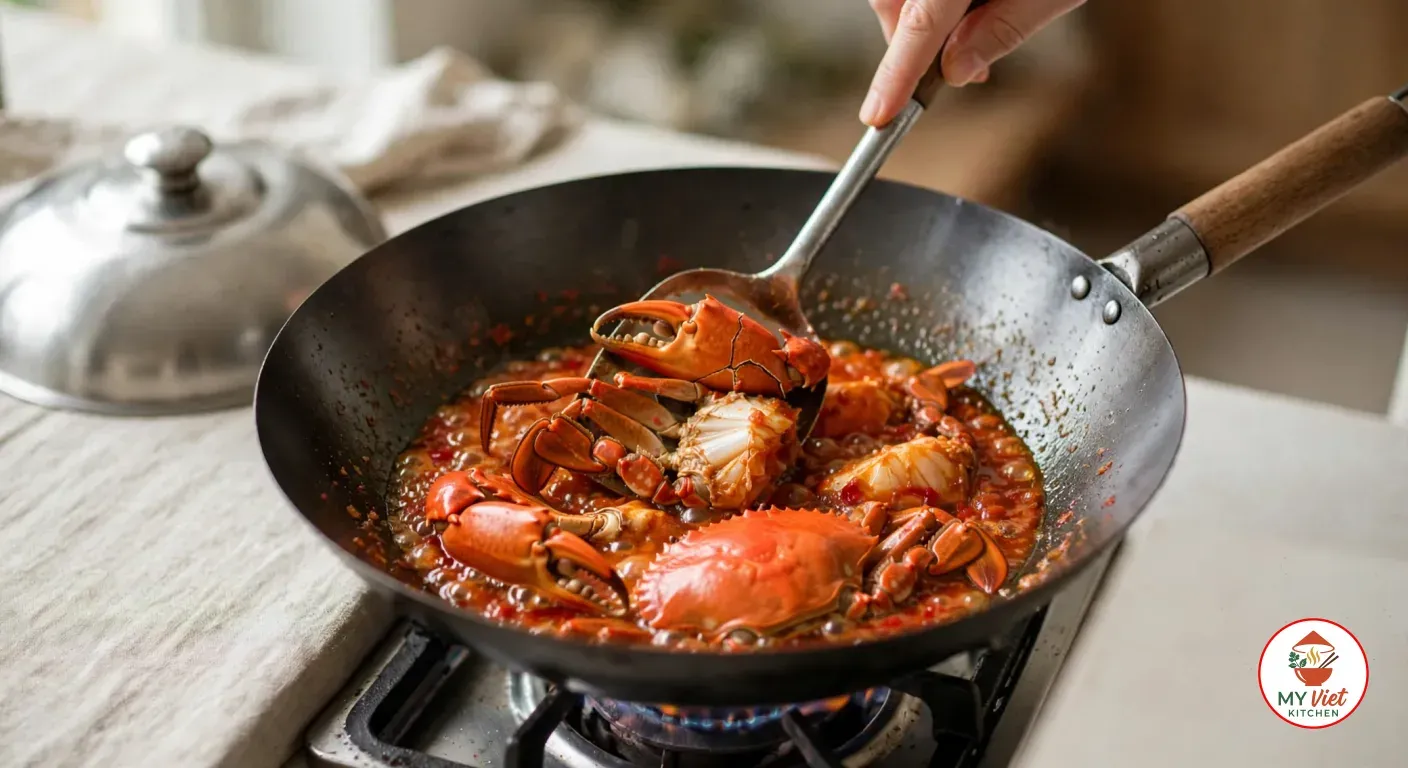
The best-known restaurant version, covered below, deep-fries the crab before it meets the sauce. At home it’s easier to toss the raw pieces in the paste and then simmer them in the sauce under a lid for 10 to 12 minutes. The cracked claws let the sauce reach the meat.
How Do You Kill and Clean a Live Mud Crab?
Buy the crab alive and cook it the same day. The US Food and Drug Administration advises picking crabs that still move their legs, because they spoil fast after death (FDA). A good mud crab feels heavy for its size, has all its legs and claws, and doesn’t slosh when you shake it gently (Sydney Fish Market).
The simplest route is to ask the fishmonger to kill and clean it. RSPCA Australia prefers that: it recommends that trained staff kill crabs before sale, ideally with an electrical stunner built for crustaceans (RSPCA Australia).
At home, Sydney Fish Market suggests about 45 minutes in the freezer, until the crab stops moving but before it freezes, and then killing it promptly (Sydney Fish Market).
For a stunned crab, the RSPCA’s method is to spike both nerve centres. Turn the crab on its back and push a pointed spike or sharp-pointed knife straight through each one. One lies under a shallow depression at the front, the other towards the rear, sometimes under a small hole. The RSPCA warns that it isn’t well understood whether chilling makes a crab unconscious, and that chilling may itself be painful. It also rules out boiling a crab without stunning it first, pulling it apart, and putting it in fresh water (RSPCA Australia).
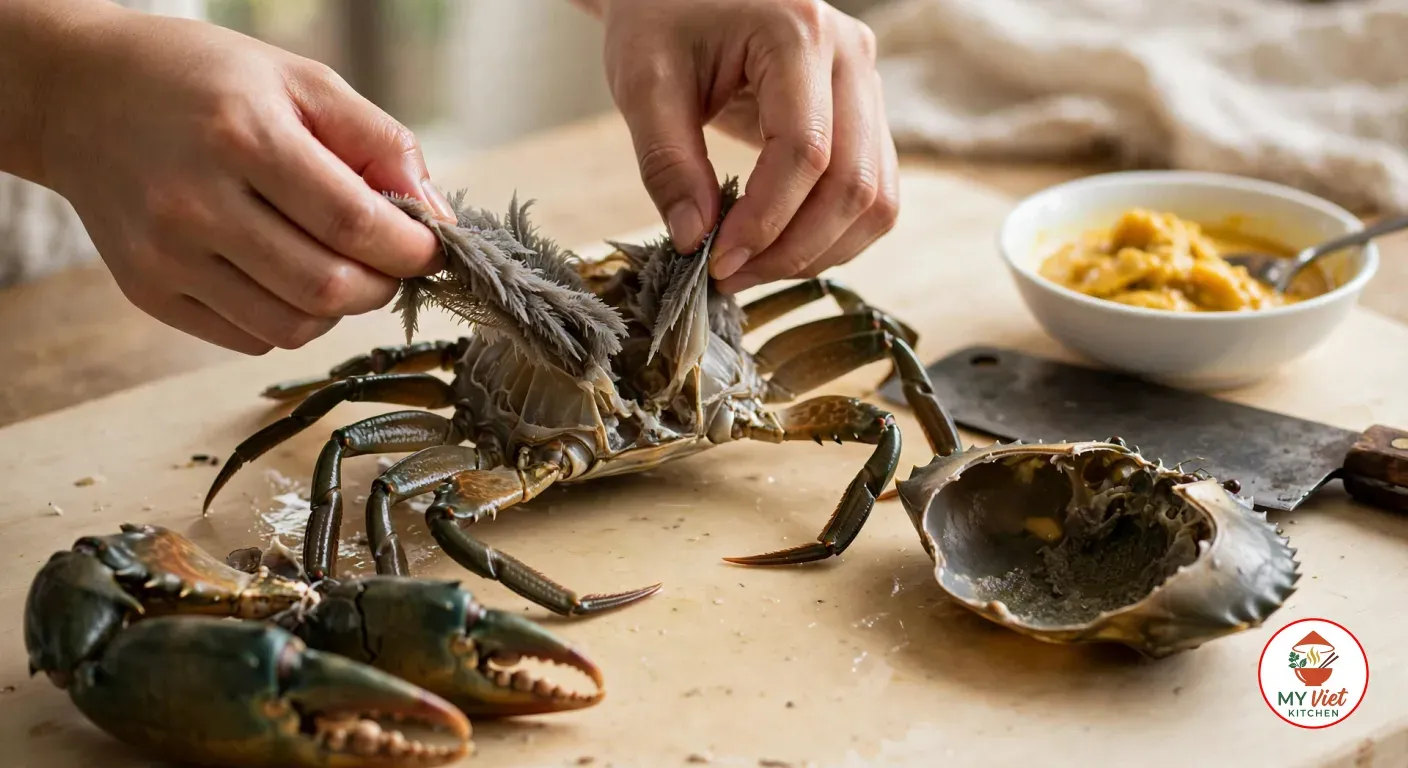
Cleaning takes about 10 minutes. The flap on the underside, called the apron, comes off first, which frees the top shell. The grey, finger-like gills and the mouthparts are inedible, but the yellow tomalley inside the shell is worth saving for the sauce (RecipeTin Eats). Adam Liaw’s recipe for SBS then cuts the body into four, with two legs on each piece (SBS Food).
Who Created Chili Crab?
Most accounts credit Cher Yam Tian. In the mid-1950s she added bottled chili sauce, instead of her usual tomato sauce, to a dish of stir-fried crabs. In 1956 she and her husband, Lim Choon Ngee, began selling it from a pushcart along the Kallang River. Trade was good enough that in 1962 they opened a restaurant on Upper East Coast Road, Palm Beach Seafood (CNA).
Their son Roland took over the family business in 1985. His Roland Restaurant, now in Marine Parade, still makes the dish to his mother’s recipe. Cher died on 15 February 2023, aged 90 (CNA).
The sauce most Singapore restaurants serve today has moved on from hers. Singapore’s National Heritage Board says it is richer and less sweet, and that the sambal and eggs now found in it were first added at Dragon Phoenix restaurant (Roots.gov.sg). Dragon Phoenix opened in Tanjong Pagar in 1963 under the chef Hooi Kok Wai, also spelled Hooi Kok Wah (Wikipedia). The Michelin Guide credits the familiar version to him, one of four chefs known in the 1960s as the “heavenly kings” of Chinese cuisine. His crabs are deep-fried, then fried again in a sauce with lemon juice, vinegar, sambal, tomato paste and egg white (Michelin Guide).
The Heritage Board added chili crab to Singapore’s inventory of intangible cultural heritage in March 2019. It notes that the dish is often described as Singapore’s national seafood dish (Roots.gov.sg).
Ingredients for Chili Crab
For the Crab:
- 1 live mud crab, about 1 kg (2¼ lb)
For the Chili Paste:
- 6 long fresh red chilies (about 90 g / 3 oz), roughly chopped
- 4 small shallots (about 80 g / 3 oz), peeled
- 4 garlic cloves, peeled
- 2.5 cm (1 in) piece of ginger, peeled and sliced
- 1 teaspoon belacan (fermented shrimp paste), optional
- 2 tablespoons water, for blending
- 2 tablespoons neutral oil
For the Sauce:
- 3 tablespoons tomato ketchup
- 2 tablespoons sweet chili sauce
- 1 tablespoon sambal oelek
- 2 teaspoons sugar
- 1 tablespoon rice vinegar
- 1 tablespoon light soy sauce
- 1 cup (250 ml) unsalted chicken stock or water
- 1 tablespoon cornstarch mixed with 2 tablespoons water
- 2 eggs, lightly beaten
To Serve:
- 2 spring onions, chopped
- A handful of cilantro leaves
- 6 to 8 mantou (Chinese buns), fried or steamed
Step-by-Step Instructions
Step 1: Prepare the Crab
1If the crab is live, put it in the freezer for about 45 minutes, until it no longer moves, but don’t let it freeze. Turn it on its back and kill it at once by spiking both nerve centres, as described above. Lift the triangular apron on the underside and twist it off. Push your thumb under the back of the top shell and pull it away. Scrape any yellow tomalley from the shell and body into a small bowl. Pull off the gills on both sides and twist off the mouthparts, then rinse the body under cold water. Twist off the claws. Cut the body in half, then cut each half again so every piece keeps two legs. Lay each claw flat and crack it once on both sides with the back of a heavy knife. Rinse the top shell and keep it if you’d like to set it over the crab on the platter.
Step 2: Mix the Sauce
2In a mixing bowl, stir the ketchup, sweet chili sauce, sambal oelek, sugar, rice vinegar and soy sauce together until the sugar has dissolved. Stir in the stock. In a small cup, mix the cornstarch with 2 tablespoons of water and set it beside the stove with the beaten eggs.
Step 3: Fry the Chili Paste
3Put the chilies, shallots, garlic, ginger and belacan in a blender or small food processor with 2 tablespoons of water. Blend to a coarse paste, scraping down the sides once or twice. Heat the oil in a large wok over medium heat and add the paste. Keep it moving with a spatula for 4 to 5 minutes. Stop when the paste has darkened, the raw smell has gone and a film of red oil seeps out around it. If it catches on the bottom, lower the heat.
Step 4: Cook the Crab
4Turn the heat to high and add the crab pieces, the claws and the top shell, if you kept it. Toss them through the paste with a spatula; after 2 or 3 minutes the shells will begin to redden. Pour in the sauce from the bowl and stir in the tomalley. Bring it to a boil, cover the wok and turn the heat down to medium. Let it bubble gently for 10 to 12 minutes, and turn the pieces over once at the halfway point. The crab is ready when the shells are red-orange all over and the meat in the thickest claw is firm and opaque.
Step 5: Thicken and Add Egg
5Take off the lid and give the cornstarch mixture a stir. Pour it into the bubbling sauce. Within a minute of stirring, the sauce should look glossy and cling to a spoon. Turn the heat to low. Pour in the beaten eggs in a thin stream while you stir slowly in one direction. Leave them for 30 seconds to set, then fold them through so they stay in soft ribbons rather than scrambling. Taste the sauce and add a pinch of sugar, a splash of vinegar or a little salt if it needs it.
Step 6: Garnish and Serve
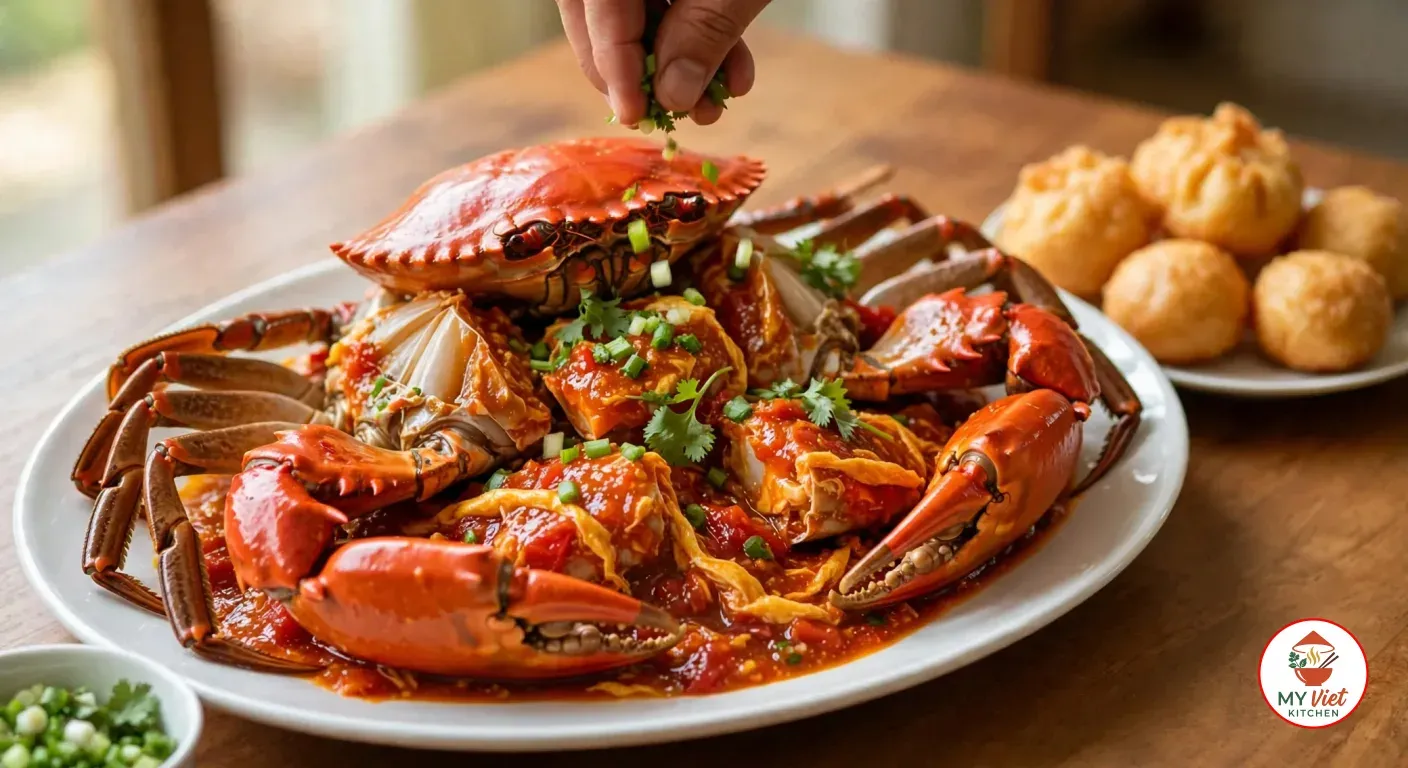
6Pile the crab pieces on a large platter and spoon all the sauce over them. Scatter the spring onions and cilantro on top. Serve straight away with the mantou, warmed or fried as the packet directs, for dipping. Put out finger bowls, crab crackers or a small hammer, and plenty of napkins.
Frequently Asked Questions
Is chili crab very spicy?
Not usually. Most versions taste sweet and tangy first, with moderate heat. Singapore’s National Heritage Board notes that the sauce varies in sweetness and spiciness from one cook to the next (Roots.gov.sg). For a milder sauce, seed the fresh chilies and leave out the sambal oelek. For more heat, keep the seeds in and add one or two bird’s eye chilies to the paste.
Can I use another kind of crab?
Yes. Mud crab is the usual choice, but other species work too (Wikipedia). One Dungeness crab of about 1 kg (2¼ lb) is a straight swap. Two or three blue swimmer crabs have thinner shells and need only 6 to 8 minutes under the lid. Crab sold frozen is usually already cooked, so it only needs heating through and soaks up less of the sauce.
What are mantou, and should you fry or steam them?
Mantou are plain Chinese buns made from a yeasted wheat dough. With chili crab they are served small, either fried or steamed, and you tear them open to mop up the sauce (Roots.gov.sg). Frozen mantou are sold in most Asian groceries. Fried ones turn crisp outside and soak up more sauce, while steamed ones stay soft and light.
How do you know when the crab is cooked?
Check the shell and the meat. The shells turn red-orange all over. Inside the thickest claw, the meat should be firm, pearly and opaque, the sign the US Food and Drug Administration gives for cooked crab (FDA). If it still looks glassy, cover the wok for 2 more minutes. Overcooked crab goes dry and stringy, so take a first look at 10 minutes.
Sources
- Creator of Singapore’s iconic chilli crab dish dies aged 90, CNA Lifestyle, February 2023
- Chilli Crab, Roots.gov.sg, National Heritage Board
- Where To Eat Chilli Crab In Singapore, MICHELIN Guide, March 2020
- Hooi Kok Wai, Wikipedia
- Chilli crab, Wikipedia
- What is the most humane way to kill crustaceans for human consumption?, RSPCA Australia Knowledgebase, February 2026
- Mud Crab, Sydney Fish Market
- How to clean and cut a whole crab, RecipeTin Eats
- Singapore chilli crab, Adam Liaw, SBS Food, June 2018
- Selecting and Serving Fresh and Frozen Seafood Safely, US Food and Drug Administration