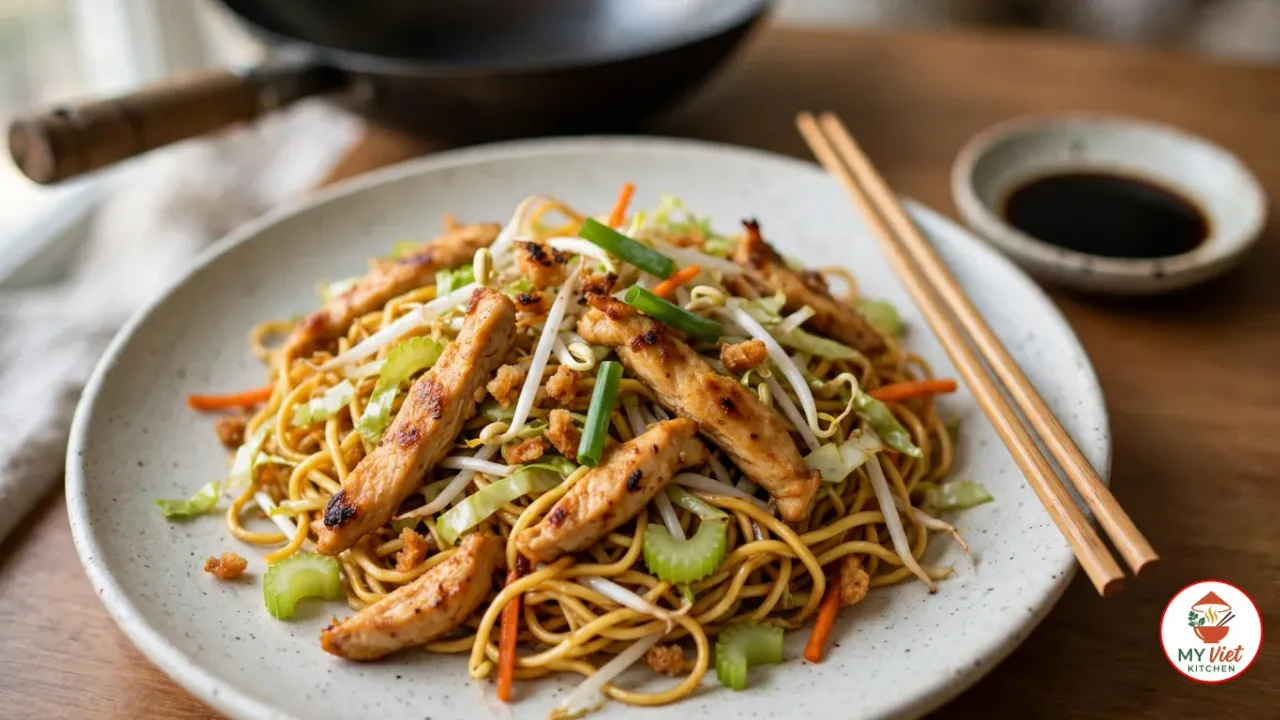
Chow mein is a dish of Chinese stir-fried noodles with vegetables and often meat. Here thin egg noodles are boiled, left to dry, then seared in a very hot wok so some strands turn golden while the rest stay soft. Soy-marinated chicken thigh, cabbage, carrot, celery and bean sprouts go in with a sauce of light soy, dark soy and oyster sauce. From cutting board to plate it takes about 35 minutes.
Prep Time: 20 minutes | Cook Time: 15 minutes | Total Time: 35 minutes | Servings: 4
Difficulty: Easy | Calories: ~520 per serving
https://www.youtube.com/watch?v=VXiUA—QqIY
What Does “Chow Mein” Mean?
The name describes the cooking. The first character, 炒, means stir-fried, and the second, 麵, means noodles. In Mandarin the dish is chǎomiàn and in Cantonese cháaumihn (Wikipedia).
The English spelling follows a third pronunciation, the Taishanese chāo-mèing. Most of the first Chinese immigrants to the United States came from Taishan in Guangdong, and they brought the dish with them around the time of the California gold rush. “Chow mien” appeared in American English print in 1890, and today’s spelling in 1903 (Wikipedia).
Crispy or Soft: Which Style Is This?
Order chow mein on the East Coast of the United States and then on the West Coast, and you may get two different plates. The American market has two main kinds. Crispy chow mein uses fried noodles, often under a thick brown sauce. Soft, or steamed, chow mein is tossed with soy sauce and vegetables, most often onions and celery, sometimes carrot, cabbage and bean sprouts. On the East Coast the name almost always means the crispy kind, and the soft noodles are sold as lo mein. On the West Coast chow mein nearly always means the soft style, and the term lo mein is not widely used (Wikipedia).
This recipe is the soft style with a little crunch. The noodles rest untouched against the hot metal for a full minute before you toss them. The strands touching the wok go golden and crisp in patches, and the rest stay chewy.
The fully crisp version is a separate technique. It’s called liang mian huang, “two sides yellow”, after the color of the noodles on each face. Boiled noodles fry slowly in a pan over low heat until both sides are golden. A stir-fry of sliced pork or shrimp in a thick, hot sauce then goes over the top. The outside crunches while the middle stays moist. The MICHELIN Guide traces the dish to Shanghai and Suzhou, and says it caught on with Hong Kong’s Cantonese and Teochew communities once it reached the city (MICHELIN Guide). The last question in the FAQ below shows how to adapt this recipe to it.
Why Dry the Noodles Before They Go in the Wok?
Water stops noodles from browning. A wet noodle has to boil off its surface water before it can fry, and a mound of damp noodles cools the wok so it steams everything in it. Daddy Lau’s chow mein recipe on Made With Lau lists waterlogged noodles and a pan that isn’t hot enough among its three top mistakes (Made With Lau).
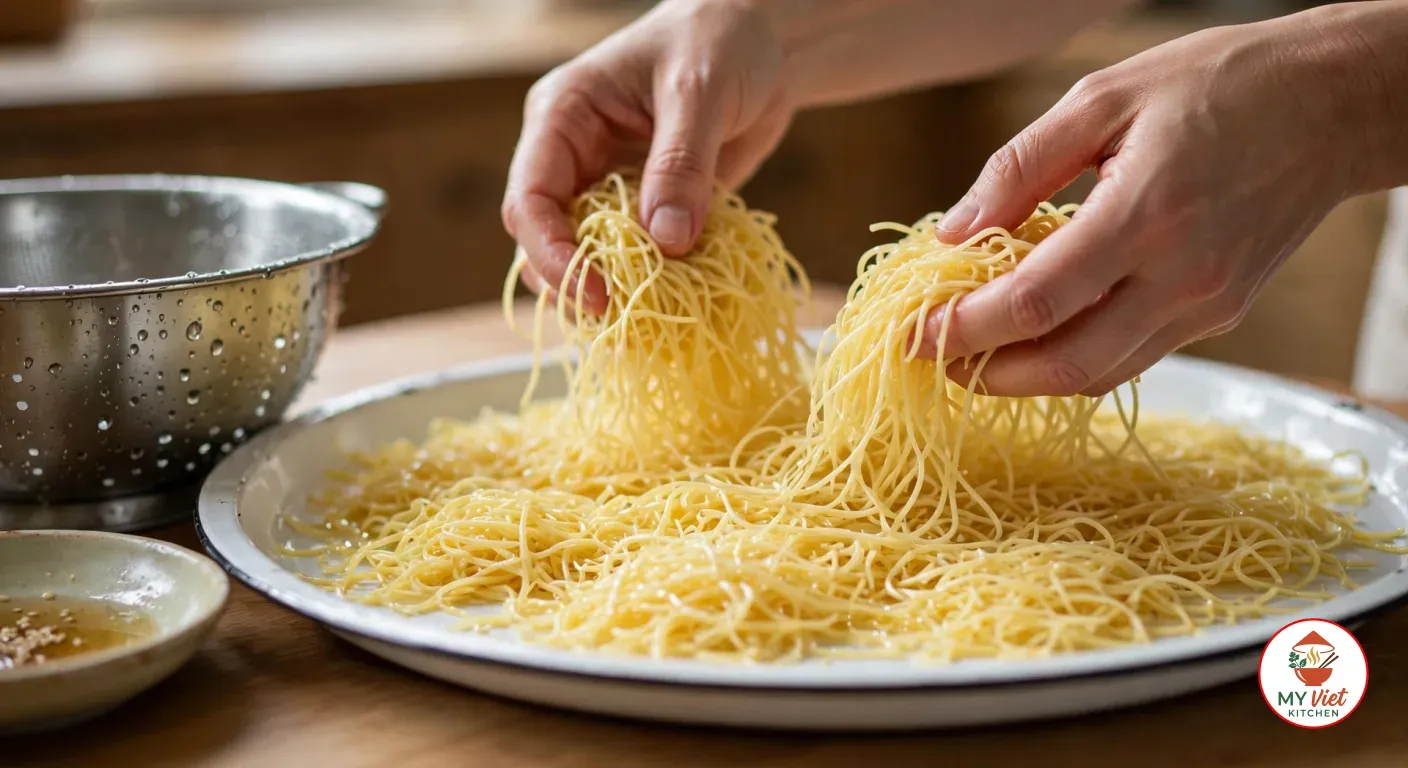
Plan the noodles around that. Boil them a minute under the packet time, since they keep softening in the sauce. Rinse them under cold water to stop the cooking and wash off loose starch, then drain them for a full minute. A teaspoon of sesame oil keeps the strands apart. Spread them in a thin layer on a tray for 5 to 10 minutes and lift them once with your fingers so the bottom layer dries too. They’re ready when they feel tacky rather than wet.
Then keep the heat high and the wok uncrowded. The chicken and the vegetables each cook alone so their juices boil off quickly. When the noodles go in, spread them out and leave them for a whole minute. If you stir right away, nothing has time to brown. Add the sauce only after that first sear: just under 5 tablespoons in all, enough to coat 4 servings without leaving liquid in the bottom of the wok.
Ingredients for Chow Mein
For the Noodles and Vegetables:
- 400 g (14 oz) fresh thin egg noodles (chow mein noodles), or 250 g (9 oz) dried
- 1 teaspoon sesame oil
- 2 cups (150 g) shredded green cabbage
- 1 medium carrot, cut into matchsticks
- 1 stalk celery, thinly sliced on an angle
- 1 cup (100 g) bean sprouts
- 3 green onions, cut into 5 cm (2 in) pieces
For the Chicken:
- 250 g (9 oz) boneless, skinless chicken thigh, thinly sliced
- 1 tablespoon soy sauce
- 1 tablespoon Shaoxing wine or dry sherry
- 1 teaspoon cornstarch
For the Chow Mein Sauce:
- 2 tablespoons soy sauce
- 1 tablespoon oyster sauce
- 1 tablespoon dark soy sauce
- 1 teaspoon sesame oil
- 1 teaspoon sugar
- White pepper to taste
For Stir-Frying:
- 3 tablespoons neutral oil, such as peanut or canola
- 2 cloves garlic, minced
- 1 teaspoon grated fresh ginger
Step-by-Step Instructions
Step 1: Prepare the Noodles
1Boil a large pot of water hard, add the noodles and tease the nests apart with chopsticks as they soften. Pull them a minute before the packet time, when they’re tender but still firm at the center. Drain them, rinse under cold running water and shake the colander until no more water drips. Toss the noodles with 1 teaspoon of sesame oil. Spread them over a large plate or tray and let them dry for 5 to 10 minutes, fluffing them once halfway.
Step 2: Marinate the Chicken
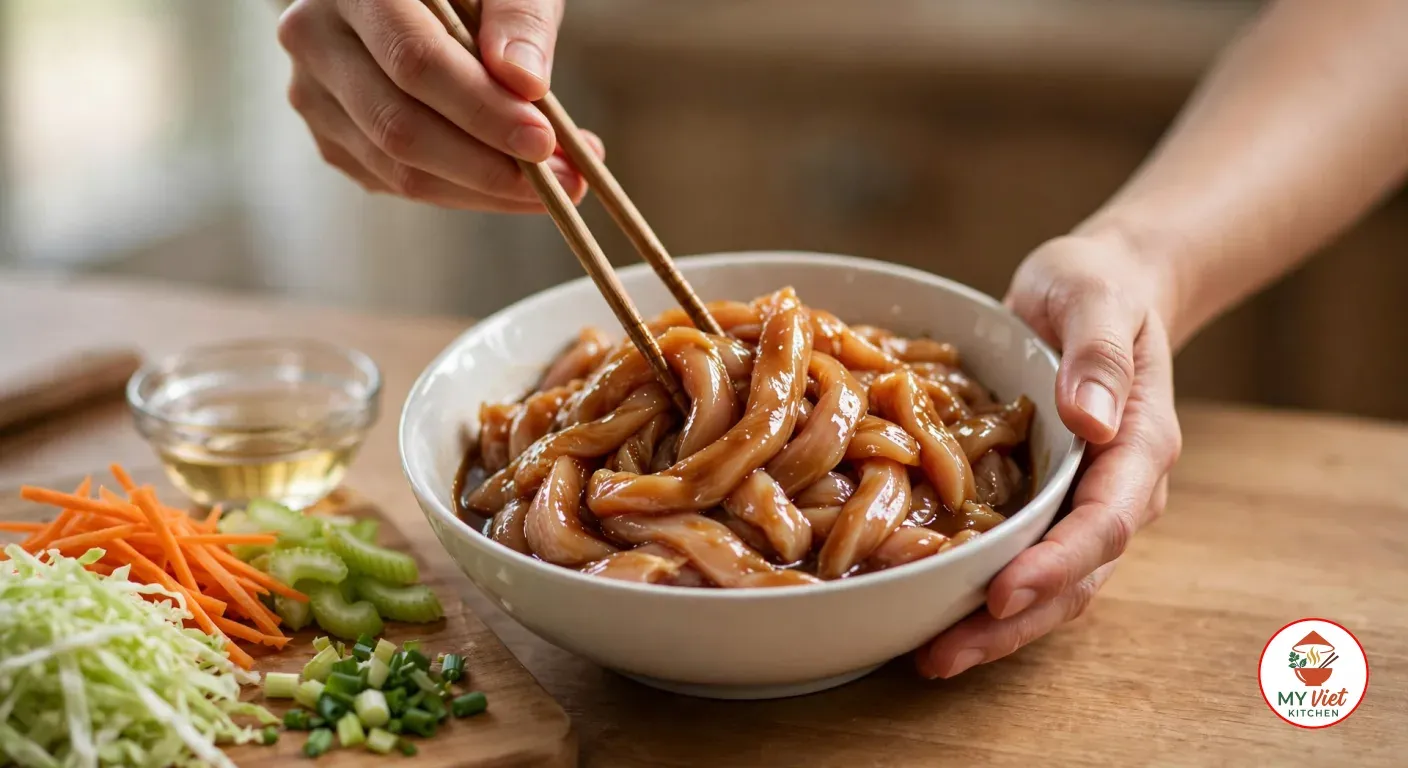
2Put the sliced chicken in a bowl with 1 tablespoon of soy sauce, the Shaoxing wine and the cornstarch. Mix until every strip is coated and no dry cornstarch is left. Leave it for 10 minutes while you cut the cabbage, carrot, celery and green onions. The cornstarch forms a thin film that keeps the thigh meat juicy in the hot wok.
Step 3: Mix the Chow Mein Sauce
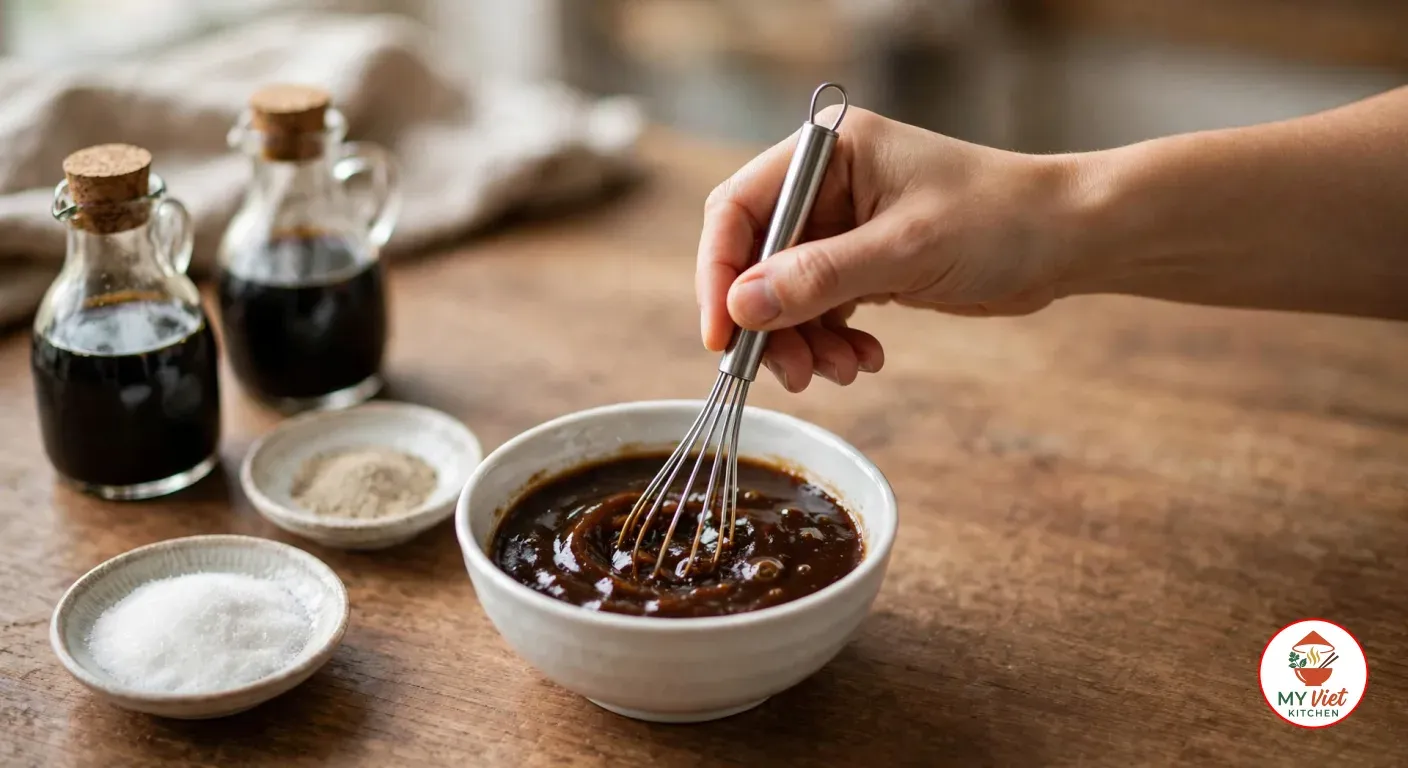
3In a small bowl, whisk the remaining 2 tablespoons of soy sauce with the oyster sauce, dark soy sauce, the second teaspoon of sesame oil, the sugar and a pinch of white pepper. Stir until the sugar dissolves. It will taste strong on its own, since the noodles soak it up. Set the bowl by the stove, because the last two steps take under 5 minutes.
Step 4: Stir-Fry the Chicken
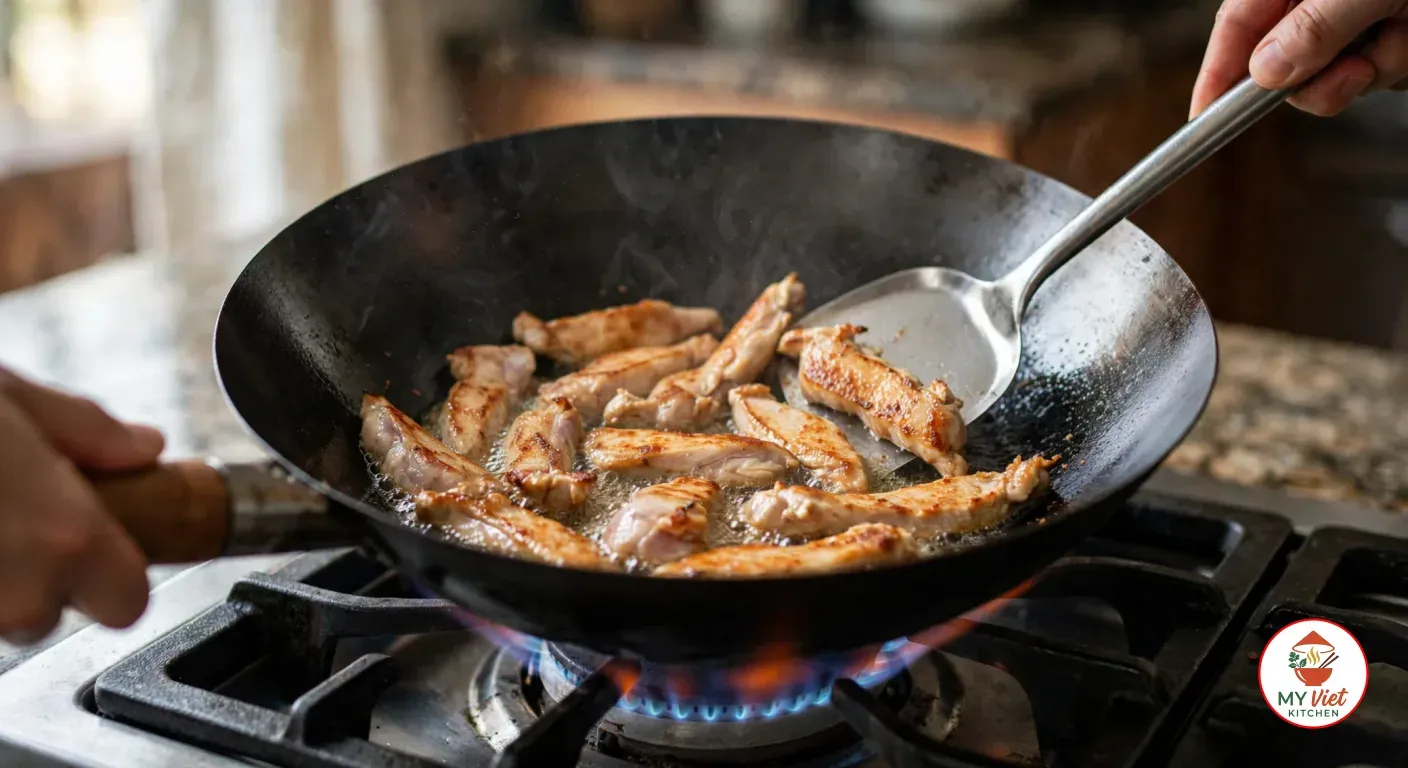
4Heat the wok over your highest flame until a wisp of smoke rises from it. Swirl in 1 tablespoon of the neutral oil and lay the chicken in a single layer. Leave it alone for 1 minute so the underside sears and releases. Then stir-fry for 1 to 2 minutes more, until the strips are golden and no pink shows when you cut the thickest one. Tip the chicken onto a plate and leave the browned bits in the wok.
Step 5: Stir-Fry the Vegetables
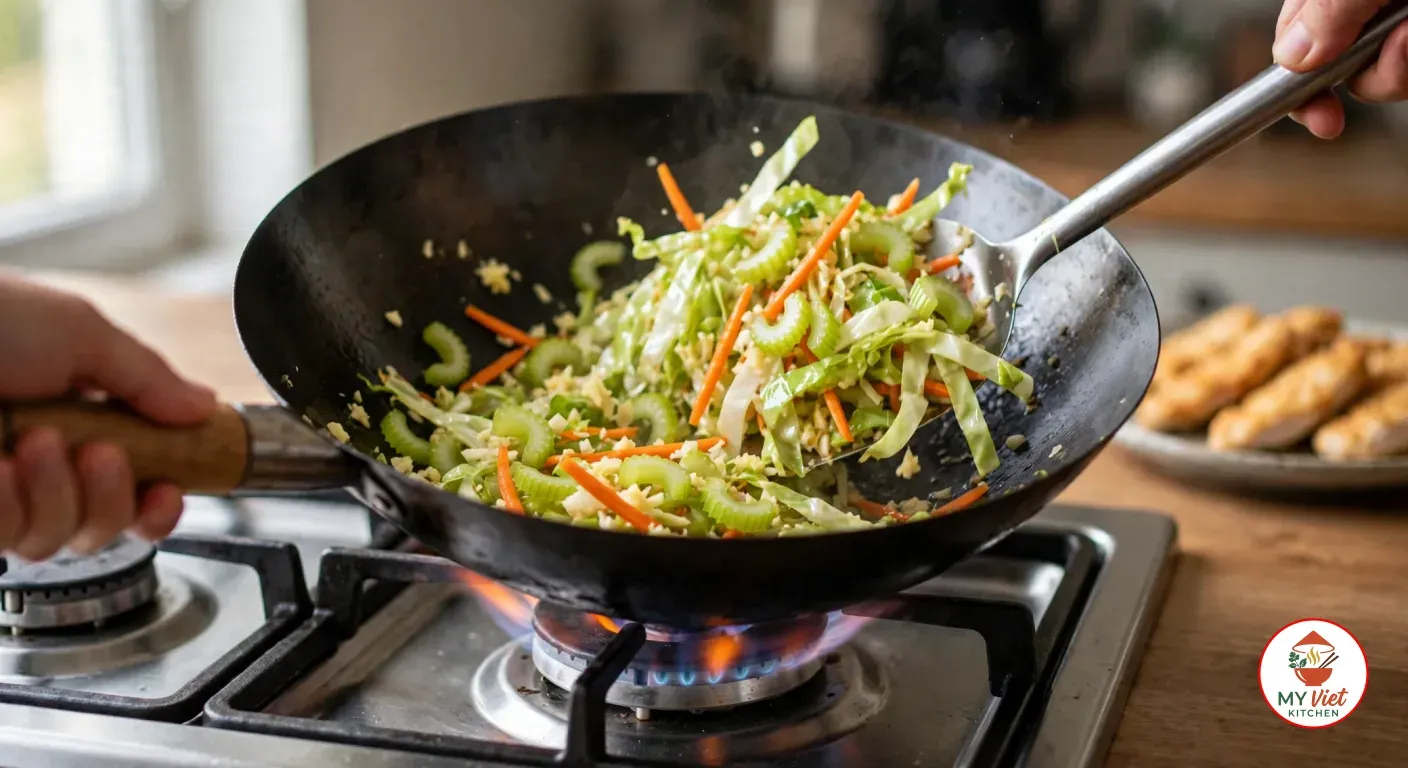
5Add a second tablespoon of oil to the wok. Stir the garlic and ginger for about 10 seconds, until fragrant but not brown. Add the carrot and celery and toss for 1 minute; they’re the firmest, so they go first. Add the cabbage and stir-fry for 1 minute more. Stop while it has just wilted at the edges and still crunches in the middle.
Step 6: Combine Noodles and Finish
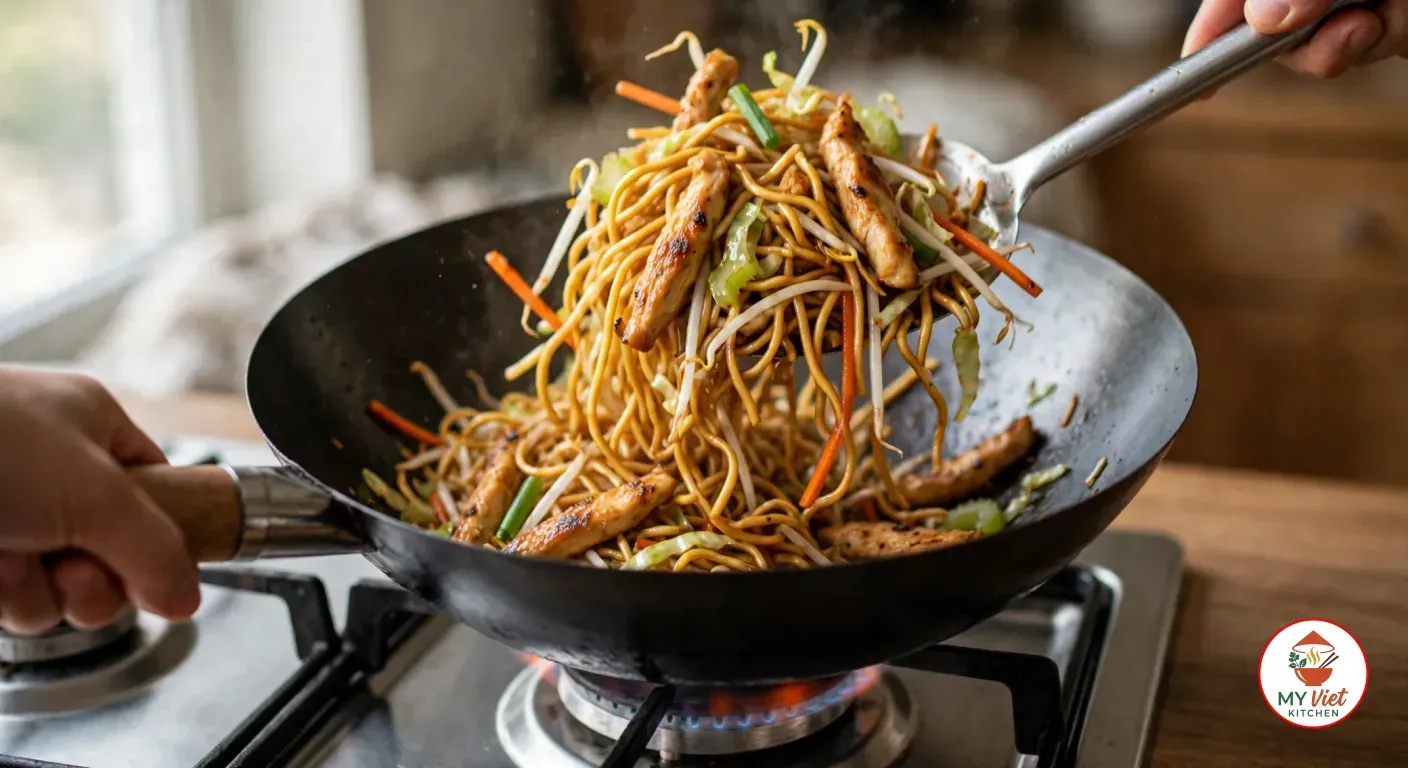
6Push the vegetables up one side of the wok. Pour the last tablespoon of oil into the empty side, add the noodles and spread them out. Leave them untouched for 1 minute so the underside browns. Toss the noodles through the vegetables, pour the sauce around the edge of the wok and toss for about 1 minute, until every strand is evenly brown. Return the chicken with the bean sprouts and green onions. Toss for 30 seconds, just long enough to heat the sprouts, and serve at once.
Frequently Asked Questions
What is the difference between chow mein and lo mein?
The noodles are fried in chow mein and not in lo mein. In Cantonese cooking, lo mein, or “stirred noodles”, is boiled wheat noodles tossed in a sauce such as oyster sauce or served with it on the side. It is traditionally not pan-fried or stir-fried. American Chinese restaurants blur the line. Their lo mein is usually stir-fried with a soy-based sauce, and some menus treat the two names as one dish (Wikipedia).
Which noodles should I buy?
Fresh thin egg noodles, sold chilled in Asian grocers and often labelled chow mein noodles. They need only a short boil and brown quickly. Dried egg noodles work as well; use 250 g (9 oz) and take them off the heat a minute before the packet time. Daddy Lau’s recipe on Made With Lau prefers thicker fresh yellow noodles and suggests ramen or dried egg noodles when you can’t find them (Made With Lau).
Can I make chow mein without a wok?
Yes. Use the widest heavy skillet you own, ideally 30 cm (12 in) or more, and heat it until a drop of water skitters across it before the oil goes in. A flat pan holds less than a wok. Cook the chicken and vegetables in separate batches, and fry the noodles in two lots if they sit more than 2 cm (¾ in) deep.
How do I make crispy pan-fried chow mein?
Fry the noodles as one flat cake instead of tossing them. After drying them, press them into a 1 cm (½ in) layer in a nonstick or well-seasoned pan with 2 tablespoons of oil. Fry over medium-low heat until the underside is golden, then flip it with a plate and brown the second side. Slide it onto a platter. Stir-fry the chicken and vegetables. Mix 1 extra teaspoon of cornstarch and 1/2 cup (120 ml) of water into the sauce, add it to the wok, let it thicken and pour it over the cake.
Sources
- Chow mein, Wikipedia
- Lo mein, Wikipedia
- Tracing the Origin: Two-Faced Pan-Fried Noodles, MICHELIN Guide Hong Kong Macau, December 2018
- Chicken Chow Mein, Made With Lau