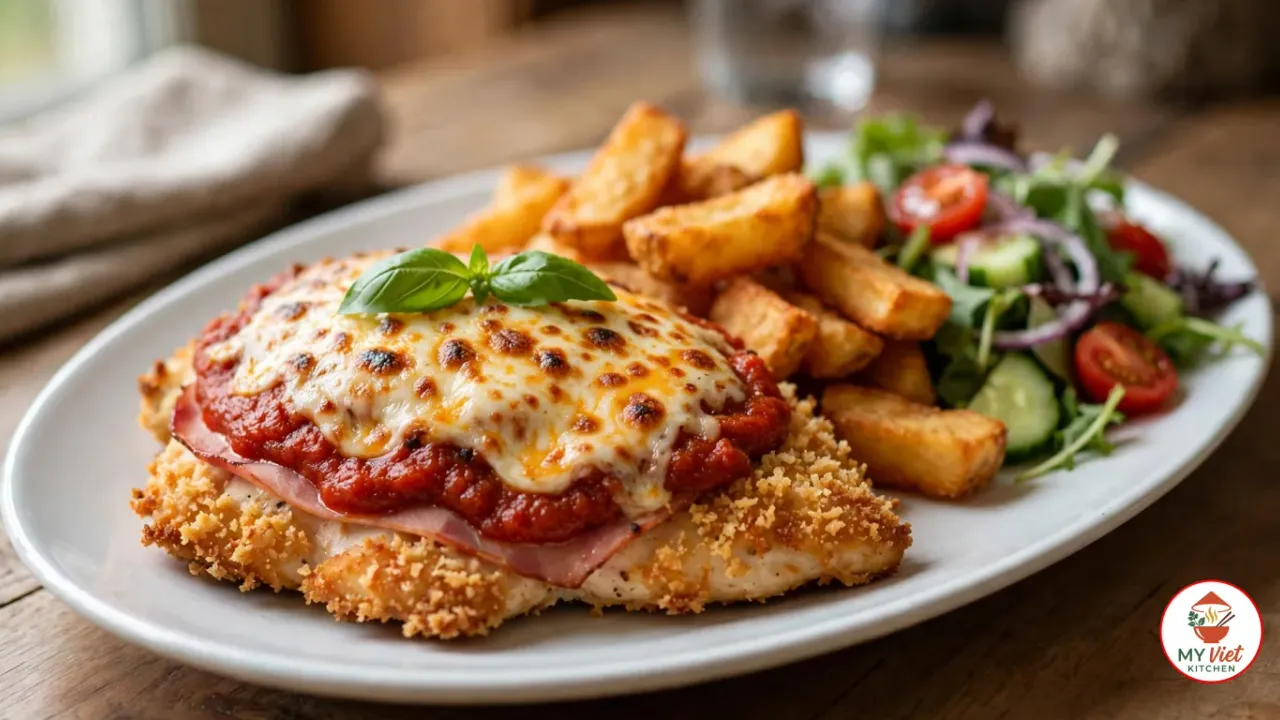
Chicken parmigiana is a crumbed chicken breast, fried and then baked under a sauce of crushed tomatoes and a layer of cheese. In Australia it’s a pub standard, served with chips and salad and usually ordered as a parma or a parmi. This recipe follows the pub version. The breast is pounded to 1/2 inch and coated in panko and Parmesan, then topped with leg ham, thick napoli sauce, and mozzarella and cheddar browned in a hot oven.
Prep Time: 25 minutes | Cook Time: 50 minutes | Servings: 4
Difficulty: Medium | Calories: ~810 per serving

Where Did the Pub Parma Come From?
Its ancestor is Italian, but it isn’t chicken. Parmigiana in Italy is fried, sliced eggplant layered with mozzarella and a sauce of tomatoes, then baked, and Calabria, Campania, Apulia and Sicily all claim it (Wikipedia). Meat took the eggplant’s place in the United States. The chicken version grew up in the Italian diaspora there in the early 20th century, possibly as a cross between parmigiana and cotoletta, a breaded veal cutlet. Italian-American restaurants had made it a staple by the 1950s (Wikipedia).
Australia’s early record is patchy. Food historian Jan O’Connell told Broadsheet that a 1951 Weekly Times recipe called chicken parmigiana was boiled chicken with rice and sultanas. The earliest menu mention the magazine found, in a 1953 issue of Adelaide’s The Mail, describes chicken cooked in light wine and served with grated cheese (Broadsheet). By 1980 it was on the menu of the Pimlico restaurant in Kew, in Melbourne (Australian Food Timeline).
Pubs came later. In a 2019 ABC Radio Hobart interview, O’Connell said chicken parmigiana didn’t become a pub staple until the 1980s and was mostly a restaurant dish before then (Wikipedia). Canberra food historian Colin Bannerman ties the timing to how chicken was sold. Birds only started to appear cut into portions in the 1980s and 1990s, and before that a hotel had to think hard about any dish that needed a boned breast. Only an upmarket one, with other uses for the rest of the bird, could afford it (Broadsheet).
Is It a Parma, a Parmi or a Parmy?
All three, depending on where you order it. The shorthand varies from region to region (Wikipedia). Consumer research that Arnott’s commissioned in 2020 put numbers on the split. Nationally, 45% of Australians said parmi or parmy, 34% said parma and 21% something else. Victoria went the other way, 64% parma to 20% parmi or parmy, and half of the Northern Territory respondents didn’t shorten the name at all (Australian Food News).
The same research found that 45% of Australians misspell the full name. The Italian word is parmigiana, with the “gi” in the middle. Some trace it to the city of Parma and its cheese. Sicilian writers trace it instead to palmigiana, a dialect word for the slats of a louver, which the layered eggplant slices resemble (Wikipedia).
Does Chicken Parmigiana Need Ham?
No, but many Australian versions have it. At its core the dish is breaded chicken under sauce and cheese, with ham or bacon sometimes added (Wikipedia). In the Arnott’s survey, 34% of Australians named ham as an essential ingredient and 16% named bacon (Australian Food News). Argentina has a close cousin in milanesa a la napolitana, sometimes made with chicken, sometimes topped with ham and usually served with fried potatoes (Wikipedia).
The ham also does a job. Joel Mielle of Recipe30, the chef in the video above, tops his parma with ham “to keep the crispy panko coating from going soggy” (Recipe30). A thin slice sits between the crumb and the napoli and holds back some of the sauce’s moisture. If you leave it out, spread the sauce a little thinner.
How Do You Keep the Crumb Crisp Under the Sauce?
A soggy parma usually comes from a wet sauce or oil that has cooled. Four habits prevent both:
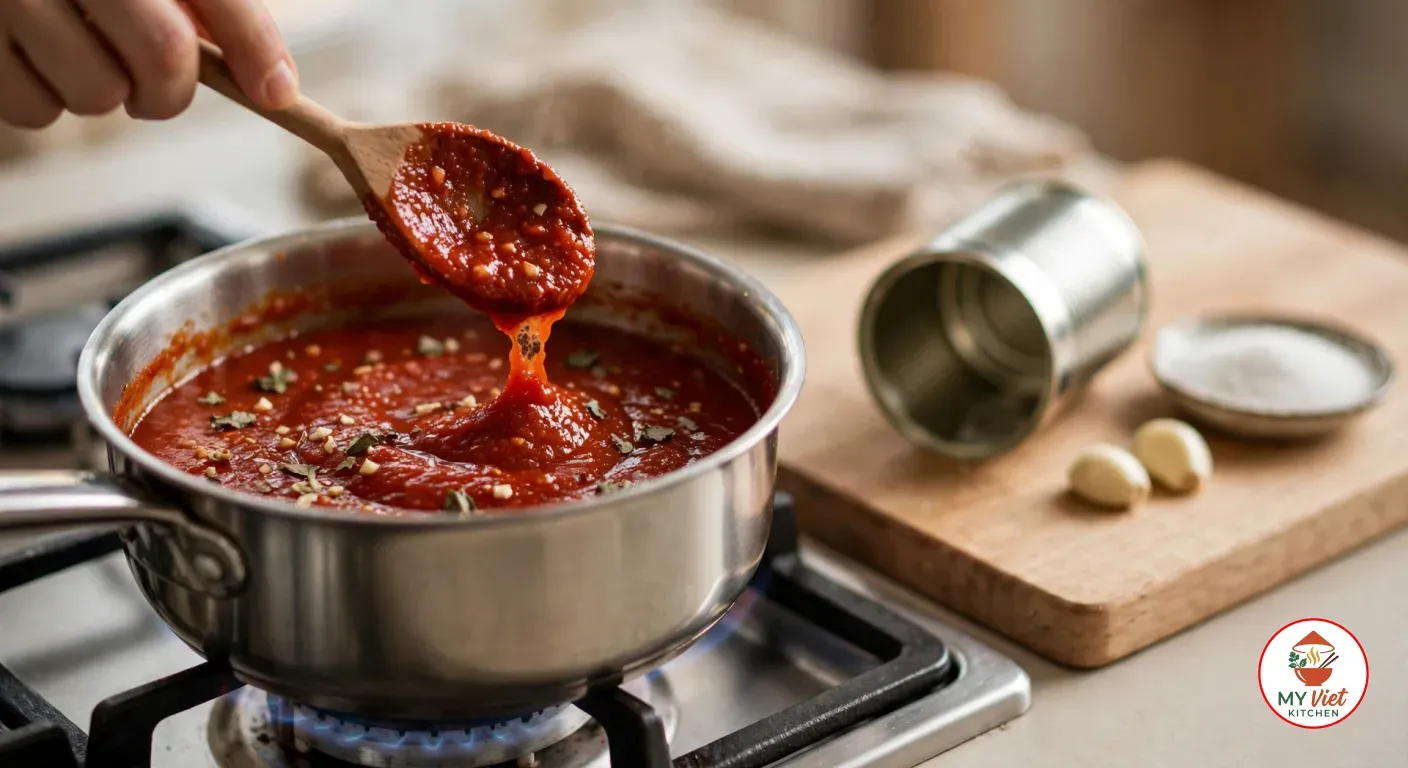
- Reduce the napoli until it holds a trail behind the spoon, 15 to 20 minutes for a 14-ounce (400 g) can. A loose sauce soaks straight into the crumb.
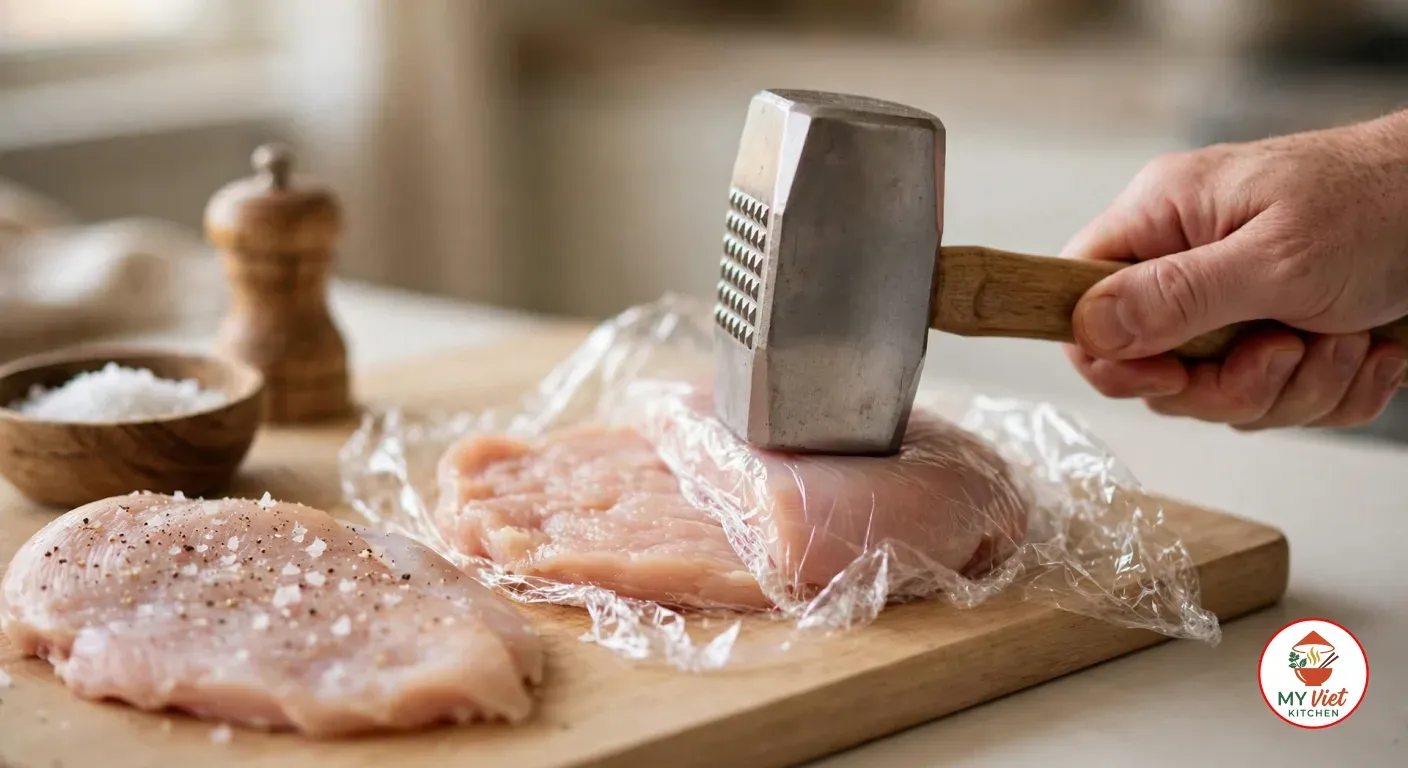
- Pound the breasts until they’re 1/2 inch (1.25 cm) thick from edge to edge. An unpounded breast has thin edges and a thick middle, so the crumb burns before the center is done.
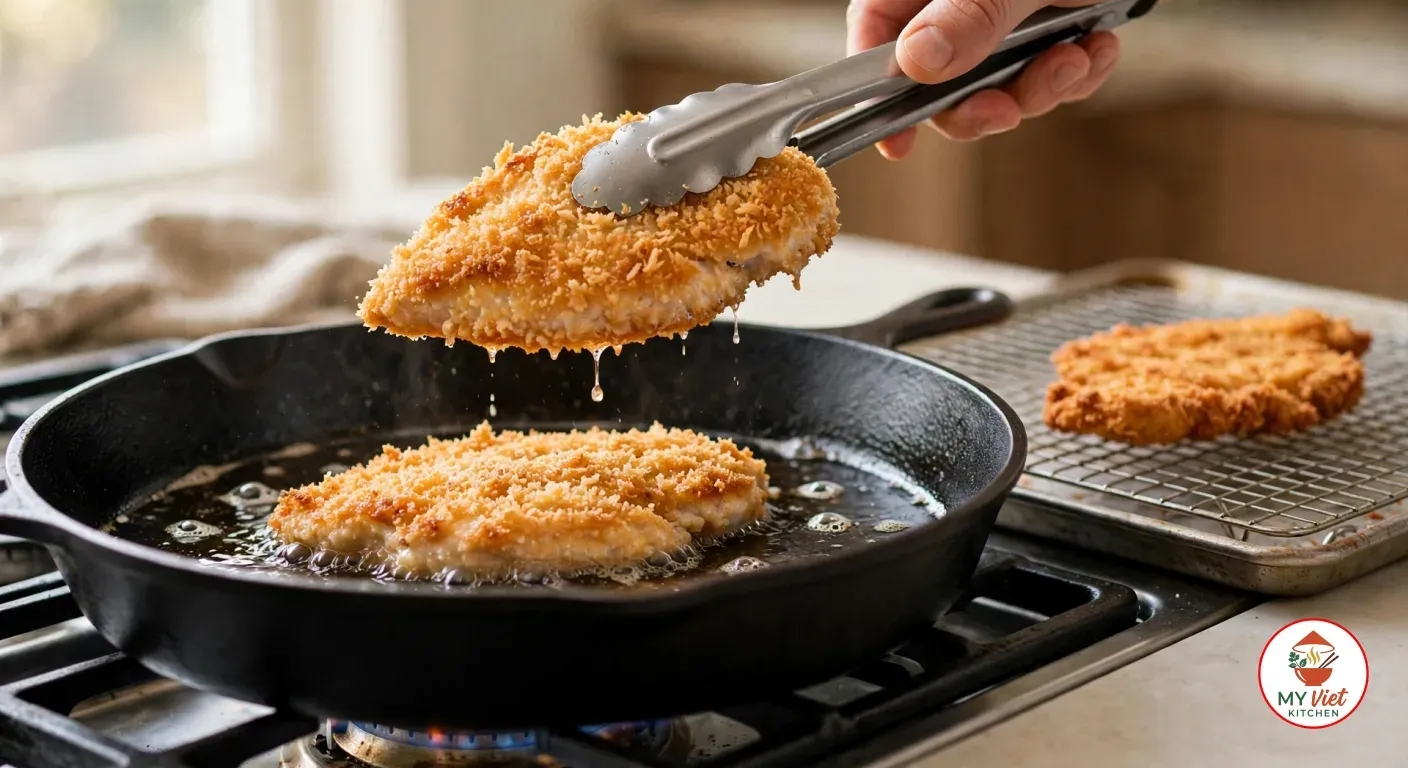
- Keep the oil near 350°F (175°C) and fry two pieces at a time. A crowded pan cools the oil, and the crumb drinks it instead of crisping.
- Drain the chicken on a wire rack, not paper towels, and leave a rim of bare crumb when you add the sauce. Steam trapped underneath softens the bottom, while an uncovered border stays crunchy in the oven.
Pounded this thin, the chicken cooks through in the pan, but check one piece with a thermometer. Australia’s Food Safety Information Council says chicken should reach 75°C (167°F) in the center of the thickest part (Food Safety Information Council).
Ingredients for Chicken Parmigiana
For the Napoli Sauce:
- 1 tablespoon olive oil
- 2 cloves garlic, minced
- 1 can (14 oz / 400 g) crushed tomatoes
- 1 teaspoon sugar
- 1 teaspoon dried basil
- Salt and pepper to taste
For the Crumbed Chicken:
- 4 boneless, skinless chicken breasts, about 7 oz (200 g) each
- 1 cup (125 g) all-purpose flour
- 3 large eggs, beaten
- 2 cups (110 g) panko breadcrumbs
- 1/2 cup (45 g) finely grated Parmesan
- 1 teaspoon garlic powder
- 1 teaspoon dried oregano
- Salt and black pepper to taste
- About 2 cups (480 ml) canola or sunflower oil, for shallow frying
For the Toppings:
- 4 thin slices leg ham
- 1 1/2 cups (170 g) shredded mozzarella
- 1/2 cup (55 g) shredded aged cheddar
- Fresh basil leaves, to garnish
Step-by-Step Instructions
Step 1: Prepare the Napoli Sauce
1Start with the sauce so it can reduce while you work on the chicken. Warm the olive oil in a small saucepan over medium heat. Add the garlic and give it about half a minute of stirring, until it smells sweet but hasn’t browned. Tip in the crushed tomatoes with the sugar, dried basil and a pinch each of salt and pepper. Lower the heat and let it bubble gently for 15 to 20 minutes, with a stir every few minutes, until a spoon dragged through the sauce leaves a trail. You’ll have a little over 1 cup (250 ml). Take it off the heat.
Step 2: Pound and Season the Chicken
2Lay one breast between two sheets of plastic wrap on a cutting board. Working from the thick end outward, pound it with the flat face of a meat mallet or a rolling pin until it’s an even 1/2 inch (1.25 cm) thick all over, an oval about 6 inches (15 cm) long. Repeat with the other three, then season both sides of each with salt and black pepper. Wash the board and your hands before you touch anything else.
Step 3: Crumb the Chicken
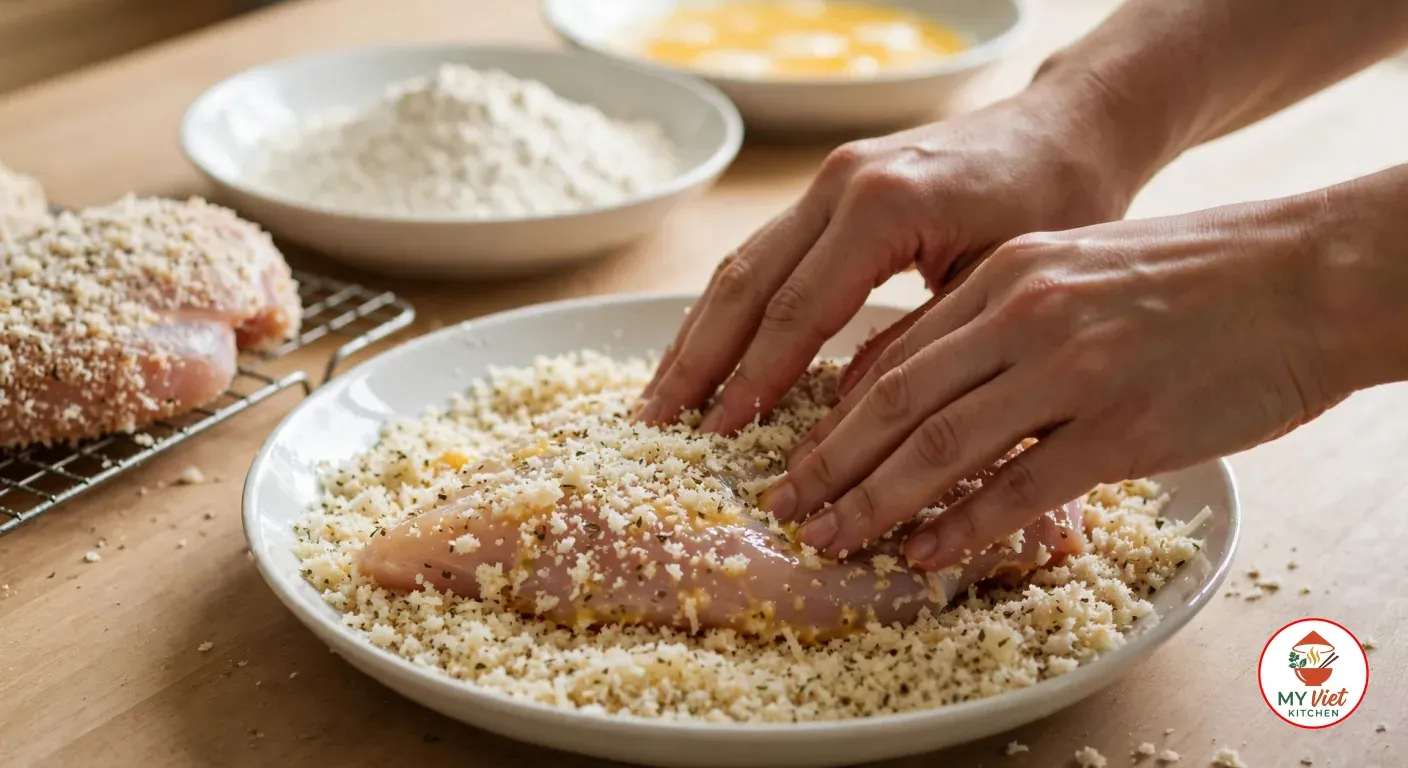
3Set out three shallow bowls: flour in the first, beaten eggs in the second, and in the third the panko, Parmesan, garlic powder and oregano stirred together. Coat a breast in flour and shake off the excess, then dip it in egg and let the drips fall back into the bowl. Lay it in the crumbs, press down firmly with your palm, turn it and press again until no bare patches show. Set it on a wire rack and crumb the rest. Keep one hand for the egg and the other for the dry bowls, so your fingers don’t build up a crust of their own.
Step 4: Fry Until Golden
4Turn the oven on to 400°F (200°C) so it’s ready when the chicken is. Pour the oil into a large cast-iron or other heavy skillet to a depth of about 1/4 inch (6 mm) and heat it over medium-high heat to 350°F (175°C). Without a thermometer, drop in a pinch of crumbs: they should sizzle at once. Lower two pieces into the pan, laying them away from you so any splash goes the other way. Give them 3 to 4 minutes, until the underside is deep golden, then turn them with tongs and cook the second side 3 to 4 minutes more, until the thickest part reads 75°C (167°F). Lift them onto a wire rack set over a tray, let the oil come back to temperature and fry the other two.
Step 5: Assemble and Bake
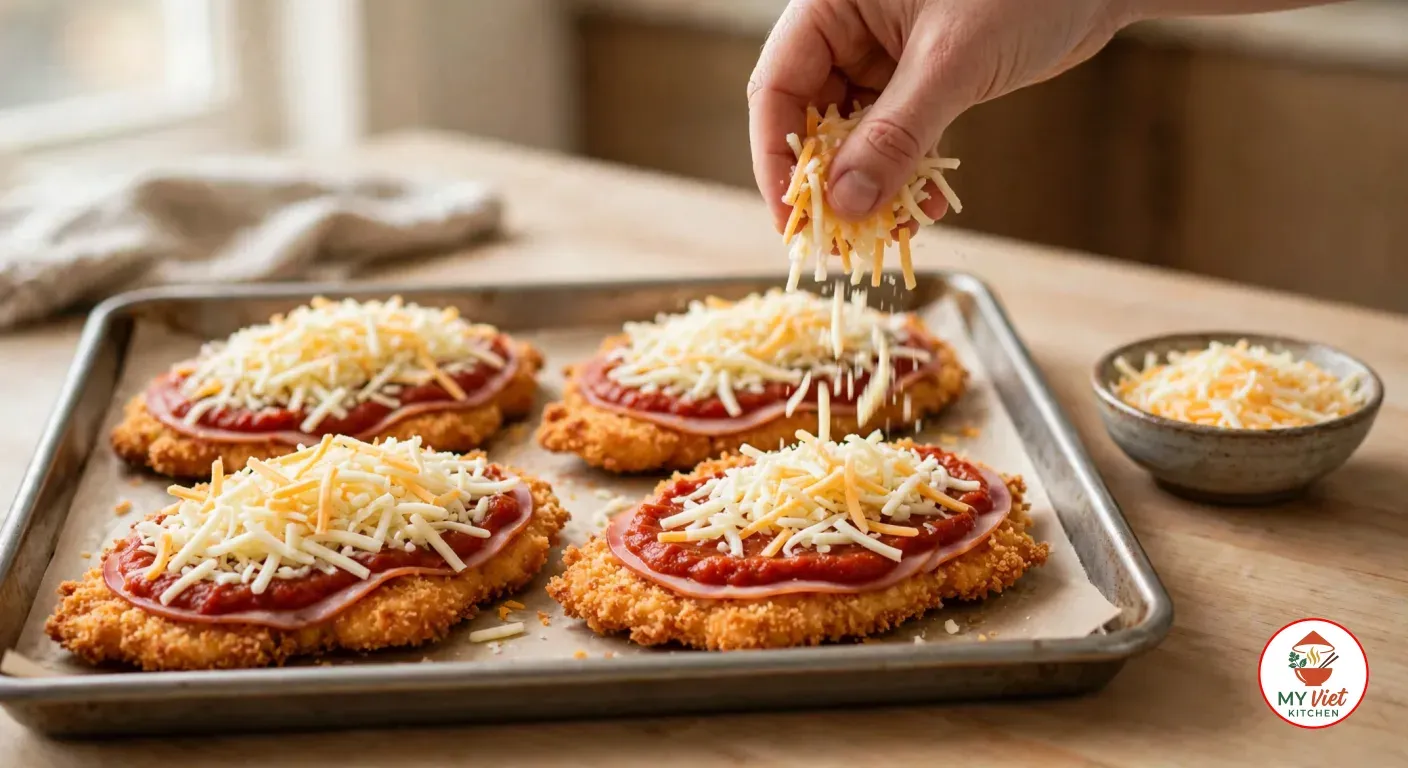
5Line a baking tray with parchment paper and set the fried pieces on it. Lay a slice of ham on each piece. Spoon 3 to 4 tablespoons of napoli sauce over the ham and spread it out, stopping about 1/2 inch (1 cm) short of the edge so a rim of crumb stays bare. Scatter the mozzarella and cheddar over the sauce. Bake the tray in the hot oven until the cheese has melted, bubbles at the edges and has browned in spots, 10 to 12 minutes.
Step 6: Serve with Chips and Salad
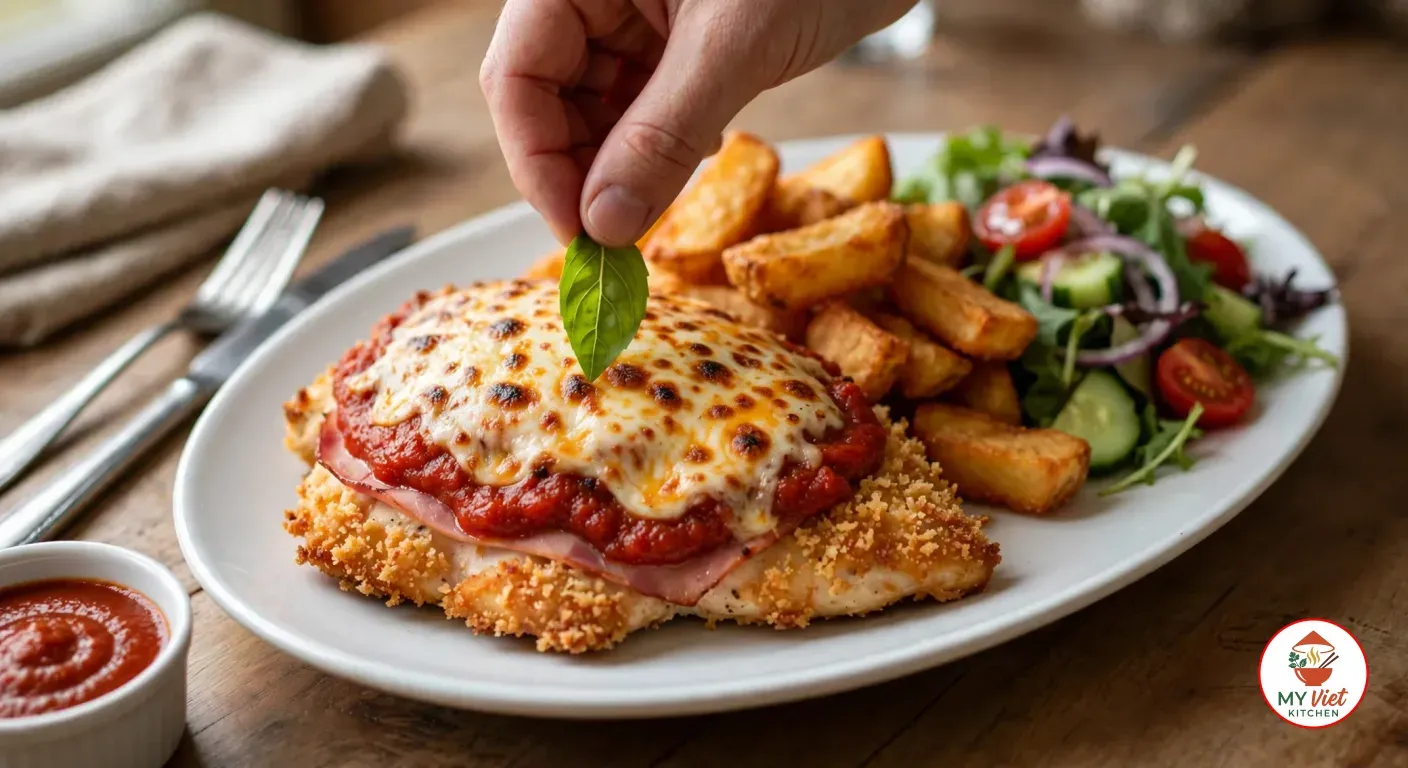
6Let the chicken parmigiana stand on the tray for 2 minutes, so the cheese sets enough to stay put when you cut it. Move each piece to a plate with a spatula, add a basil leaf or two and serve it with hot chips and a green salad dressed with lemon and olive oil. Warm any napoli sauce left in the pan and put it on the table in a small bowl.
Frequently Asked Questions
What is the difference between chicken parmigiana and chicken parmesan?
They are the same dish under two names. In the United States and Canada, chicken parmesan is usually eaten as a main dish, sometimes with pasta or in a sandwich, while Australian pubs serve chicken parmigiana with chips and salad (Wikipedia). Ham or bacon is an extra that some Australian cooks add and others leave off (Wikipedia).
Can I bake the crumbed chicken instead of frying it?
Yes. Spray both sides with oil, set the pieces on a wire rack over a tray and bake them in a 425°F (220°C) oven, turning them halfway. They need 15 to 20 minutes in all, until the crumb is golden and a thermometer in the thickest piece shows 75°C (167°F). Then add the toppings and bake as in Step 5. The crust comes out paler and drier than a fried one.
Which cheese melts best on a parma?
Low-moisture mozzarella gives the stretch, and a little cheddar adds color and a sharper taste. Mozzarella, Parmesan and provolone are the usual cheeses on the dish (Wikipedia). Fresh mozzarella packed in water is too wet here, since it lets water out onto the sauce and browns less.
Can I use chicken thighs?
Yes. Boneless thigh fillets stay juicier and forgive an extra minute in the pan, though they come out smaller and less even than a pounded breast. Flatten them gently to 1/2 inch (1.25 cm), fry them for about the same time and check for 75°C (167°F) in the thickest part.
How do I reheat leftover chicken parmigiana?
In the oven. Lay the pieces on a rack in a roasting tray and slide them into a 350°F (180°C) oven. After 12 to 15 minutes the cheese softens again and the center is hot. A microwave turns the crumb soft, and chips are better made fresh than reheated.
Sources
- Chicken parmesan, Wikipedia
- Parmigiana, Wikipedia
- A Brief History of the Chicken Parmigiana, Luke Robertson, Broadsheet, 2019
- 1980 Chicken Parmigiana on the menu, Australian Food Timeline
- Keep parm and carry on, Arnott’s sheds light on the parmi/parma debate, Australian Food News, 2020
- Aussie Chicken Parmigiana, Joel Mielle, Recipe30
- Meat thermometers – How to cook meat and poultry safely, Food Safety Information Council