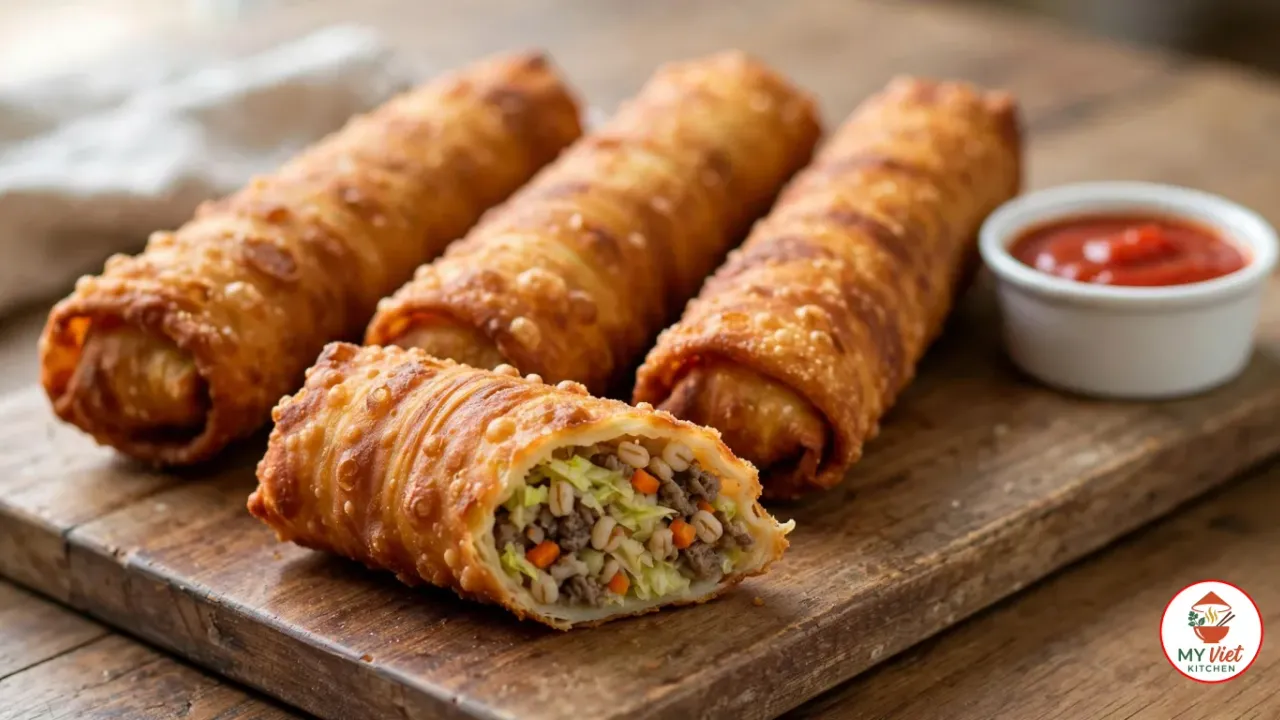
The chiko roll is an Australian takeaway snack: a filling of cabbage, barley and beef sealed in a thick wheat pastry tube, deep-fried and eaten hot with tomato sauce. Fish and chip shops fry a frozen factory version. This version builds its thick, crunchy shell from two layers of egg pastry, and each roll is about 15 cm (6 in) long. Plan on 3 hours, most of it spent cooling the filling and chilling the rolls.
Prep Time: 55 minutes | Cook Time: 1 hour 20 minutes | Total Time: 3 hours, including cooling, resting and chilling | Servings: 8 chiko rolls
Difficulty: Medium | Calories: ~400 per serving

What’s Actually Inside a Chiko Roll?
Not chicken. Sales took off in the 1950s and 1960s. The roll of that era was “a mixture of cabbage, barley, carrots, celery, condiments and meat (beef or mutton) wrapped in an egg-batter dough” (Australian Dictionary of Biography).
The frozen rolls Simplot makes today are close to that. Vegetables come first on the label at 31%: cabbage, carrot, celery, onion and green beans. Wheat flour, water and cooked barley follow. Beef is only 4%, and one roll weighs 162 g (Chiko).
Even the name has two stories. Wikipedia, citing CooksInfo, says the roll was first sold in 1951 as the “Chicken Roll” (Wikipedia). The McEncroe family told the ABC in 2016 that it was first known as the snack roll and took the Chiko name when it went to Melbourne (ABC News).
The recipe here keeps the cabbage and barley base but is meatier. Each roll gets about 28 g (1 oz) of raw beef, against about 6.5 g in a shop roll. The barley gives the filling body and soaks up some of the cabbage’s juice. Dice the carrot, celery and onion no bigger than a pea, or they can poke through the pastry as you roll. For a filling closer to the packet, add a handful of finely chopped green beans with the carrot.
Why Is the Pastry So Thick?
McEncroe built it to be held. In the brand’s own account, he found a competitor’s chop suey rolls too flimsy to handle outdoors. He wanted a larger, sturdier roll you could eat in one hand, with a crisp outer layer that doubled as its own holder (Chiko).
Factory rolls get their shell in one pass. At Simplot’s plant in Bathurst, New South Wales, a machine forms the pastry and filling together as one long roll, then slices it and folds the ends (Chiko).
At home, two layers do that job. A single sheet rolled 3 to 4 mm thick tends to brown before its inner side has cooked. So each roll here gets a 2 mm inner wrap and a 1 mm outer wrap, stuck together with a film of water. In the oil they fry into one thick, crunchy shell in 6 to 8 minutes. The egg in the dough follows McEncroe’s egg-batter pastry and helps it brown.
The second layer is why the pastry starts with 3 cups (375 g) of flour. That makes about 620 g of dough, or 8 pieces of roughly 75 g. Cut a third off each piece. The larger part, about 50 g, makes the inner sheet: 20 × 13 cm (8 × 5 in) at 2 mm. The 25 g piece covers the outside at about 1 mm. Two cups of flour would only stretch to the inner wraps.
Is a Chiko Roll Just a Big Spring Roll?
It began as a tougher take on one. In 1950 McEncroe saw a Chinese chop-suey roll being sold outside the Richmond football ground and developed a similar product, later called the Chiko roll. It was acclaimed at the Wagga Wagga show in New South Wales in 1951. By 1979, Australians were eating up to 40 million a year, and more than a million went to Japan (Australian Dictionary of Biography). Simplot told The Sydney Morning Herald that sales had fallen to about 17 million by 2011 (The Sydney Morning Herald).
Where it was born is still argued. McEncroe was a Bendigo boilermaker who also sold food at country shows. In 2016, MPs for Bendigo, Wagga Wagga and Bathurst each claimed the roll for their town (ABC News). The McEncroe family says three brothers, Leo, Gerry and Frank, first made it at a dairy factory in Bendigo (ABC News). Bathurst’s claim rests on the factory, which Simplot runs there; it has owned the brand since 1995 (Chiko).
For a cook, the differences are the wrapper and the size. A spring roll wrapper is a thin sheet that crisps in a few minutes. Here the pastry is a sturdy wheat and egg dough, the roll is about 15 cm long, and it needs 6 to 8 minutes in the oil. As with a spring roll, the filling is cooked and cooled first, so the frying only has to cook the pastry and heat the middle.
Ingredients for Chiko Roll
For the Filling:
- 1/3 cup (65 g) pearl barley
- 1 tablespoon vegetable oil
- 1/2 pound (225 g) lean ground beef
- 1 small brown onion, finely diced
- 1 large carrot, finely diced
- 1 celery stalk, finely diced
- 3 cups (210 g) finely shredded green cabbage
- 1 tablespoon soy sauce
- 1 tablespoon Worcestershire sauce
- 1 teaspoon garlic powder
- 1/2 teaspoon ground white pepper
- 1/4 teaspoon salt, plus more to taste
For the Pastry:
- 3 cups (375 g) all-purpose flour, plus extra for dusting
- 1 teaspoon salt
- 1 large egg
- 2 tablespoons (28 g) butter, melted
- 2/3 cup (160 ml) warm water, plus 1 to 2 tablespoons if needed
For Frying and Serving:
- Vegetable oil for deep-frying, about 2 quarts (2 L)
- Tomato sauce (ketchup) or sweet chilli sauce
Step-by-Step Instructions
Step 1: Cook the Filling
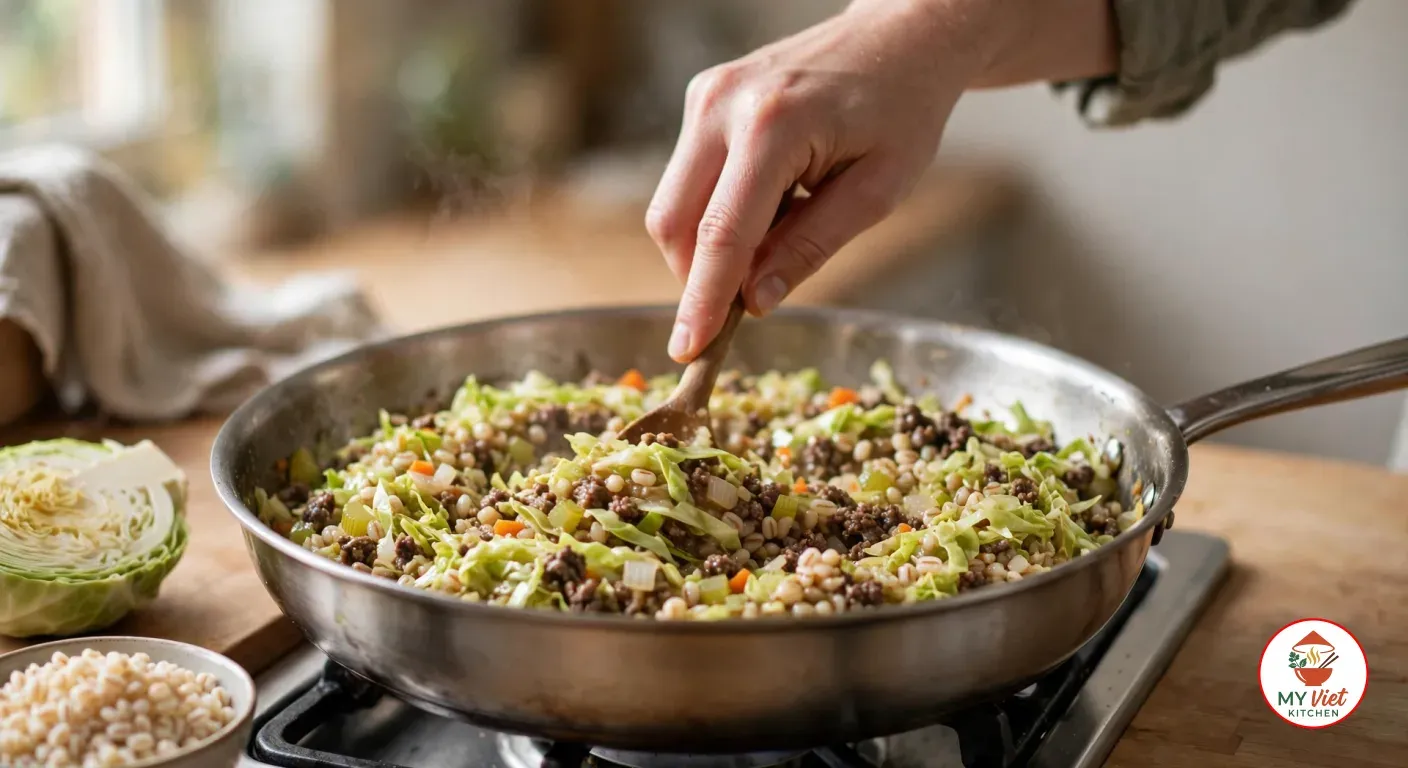
1Rinse the barley and cook it at a gentle simmer in 4 cups (1 L) of water. After 25 to 30 minutes the grains should be tender with a little chew left; drain them well. While it cooks, dice the onion, carrot and celery to about the size of a pea and shred the cabbage finely. Set a large skillet with the oil over medium-high heat. Add the beef and let it brown for about 5 minutes, pressing it into fine crumbs with a wooden spoon. Add the onion, carrot and celery and give them 5 minutes to soften. Stir in the cabbage, barley, soy sauce, Worcestershire sauce, garlic powder, white pepper and 1/4 teaspoon of salt. Give it about 10 minutes more, stirring often. The cabbage should collapse, and a spoon drawn through the mix should leave a dry trail on the pan. Taste and add salt if it needs it. Spread the filling on a tray, leave it for 10 minutes, then refrigerate it for 30 minutes until cold.
Step 2: Make the Pastry Dough
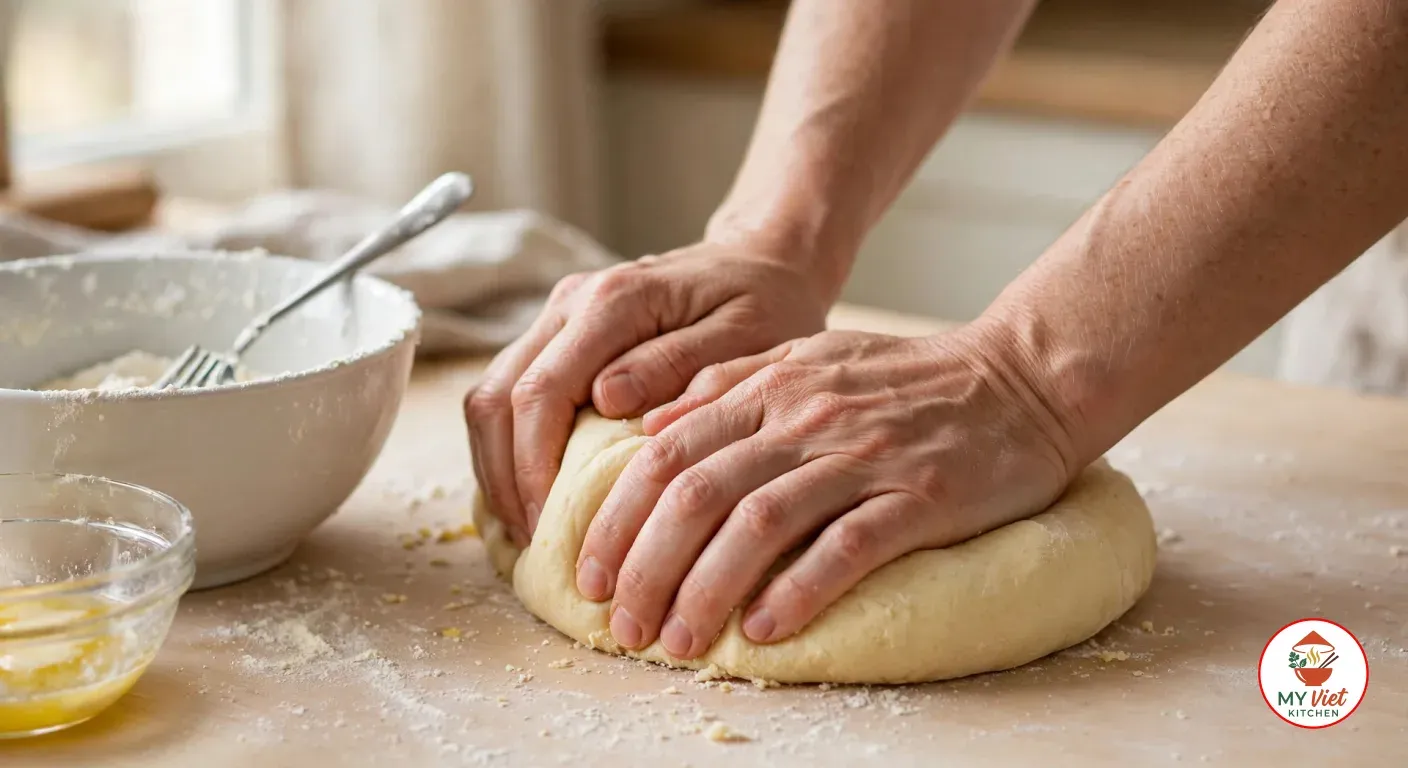
2Start the dough while the filling chills: whisk 1 teaspoon of salt into the flour in a large bowl. In a jug, beat the egg with the melted butter and the warm water. Pour this into the flour and stir with a fork until it clumps together. Add 1 to 2 tablespoons more water only if dry flour is left in the bottom of the bowl. Knead it on a lightly floured counter until smooth and firm, which takes 5 to 8 minutes. It should feel stiffer than bread dough. Cover it and leave it on the counter for 20 minutes. That pause relaxes the gluten, so the sheets won’t spring back when you roll them thin.
Step 3: Roll and Fill the Dough
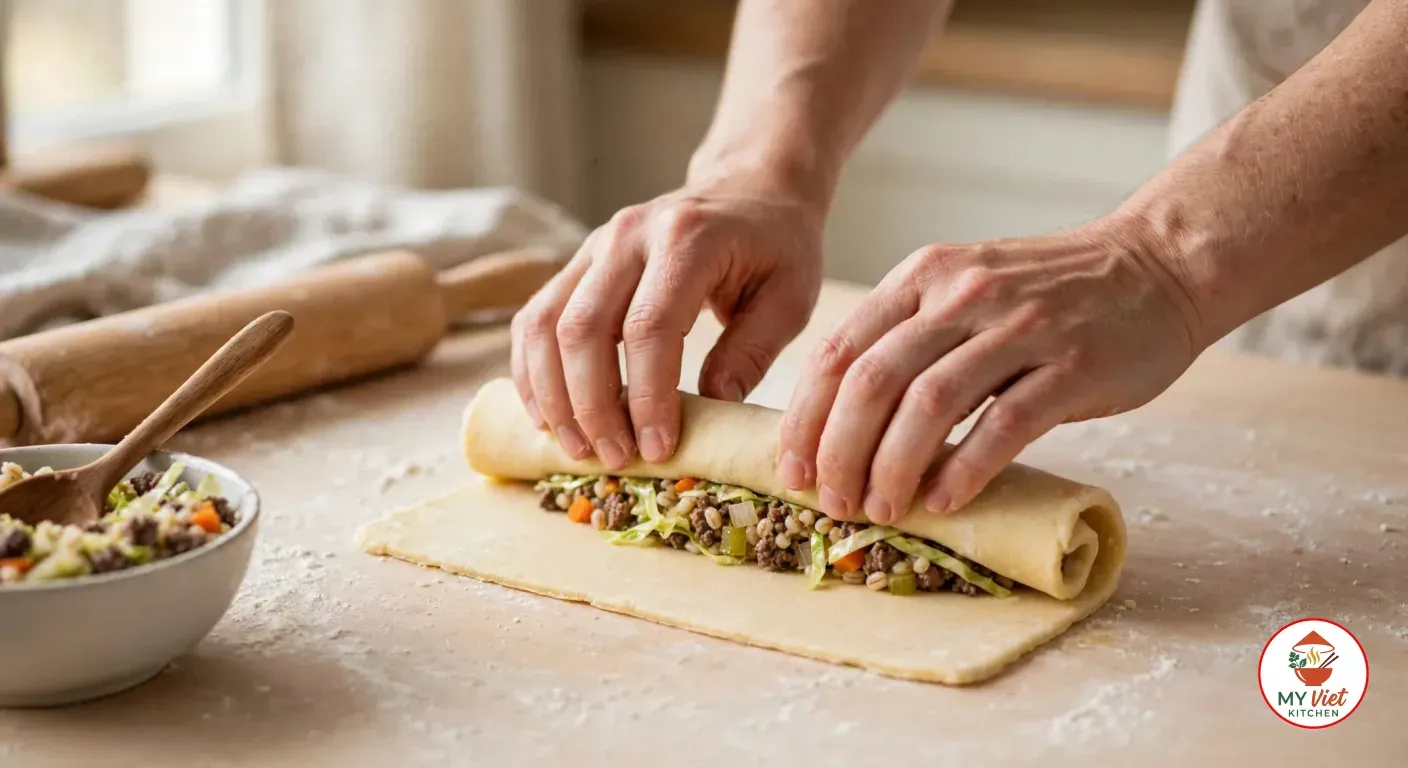
3Cut the dough into 8 equal pieces of about 75 g (2⅔ oz). Cut a third off each piece and keep the small pieces covered for step 4. On a floured surface, roll one larger piece into an 8 by 5 inch (20 by 13 cm) rectangle, about 2 mm thick. Spoon a heaped 1/3 cup (about 75 g) of cold filling into a 6-inch (15 cm) log along one long edge, leaving 1 inch (2.5 cm) of dough clear at each end. Fold those ends over the filling, then roll the dough up tightly. Brush the far edge with water and press the seam closed. Repeat with the other large pieces.
Step 4: Double-Wrap for Crunch
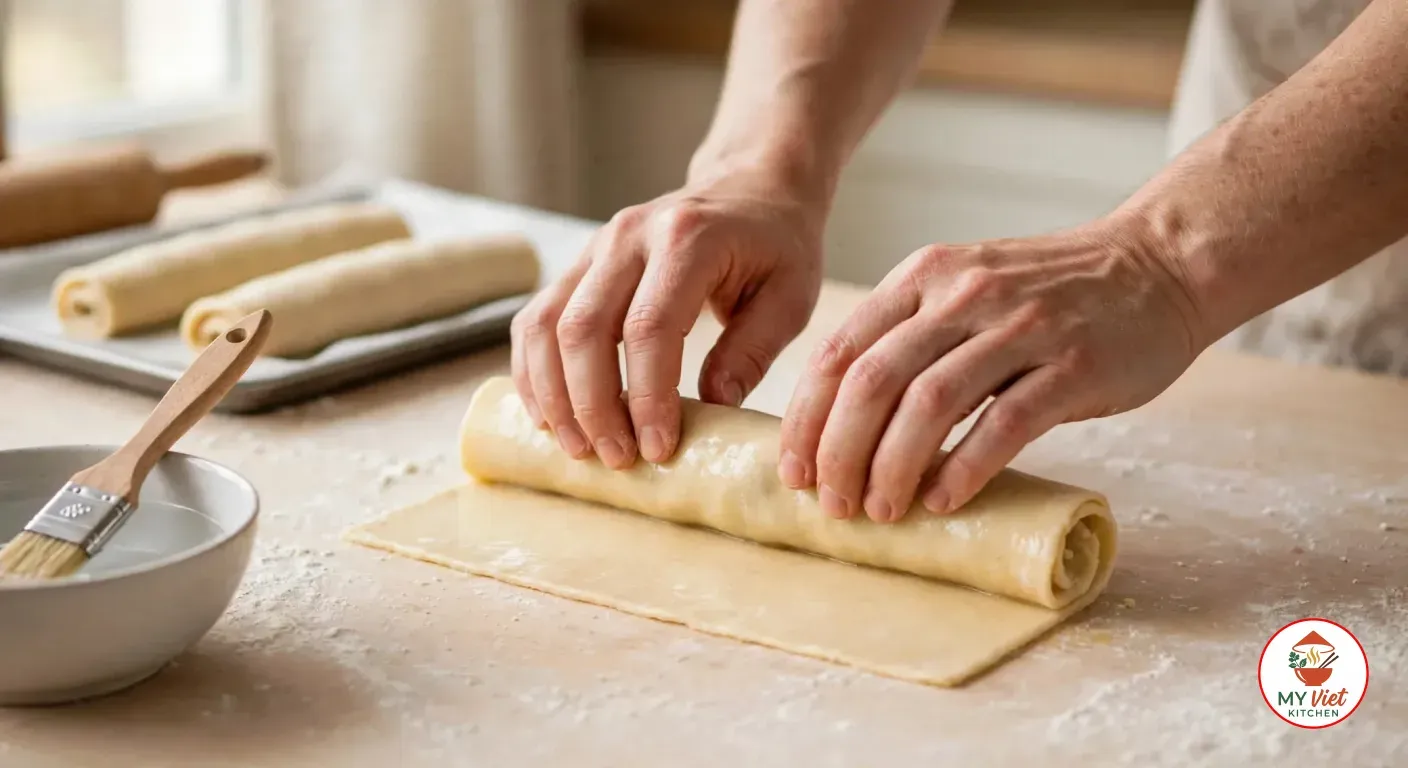
4Roll out one small piece as thin as you can, to about 1 mm and a 7 × 5 inch (18 × 13 cm) sheet. Brush it lightly with water. Lay a filled roll along one long edge so that 1/2 inch (1 cm) of dough sticks out past each end. Roll it up, smoothing out air as you go, then fold the overhang over the ends and press every seam firmly. Air left between the layers expands in the hot oil and can split the outer wrap. Line a tray with parchment, set the finished rolls on it seam-side down and chill them for 30 minutes to firm the pastry. Start heating the oil for step 5 in the last 10 minutes.
Step 5: Deep-Fry Until Golden
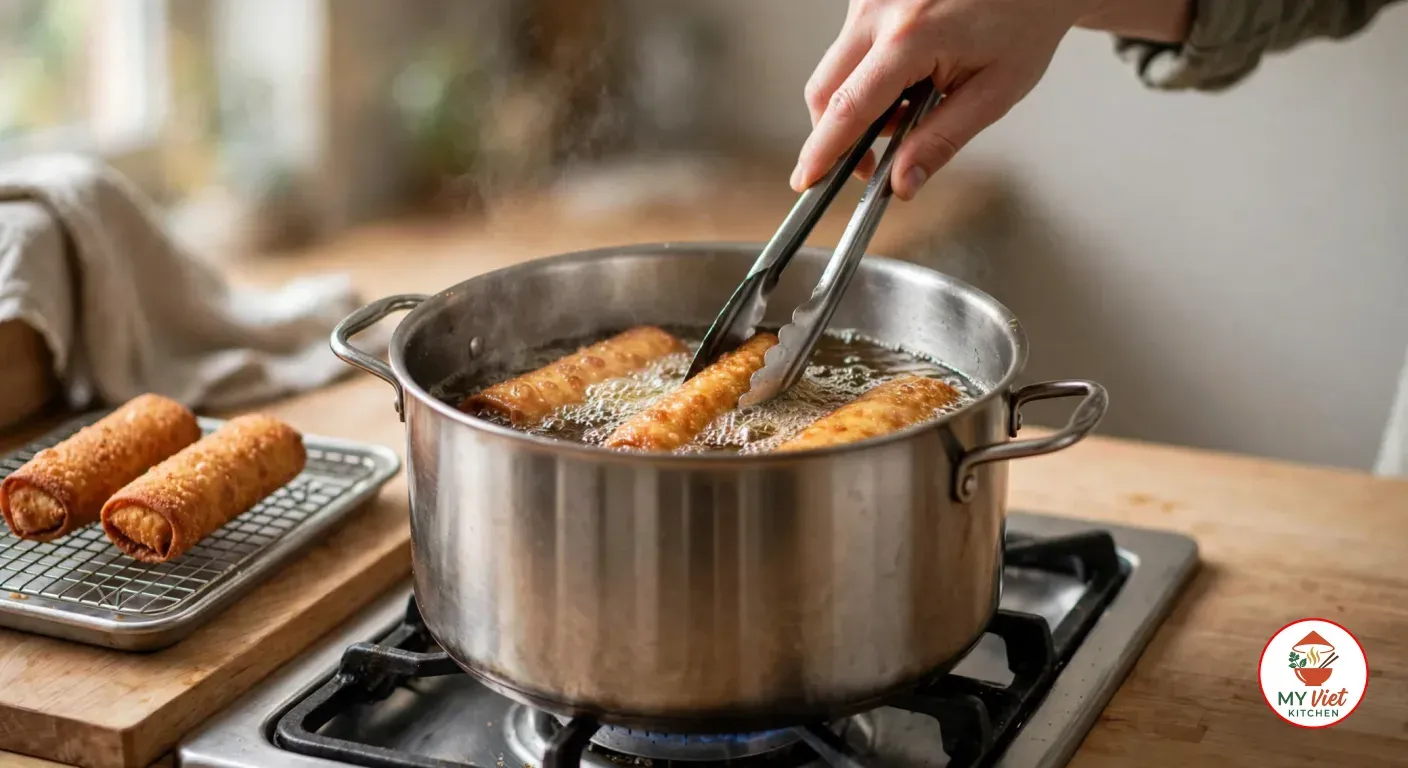
5Choose a deep, heavy pot and add oil until it is at least 2 inches (5 cm) deep but no more than half full. Heat it to 350°F (175°C), checking with a deep-fry thermometer. Lower in 2 or 3 rolls with tongs. Turn them every minute or two. After 6 to 8 minutes they should be deep golden all over and firm when squeezed gently with the tongs. Drain them on a wire rack over a tray. Wait for the oil to climb back to 350°F before the next batch goes in. Give them 3 minutes on the rack before serving, as the filling holds its heat.
Step 6: Serve with Sauce
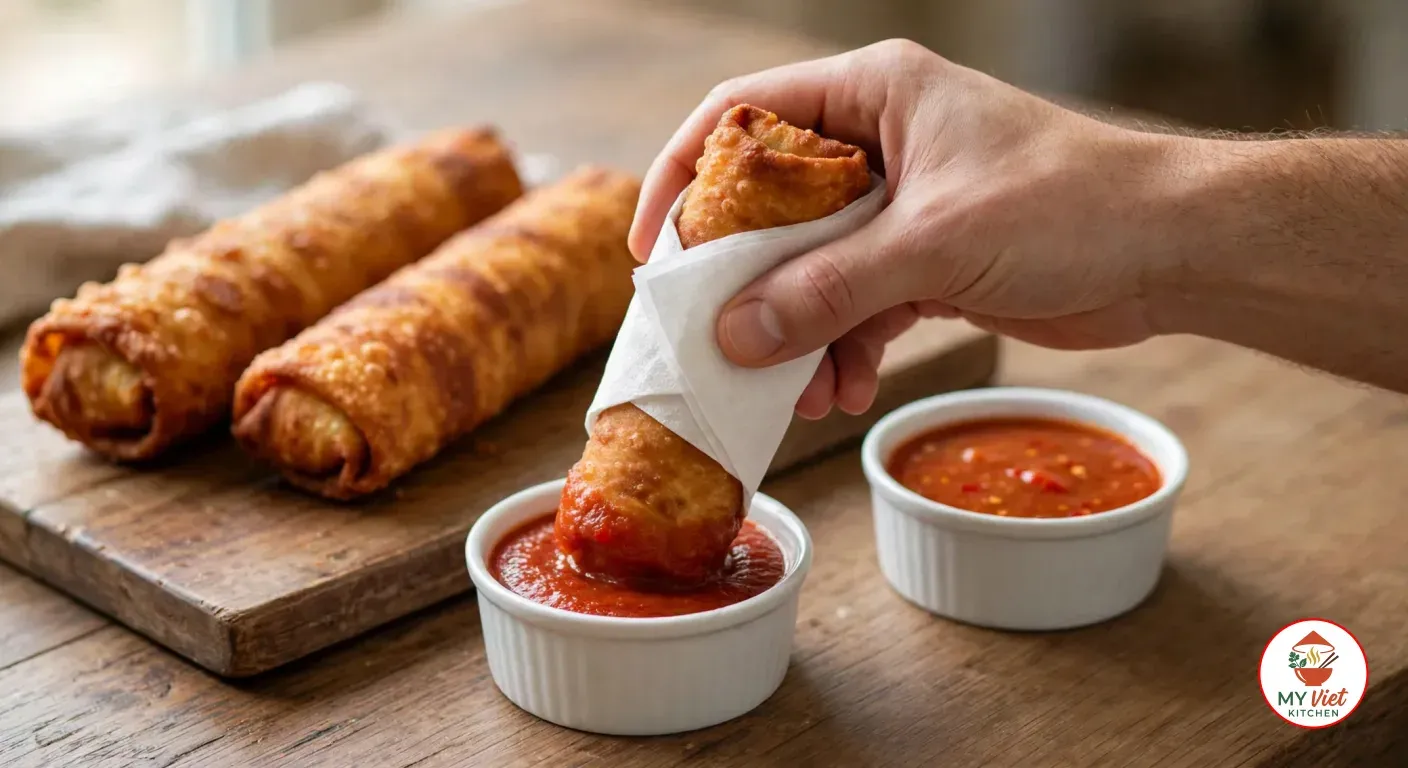
6Serve the rolls hot, with tomato sauce or sweet chilli sauce for dipping. To eat one the takeaway way, wrap the bottom half in a paper napkin and hold it in one hand.
Frequently Asked Questions
Can you bake chiko rolls instead of frying them?
Yes, though the crust comes out paler and more like bread. Heat the oven to 400°F (200°C). Brush the chilled rolls all over with oil and set them on a parchment-lined tray. They need 25 to 30 minutes, with one turn halfway through, to come out golden and firm. Rest them for 3 minutes before serving.
Can I use lamb instead of beef?
Yes. The early rolls were made with beef or mutton (Australian Dictionary of Biography), and the McEncroe family told the ABC that both were used (ABC News). Swap in the same 1/2 pound (225 g) of ground lamb. Spoon off any fat that pools in the skillet before the vegetables go in, so the filling stays dry.
Can I freeze chiko rolls before frying?
Yes. Freeze the fully wrapped, unfried rolls on a lined tray until hard, then pack them into a freezer bag. Frozen meats keep their quality best for 2 to 3 months, according to the UK Food Standards Agency (Food Standards Agency). Factory rolls were deep-fried before freezing, so a shop’s fryer only had to reheat them (Australian Dictionary of Biography). Homemade ones have raw pastry around a frozen center, so they need gentler heat for longer. Fry them straight from the freezer at 325°F (165°C), turning often. They take 10 to 12 minutes to turn deep golden and steaming hot in the middle.
Why did my chiko roll split or turn greasy?
Splits come from steam or trapped air. A filling that is still warm or wet turns to steam inside the roll. Air caught between the two layers swells in the oil. Chill the filling until cold, and smooth each layer on tightly. Greasy rolls mean the oil was too cool. Below about 325°F (165°C) the pastry soaks up oil instead of crisping, so fry only 2 or 3 at a time and let the oil recover between batches.
Sources
- Francis Gerald (Frank) McEncroe (1908–1979), Australian Dictionary of Biography, 2000
- Our story, Chiko (Simplot Australia)
- Chiko Rolls: ingredients and nutrition, Chiko (Simplot Australia)
- Chiko Roll, Wikipedia
- Wagga Wagga, Bendigo or Bathurst: MPs square off over origin of the Chiko Roll, ABC News, September 2016
- Chiko Roll debate heats up as Bendigo family back Victoria’s claim on snack’s origins, ABC News, September 2016
- Farewell to surfie molls and panel vans, The Sydney Morning Herald, August 2012
- How to chill, freeze and defrost food safely, Food Standards Agency