My Viet KitchenMy Viet Kitchen
HomeVietAsianEuropeanAfricanAmericanAustralianAboutContact
More
FAQPrivacy Policy
HomeVietAsianEuropeanAfricanAmericanAustralianAboutContactFAQPrivacy PolicySearch

Follow us

Home › Asian Dishes › Congee Recipe: Comforting Chinese Rice Porridge

My Viet Kitchenmyvietkitchen.com/congee/

Congee Recipe: Comforting Chinese Rice Porridge

Asian DishesOctober 16, 20269 min read

Share
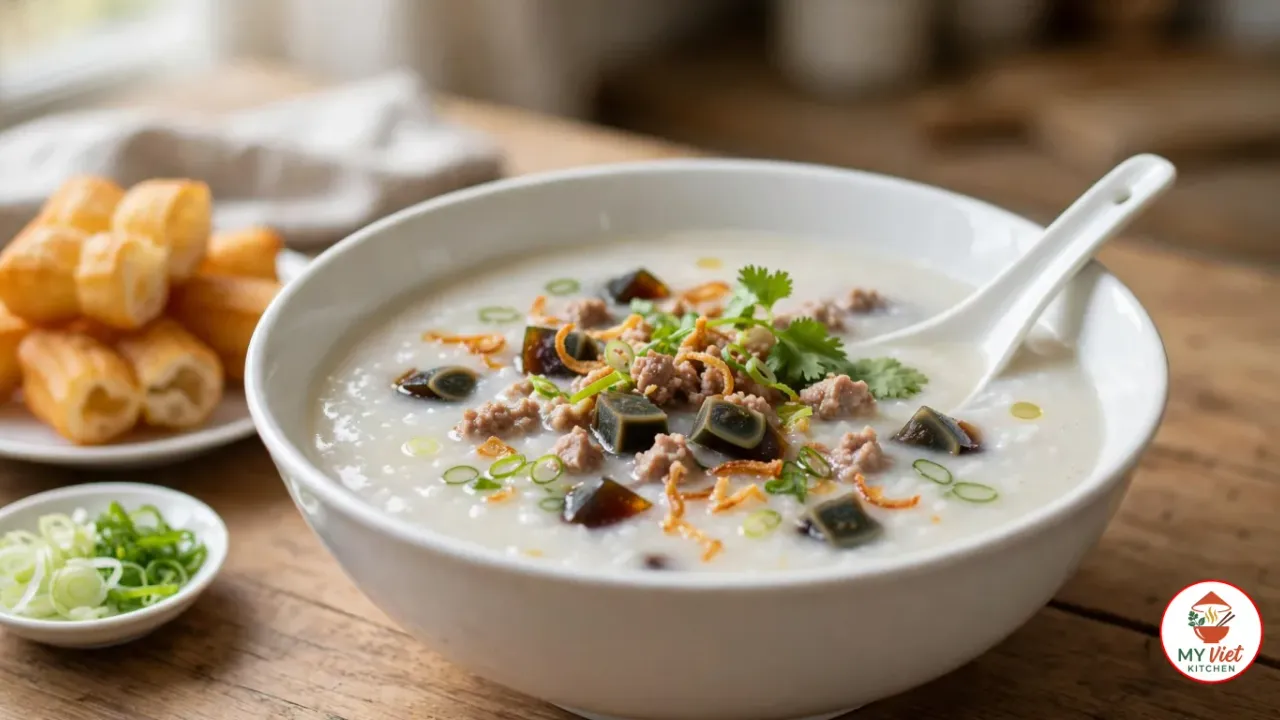
A deep white porcelain bowl of smooth congee topped with minced pork, diced century egg, sliced green onion, fried shallots and cilantro, with a porcelain spoon, a plate of youtiao and a dish of green onion on a wooden table

Prep 15 minutesCook 1 hour 45 minutesTotal 2 hoursYield 4 servings

Ingredients

  • 1 cup (200 g) long-grain jasmine rice
  • 1 tablespoon neutral oil, such as vegetable or peanut
  • 1 teaspoon salt, plus more to taste
  • 10 cups (2.4 liters) low-sodium chicken stock or water, or a mix
  • 1-inch (2.5 cm) piece fresh ginger, sliced into coins
  • 2 dried scallops, broken into small pieces (optional)
  • 8 oz (225 g) minced pork
  • 1 tablespoon light soy sauce
  • 1 teaspoon sesame oil, plus a few drops to finish
  • 1/2 teaspoon ground white pepper, plus more to taste
  • 1 teaspoon cornstarch
  • 2 century eggs, peeled and diced (optional)
  • 2 green onions, thinly sliced
  • 2 tablespoons fried shallots
  • A small handful of cilantro leaves
  • Youtiao (deep-fried Chinese dough sticks), to serve (optional)

Method

  1. Rinse and Prepare the Rice. Rinse the rice in a bowl of cold water, swirling and draining it 3 or 4 times, until the water is only faintly cloudy. Drain well, then toss the rice with the oil and 1 teaspoon of salt. Leave it for 15 minutes while the stock heats.
  2. Bring the Stock to a Boil. Pour the stock or water into a heavy 5-quart (5-liter) pot or larger. Add the ginger and the broken dried scallops, if using, and bring to a rolling boil over high heat, about 15 minutes.
  3. Add the Rice and Simmer. Stir the rice into the boiling stock. When it boils again, lower the heat until it bubbles gently, set the lid ajar and simmer for about 1 1/2 hours, stirring and scraping the bottom every 10 to 15 minutes, until the grains have broken down into a creamy porridge.
  4. Prepare the Pork Topping. While the congee simmers, mix the pork with the soy sauce, 1 teaspoon of sesame oil, 1/2 teaspoon of white pepper and the cornstarch, and leave it for at least 15 minutes. For the last 10 minutes of simmering, drop the pork into the pot in small pinches, stir to separate the pieces and cook until no pink remains.
  5. Adjust Consistency and Season. If the congee is thicker than you like, stir in hot water or stock 1/4 cup at a time. Season with salt and white pepper, and lift out the ginger coins.
  6. Garnish and Serve. Ladle the congee into deep bowls. Top with the century egg, green onions, fried shallots, cilantro and a few drops of sesame oil. Serve hot, with youtiao for dipping if you like.

Nutrition 460 calories per serving, protein 21g, fat 22g, carbohydrates 45g, fiber 1g, sodium 1350mg

In this recipe

  1. Where Does the Name Congee Come From?
  2. Which Rice Should You Use?
  3. How Thick Should Congee Be?
  4. Ingredients for Congee
  5. Step-by-Step Instructions
  6. Frequently Asked Questions
  7. Sources

Congee is a savory porridge made by simmering rice in plenty of water or stock until the grains break down. In Cantonese it is called jook. Here jasmine rice cooks for 1 1/2 hours with ginger and dried scallops until it pours like thick cream, then gets seasoned pork and diced preserved egg. Most of the 2 hours is hands-off simmering, with a stir every 10 to 15 minutes.

Prep Time: 15 minutes | Cook Time: 1 hour 45 minutes | Total Time: 2 hours (the rice rests while the stock heats) | Servings: 4

Difficulty: Easy | Calories: ~460 per serving

Where Does the Name Congee Come From?

From India, not China. On Language Log, the linguist Victor Mair quotes a 2017 South China Morning Post column by Lisa Lim. She traces the English word to the Tamil kanji, from a word for “boilings” that means the water rice has been cooked in. The Portuguese carried the word to Europe from the 1560s (Language Log).

In Chinese the dish is 粥: zhōu in Mandarin and jūk in Cantonese, the jook in this recipe’s name. Lim traces the earliest reference to the Zhou dynasty, around 1000 BC (Language Log). The pork and century egg version made here, 皮蛋瘦肉粥, comes from Guangdong (Wikipedia).

Rice porridge runs right across Asia under other names. Lim’s list includes Thai chok, Japanese okayu, Tagalog lúgaw and Vietnamese cháo. In Vietnam, cháo gà is cooked in chicken broth with chicken, garlic and ginger, and cháo usually comes with quẩy, the local youtiao, on the side (Wikipedia).

Which Rice Should You Use?

Long-grain jasmine rice is the one to buy. After 90 minutes of gentle simmering it falls apart into a loose, pourable porridge, and its light scent carries through the stock. Broken jasmine rice, sold cheaply in Asian grocers, is made of smaller fragments that soften sooner, so start checking it after about an hour.

Medium- and short-grain rice, such as Calrose or sushi rice, give a thicker, stickier pot that sets firmly as it cools. If that is all you have, add 2 extra cups of liquid. Leave glutinous (sticky) rice for desserts, because on its own it turns gluey.

Whatever the grain, rinse it first. Made With Lau lists skipping the rinse among its top three congee mistakes. Its recipe then soaks the rice with a little salt and oil, explaining that the salt seasons the rice and the oil helps the congee turn silky (Made With Lau). Here the rinsed rice is simply tossed with them while the stock heats.

How Thick Should Congee Be?

There’s no single answer. Depending on how much water goes in, congee ranges from something as thick as oatmeal to a thin gruel (Wikipedia). This recipe uses 10 cups of liquid to 1 cup of rice, a 1:10 ratio. After 1 1/2 hours it coats a spoon and still pours from a ladle.

Keep the heat low enough that only a few lazy bubbles break the surface. At a hard boil the starch foams up over the rim, and the porridge catches on the bottom long before the grains have softened. A lid set ajar holds in some heat but lets steam escape, and Made With Lau warns against closing it tightly (Made With Lau).

Stir every 10 to 15 minutes, and scrape the bottom of the pot with a flat-edged wooden spoon each time. In the last half hour the porridge thickens fast, so stir more often. It also keeps thickening off the heat, so take it off a little looser than you want it in the bowl.

Ingredients for Congee

For the Congee:

  • 1 cup (200 g) long-grain jasmine rice
  • 1 tablespoon neutral oil, such as vegetable or peanut
  • 1 teaspoon salt, plus more to taste
  • 10 cups (2.4 liters) low-sodium chicken stock or water, or a mix
  • 1-inch (2.5 cm) piece fresh ginger, sliced into coins
  • 2 dried scallops, broken into small pieces (optional)

For the Pork:

  • 8 oz (225 g) minced pork
  • 1 tablespoon light soy sauce
  • 1 teaspoon sesame oil
  • 1/2 teaspoon ground white pepper, plus more to taste
  • 1 teaspoon cornstarch

To Serve:

  • 2 century eggs, peeled and diced (optional)
  • 2 green onions, thinly sliced
  • 2 tablespoons fried shallots
  • A small handful of cilantro leaves
  • A few drops of sesame oil
  • Youtiao (deep-fried Chinese dough sticks), optional

Step-by-Step Instructions


Step 1: Rinse and Prepare the Rice

1Put the rice in a large bowl and cover it with cold water. Swirl it with your fingers, then pour the cloudy water off, holding the grains back with your hand or a strainer. Repeat 3 or 4 times, until the water is only faintly cloudy. Drain the rice well in a fine-mesh strainer and tip it back into the bowl. Add the oil and 1 teaspoon of salt and toss until every grain is coated. Leave it for 15 minutes, and start step 2 now so the stock heats while the rice rests.
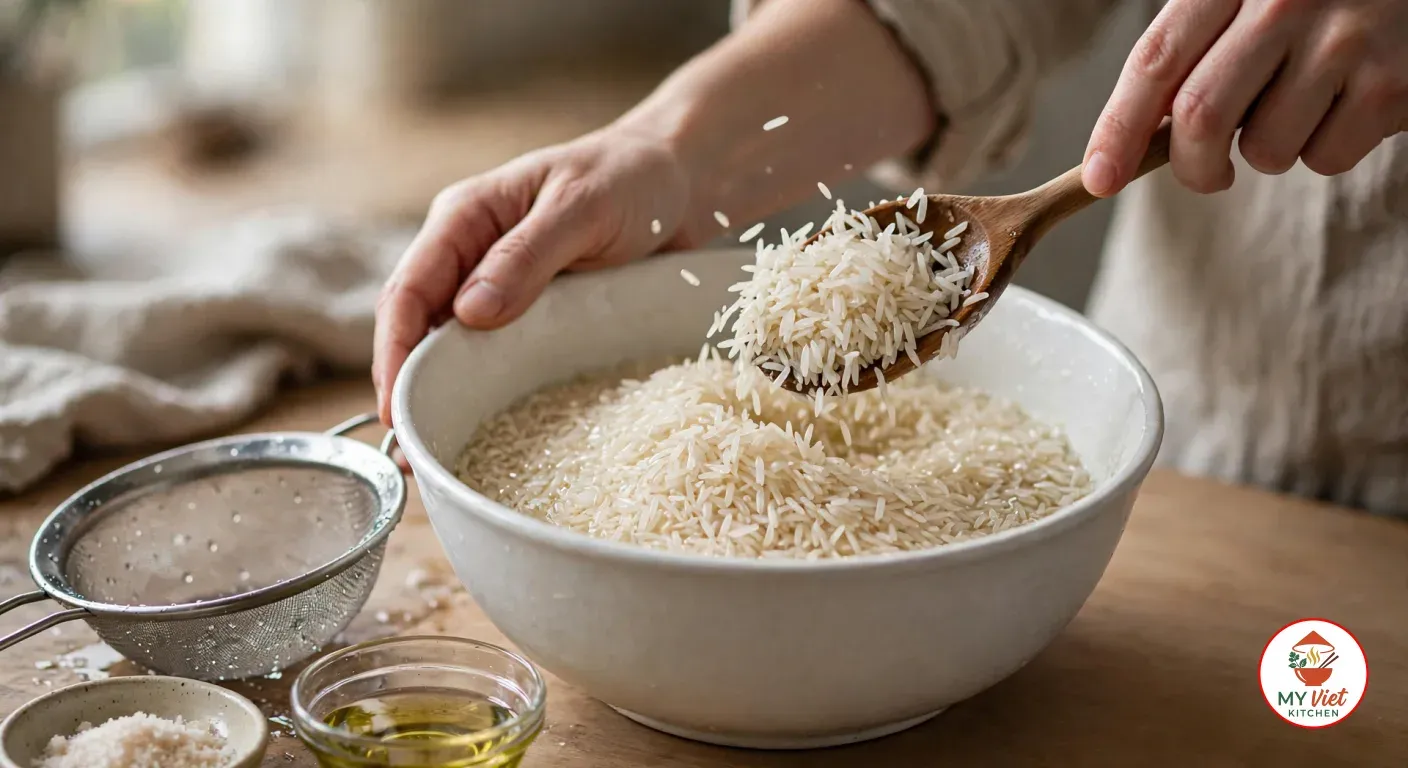
A hand lifting a wooden spoonful of rinsed, oil-coated jasmine rice over a white ceramic bowl of rice, the other hand steadying the bowl, beside a wet mesh strainer, a dish of coarse salt and a small glass bowl of oil
Step 1- Rinse and Prepare the Rice

Step 2: Bring the Stock to a Boil

2Pour the stock or water into a heavy 5-quart (5-liter) pot or larger. A Dutch oven is ideal, since a thin pot scorches the porridge once it thickens. Add the ginger coins. If you are using dried scallops, break them into small pieces with your fingers, give them a quick rinse and drop them in. There’s no need to soak them first, because they spend 1 1/2 hours in the pot. Put the lid on and turn the heat to high. A full rolling boil takes about 15 minutes.
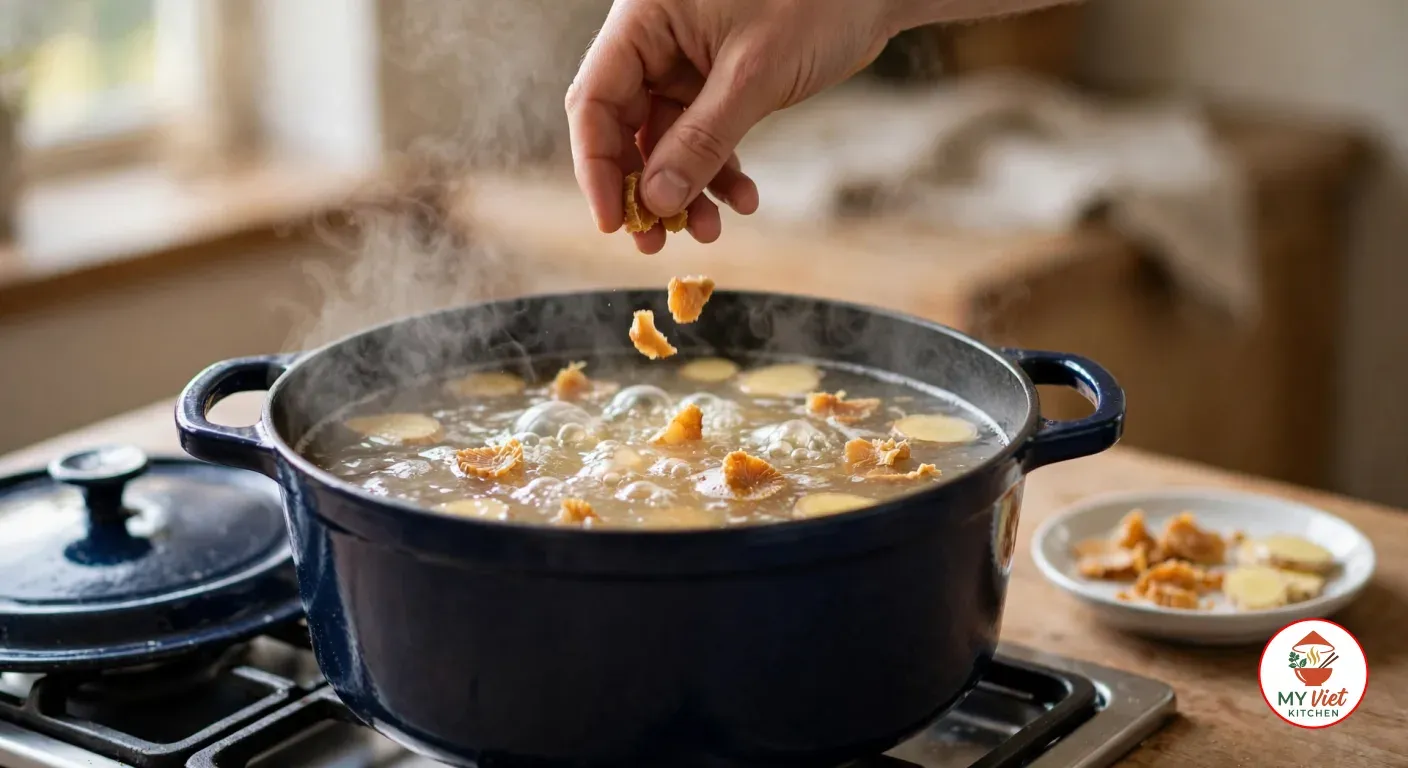
A hand dropping pieces of dried scallop into a dark blue enameled Dutch oven of stock at a rolling boil with ginger coins, the lid beside it on a gas stove and a dish of scallops and ginger on the counter
Step 2- Bring the Stock to a Boil

Step 3: Add the Rice and Simmer

3Scrape the rice and its oil into the boiling stock and stir at once, so the grains don’t settle and stick. Let it come back to a boil, then turn the heat down until only a few slow bubbles rise. Set the lid on at an angle to leave a gap. Simmer for about 1 1/2 hours, stirring every 10 to 15 minutes and scraping the bottom each time. At about 45 minutes the grains swell and start to split. By the end they have mostly broken down, and the porridge is creamy and coats the back of a spoon. Start step 4 while it cooks.
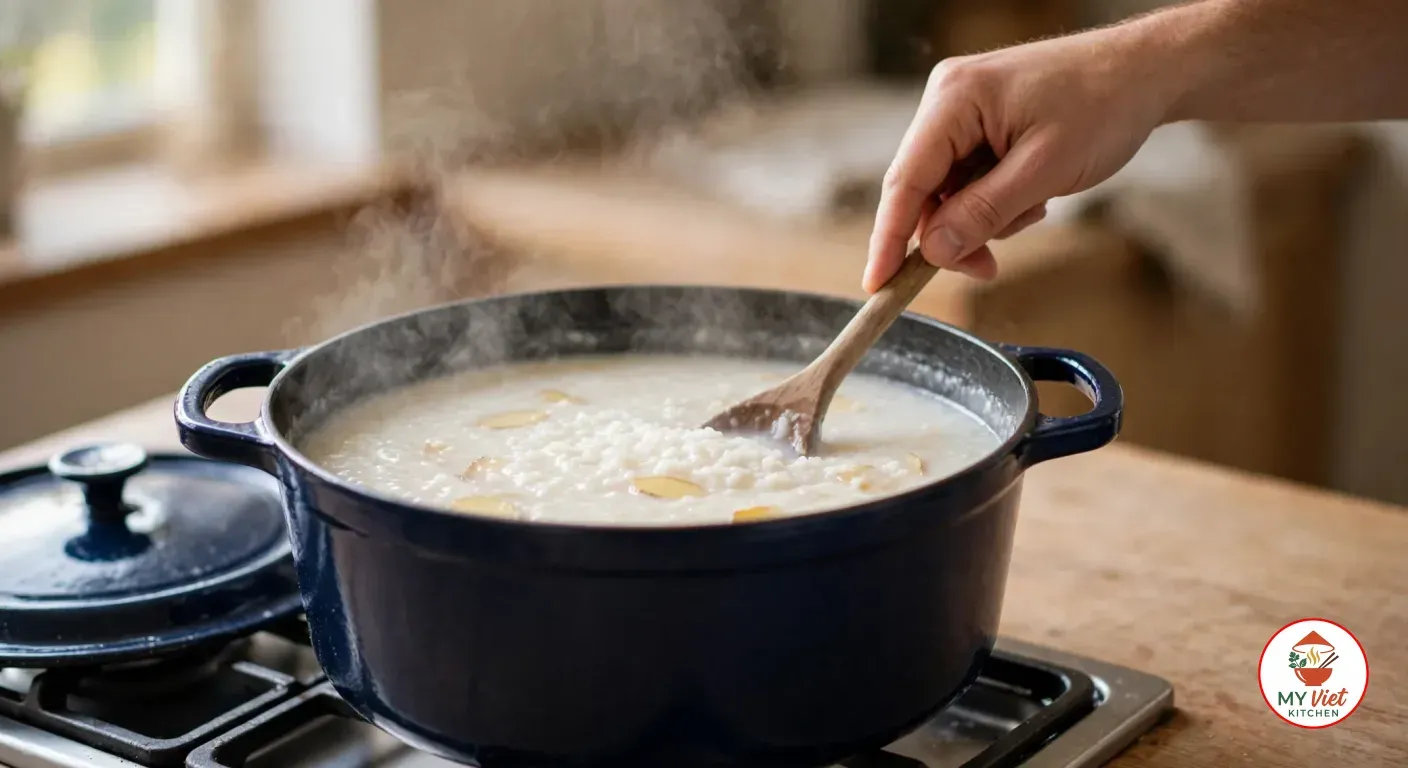
A hand stirring simmering rice congee with a wooden spoon in a dark blue enameled Dutch oven on a gas stove, the grains softening into a creamy porridge with ginger coins, the lid beside the pot
Step 3- Add the Rice and Simmer

Step 4: Prepare the Pork Topping

4In a small bowl, mix the minced pork with the soy sauce, 1 teaspoon of sesame oil, 1/2 teaspoon of white pepper and the cornstarch. Stir hard in one direction for a minute, until the pork turns sticky and holds together. Cover the bowl and chill the pork for 15 minutes or more. With about 10 minutes of simmering left, drop the pork into the congee in pinches the size of a grape. Stir gently to separate the pieces and let them cook until no pink remains inside, 5 to 8 minutes.
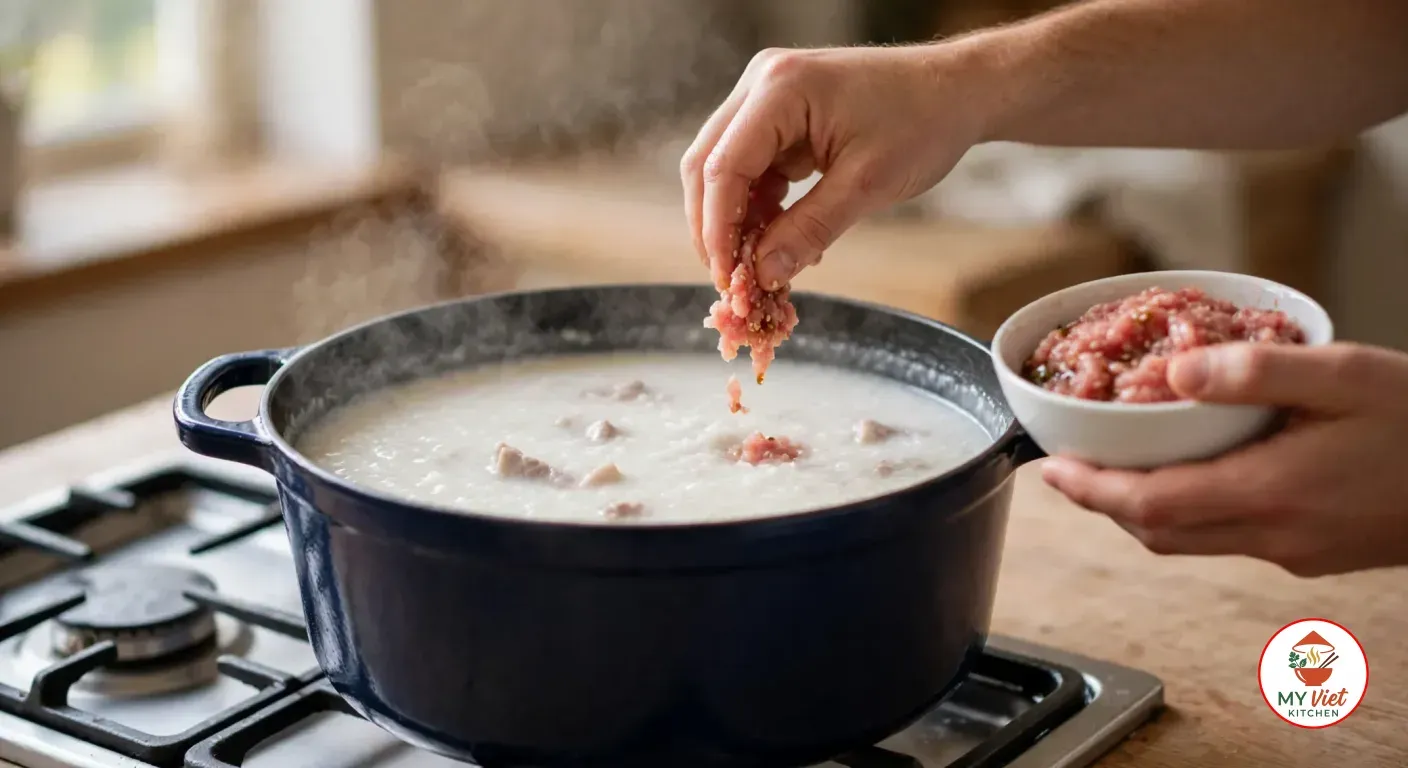
A hand dropping a pinch of marinated minced pork into creamy congee in a dark blue Dutch oven on a gas stove, the other hand holding a small white bowl of the raw pork
Step 4- Prepare the Pork Topping

Step 5: Adjust Consistency and Season

5Check the texture. It should pour slowly from a ladle and settle flat in the bowl. If it’s too thick, stir in hot water or stock, 1/4 cup at a time, and let it bubble for a minute between additions. Add hot liquid rather than cold, so the pot keeps simmering. Taste and season with salt and white pepper; dried scallops and stock both add salt, so go slowly. Fish out the ginger coins and turn off the heat.
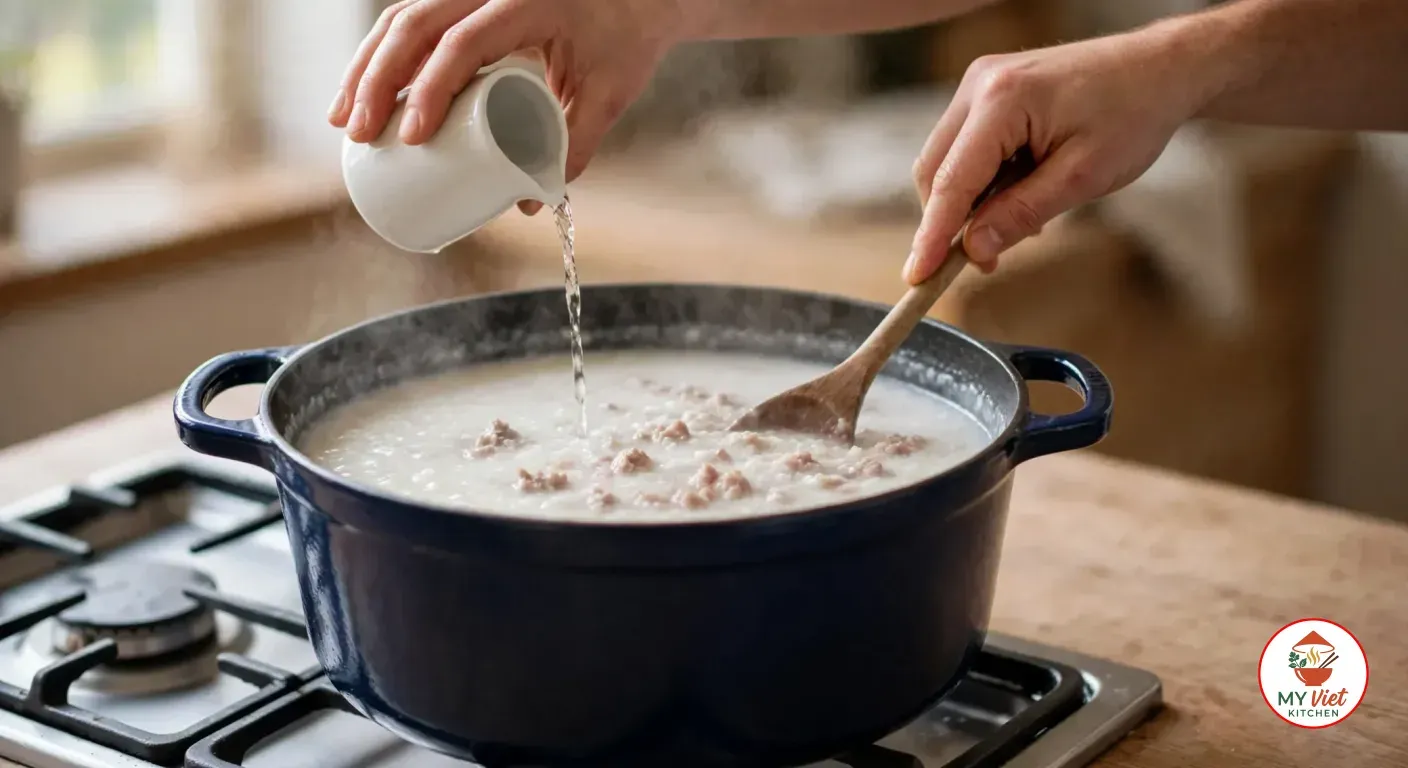
One hand pouring hot water from a small white jug into creamy congee with cooked minced pork while the other stirs with a wooden spoon, in a dark blue Dutch oven on a gas stove
Step 5- Adjust Consistency and Season

Step 6: Garnish and Serve

6Ladle the congee into deep, warmed bowls. Scatter the diced egg over each one, then the green onions, fried shallots and cilantro. Finish with a few drops of sesame oil. Serve straight away, with pieces of youtiao on the side to dip or to lay on top, where they soften underneath and stay crisp on top.
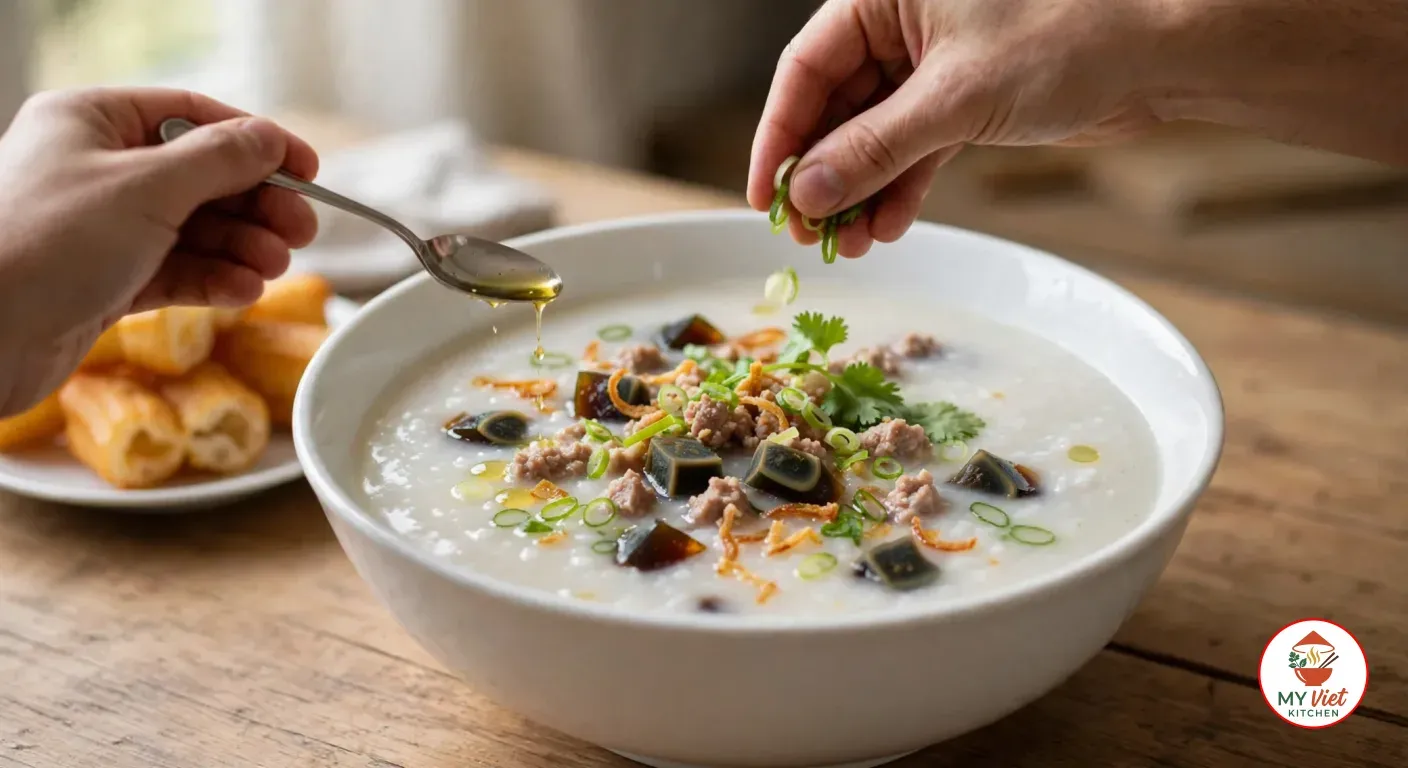
Hands sprinkling sliced green onion and drizzling sesame oil from a teaspoon over a white bowl of congee topped with minced pork, diced dark preserved egg, fried shallots and cilantro, a plate of youtiao behind
Step 6- Garnish and Serve

Frequently Asked Questions

Can I make congee faster?

Yes, with frozen rice or a harder boil. The Woks of Life washes and drains the rice, then freezes it in a bag for at least 8 hours. The water in the grains expands as it freezes and breaks them into small pieces, so the congee simmers in about 20 minutes (The Woks of Life). In the Made With Lau video above, Daddy Lau keeps the pot at a steady boil with the lid ajar for about 25 minutes. Then he whisks it to break up the rice, and the congee is ready for toppings in about 30 minutes (Made With Lau).

What is a century egg, and can I leave it out?

A century egg is a duck, chicken or quail egg preserved for several weeks to several months in a mix of clay, ash, salt, quicklime and rice hulls. The white sets into a dark brown, translucent jelly with a salty taste. The yolk turns dark greenish-grey, creamy and strong-smelling (Wikipedia). Asian grocers sell them ready to eat. Peel one, rinse it and dice it. They are optional here; a salted duck egg or a soft-boiled egg works in their place.

How long do congee leftovers keep?

One day. The UK’s Food Standards Agency says to chill cooked rice as quickly as possible, ideally within an hour. Keep it in the fridge for no more than a day before reheating. It also says to reheat rice only once, until it is steaming hot all the way through (Food Standards Agency). Cold congee sets almost solid in the fridge; stir in a little water while it heats.

Is congee gluten-free?

The porridge itself is, since it is only rice, stock and seasoning, but two of the usual extras are not. Most soy sauce is brewed with wheat, so use a tamari made without wheat in the pork marinade. Youtiao are strips of deep-fried wheat dough, so leave them out or serve rice crackers for crunch (Wikipedia). Check the label on the stock as well.

Sources

  • Congee: the Dravidian roots of the name for a Chinese dish, Language Log, November 2017
  • Congee, Wikipedia
  • Century egg, Wikipedia
  • Youtiao, Wikipedia
  • Dad’s Century Egg & Pork Congee, Made With Lau
  • 20 Minute Congee, The Woks of Life, October 2016
  • Home food fact checker, Food Standards Agency
Love This Recipe?

Click on a star to rate it!

☆☆☆☆☆No votes so far! Be the first to rate this recipe.

Share

Tags: comfort foodcongeecongee recipeChinese congeerice porridgejookChinese rice porridgehow to make congeecongee toppingsAsian breakfastChinese breakfastrice porridge recipehomemade congeeCantonese congeeplain congee

A cream stoneware bowl heaped with small golden-brown rectangles of chin chin on an oak table, with loose pieces in front, one broken open to show its dry, pale inside, and a dish of whole nutmegs and a linen napkin behind← PreviousChin Chin Recipe: Crunchy Nigerian Fried DoughNext →Chow Mein: Easy Chinese Stir-Fried NoodlesA speckled off-white stoneware plate of chicken chow mein, thin egg noodles tossed with seared strips of chicken thigh, shredded cabbage, sliced celery, carrot matchsticks, bean sprouts and green onion, with wooden chopsticks, a dish of soy sauce and a black wok behind on a wooden table

More Asian Dishes

A wide white speckled bowl of dan dan noodles, the pale wheat noodles sitting in a shallow pool of red chili oil and topped with crisp minced pork and dark ya cai, crushed peanuts, sliced green onion and half a baby bok choy, with wooden chopsticks across the rim on a wooden table
Asian Dishes

Dan Dan Noodles: Chengdu-Style Recipe with Ya Cai

October 18, 2026

A speckled off-white stoneware plate of chicken chow mein, thin egg noodles tossed with seared strips of chicken thigh, shredded cabbage, sliced celery, carrot matchsticks, bean sprouts and green onion, with wooden chopsticks, a dish of soy sauce and a black wok behind on a wooden table
Asian Dishes

Chow Mein: Easy Chinese Stir-Fried Noodles

October 16, 2026

Two puffed golden bhature on a round stainless-steel plate beside a steel bowl of dark brown chole topped with red onion rings, a slit green chili and cilantro, with two lemon wedges and a small steel bowl of green chutney, on a wooden table
Asian Dishes

Chole Bhature: Indian Chickpea Curry Recipe

October 15, 2026

Recent recipes

  • A wide white speckled bowl of dan dan noodles, the pale wheat noodles sitting in a shallow pool of red chili oil and topped with crisp minced pork and dark ya cai, crushed peanuts, sliced green onion and half a baby bok choy, with wooden chopsticks across the rim on a wooden tableDan Dan Noodles: Chengdu-Style Recipe with Ya CaiOctober 18, 2026
  • A small glass jar and a white bowl of glossy deep purple Davidson plum sauce with a silver spoon, beside oval dark blue-purple Davidson plums, one cut in half to show its crimson flesh and seed, a gold jar lid and a linen towel on a pale wooden tableDavidson Plum Sauce: Tart Australian Native Fruit CondimentOctober 18, 2026
  • Four pan-seared crocodile tail steaks on a white plate, one sliced to show the white centre, under garlic-herb butter with golden garlic cloves, rosemary, thyme, parsley and lemon wedges, a cast-iron skillet behindCrocodile Meat: Pan-Seared Tail Steaks with Garlic-Herb ButterOctober 17, 2026
  • A round damper loaf with a golden, flour-dusted crust split along its scored cross, one craggy piece broken off to show the soft white crumb, on a pale wooden board with a dish of butter, a butter knife and a small glass jug of golden syrupDamper Bread: Classic Australian No-Yeast LoafOctober 17, 2026

Follow us

Where shall we eat today?

  • Vietnamese
  • Asian
  • European
  • African
  • Americas
  • Australia
  • Drinks
  • Surprise me

Recently updated

  • Dan Dan Noodles: Chengdu-Style Recipe with Ya Cai
  • Davidson Plum Sauce: Tart Australian Native Fruit Condiment
  • Crocodile Meat: Pan-Seared Tail Steaks with Garlic-Herb Butter
  • Damper Bread: Classic Australian No-Yeast Loaf
  • Chow Mein: Easy Chinese Stir-Fried Noodles

Categories

  • Vietnamese Dishes
  • Asian Dishes
  • European Dishes
  • African Dishes
  • American Dishes
  • Australian Dishes
  • Beverages

Pages

  • About Us
  • Contact Us
  • FAQ
  • Privacy Policy
  • RSS

Tags

European dishescomfort foodAfrican recipesLatin American foodAsian recipesEast African foodSouth American foodWest African recipesAustralian cuisineCaribbean cuisineAfrican dishesEastern European foodMexican foodSouth African foodvietnamese cuisineFrench cuisineBalkan foodCaribbean foodeasy dinner recipeItalian cookingMexican cuisinePeruvian foodBalkan cuisinefamily dinnerisland foodLatin American recipesNorth African recipessummer grillingAuthentic Vietnameseeasy Vietnamese recipes

All tags

Follow us
© 2026 My Viet KitchenAuthentic Vietnamese flavors, made simple