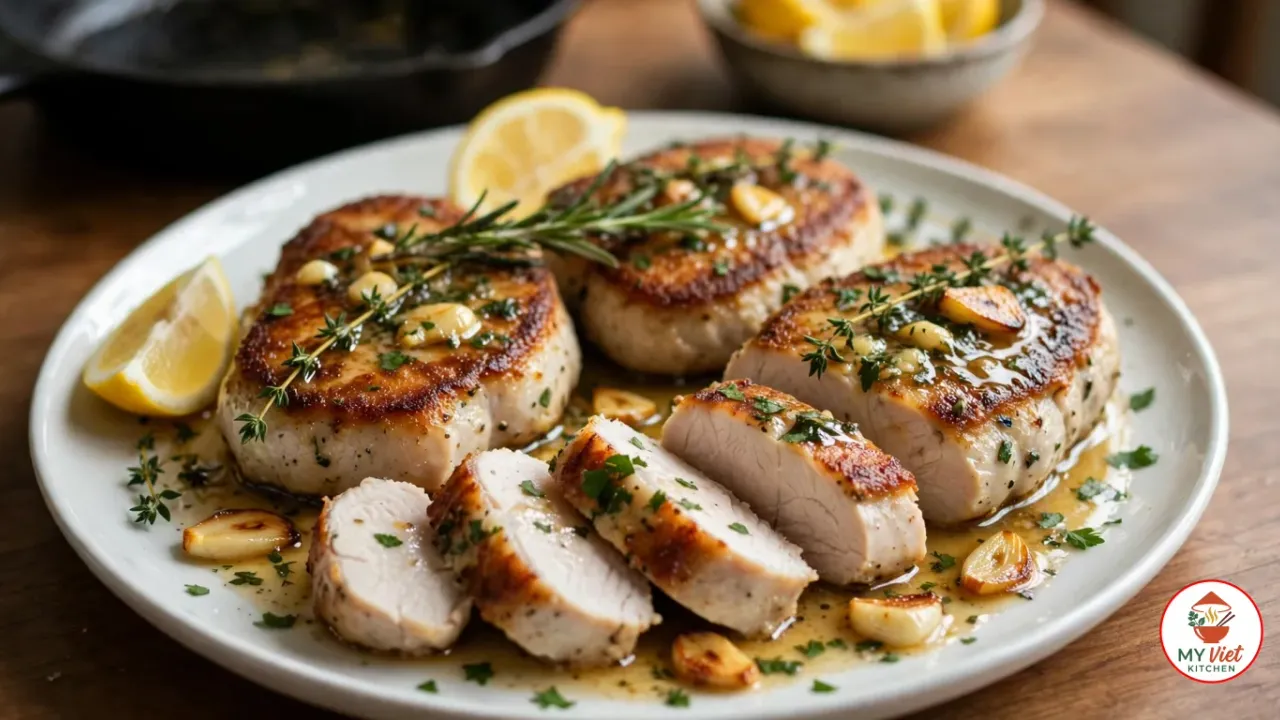
Crocodile meat is pale meat from farmed crocodiles, and the tail fillet is the cut to buy for steaks. Here a 1 1/2-pound (680 g) tail fillet becomes four steaks, seared in a cast-iron skillet and then basted with butter, garlic, rosemary and thyme. They cook through to 75°C (167°F) and rest for 5 minutes before slicing. Once the meat has thawed, dinner takes 35 minutes.
Prep Time: 20 minutes | Cook Time: 15 minutes | Total Time: 35 minutes (plus overnight thawing in the fridge) | Servings: 4
Difficulty: Easy | Calories: ~280 per serving

Which Crocodile Cut Should You Buy?
Ask for tail fillet: a long, boneless piece of pale muscle that slices into neat steaks. Food Standards Australia New Zealand (FSANZ) lists raw tail fillet as its own food in its nutrient database, next to back leg (FSANZ). For its 2019 analysis of game meats, FSANZ ordered crocodile from a specialty meat supplier in Victoria. Its “crocodile steak” sample combined strip loin and tail fillet (FSANZ). Strip loin works here too, cut to the same thickness.
Expect the meat to come frozen. In Australian plants, crocodile portions are dipped in an antimicrobial solution, such as dilute acetic acid or chlorine, then vacuum-packed and frozen (FSANZ). Thaw the sealed pack on a plate in the fridge overnight. Pour off the liquid in the bag and dry the meat well, because a wet surface steams instead of browning.
Meat is a side line for the farms. AgriFutures Australia counts 21 crocodile operators across the Northern Territory, Queensland and Western Australia, and says the industry is led by skins for luxury leather goods. Its meat is sold mostly within Australia, both for people and as pet meat (AgriFutures Australia). Buy from a butcher or game supplier that sells it for the table.
How Done Should Crocodile Meat Be?
All the way through: 75°C (167°F) at the centre of each steak. The food-safety reports on crocodile cited below don’t give a cooking temperature, so this recipe borrows the one for chicken.
Salmonella is the reason. A 2013 FSANZ review found it had been isolated from the skin, cloaca and meat of farmed crocodiles in the Northern Territory and Queensland. In a 1989 study of two Territory farms, 16% of crocodile meat swabs still yielded Salmonella after chlorine treatment (FSANZ). In 2007 the European Food Safety Authority also named Salmonella as a potential risk, given the high contamination rate in fresh and frozen crocodilian meat (EFSA).
Processing has improved since those studies. The same FSANZ review says scrubbing carcasses with sanitiser and dipping the meat in acetic acid greatly reduce contamination. It found no reported cases of food poisoning from crocodile meat. Trichinella worms found in crocodiles in Africa and Papua New Guinea are destroyed by freezing, and FSANZ found no data suggesting they are present on the Australian mainland (FSANZ).
Australia’s Food Safety Information Council says whole cuts of beef, lamb and kangaroo carry bacteria only on the outside and can be cooked to taste. Poultry is different: bacteria can be present all the way through, so it must reach 75°C in the centre (Food Safety Information Council). Crocodile appears on neither list. Because Salmonella has been found in its meat, this recipe treats it like chicken. Skip rare and medium, and check every steak with an instant-read thermometer.
Why Does Crocodile Dry Out So Fast?
There is very little fat to cover a few extra minutes. In the FSANZ database, raw tail fillet carries 1.6 g of fat per 100 g, against 0.8 g for lean chicken breast, and both have 22.5 g of protein (FSANZ). Cook it the way you would a skinless chicken breast.
Even thickness matters most. Over medium-high heat, a 3/4-inch (2 cm) steak hits 75°C at its core in roughly 7 to 9 minutes. That is before the crust burns or the outer layer turns stringy. A thick end and a thin end on one steak finish minutes apart, so flatten the thick parts first. Start probing once the butter goes in, and lift each steak out the moment it reads 75°C. Basting adds back some of the fat the meat lacks.
Ingredients for Crocodile Steaks
For the Steaks:
- 1 1/2 lb (680 g) crocodile tail fillet, thawed
- 1 teaspoon fine salt
- 1/2 teaspoon ground white pepper
- 1 teaspoon smoked paprika
- 1 teaspoon garlic powder
- 2 tablespoons olive oil
For the Garlic-Herb Butter:
- 3 tablespoons (40 g) unsalted butter
- 4 garlic cloves, lightly smashed
- 2 sprigs fresh rosemary
- 4 sprigs fresh thyme
To Serve:
- 1 tablespoon lemon juice
- 2 tablespoons chopped fresh parsley
- 1 lemon, cut into wedges
Step-by-Step Instructions
Step 1: Prepare and Season the Crocodile Meat
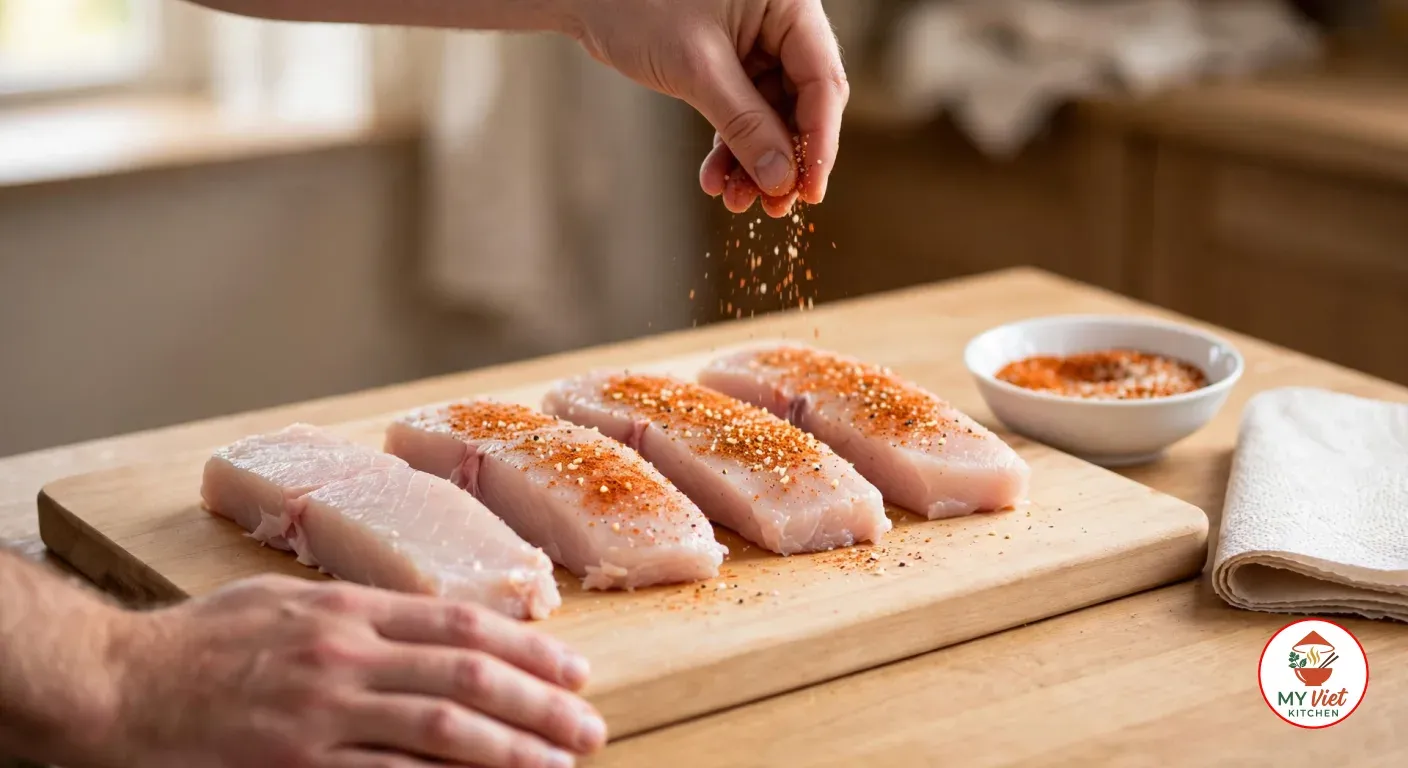
1The night before, set the sealed fillet on a plate in the fridge to thaw. When you’re ready to cook, open the pack, pour off the liquid and cut the fillet into 4 equal steaks. If any piece is thicker than 1 inch (2.5 cm), lay it between two sheets of baking paper and flatten it gently with a rolling pin to an even 3/4 inch (2 cm). Pat every surface dry with paper towels. Mix the salt, white pepper, smoked paprika and garlic powder in a small bowl, and sprinkle it over both sides of each steak. Leave them for 15 minutes while you smash the garlic and pick out the herbs.
Step 2: Sear the Steaks
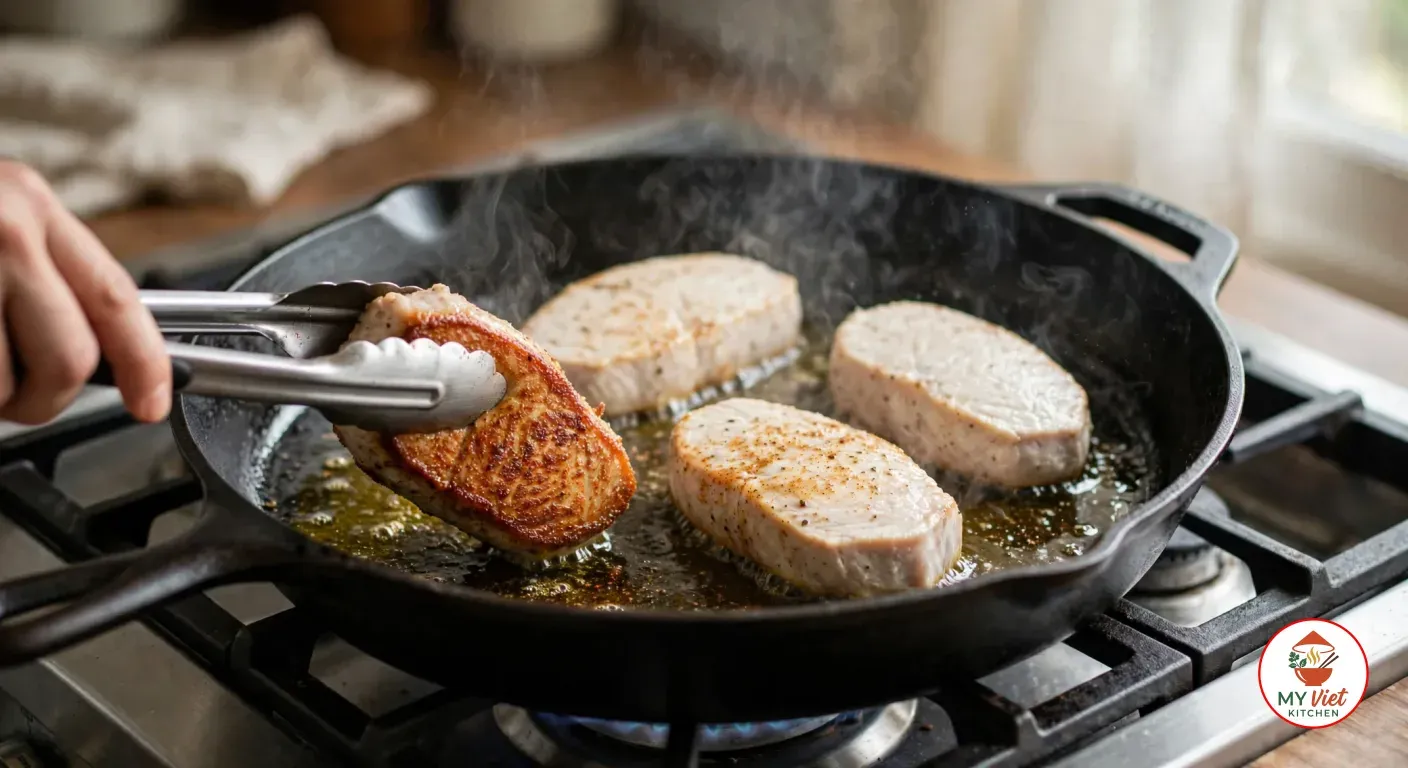
2Put a 12-inch (30 cm) cast-iron skillet over medium-high heat with the olive oil. When the oil shimmers and moves freely across the pan, lay in the steaks, leaving a finger’s width between them. Leave them alone for 3 minutes. They should sizzle steadily and come away from the pan easily once a golden-brown crust has formed. If one sticks, give it another 30 seconds. Turn each steak with tongs and sear the second side for 2 minutes.
Step 3: Baste with Garlic-Herb Butter
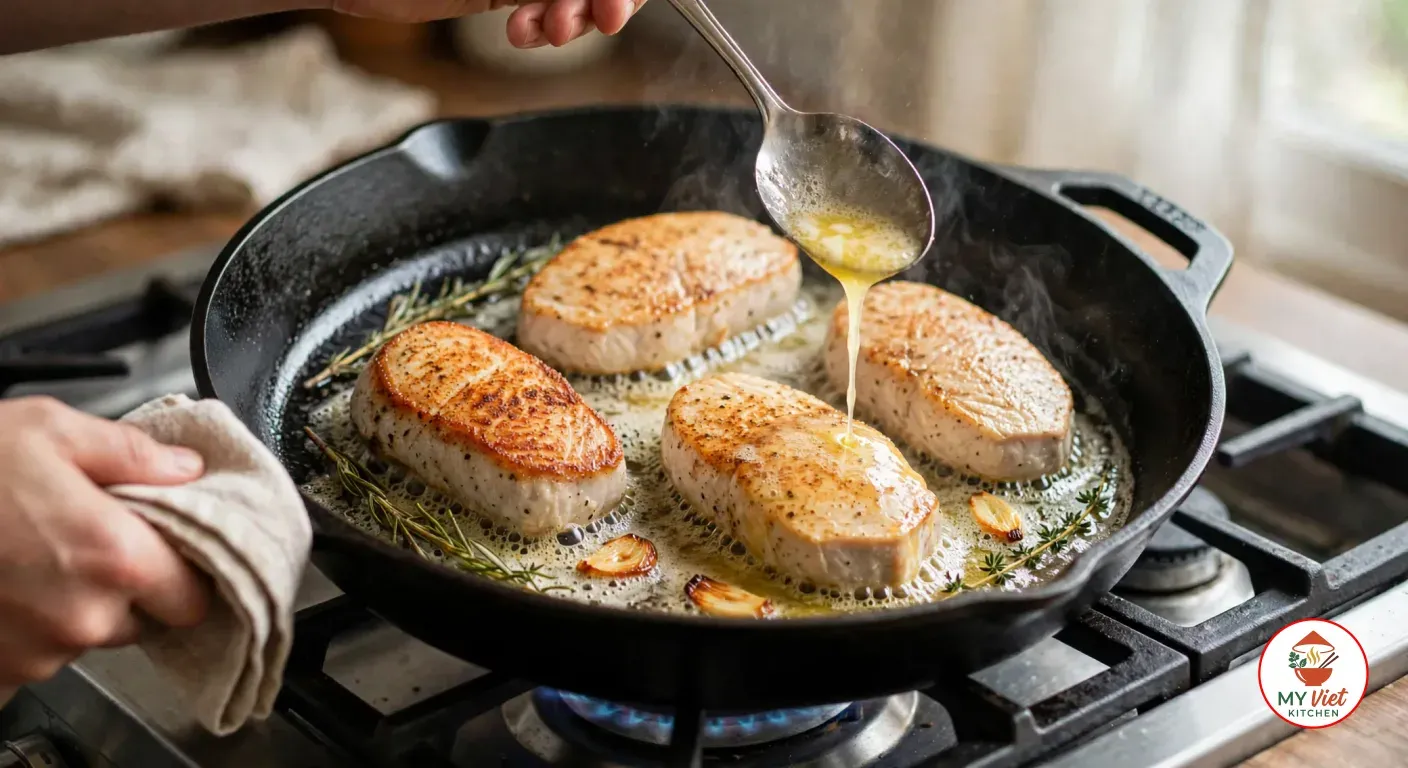
3Turn the heat down to medium and drop the butter, smashed garlic, rosemary and thyme into the pan around the steaks. Once the butter foams, tilt the skillet toward you with a towel around the handle so the butter pools at the low side. Baste the steaks with it for 2 to 4 minutes, turning the garlic cloves when they start to colour. Push an instant-read thermometer sideways into the thickest part of each steak. Take each one out as soon as it reads 75°C (167°F); thinner steaks get there first.
Step 4: Rest and Serve
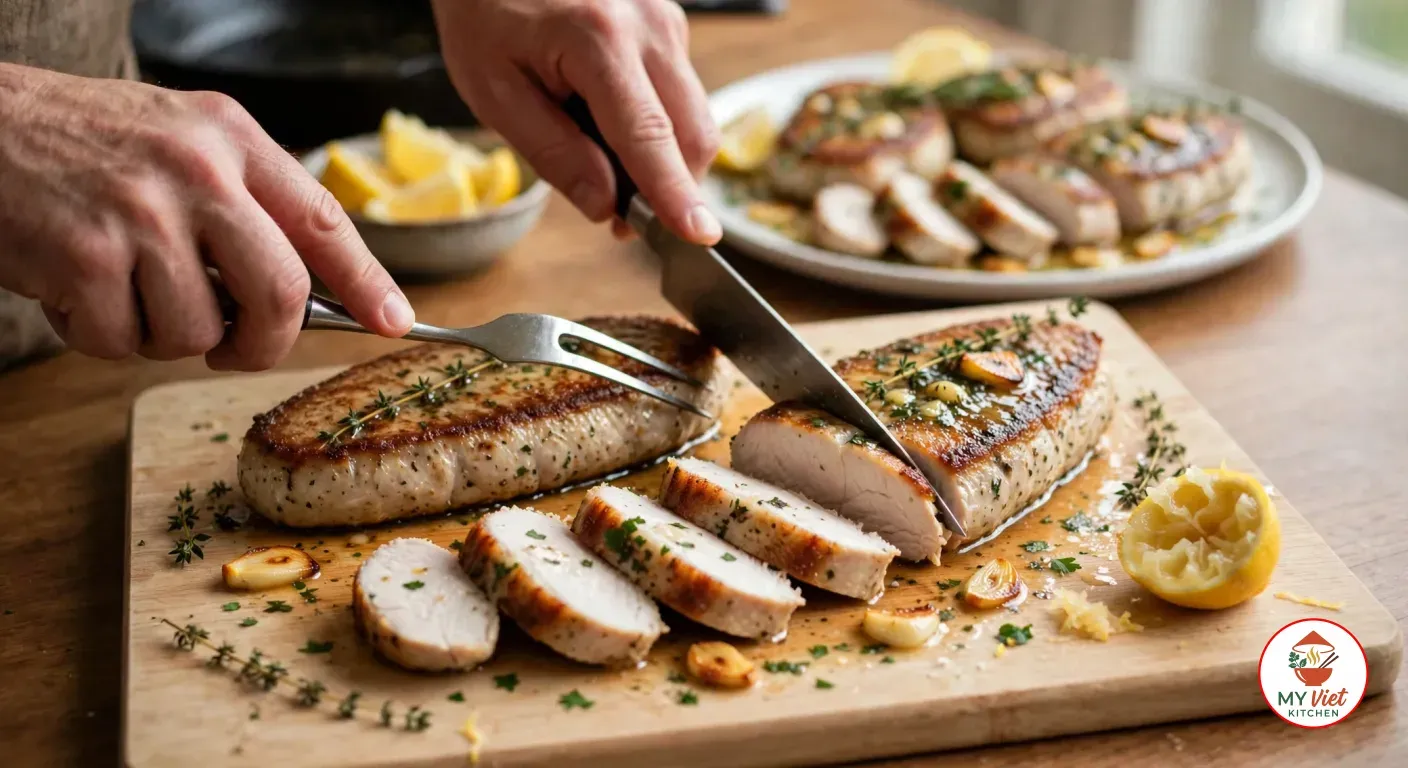
4Move the steaks to a cutting board and squeeze the lemon juice over them while they are hot. Rest them for 5 minutes, which keeps more of their juice inside when you cut. Slice each steak across the grain into pieces about 1/2 inch (1 cm) thick and fan them out on warm plates. Spoon the garlic-herb butter and soft garlic from the pan over the slices, scatter with parsley and serve with lemon wedges.
Frequently Asked Questions
What does crocodile meat taste like?
Many people compare it to chicken, says a Darwin cook who serves it. Justin Whitrow slow-cooks whole crocodiles for eight to nine hours for tacos at the Mindil Beach Sunset Markets. He told ABC News that a lot of people call it chicken-flavoured, but that after the smoker it comes out “more like a sticky pork kind of consistency” (ABC News).
Is crocodile meat healthy?
It is a lean, high-protein meat, much like chicken breast. Per 100 g, raw tail fillet has 442 kJ (about 106 Calories), 22.5 g of protein, 1.6 g of fat, 72 mg of cholesterol and 51 mg of sodium. Its long-chain omega-3s come to 43 mg per 100 g, a small amount (FSANZ). Most of the fat in this recipe comes from the butter and oil, not the meat.
Can I marinate the steaks first?
Yes, in the fridge, and the cooking target stays the same. Australia’s Food Safety Information Council groups marinated meats with chicken and sausages, which should reach 75°C in the centre of the thickest part (Food Safety Information Council).
Is it legal to buy crocodile meat?
Yes, in Australia, when it comes from licensed farms and processors. The saltwater crocodile is listed under CITES, the treaty on trade in endangered species, and the federal environment department oversees the industry to a degree and handles the CITES reporting (AgriFutures Australia). Farms and processing plants should be licensed by a state wildlife or meat authority (FSANZ). Elsewhere it depends on the country. In 2007 EFSA reported that some EU member states banned imports of reptile meat while others allowed them under conditions (EFSA).
Sources
- Australian Food Composition Database – Release 3 (Nutrient profiles file: F003301 Crocodile, tail fillet, raw; F003299 Crocodile, back leg, raw; Chicken, breast, lean flesh, raw), Food Standards Australia New Zealand, December 2025
- 2019 Game meats analytical program, Food Standards Australia New Zealand, updated February 2025
- Supporting Document 3: Assessment of the microbiological hazards associated with the minor and wild game meat species (Proposal P1014), Food Standards Australia New Zealand, October 2013
- Supporting Document 3: Current Regulatory Requirements for Meat Safety (Proposal P1014), Food Standards Australia New Zealand
- EFSA advises on health risks of consuming reptile meat, European Food Safety Authority, November 2007
- Safe cooking temperatures, Food Safety Information Council
- Meat thermometers, Food Safety Information Council, April 2014
- Saltwater Crocodile, AgriFutures Australia
- Slow-cooked crocodile tacos with pawpaw slaw on the menu at Darwin’s Mindil Beach Sunset Markets, ABC News, June 2018