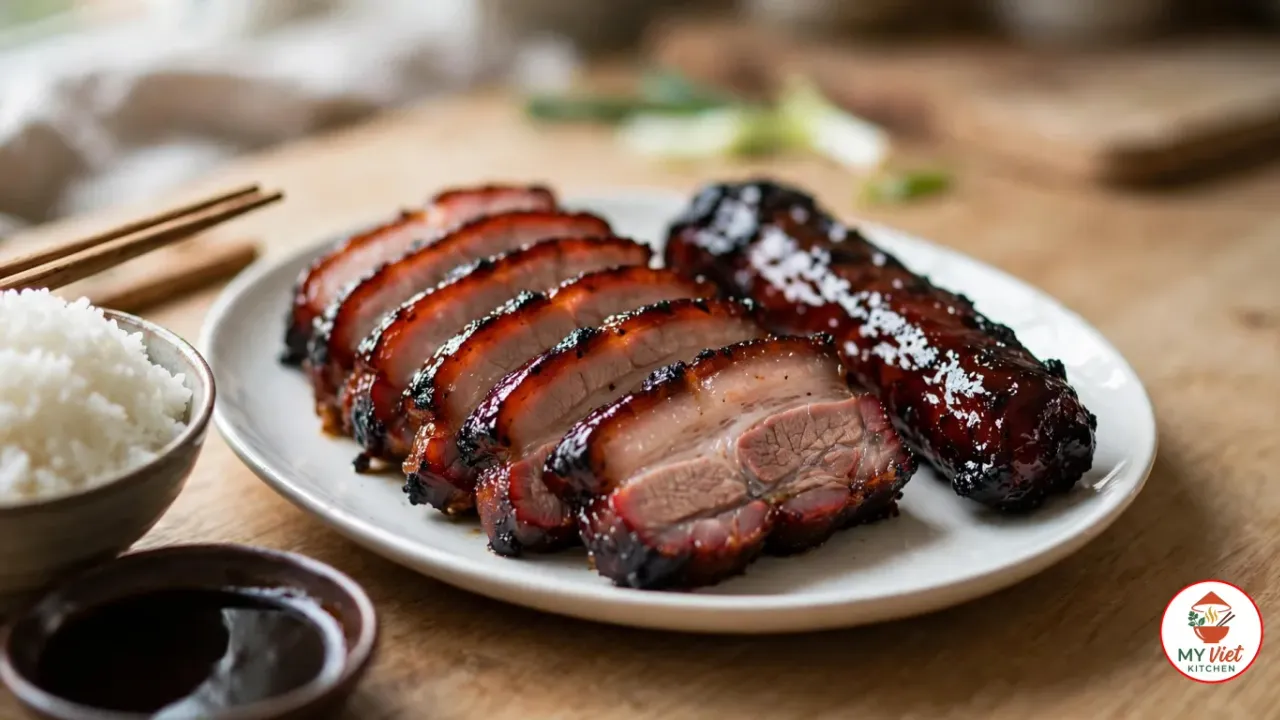
Char siu is a Cantonese barbecued pork dish: strips of fatty pork marinated in hoisin, soy sauce, rice wine and five-spice, then roasted and glazed. The outside turns sticky and the edges blacken. It’s sold in siu mei shops, which specialize in Cantonese roast meats (Wikipedia). This oven version uses boneless pork shoulder, an overnight marinade and a tray of water under the rack, so the sugar that drips off doesn’t burn.
Prep Time: 20 minutes | Cook Time: 45 minutes | Total Time: 9 hours 15 minutes, including 8 hours of marinating | Servings: 6
Difficulty: Easy | Calories: ~375 per serving

What Does the Name Char Siu Mean?
Char siu (叉燒) means “fork roasted” in Cantonese (Wikipedia). The MICHELIN Guide points out that people roast meat on spits and forks almost everywhere, so the technique is hard to trace. Even so, the dish is widely believed to come from Guangdong, where pork is the main red meat (MICHELIN Guide).
The forks have mostly gone. According to the same guide, most Hong Kong shops now lower the meat into a barrel-shaped oven through an opening in the top (MICHELIN Guide). Food writer Janice Leung Hayes describes the order of work: the pork is roasted until almost cooked, then dipped in a sugary glaze (Tatler Asia). This recipe keeps that order, with the glaze going on only in the last 10 minutes.
Once roasted, char siu is eaten sliced with rice or noodles, and it fills buns and pastries in Cantonese dim sum (Wikipedia).
Which Pork Cut Do Hong Kong Roasters Use?
Pork collar, called mui tau (梅頭). The MICHELIN Guide reports that almost every Hong Kong roaster uses it. Chef Li Man Lung of Duddell’s explains why: “The meat-to-fat ratio is close to 50:50, which is great for roasting char siu” (MICHELIN Guide). Wikipedia gives the collar or shoulder as the usual cut (Wikipedia). Leung Hayes adds that in Cantonese communities outside Hong Kong, Malaysia among them, she has seen the belly used too (Tatler Asia).
Away from a Chinese butcher, boneless pork shoulder, sold as pork butt or Boston butt, is the easiest match. It’s the cut Daddy Lau uses in the video above (Made With Lau).
Pick a piece with streaks of fat running through it and trim any outer layer thicker than about 1 cm. Then slice it with the grain into strips roughly 4 cm (1 1/2 inches) thick. At that size the marinade reaches every side, and the center cooks through in the time the glaze needs to darken. Lean loin and tenderloin have too little fat to stay juicy through 45 minutes of roasting.
What Makes Char Siu Red?
Traditionally, red fermented bean curd and red yeast rice, though red food coloring is now common in their place (Wikipedia). Red yeast rice takes its color from the mold Monascus purpureus, and it’s used to color fermented tofu among other foods (Wikipedia). That’s why a cube of red bean curd tints the marinade as well as salting it. The MICHELIN Guide names red fermented tofu as the source of char siu’s distinctive hue (MICHELIN Guide).
Cooks disagree on whether you need either. Nagi Maehashi of RecipeTin Eats writes that the small amount of bean curd doesn’t add any flavor, so she switched to food coloring. For anyone who keeps the curd, she suggests about 2 tablespoons of its liquid and no dye (RecipeTin Eats). Adam Liaw uses the bean curd and says you don’t need to add food coloring (Adam Liaw).
Leung Hayes would like to see red coloring dropped altogether (Tatler Asia). This recipe uses no dye and makes the curd optional. Without it, the dark soy sauce and the glaze still roast the outside to a deep mahogany.
Why Do Roasters Glaze With Maltose?
For shine and stickiness. Maltose is a natural sugar made from fermented grains (Tatler Asia), and Wikipedia credits maltose or honey with char siu’s high sugar content and glossy glaze (Wikipedia). The two chefs the MICHELIN Guide interviewed, Lau Ping Lui of Tin Lung Heen and Li Man Lung, both glaze with maltose, though some chefs use honey. Li’s reason: “Pure honey is too floral for char siu, in my opinion” (MICHELIN Guide).
Maltose sets almost solid in the jar. Bill Leung of The Woks of Life warms it in the microwave so it’s easier to work with (The Woks of Life). Standing the jar in hot water for a few minutes also works. Honey is the easy substitute. It’s runnier and more floral, and it browns faster, so watch it closely once it’s on.
Sugar that drips onto a hot, dry tray scorches and fills the kitchen with smoke. The Woks of Life pours 1 1/2 cups of water into the tray under the rack to stop it. Its recipe also starts the oven at 475°F for 10 minutes, then turns it down to 375°F (The Woks of Life). Made With Lau adds a little water to the pan for the same reason (Made With Lau).
This recipe uses the water tray and the hot start. The glaze waits until the last 10 minutes, so the sugar has time to caramelize but not to burn.
Ingredients for Char Siu
For the Pork and Marinade:
- 900 g (2 lb) boneless pork shoulder (pork butt) or pork collar, with some fat
- 3 tablespoons hoisin sauce
- 2 tablespoons light soy sauce
- 1 tablespoon dark soy sauce
- 1 tablespoon oyster sauce
- 2 tablespoons Shaoxing wine or dry sherry
- 2 tablespoons honey
- 1 teaspoon toasted sesame oil
- 1 teaspoon Chinese five-spice powder
- 3 cloves garlic, finely minced
- 1/2 teaspoon ground white pepper
- 1 cube red fermented bean curd (about 15 g), mashed, plus 1 tablespoon of its liquid, optional
For the Glaze:
- 3 tablespoons (60 g) maltose or honey
- 1 tablespoon hot water
Step-by-Step Instructions
Step 1: Prepare the Pork and Marinade
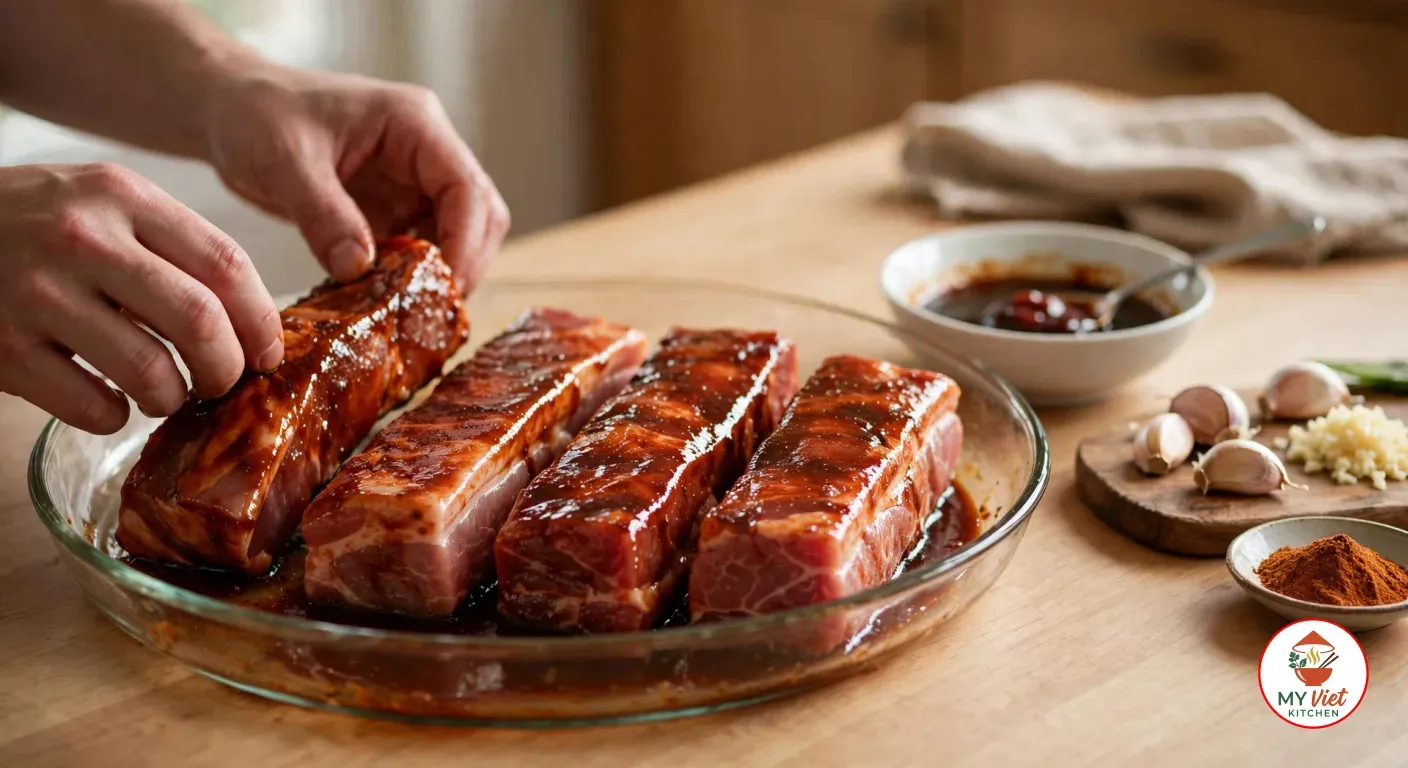
1Cut the pork along the grain into strips about 4 cm (1 1/2 inches) thick and 15 cm (6 inches) long. In a bowl, stir together the hoisin sauce, light and dark soy sauce, oyster sauce, Shaoxing wine, honey, sesame oil, five-spice powder, garlic and white pepper. If you’re using red bean curd, mash the cube into its liquid until smooth and stir it in. Spoon 3 tablespoons of the marinade into a small bowl, cover it and refrigerate it for basting. Because it never touches the raw pork, it’s safe to brush on later. Turn the strips in the rest of the marinade until every side is coated. Cover the bowl and leave it in the fridge overnight, or for 8 hours at the very least, turning the strips once.
Step 2: Roast the Char Siu
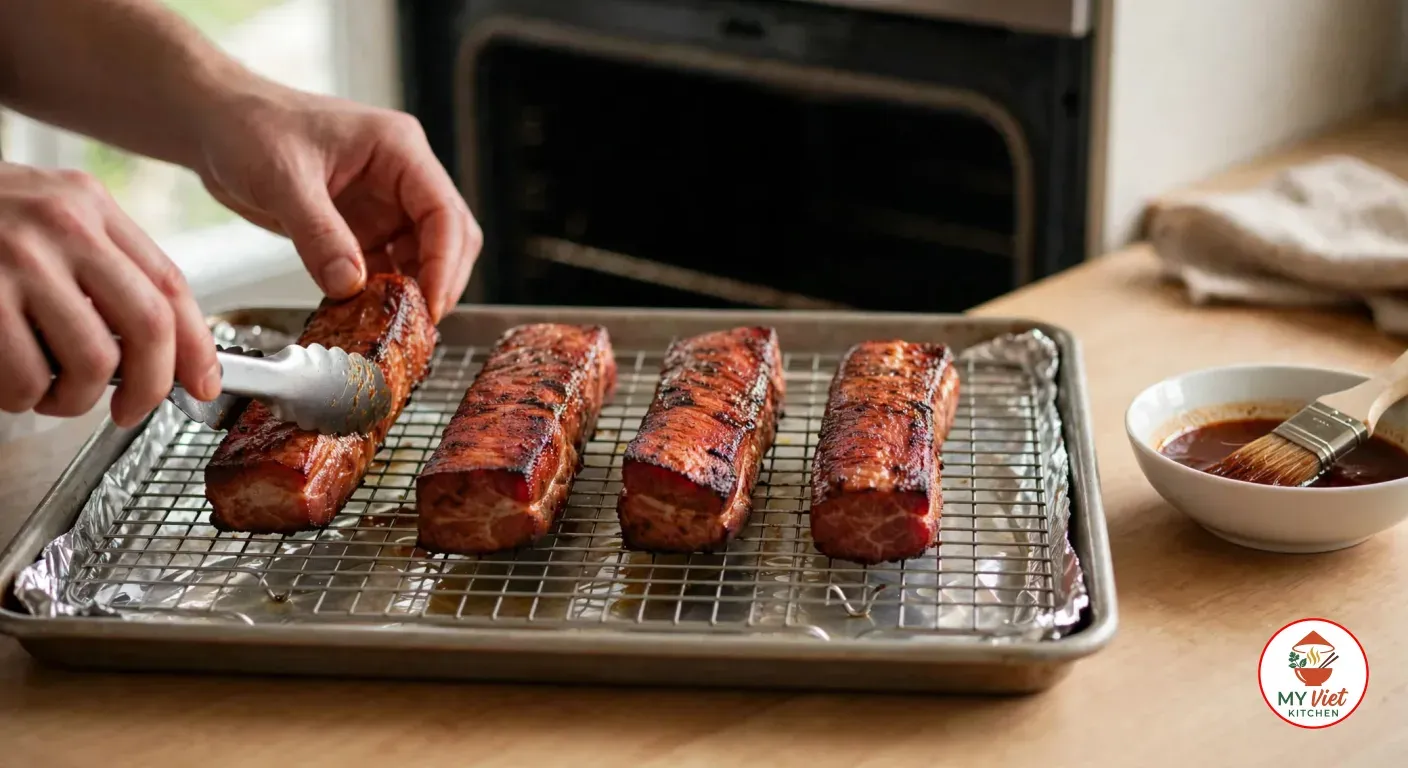
2Heat the oven to 475°F (245°C) with a rack in the upper third. Line a rimmed baking tray with foil, set a wire rack on it and pour 1 1/2 cups (360 ml) of water into the tray. Lift the pork out of the marinade, let the extra run off and lay the strips on the rack with a few centimeters between them. Throw away the used marinade. Roast for 10 minutes, turn the heat down to 375°F (190°C) and roast for 15 minutes. Take the tray out, turn the strips with tongs and brush them all over with the reserved marinade. Top up the water if the tray has dried out, and roast for 10 minutes more.
Step 3: Apply the Final Glaze
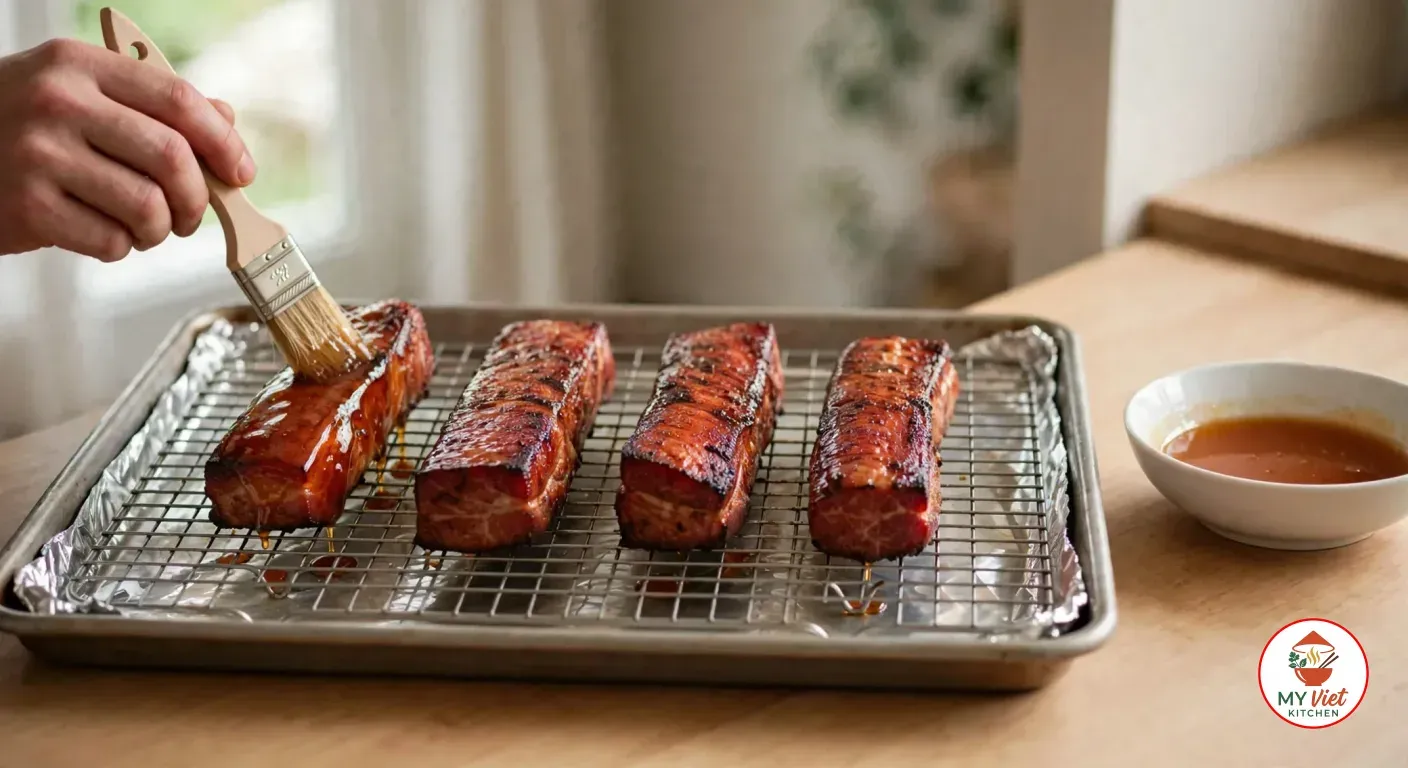
3While the pork roasts, warm the maltose for a few seconds in the microwave, or stand the jar in hot water, until it flows off a spoon. Stir in the hot water. If you’re using honey, just mix it with the water. After the pork has roasted for 35 minutes, brush the glaze thickly over the tops of the strips and roast for 5 minutes. Turn them, glaze the other side and roast for 5 minutes more. The glaze should be sticky and the edges charred in spots. An instant-read thermometer pushed into the thickest strip should show at least 145°F (63°C). For darker edges, put the tray under the broiler for 1 to 2 minutes and don’t walk away: the sugar can go from caramel to burnt in seconds. Keep a spoonful of glaze back for serving.
Step 4: Rest and Slice
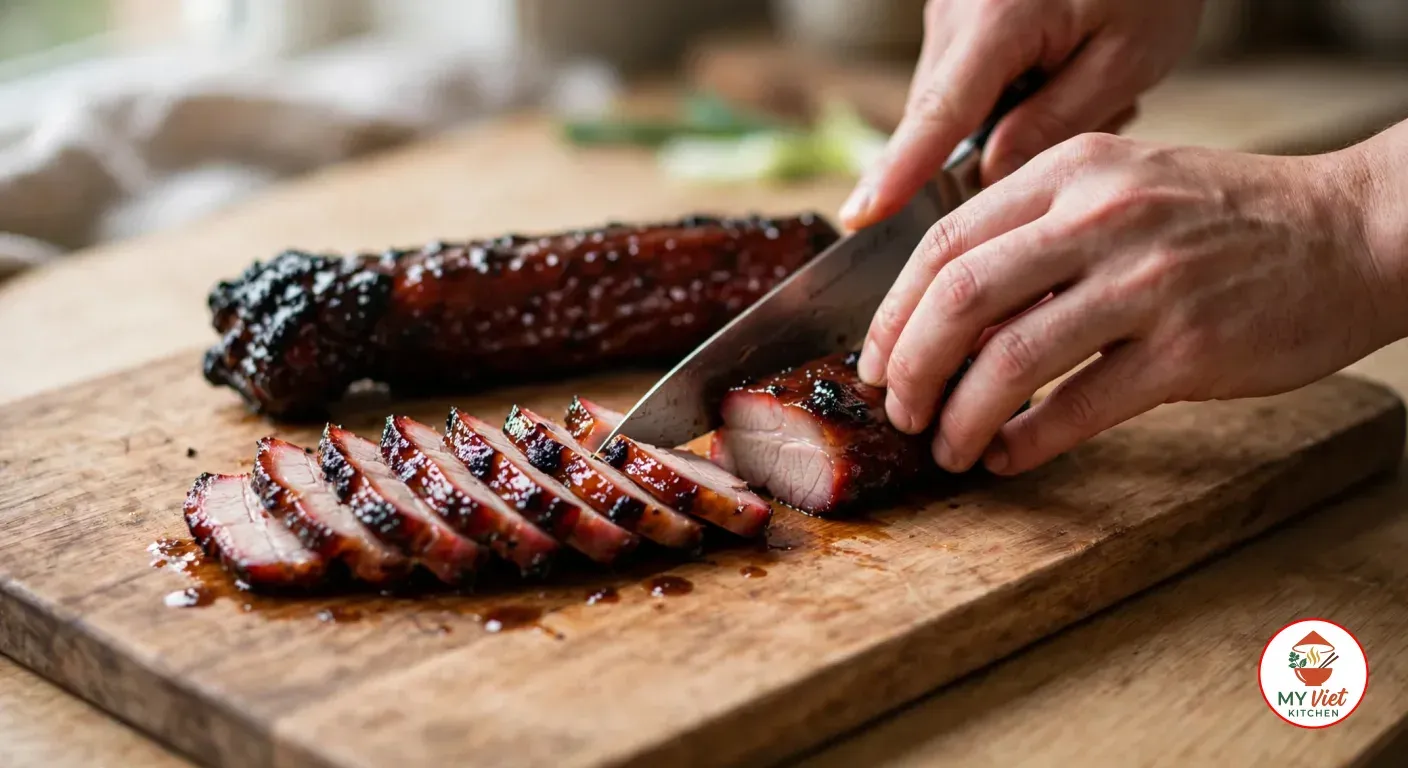
4Move the strips to a cutting board, brush them with the last of the glaze and let them rest for 10 minutes so the juices settle. Slice across the grain about 6 mm (1/4 inch) thick. Serve the slices warm over rice or noodles, with any juices from the board spooned over the top.
Frequently Asked Questions
How long should char siu marinate?
At least 8 hours, and overnight is the easiest to plan around. The Woks of Life (The Woks of Life) and Adam Liaw (Adam Liaw) both marinate overnight or for at least 8 hours. RecipeTin Eats goes longer, 24 to 48 hours, and calls 3 hours the bare minimum (RecipeTin Eats).
What temperature should char siu reach?
At least 145°F (63°C) in the thickest part, followed by a rest of 3 minutes or more. In 2011 the USDA lowered its advice for whole cuts of pork from 160°F to 145°F with a 3-minute rest (CIDRAP). The 10-minute rest in step 4 covers it. Shoulder has enough fat to stay moist well past that point, and The Woks of Life’s recipe aims for 160°F (71°C) (The Woks of Life).
Can you make char siu in an air fryer?
Yes, in pieces small enough to sit with space around them. The Woks of Life cooks 9- to 10-ounce (255 to 285 g) pieces in an air fryer at 375°F (190°C) for 15 to 18 minutes in total. The time is split into three rounds, with the pork glazed and turned between them. A quarter cup of hot water goes in the basket under the rack to keep the meat moist (The Woks of Life).
What is char siu called in other countries?
In Thailand it’s mu daeng, “red pork,” often served over rice as khao mu daeng. In Japan, chāshū can mean Cantonese-style char siu as well as roast or boiled pork, and the braised kind is a usual ramen topping. The Vietnamese name is xá xíu (Wikipedia).
Sources
- Char siu, Wikipedia
- Red yeast rice, Wikipedia
- Restaurant Secrets: How To Order Char Siu Like An Expert, MICHELIN Guide, 2020
- #NoCharSiuNoLife: An Ode To Cantonese Barbecued Pork, Janice Leung Hayes, Tatler Asia, 2019
- Dad’s Char Siu Pork: The Chinese Restaurant Way, Made With Lau
- Char Siu (Chinese BBQ Pork), Restaurant-Style, The Woks of Life
- Air Fryer Char Siu, The Woks of Life
- Char Siu Pork (Chinese BBQ Pork), RecipeTin Eats
- How to Make Authentic Char Siew (Cantonese Barbecue Pork), Adam Liaw
- USDA: 145 degrees is safe temp for pork, CIDRAP, University of Minnesota, 2011