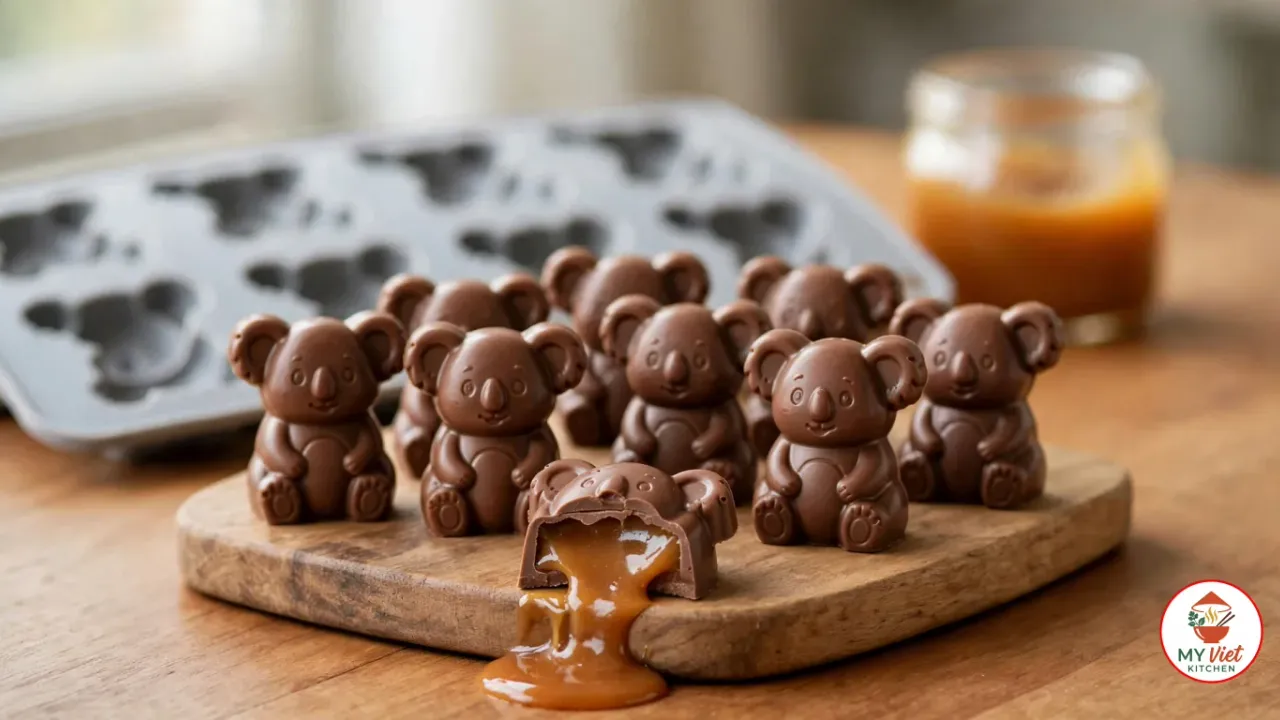
A Caramello Koala is a koala-shaped milk chocolate with a soft caramel centre, made by Cadbury Australia. This recipe is a copy you make at home, not the Cadbury product. You temper milk chocolate, brush it into a silicone koala mold, fill the shells with a golden syrup caramel and seal them with more chocolate. It makes 12 koalas close to the size of the 35 g Giant bar. Allow 2 hours, most of it cooling and chilling.
Prep Time: 45 minutes | Cook Time: 15 minutes | Servings: 12 chocolates
Difficulty: Medium | Calories: ~165 per chocolate

Who Makes the Caramello Koala?
Cadbury Australia makes the Caramello Koala, and Cadbury has belonged to Mondelez International since 2010 (Wikipedia). The name and the koala character are Cadbury’s, so what you make here is a copy for your own kitchen.
Sources disagree about when it started. Wikipedia says Cadbury introduced it in Australia in 1966, and calls it reputedly the first mass-marketed sweet modelled on an Australian animal. Chowhound says it first went on sale in the 1960s as the Caramello Bear and took its koala name and shape in the 1980s.
The usual koala weighs 15 g (0.53 oz), and a 35 g (1.2 oz) Giant is mostly sold for fundraisers. Cadbury shrank the small one from 20 g in April 2015, citing rising input costs, and the Giant has gone down from 40 g (Wikipedia).
The label of the share pack, as transcribed on Open Food Facts, gives milk chocolate as 70 percent of the product. Its other ingredients include glucose syrup, sweetened condensed milk, golden syrup and invert sugar. This copy keeps the golden syrup and swaps the condensed milk for cream. Brushed shells are thinner than factory ones, so expect more caramel in each bite.
Do You Have to Temper the Chocolate?
Yes, for molded chocolates. Chocolate that is only melted tends to set soft and dull. Callebaut’s troubleshooting guide lists untempered chocolate as a reason molded figures don’t harden and stick to the mold (Callebaut). The same guide recommends two or three layers of chocolate, since a thicker shell contracts better as it cools. Contraction is what lets the koalas drop out of the silicone in one piece.
Tempering takes the chocolate through three temperatures. For its milk chocolate, Callebaut melts it to 45°C (113°F), cools it to 27°C (81°F) and warms it to 29 to 30°C (84 to 86°F). It also warns against letting the chocolate rise above that last figure (Callebaut). Other brands print slightly different curves, so check the packet if yours has one. Then test a spoon tip before you start molding.
Compound coatings sold as “melts” skip all of this, because they use palm kernel oil or other vegetable fats in place of cocoa butter (Keylink). They will fill the mold, but the shell is no longer milk chocolate.
How Runny Should the Caramel Be?
At room temperature it should hold a soft mound on a spoon for a second, then slump. Water decides the texture. Once the cream goes in, the caramel simmers and gives off water, and the hotter it gets, the firmer it sets. Tasting Table puts caramel sauce at 220°F (104°C) and says that by 245°F (118°C) it becomes chewy and firm (Tasting Table).
This recipe stops at 104°C for a centre that flows. For one that oozes less, cook it 2 or 3 degrees hotter. How dark you take the sugar changes the flavor, from mild to slightly bitter, more than the texture.
Heat matters again when you fill. Callebaut’s filling tutorial says a filling should be no warmer than 28°C (82°F) when it goes into the shells, or it can melt them (Callebaut). Making the caramel first gives it time to cool while you temper the chocolate and line the mold.
Which Mold Should You Use?
Silicone is the easy choice, since you can bend it to push each koala out. The amounts below suit a mold with 12 koala cavities of about 2 tablespoons (30 ml) each, close to the Giant size. A mold with smaller cavities, like the 15 g koala, makes about twice as many. Have some extra chocolate ready for it, because small shells use more chocolate for each spoonful of caramel. Hearts, bears and half-spheres all work with the same steps.
Ingredients for Homemade Caramello Koala
Caramel Filling:
- 1/2 cup (100 g) granulated sugar
- 1 tablespoon golden syrup
- 2 tablespoons water
- 1/2 cup (120 ml) heavy cream, warmed
- 2 tablespoons (30 g) unsalted butter, cubed
- 1/4 teaspoon fine sea salt
- 1 teaspoon vanilla extract
Chocolate Shells:
- 300 g (10.5 oz) milk chocolate, finely chopped
Equipment:
- Silicone koala mold with 12 cavities of about 30 ml (2 tablespoons) each
- Digital probe or instant-read thermometer
- Heavy 2-quart (2-liter) saucepan, deep enough for the caramel to foam up
- Heatproof glass bowl that sits on a saucepan of water
- Small pastry brush
- Piping bag, or a zip-top bag with one corner snipped off
- Offset spatula or bench scraper
Step-by-Step Instructions
Step 1: Make the Caramel Filling
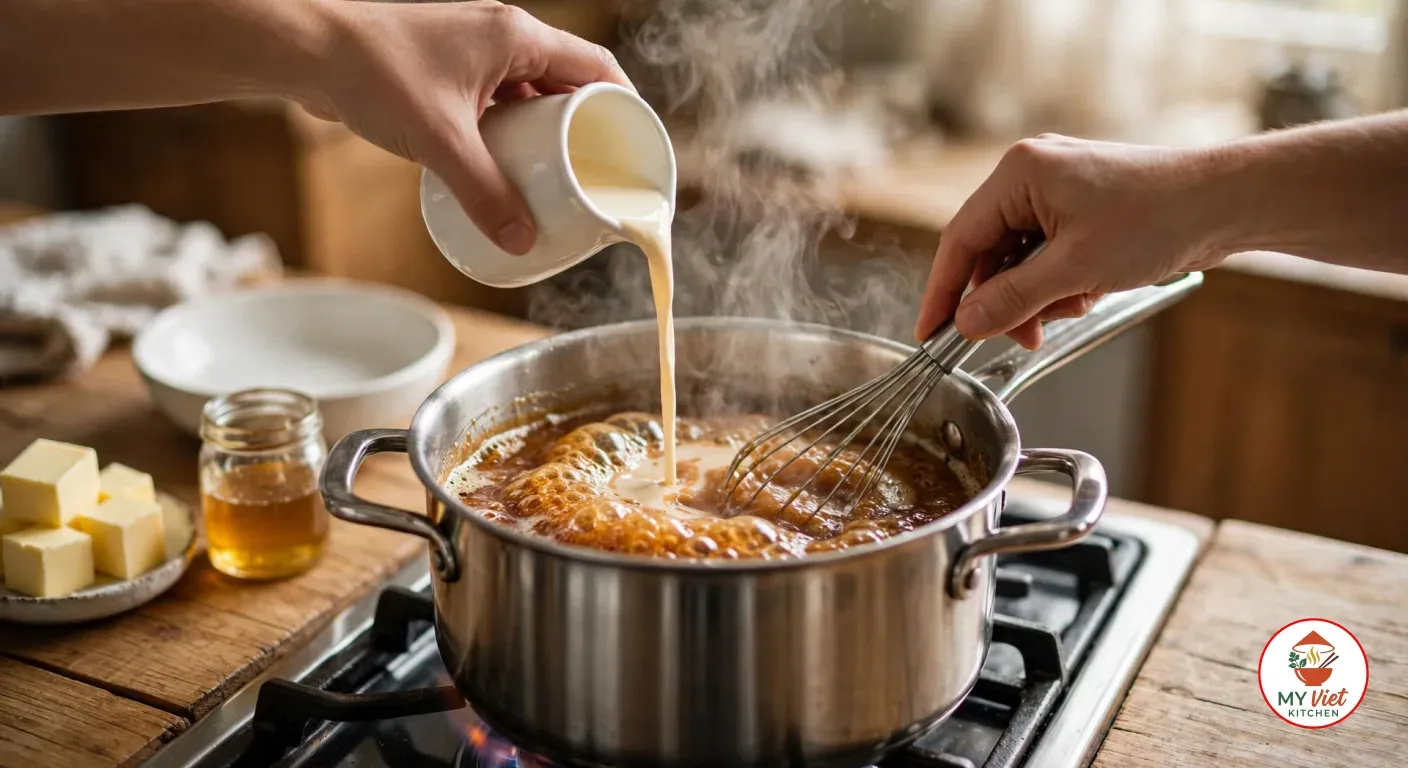
1Warm the cream until it steams and keep it near the stove. Put the sugar, golden syrup and water in the saucepan over medium heat and stir until the sugar dissolves. Once it boils, stop stirring. Let it bubble, swirling the pan now and then, until it turns deep amber like dark honey, about 8 minutes. Take the pan off the heat and whisk in the warm cream a little at a time. It will foam and spit, so keep your hand to one side. Return the pan to medium-low heat and simmer, stirring, until the thermometer reads 104°C (220°F). Off the heat, whisk in the butter, salt and vanilla. Pour the caramel into a shallow bowl and let it cool to 28°C (82°F) or below, 45 to 60 minutes.
Step 2: Temper the Chocolate
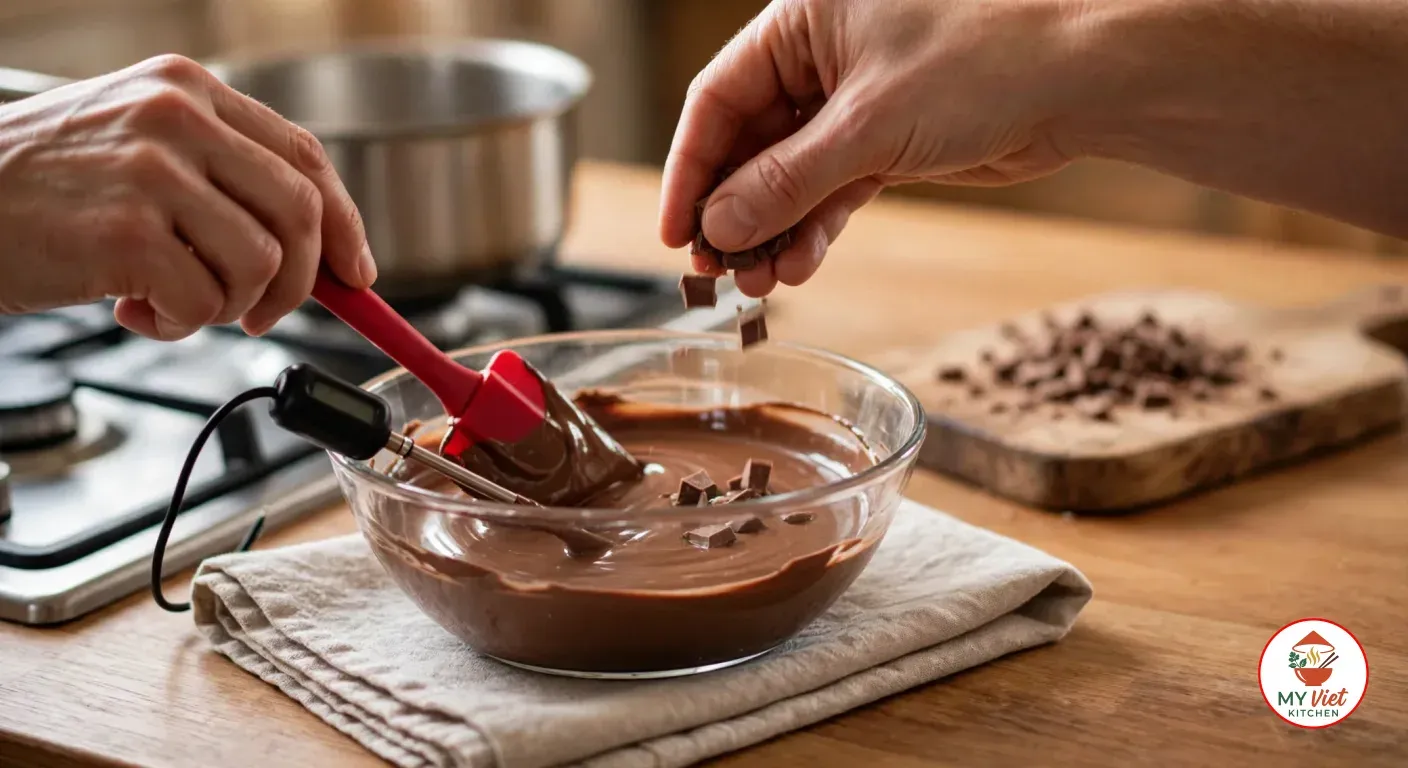
2While the caramel cools, set aside 100 g (3.5 oz) of the chopped chocolate. Put the other 200 g (7 oz) in a dry heatproof bowl over a saucepan of barely simmering water, with the bottom of the bowl clear of the water. Stir until the chocolate melts and reaches 45°C (113°F). Lift the bowl onto a folded towel and stir in the reserved chocolate. Keep stirring until it cools to 27°C (81°F), then fish out any pieces that haven’t melted. Set the bowl back over the warm water for 5 seconds at a time, stirring in between, until it reaches 29 to 30°C (84 to 86°F). Dip the tip of a spoon in it and leave it on the counter. If it sets firm and shiny within a few minutes, the chocolate is ready.
Step 3: Mold the Chocolate Shells
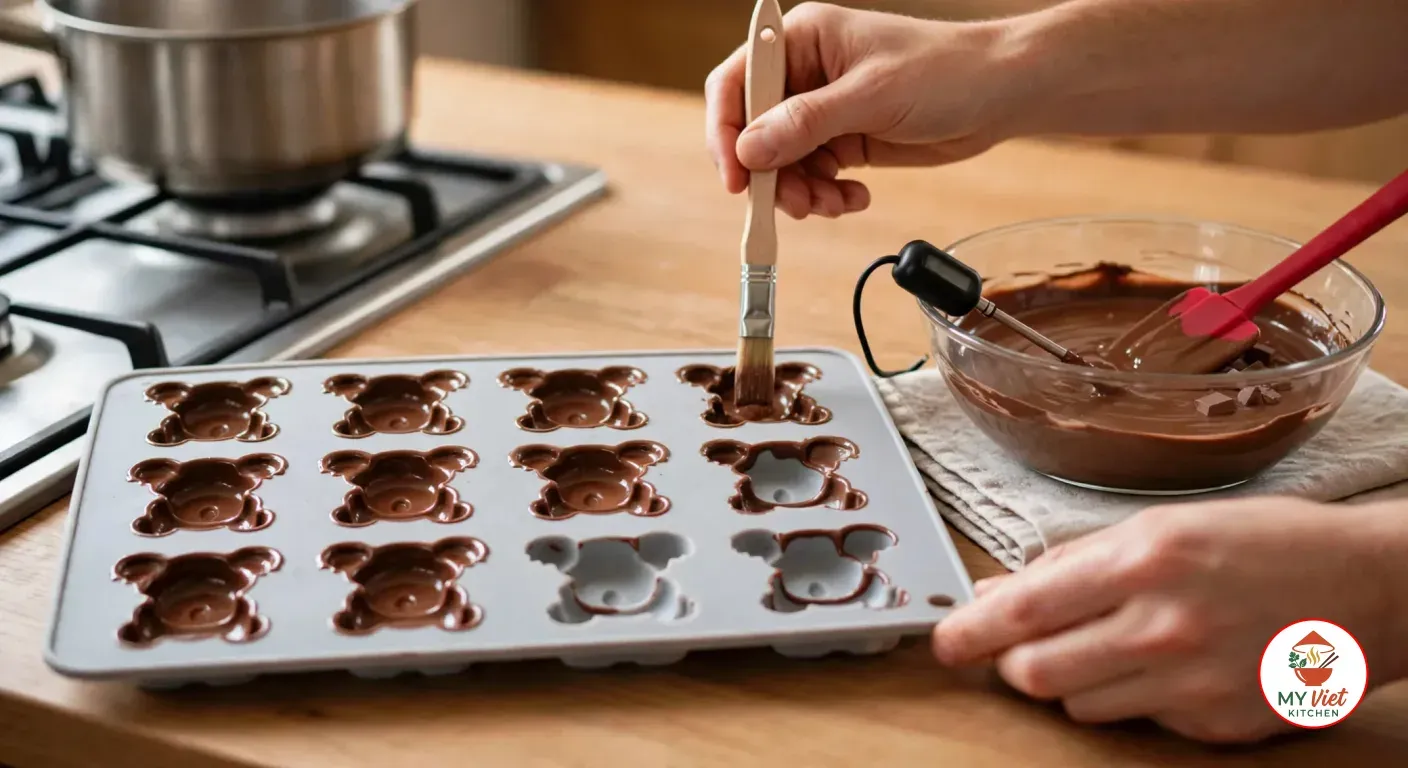
3Check that the mold is clean and completely dry, since a drop of water makes chocolate seize. Spoon about 2 teaspoons of tempered chocolate into one cavity and brush it up the sides, into the ears and right to the rim. Coat every cavity the same way, then chill the mold for 5 minutes. Brush on a second, thinner coat, looking for thin spots at the ears and the rim, and chill for 5 minutes more. Keep the leftover chocolate in its bowl. When it starts to thicken, warm it over the water for a few seconds, without letting it go above 30°C (86°F).
Step 4: Fill the Shells
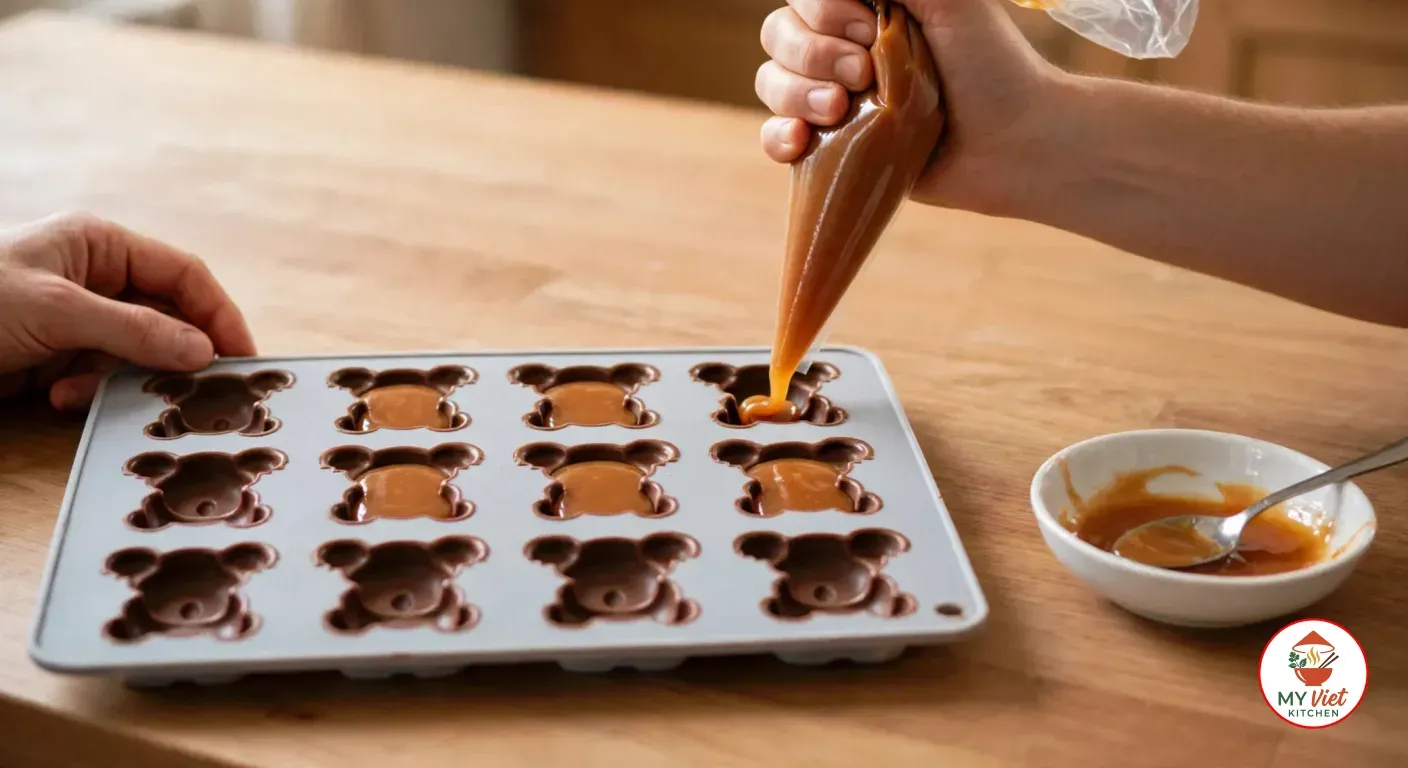
4Take the caramel’s temperature first: at 28°C (82°F) or cooler, it won’t soften the shells. Stir it smooth, spoon it into the piping bag and snip a small opening. Fill each shell to about 2 mm (1/16 inch) below the rim, which leaves room for the chocolate seal. Keep caramel off the flat top of the mold, because the seal won’t stick where caramel has touched. Wipe any drips with a paper towel. Chill the filled mold for 10 minutes so the caramel firms a little.
Step 5: Seal and Set
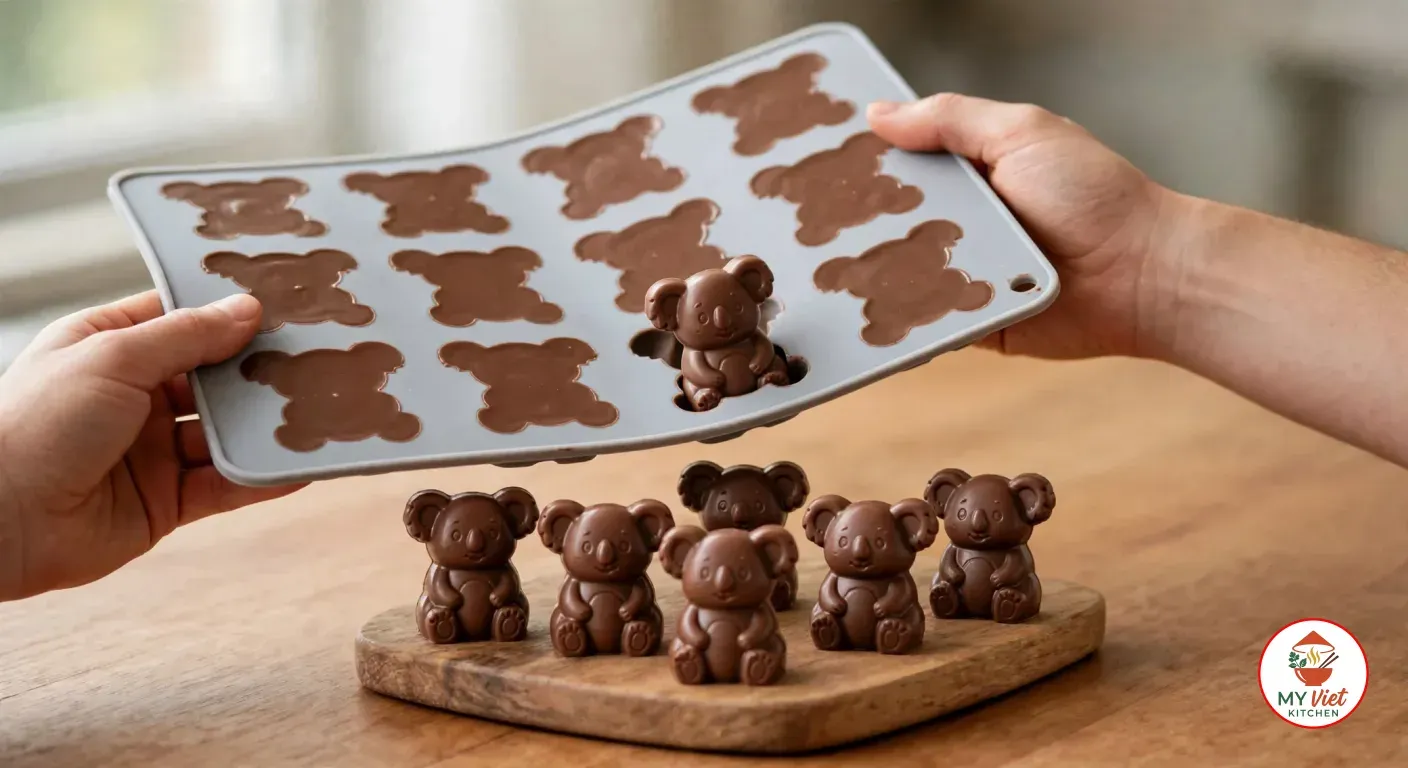
5Warm the remaining chocolate back to 29 to 30°C (84 to 86°F). Spoon it over each filled shell so it covers the caramel and joins the chocolate at the rim. Drag an offset spatula or bench scraper across the mold to level the bases and clear off the excess. Chill for 30 minutes, until the chocolate is firm. Flex the mold and push each koala out from underneath. If one sticks, give the mold 10 more minutes in the fridge and try again.
Frequently Asked Questions
Is a Caramello Koala the same as a Caramello Bear?
They are close relatives. Cadbury sold the chocolates in South Africa as the Caramello Bear, with a bear as the mascot, until they were discontinued there in 2012, according to Wikipedia. In Australia, Chowhound reports that the koala itself first went on sale in the 1960s under the Caramello Bear name.
Can I make these without a koala mold?
Yes. Any chocolate mold takes the same method, from half-spheres to hearts or bears. With no mold at all, brush two coats of chocolate inside paper mini-muffin cases, fill and seal them the same way, and peel off the paper once the chocolate is firm.
Why did my koalas stick to the mold?
Usually the chocolate was out of temper or the shells were too thin. Callebaut lists untempered chocolate, thin shells and too little cooling time as reasons molded figures won’t release. Melt the chocolate again, repeat the temperatures in step 2 and test a spoon tip before you start. Brush on two full coats, and give the sealed mold its full 30 minutes in the fridge.
Why did caramel leak out of the base?
Caramel left on the rim of a cavity is the usual cause, because the sealing chocolate can’t bond to it. Fill to about 2 mm below the rim, wipe off any drips, and spread the seal until it meets the shell all the way around. Caramel that went in warmer than 28°C (82°F) can also thin the shell from inside.
How long do homemade Caramello Koalas keep?
Store them in a closed container in the fridge and eat them within a week, because the filling is made with fresh cream. Take them out about 15 minutes before serving so the caramel loosens. Leave the lid on while they warm up, which stops moisture from beading on the chocolate.
Sources
- Caramello Koala and Cadbury, Wikipedia
- 14 Australian Candies You Need To Try At Least Once, Chowhound, 2025
- Caramello Koala – Dairy Milk – 180 g, Open Food Facts
- Guide to Different Tempering Methods, How to fill moulded chocolates and Hollow figures, Callebaut
- Chocolate vs Compound Coating, Keylink
- What’s The Exact Temperature Needed For Caramel Sauce?, Tasting Table, 2023