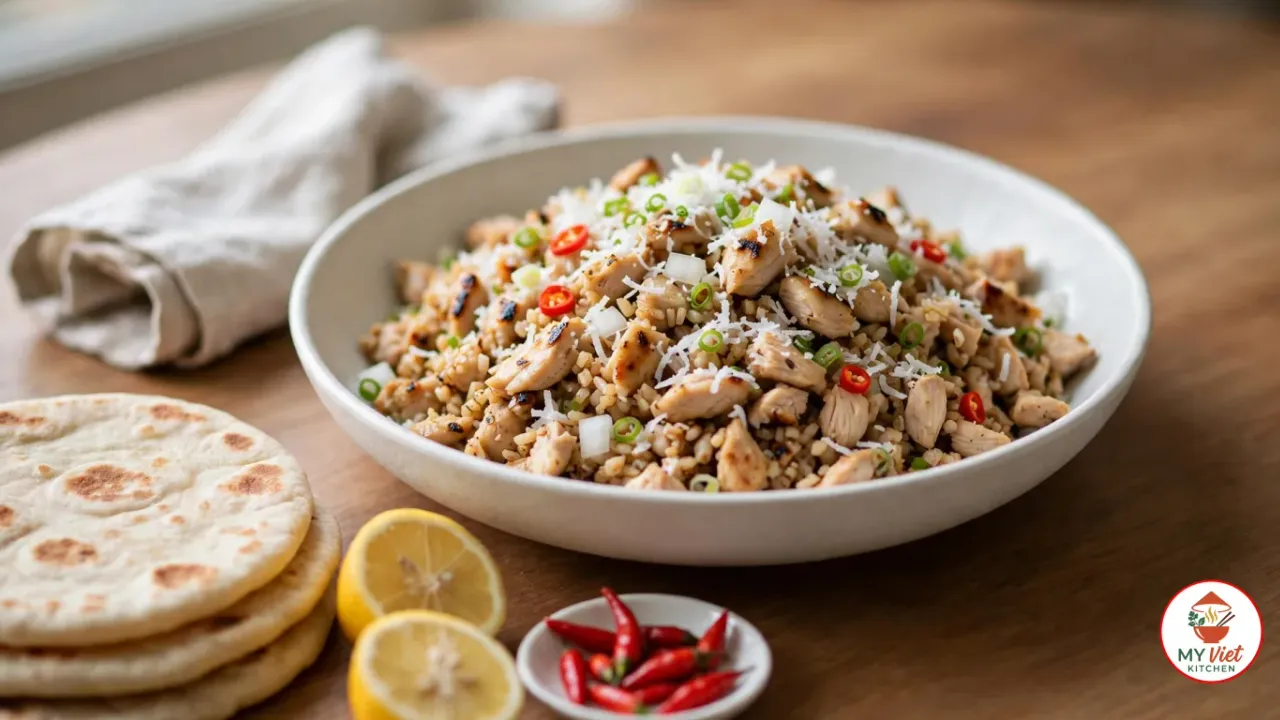
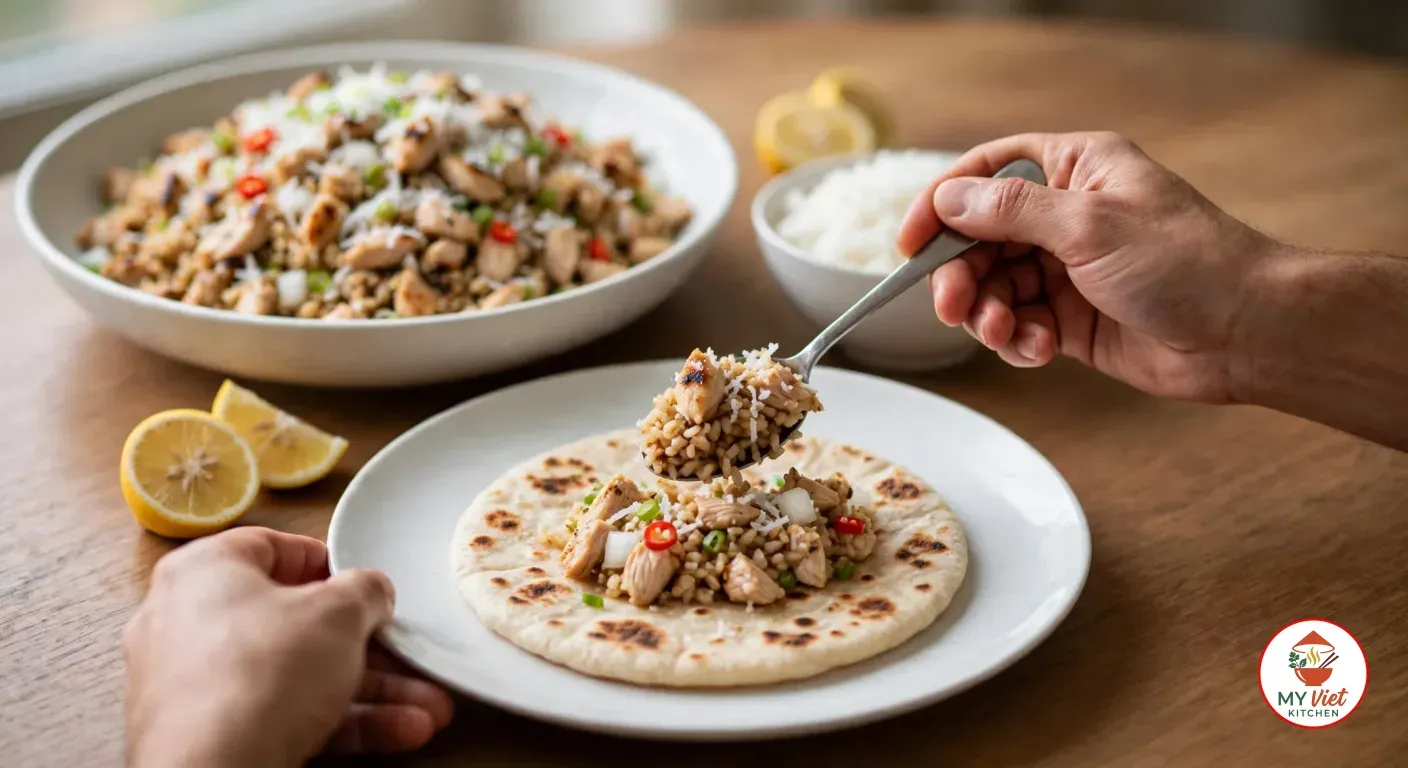
Chicken kelaguen is a Chamorro dish of grilled chicken chopped fine and tossed with lemon juice, salt, onions, hot peppers and, most of the time, grated coconut. It comes from Guam and the rest of the Mariana Islands and is eaten cold or at room temperature with titiyas or rice. In this version the thighs are grilled until fully cooked before the lemon goes on, and the coconut makes up about a quarter of the chicken’s volume.
Prep Time: 25 minutes | Cook Time: 20 minutes | Servings: 6
Difficulty: Easy | Calories: ~265 per serving

Does the Lemon Juice Cook the Chicken?
Not in this dish. Kelaguen as a method relies on lemon juice. Guampedia explains that raw fish or shrimp is “cooked” by the acidity of the lemon, and deer and beef go into the juice raw as well. Chicken is the exception. It’s barbecued over a charcoal or wood fire, or boiled, and only then chopped and dressed with lemon juice and salt (Guampedia).
On raw fish and shrimp, acid makes the proteins coagulate, so the flesh turns firmer and opaque. America’s Test Kitchen adds that acid has some effect on microbes but is not nearly as effective as heat, especially against parasites (America’s Test Kitchen). So the grill does the safety work here, and the lemon is there for flavor.
The CDC’s target for chicken is an internal 165°F (74°C), checked with a food thermometer. The same page warns against letting raw chicken juices touch cooked food. Chop the grilled thighs on a clean board, not the one that held them raw (CDC).
How Much Coconut Should You Add?
About one part coconut to four parts chicken, by volume. In the kelaguen recipe Judy Flores wrote for Guampedia, grated coconut goes into chicken or shrimp kelaguen in small amounts until the flavors balance. It should come to only about a quarter of the protein’s volume. Guampedia also says coconut is usually, but not always, added to chicken, fish and shrimp kelaguen, and that some cooks use lechen niyok, coconut cream, for fish (Guampedia).
Paula Quinene, a Guam cookbook author, writes that coconut goes in much of the time for a richer flavor but is optional except in shrimp kelaguen. On Guam it’s grated on a kamyo, a grater built high enough that you sit on its bench to use it (PaulaQ).
Two pounds of thighs give roughly 4 to 5 cups of chopped meat, so 1 cup (80 g) of grated coconut keeps close to that ratio. Frozen grated coconut, thawed and squeezed of any water, is the easiest stand-in for a freshly grated mature nut.
What Is Donne’ Sali?
It’s the small, fiery chili that goes into kelaguen on Guam. Mari Marutani, a professor at the University of Guam, describes donne’ sali as having small, bright red and very pungent fruit. She says it has long been harvested from the wild. Guam’s other main hot pepper, donne’ ti’au, is long and red and grows mostly in backyard gardens (Stripes Guam).
In Chamorro, donne’ means pepper, and sali refers to the paluman sali, a native bird that feeds on the red peppers and spreads their seeds across the islands (Rep. Kimberlyn King-Hinds).
Hot peppers arrived from outside, though. Chilies are native to the Americas, and Guampedia says the Spanish introduced them to the Marianas (Guampedia). Wikipedia says donne’ sali is thought to have come with the Spanish in the 1600s and gives its other name, boonie pepper (Wikipedia). Away from the islands, Thai bird’s eye chilies, also small and red, are the easiest swap to find. Start with 2, taste once everything is mixed, and add more. Wash your hands well after mincing them.
How Is Chicken Kelaguen Served?
Cold or at room temperature, over rice or wrapped in a tortilla or in titiyas, the Chamorro version (Wikipedia). Titiyas takes its name from the Spanish word tortilla and can be made from corn, wheat flour or another starch. The flour kind is mixed with coconut cream and a little salt and sugar, and Guampedia calls titiyas an essential item on the fiesta table (Guampedia). On Guam the dish also goes by kelaguen månnok, since månnok is the Chamorro word for chicken (Wikivoyage).
A fiesta is a celebration held in honor of a patron saint (Guampedia), and kelaguen has a set place on its buffet. Chicken kelaguen goes after the barbecued chicken and other meats, while fish and shrimp kelaguen are grouped after the barbecued fish. Guampedia calls kelaguen a signature local dish and notes that several restaurants on the island serve it as an appetizer or on the salad bar. At least one family sells chicken kelaguen in taco-shell-shaped titiyas through local stores (Guampedia).
A few hours of chilling lets the flavors blend, according to Guampedia, but don’t leave the bowl out all afternoon at a party. The CDC says to refrigerate leftover chicken within 2 hours, or within 1 hour when it sits above 90°F (32°C), as it can at a picnic (CDC).
Ingredients for Chicken Kelaguen
For the Chicken:
- 2 pounds (900 g) boneless, skinless chicken thighs
- 1 tablespoon neutral cooking oil, for the grill grates
For the Dressing:
- 1/2 cup (120 ml) fresh lemon juice, from about 3 lemons
- 1 teaspoon fine salt, plus more to taste
- 3/4 cup (110 g / 4 oz) finely diced white onions
- 4 green onions, thinly sliced
- 2 to 4 donne’ sali or Thai bird’s eye chilies, minced
- 1 cup (80 g / 3 oz) freshly grated mature coconut, or thawed frozen grated coconut
Step-by-Step Instructions
Step 1: Grill the Chicken
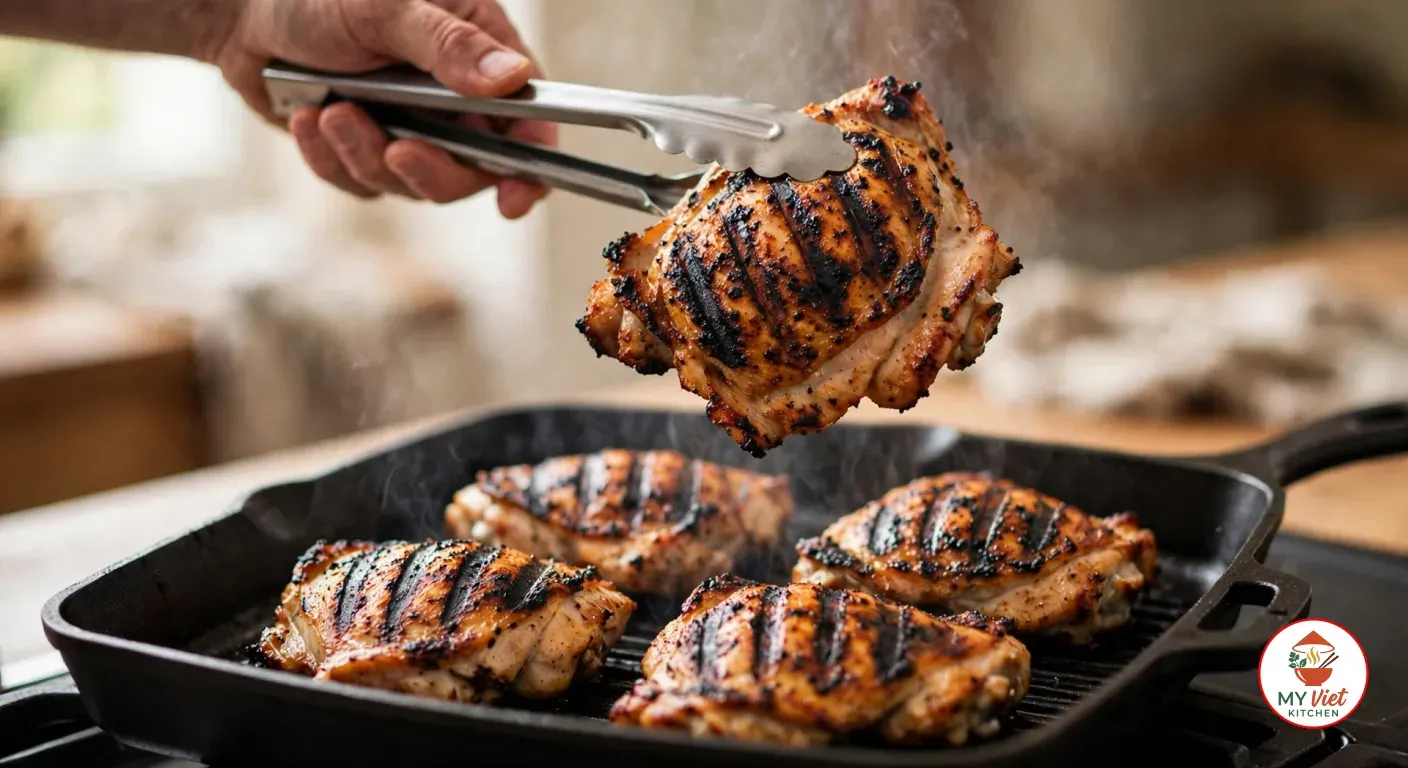
1Heat a charcoal grill, gas grill or ridged cast-iron grill pan over high heat. Charcoal or wood gives the smokiest kelaguen, and it’s how chicken for the dish is traditionally barbecued on Guam. Pat the thighs dry and leave them unseasoned, as Guampedia’s recipe does, because the salt goes in later with the lemon. Oil the grates and lay the thighs on them. Leave them alone for 5 to 7 minutes on each side, until they’re charred in spots and an instant-read thermometer in the thickest part reads 165°F (74°C). Rest the cooked thighs on a clean plate for 5 minutes.
Step 2: Chop the Chicken
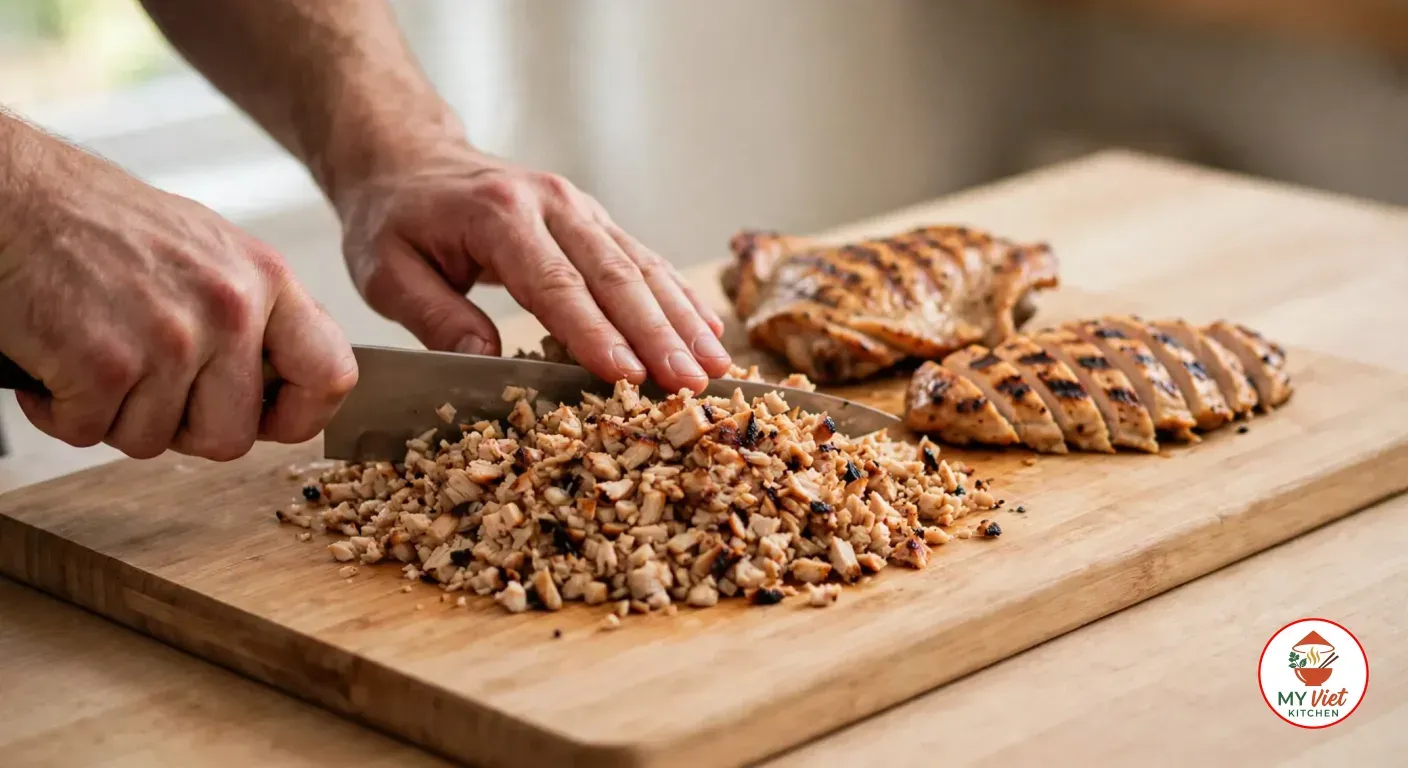
2Move the thighs to a fresh, clean cutting board. Slice each thigh into thin strips, then cut across the strips until the pieces are somewhere between a grain of rice and a small pea, trimming away any gristle as you go. A heavy chef’s knife or a cleaver makes quick work of it. Fine pieces soak up the lemon evenly and hold the coconut, while shreds stay stringy. Scrape the chicken into a large bowl while it’s still warm.
Step 3: Add Lemon Juice and Toss
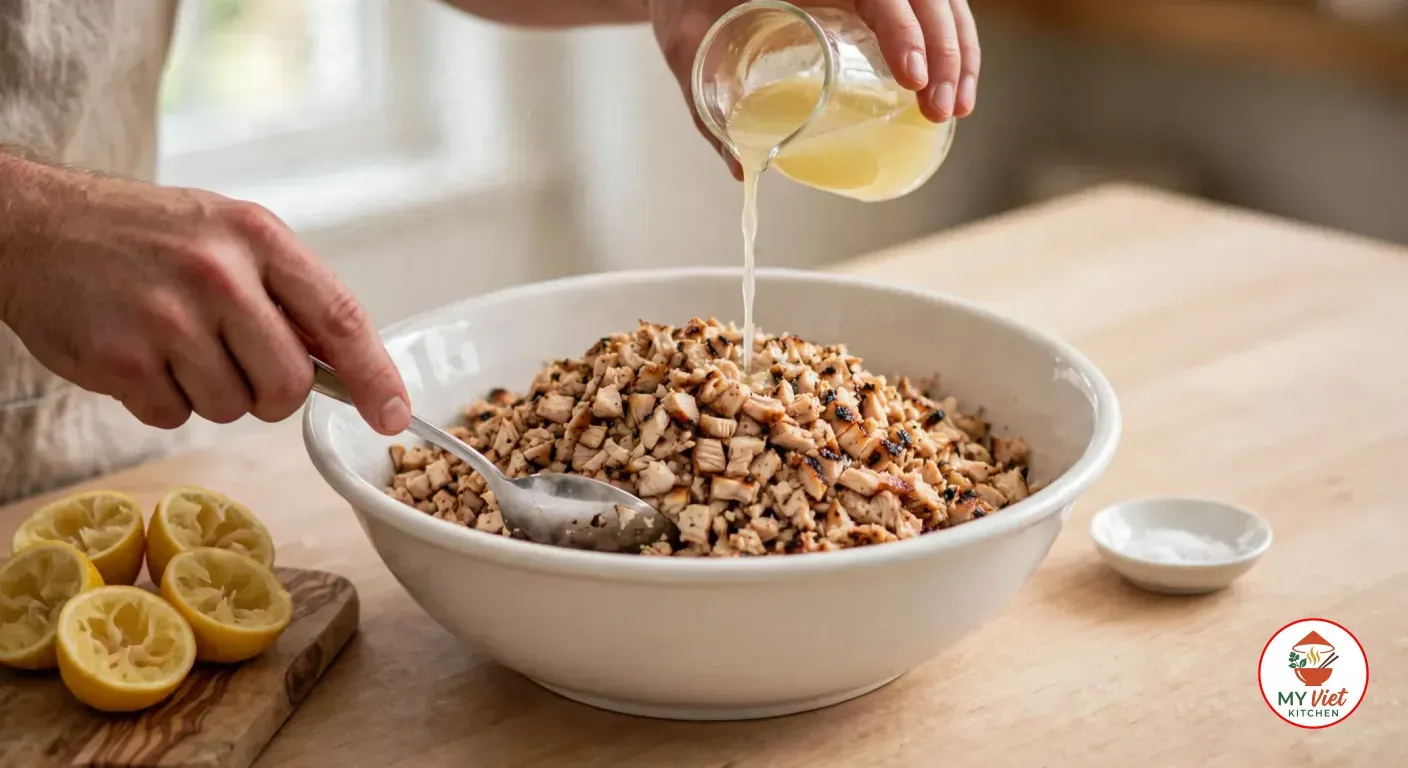
3Pour the lemon juice over the warm chicken, sprinkle in the teaspoon of salt and toss with a large spoon until every piece is wet. Leave it for 5 minutes, giving it one more toss halfway. At this point the chicken should taste sharply of lemon and a little too salty on its own, because the onions and coconut will tame both.
Step 4: Mix in Coconut and Aromatics
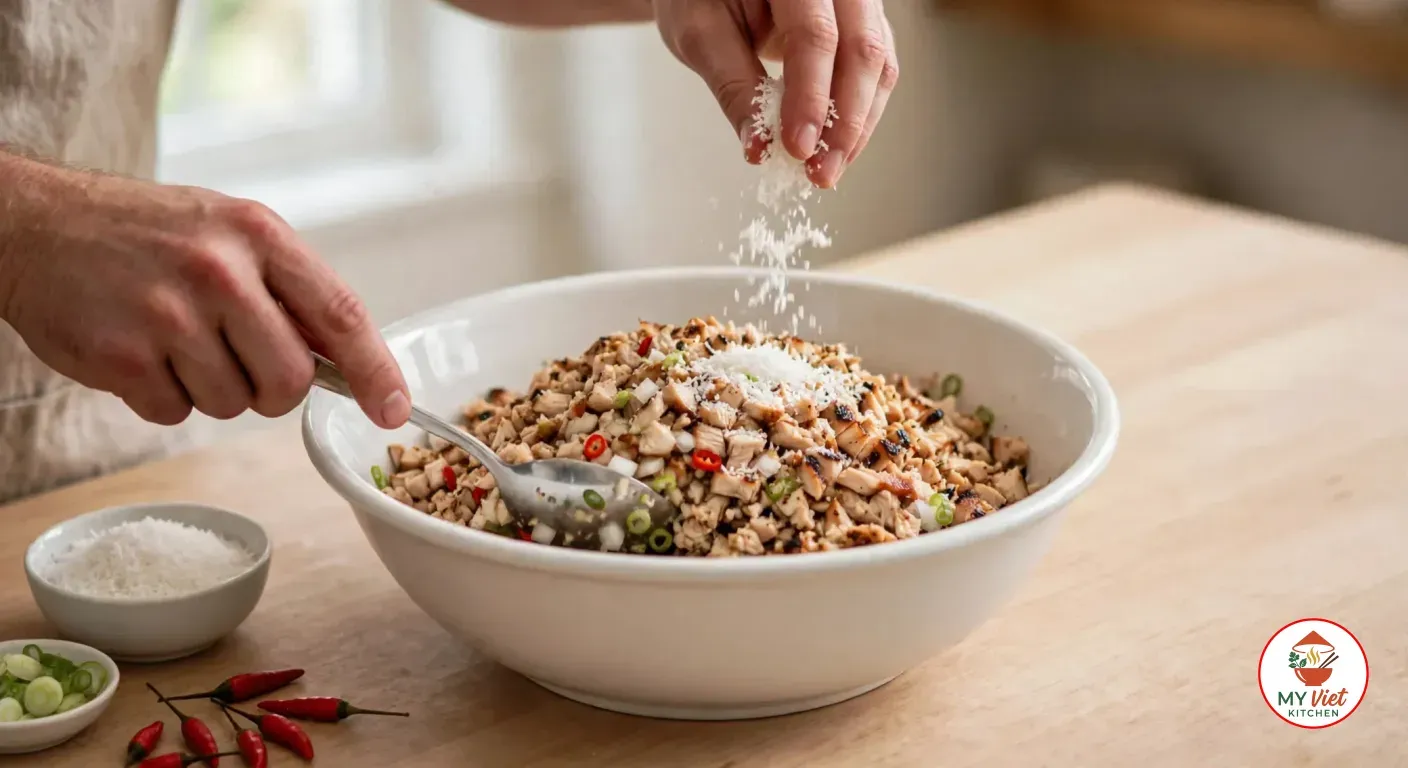
4Add the diced white onions, green onions and chilies and toss them through. Then add the coconut a third at a time, tossing after each addition, until its sweetness rounds off the sourness without hiding it. Taste a spoonful. If it’s flat, add lemon juice a tablespoon at a time; if it’s dull, a pinch of salt; if it’s mild, more chili.
Step 5: Serve
5Serve the kelaguen at room temperature with warm titiyas or flour tortillas for wrapping, or spoon it over a bowl of hot rice. For a deeper flavor, chill the covered bowl for 2 to 3 hours first, then let it stand for 15 minutes before serving. Put any leftovers back in the refrigerator within 2 hours.
Frequently Asked Questions
Can I use rotisserie or boiled chicken?
Yes. Boiling is the other usual way to cook chicken for kelaguen, Guampedia notes, so any fully cooked bird will do (Guampedia). Take off the skin and bones first. A rotisserie bird gives a milder kelaguen without the grill’s char.
Can I use lime juice or lemon powder instead of fresh lemons?
Yes. Lime juice works in the same amount, though the kelaguen tastes a little different. Guam cooks also use lemon powder, and Paula Quinene’s site carries a chicken kelaguen made with it (PaulaQ). Powders vary in strength, so stir in a little at a time and taste before adding more salt.
Can I make chicken kelaguen ahead of time?
Yes, and it gets better. Guampedia notes that kelaguen tastes best after a few hours in the refrigerator, once the flavors have blended (Guampedia). Make it up to a day ahead and keep it covered and cold. The onions soften and the coconut soaks up some of the lemon, so taste it again before serving and add a squeeze of lemon or a pinch of salt.
Is chicken kelaguen gluten-free?
Yes, as written. Chicken, lemon juice, salt, onions, chilies and coconut contain no gluten. Flour titiyas and flour tortillas are made with wheat, though. To keep the plate free of gluten, serve it over rice or with corn titiyas, one of the common kinds on Guam (Guampedia).
Sources
- Kelaguen: Meat, Chicken or Seafood with Lemon, Judy Flores, Guampedia
- Titiyas: Flatbread, Guampedia
- Hale’-ta: CHamoru/Chamorro Cultural Glossary, Guampedia
- Chamorro Chicken Kelaguen, Paula Quinene, PaulaQ.com
- Guam Kitchen: Donne peppers bring heat to Chamorro dishes, Stripes Guam
- Virginia Tech Research Highlights Tinian’s Donne’ Sali, Office of Rep. Kimberlyn King-Hinds, 2026
- Kelaguen, Wikipedia
- Cuisine of the Mariana Islands, Wikipedia
- Chamorro phrasebook, Wikivoyage
- The Science of How Acid “Cooks” Seafood, America’s Test Kitchen
- Chicken and Food Poisoning, Centers for Disease Control and Prevention