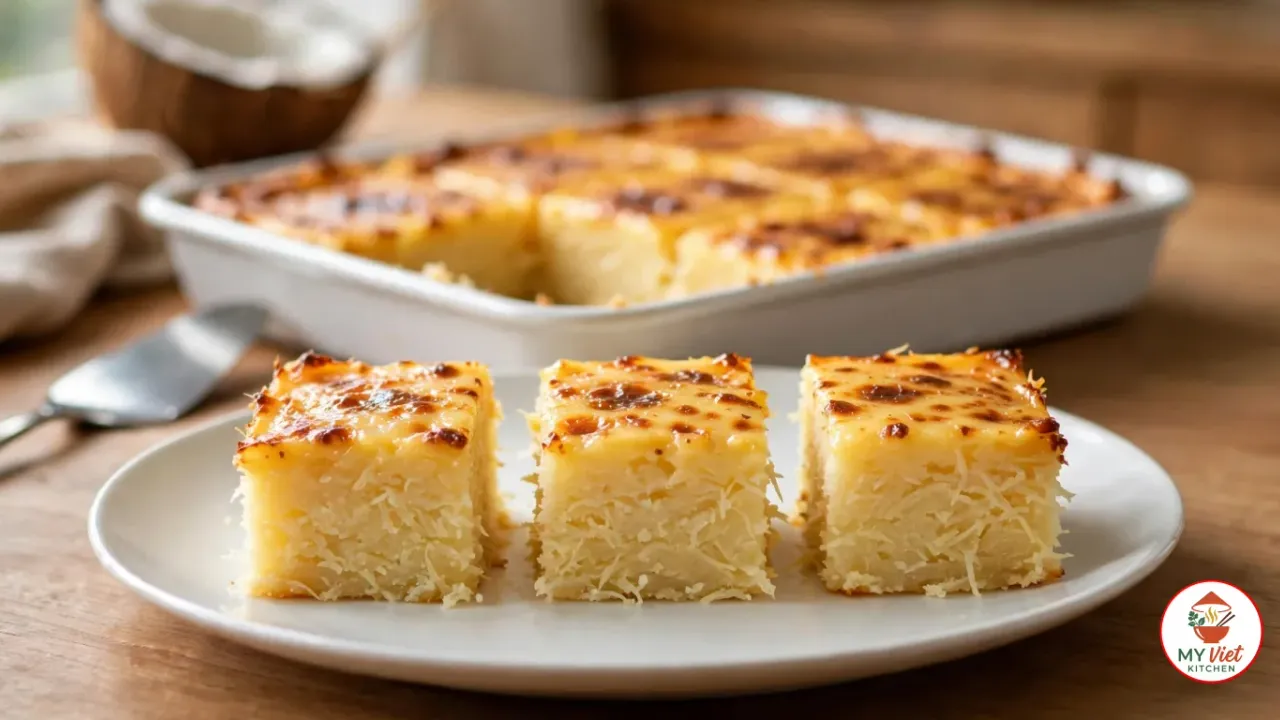
Cassava cake is a dense, chewy dessert of grated cassava baked with coconut milk, sugar and eggs, usually under a thin custard top. It is best known as a Filipino dish, and Pacific bakers make a Fijian version too. This recipe follows the Fijian one. Grated coconut goes into the batter. Before the last bake, the hot cake is pricked with a fork so a custard of egg yolks, condensed milk and coconut cream sinks in.
Prep Time: 30 minutes | Cook Time: 1 hour 20 minutes | Cooling: 1 hour | Servings: 12
Difficulty: Easy | Calories: ~480 per serving

Is Cassava Cake Filipino or Fijian?
Both, in different forms. Wikipedia describes cassava cake as a Filipino moist cake and a kind of bibingka, a family of traditional baked cakes, made with grated cassava in place of ground glutinous rice. Cassava came to the Philippines from Latin America on the Manila galleons, starting no later than the 16th century (Wikipedia). Filipino cooks mix the cassava with coconut milk and condensed milk. A custard of egg yolks, condensed milk and coconut cream goes on top, and the cake bakes again until it sets.
Fiji eats a great deal of cassava as well. Cassava, called tavioka there, has replaced yams as the country’s most grown and most eaten staple (Wikipedia). Cooks turn it into sweets such as vakalolo. In a video for The Coconet, a Pacific media site, Maika boils grated cassava in foil parcels for 45 minutes. The cassava is then kneaded and mixed with a syrup of melted sugar and coconut milk (The Coconet).
The Fijian cassava cake behind this recipe comes from Sweet & Me, a Pasifika-inspired cake shop in Onehunga, Auckland, and the chef Bertrand Jang. Their batter mixes 800 g of cassava with a cup of grated coconut, cornflour and baking powder, and bakes in an 8-inch tin at 160°C for 40 minutes. The baked cake is pricked, covered with egg yolks whisked into condensed milk and coconut cream, and baked for 10 minutes more (NZ Herald; The Coconet).
Here the grated coconut and the forked-in custard stay. The batter skips the cornflour and baking powder, gets its sweetness from brown sugar, and is scaled up for a 9x13-inch dish that cuts into 12 squares.
Is Cassava Safe to Eat?
Yes, once it is peeled and fully cooked. Raw cassava contains cyanogenic glycosides, compounds that can break down and release hydrogen cyanide. Food Standards Australia New Zealand says cassava sold in both countries is safe if prepared properly. Under the Food Standards Code, it must carry a label saying it has to be peeled and fully cooked before eating (FSANZ).
Sweet cassava, the low-cyanide type, is the only kind permitted for sale there (FSANZ survey). Hong Kong’s Centre for Food Safety puts sweet roots below 50 mg of hydrogen cyanide per kilogram and says peeling and thorough cooking generally make them safe. Bitter roots, by contrast, need more extensive processing (Centre for Food Safety). For this cake, that means:
- Peel deep. Take off the brown bark and the pinkish layer under it, and cut out the woody core.
- Throw the juice away. The Tasting Table recipe discards it, noting that raw cassava and its juice can be toxic.
- Don’t taste the raw batter. Bake until the center is firm.
- Treat frozen cassava the same way. The Food Safety Information Council says frozen cassava needs the same thorough cooking as fresh.
Fresh or Frozen Grated Cassava?
Frozen grated cassava, sold in Asian and Pacific grocery stores, skips the peeling and grating. Yasmin Newman’s recipe for SBS Food uses it, thawed before you start. Leave the packs in the fridge overnight, or sink the sealed packs in a bowl of cold water until they soften.
Fresh roots take more work and more weight than you might expect. Tasting Table’s cake starts with 2 pounds of roots and ends up with just over 1 pound of grated cassava once they’re peeled, cored and squeezed. For the 2 pounds (900 g) this recipe needs, buy about 4 pounds (1.8 kg) of roots.
Squeeze either kind gently. Tasting Table presses out only the excess juice, and the shreds should still feel damp when you open the towel. Wrung bone-dry, they leave the batter short of liquid.
Ingredients for Cassava Cake
For the Cake:
- 2 pounds (900 g) grated cassava, fresh or frozen and thawed (about 4 cups)
- 1 cup (80 g) unsweetened grated coconut, fresh, frozen or desiccated
- 1 can (13.5 ounces or 400 ml) full-fat coconut milk
- 1 cup (240 ml) coconut cream
- 3/4 cup (165 g) packed brown sugar
- 1/4 cup (50 g) granulated sugar
- 1/4 cup (57 g) unsalted butter, melted, plus more for the dish
- 3 large eggs, beaten
- 1/2 teaspoon vanilla extract
- 1/4 teaspoon salt
For the Coconut Custard Topping:
- 2 large egg yolks
- 1/2 cup (120 ml) sweetened condensed milk
- 1/2 cup (120 ml) coconut cream
Step-by-Step Instructions
Step 1: Prepare the Cassava
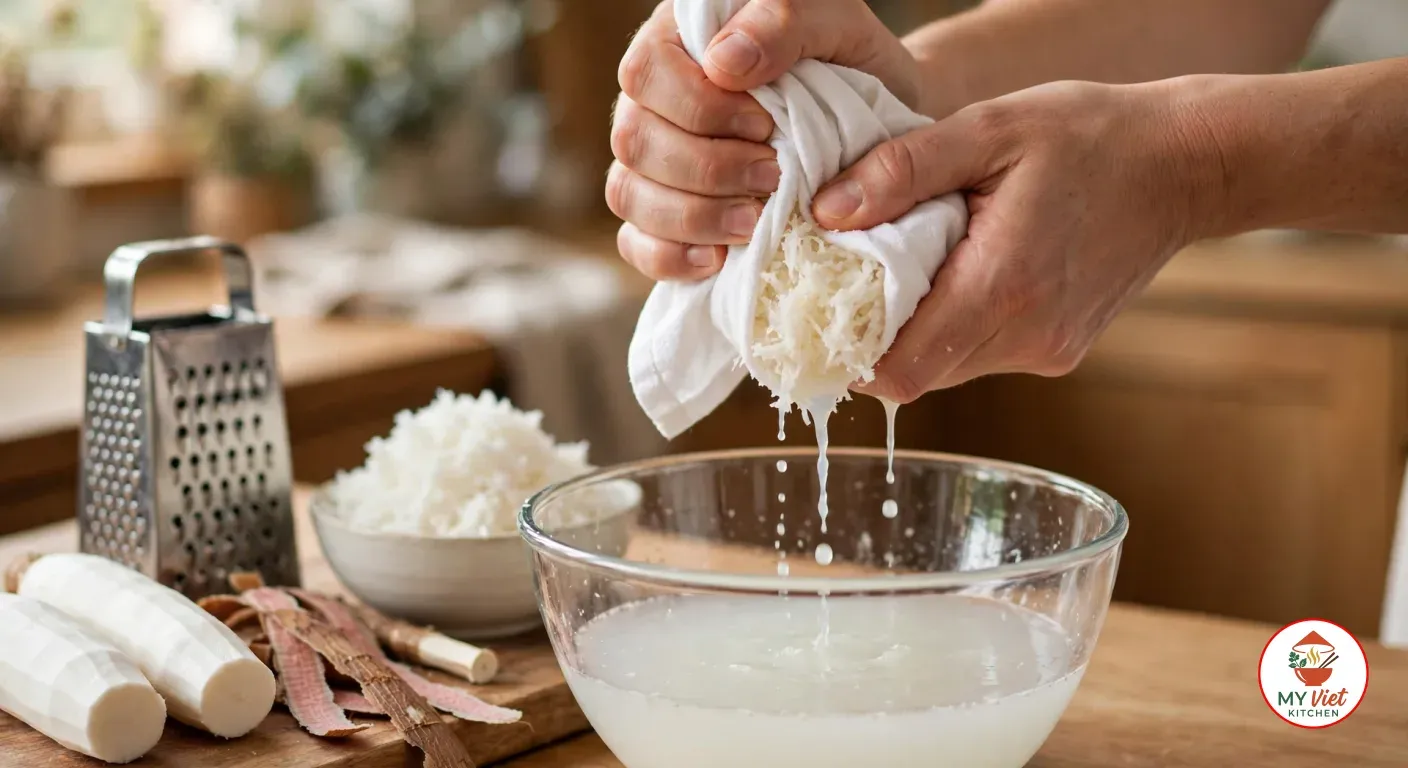
1For fresh cassava, trim both ends and cut the roots into 3-inch (8 cm) lengths. Stand each piece on its end and slice down the sides to remove the brown bark and the pinkish layer beneath it, until only white flesh shows. Quarter the pieces lengthwise and cut away the thin, woody core. Grate the flesh on the fine side of a box grater or with the grating disc of a food processor. For frozen cassava, thaw it completely. Wrap the grated cassava in a clean cotton towel, squeeze it gently over a bowl and discard the juice. You should have about 4 cups (900 g).
Step 2: Mix the Batter
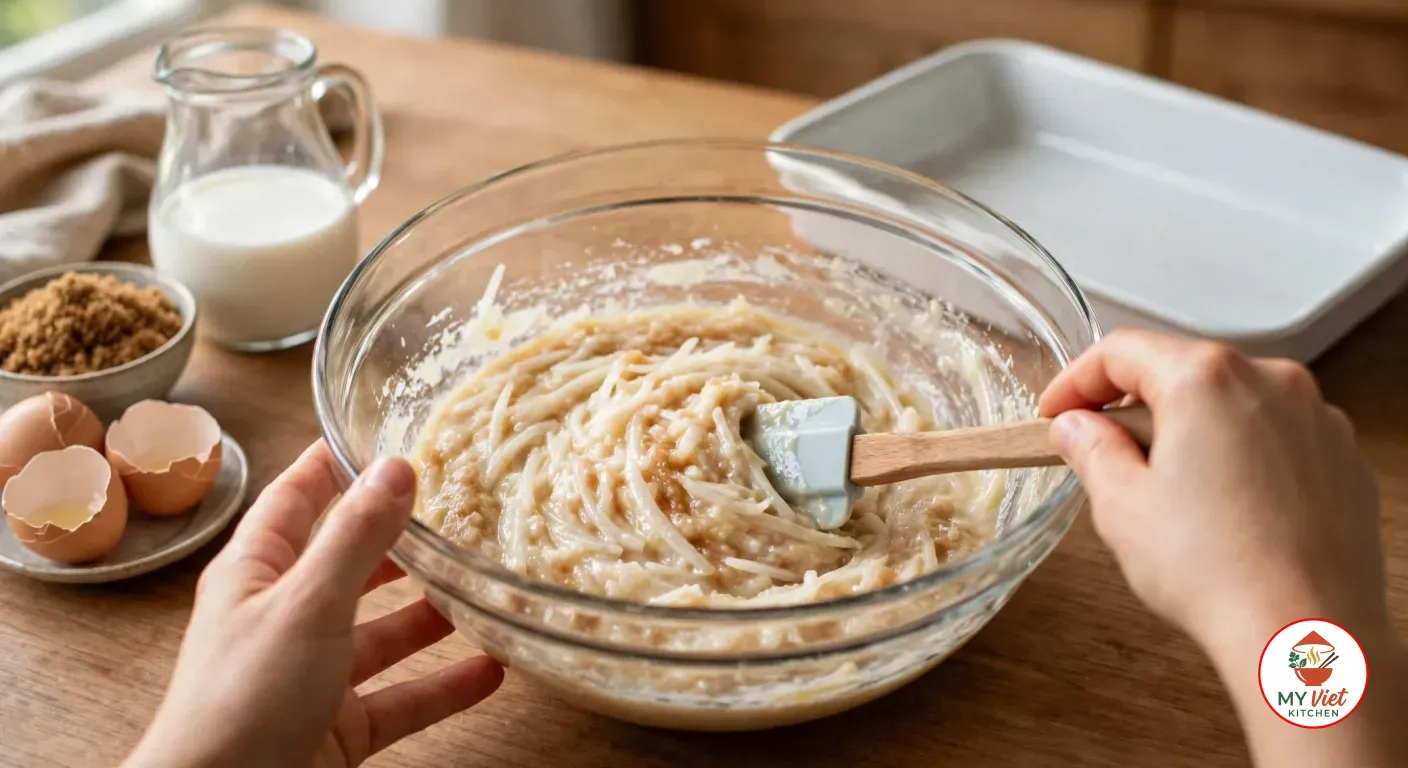
2Heat the oven to 350°F (180°C) and butter a 9x13-inch (23 x 33 cm) baking dish. In a large bowl, whisk the coconut milk, 1 cup of the coconut cream, the brown sugar, granulated sugar, melted butter, eggs, vanilla and salt until the sugar dissolves. Add the grated cassava and the grated coconut and stir until no dry clumps remain. The batter should be loose and wet, closer to thick porridge than to cake batter. Pour it into the dish and smooth the top with the spatula.
Step 3: Bake the Cassava Cake
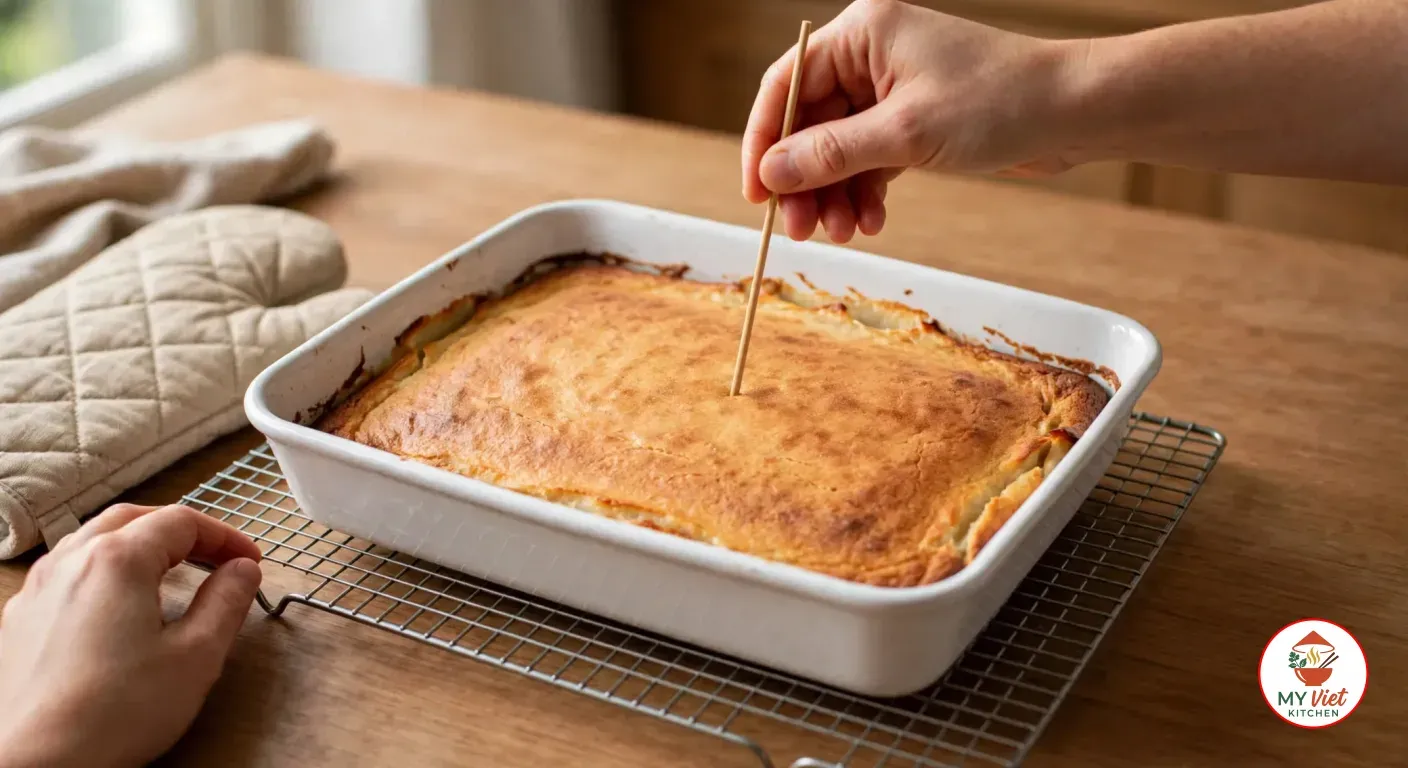
3Bake on the middle rack for 50 to 60 minutes. The cake is ready when the top is golden brown, the edges have pulled away a little from the dish, and a skewer pushed into the center comes out clean. If the middle still looks wet or wobbles when you nudge the dish, give it 5 more minutes and test again. Leave the oven on.
Step 4: Add the Coconut Cream Topping
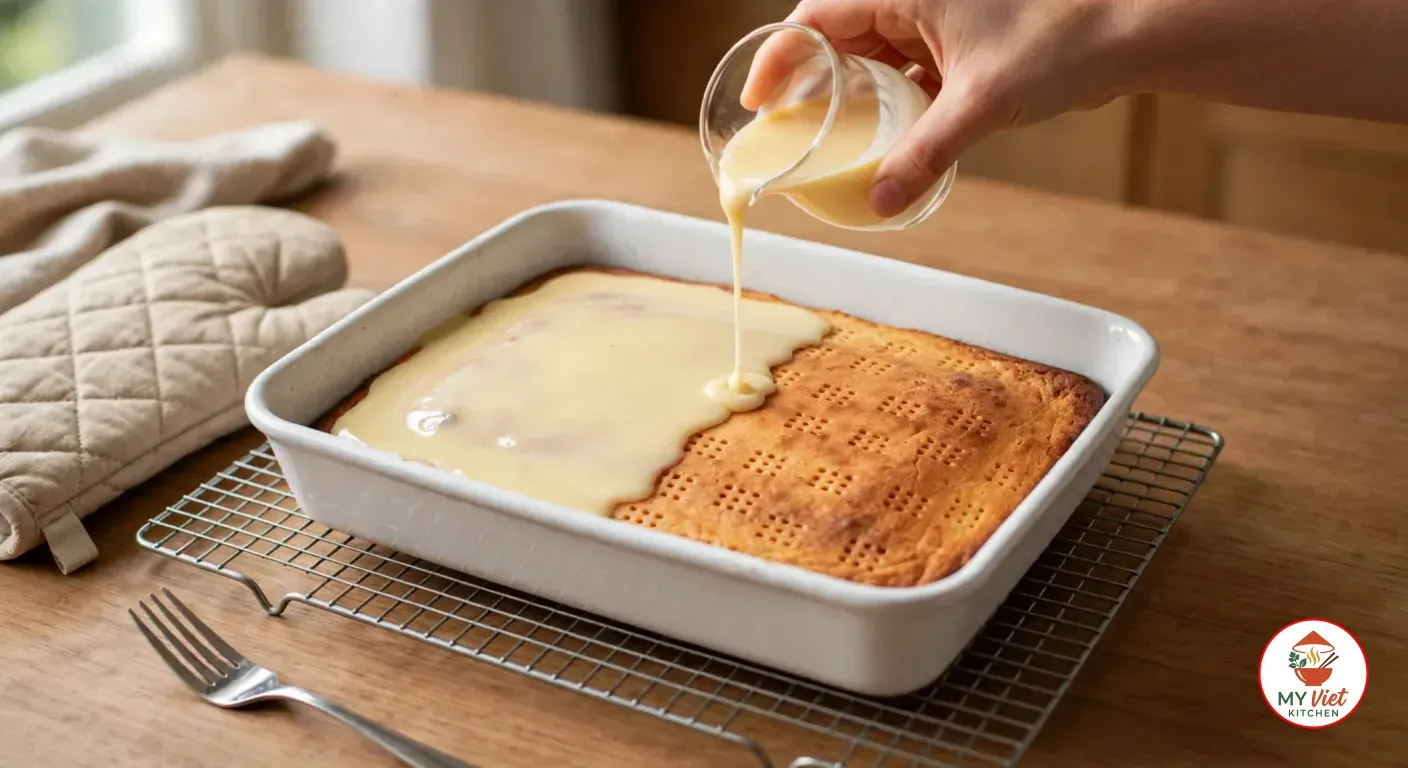
4Whisk the egg yolks, condensed milk and the remaining 1/2 cup of coconut cream until smooth. Prick the hot cake all over with a fork, about every inch, then pour the topping over it and tilt the dish so it reaches the corners. Bake for 10 to 15 minutes, until the topping no longer runs when you tilt the dish. For brown spots, slide the dish under a hot broiler for 2 to 4 minutes and stay with it, because the topping browns fast. Let the cake cool for at least 1 hour, then cut it into 12 squares.
Frequently Asked Questions
Why is my cassava cake gummy in the middle?
It most likely came out of the oven too early or was cut while still warm. A good one is dense and chewy, and Wikipedia notes that more cassava makes it firmer, while less makes it softer and moister. A wet, gluey center is something else. Bake until a skewer comes out clean, then give the cake a full hour on the counter, as the Tasting Table recipe does, before you slice it.
Is cassava cake gluten-free?
This recipe is, because cassava is a root and nothing here contains wheat. Other versions can differ. The topping in Yasmin Newman’s recipe for SBS Food is thickened with 2 tablespoons of plain flour. If you cook for someone with coeliac disease, read the labels on the condensed milk and vanilla as well.
How long does cassava cake keep?
About 4 days in a covered dish in the fridge. With eggs, coconut milk and a custard top, it needs the same care as a custard pie. University of Illinois Extension says custard-based pies shouldn’t sit out of the fridge for more than two hours, and cites USDA for keeping pumpkin pie up to four days chilled. Cut it cold for neat squares, then let them warm up on the counter for 20 minutes.
Can I put cheese on cassava cake?
Yes. That is a Filipino habit rather than a Fijian one. Wikipedia lists cheddar, macapuno (soft coconut strings) and grated coconut among the extras added before the second bake. For this recipe, scatter 1/2 cup (50 g) of finely grated cheddar over the custard just before it goes under the broiler.
Sources
- Cassava cake and Fijian cuisine, Wikipedia
- Bertrand Jang’s Fijian cassava cake, NZ Herald
- How to make Cassava Cake and How to Make Vakalolo, The Coconet
- Cassava cake, Yasmin Newman, SBS Food
- Soft Cassava Cake Recipe, Carlos Leo, Tasting Table
- Cassava and bamboo shoots and Combined survey and risk assessment for cyanogenic glycosides, Food Standards Australia New Zealand
- Cyanide Poisoning and Cassava, Centre for Food Safety, Hong Kong, 2008
- Cassava and bamboo shoots, Food Safety Information Council, 2016
- Do I Need to Refrigerate the Pie?, University of Illinois Extension, 2019