My Viet KitchenMy Viet Kitchen
HomeVietAsianEuropeanAfricanAmericanAustralianAboutContact
More
FAQPrivacy Policy
HomeVietAsianEuropeanAfricanAmericanAustralianAboutContactFAQPrivacy PolicySearch

Follow us

Home › African Dishes › Cape Malay Curry Recipe: South African Aromatic Stew

My Viet Kitchenmyvietkitchen.com/cape-malay-curry-recipe/

Cape Malay Curry Recipe: South African Aromatic Stew

African DishesOctober 8, 20268 min read

Share
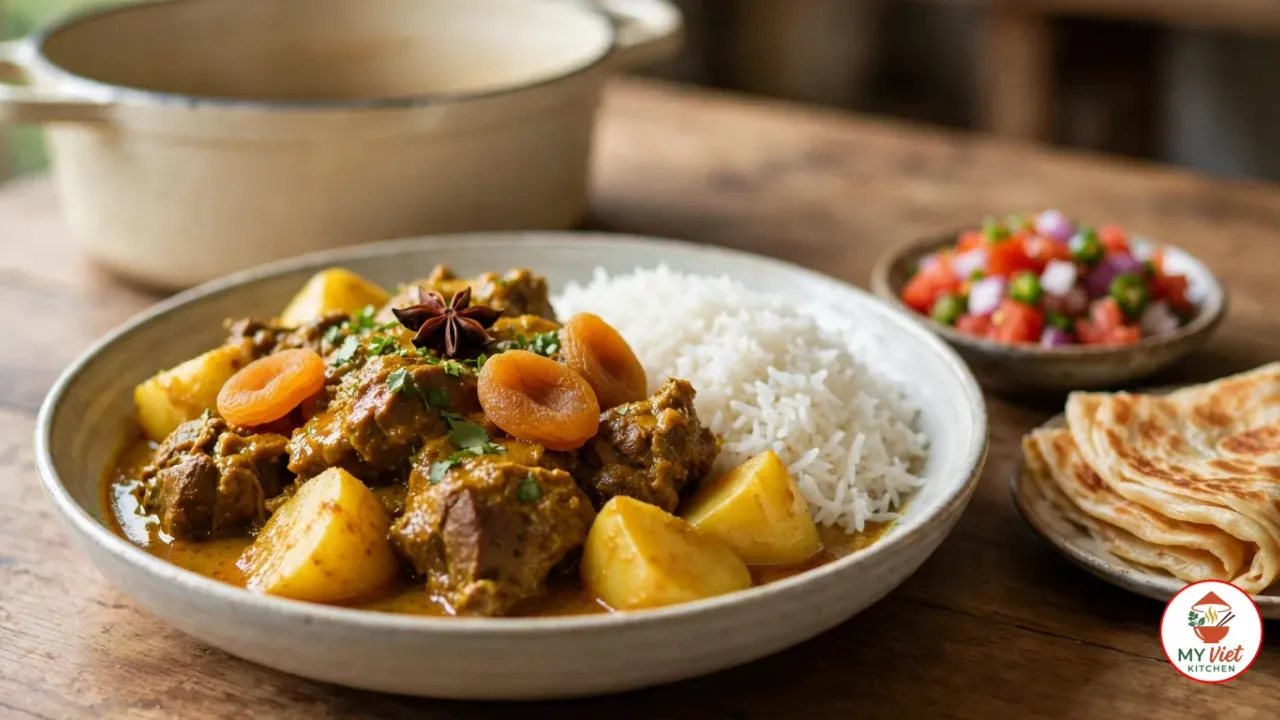
A wide off-white bowl of Cape Malay curry, chunks of lamb and potato in a golden sauce with dried apricot halves, a star anise pod and chopped cilantro beside white basmati rice, with a small bowl of tomato, onion and green chilli sambal, a plate of flaky roti and a cream enamelled cast iron pot on a wooden table

Prep 25 minutesCook 155 minutesTotal 180 minutesYield 6 servings

Ingredients

  • 2 pounds (900 g) boneless lamb shoulder, cut into 1.5-inch (4 cm) cubes
  • 2 tablespoons vegetable oil
  • 2 large onions, finely diced
  • 4 cloves garlic, minced
  • 1 tablespoon grated fresh ginger
  • 2 tablespoons Cape Malay curry powder or another mild curry powder
  • 1 teaspoon ground turmeric
  • 1 teaspoon ground cinnamon
  • 1 teaspoon ground cumin
  • 1 teaspoon ground coriander
  • 4 green cardamom pods, lightly crushed
  • 2 whole star anise
  • 2 bay leaves
  • 1 cinnamon stick
  • 1 can (400 g) diced tomatoes
  • 1 cup (250 ml) beef or lamb stock
  • 1/2 cup (about 75 g) dried apricots, halved
  • 2 tablespoons smooth apricot jam
  • 1 tablespoon brown sugar (optional)
  • 2 medium potatoes, peeled and quartered
  • Juice of 1/2 lemon, to taste
  • Salt and black pepper to taste
  • Fresh cilantro for garnish

Method

  1. Brown the Lamb. Pat the lamb dry and season it with salt and pepper. Heat the oil in a heavy pot over medium-high heat and brown the lamb in 3 batches, about 6 minutes per batch, until browned on all sides. Move it to a plate and keep the browned bits in the pot.
  2. Build the Aromatic Base. Lower the heat to medium and fry the onions in the same pot for 10 to 12 minutes, until golden. Stir in the garlic and ginger for 1 minute, then the curry powder, turmeric, ground cinnamon, cumin and coriander for 2 minutes. Add the cardamom, star anise, bay leaves and cinnamon stick, then the tomatoes and stock, and scrape up the browned bits.
  3. Simmer the Curry with Fruit. Return the lamb and its juices to the pot with the dried apricots, apricot jam and brown sugar, if using. Bring to a gentle simmer, cover and cook on low heat for 1 1/2 hours, stirring every 20 minutes.
  4. Add Potatoes and Finish. Add the potatoes, push them under the sauce, cover and simmer for 30 minutes more, until they are tender and the lamb breaks apart easily. Remove the star anise, bay leaves and cinnamon stick. Season with salt, pepper and lemon juice, garnish with cilantro and serve with rice or roti.

Nutrition 520 calories per serving, protein 30g, fat 30g, carbohydrates 34g, fiber 5g

In this recipe

  1. Where Does Cape Malay Curry Come From?
  2. Should Cape Malay Curry Taste Sweet?
  3. How Is It Different From a Durban Curry?
  4. Ingredients for Cape Malay Curry
  5. Step-by-Step Instructions
  6. Frequently Asked Questions
  7. Sources

Cape Malay curry is a mild, fragrant curry from the Cape Malay community of Cape Town, South Africa. Its warmth comes from cinnamon, cardamom and turmeric rather than chilli heat. This version braises lamb shoulder with tomatoes, dried apricots and a spoonful of apricot jam for 90 minutes, then adds potatoes for the last 30. Plan on 3 hours from start to finish, most of it hands-off simmering.

Prep Time: 25 minutes | Cook Time: 2 hours 35 minutes | Servings: 6

Difficulty: Medium | Calories: ~520 per serving

Where Does Cape Malay Curry Come From?

The Dutch East India Company set up a supply station at the Cape in 1652 and brought in enslaved people and political exiles to work for the settlement. They came from the Dutch East Indies (now Indonesia), India, Sri Lanka and Madagascar, among other places, and many were Muslim (South African History Online). Estimates cited by Wikipedia put Malagasy, Indian, Southeast Asian and continental African captives in roughly equal numbers.

Their mostly Muslim descendants came to be called Cape Malays. The name is misleading, since the community’s roots lie more in Indonesia than in Malaysia, in places such as Aceh, Sulawesi and Java (Daily Maverick). Few of the cooks left written records, so the exact origin of Cape Malay curry, like most of these dishes, is hard to trace.

Enslaved cooks worked with turmeric, cinnamon, cumin, coriander and chilli, and toned down the heat for the households they cooked for (Fine Dining Lovers). Popular Cape Malay curries today include chicken, mutton, beef, crayfish, lentils and beans.

Should Cape Malay Curry Taste Sweet?

Only a little, and not every cook adds fruit. Cape Malay cooking does use sweetness, but sour, tangy and salty flavors balance the sugar, as Nikita Singh wrote in the Mail & Guardian. Dried fruit shows up most clearly in bobotie, which usually includes apricots and raisins or sultanas (Wikipedia). It also goes into blatjang, a chutney of dried fruit, usually apricots, and chillies cooked in vinegar (Dictionary of South African English).

Many curries have no fruit in the pot at all. Cass Abrahams’ Cape Malay lamb curry, published by TASTE, uses lamb, onions, tomato, potatoes and whole and ground spices, with no fruit or sugar.

This Cape Malay curry sits on the sweeter side. The dried apricots soften into the sauce over 90 minutes, and the jam rounds out the tomatoes. Adjust it to your taste:

  • Less sweet: leave out the brown sugar and jam, keep the apricots, and finish with the lemon juice.
  • No fruit: leave out the apricots, jam and sugar, and serve a fruit chutney at the table instead.
  • Before serving: if the sauce tastes flat or cloying, add lemon juice a teaspoon at a time. If it tastes sharp, stir in 1 more teaspoon of jam.

How Is It Different From a Durban Curry?

South Africa’s other well-known curry comes from Durban, on the east coast. Indentured laborers from southern India arrived there between 1860 and 1911, and Durban curry is rich red, slightly oily and very hot (Fine Dining Lovers). A Cape Malay curry is less red and less spicy. According to TASTE, Durban curries lean on curry powder and tomatoes, while Cape Malay curries favor cardamom and cinnamon.

The spices also go in differently. Faldela Tolker, who teaches Cape Malay cooking at her home in Cape Town’s Bo-Kaap neighborhood, showed Milk Street a tin of whole curry leaves, cinnamon, cardamom, fennel and coriander. They simmer whole in the sauce, and most come out before serving. “The spices are the same, but they are used differently,” she said. This recipe uses both kinds: ground spices for color and body, and whole cardamom, star anise and cinnamon that you lift out at the end.

Ingredients for Cape Malay Curry

Main Ingredients:

  • 2 pounds (900 g) boneless lamb shoulder, cut into 1.5-inch (4 cm) cubes
  • 2 tablespoons vegetable oil
  • 2 large onions, finely diced
  • 4 cloves garlic, minced
  • 1 tablespoon grated fresh ginger
  • 2 medium potatoes, peeled and quartered

For the Spice Blend:

  • 2 tablespoons Cape Malay curry powder or another mild curry powder
  • 1 teaspoon ground turmeric
  • 1 teaspoon ground cinnamon
  • 1 teaspoon ground cumin
  • 1 teaspoon ground coriander
  • 4 green cardamom pods, lightly crushed
  • 2 whole star anise
  • 2 bay leaves
  • 1 cinnamon stick

For the Sauce:

  • 1 can (400 g) diced tomatoes
  • 1 cup (250 ml) beef or lamb stock
  • 1/2 cup (about 75 g) dried apricots, halved
  • 2 tablespoons smooth apricot jam
  • 1 tablespoon brown sugar (optional)
  • Juice of 1/2 lemon, to taste
  • Salt and black pepper to taste
  • Fresh cilantro for garnish

Step-by-Step Instructions


Step 1: Brown the Lamb

1Pat the lamb cubes dry with paper towels and season them with salt and pepper. Heat the oil in a 5-quart (5-litre) Dutch oven or other heavy pot over medium-high heat. Brown the lamb in 3 batches, leaving space between the cubes, for about 6 minutes per batch. Turn the cubes until every side has a deep brown crust, since crowded meat steams instead of browning. Move each batch to a plate as it finishes, and leave the browned bits in the pot.
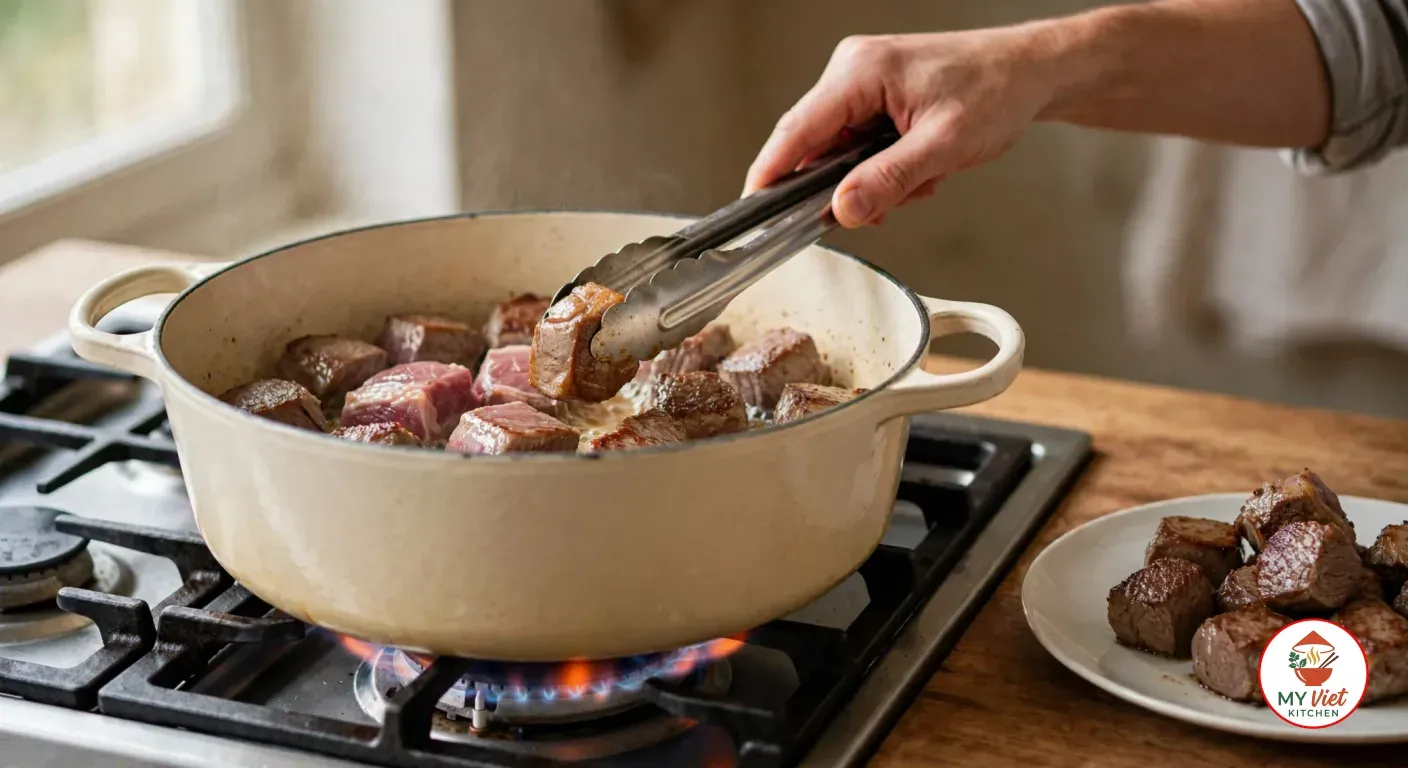
Turning a cube of lamb with stainless steel tongs in a cream enamelled cast iron pot of browning lamb over a gas flame, with a white plate of browned lamb cubes on the wooden counter beside the stove
Step 1- Brown the Lamb

Step 2: Build the Aromatic Base

2Lower the heat to medium and add the onions to the same pot. Fry them for 10 to 12 minutes, stirring often, until soft and golden. Their moisture loosens the browned bits from the bottom. Add the garlic and ginger and stir for 1 minute. Add the curry powder, turmeric, ground cinnamon, cumin and coriander, and stir for 2 minutes, adding a splash of water if the spices start to stick. Drop in the cardamom pods, star anise, bay leaves and cinnamon stick. Pour in the tomatoes and stock, and scrape the bottom of the pot clean.
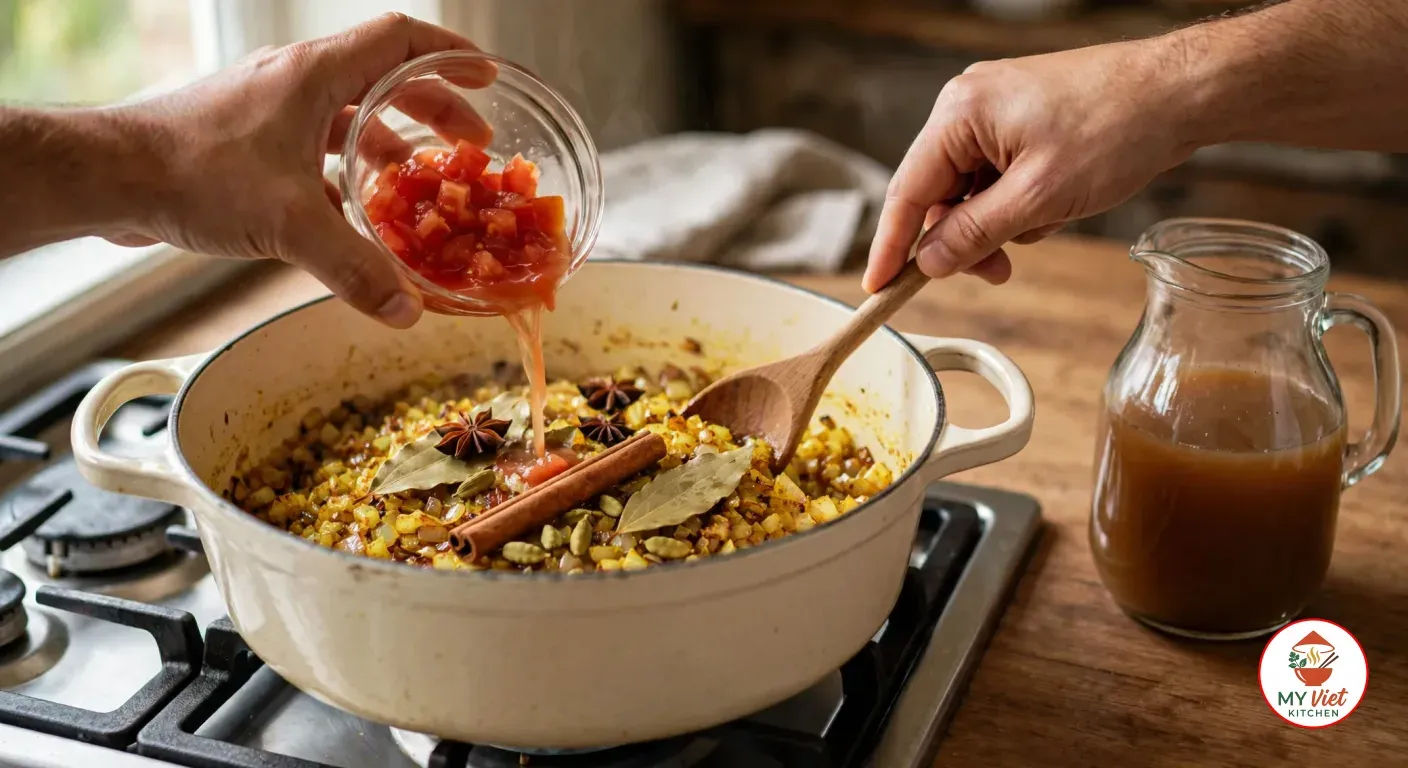
Tipping a glass bowl of diced tomatoes into a cream enamelled cast iron pot of golden spiced onions with a cinnamon stick, star anise, bay leaves and cardamom pods, stirred with a wooden spoon, beside a glass jug of stock
Step 2- Build the Aromatic Base

Step 3: Simmer the Curry with Fruit

3Return the lamb and its juices to the pot. Add the dried apricots, the apricot jam and the brown sugar, if using, and stir until the jam melts into the sauce. Bring it to a gentle simmer, then cover the pot and turn the heat to low. Cook for 1 1/2 hours, stirring every 20 minutes and scraping the bottom. The sauce should barely bubble. If it gets thick before the lamb is tender, add 1/4 cup (60 ml) of stock or water.
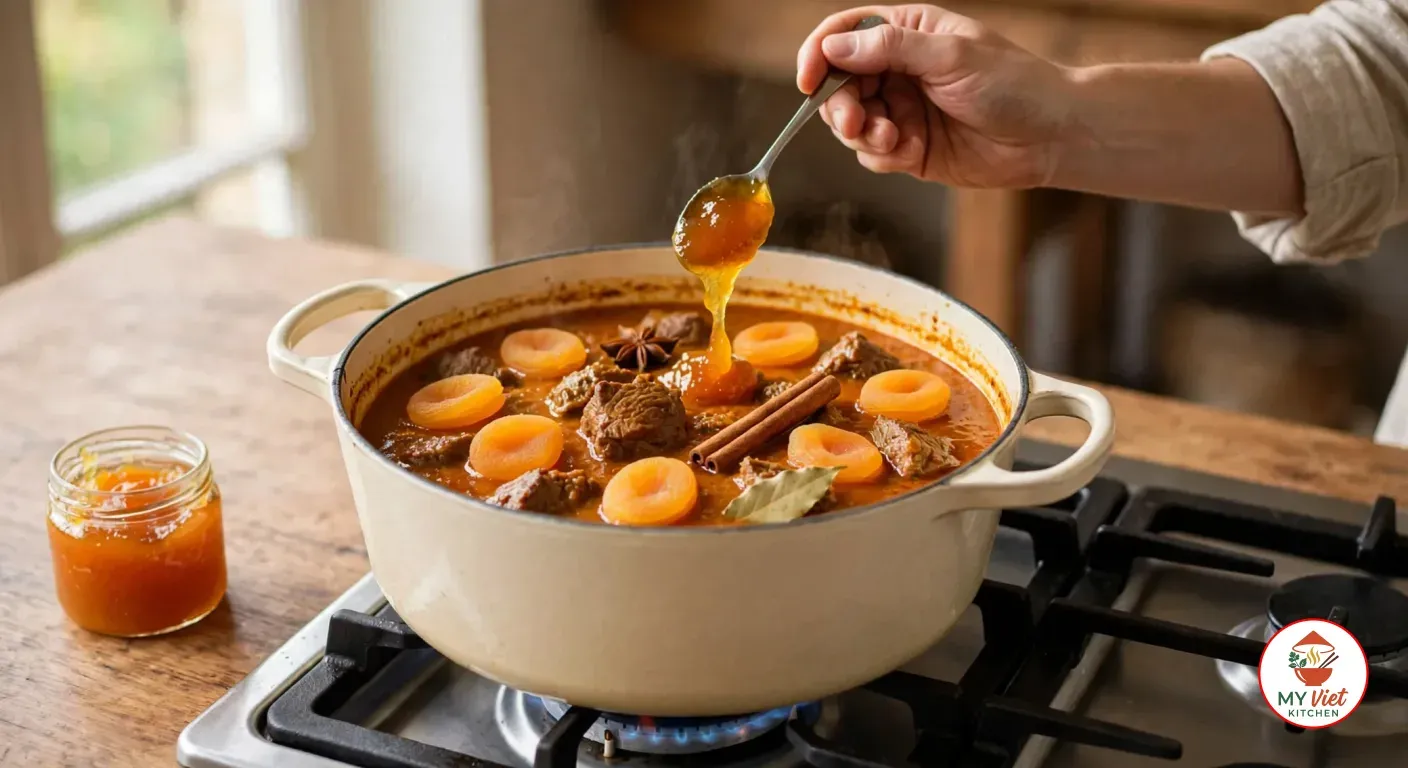
Dropping a spoonful of apricot jam into a cream enamelled cast iron pot of browned lamb simmering in tomato curry sauce with dried apricot halves, a cinnamon stick, a star anise pod and a bay leaf, beside an open jar of jam on the counter
Step 3- Simmer the Curry with Fruit

Step 4: Add Potatoes and Finish

4Add the potatoes and push them down so the sauce mostly covers them. Cover and simmer for 30 minutes more, until a knife slides into a potato easily and the lamb breaks apart under a spoon. Lift out the star anise, bay leaves and cinnamon stick, and the cardamom pods if you can find them. Taste, then season with salt, pepper and lemon juice. Scatter cilantro over the top and serve with rice or roti.
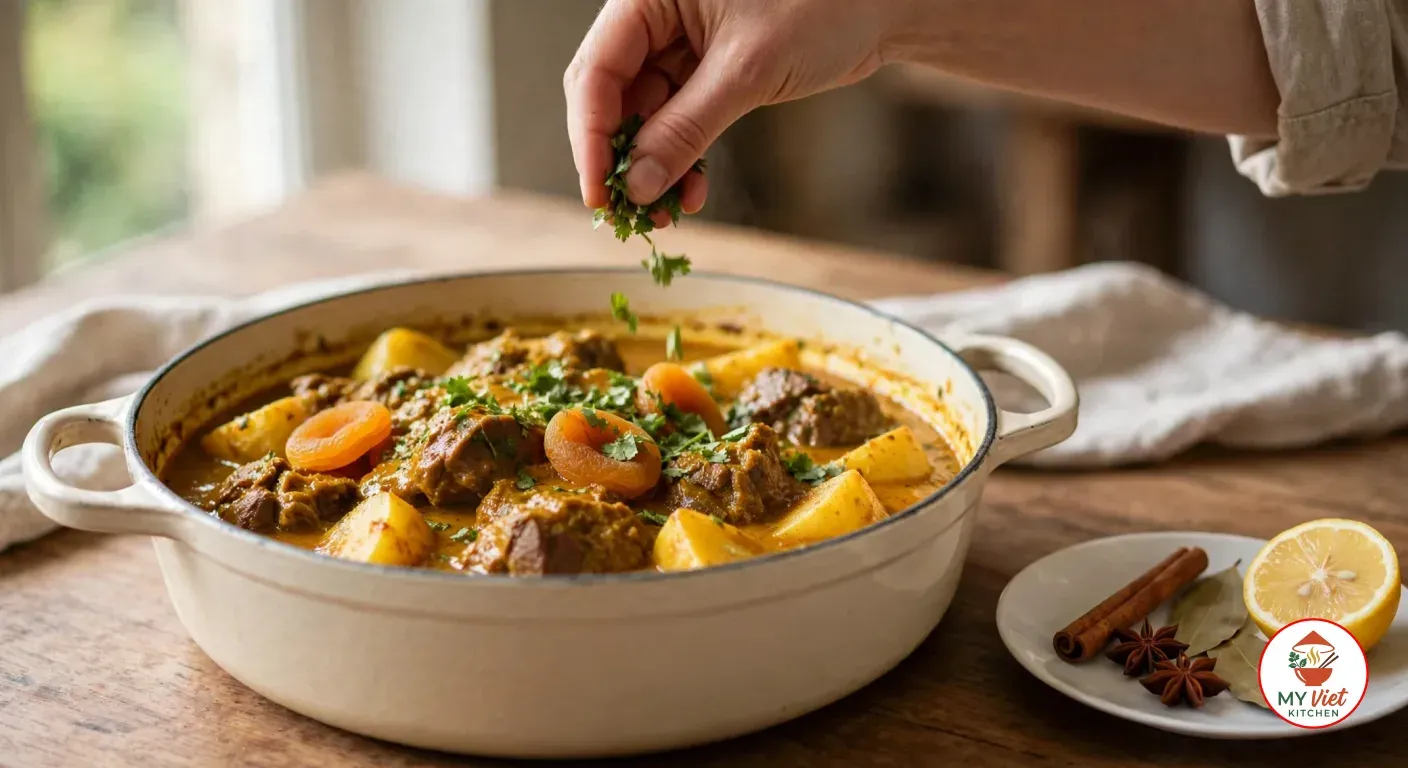
Scattering chopped cilantro over finished Cape Malay curry with lamb, potatoes and dried apricots in a cream enamelled cast iron pot, beside a saucer holding the removed cinnamon sticks, star anise and bay leaves and half a lemon
Step 4- Add Potatoes and Finish

Frequently Asked Questions

Can I make Cape Malay curry with chicken?

Yes. Use 8 bone-in chicken thighs (about 2 pounds or 1 kg) instead of the lamb, and brown them skin side down for 5 to 6 minutes. Build the sauce as in step 2, then return the chicken with the fruit and add the potatoes at the same time. Cover and cook for 40 to 45 minutes. It is done when a knife slides into the potatoes and the thickest thigh reads 165°F (74°C) near the bone.

What can I use instead of Cape Malay curry powder?

Any mild yellow curry powder works. To mix your own, combine 2 tablespoons ground coriander with 1 tablespoon each of ground cumin and turmeric. Add 1 teaspoon each of ground cinnamon, ginger and fennel, 1/2 teaspoon ground cardamom and 1/4 teaspoon ground cloves. Use 2 tablespoons in the recipe and keep the rest in a closed jar.

What do you serve with Cape Malay curry?

Serve Cape Malay curry with white rice or roti, and sambals on the side. Cass Abrahams’ lamb curry on TASTE suggests jasmine rice or rotis and a selection of sambals. In the video above, Fatima Sydow serves hers with flaky roti and slaai, a salad. A spoonful of fruit chutney suits it too.

How long does Cape Malay curry keep?

Three to four days in the fridge, per USDA guidance on leftovers, as long as the curry goes in within 2 hours of cooking. To freeze some, set that portion aside before the potatoes go in, since they turn soft and grainy in the freezer. The lamb and sauce keep their best quality for 3 to 4 months. Reheat it gently with a splash of water until it steams.

Sources

  • The Cape Malay, South African History Online
  • Cape Malays and Bobotie, Wikipedia
  • The complex history of Cape Muslim cuisine, Daily Maverick, 2020
  • Curry traditions across South Africa, Fine Dining Lovers, 2017
  • Spices beyond Cape Malay, Mail & Guardian, 2019
  • Cass Abrahams’ Cape Malay lamb curry and How to make South African curry, TASTE
  • Cape Malay Chicken Curry, Milk Street, 2017
  • Blatjang, Dictionary of South African English
  • Leftovers and Food Safety, USDA Food Safety and Inspection Service
Love This Recipe?

Click on a star to rate it!

☆☆☆☆☆No votes so far! Be the first to rate this recipe.

Share

Tags: Cape Malay recipeSouth African foodSouth African cuisineCape Malay cookingSouth African currycape malay currycape malay curry recipeCape Town foodAfrican curryfruity currylamb curryaromatic curry

A wide shallow white bowl of butter chicken, chunks of chicken thigh with charred edges in a smooth orange-red tomato and butter sauce with a swirl of cream and cilantro leaves, beside torn charred naan, a bowl of basmati rice, green cardamom pods and a cinnamon stick on a rustic wooden table← PreviousButter Chicken (Murgh Makhani): Easy Indian RecipeNext →Calulu Recipe: Angola's Dried Fish StewA white plate of calulu with a browned fish steak, whole okra pods, cubes of orange sweet potato, rounds of zucchini, dark leafy greens, tomato and onion in orange-red palm oil sauce beside a mound of white funge, with a dark grey pot of the stew and a bowl of beans in palm oil behind it on a wooden table

More African Dishes

A white plate of calulu with a browned fish steak, whole okra pods, cubes of orange sweet potato, rounds of zucchini, dark leafy greens, tomato and onion in orange-red palm oil sauce beside a mound of white funge, with a dark grey pot of the stew and a bowl of beans in palm oil behind it on a wooden table
African Dishes

Calulu Recipe: Angola's Dried Fish Stew

October 8, 2026

A deep off-white bowl of cachupa, puffed white corn kernels, red kidney beans and pale lima beans in a thick golden-brown broth with shredded braised pork, rounds of linguiça, a slice of pork belly, potato, orange sweet potato and squash and a wedge of soft cabbage, with a spoon, a small dish of hot sauce and a stainless steel stockpot on a wooden table
African Dishes

Cachupa Recipe: Cape Verde's Hearty Stew

October 7, 2026

Five Rwandan goat brochettes on a long oval white platter on a rustic wooden table, charcoal-grilled cubes of meat with charred edges threaded on wooden skewers between chunks of white onion and red and green bell pepper, with a bowl of pilipili of chopped red chili and onion, a bowl of thick-cut fried potatoes, a bowl of shredded cabbage and carrot salad and half a lemon beside it
African Dishes

Brochettes: Rwandan Grilled Meat Skewers Recipe

October 5, 2026

Recent recipes

  • Glossy koala-shaped milk chocolates standing on a small wooden board, one broken open with golden caramel flowing out onto the table, in front of a grey silicone koala mold and a glass jar of caramelHomemade Caramello Koala: Iconic Australian Chocolate RecipeOctober 9, 2026
  • Three squares of cassava cake with a golden, brown-spotted custard top on a white plate, in front of the rest of the cake in a white rectangular baking dish, with a cake server, half a coconut and a linen napkin on a wooden tableCassava Cake: Fiji-Style Coconut Cassava Dessert RecipeOctober 9, 2026
  • A white plate of calulu with a browned fish steak, whole okra pods, cubes of orange sweet potato, rounds of zucchini, dark leafy greens, tomato and onion in orange-red palm oil sauce beside a mound of white funge, with a dark grey pot of the stew and a bowl of beans in palm oil behind it on a wooden tableCalulu Recipe: Angola's Dried Fish StewOctober 8, 2026
  • A wide shallow white bowl of butter chicken, chunks of chicken thigh with charred edges in a smooth orange-red tomato and butter sauce with a swirl of cream and cilantro leaves, beside torn charred naan, a bowl of basmati rice, green cardamom pods and a cinnamon stick on a rustic wooden tableButter Chicken (Murgh Makhani): Easy Indian RecipeOctober 7, 2026

Follow us

Where shall we eat today?

  • Vietnamese
  • Asian
  • European
  • African
  • Americas
  • Australia
  • Drinks
  • Surprise me

Recently updated

  • Homemade Caramello Koala: Iconic Australian Chocolate Recipe
  • Cassava Cake: Fiji-Style Coconut Cassava Dessert Recipe
  • Calulu Recipe: Angola's Dried Fish Stew
  • Cape Malay Curry Recipe: South African Aromatic Stew
  • Butter Chicken (Murgh Makhani): Easy Indian Recipe

Categories

  • Vietnamese Dishes
  • Asian Dishes
  • European Dishes
  • African Dishes
  • American Dishes
  • Australian Dishes
  • Beverages

Pages

  • About Us
  • Contact Us
  • FAQ
  • Privacy Policy
  • RSS

Tags

European dishescomfort foodAfrican recipesLatin American foodSouth American foodEast African foodCaribbean cuisineWest African recipesAfrican dishesEastern European foodMexican foodSouth African foodvietnamese cuisineFrench cuisineAsian recipesAustralian cuisineBalkan foodCaribbean foodeasy dinner recipeItalian cookingMexican cuisinePeruvian foodBalkan cuisinefamily dinnerisland foodLatin American recipesNorth African recipessummer grillingAuthentic Vietnameseeasy Vietnamese recipes

All tags

Follow us
© 2026 My Viet KitchenAuthentic Vietnamese flavors, made simple