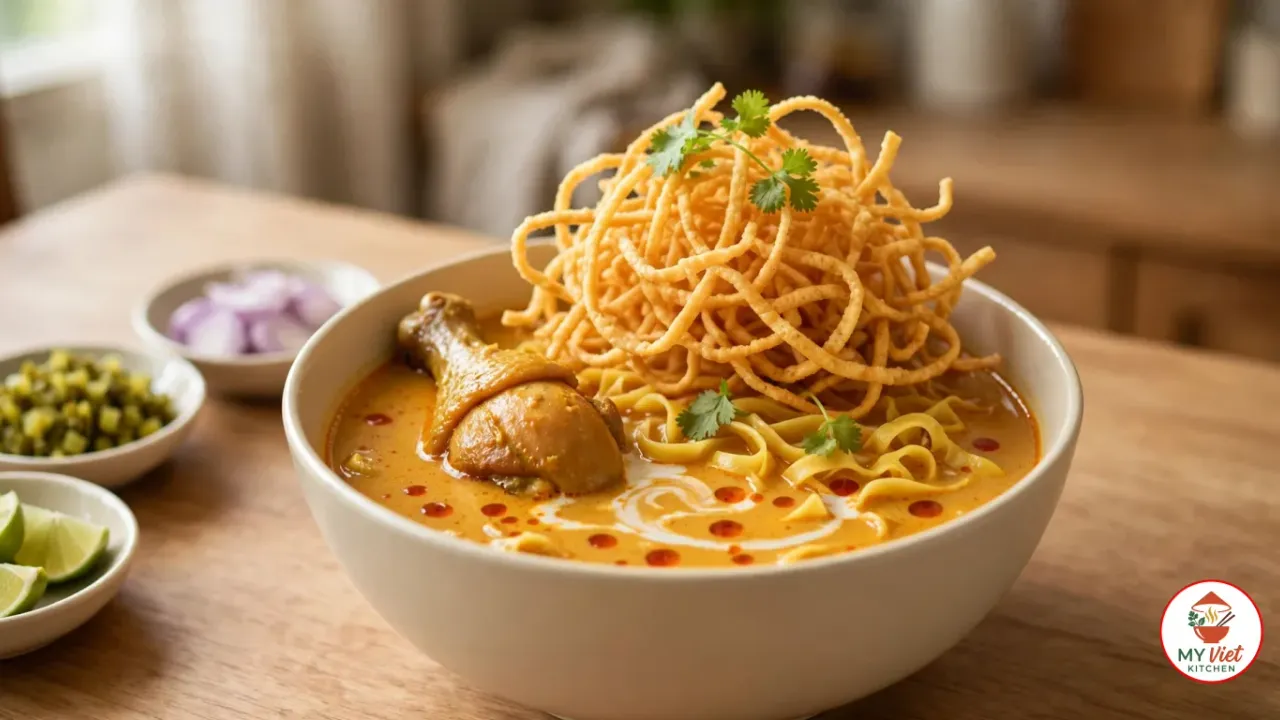
Khao soi (ข้าวซอย) is a Northern Thai dish of wheat egg noodles in coconut milk curry, usually served with chicken or beef, and it is widely regarded as the most famous dish of Chiang Mai (Wikipedia). Each bowl of khao soi holds the same noodle twice, boiled in the curry and deep-fried on top. Here a small batch of black cardamom and turmeric paste seasons chicken drumsticks that simmer until fork-tender.
Prep Time: 30 minutes | Cook Time: 55 minutes | Total Time: 1 hour 25 minutes | Servings: 4
Difficulty: Medium | Calories: ~900 per serving

Where Did Khao Soi Come From?
Its strongest influence is usually credited to the Chin Ho, Yunnanese Chinese Muslims whose trading caravans reached northern Thailand every cool, dry season by the 19th century (Wikipedia). In 1915 the ruler of Chiang Mai allowed them to settle and work in the city, and some opened shops selling the dish with freshly made noodles. It was originally halal (Wikipedia).
Early khao soi may have looked quite different. Journalist Robyn Eckhardt collected family histories from two Chiang Mai shops. At Suthasinee, a Chin Ho trader’s son and his wife replaced the rice-flour noodles of the father’s clear soup with egg noodles, then added curry paste and coconut milk. The founder of Khao Soi Lamduan Faham learned from a Chin Ho cook who used hand-cut, turmeric-colored rice-flour noodles, and moved to egg noodles and curry paste to suit the northern taste for spicy food (Wikipedia).
Coconut milk is the open question, since it is rare in northern Thai cooking. Chef Andy Ricker suggests it may have come from Burma, while a Chiang Mai University graduate student who researched the dish suggested that Khao Soi Lamduan Faham added it to please early customers, government officials from Bangkok (Wikipedia). Chiang Mai chef Phubase Chuprakong sums up the blend for SBS Food as “the curry from Muslim [culture] with the noodles from the Chinese” (SBS Food).
The name is tied to the noodles. Before machines, cooks rolled the dough into flat sheets and cut (soi) them into strips by knife. Writer Austin Bush has floated another idea, that it grew out of hkauk-hswe, the Shan term for noodles used across Myanmar, and admits this is speculation (Wikipedia).
What Goes in Khao Soi Curry Paste?
A typical paste holds dried chilies, shallots, garlic, ginger, fresh turmeric and coriander root, with dried spices such as black cardamom (cha kho in Thai), coriander seed and curry powder. Lemongrass, galangal, cumin and shrimp paste turn up only in some recipes (Wikipedia).
The paste below is based on the one Not Quite Nigella adapted from chef Sujet Saenkham of Spice I Am, which keeps lemongrass but skips galangal and shrimp paste (Not Quite Nigella). That full quantity fills three batches, so the amounts here are cut to one, with extra shallot to give the pestle more to work on.
No time to pound? Pailin Chongchitnant’s weeknight version in the cookbook Sabai starts with 1/4 cup of red curry paste, bought or pounded ahead, mixed with turmeric and curry powder, and simmers 2 cracked black cardamom pods in the broth (CBC Life).
How Thick Should the Broth Be?
Northern Thailand has no single answer. The Chiang Mai style has a thick, strongly flavored curry, the style from Fang District has a lighter broth, and Ricker observes that almost every restaurant varies its paste, coconut milk, cream and sweetness (Wikipedia).
This recipe sits between them, with one can of coconut milk to 2 1/2 cups of stock. Chongchitnant’s is thinner, 1 1/2 cups of coconut milk to 3 cups of water, yet the recipe still calls it a rich broth and ladles only about 1 cup per serving (CBC Life). For a heavier Chiang Mai bowl, replace 1 cup of the stock with more coconut milk.
Seasoning continues at the table, where diners adjust their own bowls with pickled mustard greens, shallots, lime and roasted chili paste (Wikipedia). The chili here is Chongchitnant’s quick stand-in: flakes cooked in a little oil until dark and smoky (CBC Life).
Ingredients for Khao Soi
For the Curry Paste:
- 4 dried red chilies
- 1 black cardamom pod, seeds only
- 2 teaspoons coriander seeds
- 2 teaspoons curry powder
- 1/2 teaspoon salt
- 1 lemongrass stalk, tender lower part only, thinly sliced
- 1-inch (2.5 cm) piece ginger, peeled and sliced
- 1-inch (2.5 cm) piece fresh turmeric, peeled and sliced, or 1/2 teaspoon ground
- 1 medium shallot, chopped
- 2 garlic cloves, chopped
For the Curry:
- 1 can (400 ml) full-fat coconut milk, not shaken
- 800 g (1 3/4 lb) bone-in chicken drumsticks or thighs
- 2 1/2 cups (600 ml) low-sodium chicken stock
- 1 tablespoon palm sugar or brown sugar
- 1 tablespoon fish sauce, plus more to taste
- 1 tablespoon soy sauce, plus more to taste
For the Noodles:
- 400 g (14 oz) fresh flat egg noodles
- 2 cups (480 ml) neutral oil, for frying
To Serve:
- 1/4 cup (60 ml) coconut cream
- 1/2 cup (75 g) chopped pickled mustard greens, rinsed
- 1/4 cup (35 g) thinly sliced shallots
- 4 lime wedges
- 1 handful cilantro leaves
- 2 tablespoons chili flakes
- 1 tablespoon neutral oil, for the chili flakes
You also need a mortar and pestle, a large stockpot, a small deep saucepan, a wire skimmer and a kitchen thermometer.
Step-by-Step Instructions
Step 1: Pound the Curry Paste
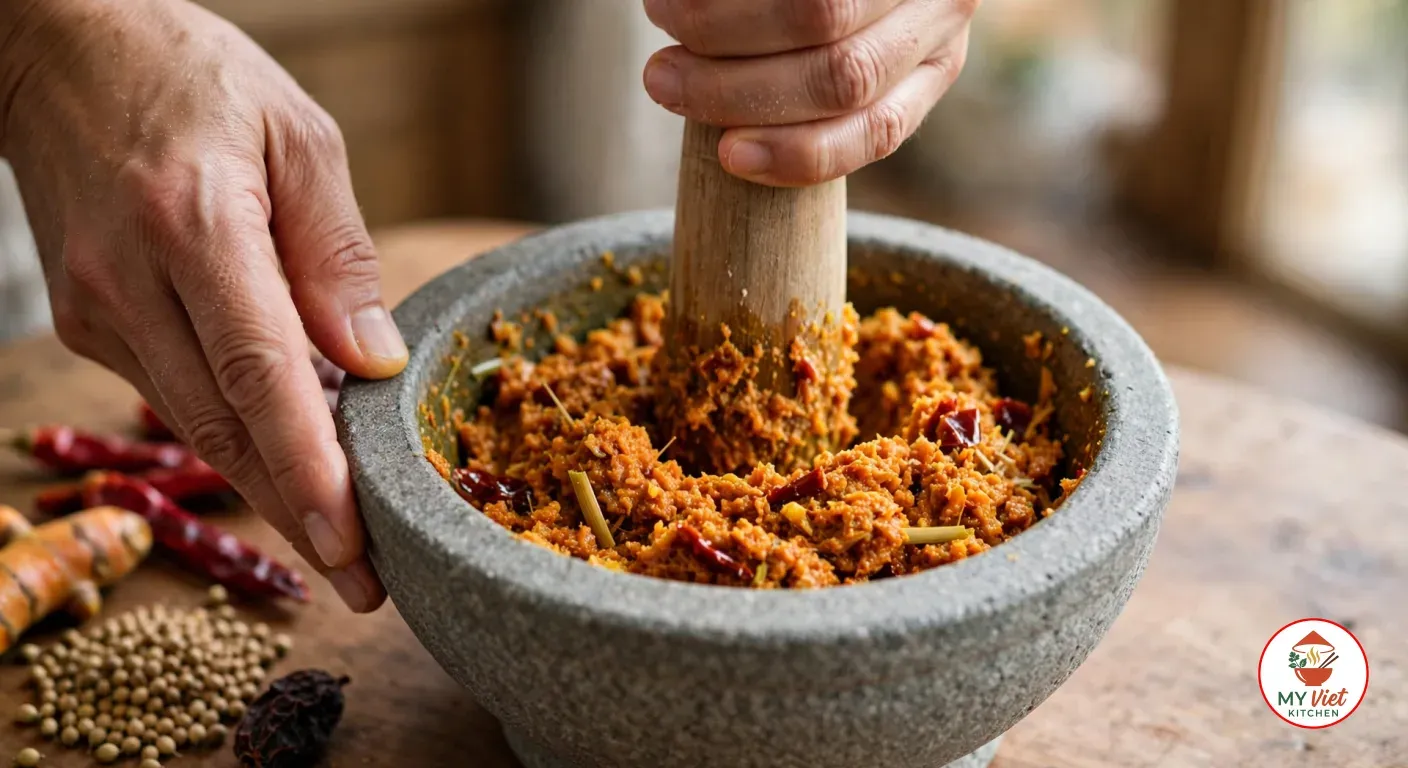
1Cover the chilies with hot water and soak for 15 minutes, then drain, cut them open and shake out the seeds for a milder curry. Toast the cardamom seeds, coriander seeds and curry powder in a dry skillet over medium heat until fragrant, about 2 minutes, then grind them in a mortar with the salt. Add the chilies and pound to a rough paste. Pound in the lemongrass, ginger and turmeric, then the shallot and garlic, until the mixture is thick and fairly smooth, about 10 minutes.
Step 2: Fry the Paste in Coconut Cream
2Open the unshaken can and spoon about 1/2 cup (120 ml) of the thick cream from the top into a large stockpot over medium heat. Let it bubble, stirring, until it starts to separate and look oily, 3 to 4 minutes. Add the paste and fry, stirring constantly, for about 3 minutes, until it darkens, turns very thick and smells toasty. Splash in a little of the remaining coconut milk if it sticks.
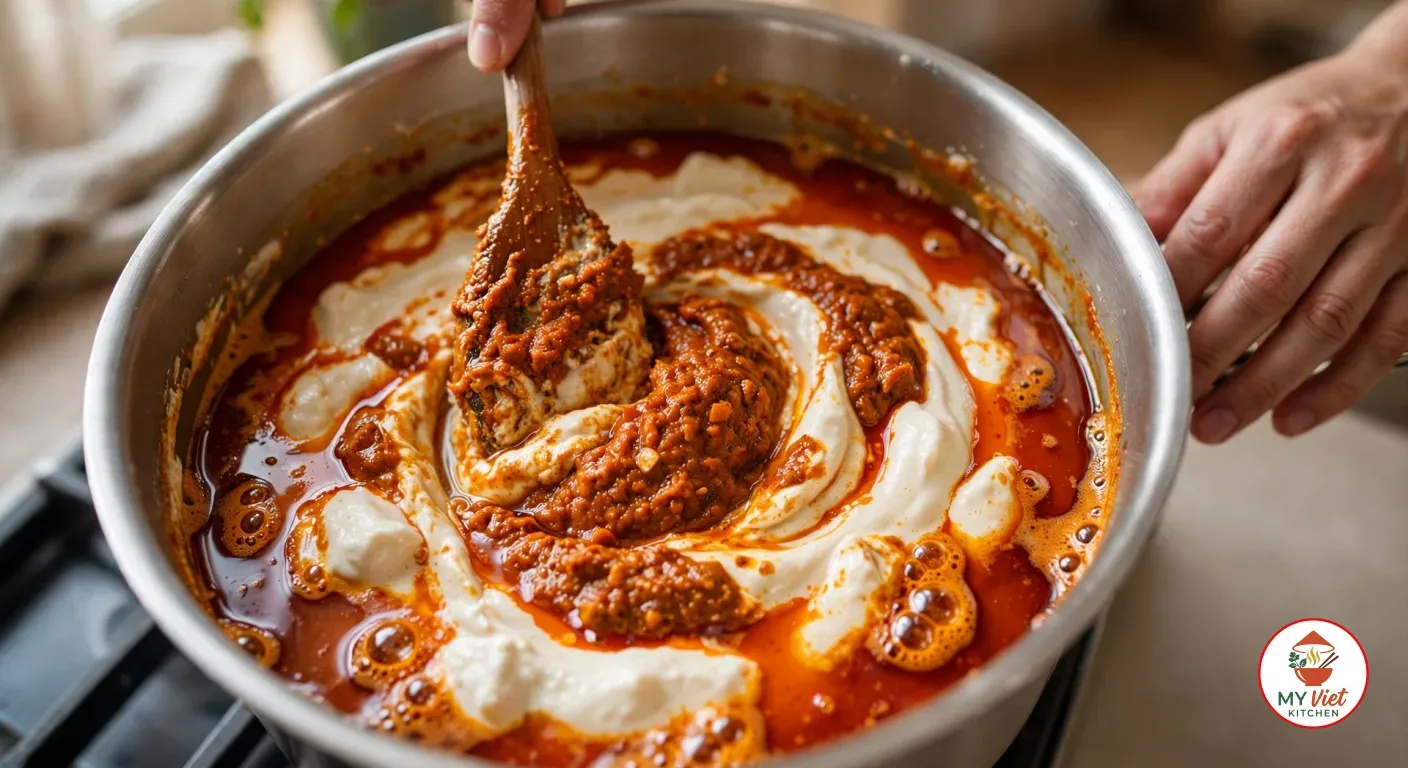
Step 3: Simmer the Chicken
3Add the chicken and turn it in the paste for 2 minutes. Pour in the rest of the coconut milk and the stock, then add the palm sugar, fish sauce and soy sauce. Once it boils, drop the heat to medium-low and cook, uncovered, until the chicken is fork-tender, 30 to 40 minutes. Meanwhile, stir the chili flakes with the 1 tablespoon of oil in the toasting skillet over low heat for a few minutes, until dark and smoky. Taste the broth at the end and add more fish sauce, soy sauce or sugar as needed.
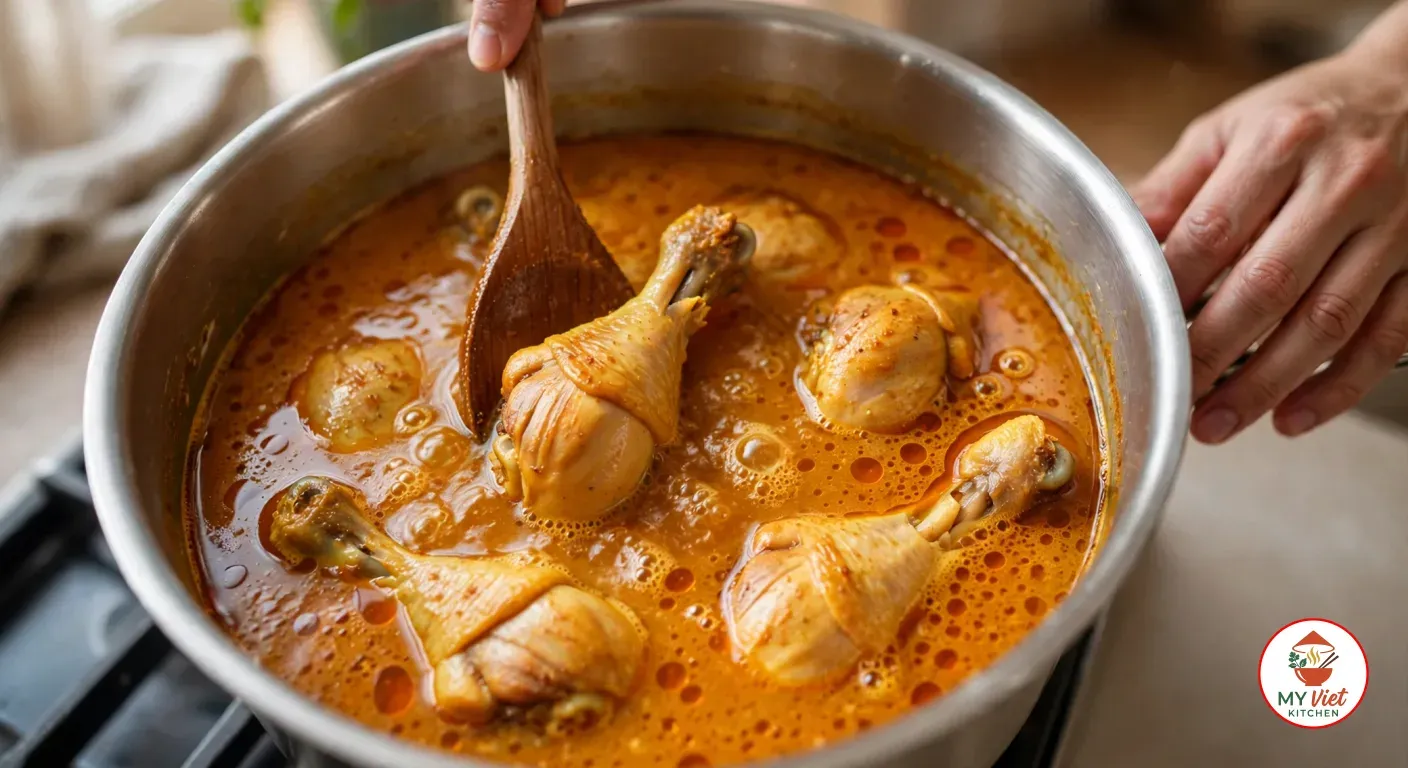
Step 4: Fry the Crispy Noodles
4Pull out 60 g (2 oz) of the noodles and shake off their loose flour. Pour the frying oil into a small, deep saucepan, no more than half full, and bring it up to 180°C (350°F). Fry the noodles in 2 batches, turning once, for about 1 minute per batch, until golden and crisp. Lift them out with a wire skimmer onto a plate lined with paper towels.
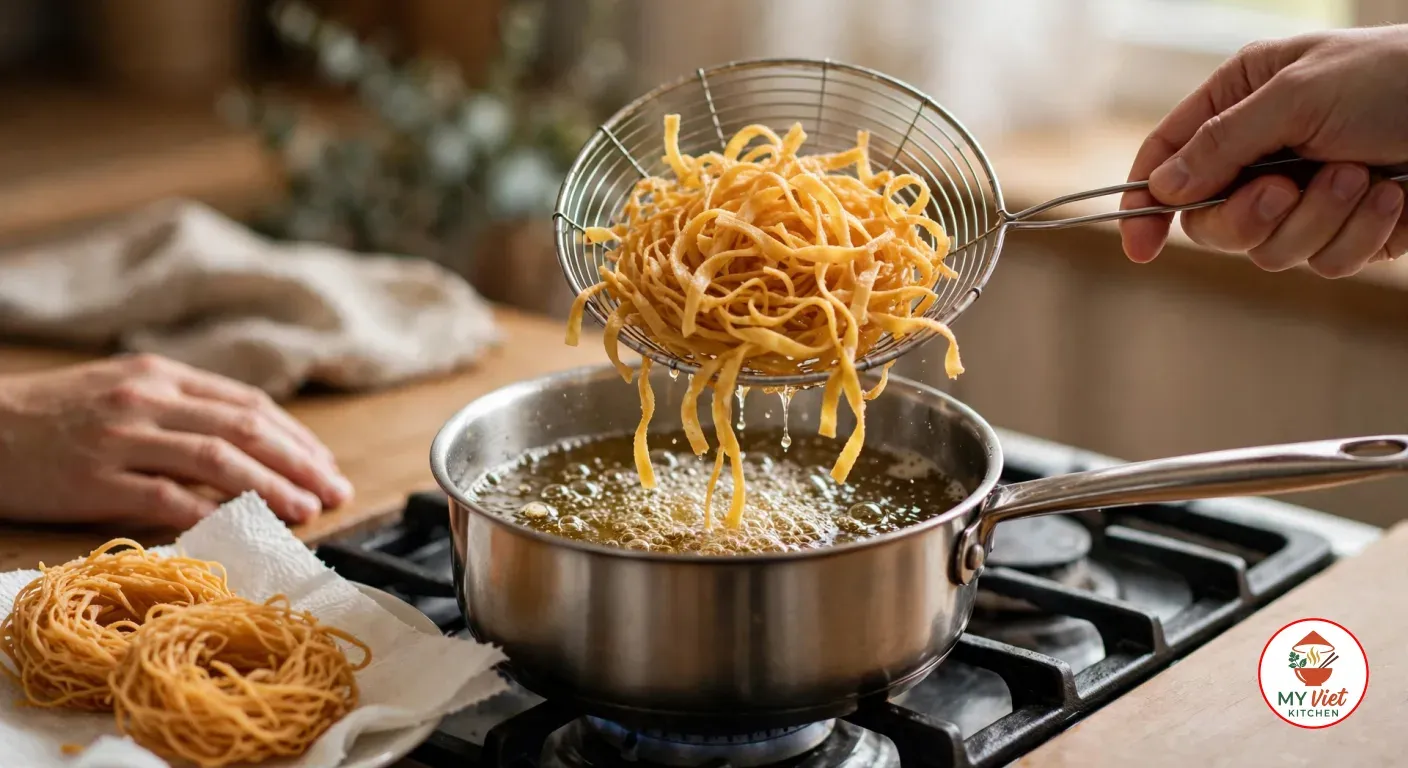
Step 5: Boil the Egg Noodles
5Get a large pot of water boiling. Loosen the remaining noodles and boil them just until cooked through, 1 to 2 minutes. Scoop them out with a clean wire skimmer and divide them among 4 deep bowls.
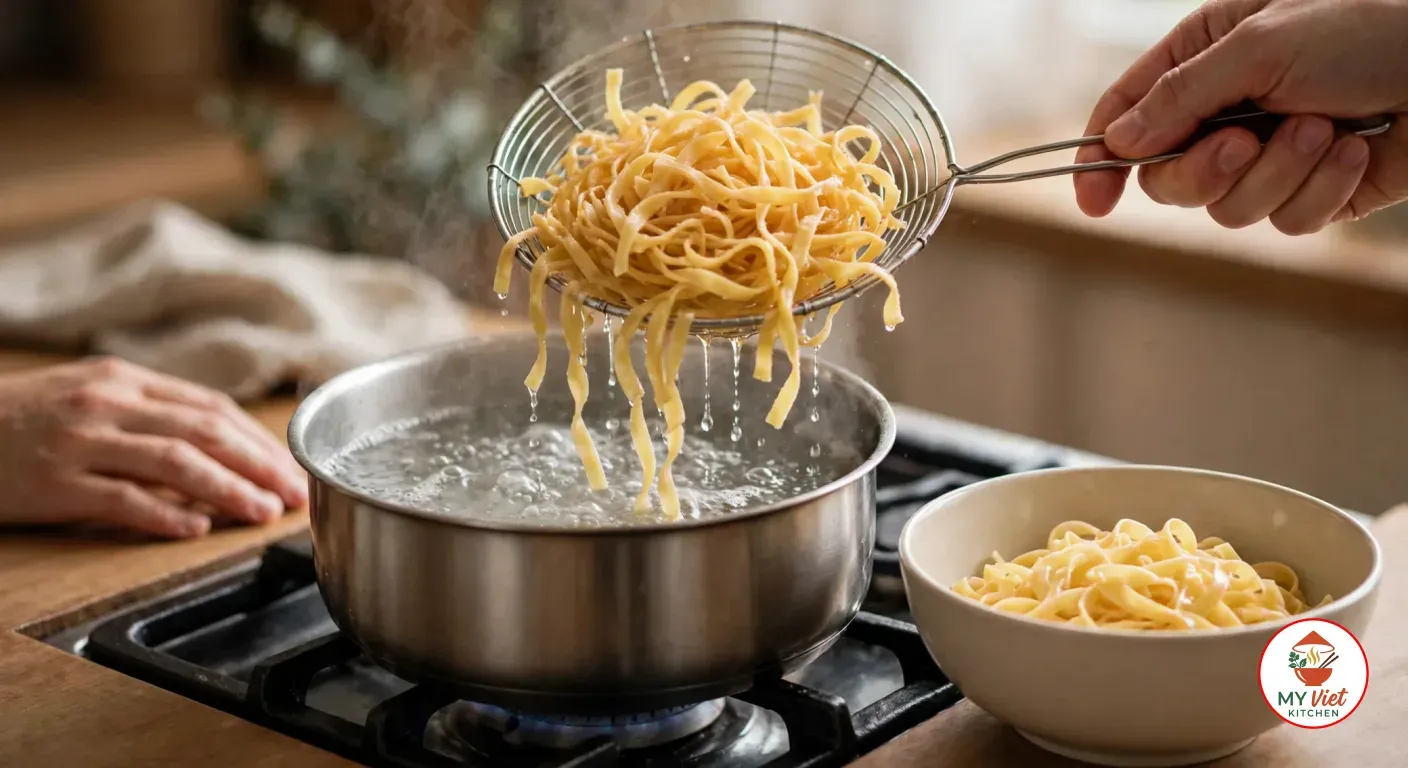
Step 6: Build the Bowls
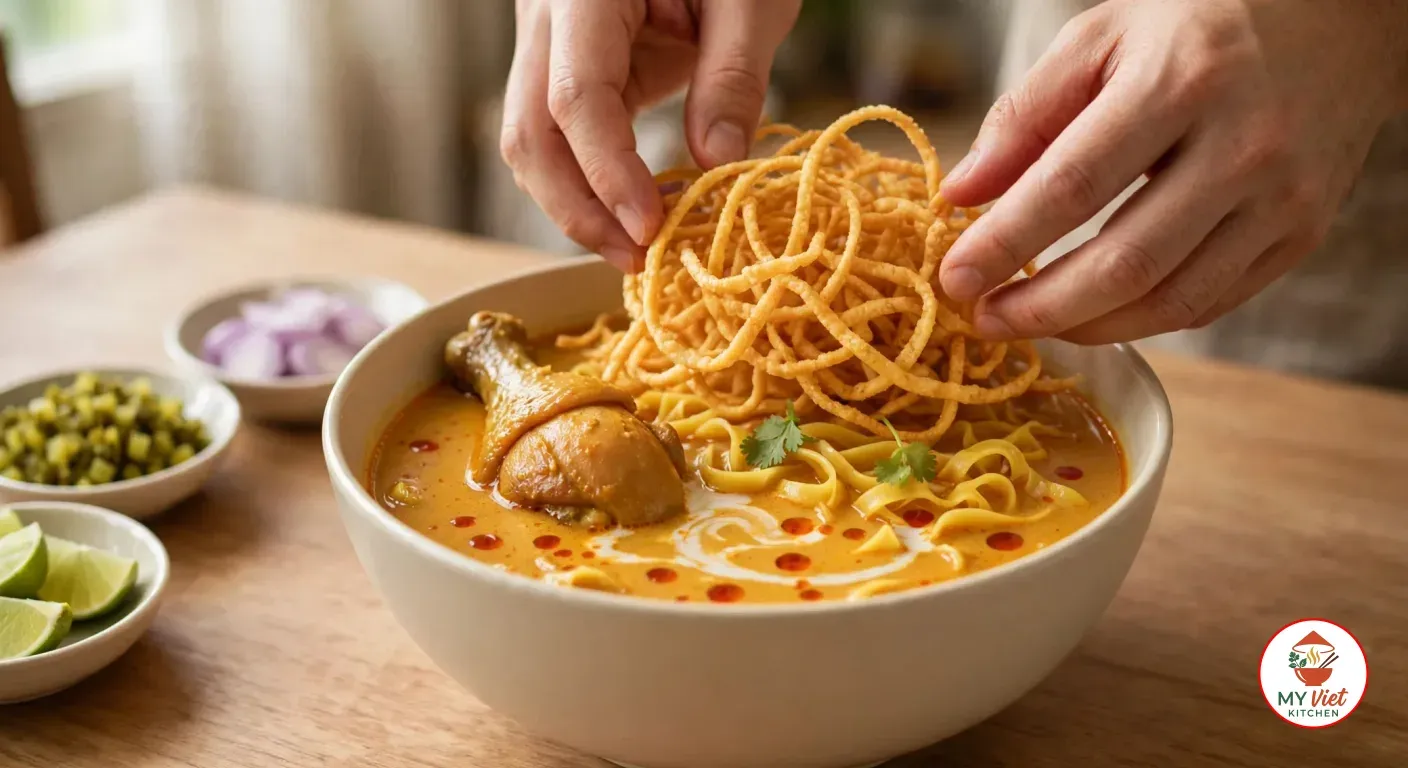
6Divide the chicken among the bowls and ladle the broth over until it almost covers the noodles. Spoon a little coconut cream over each bowl, then crown it with the crispy noodles and cilantro. Bring the pickled mustard greens, sliced shallots, lime wedges and chili flakes to the table so everyone can season their own bowl.
Frequently Asked Questions
Is khao soi the same as laksa?
No, though some Thai restaurants in Australia mistakenly call it a curry laksa. Unlike a southern Thai or Malaysian laksa, khao soi uses fish sauce, and SBS Food says every true version uses egg noodles (SBS Food).
How is Lao khao soi different?
It is a separate dish. Lao khao soi is made with hand-sliced rice-flour noodles in a clear broth, topped with a sauce of minced pork, tomatoes, garlic and fermented bean paste, and it has no relation to the Muslim-influenced Thai version (Wikipedia).
What can replace black cardamom?
Green cardamom works. Pailin Chongchitnant swaps 6 green pods for 2 black (CBC Life), so use 3 green pods for the single black pod in this paste.
Can you make khao soi ahead?
Yes, as long as the noodles stay apart. CBC Life advises refrigerating the broth and chicken apart from the noodles, or better, cooking the noodles as needed, and the paste can be mixed with its spices in bulk and frozen (CBC Life). Fry the crispy noodles shortly before serving.
Sources
- Khao soi, Wikipedia
- How to make Chiang Mai’s authentic khao soi - it’s not a curry laksa!, SBS Food
- Weeknight Chicken Khao Soi: How Pailin Chongchitnant makes this dish when she’s short on time, CBC Life
- Khao Soi Recipe (Thai Laksa Soup), Not Quite Nigella
- Thai Chef Makes KHAO SOI From Scratch!, Pailin’s Kitchen, YouTube, September 2024