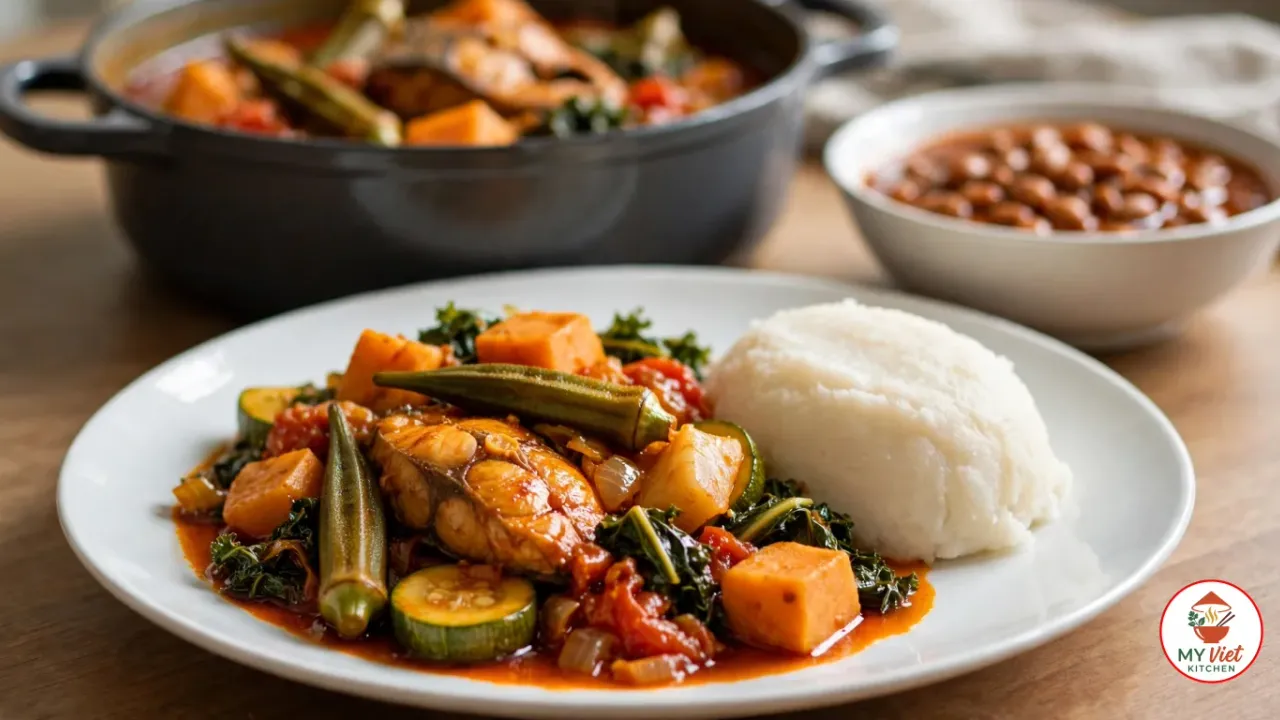
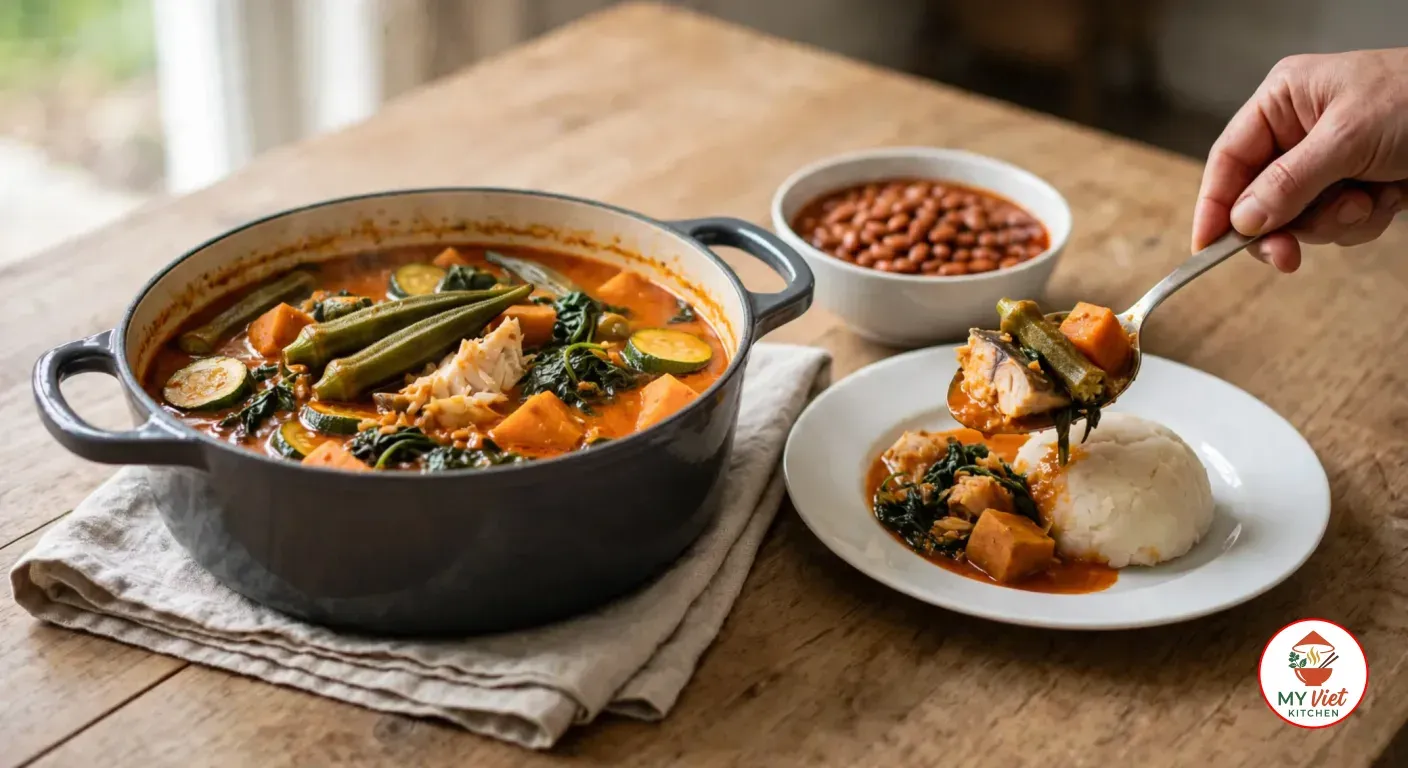
Calulu is a fish and vegetable stew from Angola, also cooked in São Tomé and Príncipe. In the Angolan version, dried fish and fresh fish go into one pot in layers with onion, tomato, sweet potato, greens and okra. Red palm oil goes over the top. Plan ahead: the dried fish soaks for 12 to 24 hours, then the pot cooks in about 50 minutes without stirring.
Prep Time: 30 minutes (plus 12 to 24 hours soaking) | Cook Time: 50 minutes | Servings: 6
Difficulty: Medium | Calories: ~450 per serving

Which Fish Go Into Calulu?
Two kinds. Angolan calulu de peixe layers dried fish and fresh fish in the same pan (Wikipedia; TAAG). The dried fish salts and flavors the broth, and the fresh fish gives you large, soft pieces. Corvina, a kind of croaker, and grouper are common choices in Angola (Portal São Francisco). When the Luanda chef Bruno Mesquita described a calulu ravioli to the news agency Lusa, its filling was the fresh and salted fish with the vegetables (Ver Angola).
Outside Angola, use what you can find:
- For the dried fish: salt cod is the easiest to buy. Soak it as you would for any salt cod dish, but stop while a flake still tastes lightly salted, because it seasons the whole pot (Portal São Francisco). African grocers also sell dried and smoked fish. Smoked fish tastes stronger, so taste a piece after soaking.
- For the fresh fish: choose a firm white fish cut into thick steaks, such as croaker, grouper, snapper or hake. Thin fillets fall apart between the layers.
With fresh fish alone, the stew still works, but the broth is milder and needs more salt at the end.
Which Greens and Vegetables Belong in Calulu?
Wikipedia and TAAG both list tomato, garlic, okra, sweet potato, spinach, zucchini and palm oil alongside the fish (Wikipedia; TAAG). Most recipes also use onion, and some add eggplant or pumpkin. For the greens, Angolan cooks use the leaves of sweet potato or cassava, and around Luanda the sweet potato leaves are themselves called “calulu” (Portal São Francisco). Wikipedia’s Angolan cuisine article also lists gimboa leaves, which it compares to spinach.
- Sweet potato leaves are sold at many Asian and African grocers. Use the leaves and thin, tender stems, and discard the thick stems.
- Spinach is the usual substitute outside Angola. Mature spinach holds up better than baby leaves, which melt away.
- Cassava leaves need long, careful preparation to remove their toxic compounds (Portal São Francisco). Leave them out unless you can buy them already prepared.
Keep the okra pods whole, with only the stem tips trimmed, if you want them to hold their shape. For a thicker broth, halve them lengthwise, since cut okra releases more of its sticky juice.
Why Is Calulu Layered Instead of Stirred?
Stirring breaks the fish. Soaked salt cod flakes apart easily, and fresh fish steaks crumble once they cook through. In Angola the pot is built in layers and cooked over medium heat, so everything cooks in place (Wikipedia).
The vegetables supply most of the liquid. Onions, tomatoes, zucchini and greens give up their water as they heat, so the recipe below adds only 1/2 cup (120 ml). Instead of stirring, hold the pot by both handles and give it a gentle shake every 10 minutes. If the bottom starts to smell toasty, pour 1/4 cup (60 ml) of hot water down the side.
What Do You Serve with Calulu?
In Angola, calulu comes with funge and with beans cooked in palm oil, called feijão de óleo de palma (Wikipedia). Funge is a thick porridge of cassava flour or maize flour (Ver Angola). Cassava funge is more common in the north of the country and maize funge in the center and south (Portal São Francisco). Plain white rice works if you can’t find either flour.
Ingredients for Calulu
Fish:
- 12 ounces (340 g) dried salted fish, such as salt cod
- 1 pound (450 g) firm fresh white fish, such as croaker, grouper or snapper
- 3 cloves garlic, crushed
- 3 tablespoons lemon juice (about 1 lemon)
- 1/2 teaspoon salt, plus more to taste
- 1/2 teaspoon black pepper
Vegetables:
- 2 large onions, sliced into rings
- 4 medium tomatoes, chopped
- 1 large sweet potato (about 12 ounces / 350 g), peeled and cut into 1-inch cubes
- 1 medium zucchini, cut into thick rounds
- 8 cups (about 225 g) sweet potato leaves or mature spinach
- 1 pound (450 g) fresh okra, stem tips trimmed
Seasoning and Oil:
- 2 bay leaves
- 1 habanero or Scotch bonnet pepper, left whole
- 1/4 cup (60 ml) red palm oil
- 1/2 cup (120 ml) water
Step-by-Step Instructions
Step 1: Soak the Dried Fish
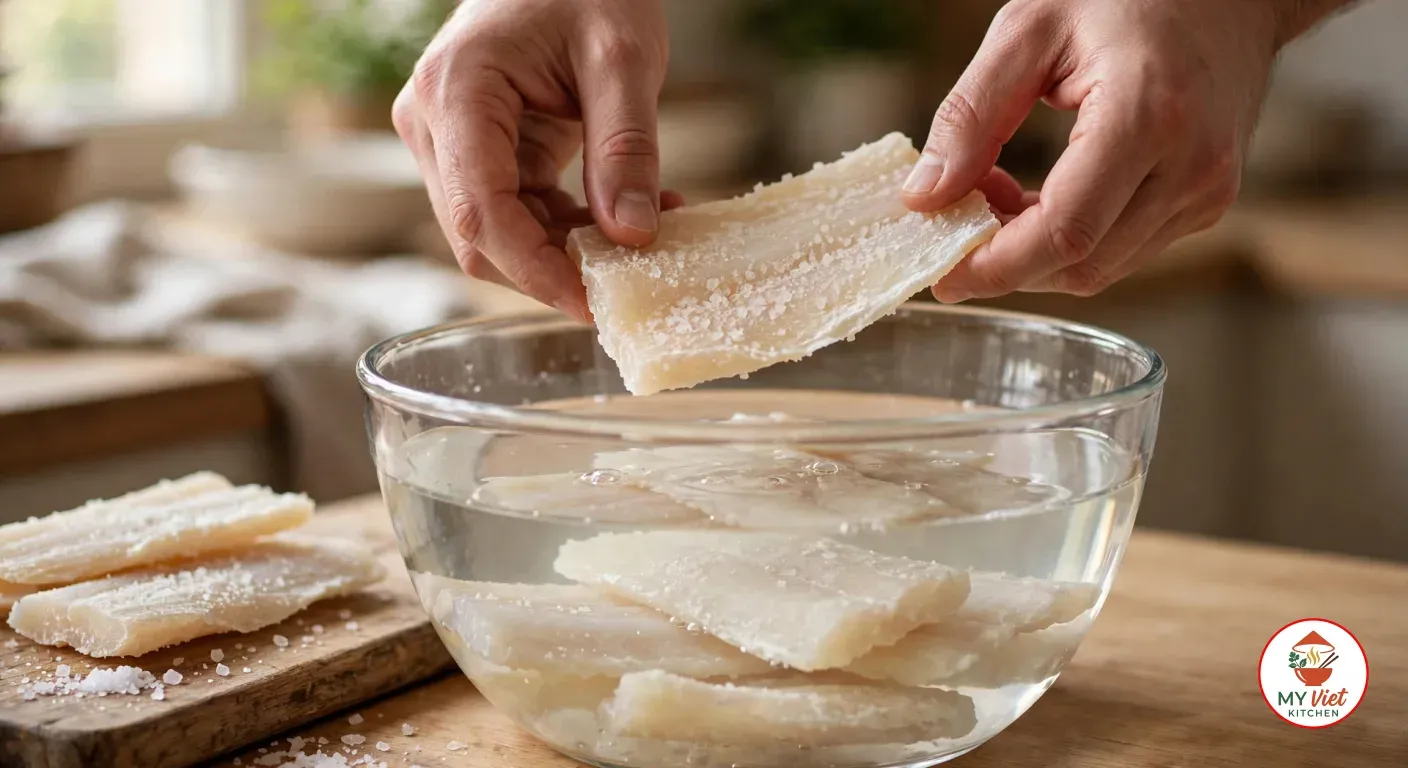
1Rinse the dried fish under cold water to wash off the surface salt. Put it in a large bowl, cover it with at least 2 inches (5 cm) of cold water and refrigerate it for 12 to 24 hours. Change the water 3 or 4 times. Very thick pieces of salt cod can need up to 36 hours. Taste a small flake: it should taste like well-seasoned food, not like sea water. Drain the fish, remove the skin and bones, and break it into large pieces about 2 inches (5 cm) across.
Step 2: Season the Fresh Fish
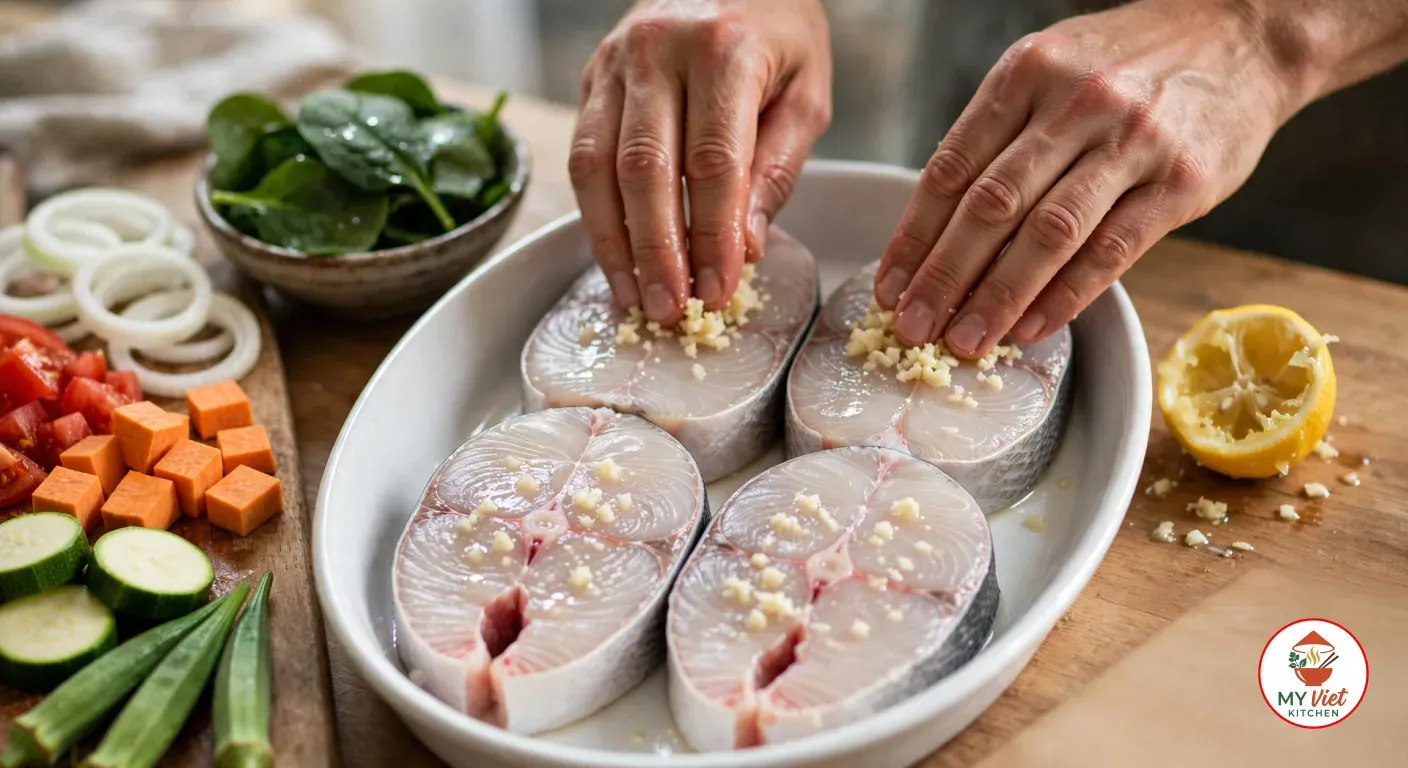
2Cut the fresh fish into thick steaks or 2-inch (5 cm) chunks. Rub them with the crushed garlic, lemon juice, 1/2 teaspoon of salt and the black pepper, and leave them for 15 to 20 minutes. Meanwhile, prepare the vegetables. Slice the onions into rings and chop the tomatoes. Peel the sweet potato and cut it into 1-inch (2.5 cm) cubes, and cut the zucchini into thick rounds. Trim the stem tips of the okra. Strip the greens from any thick stems and wash them well.
Step 3: Layer the Pot
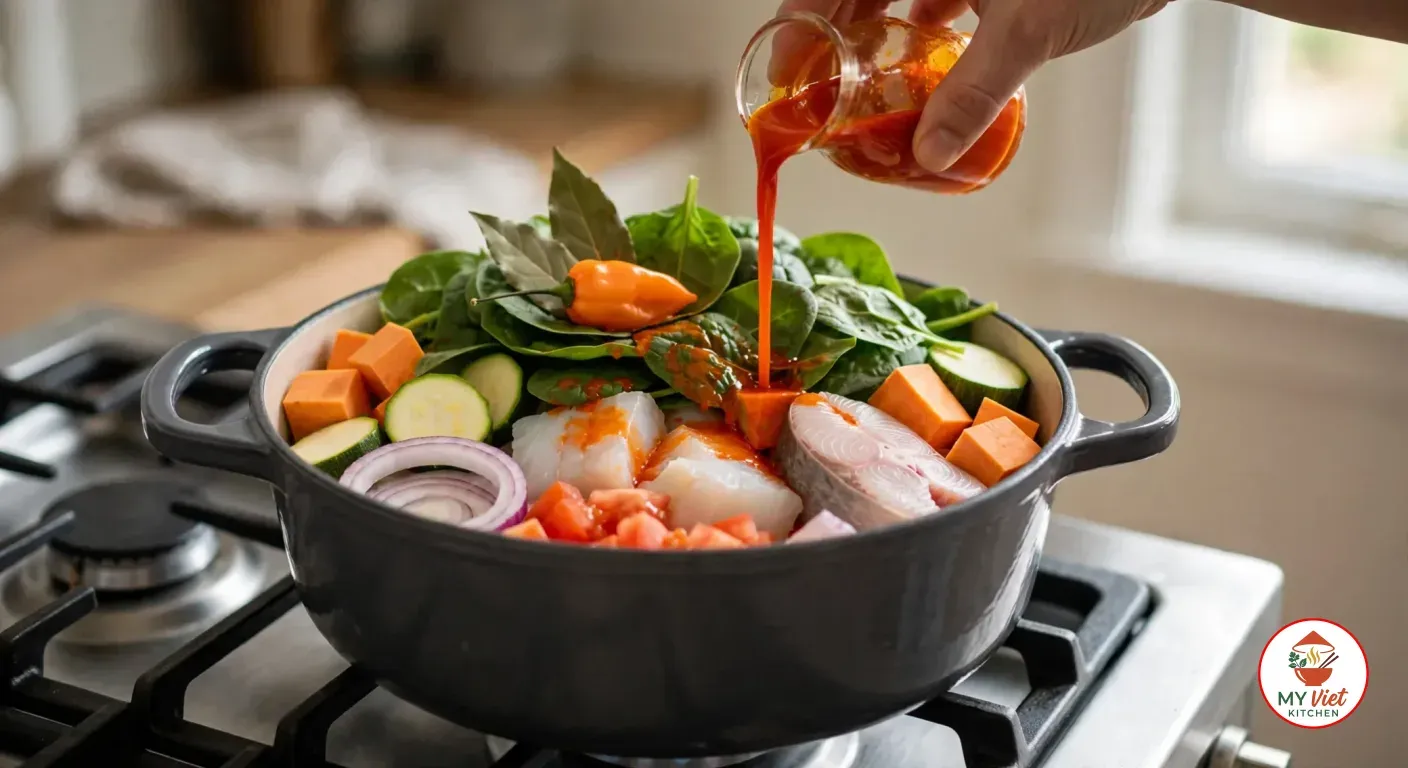
3Use a wide, heavy pot of 5 quarts (5 litres) or more, so the layers stay shallow and cook evenly. Spread half the onions and half the tomatoes over the bottom. Add half the dried fish and half the fresh fish in one layer, then half the sweet potato, zucchini and greens. Repeat the layers with the rest, finishing with greens. Tuck the bay leaves and the whole chili into the top layer. Pour the palm oil over everything and the 1/2 cup (120 ml) of water down the side of the pot. Keep the okra aside for now.
Step 4: Simmer, Then Add the Okra
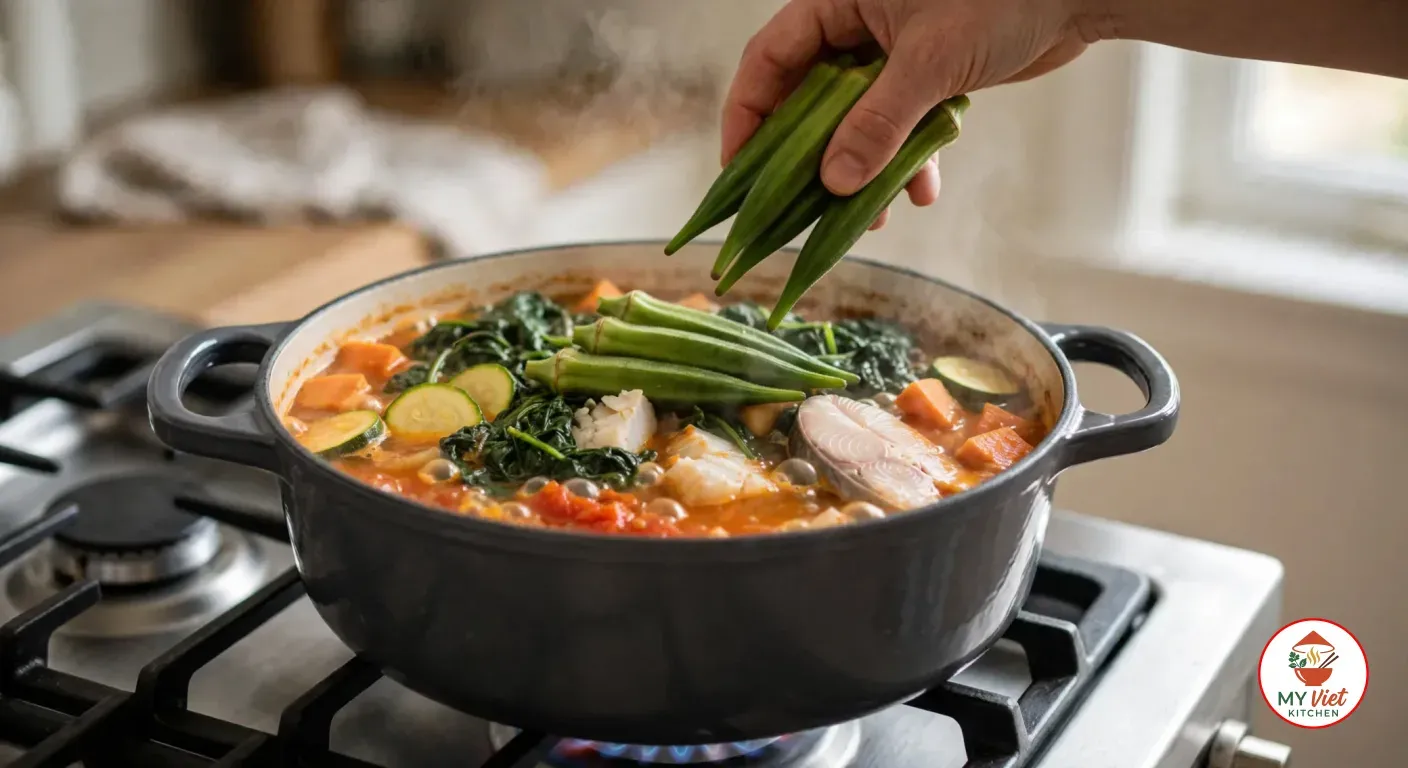
4Cover the pot and bring it to a simmer over medium heat, which takes about 5 minutes. Lower the heat to medium-low and cook for 30 minutes without stirring. Every 10 minutes, hold the pot by both handles and shake it gently so nothing sticks. Lay the okra on top, cover again and cook for 15 minutes more. The stew is ready when the okra and sweet potato are tender, the fresh fish flakes, and the liquid has turned thick and orange.
Step 5: Finish and Serve
5Taste the broth and add salt only if it needs it, since the dried fish has already salted the pot. Remove the bay leaves and the chili. Spoon the calulu from the bottom of the pot so each plate gets both kinds of fish, some of every vegetable and plenty of broth. Serve it hot with funge, beans cooked in palm oil or white rice.
Frequently Asked Questions
Is calulu the same as Brazilian caruru?
No, though the names and some ingredients overlap. Caruru from Bahia is an okra dish with onion, shrimp, palm oil and toasted peanuts or cashews, often eaten with acarajé (Wikipedia). Calulu is a stew of fish and vegetables. Angola’s national airline, TAAG, repeats the claim that calulu came from a similar Brazilian dish, but the history of both names is disputed (TAAG; Wikipedia).
Can you make calulu with meat?
Yes. Calulu de carne seca uses dried beef, soaked beforehand like the fish and cooked the same way over medium heat. In São Tomé and Príncipe, cooks also make calulu with chicken, pork or beef (Wikipedia).
How is calulu from São Tomé and Príncipe different?
It can use chicken or shrimp, and many more kinds of leaves. A recipe from the São Tomé chef Antónia Oliveira, published by UN Tourism, uses chicken or fish. It adds four kinds of chopped local leaves, guava shoots, okra, breadfruit and palm oil. There, calulu is a family meal that also appears at religious festivals, weddings and funerals (Wikipedia).
Can I make calulu without palm oil?
You can, but it won’t look or taste the same. Red palm oil gives the stew its orange color and a savory, slightly earthy flavor. African and Brazilian grocers sell it, the Brazilian shops as dendê. Without it, use 1/4 cup (60 ml) of vegetable oil and 1 teaspoon of sweet paprika for color.
How long does calulu keep?
Get leftover calulu into the fridge no more than 2 hours after cooking, and finish it in 3 to 4 days, as USDA advises for leftovers. Frozen, it keeps its best quality for 3 to 4 months. Reheat it in a covered pot with a splash of water, shaking rather than stirring, until it steams. The sweet potato and zucchini turn softer after freezing.
Sources
- Calulu, Angolan cuisine and Caruru (food), Wikipedia
- Calulu, TAAG Angola Airlines destination guide
- Culinária Angolana, Portal São Francisco
- Quando a gastronomia se reinventa para mostrar que não é só funge, Lusa / Ver Angola, 2015
- São Tomé and Príncipe: Antónia Oliveira, Calulu, UN Tourism
- Leftovers and Food Safety, USDA Food Safety and Inspection Service