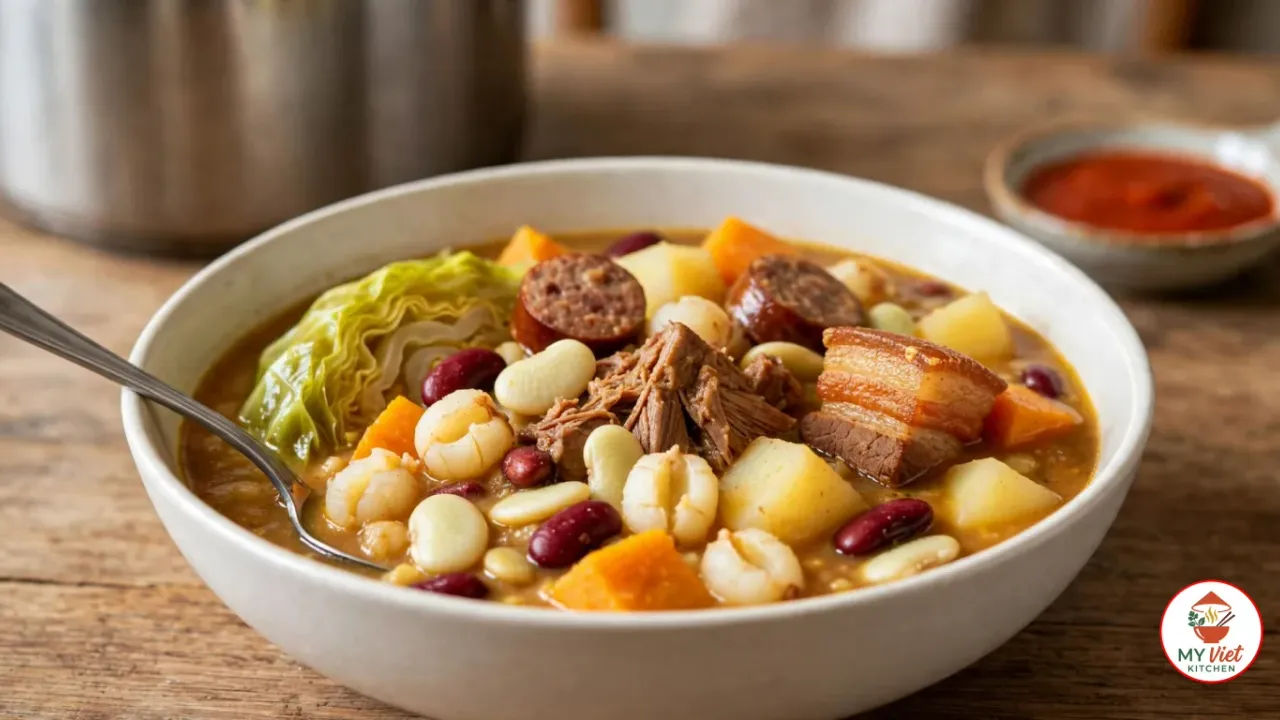
Cachupa is a slow-cooked stew of dried corn, beans, meat and vegetables, and it is the national dish of Cape Verde. This version is cachupa rica, made with pork shoulder, pork belly and linguiça sausage. Plan for two stages: the corn and beans soak overnight, then the pot simmers for about 3 hours. Make the full pot, because the leftovers get fried for breakfast the next day.
Prep Time: 40 minutes (plus 8 to 12 hours soaking) | Cook Time: 3 hours | Servings: 8
Difficulty: Medium | Calories: ~810 per serving

Which Corn Should You Buy for Cachupa?
Cape Verdean cooks use dried field corn with the hull removed. Traditionally, the kernels are pounded in a wooden mortar until the skins come off and the edges turn round and smooth, as ReVista describes. Outside Cape Verde, you have three good options:
- Corn sold for cachupa. Portuguese, Cape Verdean and some African grocers sell bags labelled milho para cachupa, in white or yellow. Use it as it comes.
- Samp. South African shops sell samp, dried corn that is stamped and broken until its skin comes off (Wikipedia). Like cachupa corn, it is dehulled by pounding, not by chemicals.
- Dried hominy. Latin American shops sell dried hominy, corn soaked and cooked in lime or lye to loosen the hull (Wikipedia). It tastes slightly different from pounded corn, and many recipes written in the US call for it. Soak and cook it the same way, and bite a kernel before you add the meats.
Canned hominy is already cooked, so save it for the quick version in the FAQ. It does not release enough starch to thicken the pot the way dried corn does. Skip whole dried corn that still has its skin, such as popcorn or animal-feed corn, because the skins stay chewy after hours of cooking.
Cachupa Rica or Cachupa Pobre: Which Are You Making?
The names mean “rich” and “poor” cachupa. Both start with the same corn and beans. Cachupa rica adds more ingredients, above all meat: pork, bacon and chouriço sausage. Cachupa pobre is the simpler pot, with little or no meat (Wikipedia; Diário de Notícias). Some cooks use fish in place of pork.
The recipe below is a rica. For a pobre, leave out the three meats and use vegetable broth. Add 2 more cups of vegetables, such as cassava, carrots or kale, and an extra teaspoon of paprika. Expect changes from cook to cook as well. Leila Vaz, a street vendor in Praia, told RTP that one cachupa recipe will never be the same as another.
What Is Cachupa Guisada?
Cachupa guisada, also called cachupa frita or refogada, is leftover cachupa fried in a pan. It is often eaten for breakfast with a fried egg, linguiça or fried mackerel (Wikipedia).
To make it, chill the leftover stew overnight so it firms up. Heat 2 tablespoons of olive oil in a large cast iron or nonstick skillet over medium-high heat. Add about 2 cups of cold cachupa and press it flat with a spatula. Leave it alone for 5 to 7 minutes, until the bottom is brown and crisp. Turn it in sections, give the other side 3 to 4 minutes, and top it with a fried egg.
In New Bedford, Massachusetts, Angelo Barbosa told The New Bedford Light that you can’t think about cachupa guisado without the cachupada the night before. A cachupada is the gathering where friends and family cook the big pot together.
Why Does Cachupa Matter So Much in Cape Verde?
Corn and beans are the staples of Cape Verdean cooking. The country is ten volcanic islands, 600 to 850 km west of Senegal, with a dry climate (Wikipedia). Forbes África Lusófona calls corn, the base of the Cape Verdean diet, a symbol of how the islands came through drought and famine. Vendors in the capital, Praia, sell it from street stalls at weekends, and in 2017 the city cooked a 6-ton pot that set a Guinness World Record.
More Cape Verdeans now live abroad than on the islands, mostly in the United States and Portugal (Wikipedia). The dish travelled with them. In New Bedford, families with roots on the island of Brava call it munchupa (The New Bedford Light).
Ingredients for Cachupa
Corn and Beans:
- 2 cups (about 340 g) dried cachupa corn, samp or dried white hominy
- 1 cup dried kidney beans
- 1 cup dried lima beans or butter beans
- 12 cups (3 litres) water or broth, plus hot water as needed
Meats:
- 1 pound (450 g) pork ribs or shoulder, cut into chunks
- 2 linguiça or chorizo sausages, sliced into rounds
- 1/2 pound (225 g) pork belly or bacon, cubed
- 2 tablespoons olive oil
Aromatics and Seasonings:
- 1 large onion, diced
- 4 cloves garlic, minced
- 2 bay leaves
- 1 teaspoon paprika
- 1 teaspoon salt, adjusted to taste
- 1/2 teaspoon black pepper
Vegetables:
- 2 medium potatoes, peeled and cubed
- 1 large sweet potato, peeled and cubed
- 2 green bananas, peeled and sliced
- 1 cup cubed butternut squash or pumpkin
- 1/2 small cabbage, cut into wedges
Step-by-Step Instructions
Step 1: Soak the Corn and Beans
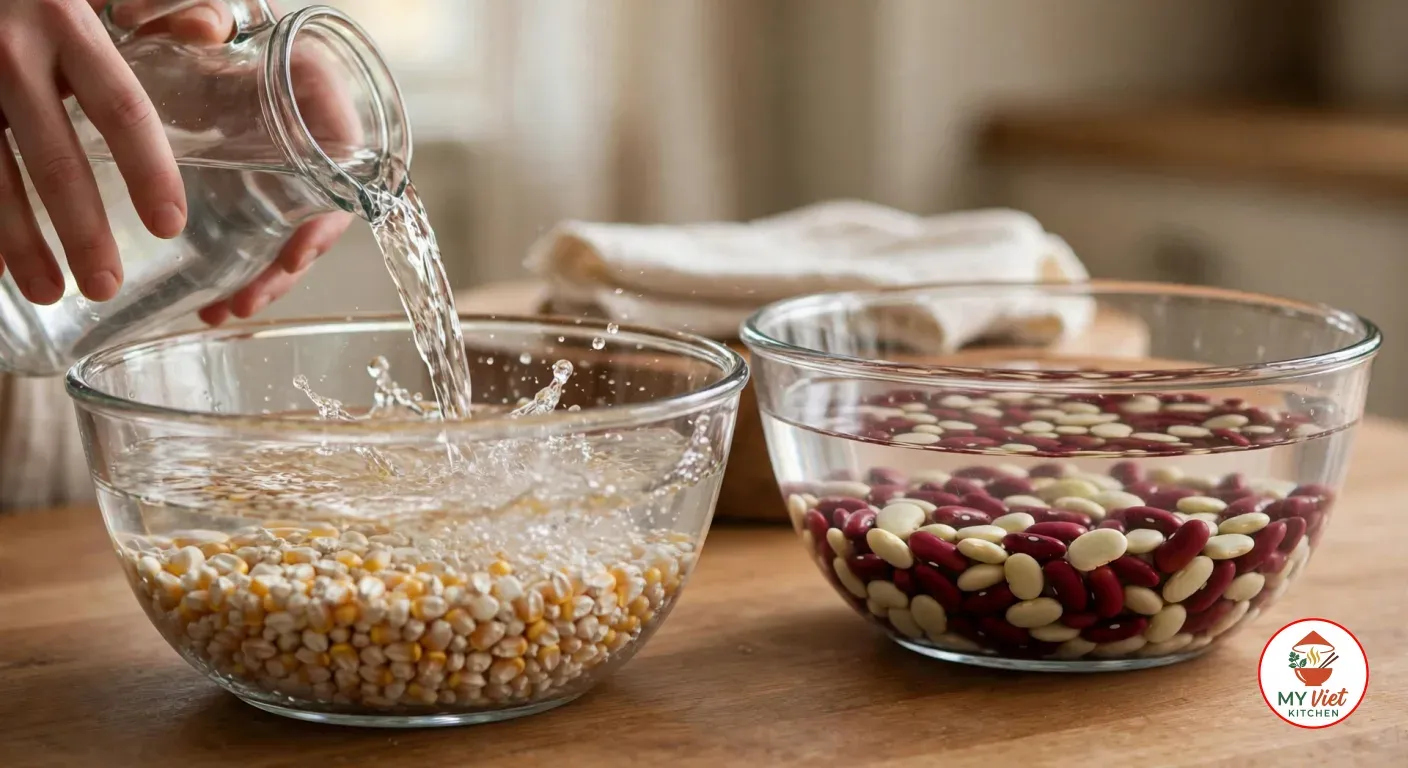
1Put the dried corn in a large bowl and the kidney and lima beans in a second bowl. Cover each with at least 3 inches (8 cm) of cold water, since the corn swells to about twice its size. Soak for 8 to 12 hours, or overnight. Drain both and rinse them under cold running water. Keep them apart, because the corn needs an hour’s head start in the pot.
Step 2: Cook the Corn and Beans
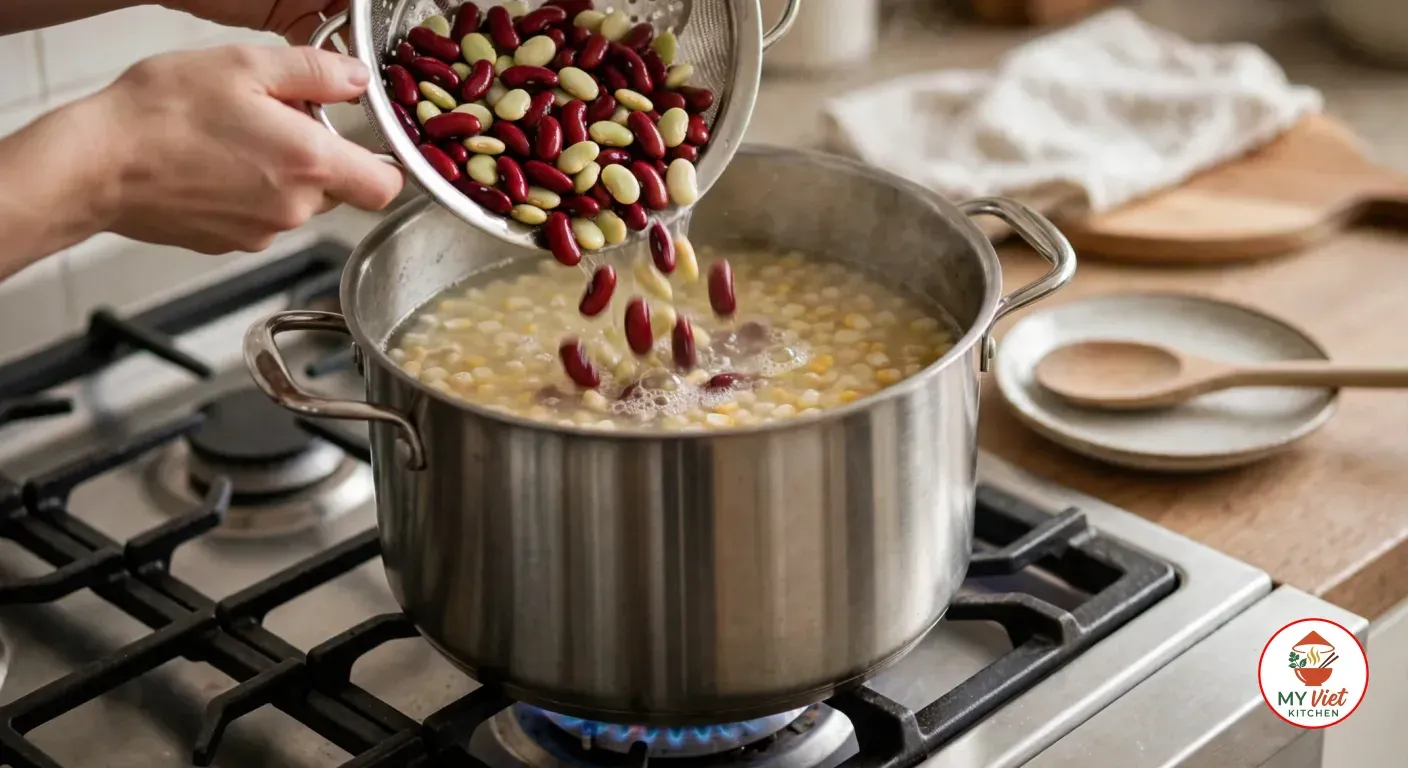
2Put the soaked corn in a heavy pot that holds at least 8 quarts (7.5 litres), and add 12 cups (3 litres) of water or broth. Bring it to a boil and skim off the foam. Lower the heat to a steady simmer, partly cover the pot and cook for 1 hour, stirring now and then. Keep the liquid about 1 inch (2 to 3 cm) above the corn, adding hot water if it drops. Add the drained beans and simmer 30 minutes more. The corn should now be tender outside but still firm in the center, and the beans should be starting to soften. Don’t salt the pot yet.
Step 3: Brown the Meats
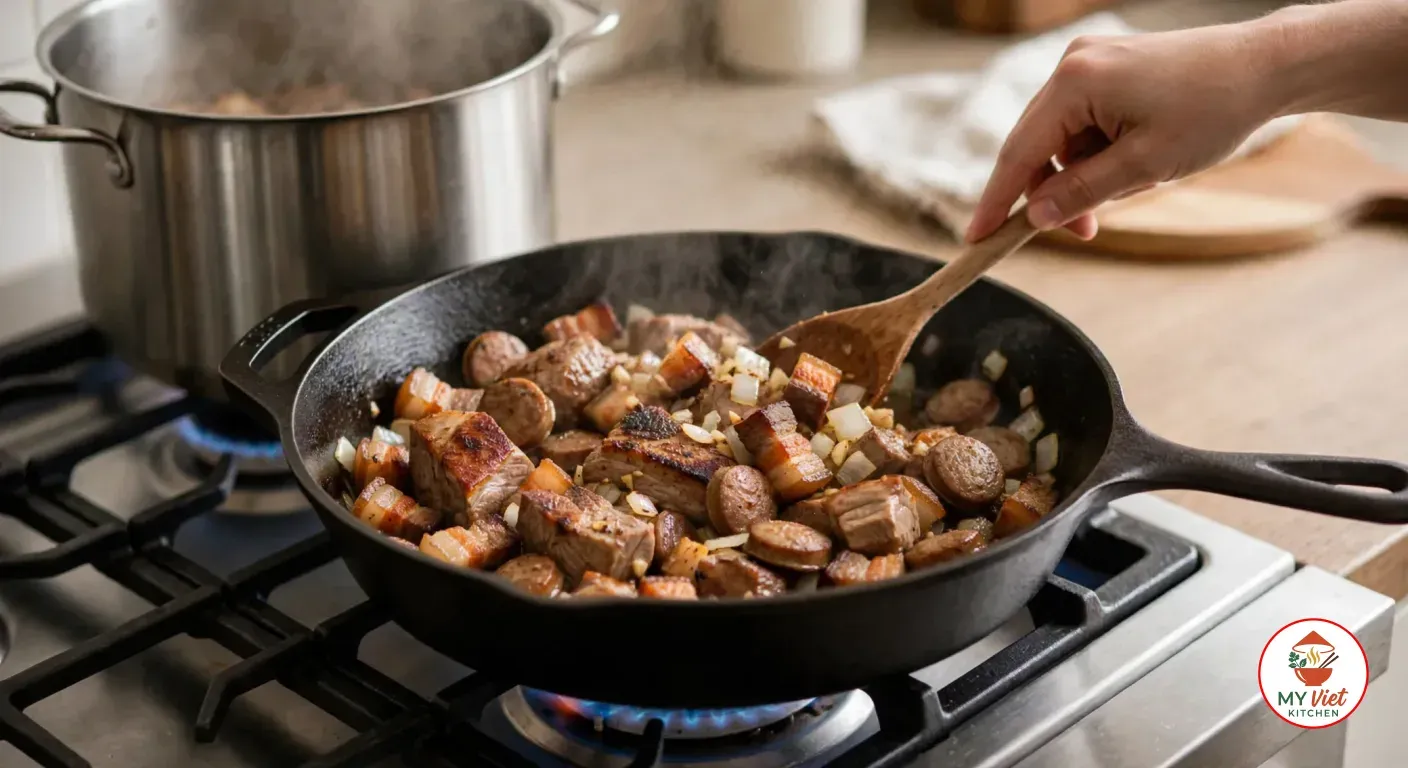
3While the corn cooks, heat the olive oil in a large skillet over medium-high heat. Brown the pork chunks on all sides for 5 to 7 minutes, then lift them onto a plate. Fry the pork belly or bacon in the same pan for about 4 minutes, until its fat runs and the edges crisp. Add the sausage slices for 3 minutes, then the onion and garlic for about 4 minutes, until the onion is soft. Pour in a ladle of broth from the corn pot and scrape up the browned bits from the bottom of the skillet.
Step 4: Combine and Simmer with Vegetables
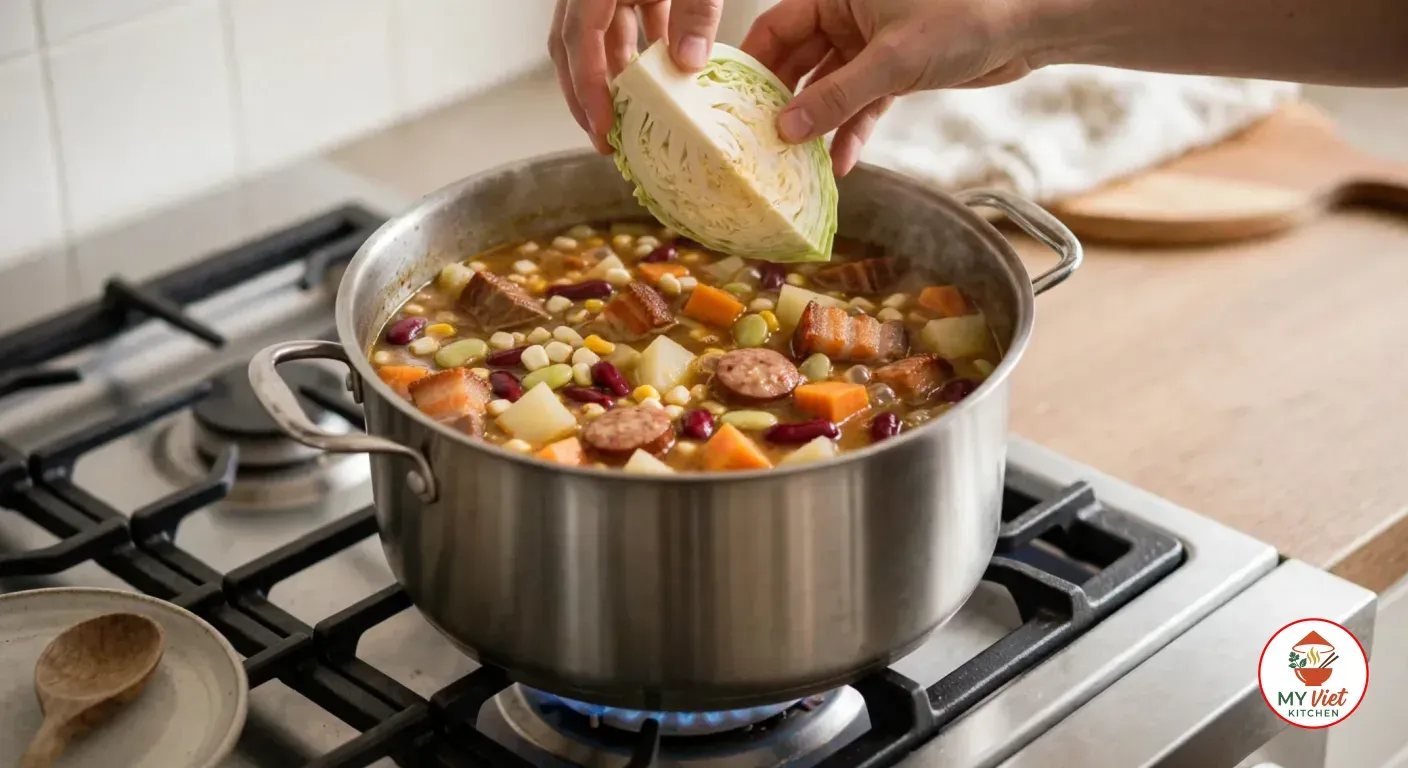
4Tip the pork, sausage, onion, garlic and pan juices into the pot with the corn and beans. Add the bay leaves, paprika, salt and pepper, and simmer for 30 minutes. Add the potatoes, sweet potato and green bananas. After 20 minutes, add the squash and push the cabbage wedges under the liquid. Simmer on low for another 25 to 40 minutes. Stir every 15 minutes and scrape the bottom, since the thickening stew can catch and burn. If it gets too thick before the corn is tender, add hot water a little at a time. The stew is ready when the vegetables are tender and the broth looks close to porridge.
Step 5: Season and Serve
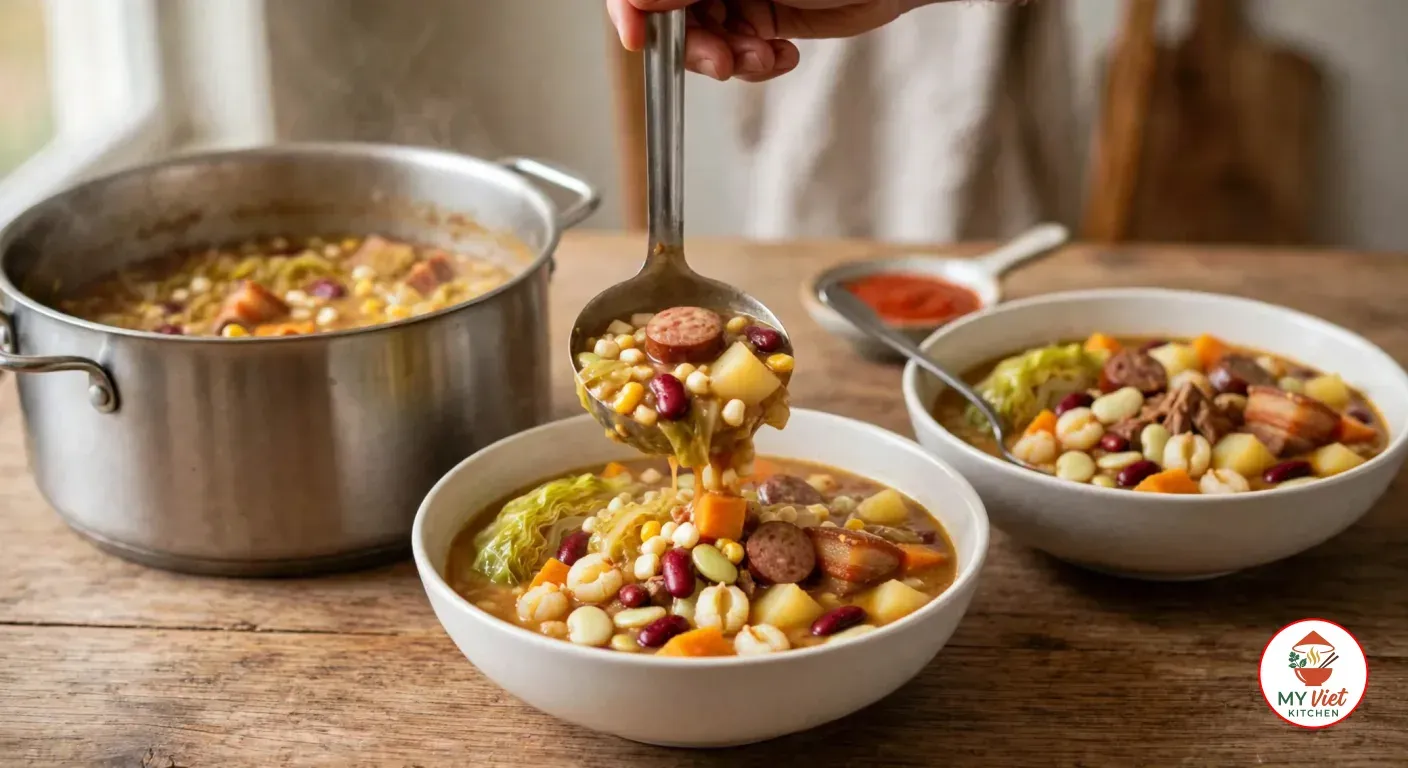
5Taste the stew and adjust the salt and pepper, then remove the bay leaves. The finished cachupa should sit between a soup and a porridge, with some corn kernels split open and the beans creamy inside. Ladle it into deep bowls so each one gets pork, sausage and vegetables, and serve it hot. Put hot sauce on the table for anyone who wants heat.
Frequently Asked Questions
Can I make cachupa with canned hominy and beans?
Yes, for a faster pot, though the broth stays thinner. Skip steps 1 and 2. Brown the meats as in step 3, then simmer them with the bay leaves, seasonings and 8 cups (2 litres) of broth for 30 minutes. Add the vegetables as in step 4, and stir in three drained 15-ounce (425 g) cans each of hominy and beans for the last 20 minutes. The whole pot takes about 1 hour 30 minutes.
How do I know when cachupa is done?
Bite a kernel of corn. It should be tender all the way through with no chalky center, and some kernels will have split open. The beans should be creamy inside, and a potato cube should break when pressed with a spoon. A spoon dragged across the pot should leave a trail for a moment.
What can I use instead of linguiça?
Portuguese chouriço is the closest match, and cured Spanish chorizo works too. Any smoked pork sausage, such as kielbasa, will also do. Fresh, unsmoked sausage gives the stew less depth, so brown it well if that is all you have.
How long does cachupa keep?
Up to 4 days in the fridge and 3 to 4 months in the freezer, following USDA guidance for leftovers. Refrigerate it within 2 hours of cooking, in shallow containers so it cools quickly. Freeze it in portions, leaving 1 inch (2 to 3 cm) of space at the top, and reheat it with a splash of water until it steams.
Is cachupa gluten-free?
The corn, beans, vegetables and fresh pork contain no gluten. Some sausages, bouillon cubes and boxed broths do, so check the labels if you cook for someone who avoids gluten.
Sources
- Cachupa, Wikipedia
- Cachupa, ReVista: Harvard Review of Latin America, 2001
- À descoberta da cachupa, Diário de Notícias, 2018
- Cachupa à solta pelas ruas de Cabo Verde, todos os fins-de-semana, RTP Notícias
- Cachupa: Tradição cabo-verdiana nas ruas da Praia, Forbes África Lusófona, 2024
- Cachupa: It’s more than food; it’s community, The New Bedford Light, 2025
- Samp, Hominy, Cape Verde and Cape Verdean cuisine, Wikipedia
- Leftovers and Food Safety, USDA Food Safety and Inspection Service