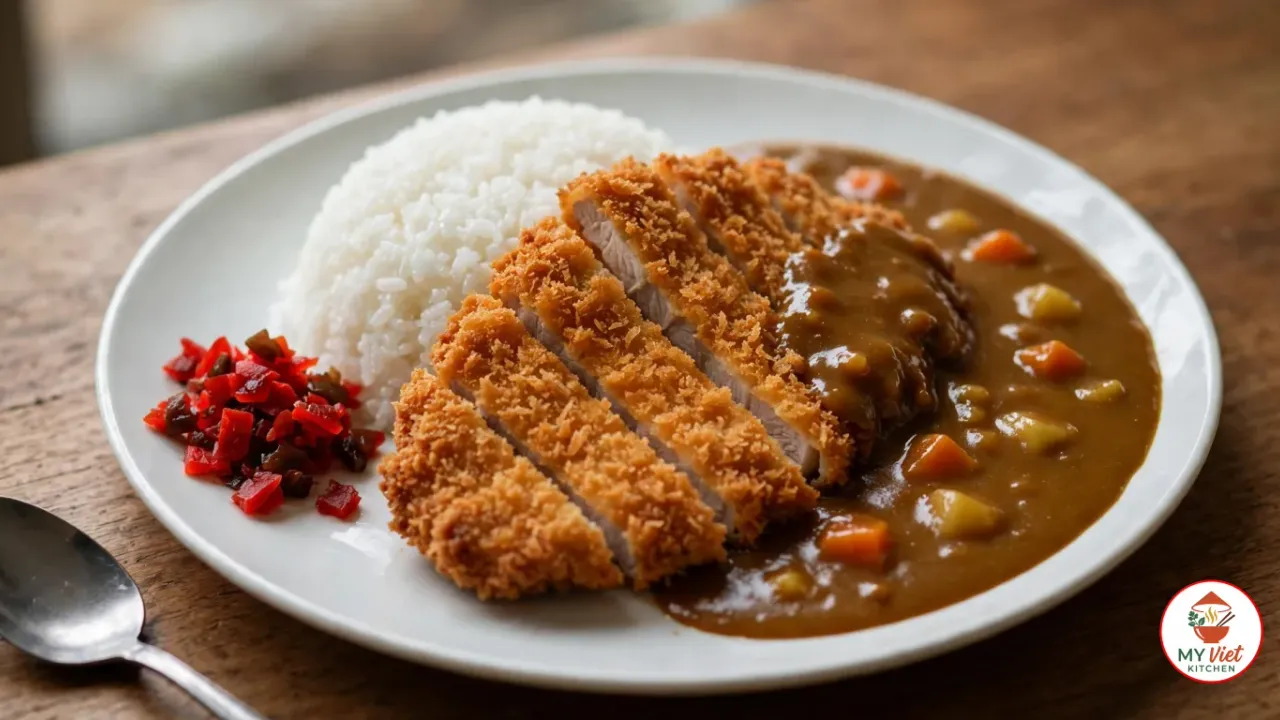
Katsu curry is a Japanese plate of tonkatsu, a panko-breaded pork cutlet, served with rice and Japanese curry. The cutlet usually comes already cut into strips, so a spoon or fork is all you need (Wikipedia). In this version the curry is thickened with a roux you brown yourself instead of a boxed block, and the cutlets fry while the sauce simmers.
Prep Time: 25 minutes | Cook Time: 1 hour | Total Time: 1 hour 25 minutes | Servings: 4
Difficulty: Medium | Calories: ~1000 per serving

Where Does Katsu Curry Come From?
Curry arrived first. It appears in Japanese cookbooks from 1872, early in the Meiji period, most likely brought by the British Royal Navy as curry powder. The Imperial Japanese Navy served it over rice instead of with bread, and thickened it with flour so it would not spoil at sea (Wikipedia). The pork cutlet came later. The European-style cutlet served in Japan was usually beef, and in 1899 Rengatei, a Western-style restaurant in Tokyo, made a pork version (Wikipedia).
Who first served the two on one plate is disputed. Three restaurants are credited: Kawakin, a food stall in Tokyo’s Asakusa district, in 1918; Ōroji, a restaurant in Shinjuku, in 1921; and Ginza Swiss in 1948 (Wikipedia). The Ginza story is the one most often told. Shigeru Chiba, a Yomiuri Giants baseball player and a regular there, complained that eating curry and a cutlet separately was too much bother. The restaurant still lists the dish as “Chiba-san’s curry” (Wikipedia).
The name also carries a pun. Katsu sounds the same as the Japanese word for “win”, MATCHA’s guide to Ginza Swiss explains, so the dish is often eaten before exams and sports matches (MATCHA).
In Britain the dish took a different path. Wagamama put katsu curry on its opening menu in 1992, and other chains followed. A JETRO report counted 17 “katsu curry” products on the website of the country’s largest supermarket chain. There, “katsu” is now also the name for a sweet curry sauce, with or without a cutlet (JETRO). In Japan the name only ever means curry served with a cutlet (Wikipedia).
Should You Use a Roux Block or Make Your Own?
Most Japanese homes make curry from instant roux, sold as blocks or powder that hold curry powder, flour, oils and flavourings. In 1963 House Foods launched Vermont Curry, a roux made with apples and honey whose mild sweetness turned curry into a children’s favourite (Wikipedia). Yumiko of RecipeTin Japan uses 230 g of it in her katsu curry. She points out that each brand needs a different amount of water, so follow the packet (RecipeTin Japan).
A block is only fat, flour and spice, so it is easy to make. Namiko Chen’s roux at Just One Cookbook uses 100 g each of unsalted butter and flour, stirred on medium-low until golden brown, which takes 20 to 25 minutes. Curry powder and garam masala go in for the last 30 seconds. She uses 6 to 7 of its 8 cubes for each litre of broth. The roux has no salt, so the curry is salted at the end (Just One Cookbook). Step 2 scales that to 60 g of each for 750 ml of stock, and the roux browns in a small pan while the onions cook.
For the spice, S&B’s curry powder in the red tin has been sold since 1923 and holds more than 80 percent of the Japanese market. Its main spices include turmeric, coriander, cumin, fenugreek, pepper, chilli and orange peel, and unlike a roux block it contains no wheat flour (Just One Cookbook). The grated apple, honey, soy sauce and ketchup are the seasonings Just One Cookbook adds to its own curry sauce (Just One Cookbook).
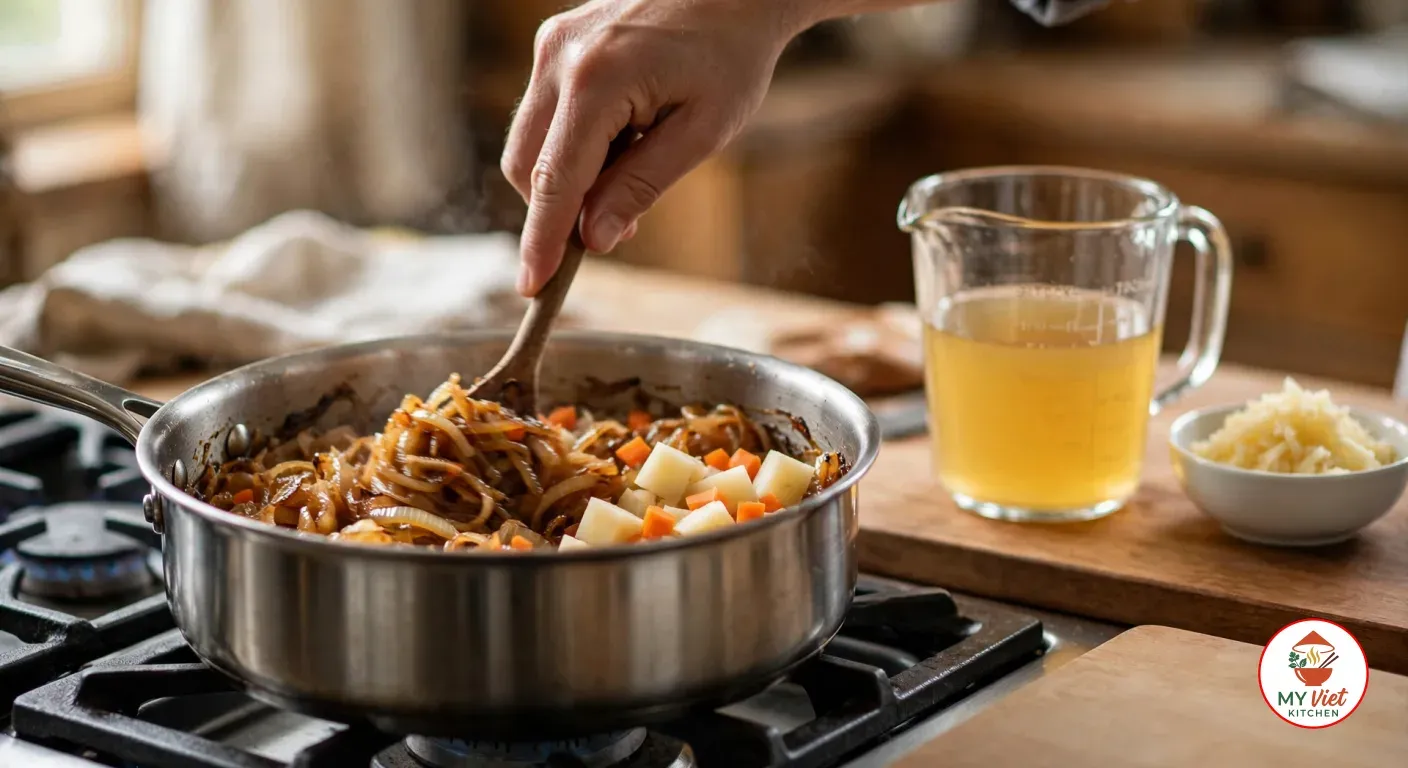
The onions give the sauce much of its sweetness. Marc Matsumoto of No Recipes says that browning onions, carrots, garlic and ginger to a glossy caramel usually takes over an hour of stirring. He grates them and adds a little baking soda, which gets them there in about eight minutes (No Recipes). At Hiden, a Japanese curry restaurant in London, the onions cook for four hours (JETRO). Twenty minutes of sliced onions, as in Step 1, lands in between. Aim for a sauce about as thick as béchamel; it sets thicker as it cools (RecipeTin Japan).
How Do You Keep the Cutlet Crisp Under the Sauce?
Start by pounding the pork thin. Marc Matsumoto flattens pork chops for katsu curry until they are about twice their original size. That gives more crust per bite and more surface for the sauce to cling to, and the cutlet fries in about half the time. Before pounding, he cuts slits 6 mm (1/4 inch) apart, no more than a third of the way through, on both sides. That cuts the connective tissue that makes a cutlet curl in the oil (No Recipes).
Then fry one cutlet at a time. Namiko Chen fries at 170 °C (340 °F) in oil about 4 cm (1 1/2 inches) deep, one piece at a time. A crowded pot cools the oil, and the crust soaks up grease. She whisks a little oil into the beaten egg so the breading stays on the meat (Just One Cookbook). A thermometer helps twice here: for the oil, and for the pork, which Health Canada says should reach 71 °C (160 °F) (Health Canada).
Last, keep some of the crust out of the sauce. Yumiko leans the cutlet strips against the rice and pours the curry into the space beside them (RecipeTin Japan). No Recipes pours it over half the katsu and serves the plate straight away, before the panko softens (No Recipes).
Ingredients for Katsu Curry
For the Curry Sauce:
- 1 tablespoon vegetable oil
- 2 medium onions (about 400 g / 14 oz), thinly sliced
- 3 garlic cloves, grated
- 1 tablespoon grated fresh ginger
- 1 medium carrot (about 120 g / 4 oz), cut into 1 cm (1/2-inch) dice
- 1 medium potato (about 200 g / 7 oz), peeled and cut into 1.5 cm (5/8-inch) cubes
- 3 cups (750 ml) low-sodium chicken stock
- 1/2 apple, peeled and finely grated
- 4 tablespoons (60 g) unsalted butter
- 1/2 cup (60 g) all-purpose flour
- 2 1/2 tablespoons Japanese curry powder, such as S&B
- 2 teaspoons garam masala
- 1 tablespoon soy sauce
- 1 tablespoon ketchup
- 1 teaspoon honey
- Salt to taste
For the Cutlets:
- 4 boneless pork loin chops, about 150 g (5 oz) each and 1.5 cm (5/8 inch) thick
- 1/2 teaspoon salt
- 1/4 teaspoon black pepper
- 1/3 cup (40 g) all-purpose flour
- 2 large eggs
- 1 teaspoon vegetable oil, for the eggs
- 2 cups (100 g) panko breadcrumbs
- About 4 cups (1 litre) vegetable oil, for deep-frying
To Serve:
- 4 cups (about 640 g) hot cooked Japanese short-grain rice
- Fukujinzuke or rakkyō pickles, for serving
Step-by-Step Instructions
Step 1: Start the Curry Sauce
1Heat the tablespoon of oil in a heavy 3-litre (3-quart) saucepan over medium heat. Add the sliced onions with a pinch of salt and cook for about 20 minutes, stirring every few minutes, until soft and deep golden brown; if they catch on the bottom, add a tablespoon of water and scrape. Stir in the garlic and ginger for 1 minute, then add the carrot and potato and stir for 2 minutes. Pour in the stock, add the grated apple and bring to a boil. Lower the heat, skim off any foam and simmer, partly covered, for 15 minutes, until a knife slides easily into the potato.
Step 2: Make the Roux and Finish the Sauce
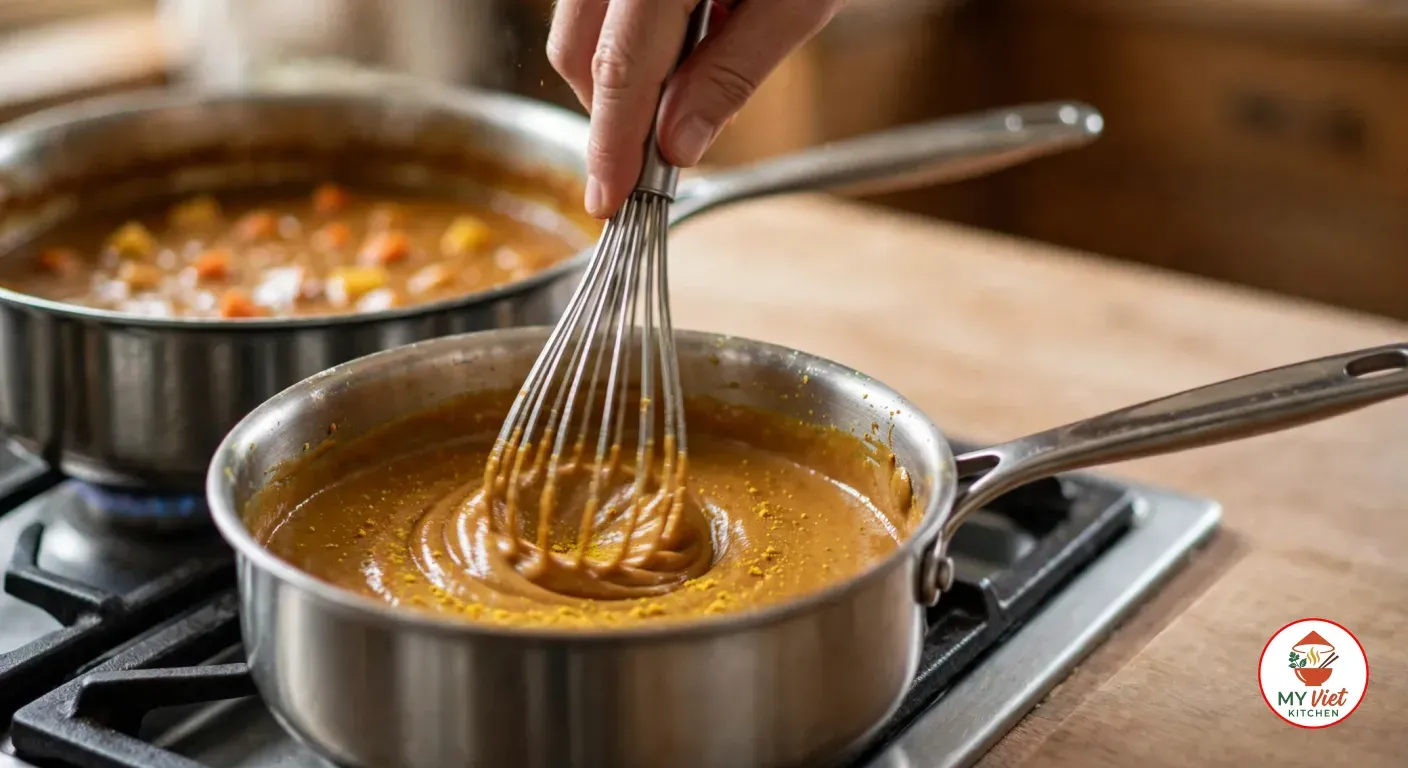
2While the onions cook, warm the butter in a small saucepan on medium-low until it melts, then stir in the 1/2 cup of flour. Keep stirring for about 20 minutes, until the roux turns golden brown and smells toasty; lower the heat if it darkens quickly. Stir in the curry powder and garam masala for 30 seconds, then take the pan off the heat. When the vegetables are tender, whisk a ladle of the hot stock into the roux until smooth, then stir it back into the saucepan. Add the soy sauce, ketchup and honey and simmer over low heat for 10 minutes, stirring often so the bottom doesn’t catch, until it is thick enough to coat a spoon. Taste, add salt as needed and keep it warm over the lowest heat.
Step 3: Prepare and Bread the Cutlets
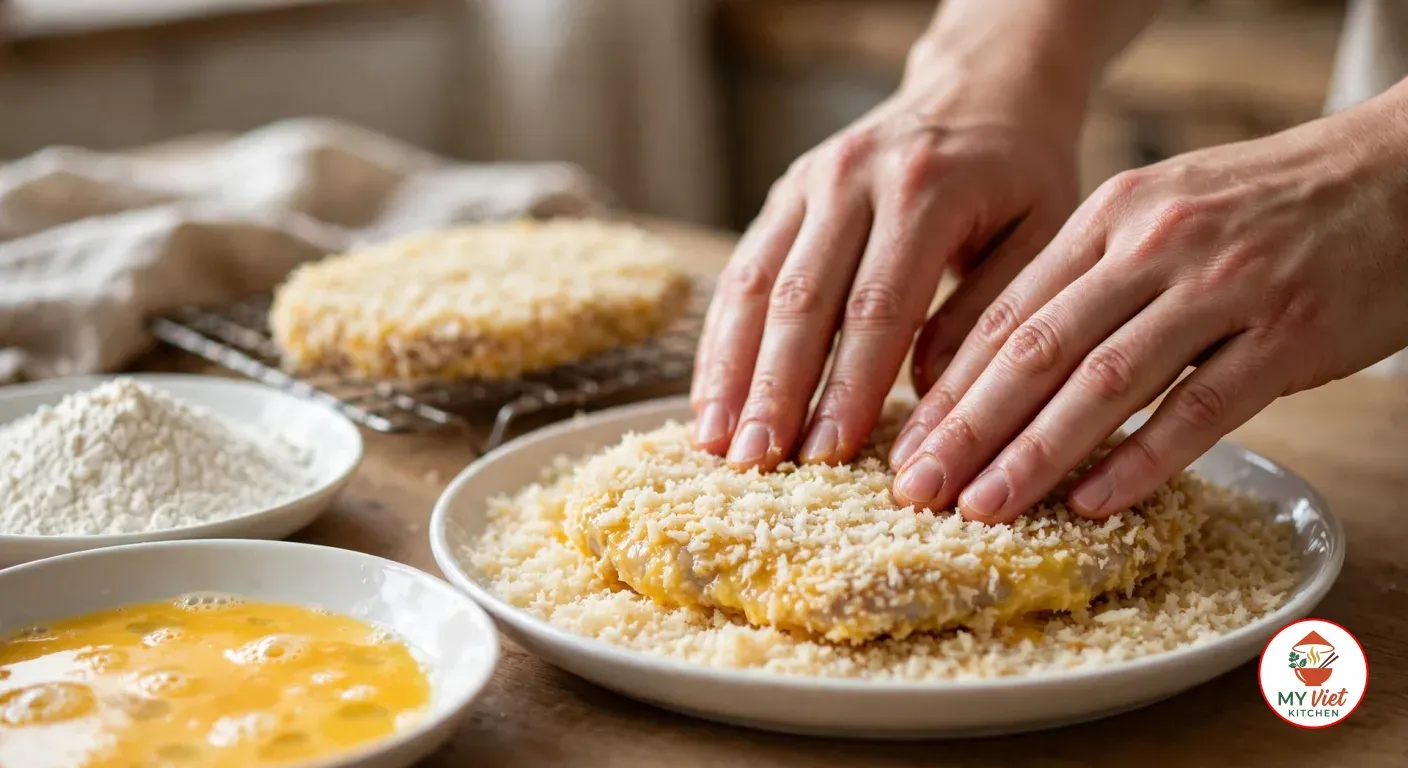
3Trim any thick fat from the pork, leaving a thin rim. Cut shallow slits 6 mm (1/4 inch) apart across both sides, no deeper than a third of the way into the meat. Cover with plastic wrap and pound with a meat mallet or rolling pin to an even 1 cm (3/8 inch). Season both sides with the salt and pepper. Put the 1/3 cup of flour, the eggs beaten with the teaspoon of oil, and the panko in three shallow dishes. Coat each cutlet in flour and shake off the excess, dip it in egg so no dry spots remain, then press it into the panko on both sides. Set the cutlets on a rack while the oil heats.
Step 4: Deep-Fry the Cutlets
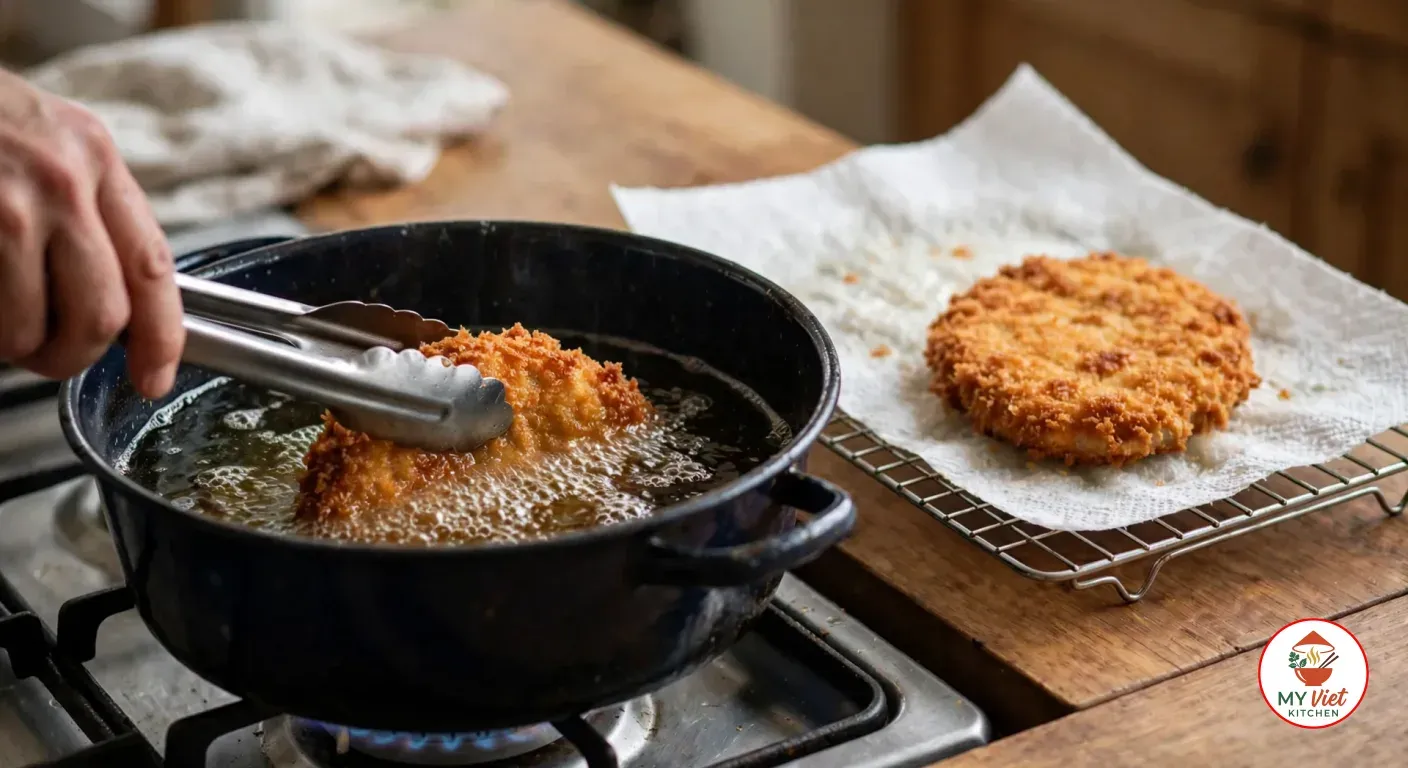
4Pour about 3 cm (1 1/4 inches) of oil into a heavy pot about 20 cm (8 inches) wide and heat it to 170 °C (340 °F) over medium heat. Lower in one cutlet and leave it alone for 2 minutes, until the crust sets, then fry for 3 to 4 minutes more, turning once or twice, until deep golden and 71 °C (160 °F) in the thickest part. Stand it on its edge on a rack lined with paper towels. Skim out loose crumbs and let the oil come back to 170 °C before the next cutlet.
Step 5: Assemble and Serve
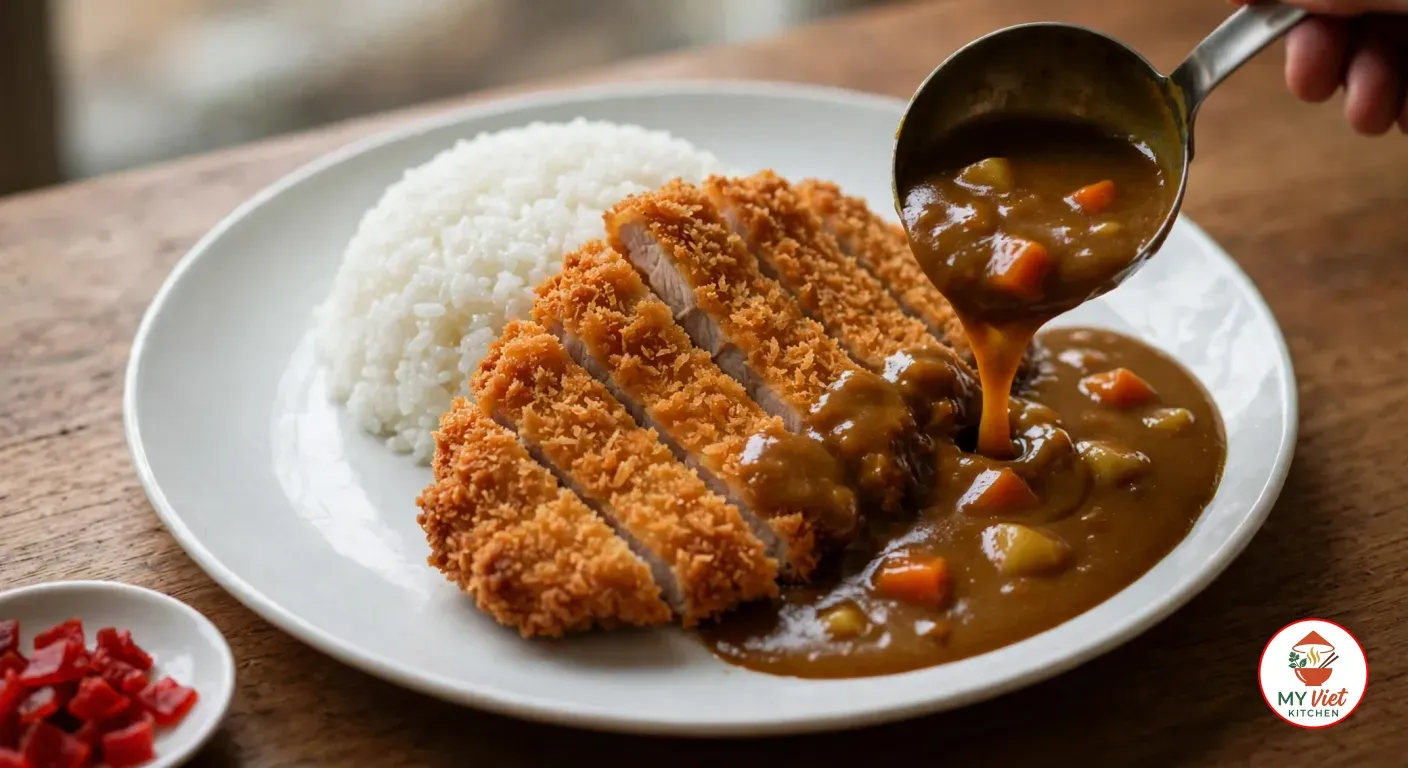
5Let each cutlet rest for 2 minutes, then cut it crosswise into strips about 2 cm (3/4 inch) wide, pressing the knife straight down. Spoon the rice onto one side of each plate and lean the strips against it. Ladle the curry into the space on the other side and over part of the cutlet, leaving some of the crust dry. Add the pickles and serve at once.
Frequently Asked Questions
Can you make katsu curry with chicken?
Yes. The pork cutlet can be swapped for chicken (Wikipedia), and in Britain chicken katsu curry is a standard item on Japanese restaurant menus (JETRO). Just One Cookbook butterflies a boneless breast and pounds it 6 mm to 1.3 cm (1/4 to 1/2 inch) thick. It fries at 170 °C (340 °F) for about 3 minutes in all, turning once (Just One Cookbook). Health Canada puts the safe temperature for chicken pieces at 74 °C (165 °F). That is a little higher than for pork chops, so check the thickest part (Health Canada).
What do you serve with katsu curry?
Pickles, mainly. Japanese curry rice usually comes with fukujinzuke or pickled rakkyō on the side (Wikipedia), and katsu curry may also come with a bowl of miso soup (Wikipedia). No Recipes adds finely shredded cabbage, the salad served with plain tonkatsu (No Recipes), and Just One Cookbook tops the plate with half a hard-boiled egg (Just One Cookbook).
Can you make katsu curry ahead?
Make the curry ahead and fry the cutlets fresh. Namiko Chen of Just One Cookbook cooks her curry the night before: it tastes better the next day and is easier to reheat while the katsu fries (Just One Cookbook). RecipeTin Japan keeps curry 2 to 3 days in the fridge or a month in the freezer. Leave the potatoes out of a batch you plan to freeze, because they turn spongy. The sauce sets thick in the fridge, so loosen it with water as it warms (RecipeTin Japan). Leftover cutlets keep 2 days in the fridge. Just One Cookbook reheats them for 15 to 20 minutes at 180 °C (350 °F), or about 30 from frozen (Just One Cookbook).
Is katsu curry spicy?
Usually not very. The heat comes from the chilli in the curry powder. Marc Matsumoto of No Recipes notes that most Japanese curry powders are fairly mild, and suggests cayenne or hot sauce if you want more (No Recipes). Just One Cookbook’s roux takes an optional 1/2 teaspoon of cayenne and advises adding it sparingly, since the heat builds as the sauce simmers (Just One Cookbook). Boxed roux comes in mild, medium-hot and hot (RecipeTin Japan).
Sources
- Katsu curry, Wikipedia
- Japanese curry, Wikipedia
- Tonkatsu, Wikipedia
- Savor Ginza Swiss’ Original Katsu Curry - Since 1947, Yoko Tagami, MATCHA, October 2017 (archived copy)
- The story of how katsu curry conquered the UK, Taste of Japan, JETRO
- How to Make Japanese Curry Roux, Namiko Chen, Just One Cookbook, August 2025
- Japanese Curry Powder, Namiko Chen, Just One Cookbook, November 2023
- Katsu Curry, Namiko Chen, Just One Cookbook, July 2024
- Chicken Katsu, Namiko Chen, Just One Cookbook, July 2025
- Katsu Curry (Japanese Curry with Chicken Cutlet), Yumiko, RecipeTin Japan, December 2021
- Katsu Curry, Marc Matsumoto, No Recipes, September 2021
- Safe cooking temperatures, Health Canada
- Tonkatsu Curry Recipe (カツカレー Katsu Curry), No Recipes, YouTube, September 2021