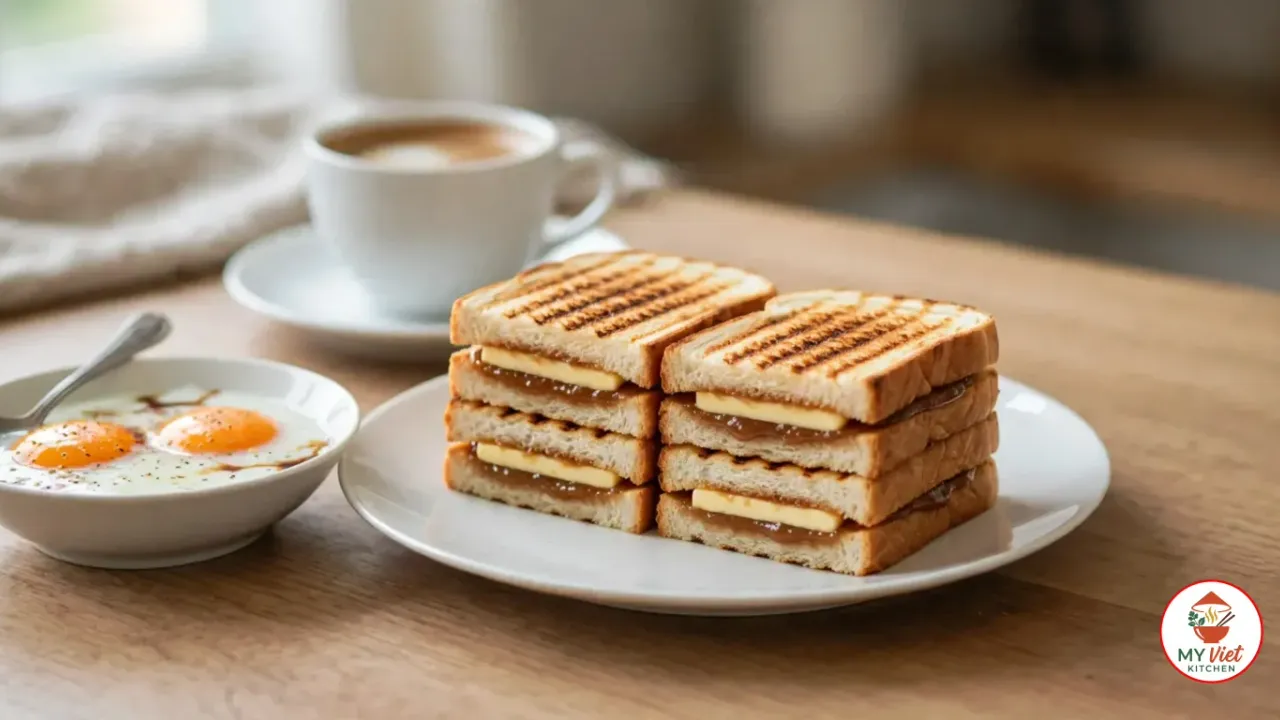
Kaya toast is a coffee-shop breakfast from Singapore and Malaysia: two slices of toast holding butter and kaya, a jam of coconut milk, eggs and sugar, usually served with soft-boiled eggs and kopi, the local coffee (Wikipedia). This recipe cooks a small jar of the dark, caramel-flavoured Hainanese kind of kaya. Then the bread is grilled and the eggs are half-boiled, as in a kopitiam.
Prep Time: 20 minutes | Cook Time: 1 hour 10 minutes | Total Time: 2 hours 30 minutes, including 1 hour of cooling | Servings: 4
Difficulty: Medium | Calories: ~470 per serving

Where Does Kaya Toast Come From?
The usual account credits Hainanese immigrants in the Straits Settlements. They served on British ships docked at the ports, and kaya toast is believed to be their adaptation of what they prepared on board. Kaya took the place of Western fruit jam. Later they opened kopitiams, coffee shops that sold coffee, tea and cakes and made their own kaya. These became a common sight in Singapore around 1945, after the Japanese occupation, when commercial rents were affordable (Wikipedia).
Two of those shops are still household names. The shopfront at 67 Killiney Road dates from late 1919. It was an ordinary Hainanese kopitiam, popular for its charcoal-grilled toast, until a regular customer, Woon Tek Seng, bought it in 1993 and renamed it Killiney Kopitiam. It holds a Singapore Book of Records entry as the oldest existing Hainanese coffee shop (Killiney Kopitiam).
The other began with Loi Ah Koon, who arrived from Hainan in 1926 and worked as a coffee-stall assistant before running his own stall at Telok Ayer Basin. His wife suggested cutting each slice of bread in half and pairing the toast with the kaya she made, and that became the stall’s signature. It was registered as Ya Kun Coffeestall in 1944, and the chain now has more than fifty outlets in 14 countries (Wikipedia).
The dish is not Singapore’s alone. In Malaysia, toast with butter and kaya is roti bakar, sometimes called kaya toast in English (Wikipedia). SBS Food describes it as a breakfast served in kopitiams all over Penang (SBS Food). People eat it in the morning or as a late-afternoon snack. Sellers have swapped charcoal for electric grills and their own loaves for factory bread, but Ya Kun and Killiney still make kaya to traditional recipes. In October 2021 the Monetary Authority of Singapore put kaya toast on commemorative coins, issued to mark the UNESCO listing of hawker culture the year before (Wikipedia).
Which Kaya Goes on the Toast?
Kaya means “rich” in Malay, a reference to its texture. It is made from coconut milk, chicken or duck eggs and sugar, and flavoured with pandan leaves. Its colour depends on the egg yolks, the amount of pandan and how far the sugar is caramelised. Nyonya kaya is light green. Hainanese kaya is a darker brown and uses caramelised sugar. Where the jam itself comes from is less clear: some sources describe it as a Eurasian jam adapted from a Portuguese egg jam (Wikipedia).
The brown kind is the one tied to the kopitiam. Adam Liaw presented SBS’s Destination Flavour Singapore. He thinks kaya toast “might be the Hainanese community’s greatest contribution to the cuisine of the Malay peninsula”. In his telling they took the coconut jams found around Asia and boosted the flavour with dark caramel (Adam Liaw).
His full batch uses 10 eggs, 600 to 750 g of caster sugar, 400 g of coconut cream and five knotted pandan leaves. He stirs the sugar into the eggs slowly, in one direction and without lifting the whisk, because lifting it beats in air bubbles. The pot then stands on a tea towel in a larger pan of simmering water. The kaya has to be thick before the caramel, 50 g of sugar finished with 20 g of butter, goes in (Adam Liaw). The steps below make four-tenths of that batch, enough for this breakfast and several more.
Two details shorten the stirring. Thickening takes anywhere from 30 minutes to an hour or more, depending on the heat and on how much liquid the coconut cream carries. With a can, Liaw leaves it unshaken and scoops out only the thick cream on top (Adam Liaw). In the version he wrote for SBS, the kaya is ready for its caramel when it has the consistency of hollandaise or a loose lemon curd. Fresh pandan leaves, that recipe notes, give the jam a slightly toasted, nutty flavour (SBS Food).
A jar from a shop is no disgrace. KP Kwan of Taste of Asian Food has made these eggs in a restaurant kitchen. He suggests buying kaya when all you want is a quick breakfast, because it takes time and cannot be cooked over high heat. Kaya without pandan is light brown, he adds, and kaya with pandan a natural light green. He steers clear of bright green jars, which are likely coloured (Taste of Asian Food).
How Do Kopitiams Make the Toast and Eggs?
Kwan sets three tests for the toast. The bread is cut at least half an inch thick. It is grilled over charcoal, or failing that on a grill pan. And it is filled with plenty of kaya and a slab of cold butter. Medium to high heat leaves it crusty outside and soft inside. Some coffee shops rest the butter slabs on ice cubes so they reach the table unmelted (Taste of Asian Food). In Penang, many kopitiams bake the Hainanese bread in-house and toast it by hand over charcoal. The butter is there because it “balances the sweet-salty taste of the toast” (SBS Food).
Liaw describes two ways to build it. For the first, the toast loses its crusts, is covered with thick slices of butter and lots of kaya, and is cut in half. For the second, which he calls wafer-style, each slice is grilled on both sides and then split horizontally into two thin sheets, which are filled the same way. He cuts the butter with a cheese slicer to keep the slices even (Adam Liaw). The kaya itself is the subject of Part 1 of his video series.
The eggs are half-boiled, which is looser than a Western soft-boiled egg: white and yolk are both still runny when served (Taste of Asian Food).
Nobody actually boils them. In the Penang recipe a saucepan of water is boiled and taken off the heat, and the eggs sit in it, covered, for 7 minutes (SBS Food). Liaw cools the boiled water with 125 ml (1/2 cup) of cold water before the eggs go in and gives them 6 minutes (SBS Food). Kwan pours 2 litres of boiling water over four room-temperature eggs and waits 4 minutes, or 6 for firmer eggs, and warns that eggs straight from the fridge need longer. He seasons them with light soy sauce and white pepper and regards dark soy as some shops’ own interpretation. To eat, dip the toast into the egg, then lift the plate and slurp what is left (Taste of Asian Food).
Ingredients for Kaya Toast
For the Kaya:
- 4 large eggs
- 1 1/4 cups (250 g) caster (superfine) sugar
- 1/8 teaspoon salt
- 2 pandan leaves, tied in a knot
- 2/3 cup (160 g) thick coconut cream, scooped from the top of an unshaken can
- 1 1/2 tablespoons (20 g) caster sugar, for the caramel
- 2 teaspoons (8 g) unsalted butter, for the caramel
For the Toast:
- 8 slices soft white sandwich bread, about 1.5 cm (5/8 inch) thick
- 4 tablespoons (60 g) cold salted butter
For the Half-Boiled Eggs:
- 4 large eggs, at room temperature
- Light or dark soy sauce, to taste
- Ground white pepper, to taste
- Hot kopi or strong black coffee, for serving
Step-by-Step Instructions
Step 1: Dissolve the Sugar in the Eggs
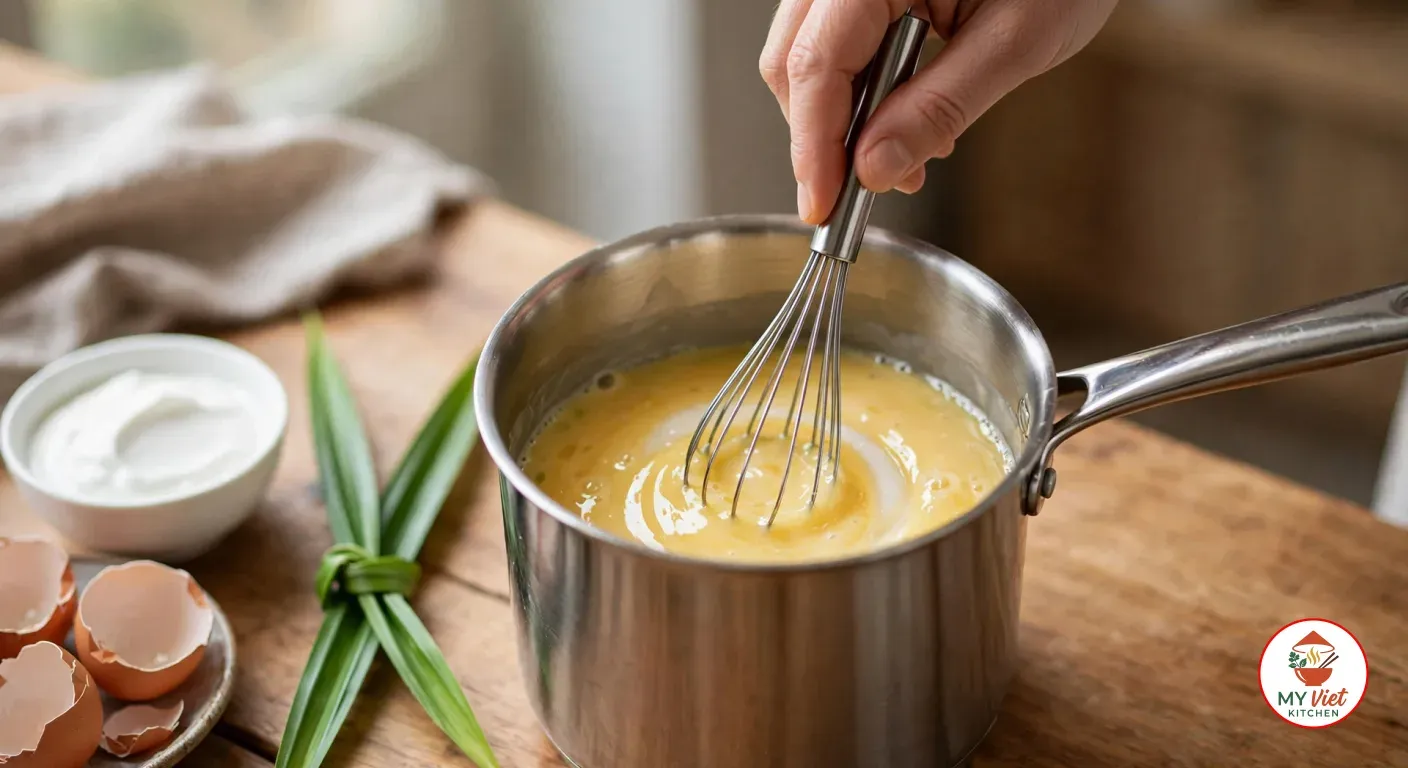
1Crack 4 eggs into a small, deep saucepan of about 1.5 litres (1 1/2 quarts) and add the 250 g of sugar and the salt. Stir slowly with a whisk, always in the same direction and without lifting it out of the mixture, for about 10 minutes, until it is smooth and runny and most of the sugar has dissolved. Meanwhile, lay a folded tea towel in the bottom of a wide pot, pour in water to a depth of about 5 cm (2 inches) and bring it to a gentle simmer.
Step 2: Cook the Kaya over Simmering Water
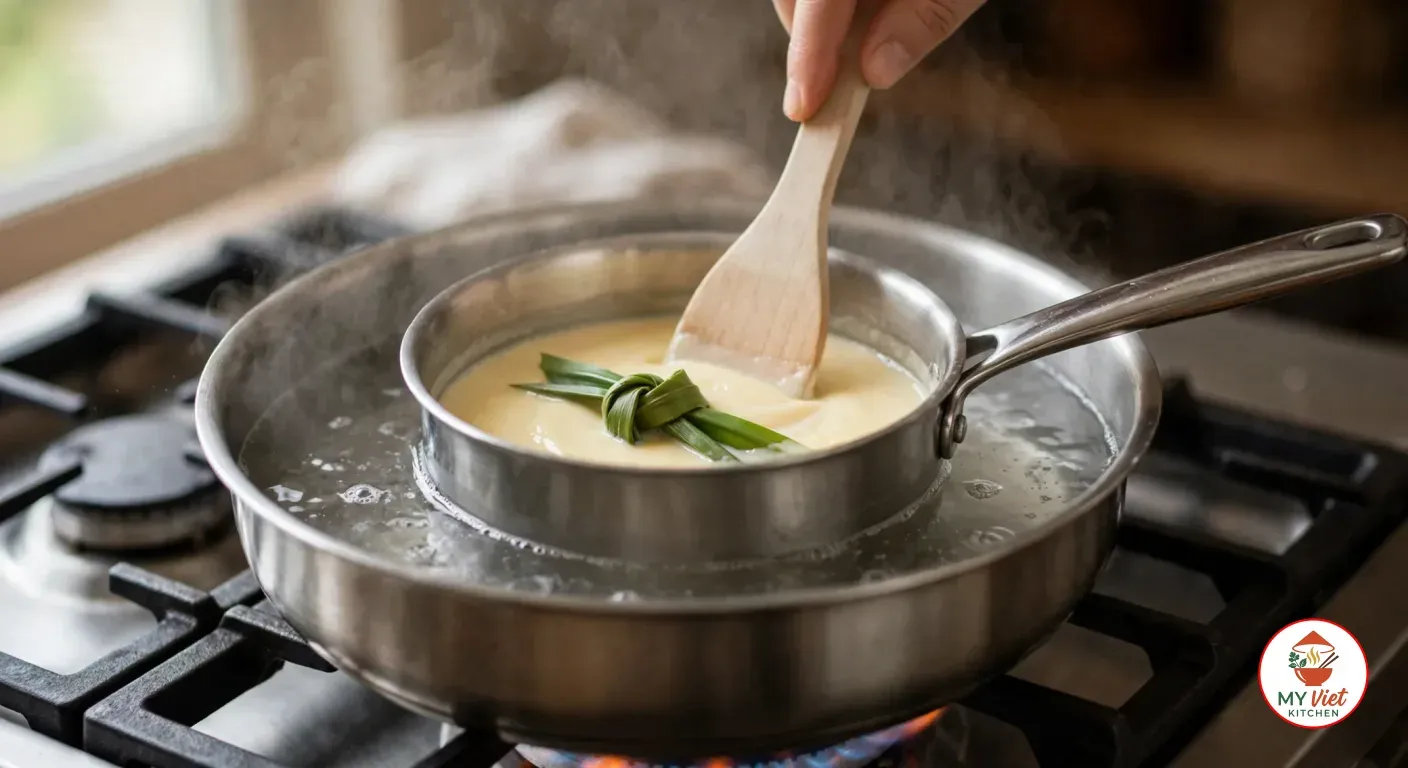
2Stand the saucepan on the towel in the simmering water, which should reach about halfway up its sides. Stir for 5 minutes, until no grains of sugar are left. Add the knotted pandan leaves and the coconut cream. Keep the water at a bare simmer and stir often with a spatula, scraping the bottom and the corners, for 30 to 45 minutes, until the kaya is as thick as a loose lemon curd and coats the spatula. Add hot water to the pot if the level drops.
Step 3: Add the Caramel and Cool
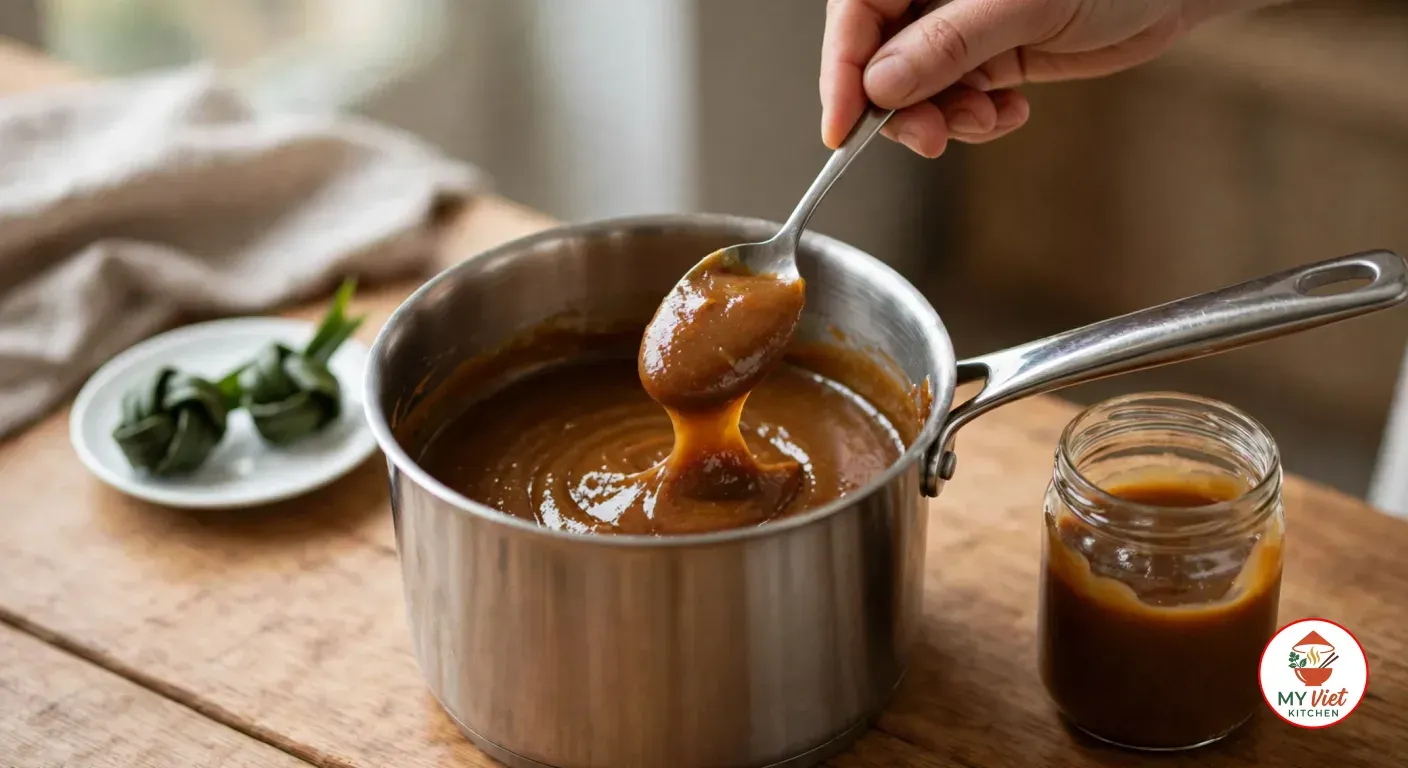
3Lift the saucepan out of the water. Melt the 20 g of sugar in a small pan over low heat, swirling instead of stirring, until it is a dark amber caramel, about 5 minutes. Off the heat, add the 2 teaspoons of butter and stir until smooth. Whisk the caramel into the kaya at once; it may harden into threads at first. Put the saucepan back in the water and stir for about 5 minutes, until the caramel has melted in and the kaya is thick again. Fish out the pandan leaves. Leave the kaya to cool for about 1 hour, stirring now and then, then pour it into a clean jar and refrigerate. This makes about 1 2/3 cups (400 ml).
Step 4: Half-Boil the Eggs
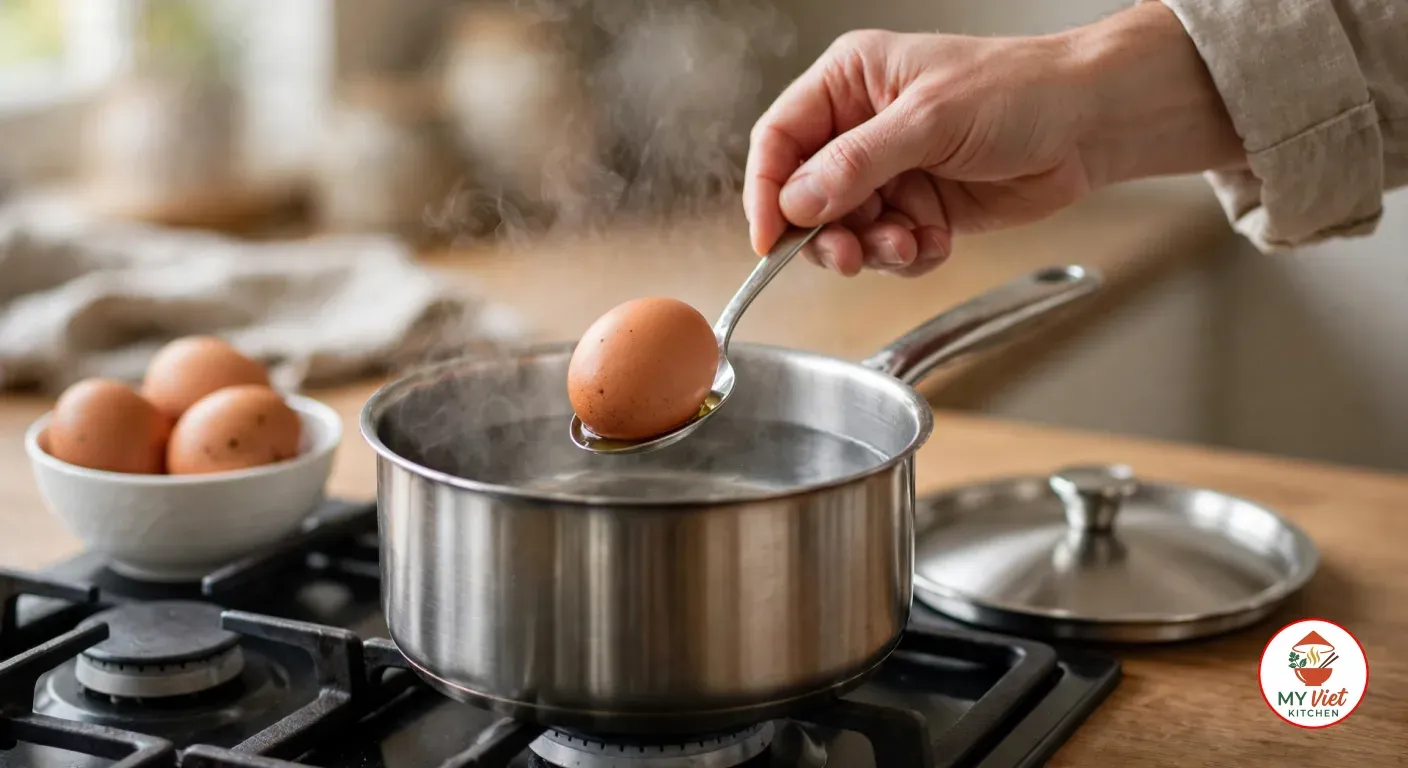
4Bring about 1.5 litres (6 cups) of water to a full boil in a medium saucepan, then turn off the heat. Lower in the 4 room-temperature eggs one at a time with a spoon, put the lid on and set a timer for 7 minutes. Cut the cold butter into 8 thin slabs and put them back in the fridge.
Step 5: Grill the Bread
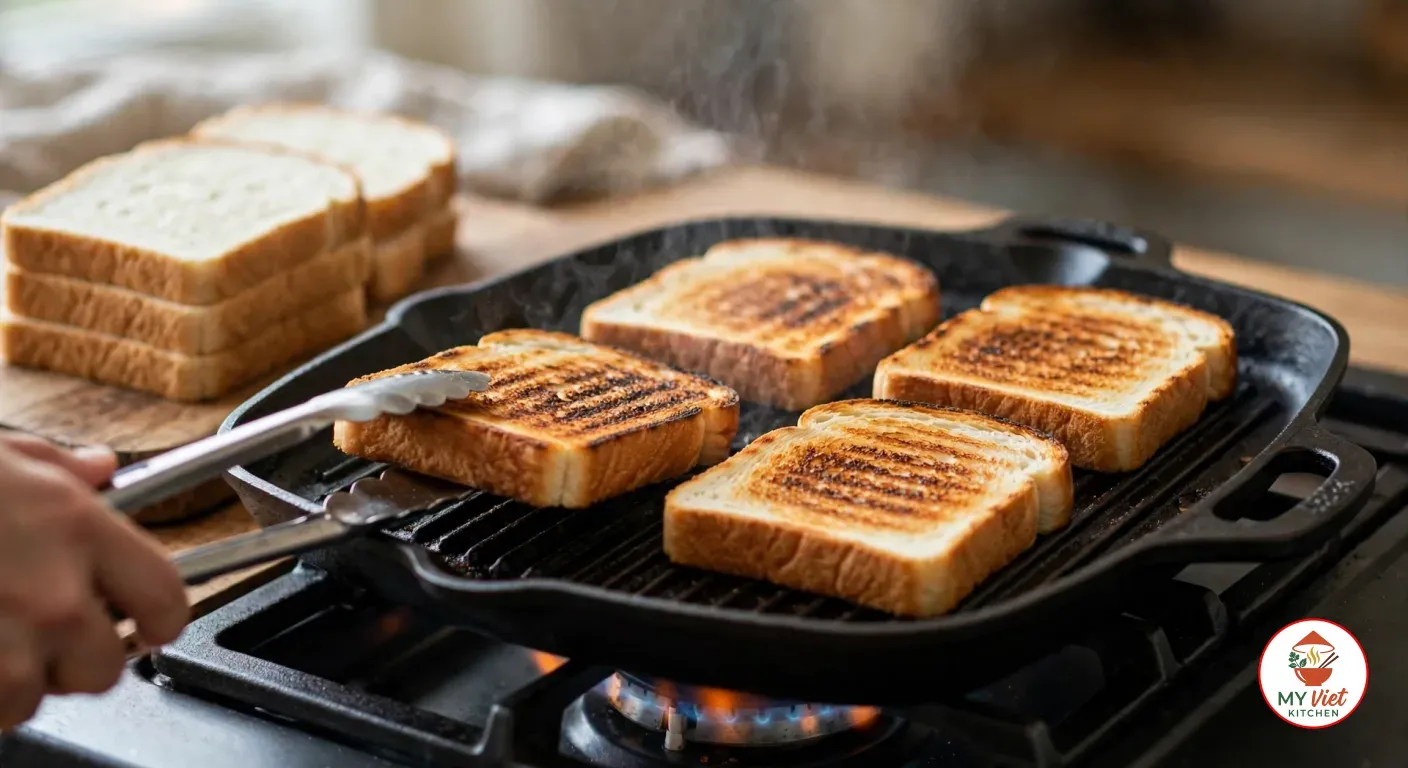
5While the eggs sit in the hot water, heat a ridged grill pan or a heavy frying pan over medium-high heat. Grill the bread dry, 4 slices at a time, 1 to 2 minutes a side, until well browned and crusty outside but still soft in the middle.
Step 6: Assemble and Serve
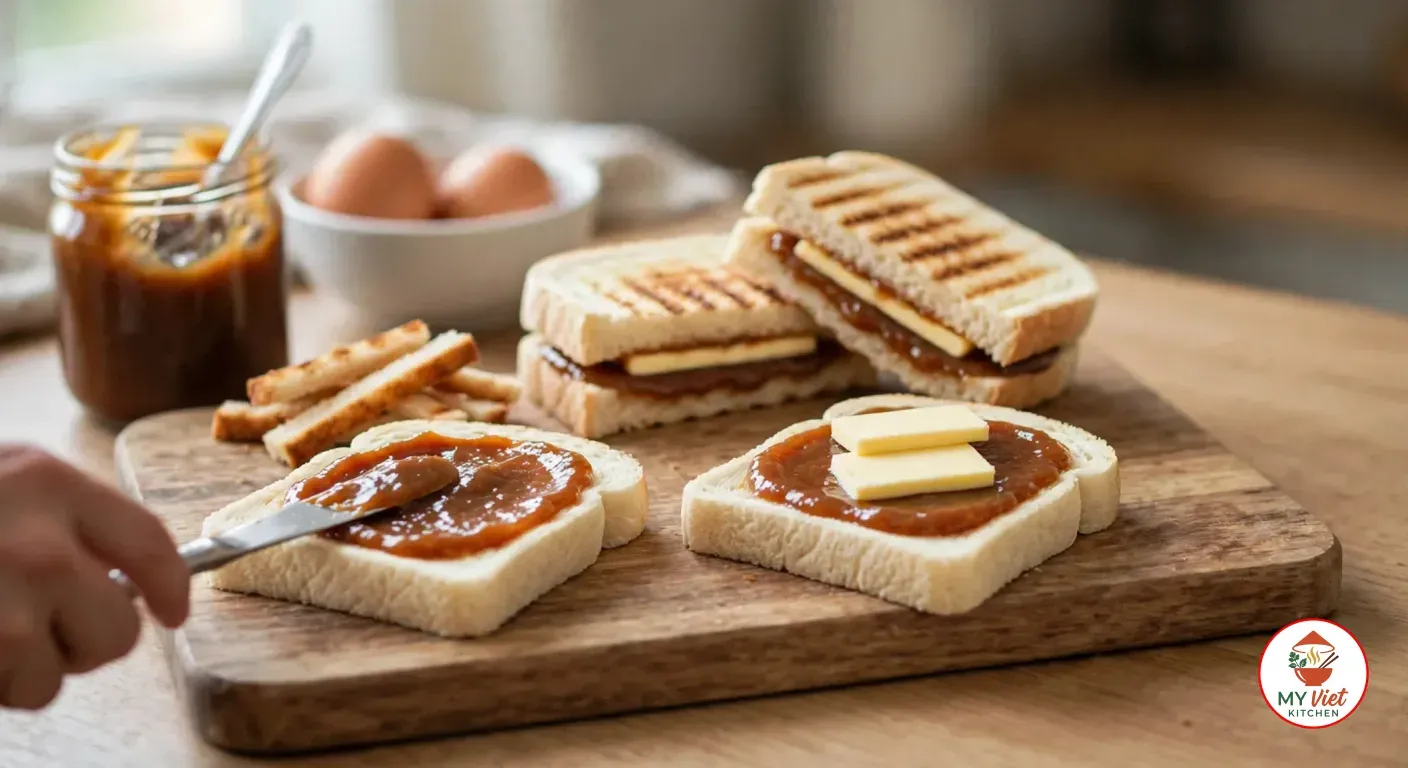
6When the timer rings, lift the eggs out of the water and set them aside. Trim the crusts off the toast. Spread about 1 tablespoon of kaya on every slice, lay 2 slabs of cold butter on half of the slices and close them with the rest, kaya side down. Cut each sandwich in half. Crack each egg into a small bowl, scooping out any white that clings to the shell: the white should be milky and barely set, the yolk liquid. Season with a few drops of soy sauce and a pinch of white pepper, and serve with the toast and hot coffee.
Frequently Asked Questions
How long does kaya keep?
In the fridge, one to two weeks. Adam Liaw’s SBS recipe keeps kaya refrigerated in sterilised jars for that long (SBS Food). It is an egg custard, not a boiled fruit jam, so chill it as soon as it has cooled. The Singapore Food Agency’s advice for food containing eggs is to refrigerate it promptly, below 4 °C (39 °F) (SFA).
Are half-boiled eggs safe to eat?
They carry some risk. The Singapore Food Agency explains that lightly cooked eggs are relatively safe in Singapore, because the farms supplying the country must be free of Salmonella Enteritidis. It warns travellers that eggs elsewhere may not be suitable. Even so, it notes that runny whites and yolks may still contain bacteria. It advises young children, pregnant women, the elderly and people with weakened immune systems to avoid raw eggs, and suggests pasteurised eggs for dishes that need raw or lightly cooked ones (SFA).
Can you make kaya toast without a grill pan?
Yes. The SBS recipe from Penang grills the bread in a hot frying pan or under a hot oven grill until well toasted on both sides (SBS Food). KP Kwan points out that bread cut thick enough for kaya toast may not fit the slots of a regular electric toaster (Taste of Asian Food). Ordinary sliced bread does fit, and Adam Liaw’s recipe asks only that the bread be grilled until well toasted (Adam Liaw).
What do you drink with kaya toast?
Kopi, the region’s coffee. Ordered plain, kopi comes with sugar and condensed milk; kopi O is black with sugar, and kopi C has sugar and evaporated milk. For Hainanese-style kopi the beans are roasted with sugar and margarine (Wikipedia). At home, Adam Liaw simmers 2 tablespoons of dark-roasted, Hainanese-style ground coffee in about 500 ml (2 cups) of water for about 20 seconds. He pours it through a filter and stirs in 2 teaspoons of sugar (SBS Food). KP Kwan sometimes orders cham, coffee mixed with tea (Taste of Asian Food).
Sources
- Kaya toast, Wikipedia
- Coconut jam, Wikipedia
- Ya Kun Kaya Toast, Wikipedia
- Kopi (drink), Wikipedia
- About Us, Killiney Kopitiam
- Hainanese-style Kaya and Kaya Toast, Adam Liaw
- Kaya toast with half-cooked eggs and Hainanese coffee, Adam Liaw, SBS Food, February 2017
- Hainanese-style Kaya toast and half-boiled egg, Aim Aris and Ahmad Salim, SBS Food, December 2022
- How to make kaya toast and half-boiled egg, KP Kwan, Taste of Asian Food, September 2022
- Are Raw Eggs Safe to Eat?, Herman Teo, Singapore Food Agency, February 2023
- How to Make Kaya Coconut Jam | PART 1 | Hainanese-style Kaya | Malaysian & Singaporean Recipe, Adam Liaw, YouTube, July 2018
- Two Ways to Make Great Kaya Toast | Part 2 | Hainanese-style Coconut Jam | Recipe, Adam Liaw, YouTube, July 2018