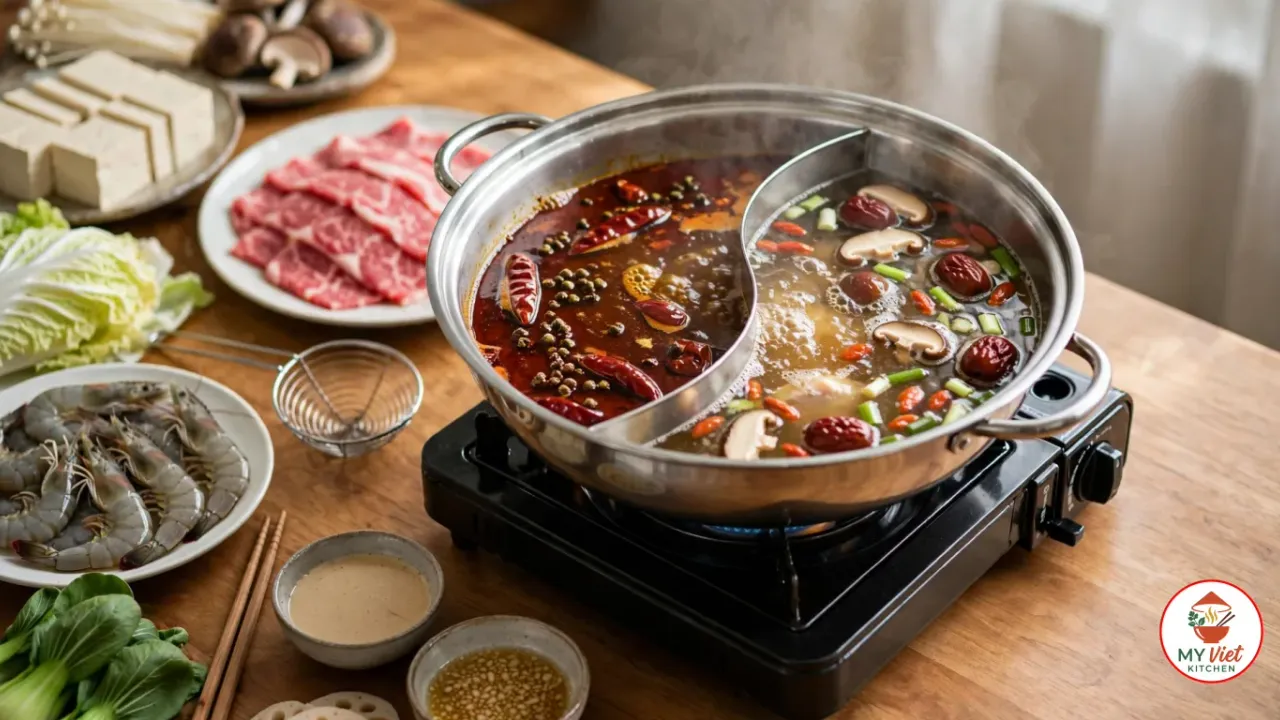
Hot pot is a Chinese meal of soup or stock kept simmering over a heat source on the table, in which diners cook raw meat, vegetables and soy foods. Each cooked piece then goes into a dipping sauce (Wikipedia). Its Chinese name, huǒguō, means “fire pot”. This recipe fills a divided pot with a numbing, chilli-red Sichuan-style broth on one side and a mild chicken broth on the other, for four people.
Prep Time: 1 hour, including a 30-minute soak | Cook Time: 1 hour 15 minutes (30 minutes for the broths, about 45 at the table) | Total Time: 2 hours 15 minutes, plus 1 to 2 hours of freezing if you slice the meat yourself | Servings: 4
Difficulty: Medium | Calories: ~1,100 per serving

What Goes Into a Spicy and a Mild Hot Pot Broth?
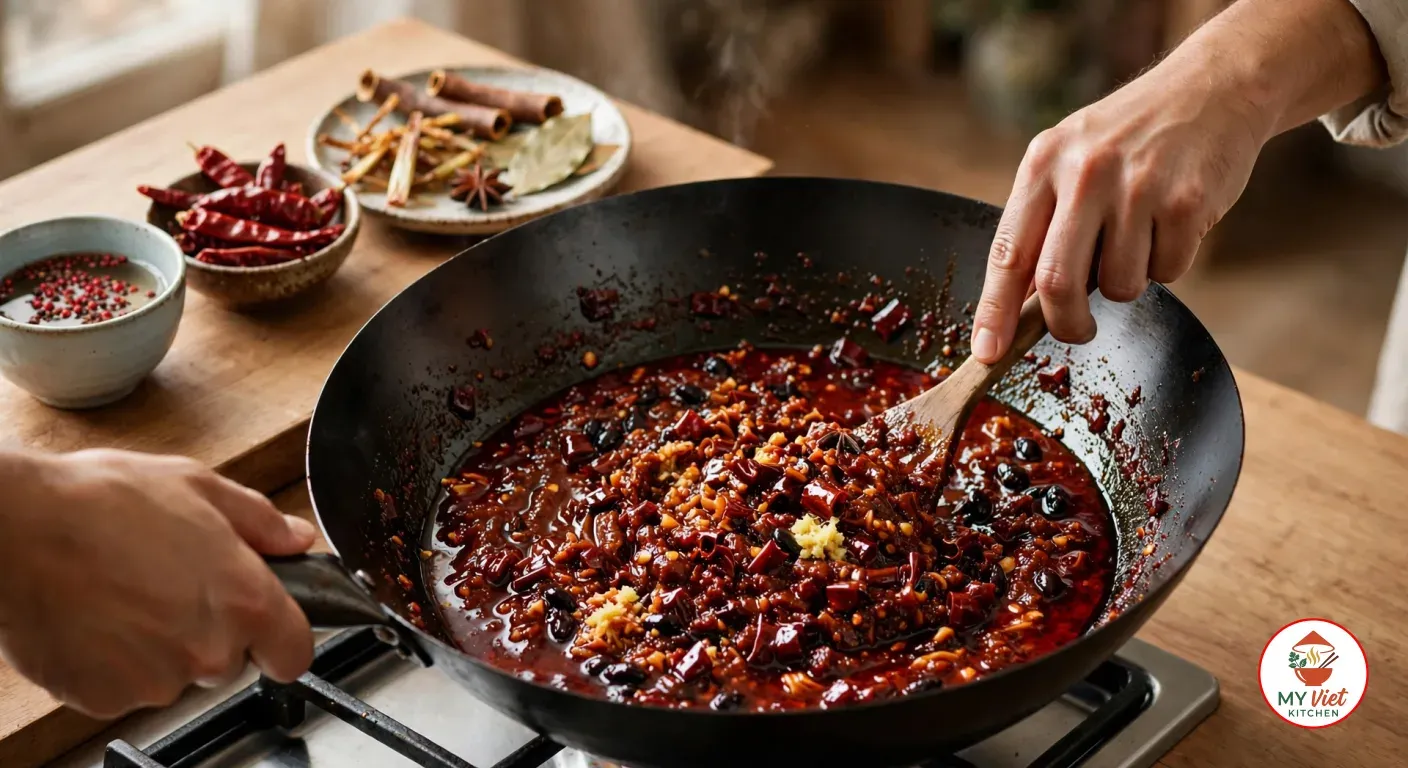
The red broth is the one most people picture. Wei Guo of Red House Spice writes that the most popular type, hong you guo di (“red oil hot pot broth”), comes from Sichuan and Chongqing. It is high in fat, usually beef tallow but sometimes cooking oil, and it tastes of mala: mouth-numbing and hot. Dried chillies and Sichuan pepper create the mala. Chilli bean paste and fermented black beans bring savoury depth and salt, and star anise, cassia and bay leaves perfume the fat (Red House Spice).
Tallow is what separates the two big spicy styles. Maggie Zhu of Omnivore’s Cookbook describes the Chongqing base as red chilli oil made with beef fat and few spices. It is oilier, spicier and heavier than the Sichuan base, which uses vegetable oil (Omnivore’s Cookbook).
In Chengdu and Chongqing the fat is often rendered beef tallow, writes Taylor Holliday of The Mala Market. Too much of it, she warns, can make the room smell like a barnyard, so her recipe mixes tallow with roasted rapeseed oil (The Mala Market). This recipe also combines the two: 100 g of tallow with a little oil. All oil works too; the broth is just less savoury.
Most homemade bases are made ahead. Red House Spice chills its batch for at least 24 hours, then cuts it into four blocks. One block and about 1.5 litres of hot water or stock fill one side of a divided pot (Red House Spice).
Here you make a single side’s worth on the day. The Mala Market works the same way: its base simmers in stock for 10 minutes, then steeps, preferably for at least half an hour, while you prepare the rest (The Mala Market). Soak the dried chillies first. Wei Guo explains that soaking makes them easier to chop and keeps them from burning in the hot fat (Red House Spice).
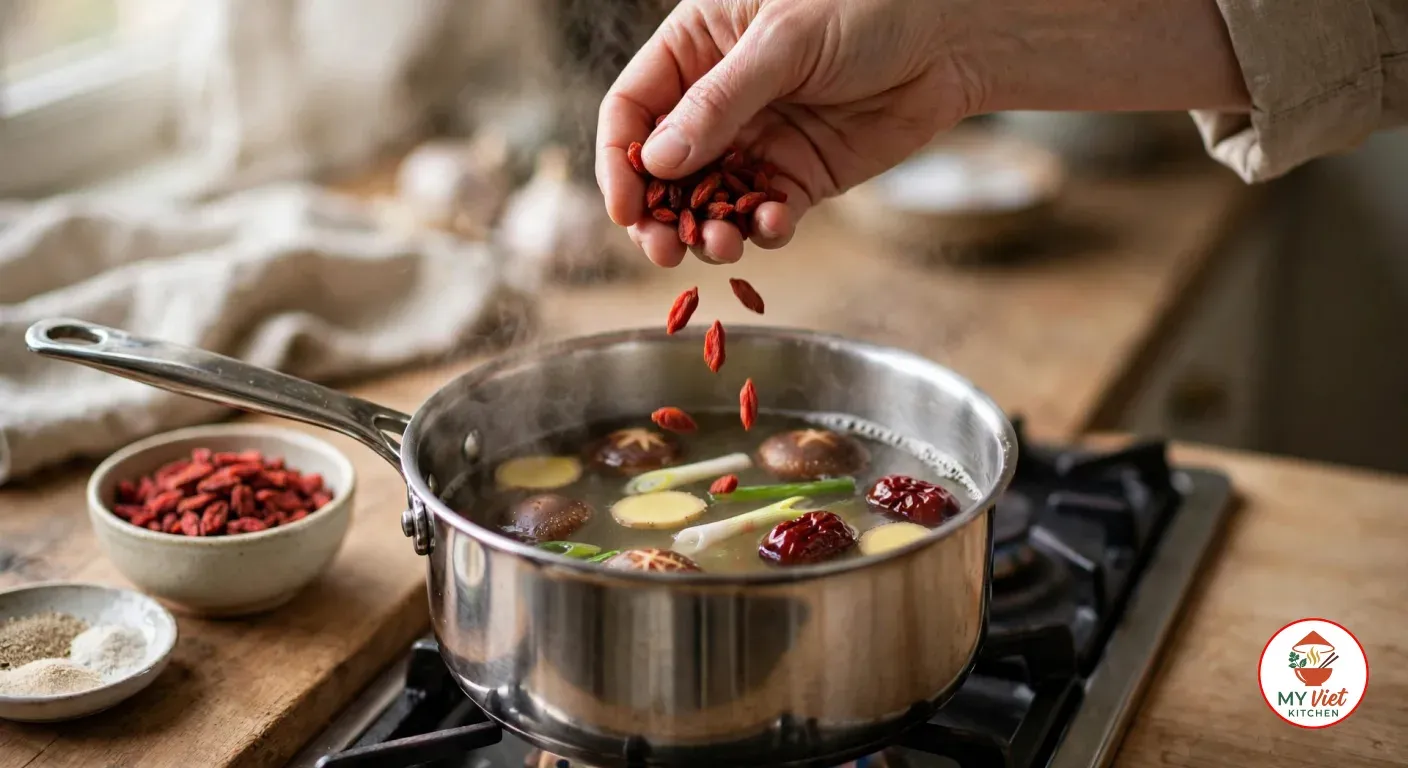
The mild side is qing tang guo di, clear broth: stock with aromatics, herbs and sometimes vegetables. The simplest version is water, scallions and ginger, as in Beijing lamb hot pot (Red House Spice). Zhu, who grew up in Beijing, calls clear broth the default in northern China. Her family made it with water, scallions, ginger, peppers, shiitake and jujubes (Omnivore’s Cookbook). That split runs through the dish: southern styles lean to spicy broths and complex sauces, while northern ones are simpler and focus more on meat, particularly mutton (Wikipedia).
How Do You Set Up a Divided Pot and Burner?
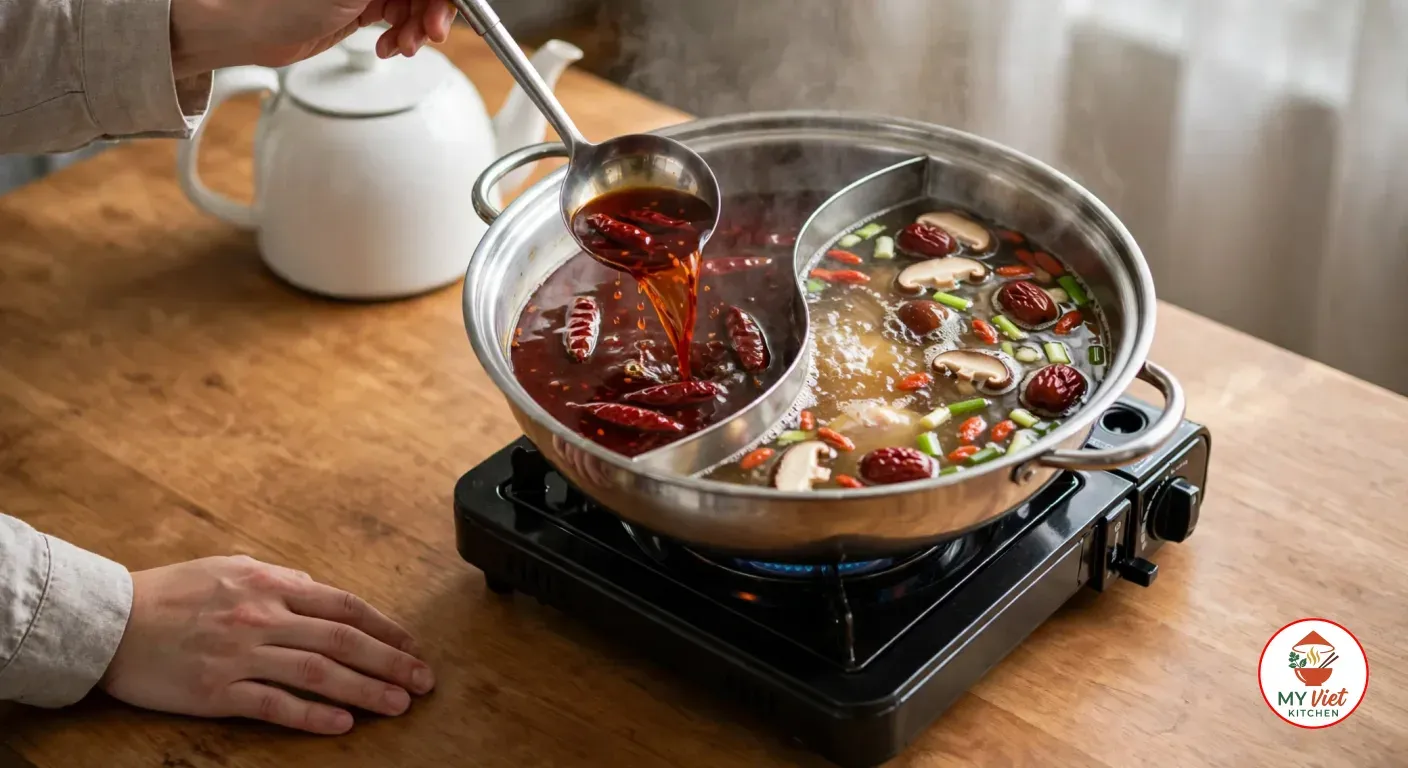
You need a heat source at the table and a wide pot. Sarah Leung of The Woks of Life says any portable heat source works. That can be an electric coil or induction burner, a tabletop gas burner, or a hot pot set with its own heating element. She calls Chinese stainless steel hot pots ideal: wide and deep enough to hold plenty of food, and thin enough to heat quickly when more goes in. Some have a “yin-yang” divider for two soups at once (The Woks of Life).
With no split pot, Zhu suggests two pots with different broths. A big pot usually serves six people perfectly, she adds, and possibly eight (Omnivore’s Cookbook).
A butane burner needs some care. Singapore’s Consumer Product Safety Office says to use it in a well-ventilated place with air flowing over the top and sides. It warns against pans larger than the manual allows, because they concentrate heat back towards the gas canister, which can overheat and explode. After use, take out the canister, cap it and store it somewhere cool and away from flames, even when empty (Consumer Product Safety Office). Check the burner’s largest permitted pot size before you buy a divided pot for it.
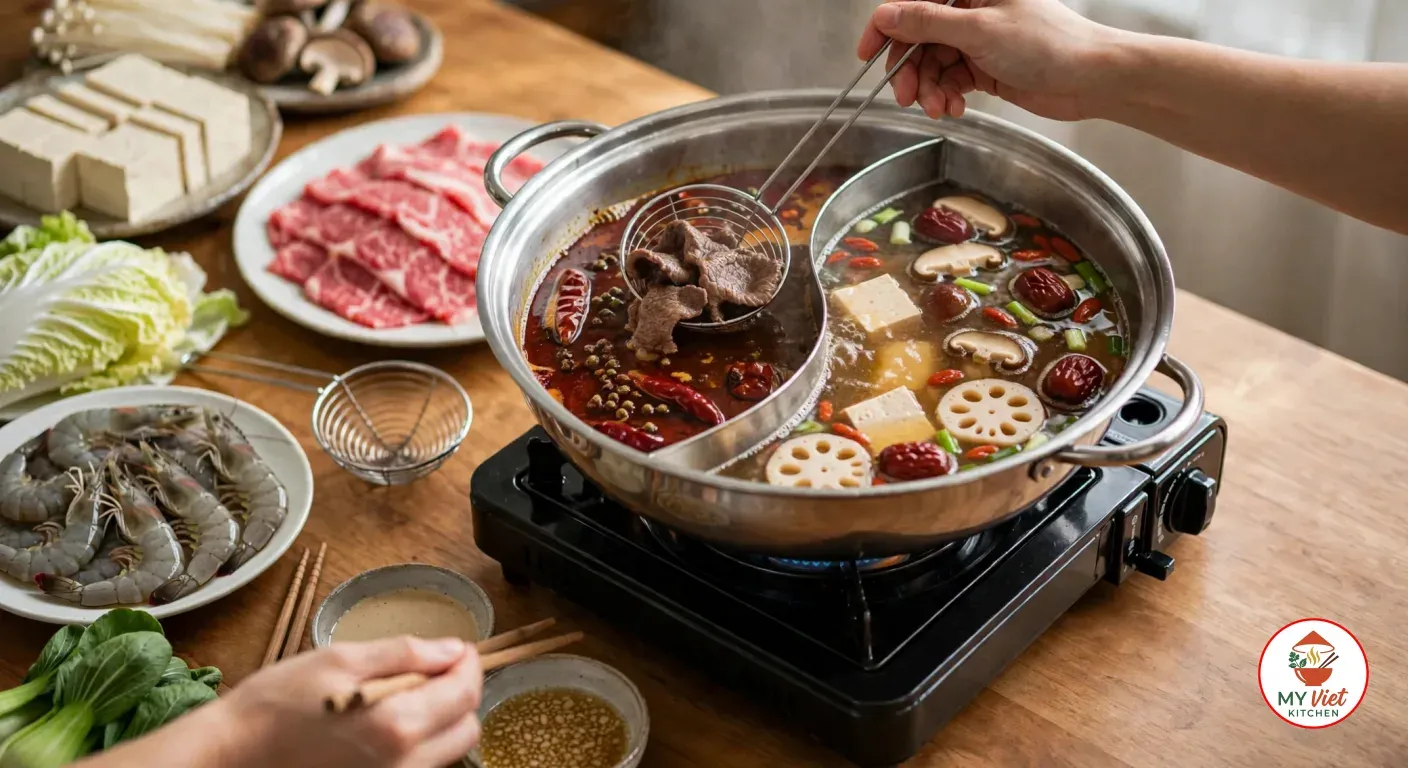
Small tools make the meal easier. Wire ladles hold food under the boiling broth and tip it neatly into your bowl. Bamboo or wooden chopsticks are best: plastic can melt, and metal conducts heat (The Woks of Life). Give each person one or two small sauce bowls and a plate (Omnivore’s Cookbook).
How Long Do Hot Pot Ingredients Take to Cook?
Seconds for thin meat and soft greens, minutes for everything else. Zhu’s timings: thinly sliced meat usually needs less than 30 seconds, spinach 30 seconds, and bok choy and napa cabbage 2 to 4 minutes. Small mushrooms take 2 to 3 minutes, large shiitake 5 or more, and frozen fish balls 2 to 4. Tofu goes in early and comes out after 10 minutes or longer (Omnivore’s Cookbook). The Woks of Life gives enoki 30 to 45 seconds and frozen dumplings 5 to 10 minutes (The Woks of Life).
Hong Kong’s Centre for Food Safety calls inadequate cooking a major food safety risk in hot pot. Whenever water or soup is added, take food out only after the soup is back at a full boil. Don’t overfill the pot, and cook larger pieces to a core temperature of at least 75°C (167°F) (Centre for Food Safety).
Shrimp should be cooked until the shells turn red and the flesh is white and opaque (Centre for Food Safety). The Woks of Life lets the broth boil for at least 30 seconds to 1 minute after raw meat goes in before anything else comes out (The Woks of Life).
Raw and cooked food sit close together at a hot pot table. The Centre for Food Safety warns that this raises the chance of pathogens from raw ingredients reaching cooked food, and advises different chopsticks and utensils for each (Centre for Food Safety). Put cooking chopsticks or tongs on every raw plate and keep your own pair for eating. Small frozen items such as fish balls and dumplings can go into the pot straight from frozen, the Centre adds.
Cook the noodles early. Zhu says to serve them at the start, because the broth gets too cloudy after all the cooking, and that they more commonly go in the non-spicy broth. When a broth has reduced to about half, she says to add hot water and wait for it to boil again (Omnivore’s Cookbook). In the video above, Yi’s Sichuan Kitchen makes a spicy base with olive oil and a plain bone-stock soup for the two sides of a pot on the same day.
Ingredients for Chinese Hot Pot
For the Spicy Broth:
- 25 g (about 1 cup) dried Sichuan chillies, plus 6 whole ones for the top
- 1 tablespoon red Sichuan peppercorns
- 1 tablespoon Shaoxing rice wine
- 1/2 cup (100 g) beef tallow, or 1/2 cup (120 ml) neutral oil
- 2 tablespoons neutral oil
- 1 star anise
- 1 small piece cassia cinnamon
- 2 bay leaves
- 3 scallions, cut into 5 cm (2 inch) lengths
- 3 tablespoons (about 50 g) Pixian doubanjiang (Sichuan chilli bean paste)
- 1 tablespoon fermented black beans, rinsed and chopped
- 4 garlic cloves, minced
- 1 tablespoon minced ginger
- 2 teaspoons sugar
- 6 cups (1.5 litres) unsalted chicken or beef stock, or water
For the Mild Broth:
- 6 cups (1.5 litres) low-sodium chicken stock
- 4 dried shiitake mushrooms
- 5 slices ginger
- 3 scallions, cut into 5 cm (2 inch) lengths
- 6 dried jujubes (Chinese red dates), optional
- 1 tablespoon dried goji berries, optional
- 1 pinch ground white pepper
- Salt, to taste
For the Dippers:
- 300 g (11 oz) thinly sliced fatty beef, such as ribeye or hot pot beef rolls
- 200 g (7 oz) thinly sliced lamb shoulder, or fatty pork such as belly
- 200 g (7 oz) raw shell-on shrimp
- 200 g (7 oz) fish balls, fresh or frozen
- 400 g (14 oz) firm tofu
- 200 g (7 oz) enoki mushrooms
- 150 g (5 oz) fresh shiitake or oyster mushrooms
- 1/2 small napa cabbage (about 400 g)
- 300 g (11 oz) baby bok choy
- 200 g (7 oz) spinach or chrysanthemum greens
- 1 small lotus root (about 200 g), or 1 potato
- 100 g (3.5 oz) dried mung bean vermicelli
For the Sesame Sauce:
- 1/2 cup (120 g) Chinese sesame paste
- 6 to 8 tablespoons water
- 1 cube red fermented bean curd, optional
- 1 tablespoon light soy sauce
- 1 tablespoon toasted sesame oil
- 1 teaspoon sugar
For the Garlic Sesame Oil Dip:
- 6 tablespoons toasted sesame oil
- 2 tablespoons neutral oil
- 2 tablespoons finely minced garlic (about 6 cloves)
- 1 pinch salt
For the Table:
- 3 scallions, chopped
- 1 small bunch cilantro, chopped
- Light soy sauce, Chinkiang black vinegar and chilli oil
- Hot water or extra stock, for topping up
Step-by-Step Instructions
Step 1: Make the Spicy Broth
1Set 6 whole chillies aside. Cover the rest with just-boiled water, and put the dried shiitake for the mild broth in a second bowl of hot water; soak both for 30 minutes. Drain the chillies, pull off the stems and chop them, or pulse them in a food processor, to a coarse paste. Stir the Sichuan peppercorns into the Shaoxing wine. In a large saucepan or wok over medium heat, melt the tallow with the oil, add the star anise, cassia and bay leaves and cook until the bay leaves start to brown, about 3 minutes. Lift out the spices, fry the scallions until their edges brown, and lift them out too. Add the chilli paste, doubanjiang, black beans, garlic and ginger, turn the heat to medium-low and stir for 8 minutes, until the oil is deep red; don’t let it scorch. Add the peppercorns with their wine and the sugar, cook for 1 minute, then pour in the stock. Bring to a boil, simmer for 10 minutes and leave it off the heat to steep for at least 30 minutes.
Step 2: Make the Mild Broth
2Pour the chicken stock into a saucepan. Squeeze the soaked shiitake, cut off the stems and add the caps with the ginger, scallions and jujubes. Bring to a boil, then simmer gently for 15 minutes. Add the goji berries and white pepper and taste; add salt only a little at a time, because the broth reduces at the table and gets saltier. Keep it warm.
Step 3: Prepare the Dippers
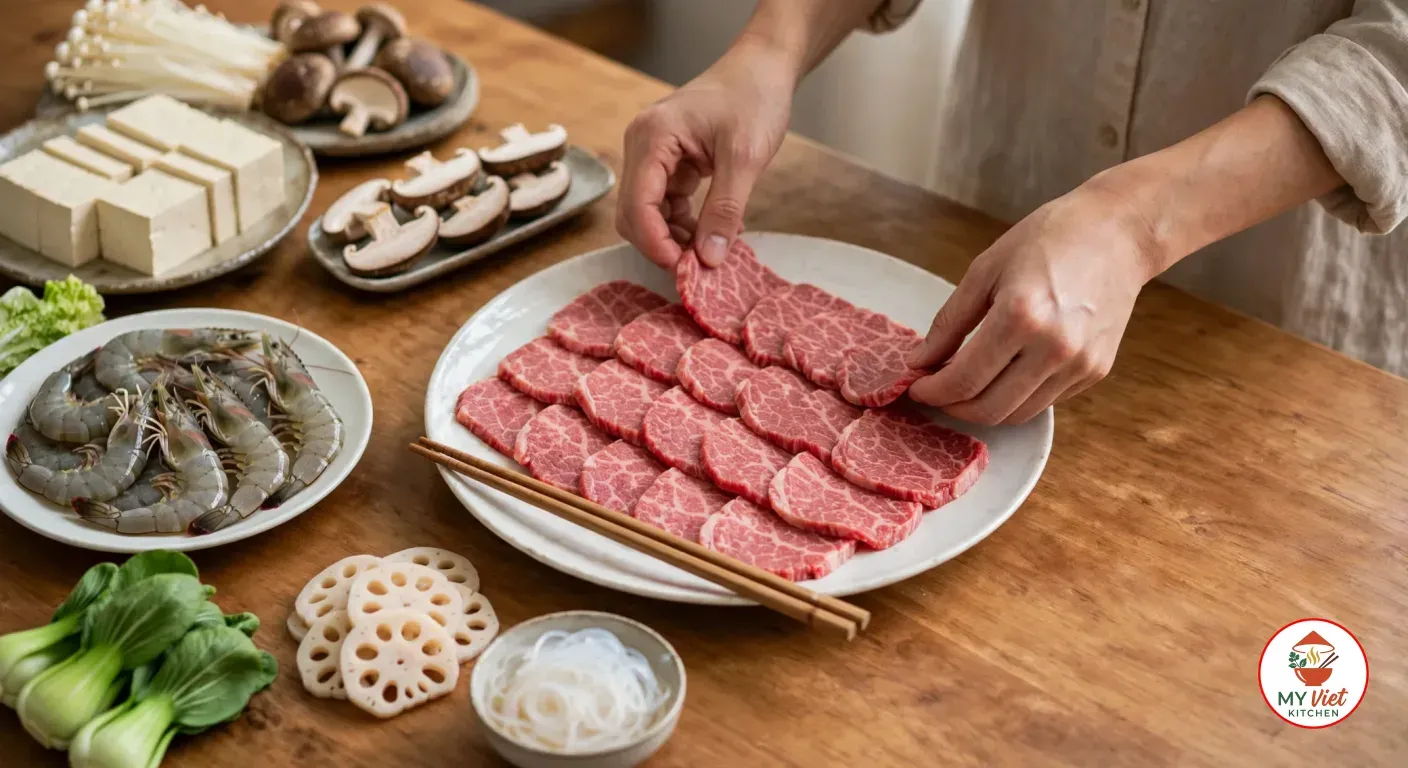
3Keep shop-bought sliced hot pot meat in the fridge until the broth boils. To slice your own, freeze the beef and lamb or pork for 1 to 2 hours until firm but not hard, then cut it across the grain as thinly as you can. Rinse the shrimp. Cut the tofu into 1.5 cm (1/2 inch) slices, trim the base off the enoki and pull it into small bundles, and stem and halve the shiitake. Cut the napa cabbage into 3 to 5 cm (1 to 2 inch) pieces, halve the bok choy, wash the greens, and peel and slice the lotus root 5 mm (1/4 inch) thick. Soak the vermicelli in warm water for 10 minutes and drain. Arrange the vegetables, tofu and noodles on platters, and put the raw meat and seafood on their own plates, each with its own serving chopsticks or tongs.
Step 4: Mix the Dipping Sauces
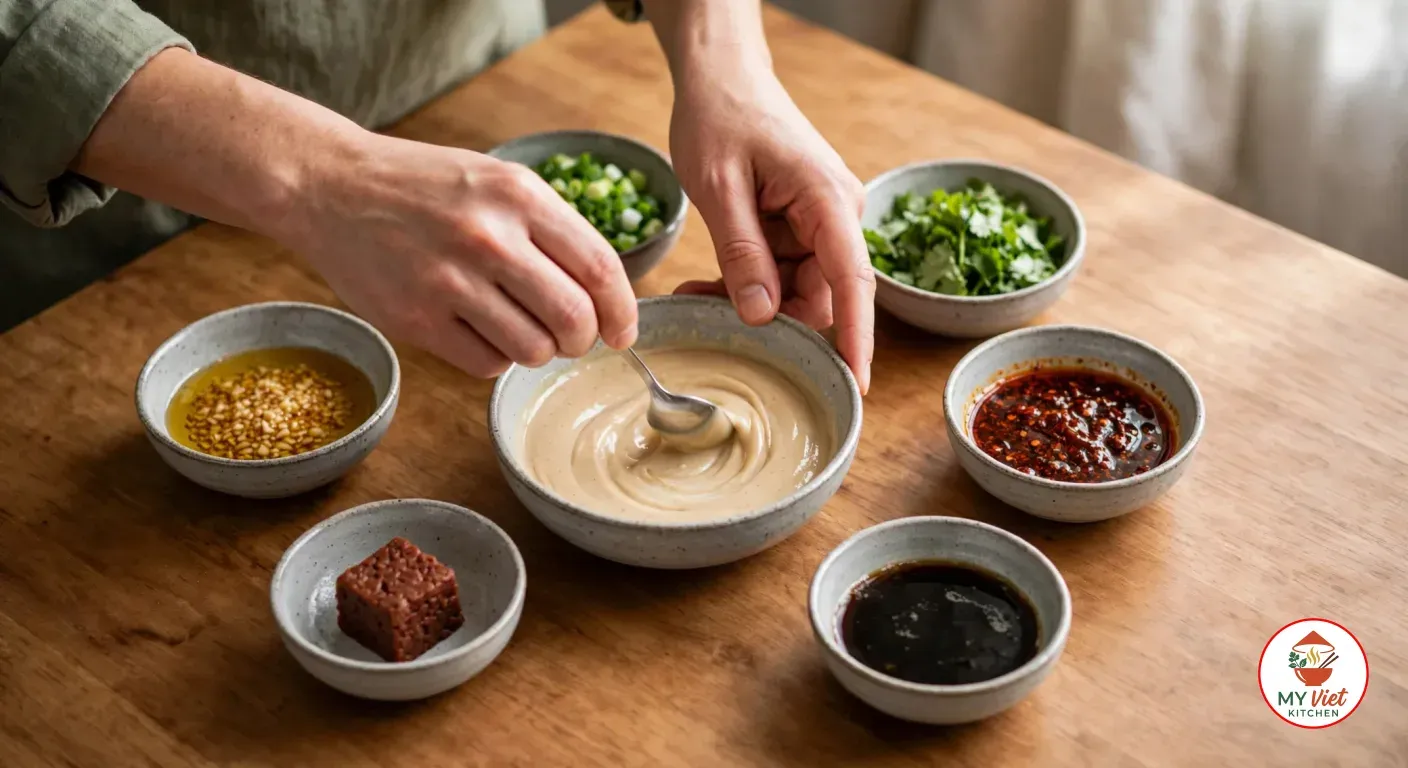
4Spoon the sesame paste into a bowl. Add the water 1 tablespoon at a time, stirring after each, until the paste turns smooth and runs slowly off the spoon. Mash in the fermented bean curd if using, then stir in the soy sauce, sesame oil and sugar. For the oil dip, stir the toasted sesame oil, neutral oil, garlic and salt together. Give everyone a small bowl of each, and put the chopped scallions, cilantro, soy sauce, black vinegar and chilli oil on the table so each person can season their own.
Step 5: Set Up the Pot at the Table
5Stand the burner or electric base on a flat, heatproof spot in the middle of the table, in a well-ventilated room, with the divided pot on top. Ladle the spicy broth into one side, scooping out most of the chilli sediment with a wire strainer if you like, and float the whole chillies on top. Pour the mild broth into the other side. Fill each side no more than two-thirds full so it can boil without spilling. Turn the heat to high; both sides should boil within 5 to 10 minutes. Keep a kettle of hot water or extra stock nearby.
Step 6: Cook and Eat at the Table
6Wait for a full boil before anything goes in, then keep it at a steady boil. Add slow items first, a few at a time, lotus root, tofu, fish balls and shiitake, and fish them out after 3 to 10 minutes. Cook thin meat a few slices at a time in a wire ladle or held in cooking chopsticks, swishing until no pink remains, 30 seconds to 1 minute. Shrimp are done when the shells are red and the flesh is white and opaque, about 3 minutes. Greens take 30 seconds to 4 minutes, enoki under a minute, and the vermicelli 1 to 2 minutes, best in the mild side early on. Handle raw food only with the cooking chopsticks and eat with your own. Dip everything in your sauce. When a side has boiled down by about half, top it up with hot water or stock and wait for a full boil again before you take anything out.
Frequently Asked Questions
What dipping sauce goes with hot pot?
It depends on the side: garlic and sesame oil for the spicy broth, sesame paste for the mild one. Taylor Holliday of The Mala Market writes that food from a Sichuan mala pot comes out already highly flavoured. So the Chengdu dip is simply toasted sesame oil mixed with vegetable oil and fresh garlic, maybe with MSG and cilantro. Food from the mild side needs a boost, so northerners add runny sesame paste, black vinegar and perhaps soy sauce and chilli oil (The Mala Market).
Can you use a store-bought hot pot base?
Yes, and Maggie Zhu of Omnivore’s Cookbook recommends it. A homemade base can need many special ingredients that are expensive or hard to find. She says one package is usually enough for one meal, diluted with 6 to 8 cups of water. She also adds a few slices of ginger, green onions and, for a spicy pot, dried chillies (Omnivore’s Cookbook). Follow the instructions on the back of the package.
Can you keep leftover hot pot broth?
Yes, if you cool it quickly and use it within three days. Hong Kong’s Centre for Food Safety advises putting leftovers in the refrigerator within two hours, keeping them no longer than three days, and reheating them no more than once (Centre for Food Safety). Bring the broth to a full boil before you use it for soup or noodles. A homemade spicy base that never touched raw food keeps longer. Red House Spice stores its blocks for 2 weeks in the fridge or up to 6 months in the freezer (Red House Spice).
Is it safe to add raw egg to the dipping sauce?
Not with ordinary eggs. Wikipedia describes a Cantonese variation that mixes a raw egg into the condiments. In Taiwan, it says, a dip of shacha sauce and raw egg yolk is very common (Wikipedia). Hong Kong’s Centre for Food Safety advises against raw eggs, including as part of a dip, because of the Salmonella risk, and suggests pasteurised shell eggs instead (Centre for Food Safety).
Sources
- Hot pot, Wikipedia
- Homemade Hot Pot Broth (Spicy and Mild), Wei Guo, Red House Spice, updated June 2022
- Chinese Hot Pot Guide, Maggie Zhu, Omnivore’s Cookbook, updated January 2023
- Chinese Hot Pot at Home, Sarah Leung, The Woks of Life, updated September 2024
- Sichuan Mala Hotpot, From Scratch (Mala Huoguo With Tallow Broth), Taylor Holliday, The Mala Market, November 2020
- Hot Tips for Safe Hot Pot, Arthur Yau, Centre for Food Safety (Hong Kong), Food Safety Focus, January 2024
- Centre for Food Safety announces test results on hot pot food samples, Centre for Food Safety (Hong Kong), December 2019
- Five keys to enjoying hotpot safely, Centre for Food Safety (Hong Kong), December 2008
- Safety Tips on Portable Butane Stoves and Gas Canisters, Consumer Product Safety Office, Singapore
- How to Make Hot Pot Soup Base| Spicy Soup + Plain Soup, Yi’s Sichuan Kitchen, YouTube, February 2024