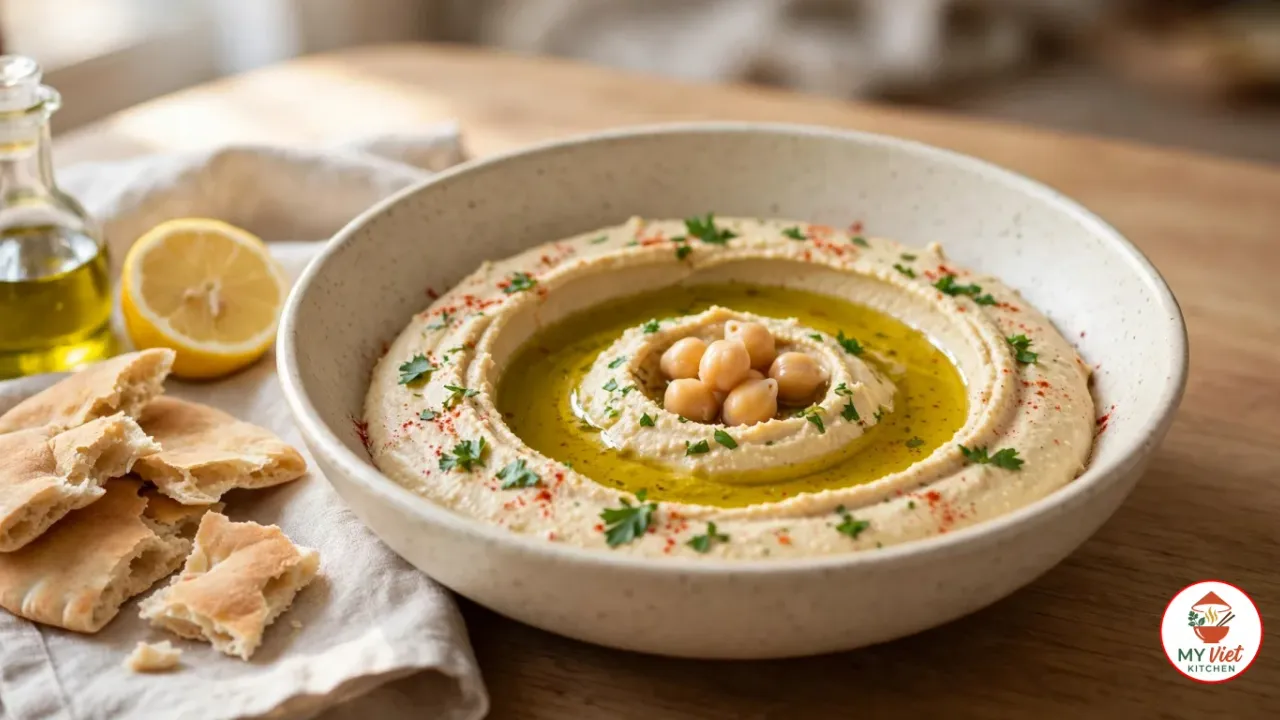
Hummus is a dip of cooked, mashed chickpeas blended with tahini, lemon juice and garlic, usually finished with olive oil and scooped up with pita. Wikipedia calls it a Levantine dish; its Arabic name means “chickpeas”, and the full name, ḥummuṣ bi ṭaḥīna, means chickpeas with tahini (Wikipedia). This recipe starts from dried chickpeas soaked overnight, cooks them until they crush with no resistance, and whips them into a lemony tahini base with ice water.
Prep Time: 20 minutes | Cook Time: 1 hour | Total Time: 13 hours 50 minutes, including a 12-hour soak and a 30-minute rest | Servings: 8 (about 3 1/2 cups)
Difficulty: Easy | Calories: ~290 per serving

Why Cook Chickpeas with Baking Soda?
Baking soda makes the cooking water alkaline, and that softens chickpeas faster. America’s Test Kitchen explains that the alkaline water helps break down the pectin in the beans. The skins soften so much that they disintegrate during cooking and rinse away easily (America’s Test Kitchen).
Yotam Ottolenghi and Sami Tamimi stir their soaked chickpeas with a teaspoon of bicarbonate of soda over high heat for about 3 minutes before adding water. Penguin reprints their basic hummus from Jerusalem on its recipe site, which says the chickpeas can then cook for anywhere between 20 and 40 minutes, sometimes longer, depending on the type and freshness. Once done, they break up easily when pressed between thumb and finger (The Happy Foodie).
Chef Michael Solomonov goes further. He splits 2 teaspoons of baking soda between the soaking water and the pot, simmers for about an hour, then a little more. “The secret to creamy hummus is overcooked chickpeas; don’t worry if they are mushy and falling apart a little,” his recipe on The Nosher says (The Nosher).
Here the baking soda is optional. Without it the chickpeas still soften, but more slowly, since the soda is what speeds up the cooking (The Happy Foodie). Judge them by touch, not by the clock.
Do You Need to Peel the Chickpeas?
Not if you cook dried chickpeas very soft with baking soda. Peeling does make a difference. When America’s Test Kitchen developed its restaurant-style hummus, removing the tough skins gave a far creamier result, but it was such a hassle that the testers skipped it. Ottolenghi and Tamimi’s baking soda method solved that, because the skins break down in the pot (America’s Test Kitchen).
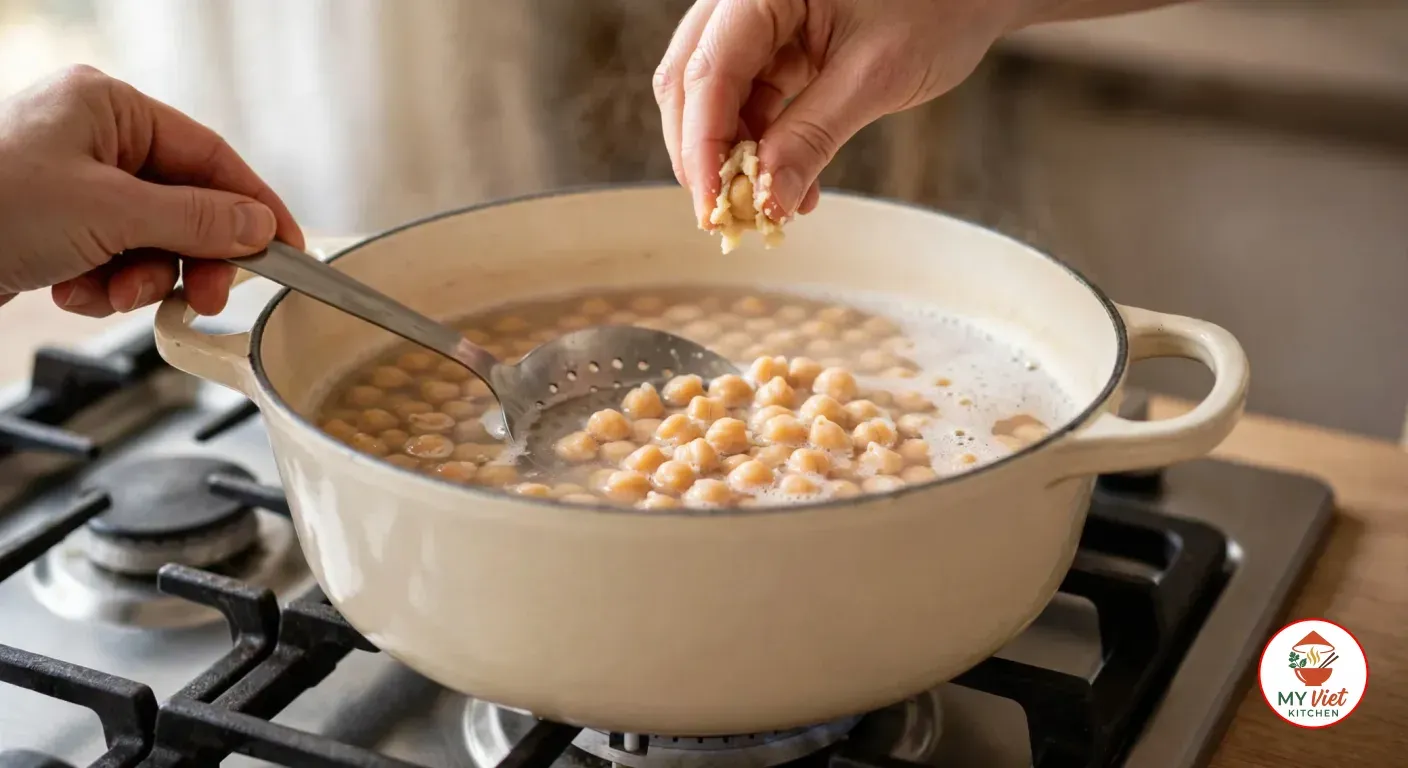
So in this recipe you only skim. As the pot comes to the boil, foam and loose skins rise to the top. Lift them off with a slotted spoon or a small sieve, as the Jerusalem method does (The Happy Foodie).
For canned chickpeas, the testers adapted the trick. They toss each rinsed 14-ounce can with 1 1/2 teaspoons of baking soda and heat it for 2 to 3 minutes. Then they rub the beans between their hands in three or four changes of cold water, and the skins float away (America’s Test Kitchen).
Why Add Ice Water to Hummus?
Water changes tahini in two stages. A little thickens it: America’s Test Kitchen explains that the carbohydrates in sesame paste are drawn to the water and form clumps, much as chocolate seizes. Add enough water, and the tahini loosens and thins out (America’s Test Kitchen). So when the tahini base in step 3 goes stiff, keep going.
Solomonov whisks ice water into tahini, lemon juice and garlic a few tablespoons at a time and notes that the sauce will lighten in colour as you whisk. When it seizes, he keeps adding water, about 1 1/2 cups in all for 2 generous cups of tahini (The Nosher).
Why cold? Hisham Ali Hassan’s Super-Light Hummus for Milk Street names a paradox: “The chickpeas puree best when hot, but aeration is optimal when the mixture is chilled.” After 5 minutes of processing the warm chickpeas, that recipe adds ice cubes one at a time (Milk Street). Here you blend the chickpeas warm and loosen them with ice water for the same reason. Milk Street thins its tahini with boiling water, though, so cold water is one good route rather than a rule.
How Much Tahini Goes into Hummus?
Recipes range widely. Ottolenghi and Tamimi’s basic hummus, as reprinted in The Christian Science Monitor, uses 1 cup plus 2 tablespoons of light tahini paste for 1 1/4 cups of dried chickpeas (The Christian Science Monitor). The advice on Penguin’s recipe site is to buy good Middle Eastern tahini “and use lots of it” (The Happy Foodie). Wikipedia notes that Israeli versions use large amounts of tahini for a creamier texture (Wikipedia).
At the lighter end, Anissa Helou’s hummus for four on Pilot Guides uses 5 tablespoons of tahini for a 660 g jar of chickpeas (425 g net weight). She adds the juice of 1 1/2 lemons and one clove of garlic (Pilot Guides).
This recipe sits between them, with 3/4 cup (180 g) for 250 g of dried chickpeas. Stir the jar well before you measure, because the oil separates and rises. Taste after blending. If the hummus tastes flat, add lemon juice and salt. For a richer one, blend in 2 to 4 more tablespoons of tahini with a splash of ice water.
Ingredients for Hummus
For the Chickpeas:
- 1 1/4 cups (250 g) dried chickpeas
- 1 teaspoon baking soda (optional)
- Cold water, for soaking and cooking
For the Tahini Base:
- 2 garlic cloves, peeled
- 1/4 cup (60 ml) fresh lemon juice (about 2 lemons), plus more to taste
- 1 teaspoon fine salt, divided, plus more to taste
- 3/4 cup (180 g) tahini, stirred well
- 1/2 cup (120 ml) ice water, plus more if needed
For Serving:
- 2 to 3 tablespoons extra virgin olive oil
- A pinch of paprika or ground cumin (optional)
- 1 tablespoon chopped flat-leaf parsley (optional)
- Warm pita, for serving
Step-by-Step Instructions
Step 1: Soak the Chickpeas
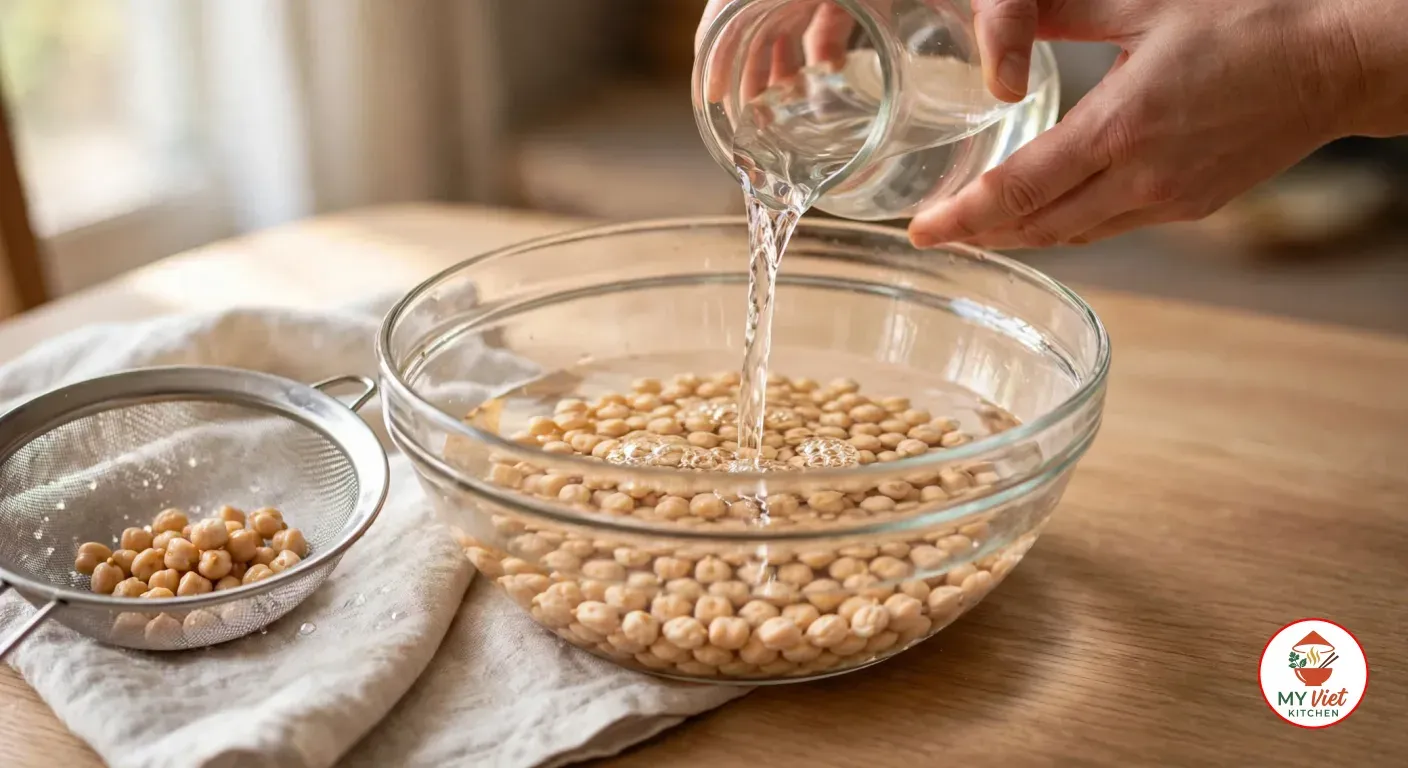
1Rinse the chickpeas in a sieve and pick out any small stones or shrivelled ones. Put them in a large bowl and pour in about 1.5 litres (6 cups) of cold water; they swell to about twice their size, so the water should stand well above them. Leave them at room temperature for 12 hours or overnight, then drain and rinse.
Step 2: Cook the Chickpeas Very Soft
2Put the drained chickpeas in a large pot with the baking soda and 2 litres (8 cups) of cold water. Set it over high heat; as it comes up to the boil, scoop off the grey foam and any loose skins that rise. Turn the heat down so the water just simmers, and set the lid ajar. Start checking after 20 minutes. They are ready when one crushes to a smooth paste between your thumb and finger with no firm centre, usually 30 to 60 minutes with baking soda and longer without it. Drain them and use them while they are still warm.
Step 3: Make the Tahini Base
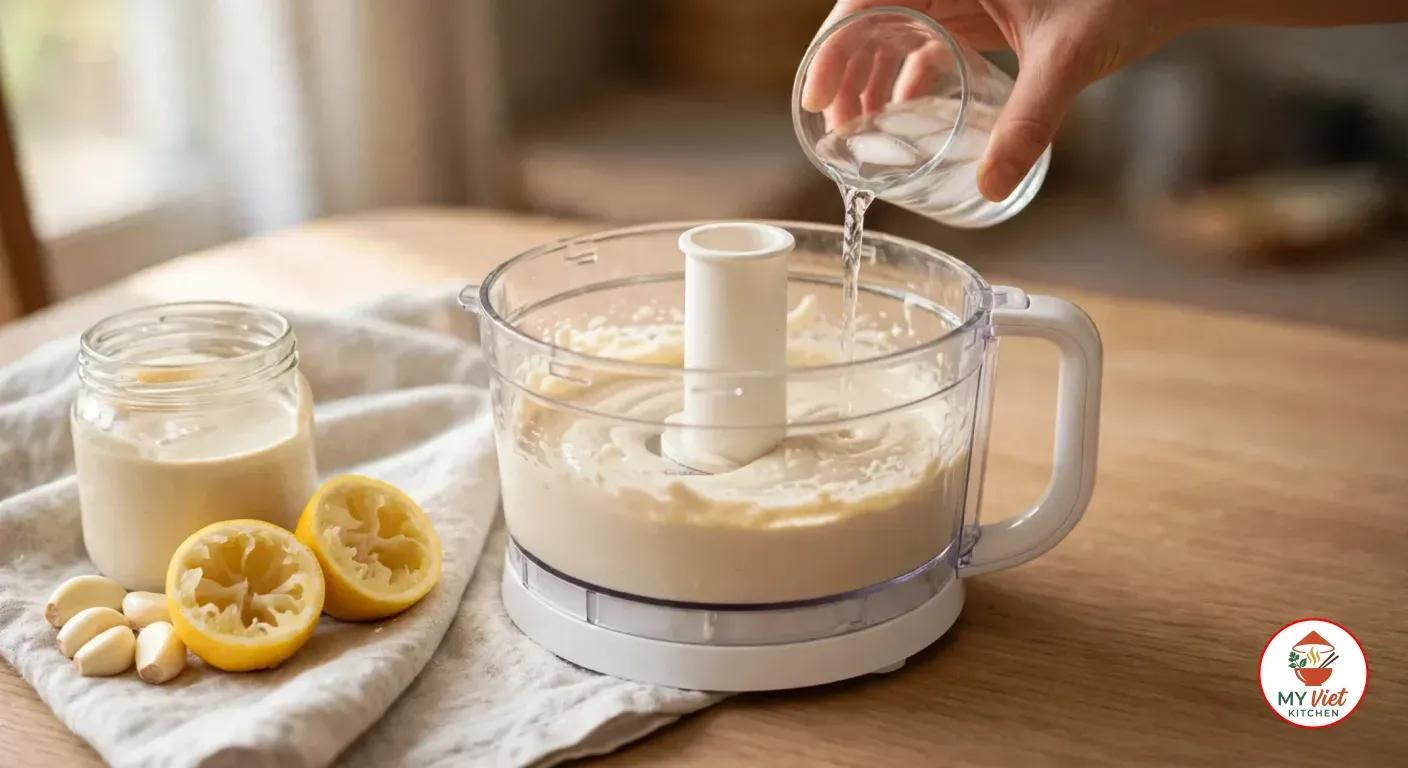
3While the chickpeas cook, put the garlic, lemon juice and 1/2 teaspoon of the salt in a food processor and pulse until the garlic is finely chopped. Leave it for 10 minutes to take the edge off the raw garlic. Add the tahini and process; it will turn thick and stiff at first. With the machine running, add 4 tablespoons of the ice water, one at a time, until the mixture loosens into a smooth, pale paste.
Step 4: Blend in the Warm Chickpeas
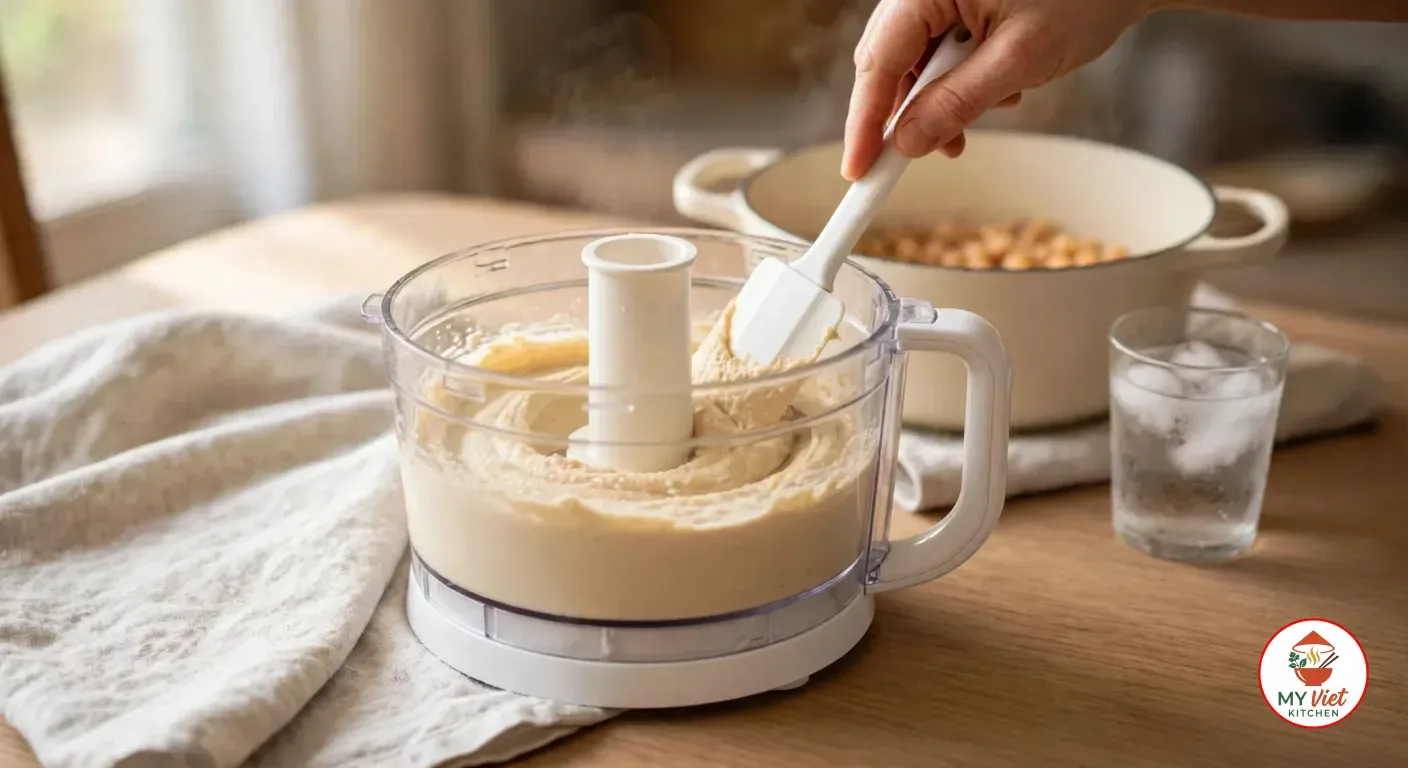
4Set aside a tablespoon of whole chickpeas for the top, if you like. Add the rest of the warm chickpeas and the remaining 1/2 teaspoon of salt to the tahini base. Process for 4 to 5 minutes, stopping every minute or so to scrape down the bowl. With the motor still on, pour in the rest of the ice water a spoonful at a time, stopping when the hummus is smooth and softly spreadable; it firms up as it cools. Taste, and add more lemon juice or salt if it needs it.
Step 5: Rest and Serve with Olive Oil
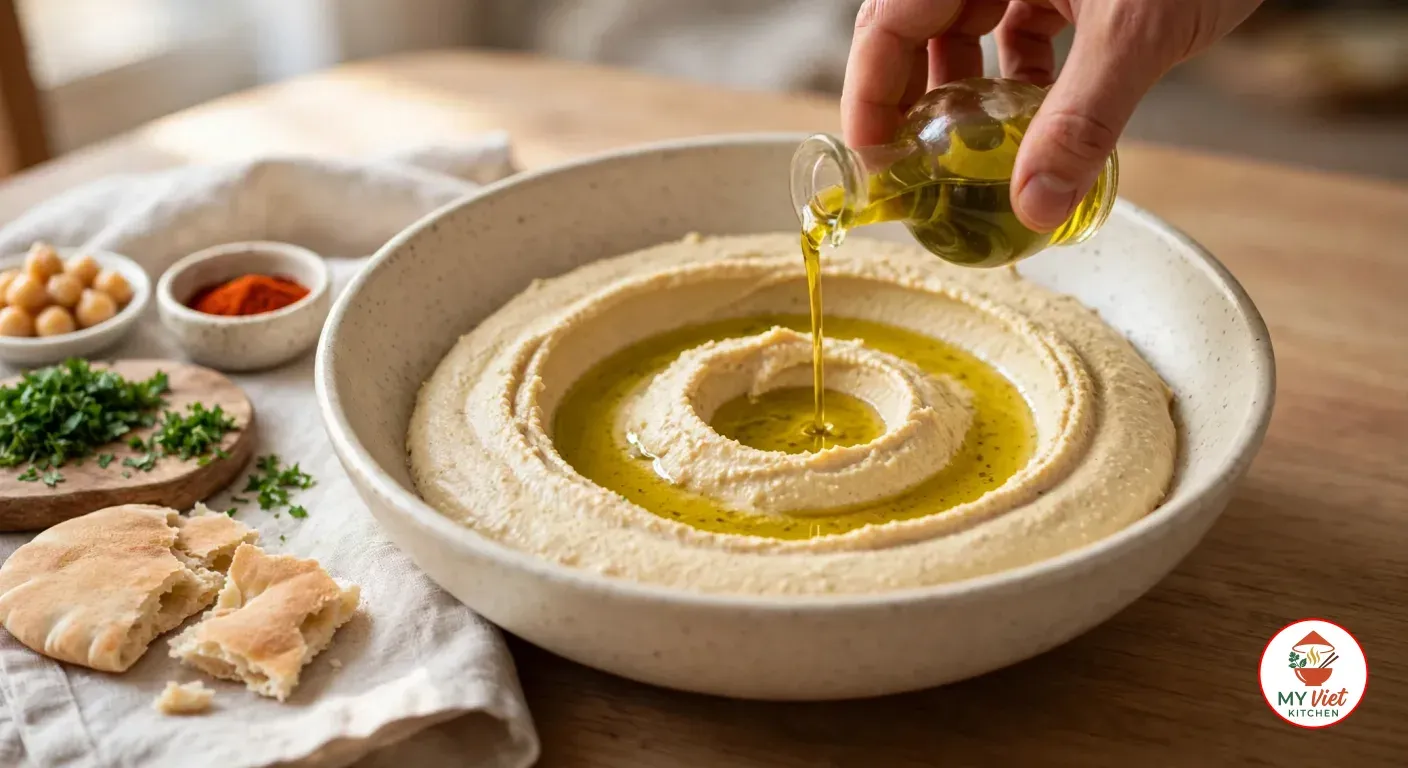
5Scrape the hummus into a bowl, press plastic wrap or a lid onto the surface and leave it for 30 minutes at room temperature to settle. Spread it in a wide, shallow bowl and draw the back of a spoon around it to make a ring-shaped groove. Pour the olive oil into the groove, then add the reserved chickpeas, a pinch of paprika or cumin and the parsley. Serve with warm pita.
Frequently Asked Questions
Can you make hummus with canned chickpeas?
Yes. Use about 600 g of drained chickpeas, roughly two and a half 400 g cans, and skip the soaking and cooking steps. The Jerusalem method starts with the same 1 1/4 cups of dried chickpeas (The Christian Science Monitor) and ends up with roughly 600 g once they are cooked and drained (The Happy Foodie). Anissa Helou writes that she used to soak and cook dried chickpeas because she didn’t like the taste of tinned ones. Now, she says, there are excellent ready-cooked chickpeas preserved in glass jars in only water and salt (Pilot Guides). Rinse them well to get rid of the salty taste. Warm canned chickpeas before blending, and take off the skins with baking soda as described above for the smoothest result.
Why is my hummus grainy?
Usually the chickpeas weren’t cooked soft enough, or the hummus wasn’t blended for long enough. Ottolenghi and Tamimi’s chickpeas should break up easily between thumb and finger, almost but not quite mushy. Their hummus then mixes for about 5 minutes once the iced water goes in (The Happy Foodie). Solomonov’s recipe (The Nosher) says to purée for several minutes until smooth, “Then puree it some more!” If it’s still gritty, the skins are the next suspect: rub them off the cooked chickpeas in a bowl of cold water, or cook the next batch longer.
How long does homemade hummus keep in the fridge?
Treat it like other cooked dishes: 3 to 4 days in a fridge at 4 °C (40 °F) or lower. That is Health Canada’s time for cooked meat, stews, egg or vegetable dishes; its storage chart doesn’t list hummus by name (Health Canada). Keep it covered, and take it out at least 30 minutes before serving, as Ottolenghi and Tamimi advise (The Happy Foodie).
Where does hummus come from?
No one knows exactly: Wikipedia says the evidence is insufficient to determine the precise location or time of its invention. The earliest mention of a dish equivalent to hummus is in a 13th-century cookbook attributed to Ibn al-Adim of Aleppo, in present-day Syria. Its chickpea kisāʾ combined chickpeas, lemon, sesame and olive oil, but no garlic. Other early recipes for something like ḥummuṣ bi ṭaḥīna appear in 14th-century cookbooks written in Cairo. Ownership is disputed too: chefs in Lebanon and Israel have traded Guinness records for the largest dish of hummus (Wikipedia).
Sources
- Hummus, Wikipedia
- How to make your own perfectly smooth hummus, Malou Herkes, Penguin Books, updated August 2021
- Michael Solomonov’s Hummus Recipe, Michael Solomonov, The Nosher, March 2021
- For Creamier Hummus, Skin Your Chickpeas, America’s Test Kitchen, May 2013
- A Surprising Tahini Thickener, America’s Test Kitchen, March 2014
- Super-Light Hummus, Hisham Ali Hassan, Milk Street, December 2025
- Creamy tahini hummus, Mary Warrington, The Christian Science Monitor, July 2015
- Lebanon Recipes – Hummus, Anissa Helou, Pilot Guides, April 2022
- Safe food storage, Health Canada, April 2024
- Yotam Ottolenghi & Sami Tamimi’s Basic Hummus | Genius Recipes, Food52, YouTube, May 2019