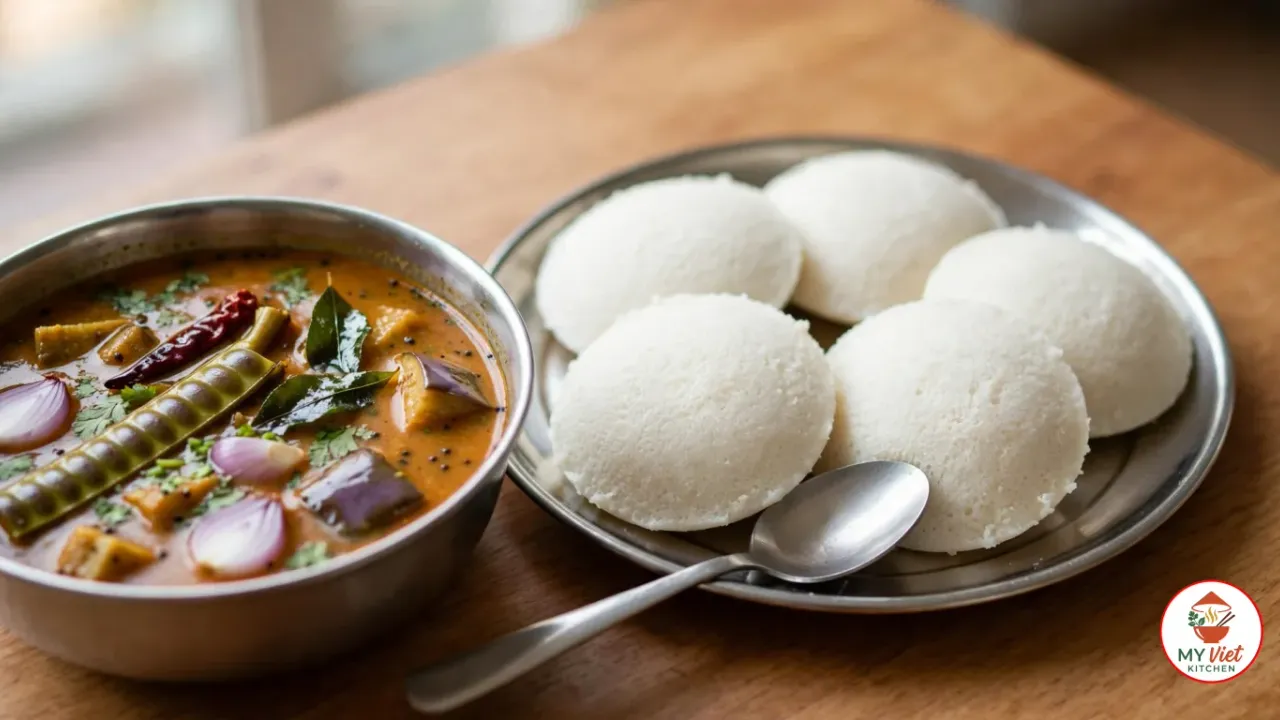
Idli sambar is a South Indian breakfast pairing of idlis and sambar. Idlis are soft rice cakes steamed from a fermented batter of hulled black lentils (urad dal) and rice (Wikipedia). Sambar is a spiced stew of lentils and vegetables, cooked with pigeon peas and tamarind broth (Wikipedia). This recipe grinds and ferments the batter overnight. Next morning, a light tiffin sambar of toor dal, drumstick, eggplant and shallots simmers before the idlis are steamed.
Prep Time: 45 minutes | Cook Time: 1 hour | Total Time: 16 hours 45 minutes, counting a 5-hour soak and about 10 hours of fermenting | Servings: 4 (about 20 idlis)
Difficulty: Medium | Calories: ~510 per serving (5 idlis with sambar)

Where Do Idli and Sambar Come From?
Idli is older than its modern recipe. A Kannada work of 920 CE, the Vaddaradhane, mentions “iddalige”, made only from a black gram batter. The Sanskrit Manasollasa of 1130 CE includes a recipe for iḍḍarikā. Those early versions lacked three things today’s idli depends on: rice, a long fermentation and steaming. References to the modern recipe appear only after 1250 CE (Wikipedia).
Where the change came from is disputed. Food historian K. T. Achaya speculated that the steamed idli might have been invented in present-day Indonesia, which has a long tradition of fermenting its food. In his account, cooks of the Hindu kings there brought the recipe back to India between 800 and 1200 CE. He likened it to an Indonesian dish he called kedli, but the writer Janaki Lenin could find no recipe by that name. Food historian Colleen Taylor Sen holds that India discovered the fermentation on its own (Wikipedia).
Sambar’s record is vaguer still. Achaya dated the earliest surviving reference, as huli, to 17th-century Karnataka. A popular legend credits the name to the Thanjavur court of Shahuji I (r. 1684–1712), after a visit by Sambhaji. Sourish Bhattacharyya, in The Bloomsbury Handbook of Indian Cuisine, points out that the two kings’ fathers were half-brothers and not on good terms, which weakens the story. Sambar is now commonly eaten with idlis or dosas and is a staple of Tamil Nadu cuisine (Wikipedia).
How Warm Does Idli Batter Need to Be?
Warm, but not hot. Swasthi Shreekanth’s ideal is 25 to 32°C, or 80 to 90°F, and at that warmth the batter takes about 8 to 12 hours. Warmer than that, the batter ferments faster, so watch it and move it to the fridge once it has doubled in volume, before it turns too sour (Swasthi’s Recipes). In cold weather the range stretches. Dassana Amit leaves her batter 14 to 24 hours or more in winter (Dassana’s Veg Recipes). Swasthi once needed about 18 hours on a windy, cold day.
The recipe card plans for 10 hours, which is why the total time comes to 16 hours 45 minutes. A workable timetable: start the soak after lunch, grind around 7 p.m., and the batter should be ready for breakfast in a warm kitchen. On a cold day, start a few hours earlier.
The microbes doing the work come with the grains. A 2019 study in Applied and Environmental Microbiology found that lactic acid bacteria made up 86% of the bacteria in fermenting idli batter, with the genus Weissella the most important. Grains sterilized on the surface did not ferment at all. The researchers also traced the carbon dioxide that leavens the batter to this bacterial fermentation (Mandhania et al.).
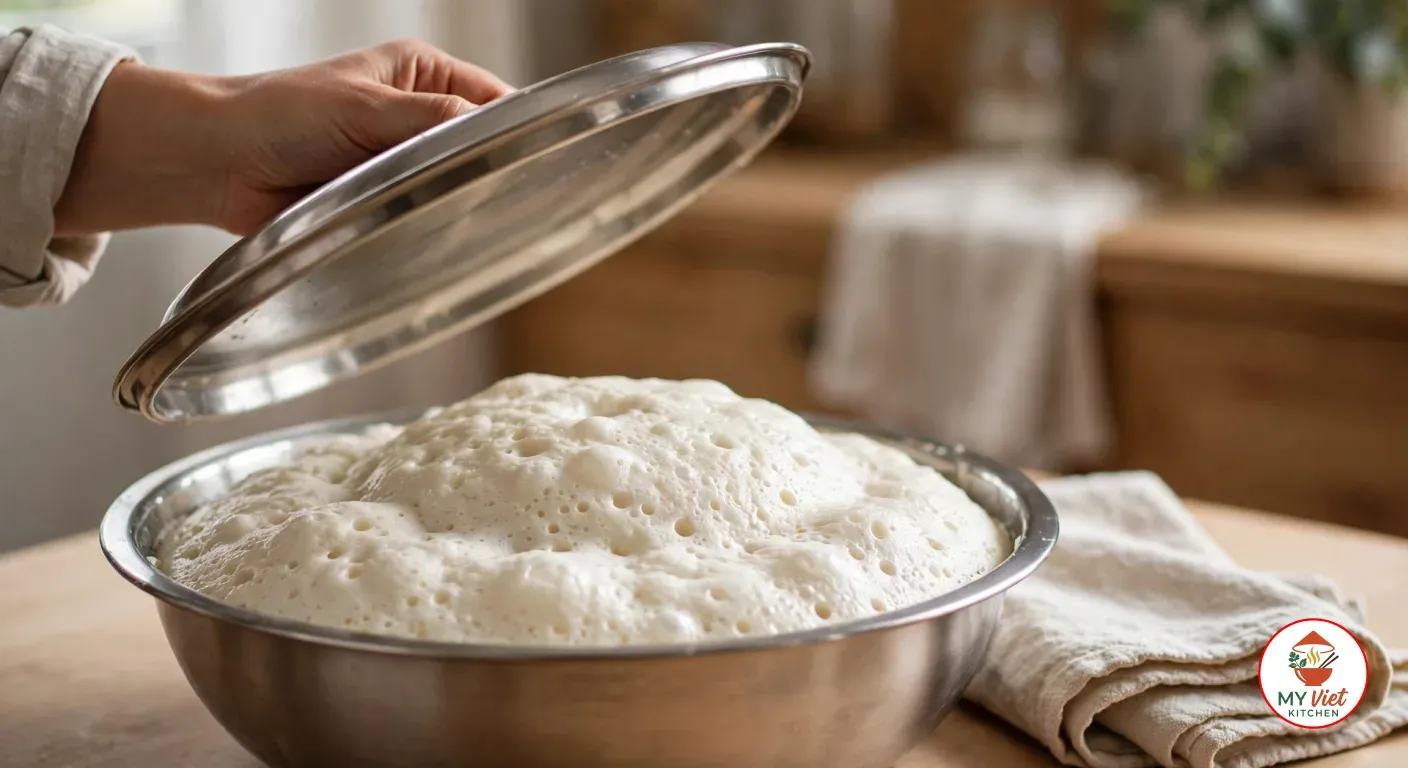
Judge the batter by its look and smell. Wikipedia says it grows to more than twice its volume overnight (Wikipedia). Dassana looks for a mild sour aroma and small air bubbles throughout, and says ready batter feels lighter when stirred. Once it is ready, steam it or chill it. Left at room temperature, she warns, it keeps fermenting and becomes very sour (Dassana’s Veg Recipes).
Why Grind the Dal and Rice Separately?
Because they need different textures. The soaked lentils are ground to a fine paste, and the rice is ground coarsely on its own before the two are combined (Wikipedia). Swasthi blends her dal with chilled water into a thick, smooth, frothy batter, then grinds the rice to “a little coarse batter (semolina texture)” (Swasthi’s Recipes). Dassana grinds them separately for a soft, fluffy texture, and says well-ground urad dal also helps the batter ferment (Dassana’s Veg Recipes).
Proportions vary more than the method. Wikipedia gives four parts rice to one part whole white lentil (Wikipedia). Swasthi says restaurants and hotels use a ratio of almost 1:4, dal to rice, because rice is cheaper. At home she favours more dal, and her two recipes use 1:2 and 1:3 (Swasthi’s Recipes). The card above takes 1:3: 100 g of urad dal to 300 g of idli rice.
Buy idli rice or another parboiled rice; both are named in Wikipedia’s method, which also notes that parboiled rice can cut the soaking time considerably (Wikipedia). Dassana’s card also allows a half-and-half mix of regular and parboiled rice (Dassana’s Veg Recipes).
What Makes a Sambar a Tiffin Sambar?
A breakfast sambar is lighter than the one poured over rice at lunch. Hebbar’s Kitchen calls idli sambar, also known as tiffin sambar, a sambar made for a purpose. It describes the hotel style as lighter and more aromatic than the everyday home sambar eaten with rice, with a slightly sweet taste from jaggery against the tamarind (Hebbar’s Kitchen). Raks Anand of Raks Kitchen writes that tiffin sambar should have less tamarind than regular sambar, leaving the tomato to give a mild tang. The same post names drumstick and brinjal (eggplant) as the best flavour givers (Raks Kitchen).
The dal varies too. Wikipedia describes sambar as cooked with pigeon peas and tamarind broth (Wikipedia), and toor dal is split pigeon peas. Subbus Kitchen makes its idli sambar with moong dal instead, for a sambar that is light and easy to digest (Subbus Kitchen). Hebbar’s Kitchen adds a small portion of moong dal to the toor for a silkier texture.
Order matters in the pot. Hebbar’s Kitchen partly cooks the vegetables before the tamarind goes in, or they may not cook evenly, and whisks the dal smooth. It also suggests roasting store-bought sambar powder in a little ghee for 30 seconds to avoid a raw spice taste (Hebbar’s Kitchen). Make the sambar first: it waits happily on low heat, and idlis are best straight from the steamer.
Ingredients for Idli Sambar
For the Idli Batter:
- 1/2 cup (100 g) skinned whole urad dal
- 1/2 teaspoon fenugreek seeds (methi)
- 1 1/2 cups (300 g) idli rice or other parboiled rice
- About 1 1/4 cups (300 ml) cold water for grinding, plus more for soaking
- 3/4 teaspoon rock salt or sea salt (not iodized)
- Oil, for greasing the idli moulds
For the Sambar:
- 1/2 cup (100 g) toor dal (split pigeon peas)
- 1/4 teaspoon ground turmeric
- 1 tablespoon seedless tamarind pulp, soaked in 1/2 cup (120 ml) warm water for 15 minutes
- 10 shallots (about 120 g), peeled and halved
- 1 drumstick (moringa pod), cut into 7 cm (3-inch) pieces
- 1 small eggplant (about 150 g), cut into 2 cm (3/4-inch) cubes
- 1 medium tomato, chopped
- 1 1/2 tablespoons sambar powder
- 1 teaspoon grated jaggery or brown sugar
- 3/4 teaspoon salt
- 3 1/2 cups (840 ml) water
- 2 tablespoons chopped cilantro
For the Tempering:
- 1 tablespoon neutral oil or ghee
- 1 teaspoon black mustard seeds
- 1 dried red chilli
- 10 curry leaves
- 2 pinches asafoetida (hing)
Step-by-Step Instructions
Step 1: Soak the Rice and Urad Dal
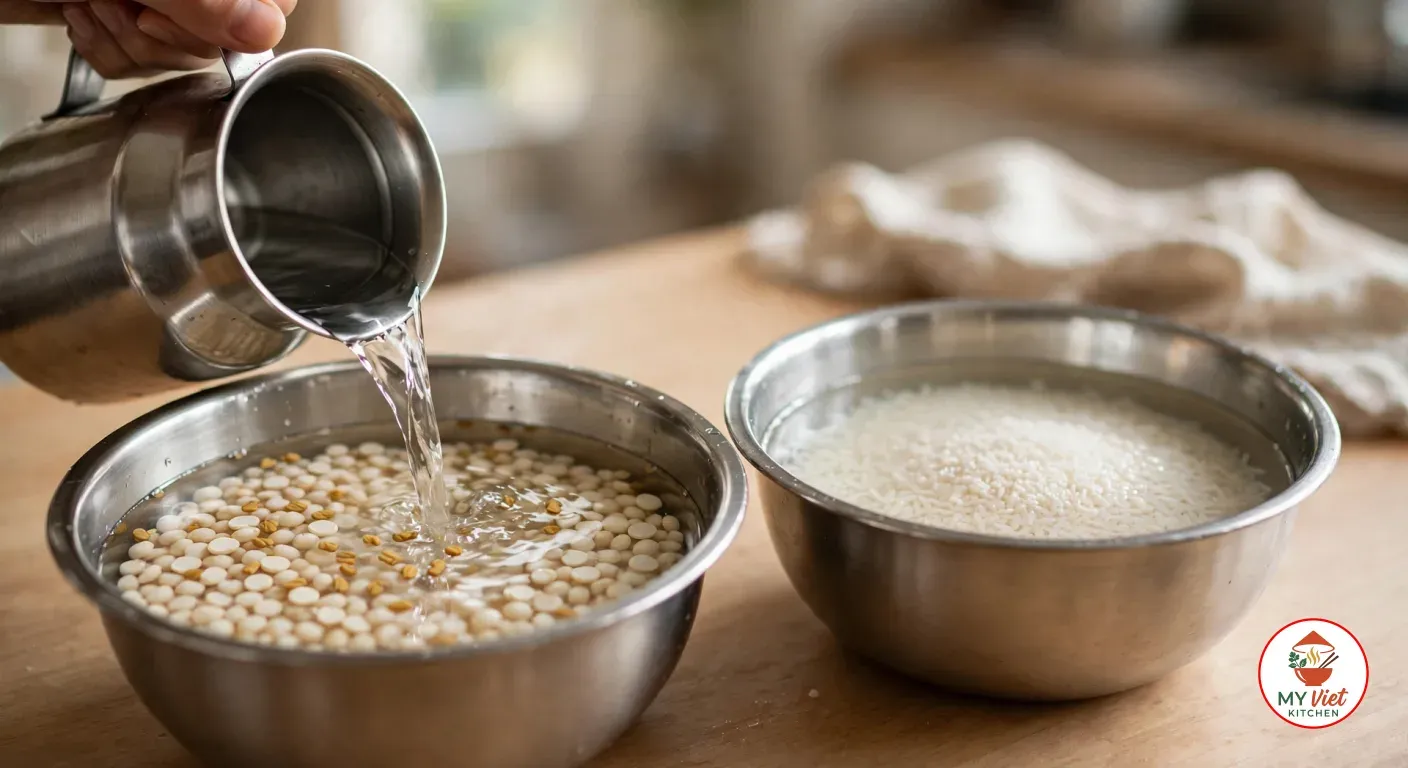
1Rinse the urad dal and fenugreek seeds together in a bowl until the water is no longer cloudy, then cover them with about 2 cups (480 ml) of fresh water. Rinse the idli rice the same way in a second bowl and cover it with about 3 cups (720 ml) of water. Soak them for 5 hours at room temperature.
Step 2: Grind the Dal and Rice Separately
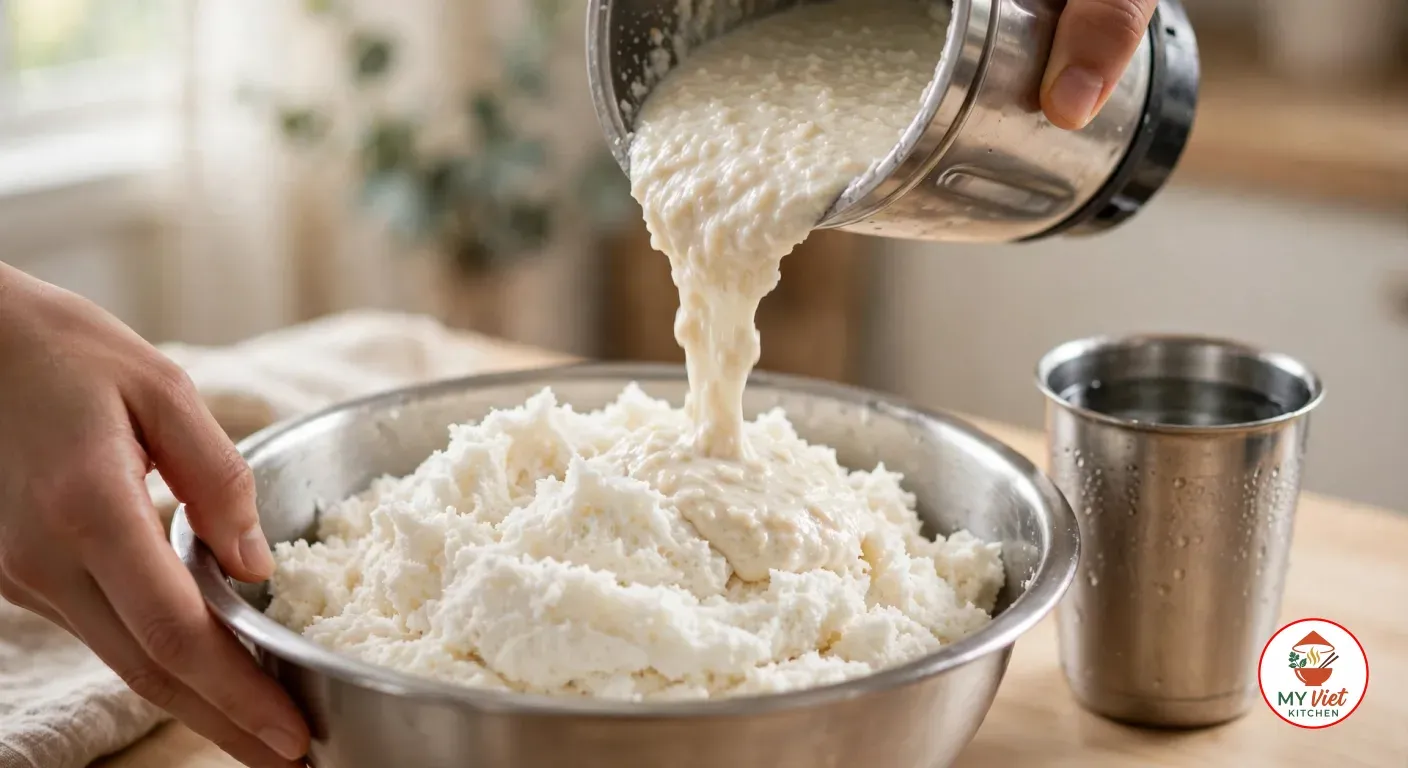
2Drain the dal and fenugreek and grind them with 1/2 cup (120 ml) of the cold water, adding it in two or three parts, until the paste is smooth, light and fluffy and has grown in volume. Stop now and then so the jar never feels warm. Scrape it into a large steel or ceramic bowl. Drain the rice and grind it with about 3/4 cup (180 ml) of cold water until it feels like fine semolina between your fingers, a little gritty rather than smooth. Pour it onto the dal paste, add the rock salt and mix with a clean hand for a minute until even. The batter should be thick but pourable.
Step 3: Ferment Until Doubled
3Set a plate loosely over the bowl rather than an airtight lid. Keep it in a warm place for 8 to 12 hours; 25 to 32°C, or 80 to 90°F, is ideal. The batter is ready when it has roughly doubled, looks domed and spongy with small bubbles all through it, and smells pleasantly sour. If your kitchen is cool, the oven with just its light switched on works, as does an Instant Pot on its low yogurt setting; allow 14 to 24 hours there.
Step 4: Cook the Toor Dal
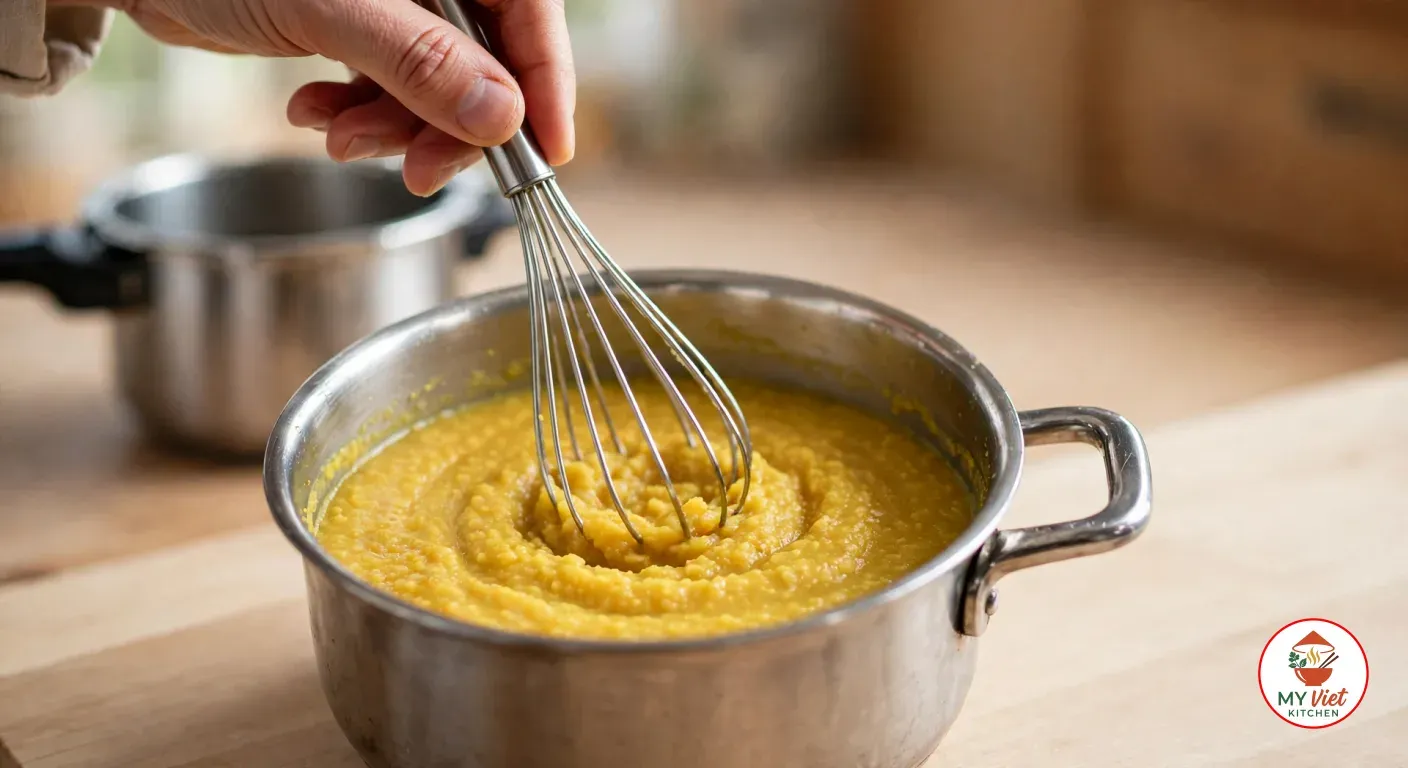
4In the morning, rinse the toor dal three times. Pressure cook it with 1 1/2 cups (360 ml) of the water and the turmeric for 4 to 5 whistles, then let the pressure drop on its own. Without a pressure cooker, simmer it in a covered pot with twice as much water for 45 to 60 minutes, topping up as it thickens, until a grain crushes easily between two fingers. Whisk or mash the dal until completely smooth.
Step 5: Simmer the Sambar
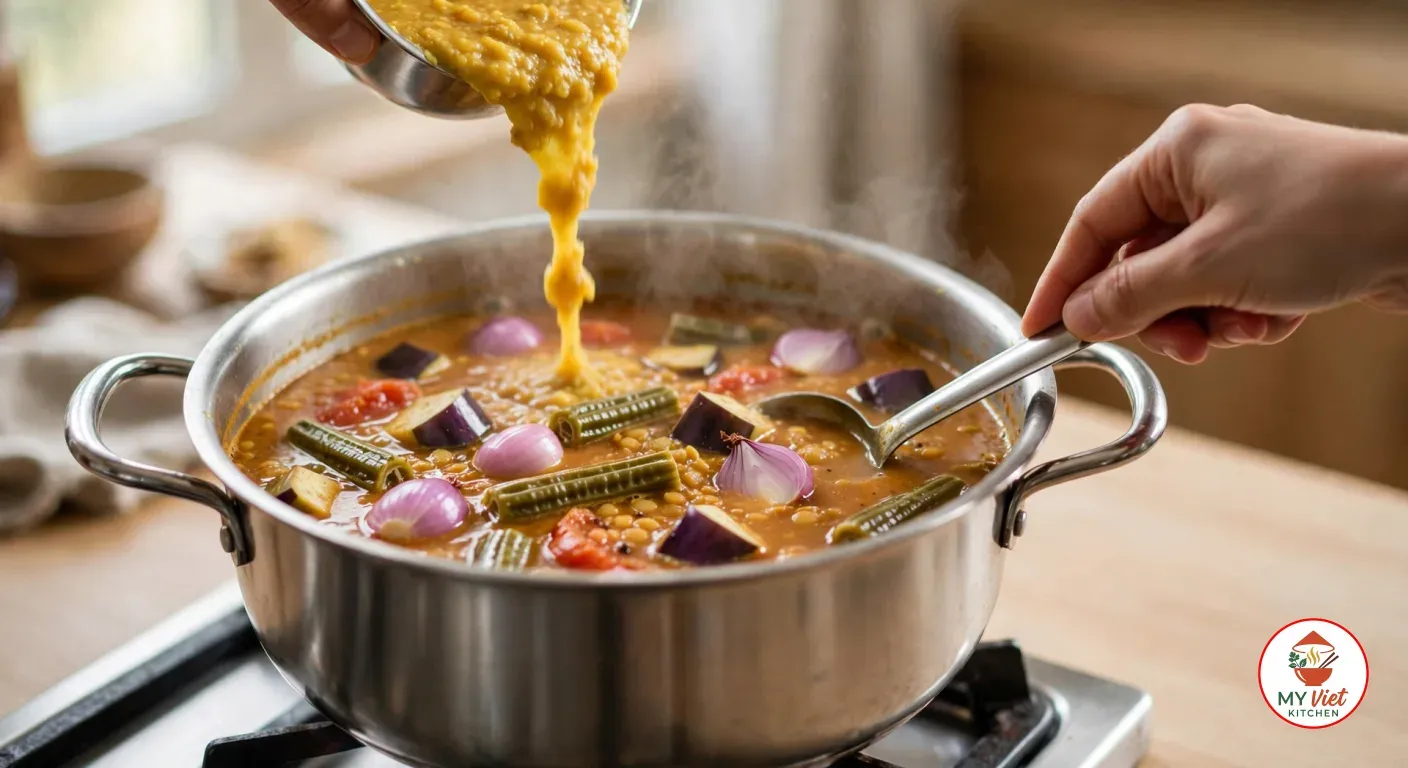
5Squeeze the soaked tamarind in its water, then strain the water and discard the fibres. Put the shallots, drumstick and eggplant in a large pot with the remaining 2 cups (480 ml) of water. Boil them for 6 to 8 minutes, until the drumstick is almost tender. Add the tomato, tamarind water, jaggery and salt and boil for 5 minutes more. Stir in the sambar powder, then the mashed dal, and simmer for 5 minutes. The sambar should pour easily, a little thicker than soup; thin it with hot water if needed.
Step 6: Temper the Sambar
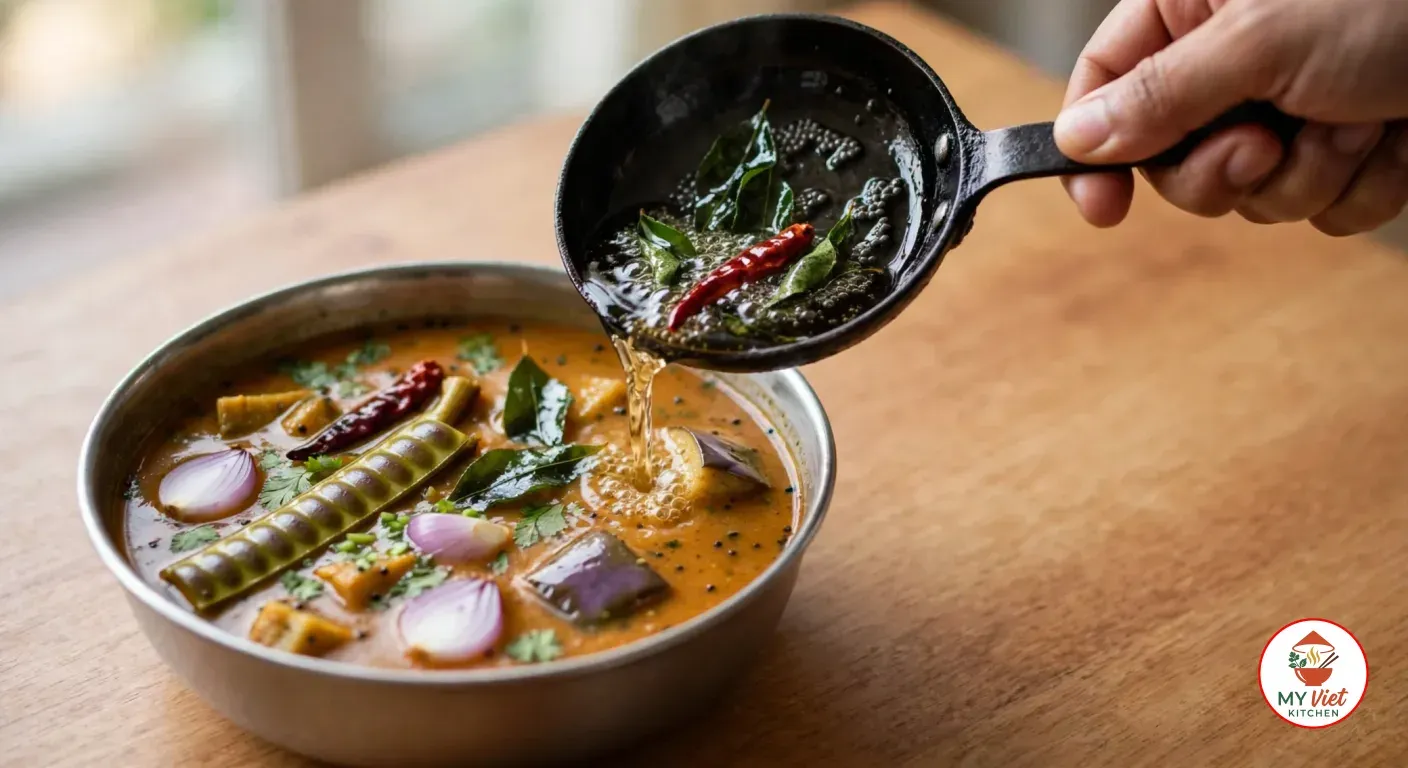
6Warm the oil in a small frying pan on medium heat, then tip in the mustard seeds. When they pop, add the dried chilli, then the curry leaves, which will spit, and the asafoetida. Stir for 10 to 15 seconds and pour the oil and spices over the sambar. Add the cilantro, cover, and keep the sambar warm on the lowest heat while the idlis steam.
Step 7: Steam the Idlis and Serve
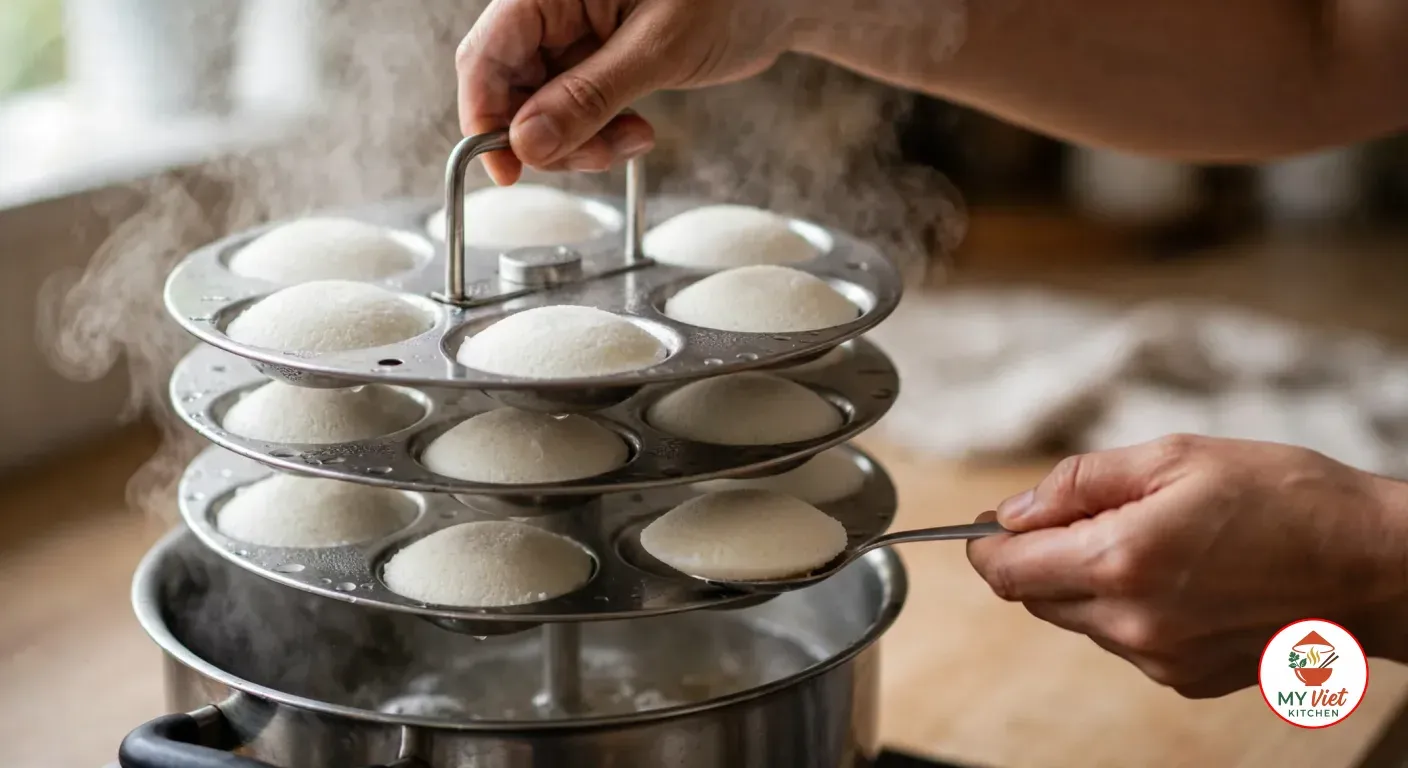
7Bring about 2 cups (480 ml) of water to a rolling boil in an idli steamer, a wide pot that fits the idli stand, or a pressure cooker with its weight removed. Oil the moulds lightly. Stir the batter gently once or twice, without beating out the air, and fill each cup about three-quarters full. Lower the stand into the pot, put the lid on and steam on medium-high for 10 to 12 minutes. A toothpick pushed into the centre of one idli should come out clean. Turn off the heat, wait 2 minutes, lift the stand out and let it rest 2 to 3 minutes more. Ease the idlis out with a spoon dipped in water, steam the rest of the batter the same way, and serve them hot with the sambar.
Frequently Asked Questions
Can you make idli batter in a blender instead of a wet grinder?
Yes, as long as the batter stays cool. Wikipedia notes that electric grinders or blenders can replace the manual rocking stone grinder (Wikipedia). Swasthi Shreekanth grinds with chilled water and warns that batter which turns hot, or even warm, while blending gives dense idlis (Swasthi’s Recipes). Grind in short bursts and rest the jar whenever it feels warm.
Why are my idlis hard or flat?
Usually the batter was under-fermented, or the dal was not ground light enough. Swasthi says idlis turn hard when the batter hasn’t fermented well, and also when they are steamed too long (Swasthi’s Recipes). Dassana Amit blames dense, flat idlis on urad dal that isn’t ground fluffy enough or on batter that is too thick (Dassana’s Veg Recipes).
What if the batter hasn’t risen by morning?
Give it more time somewhere warmer. In winter, Dassana keeps batter fermenting for 14 to 24 hours or more. Even if it hasn’t doubled, she says, you should see tiny bubbles and smell a faint sour aroma (Dassana’s Veg Recipes). If it hasn’t fermented at all after 18 to 24 hours, Swasthi suggests giving up on idli and making dosa or other dishes with the batter. Fermenting it longer, she warns, may grow mould (Swasthi’s Recipes).
Can you use idli batter for dosa?
Yes. Dassana says you can thin idli batter slightly after fermentation and use it for dosa. For dosa, she adds, you can also use raw rice such as sona masuri instead of idli rice (Dassana’s Veg Recipes). The description of her idli video adds uttapam, paniyaram and punugulu. Leftover idlis have a use too: Wikipedia describes idli upma, made by cutting up or crushing them and sautéing them (Wikipedia).
Sources
- Idli, Wikipedia
- Sambar (dish), Wikipedia
- Idli Recipe (Idli Batter Recipe with Pro Tips), Swasthi Shreekanth, Swasthi’s Recipes, January 2013 (updated February 2023)
- Soft Idli Recipe & Idli Batter Tips & Tricks, Dassana Amit, Dassana’s Veg Recipes, April 2012 (updated July 2025)
- Diversity and Succession of Microbiota during Fermentation of the Traditional Indian Food Idli, Mandhania et al., Applied and Environmental Microbiology, July 2019
- Idli Sambar Recipe | Hotel Style Tiffin Sambar, Hebbar’s Kitchen, July 2025
- Tiffin sambar recipe (Idli sambar with toor dal), Raks Anand, Raks Kitchen, January 2013 (updated August 2026)
- Tiffin Sambar / Idli Sambar / Payatham Paruppu Sambar, Sowmya Venkatachalam, Subbus Kitchen, March 2019 (updated May 2021)
- Idli Recipe (Soft and Fluffy) | Idli Batter | Dassana’s Veg Recipes, Dassana’s Veg Recipes, YouTube, April 2017