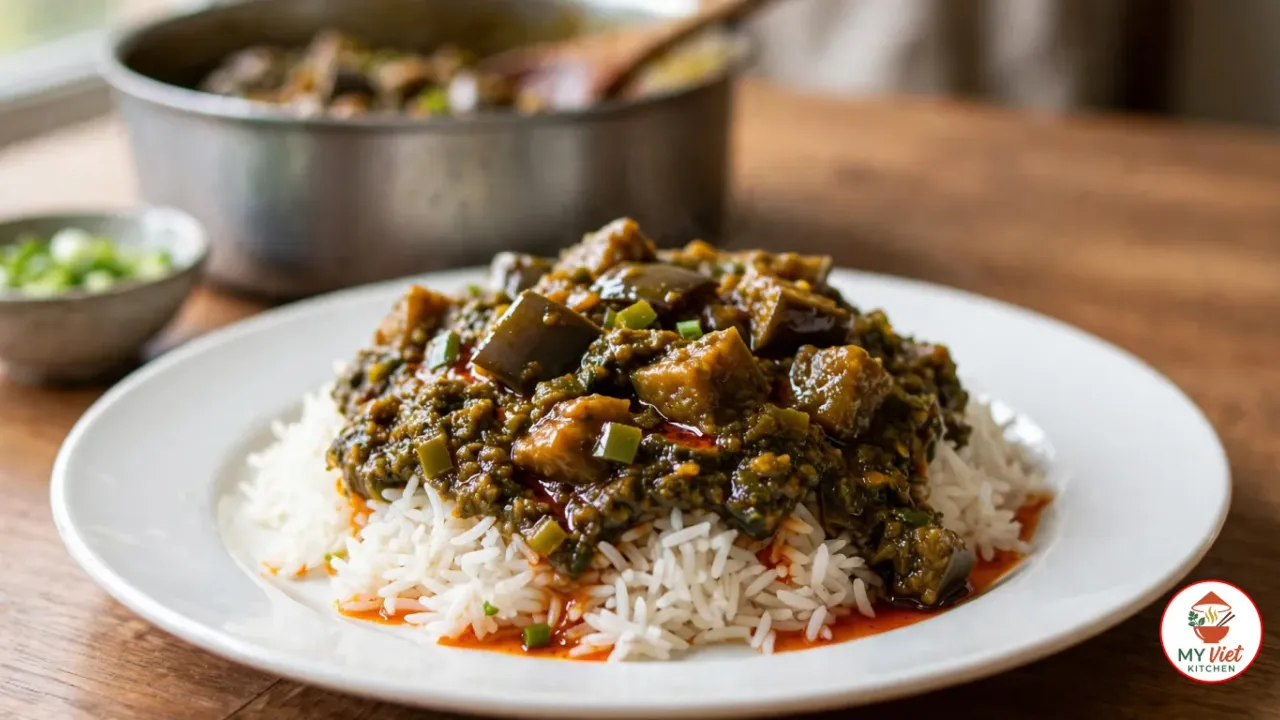
Isombe is a Rwandan stew of cassava leaves, vegetables and ground peanuts (Wikipedia). Rwanda’s New Times says it came originally from DR Congo (The New Times). This recipe boils frozen or fresh ground leaves on their own for about an hour. Then come eggplant, spinach, green peppers and celery, and peanut butter and red palm oil thicken the pot. It contains no meat.
Prep Time: 25 minutes | Cook Time: 2 hours | Total Time: 2 hours 25 minutes | Servings: 6
Difficulty: Easy | Calories: ~420 per serving

How Is Isombe Different from Liberian Cassava Leaf Stew?
Both start from ground cassava leaves, but they are built differently. In Liberia, according to Wikipedia, the leaves are braised and tenderized in a broth, then combined with red palm oil stock (Wikipedia). This site’s Liberian recipe cooks the leaves with beef, smoked fish and habanero peppers. Isombe puts vegetables first, and peanuts are what make it rich.
Which vegetables go in depends on the cook. Azizi Life, a crafts business that works with artisans in Rwanda, publishes a version with 2 eggplants, 2 packages of spinach, celery and green peppers, finished with peanut butter (Azizi Life). Gondwana Ecotours, whose guests in Rwanda cook isombe with the Kigali NGO Aspire Rwanda, lists 2 medium eggplants and 500 g of spinach for 1 pound of greens (Gondwana Ecotours).
The New Times recipe from Jaqueline Muganga has no eggplant at all. It uses spinach, green onions or leek, green peppers, palm oil and ground nuts (The New Times). Meat is optional rather than absent. A 2019 New Times feature says isombe often has a meaty flavour from stock made with boiled beef bones (The New Times). Muganga relies on other greens instead of meat bones, which, Phiona Ninsiima writes, lets vegans and vegetarians enjoy the dish too (The New Times). This recipe follows her lead.
The leaves go by other names across the region. Wikipedia gives them as sombe in Swahili, mpondu in Lingala and sakasaka in Kikongo. In the DRC, it adds, oil, onions and fish go in once the leaves have boiled, and the sauce is eaten with rice, plantain or cassava paste (Wikipedia).
How Long Should Cassava Leaves Boil?
Long enough to get rid of their cyanide, and published times vary a lot. According to the Konzo Prevention Unit at the Australian National University, the leaves are usually pounded for 10 to 15 minutes, which lets their own enzymes act on the cyanogens. They are then boiled in water for 10 to 120 minutes (ANU).
Keep the lid off. In the DRC the pot stays uncovered while the leaves boil, so that hydrogen cyanide can escape (Wikipedia). Private Kamanzi, a nutritionist in Kigali, told The New Times the same about isombe: cook it open so the gas evaporates (The New Times).
A study led by M. G. Umuhozariho is why this recipe errs on the long side. The researchers boiled leaves from bitter, sweet and wild cassava for 15 and 30 minutes after different pre-treatments. After 30 minutes, cyanide still measured 32 to 50 mg HCN per kg of dry matter, above the 10 mg/kg recommended for foods. The authors judged that safe for a vegetable eaten in small amounts as a side food (African Journal of Food Science).
They still advised extending the cooking time, and not making the leaves an everyday food, especially for children (African Journal of Food Science). So the leaves here get a 5-minute boil that is poured away, an hour on their own, then 45 minutes more with the vegetables and peanut, all uncovered. That matches the shape of Muganga’s recipe, which drains the first boil and then boils the leaves for 45 minutes to 1 hour before anything else goes in (The New Times).
Long boiling has a cost: the ANU unit reports that 30 minutes of boiling was found to cut the protein in pounded leaves by 58% (ANU). Treat frozen ground leaves as raw and give them the full time.
What Leaves Should You Use for Isombe?
Outside Central and East Africa, you will mostly find the leaves frozen and already ground. When Ninsiima and other Rwandans studying abroad cooked it for a food festival, they had to bring the leaves in from Gabon (The New Times). Fresh leaves should be young and tender; strip them from the stalks before you pound them.
Muganga’s tips are about quality. Buy good leaves, because market isombe sometimes includes rough parts that take a long time to cook. Shake the palm oil so you don’t use only the oil on top (The New Times).
Without cassava leaves, Azizi Life suggests kale or collard greens (Azizi Life), and Arielle Uwonkunda’s isombe for CBC uses collard greens or kale or green cassava leaves (CBC News). Chop them very fine. They don’t need the hour-long boil; simmer them for 15 to 20 minutes, until tender, then carry on from Step 4.
In the video above, Claire Mbabazi makes isombe under a Kinyarwanda title. The ingredients in her description include cassava leaves, peanuts, green peppers, red onions, garlic, celery, green onions, spinach and palm oil.
Ingredients for Isombe
For the Leaves:
- 2 pounds (900 g) frozen ground cassava leaves, or the same weight of fresh young cassava leaves
- About 15 cups (3.5 liters) water, for boiling
For the Vegetables:
- 1 medium eggplant (about 1 pound / 450 g)
- 1 bunch green onions (6 to 8), or 1 leek
- 2 celery stalks
- 2 green bell peppers
- 4 cloves garlic
- 10 ounces (280 g) fresh spinach
To Finish:
- 1/2 cup (130 g) natural unsweetened peanut butter
- 1/2 cup (120 ml) red palm oil
- 2 seasoning cubes (Maggi or vegetable bouillon), crushed
- 1 teaspoon salt, plus more to taste
Step-by-Step Instructions
Step 1: Prepare the Cassava Leaves
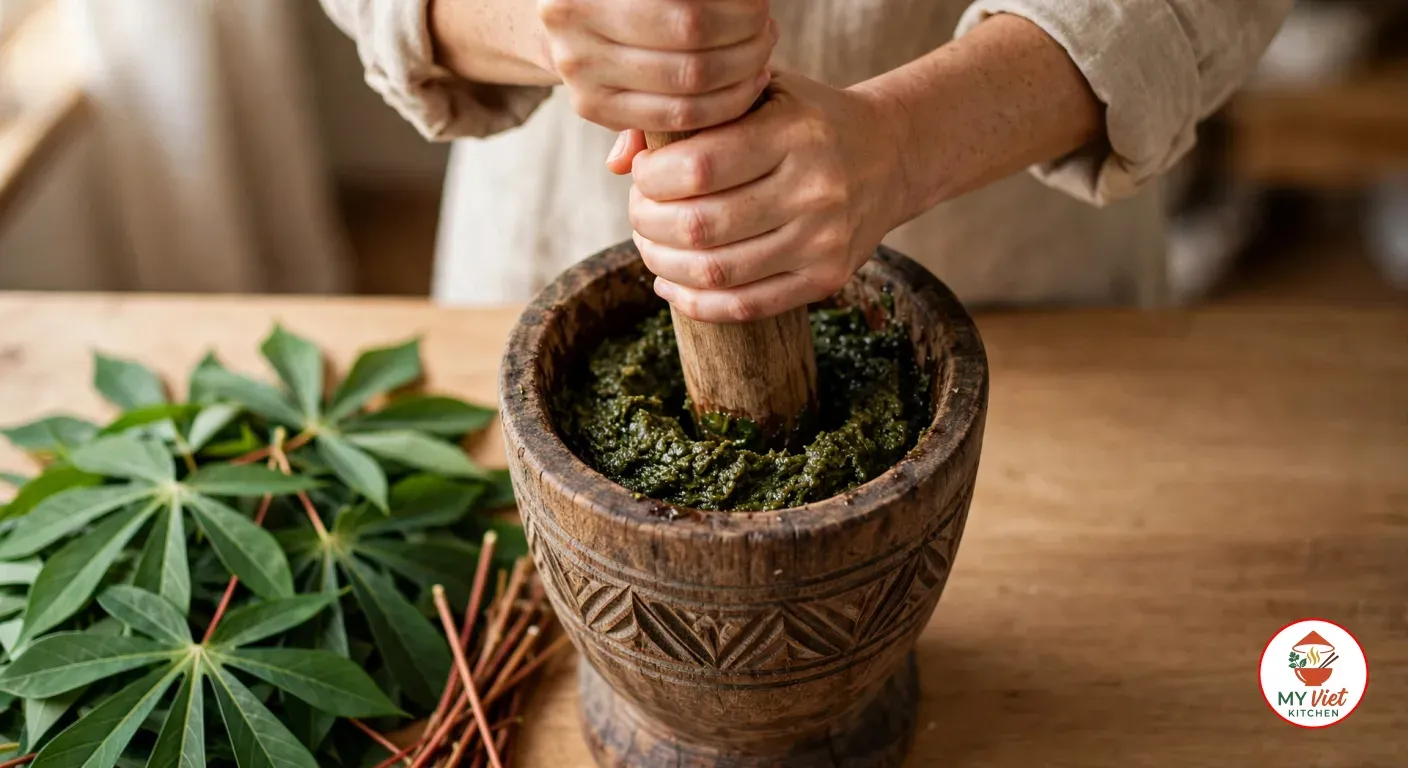
1For fresh leaves, pull the young leaves off their stalks, wash them and pound them in a mortar for 10 to 15 minutes, or grind them in a food processor, scraping down the sides, until they form a dark green, wet paste with no whole pieces left. Frozen ground leaves need no thawing; unwrap the block and use it as it is. While you wait for the water in the next step, cut the eggplant into 3/4-inch (2 cm) cubes, slice the green onions and celery, dice the green peppers, mince the garlic and chop the spinach.
Step 2: Boil and Drain the Leaves
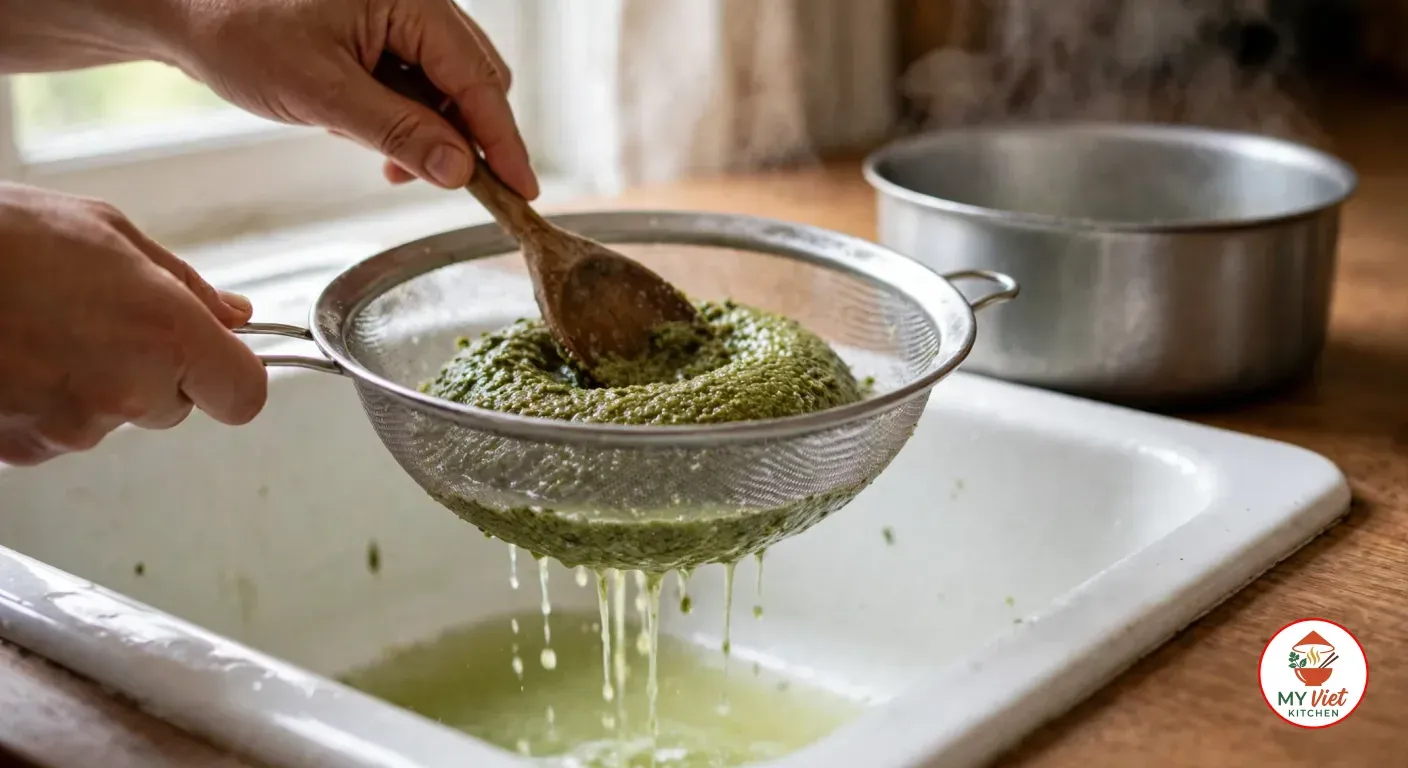
2Put the leaves in a 6-quart (6-liter) pot and pour in 8 cups (2 liters) of cold water. Bring to a boil over high heat with the lid off, breaking up a frozen block with a wooden spoon as it softens, and boil for 5 minutes. Tip the leaves into a fine sieve, let the water run off and throw it away. Put the drained leaves back in the pot and add 6 cups (1.5 liters) of fresh water.
Step 3: Boil the Leaves Uncovered for an Hour
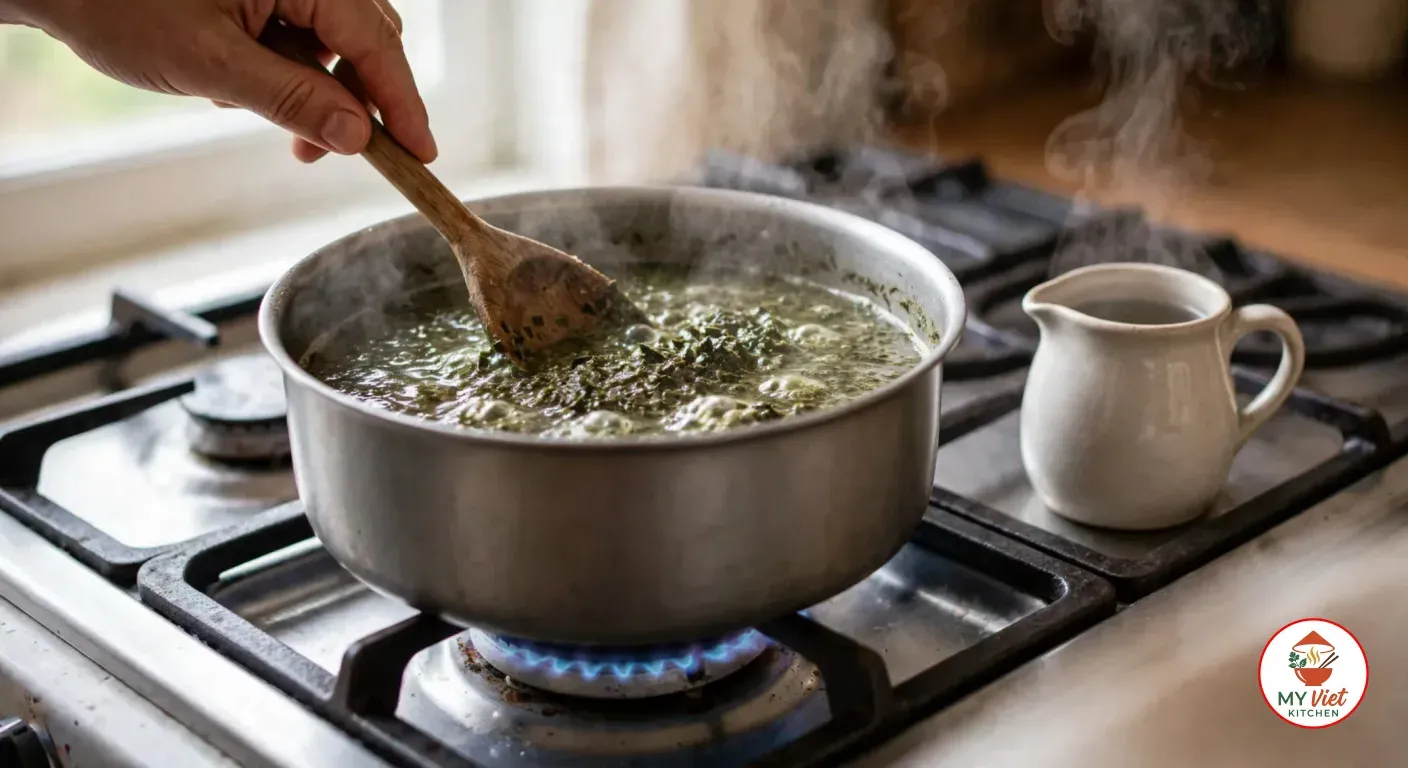
3Bring the pot back to a boil, then lower the heat so it bubbles steadily and cook for 1 hour without a lid. Stir every 10 minutes and add hot water whenever the leaves start to rise above the liquid. By the end the leaves should be soft and a dull olive green, and the sharp, grassy smell should be gone. Don’t shorten this step.
Step 4: Add the Eggplant and Greens
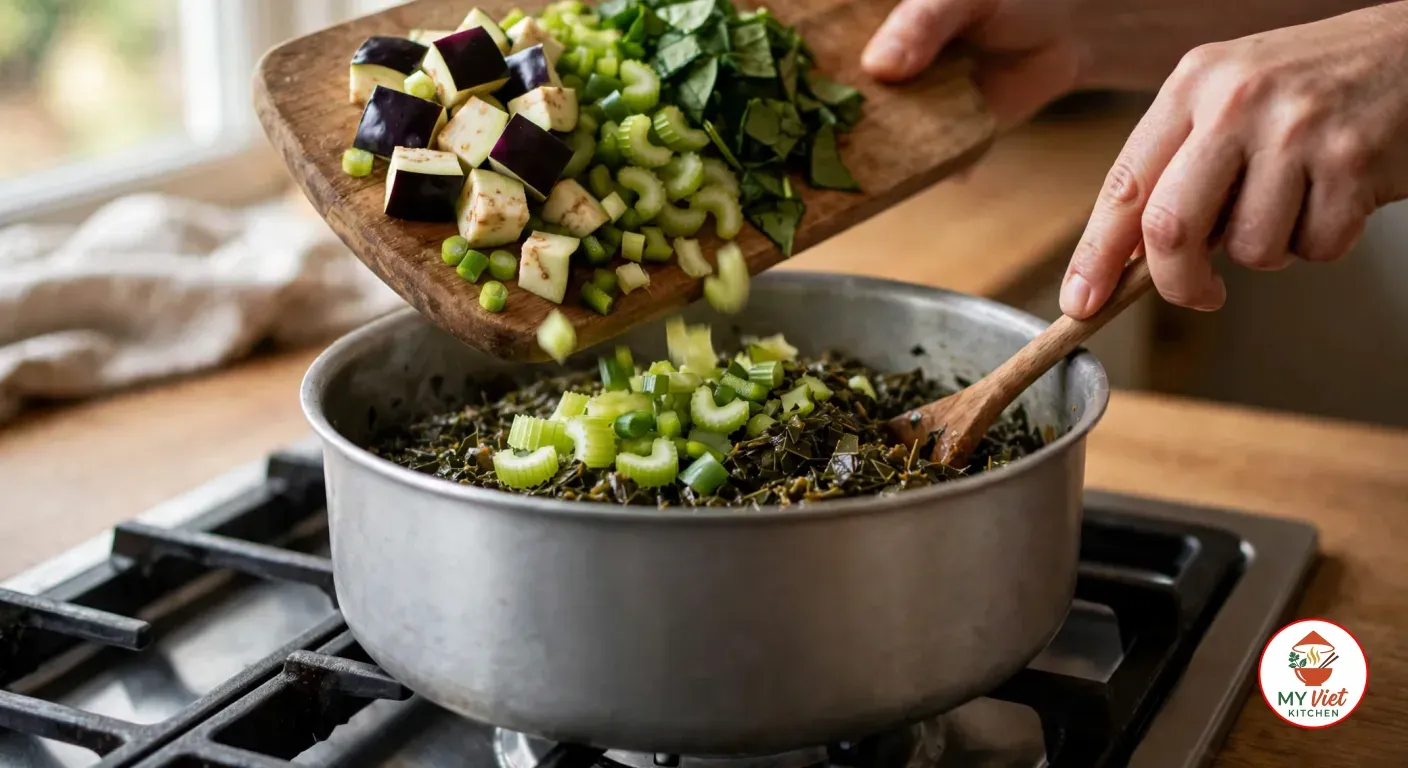
4Stir in the eggplant, green onions, celery, green peppers, garlic and spinach. If the pot looks dry, add 1 cup (240 ml) of hot water so the vegetables sit in a loose, wet mixture. Cook at a gentle boil, lid off, for 15 minutes and stir every few minutes; it’s done when a cube of eggplant squashes easily against the side of the pot.
Step 5: Finish with Peanut and Palm Oil
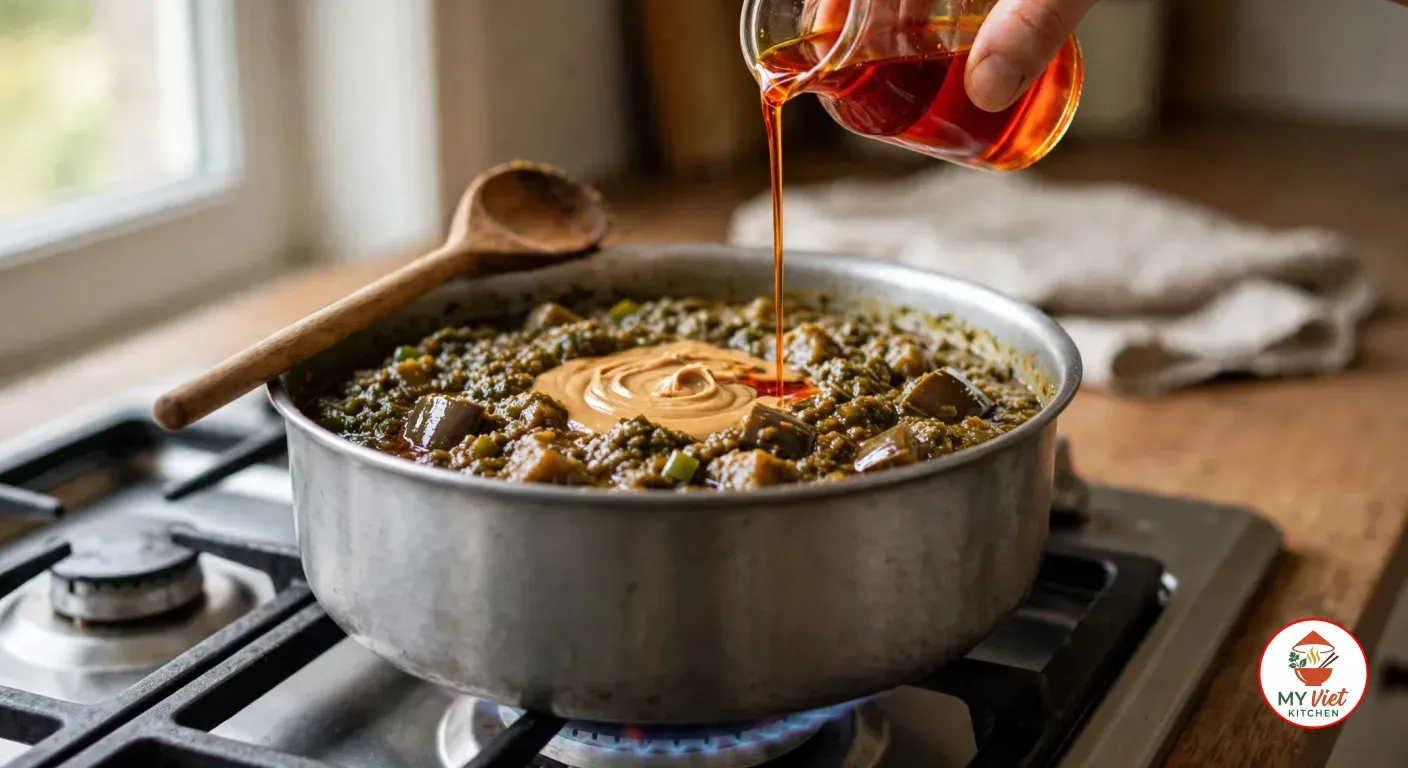
5In a bowl, stir the peanut butter with 1/2 cup (120 ml) of hot liquid from the pot until smooth. Add it to the pot with the palm oil, the crushed seasoning cubes and 1 teaspoon of salt. Turn the heat to low and simmer uncovered for 30 minutes, stirring and scraping the bottom every 3 to 4 minutes, because the peanut catches easily. The isombe is ready when a spoonful holds its shape and the eggplant has partly broken down. Taste, add salt if needed, and serve hot with rice or ubugari.
Frequently Asked Questions
Is isombe vegan?
It can be, and this version is if you use a vegetable bouillon cube rather than a meat-based one. Many recipes use stock from beef bones; The New Times notes that isombe often has a meaty flavour from stock made with boiled beef bones (The New Times). Jaqueline Muganga, whose recipe the paper published, uses no meat. Her option is fish: boil captain fish fillet or mackerel separately with some spices and add it for the last 20 minutes (The New Times).
What do you serve with isombe?
Rice or a stiff porridge. Muganga serves it over rice or ubugari, the firm porridge Rwandans make from cassava flour (The New Times). Azizi Life suggests rice, boiled potatoes or kawunga, the version made from maize flour (Azizi Life). Wikipedia adds rice and beans, or bread (Wikipedia).
Why does my isombe taste bitter?
Usually the leaves were coarse or not boiled long enough. Muganga’s advice is not to rush the first hour of boiling, which is where the grassy, unpleasant taste goes. Buy good leaves, too: market isombe sometimes includes rough parts that take longer to cook. She calls spinach key because it balances the bitterness. Phiona Ninsiima, who once boiled imported leaves almost all night and still found them bitter, couldn’t say whether the leaves, the spices or the method was to blame (The New Times).
Can you use ground peanuts instead of peanut butter?
Yes. Muganga’s recipe uses 4 to 5 serving spoons of ground nuts (The New Times). Azizi Life says that in Rwanda a spoonful of peanut flour mixed in at the end gives isombe its flavour (Azizi Life). Use 3/4 cup (100 g) of finely ground unsalted roasted peanuts in place of the peanut butter and mix them with hot liquid from the pot the same way. For a peanut-free pot, Arielle Uwonkunda’s recipe for CBC offers tahini as an alternative (CBC News).
Sources
- Isombe, Rwandan cuisine, Cassava-based dishes and Liberian cuisine, Wikipedia
- Finally, A Fantastic Isombe Recipe!, Phiona Ninsiima, The New Times, February 2020
- Eating in or dining out: Why you should eat isombe, Lydia Atieno, The New Times, December 2019
- Travel To Rwanda From Your Kitchen, Azizi Life
- How to Make Isombe, Gondwana Ecotours, January 2016
- Joy of feeding: Rwandan shares traditional recipe at UBC multicultural event, CBC News, September 2015
- Cyanide and selected nutrients content of different preparations of leaves from three cassava species, M. G. Umuhozariho, N. B. Shayo, J. M. Msuya and P. Y. K. Sallah, African Journal of Food Science, March 2014
- Konzo Prevention Unit: about, Research School of Biology, Australian National University
- Uburyo bwiza bworoshye watekamo ISOMBE iryoshye irimibirungo bya natural/prepare cassava leaves soup, COOK WITH CLAIRE MBABAZI, YouTube, March 2025