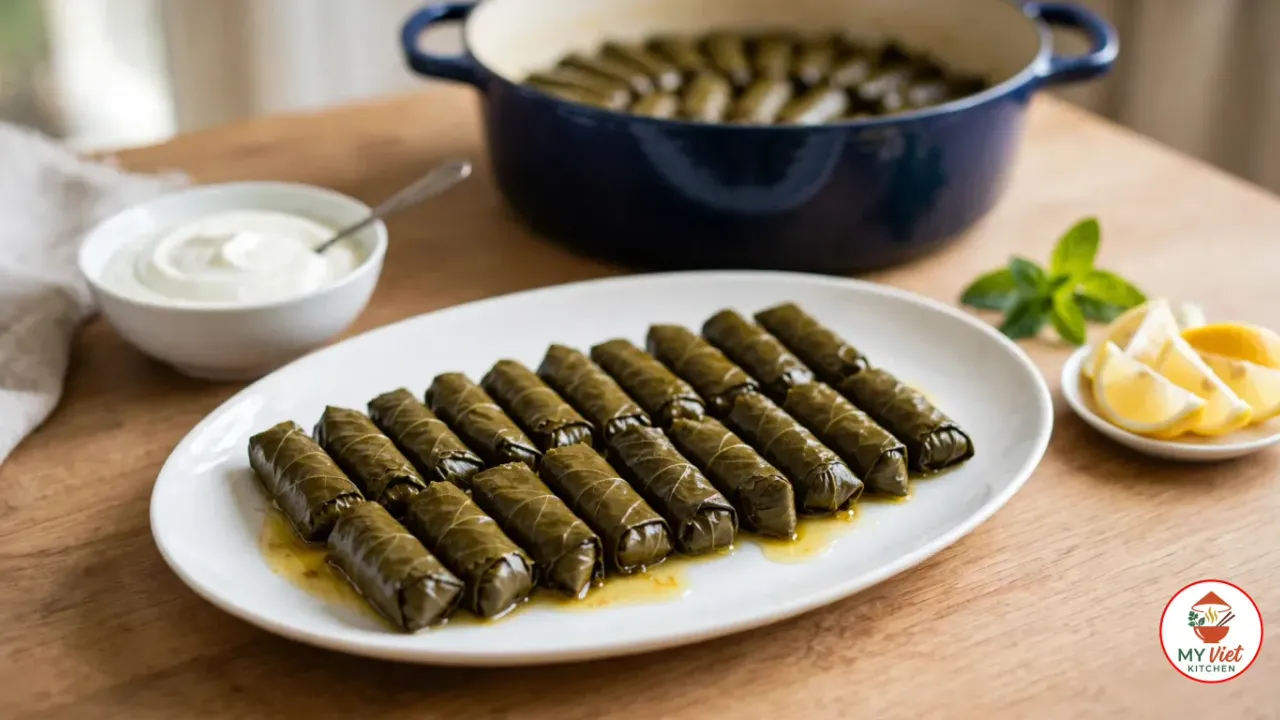
Dolma is a family of stuffed dishes, and this is the rolled-leaf kind: finger-sized grape leaf rolls wrapped around raw lamb, rice and herbs, then simmered in lemony broth under a plate (Wikipedia). One 16-ounce jar of leaves makes about 50 rolls, enough for 6 people. With meat in the filling, you serve them warm, with plain yogurt and lemon. Rolling takes the longest; the pot does the rest.
Prep Time: 1 hour 15 minutes | Cook Time: 1 hour 10 minutes | Total Time: 2 hours 40 minutes (includes a 15-minute rest) | Servings: 6
Difficulty: Medium | Calories: ~490 per serving

Dolma, Sarma or Dolmades: What Are You Rolling?
The word is Turkish and means “something stuffed” or “filled,” from the verb dolmak. Wikipedia describes dolma as a family of stuffed dishes largely associated with Ottoman cuisine: vegetables and leaves, hollowed out or wrapped, then filled with rice, minced meat, herbs and spices (Wikipedia).
Turkish cooks draw a line that other kitchens often skip. In Turkey, dolma is a hollowed vegetable with a stuffing, and sarma, the “rolled or wrapped thing,” is a filling wrapped in vine or cabbage leaves. In other former Ottoman lands, dolma is used more broadly and covers rolled leaves too (Wikipedia). So the rolls on this page would be sarma in Turkey and dolma in many other places.
The same rolls go by a string of local names. Wikipedia lists dolmades in Greece, terevor tolma in Armenia, yarpaq dolması in Azerbaijan, dolmeh in Iran and mahshi waraq enab in Egypt (Wikipedia).
Where the dish began is disputed. The same article mainly associates it with the stuffed vegetables of the Ottoman Empire, believed to have been invented in the palace kitchens, and notes that the historian William Pokhlebkin traced dolma to Armenian cooking. For stuffed vine leaves in particular, it says the origins are unknown. Dolma making in Azerbaijan joined UNESCO’s intangible heritage lists in 2017, and the culture of tolma is on Armenia’s own national list (Wikipedia).
Why Are These Served Warm?
Stuffed leaves come in two broad styles. According to Wikipedia, olive-oil dolmas are usually stuffed with rice and served cold with a garlic-yogurt sauce, while versions with a meat filling are served warm, often with tahini or avgolemono sauce. Meatless vine leaves, called yalancı dolma in Turkish, are served at room temperature (Wikipedia).
The rolls here are the warm kind. Lamb fat and butter firm up as they cool. Bring the rolls to the table while the filling is still soft, or warm leftovers gently in a covered pan with a few spoonfuls of their liquid. Stuffed vine leaves are also served with garlic yogurt (Wikipedia). For that version, grate a small clove of garlic into the cup of yogurt and add a pinch of salt.
Which Rice and Meat Should You Buy?
Use short-grain or medium-grain rice, such as Calrose or Egyptian rice. The grains go into the leaves raw, soak up the broth in the pot and cling together as they soften, so each bite holds its shape when you cut a roll in half. Long-grain rice like basmati cooks up drier and looser. Rinse the rice in a sieve until the water runs mostly clear, then drain it well, or the extra starch makes the filling pasty.
For the meat, pick ground lamb that isn’t labeled extra lean. Some fat keeps the filling juicy through an hour of simmering, while very lean meat turns dry and crumbly inside the leaf. If lamb tastes too strong for you, use half lamb and half beef, the same swap Dimitra Khan offers in her recipe (Dimitra’s Dishes). Her 16-ounce jar of leaves makes 50 to 60 rolls, so one jar is enough here, with the torn leaves left for lining the pot.
How Do You Keep the Rolls from Opening?
Start with soft leaves. Jarred leaves come rolled in tight bundles, packed in salty brine, so unroll them and rinse them well under cold water. Diane Kochilas’s recipe says both brined and fresh leaves need a bit of blanching to soften, and blanches them in batches for 2 to 3 minutes before rinsing them with cold water (Diane Kochilas). A leaf that bends without cracking will close neatly around the filling.
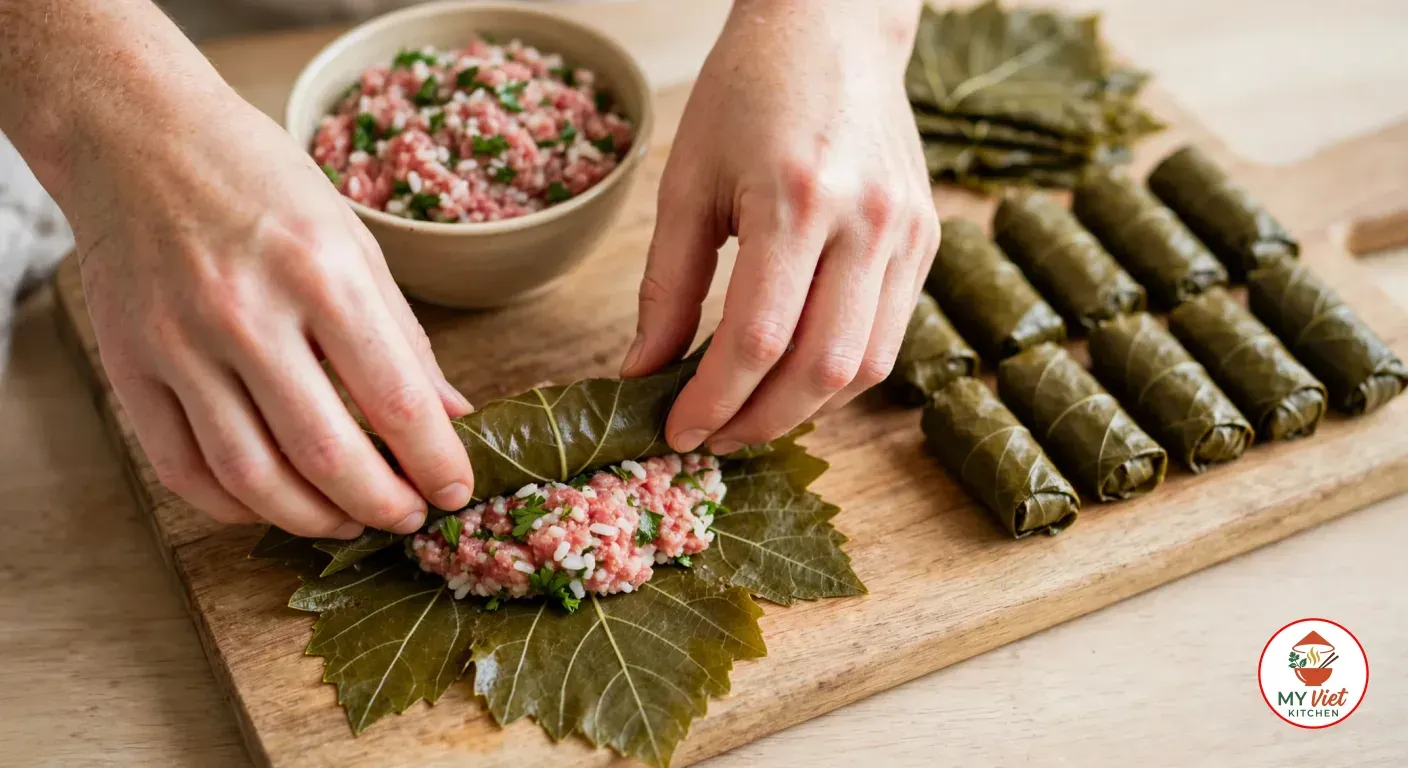
Next, don’t overfill. Lay each leaf vein side up, so the smooth side ends up on the outside. Kochilas puts a scant tablespoon of filling on each leaf, less on the smaller ones, then folds in the sides and rolls up from the base (Diane Kochilas). Dimitra Khan rolls hers snugly but not too tight, because the rice expands while it cooks (Dimitra’s Dishes). Aim for a roll about the width of your finger that feels firm when you squeeze it lightly.
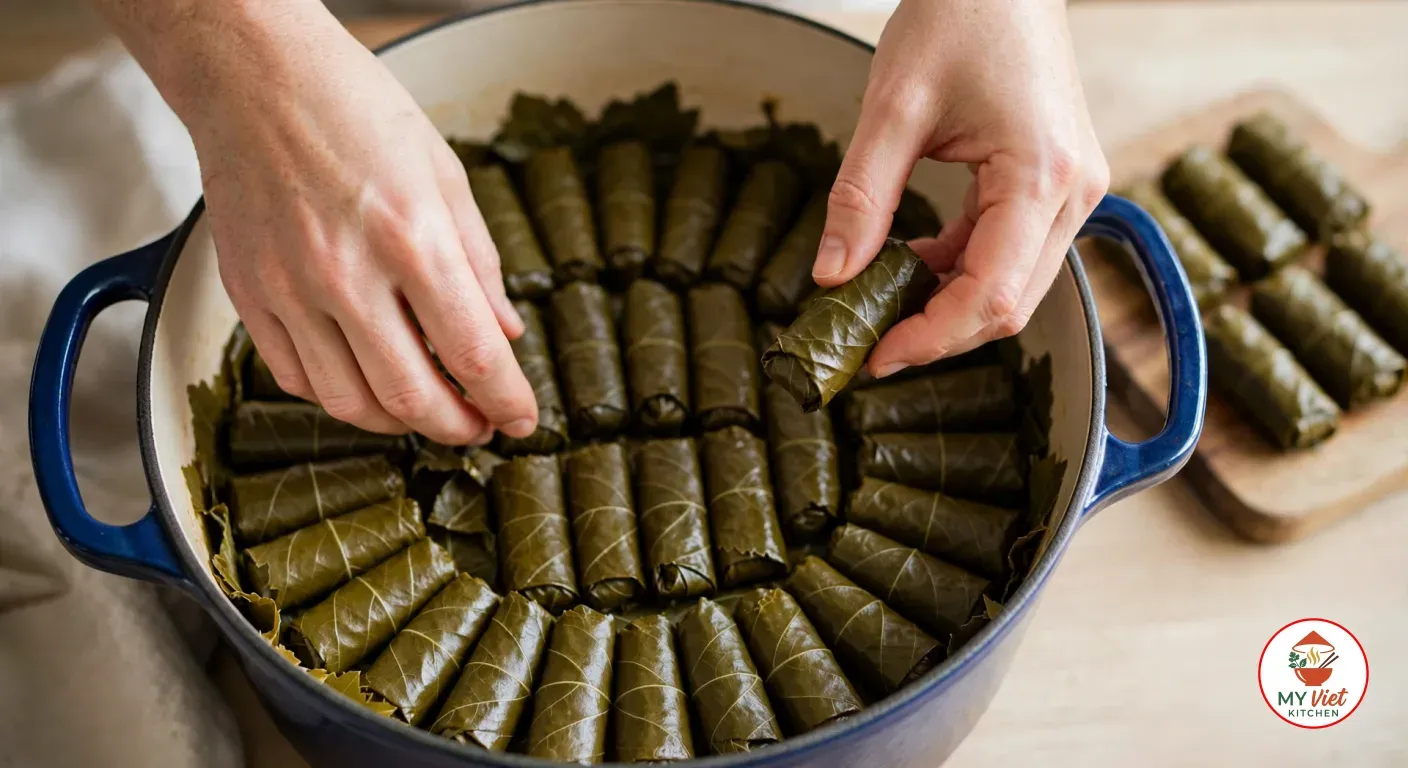
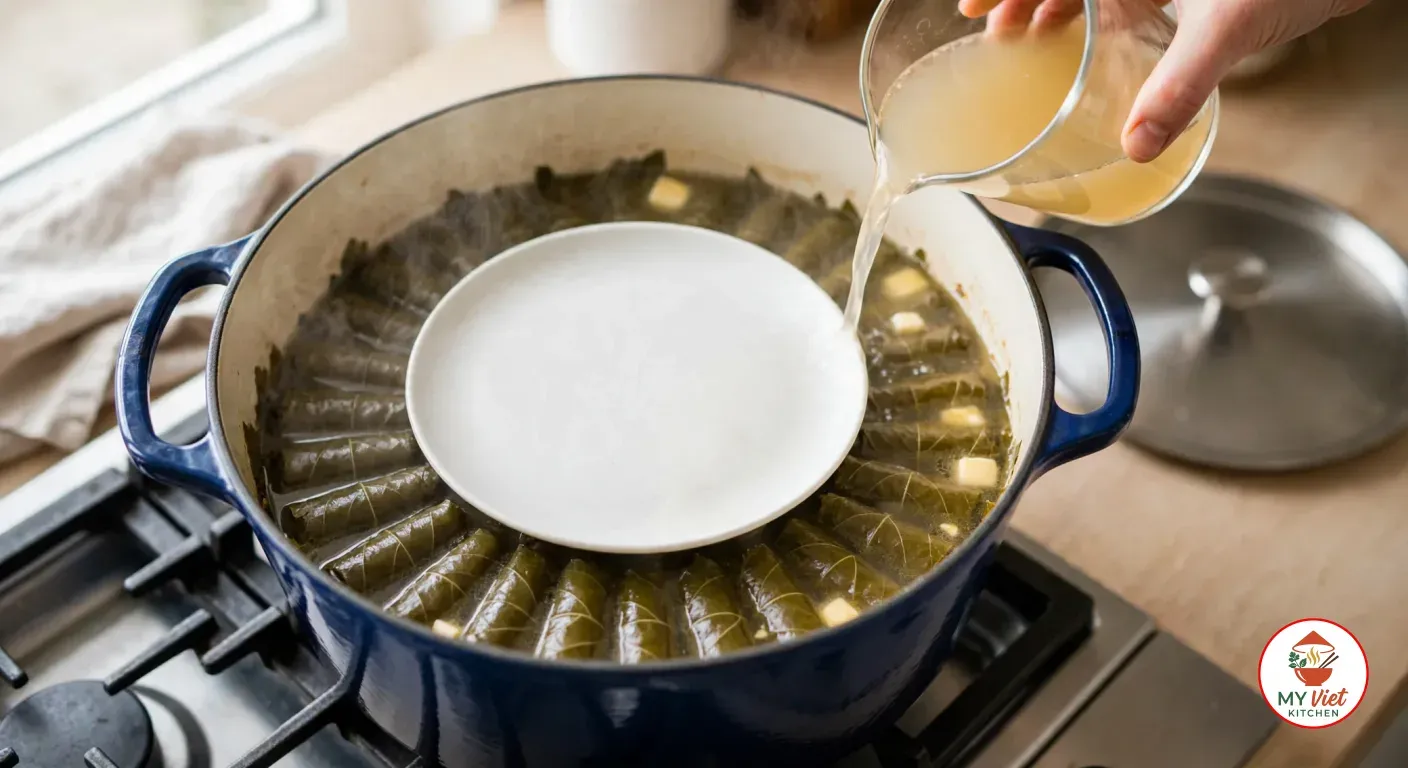
In the pot, packing does most of the work. Set every roll seam side down and push the rows close together, so each roll holds its neighbors shut. Kochilas then places a plate inside the pot over the leaves as a weight to keep them from opening during cooking (Diane Kochilas).
Watch the heat and the liquid level. A hard boil jostles the rolls and can split the leaves, so keep the pot at a lazy simmer once it boils. The liquid should just cover the top layer. If the rice in a test roll is still firm after 50 minutes and the pot looks dry, add 1/4 cup of hot water and cook 10 minutes more.
Ingredients for Dolma
For the Leaves:
- 1 jar (16 oz / 450 g) grape leaves in brine
For the Filling:
- 1 lb (450 g) ground lamb, or half lamb and half beef
- 1 cup (200 g) short-grain or medium-grain rice, rinsed and drained
- 1 large yellow onion, finely diced
- 3 tablespoons tomato paste
- 1/4 cup fresh flat-leaf parsley, finely chopped
- 1/4 cup fresh mint, finely chopped
- 1/4 cup fresh dill, finely chopped
- 3 tablespoons olive oil
- 1 teaspoon ground allspice
- 1 teaspoon ground cumin
- 1/2 teaspoon ground cinnamon
- 1/2 teaspoon black pepper
- 1 teaspoon salt
For the Cooking Liquid:
- 1/3 cup (80 ml) fresh lemon juice, from about 2 large lemons
- 2 1/2 cups (600 ml) low-sodium chicken or vegetable broth, plus hot water as needed
- 2 tablespoons (30 g) butter, cut into small pieces
To Serve:
- 1 cup (240 g) plain yogurt
- 1 lemon, cut into wedges
Step-by-Step Instructions
Step 1: Prepare the Grape Leaves
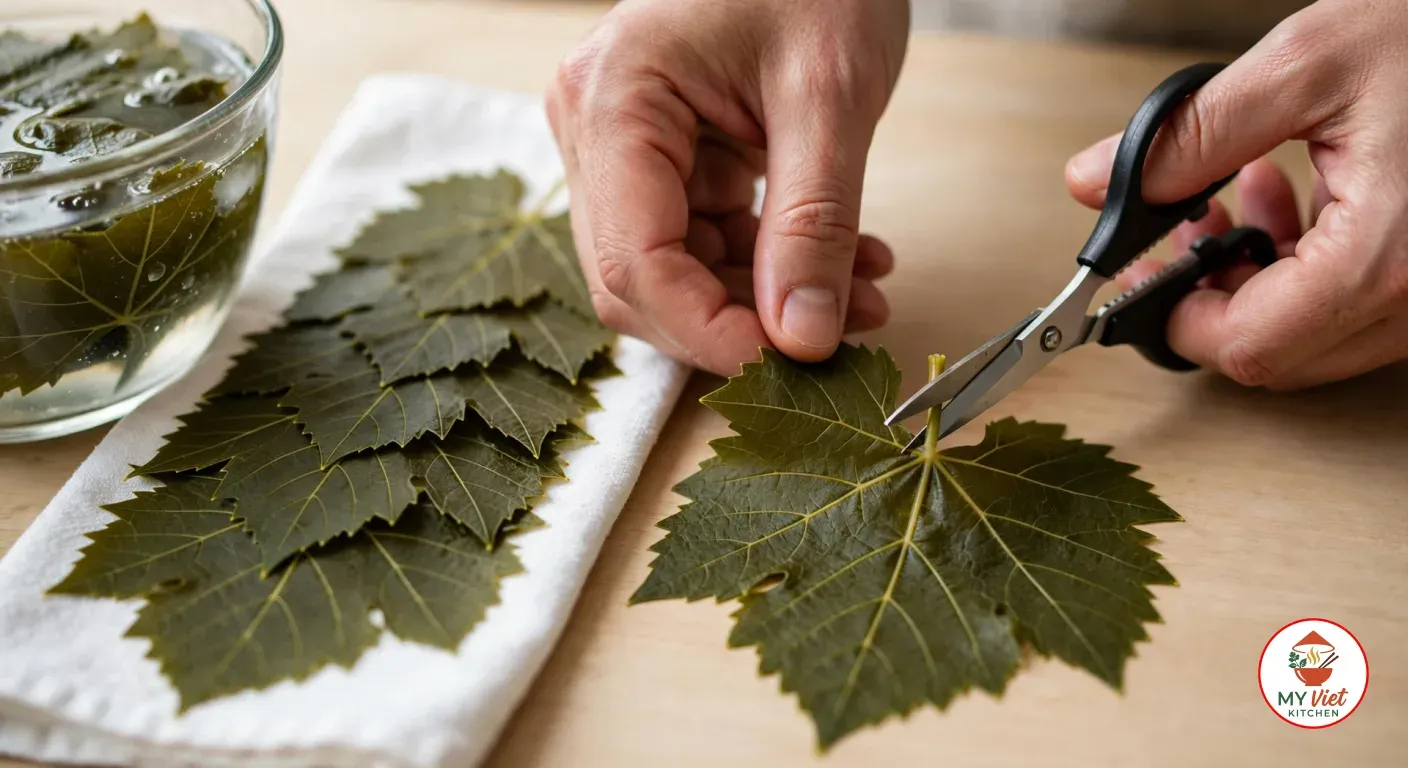
1Lift the leaf bundles out of the jar, unroll them gently and rinse the leaves well under cold running water to wash off the brine. Blanch them in batches in a large pot of boiling water, 2 to 3 minutes per batch, and drop each batch into a bowl of cold water. Snip off each stem with scissors, close to the leaf. Lay the leaves flat on a clean kitchen towel, vein side up. Put the torn and very small ones aside for lining the pot.
Step 2: Make the Filling
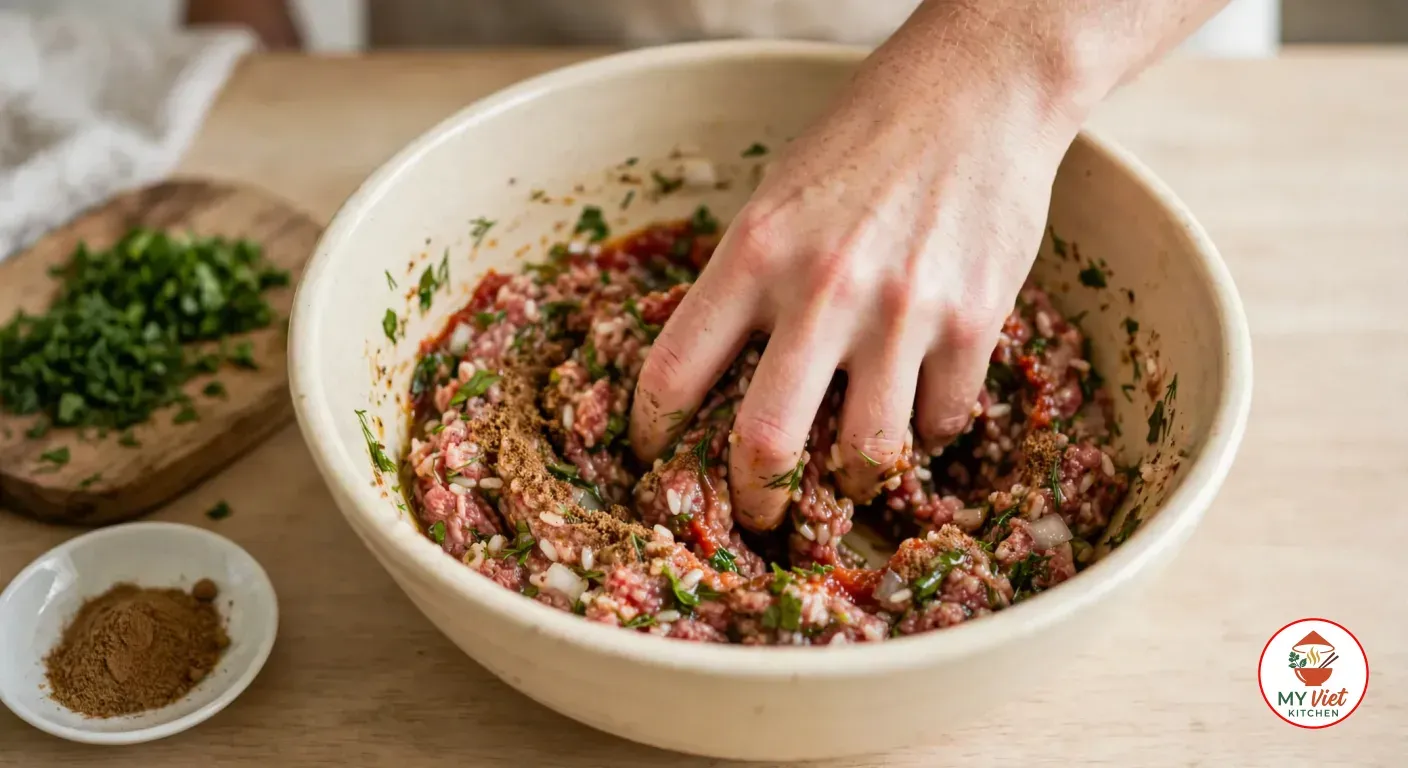
2Put the lamb, rice, onion, tomato paste, parsley, mint, dill, olive oil, allspice, cumin, cinnamon, pepper and salt into a large bowl. Work everything together with your hands for a minute or two until the rice, herbs and paste are spread evenly through the meat. Squeeze a handful: the filling should hold together but not feel wet. The rice stays raw at this point and cooks inside the leaves.
Step 3: Roll the Dolma
3Lay a leaf vein side up with the stem end toward you. Spoon about 1 tablespoon of filling near the stem end and shape it into a short log, using less on small leaves. Fold the bottom of the leaf over the filling, fold in both sides, then roll away from you into a snug cylinder about the size of your finger. Keep it firm but not so tight that it splits as the rice swells. Repeat with the remaining leaves and filling to make about 50 rolls.
Step 4: Arrange in the Pot
4Cover the bottom of a wide, heavy pot with the torn leaves you set aside, so the rolls never touch the hot base. Starting at the edge, pack the rolls in seam side down, tightly side by side in rings, and work toward the middle. If they don’t all fit in one layer, start a second layer on top of the first.
Step 5: Cook the Dolma
5Stir the lemon juice into the broth and pour it over the rolls, then dot the top with the butter. Set a heatproof plate upside down on the rolls to hold them in place. Add hot water if needed so the liquid just covers the top layer. Set the pot over medium-high heat until the liquid bubbles, about 10 minutes. Put the lid on, turn the heat down and let the rolls simmer gently for 50 to 60 minutes. Taste a roll: the rice should be tender. Turn off the heat and leave the lid on for 15 minutes so the rolls settle.
Step 6: Serve with Yogurt and Lemon
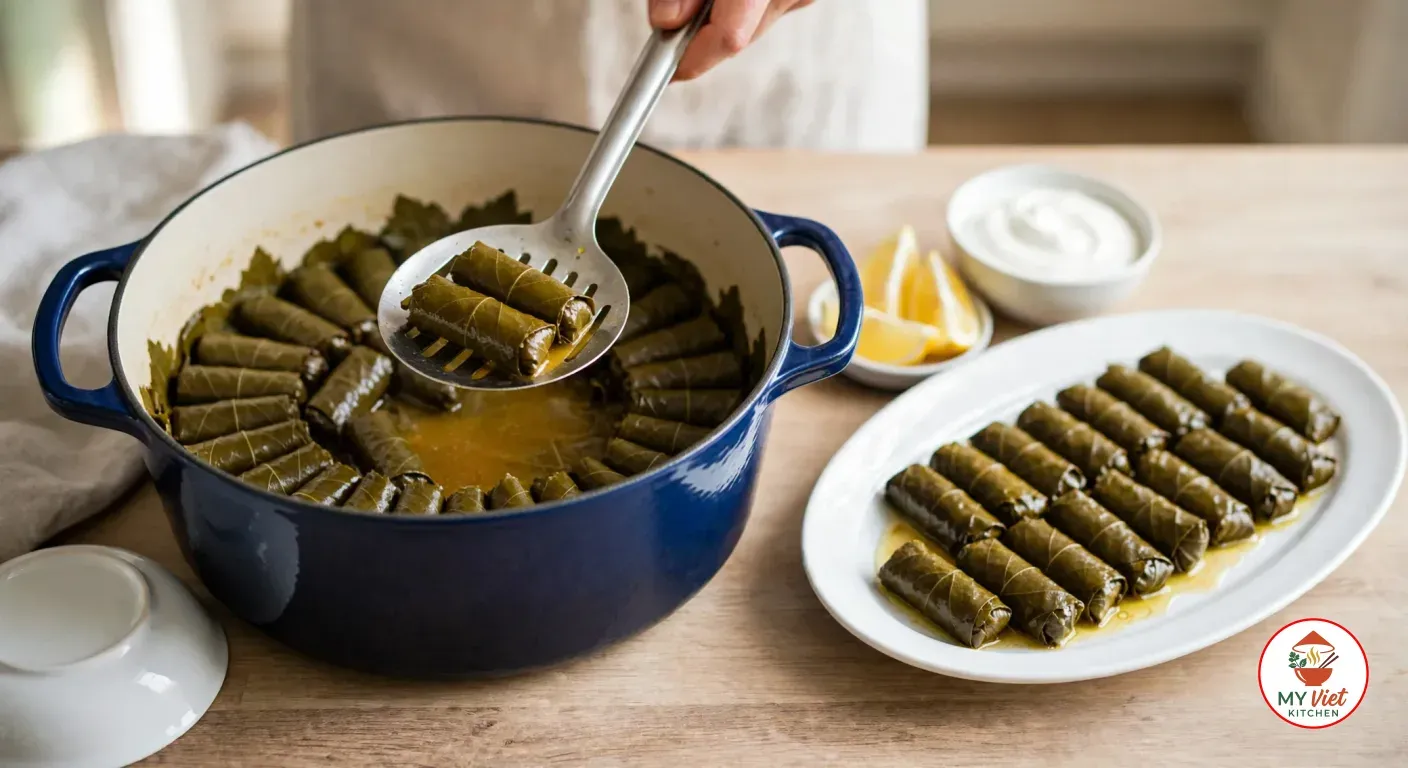
6Lift off the plate with a cloth, as it will be hot. Use a slotted spoon to move the dolma onto a platter, arranging them in a single layer. Spoon a little of the cooking liquid over the top so they stay glossy. Serve warm, with the bowl of yogurt and the lemon wedges for squeezing over each roll.
Frequently Asked Questions
Can you roll dolma a day ahead?
Yes. Dimitra Khan says you can assemble dolmades a day in advance and cook them the next day, as long as they wait in the refrigerator in an airtight container (Dimitra’s Dishes). Pack them into the pot straight from the fridge and allow a few extra minutes for the liquid to come to a boil.
Can you use fresh grape leaves?
Yes, but give them a longer blanch. Zaatar and Zaytoun trims the stalks of fresh leaves and blanches them in boiling water for five minutes to make them easy to roll (Zaatar and Zaytoun). That is longer than the 2 to 3 minutes the jarred leaves get in Step 1. Choose broad leaves without holes or tears.
What can you do with leftover filling?
Cook it in a pan or stuff vegetables with it. Dimitra Khan’s tip is to loosen it with a little water or broth and cook it in a pan for 10 to 15 minutes, until the rice is tender. She also fills peppers, tomatoes, zucchini or eggplant with it and bakes them (Dimitra’s Dishes).
Is the video recipe the same as this one?
Close, but not the same. Dimitra Khan’s lamb dolmades use the same 16-ounce jar of leaves with 2 pounds of meat, 3/4 cup of olive oil and dried oregano, and no tomato paste or warm spices. She simmers them for about 40 to 60 minutes, lets them cool for at least 30 minutes so the juices are absorbed, and serves them with tzatziki (Dimitra’s Dishes). For 6 servings, use the amounts on this page.
Sources
- Dolma, Wikipedia
- Dolmades with Lamb & Rice: Grape Leaves Stuffed with Lamb and Rice, Dimitra Khan, Dimitra’s Dishes, May 2019
- Dolmades – Grape Leaves Stuffed with Rice, Onions, and Herbs, Diane Kochilas, July 2022 (updated February 2025)
- Lebanese Stuffed Grape Leaves with Meat (Warak Enab bi Lahme), Zaatar and Zaytoun, August 2020 (updated June 2026)
- Lamb Dolmades: Lamb and Rice Stuffed Grape Leaves, Dimitra’s Dishes, YouTube, January 2018