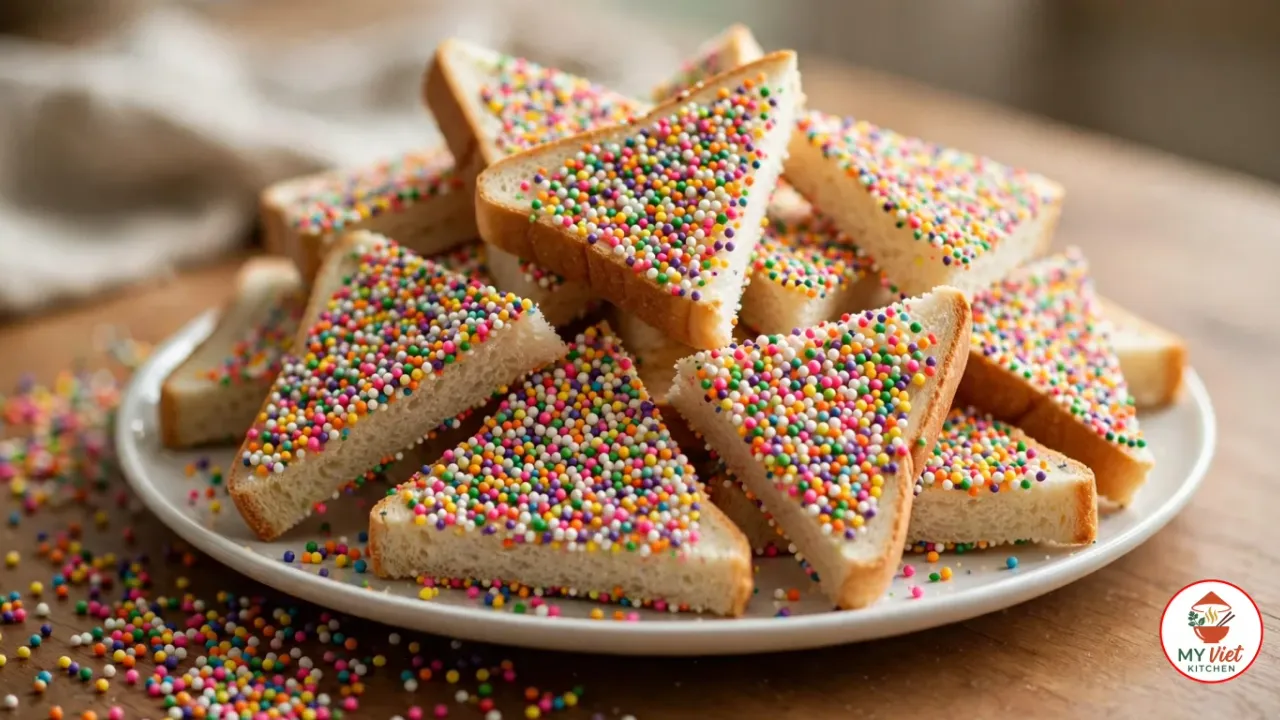
Fairy bread is soft white bread spread with butter or margarine and covered in hundreds and thousands, the tiny round sprinkles, and it turns up at children’s parties across Australia and New Zealand (Wikipedia). This recipe makes 32 small triangles from 8 slices. You butter each slice to the crusts, press it into a dish of sprinkles and cut it corner to corner twice. It takes 10 minutes of work, plus 30 minutes for the butter to soften.
Prep Time: 10 minutes | Cook Time: 0 minutes | Total Time: 40 minutes | Servings: 8
Difficulty: Easy | Calories: ~180 per serving

Which Sprinkles Are Hundreds and Thousands?
Hundreds and thousands are nonpareils: tiny opaque sugar balls in many colors. The name is used in the UK, Australia, New Zealand and South Africa (Wikipedia). In an American store, look for a jar of rainbow nonpareils. Skip the longer rod-shaped sprinkles, which some American makers treat as the standard kind and which New England and Philadelphia often call jimmies (Wikipedia).
The round shape is the point. An Australian writer at America’s Test Kitchen says the tiny bead-like balls change the texture of the sugary top layer and give it extra crunch (America’s Test Kitchen). Megan Jane de Paulo, writing in Independent Australia, calls hundreds and thousands the only acceptable topping. Rod sprinkles, she says, are “quite simply, wrong” (Independent Australia).
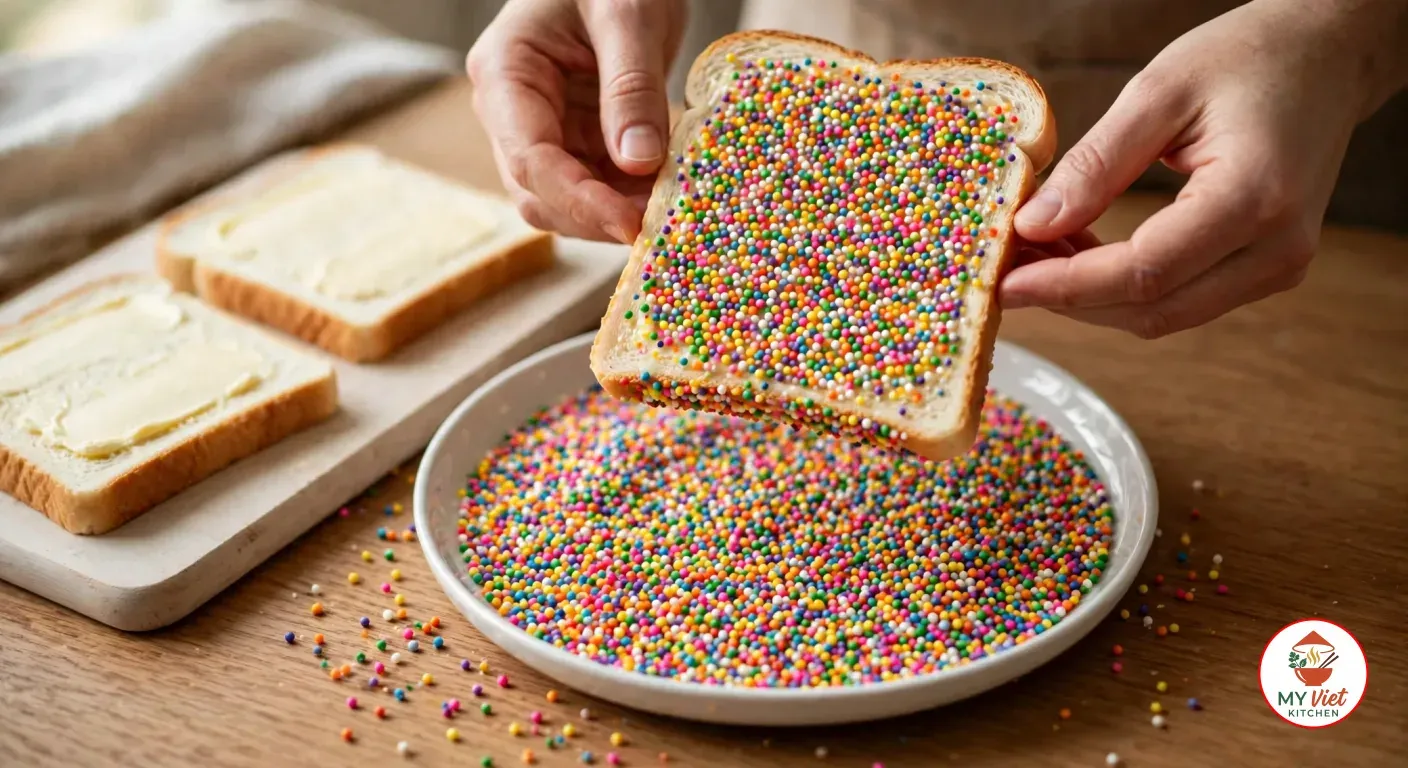
Round balls also roll. The same ATK writer passes on her mother’s advice: don’t pour them over the bread straight from the packet. Pour them onto a baking tray and press the bread in, buttered side down (America’s Test Kitchen). Step 2 does exactly that with a wide dish.
Butter or Margarine?
Either one works. Wikipedia describes fairy bread with butter or margarine (Wikipedia), but Australians argue about it. De Paulo notes that margarine was not commercially available until 1932 (Nuttelex) and Meadow Lea arrived in 1939, so she concludes the first fairy bread was slathered in butter. The 1929 newspaper mention names butter too (Independent Australia).
Margarine has its fans. Alexandria Drzazgowski of The Foreign Fork writes that you can use butter, but margarine is preferred (The Foreign Fork). For guests who avoid milk products, Tara’s Multicultural Table swaps in margarine and says to check that the bread has no dairy in its ingredients (Tara’s Multicultural Table).
This recipe uses butter, salted or unsalted. The ATK writer polled her Australian friends, and salted won for its salty-sweet contrast (America’s Test Kitchen). Either way it must be soft. Tara’s Multicultural Table warns that butter not fully softened to room temperature may tear the bread (Tara’s Multicultural Table).
How far should it go? Jessica Holmes of Sweetest Menu, a recipe writer from Melbourne, spreads it right to the edges, since that is what the sprinkles stick to (Sweetest Menu). The ATK writer stops short of the edge to leave a clean place to hold. With the crusts on, the crust is that clean edge, so here the butter goes up to it.
Crusts On or Off?
Usually on. De Paulo says the crust gives you a handle free of butter and sugary balls and keeps thin, cheap white bread steady; it is usually left uneaten (Independent Australia). She also calls four triangles “a fairy bread rule that can’t be breached”.
Drzazgowski found out how seriously people take the crusts. Her TikTok video of fairy bread with the crusts cut off was seen by 65,000 people, and many of them made fun of her. The Daily Mail wrote about it, and she was invited on Australian talk radio (The Foreign Fork). Bush Cooking, on the other hand, leaves trimming the crusts up to you (Bush Cooking).
How Far Ahead Can You Make Fairy Bread?
A few hours, no more. Holmes says you can make it a few hours before a party, but it is best fresh, while the bread is soft. She adds that it should be kept out of humidity if you can (Sweetest Menu). Tara’s Multicultural Table serves it right after assembling (Tara’s Multicultural Table).
To get ahead, butter and dip the slices, lay them in one layer on a tray and cover it with plastic wrap. Cut the triangles just before the guests arrive, so the cut edges don’t dry out.
Ingredients for Fairy Bread
For the Fairy Bread:
- 8 slices soft white sandwich bread
- 6 tablespoons (85 g) butter, salted or unsalted, or margarine
- 3/4 cup (about 150 g) hundreds and thousands (tiny round nonpareils)
Step-by-Step Instructions
Step 1: Butter the Bread
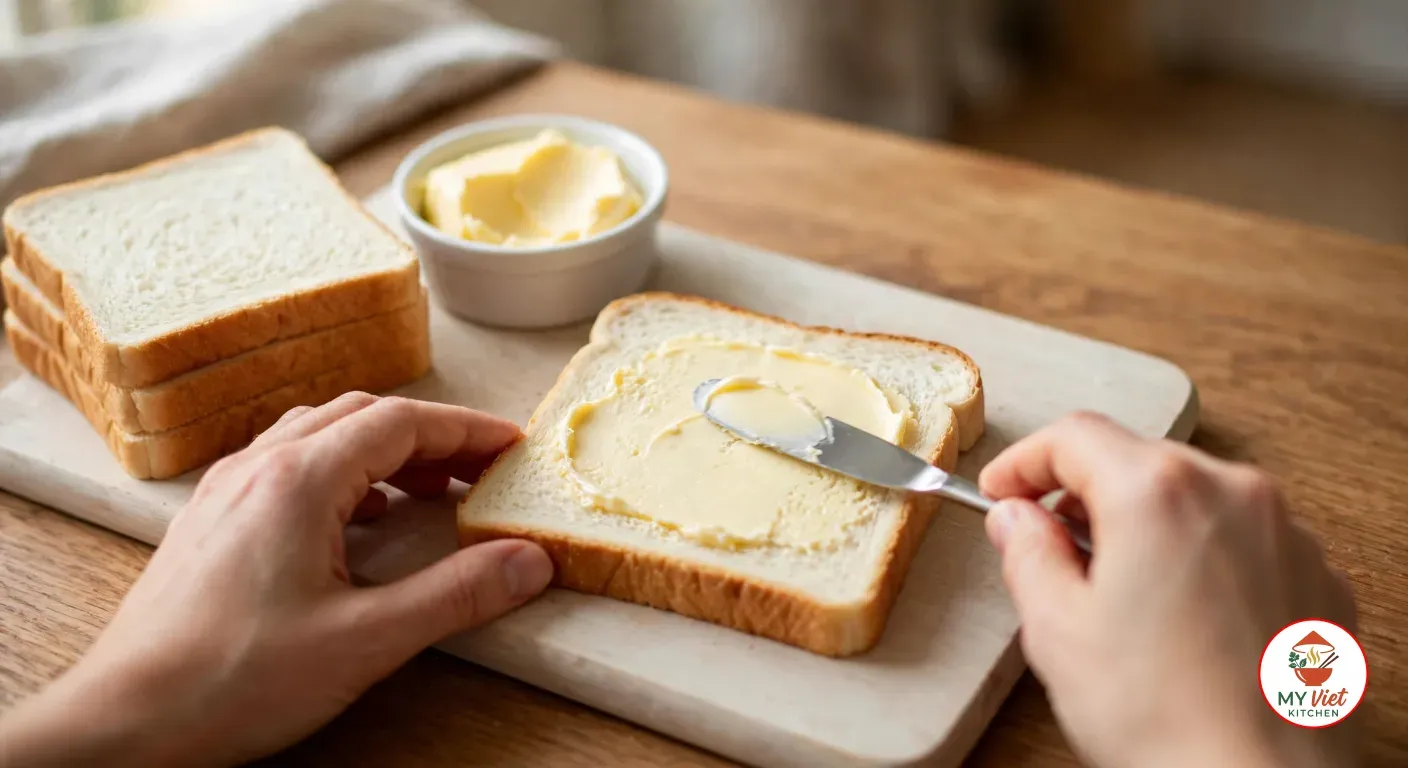
1Take the butter out of the fridge about 30 minutes ahead so it spreads without tearing the bread. Lay the 8 slices on a board and spread each one with about 2 teaspoons (10 g) of butter. Keep the layer thin and even, and take it right up to the crusts on every side: bare bread stays bare.
Step 2: Dip in the Sprinkles
2Pour the hundreds and thousands into a wide, shallow dish in a layer about 1/4 inch (5 mm) deep. Press each slice into them buttered side down, lightly and evenly, then lift it and turn it over. Press a pinch of sprinkles onto any bare patch with your fingertips. When all 8 slices are done, tip the leftover sprinkles back into their jar.
Step 3: Cut into Triangles
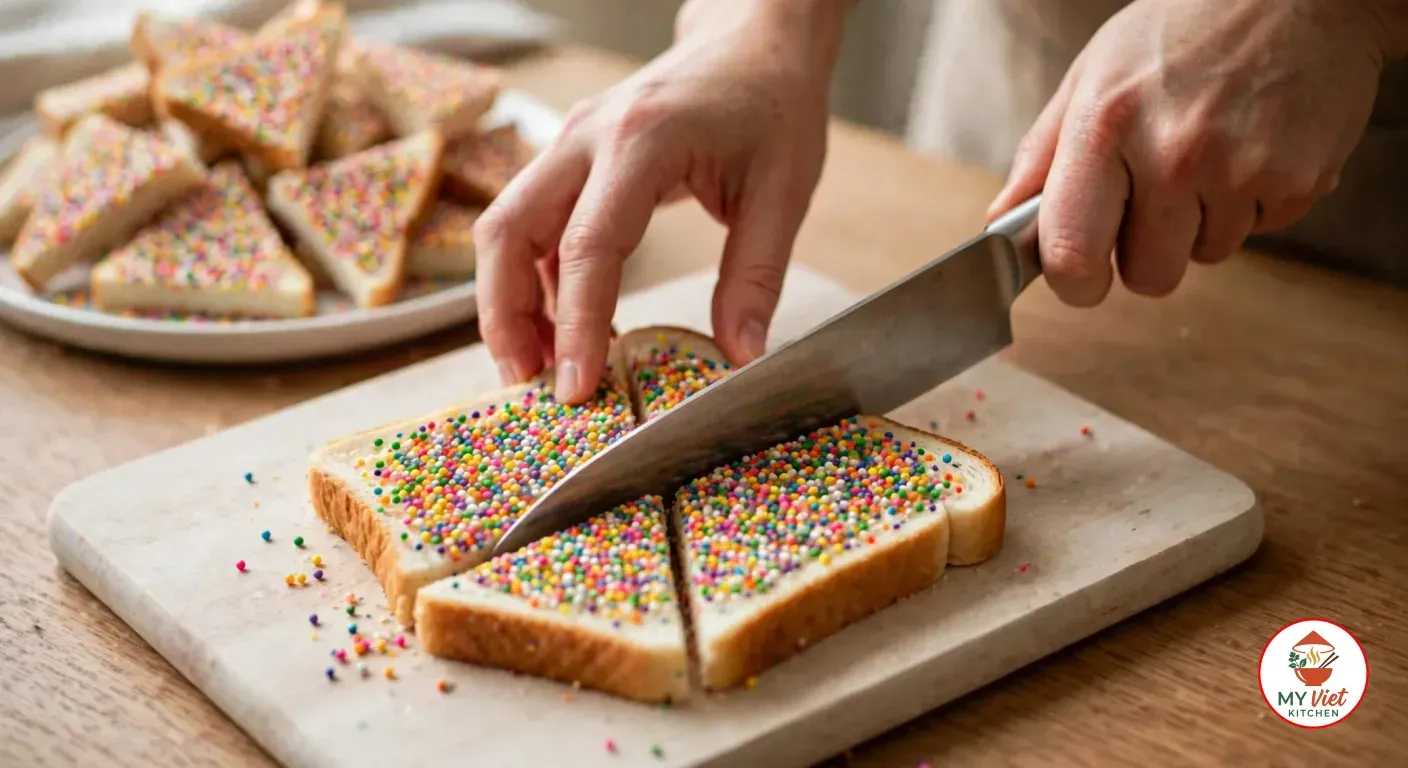
3Leave the crusts on. Cut each slice from corner to corner with a sharp knife, then along the other diagonal, to make 4 triangles. A straight push down, rather than sawing, keeps the sprinkles in place. Arrange the triangles sprinkle side up on a platter and serve within a few hours.
Frequently Asked Questions
Should you toast the bread for fairy bread?
No, fairy bread is made on soft, untoasted white bread. Megan Jane de Paulo writes in Independent Australia that it must never be toasted, but soft and squishable (Independent Australia). The America’s Test Kitchen writer asks for a fluffy Wonder Bread-style loaf with no whole grains or seeds (America’s Test Kitchen).
Where does the name fairy bread come from?
Nobody knows for sure. Wikipedia says it may come from “Fairy Bread”, a poem in Robert Louis Stevenson’s A Child’s Garden of Verses, published in 1885 (Wikipedia). The first known use for this dish is in Hobart’s The Mercury on Anzac Day 1929, about a party for children at the Consumptive Sanatorium. The Hobart Magazine quotes it: “The children will start their party with fairy bread and butter and 100s and 1,000s” (The Hobart Magazine).
Is fairy bread the same as Dutch hagelslag?
No, though the two are close. Wikipedia describes hagelslag as usually oblong chocolate sprinkles a few millimeters long, served on buttered white bread (Wikipedia). Fairy bread uses round, colored hundreds and thousands instead. The Hobart Magazine finds no direct link between them and calls them two similar snacks that evolved independently (The Hobart Magazine).
Is the video recipe the same as this one?
Very close. The video is from The Foreign Fork. Her written recipe spreads a thin layer of margarine, dips the slices margarine side down in a bowl of nonpareils, and cuts them corner to corner into two or four triangles (The Foreign Fork). This page uses butter and always cuts four. The video’s description promises the story of one “GIANT mistake” with Australian media (The Foreign Fork). Her written post tells of Australians mocking her for cutting off the crusts.
Sources
- Fairy bread, Wikipedia
- Sprinkles, Wikipedia
- Fairy Bread: the Surprising Tasmanian Origins of Australia’s Party Snack, The Hobart Magazine, January 2025
- U.S. site tries to ruin what makes fairy bread great, Megan Jane de Paulo, Independent Australia, November 2022
- What Exactly Is Fairy Bread?, America’s Test Kitchen, October 2021
- Fairy Bread from Australia, Alexandria Drzazgowski, The Foreign Fork, October 2021
- How To Make Fairy Bread (Kid’s Party Treat), Jessica Holmes, Sweetest Menu, June 2020
- Fairy Bread, Tara’s Multicultural Table, June 2024
- Fairy Bread, Bush Cooking, March 2017
- Fairy Bread Recipe from Australia, The Foreign Fork, YouTube, April 2022