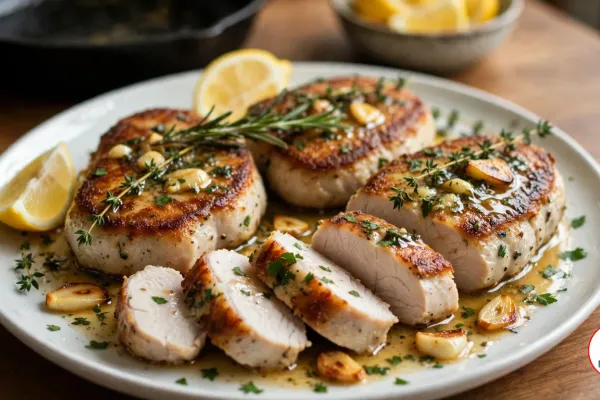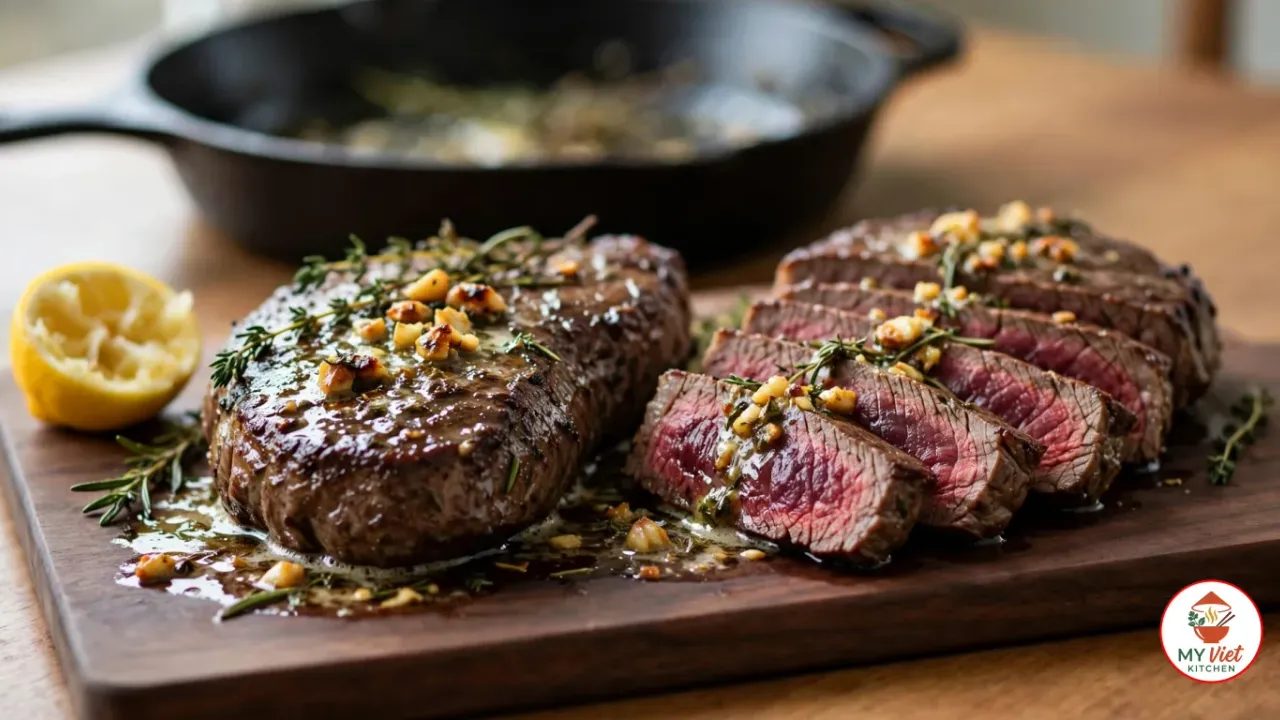
Emu steak is red meat from the emu, the big flightless bird native to Australia; raw, it is a very dark cherry red and cooks up looking like beef (The Poultry Site). Here two fan fillet steaks get a thin coat of Dijon, a hard sear in cast iron and a butter baste with garlic, thyme and rosemary. They come off at medium-rare or at the USDA’s 145°F, rest 5 minutes and finish with lemon.
Prep Time: 25 minutes | Cook Time: 10 minutes | Total Time: 40 minutes (plus overnight thawing if frozen) | Servings: 2
Difficulty: Easy | Calories: ~340 per serving

Which Emu Cut Should You Ask For?
Ask for fan fillet. A USDA fact sheet on ratites, reproduced by The Poultry Site, says the most tender meat comes from the thigh or “fan”, and that more meat comes from the drum and forequarter (The Poultry Site). Gamekeepers, a game meat supplier in Moorabbin, Victoria, sells emu fan fillet as “the most tender premium cut from the inside thigh” and notes that many chefs compare it to a filet mignon (Gamekeepers).
Packs labelled just “emu steak” can be anything. FSANZ, the food standards agency for Australia and New Zealand, describes its “Emu, steak, as purchased, raw” entry as meat from an unspecified portion of an emu (FSANZ). For its 2019 game meat analysis, FSANZ ordered emu fan fillet and flat fillet from a specialty meat supplier in Victoria (FSANZ).
Plan on frozen meat. Gamekeepers lists its fan fillet as frozen, in 1 kg packs (Gamekeepers). Amaroo Hills, an emu farm in Ashland City, Tennessee, and Liberty, North Carolina, vacuum-seals and freezes all of its cuts (Amaroo Hills). Defrost the sealed pack overnight in the fridge, sitting on a plate to catch drips.
Emu meat is a small trade even in Australia. A 2013 FSANZ review says oil is the commercially important emu product, with meat a by-product. It estimated the 2012 industry at 50 licensed farms, which slaughtered 3500 birds for 38 tonnes of meat and 19,600 litres of oil (FSANZ).
How Rare Should You Cook Emu Steak?
Emu sellers recommend medium-rare. Amaroo Hills advises grilling or pan-frying steaks to an internal 125 to 130°F, then resting them in foil for 5 to 10 minutes. For a more cooked steak, it puts medium at 130 to 140 degrees, and it warns that overcooked emu can turn “dry and a bit tough” because there is so little fat (Amaroo Hills). Gamekeepers also says to serve it medium-rare (Gamekeepers). A seared emu recipe on cherikoff.net goes further, cooking the fillets to rare (Cherikoff).
Food-safety figures sit higher. The USDA sheet classes ratites as red meat because their flesh has a pH similar to beef. It says steaks and roasts can be safely cooked to medium rare (145°F) or medium (160°F), and ground meat to 160°F (The Poultry Site).
Australia’s Food Safety Information Council gives 63°C for medium-rare whole cuts of beef, lamb and kangaroo, with a 3 to 5 minute rest. It warns that eating those cuts rare or raw may put you at risk of parasitic infection such as toxoplasmosis. Emu is not on its list (Food Safety Information Council).
Hard data on emu is scarce. FSANZ’s 2013 review found no Australian data on microbial contamination of emu or ostrich carcasses or meat, and no articles describing foodborne illness from ratite meat. In export-sector testing from 2008 to 2010, Salmonella turned up on none of the emu samples: 0 of 16, 0 of 13 and 0 of 12 (FSANZ).
So you have a choice. The sellers’ medium-rare means lifting the steaks out at 52 to 54°C on the probe; the official figure means basting on until it reads 63°C. Either way, trust an instant-read thermometer over your eyes, because the raw meat starts out so dark.
How Lean Is Emu Compared with Beef?
Very lean, though close to lean beef rump on fat. Per 100 g raw, the FSANZ database lists emu steak as purchased at 490 kJ, 23.4 g protein, 2.5 g fat and 3.85 mg iron. Fan fillet carries more protein (24.7 g) and less fat (1.8 g), with 486 kJ and 3.6 mg iron. Lean raw beef rump steak has 20.4 g protein and 2.8 g fat, but only 2.1 mg iron (FSANZ).
With under 2 g of fat in 100 g of fan fillet, the meat has almost nothing of its own to baste with. The butter in Step 3 does that job and supplies most of the fat on the plate. Don’t buy emu for omega-3s, either: FSANZ puts long-chain omega-3s in raw emu steak at 7.088 mg per 100 g, against 72.738 mg in lean rump (FSANZ).
Ingredients for Emu Steak
For the Steaks:
- 2 emu fan fillet steaks, 6 oz (170 g) each and 1 inch (2.5 cm) thick, thawed if frozen
- 1 teaspoon Dijon mustard
- 1 teaspoon flaky sea salt
- 1/2 teaspoon freshly cracked black pepper
- 1 tablespoon (15 ml) olive oil
For the Herb Butter:
- 2 tablespoons (28 g) unsalted butter
- 3 garlic cloves, lightly crushed
- 3 sprigs fresh thyme
- 2 sprigs fresh rosemary
- 1 tablespoon (15 ml) Worcestershire sauce
To Finish:
- 1 tablespoon (15 ml) lemon juice
Step-by-Step Instructions
Step 1: Dry and Season the Steaks
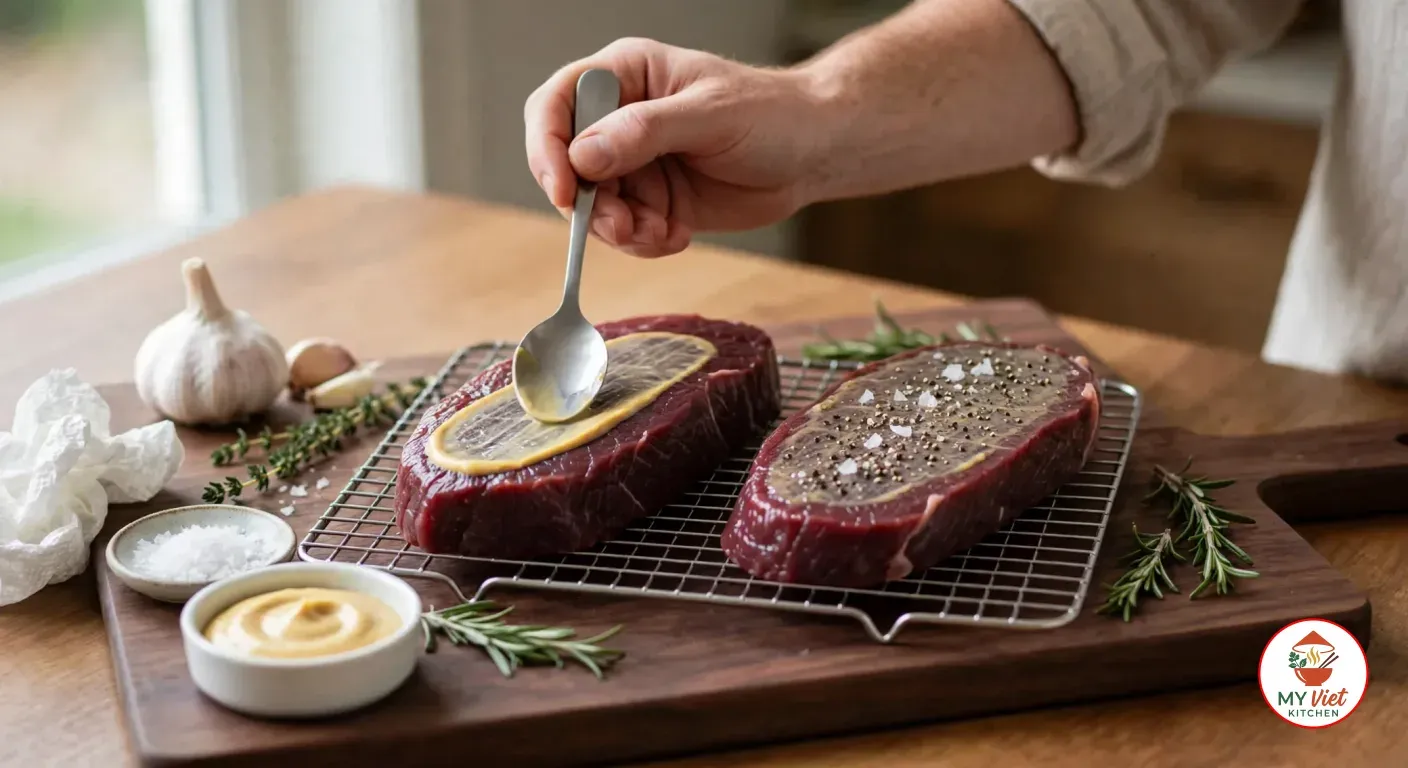
1Pull the steaks from the fridge about 20 minutes ahead. Tip away any liquid from the pack and pat both steaks completely dry with paper towels, pressing on the cut faces. Spread a thin layer of Dijon mustard over both sides with the back of a teaspoon, then scatter on the flaky salt and cracked pepper. Leave them on a wire rack on the counter for those 20 minutes, and use the time to crush the garlic and separate the herb sprigs.
Step 2: Sear Over High Heat
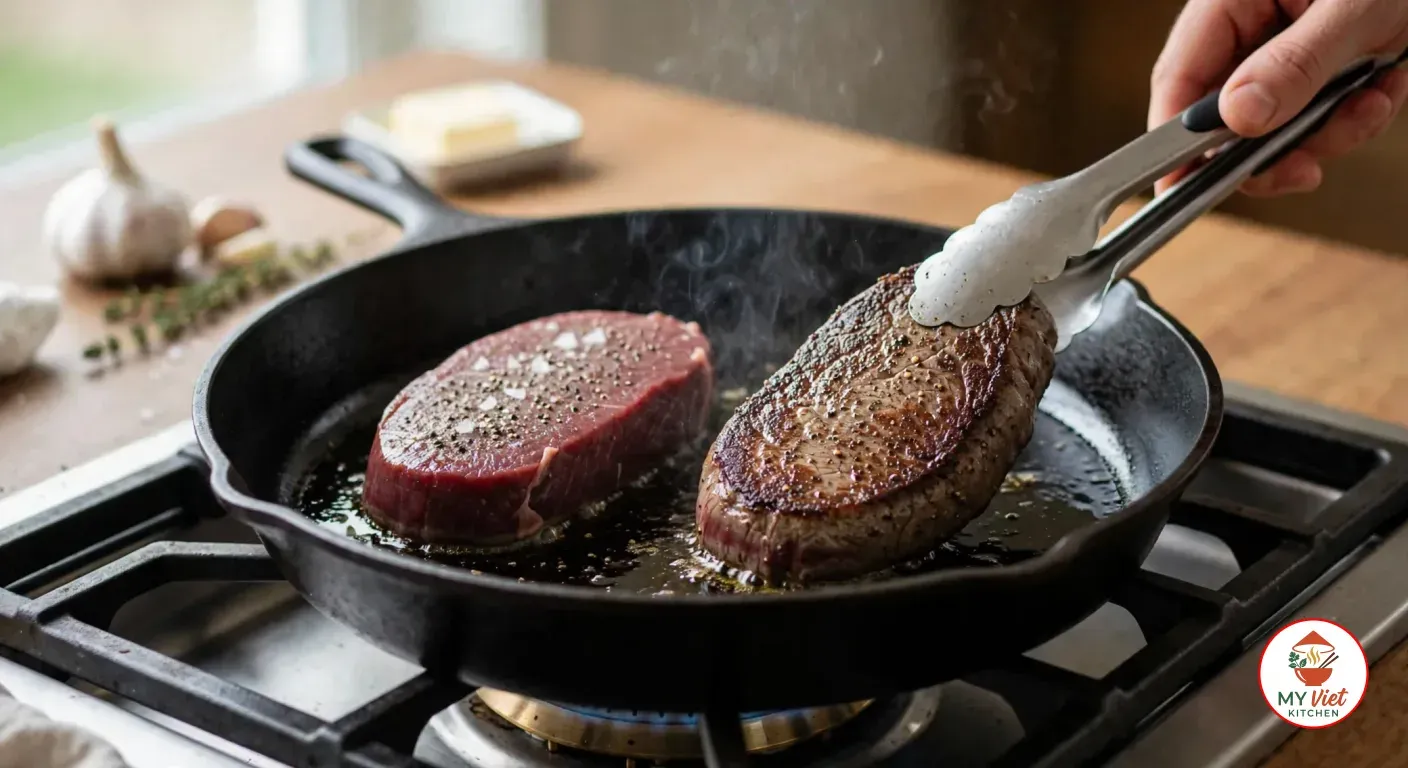
2Pour the olive oil into a 10-inch (25 cm) cast-iron pan and heat it on high until the first wisps of smoke appear. Lay in the steaks away from you and leave them alone for 2 minutes, until the underside is a dark brown crust. The mustard coating browns quickly, so watch the edges. Flip both with tongs and give the other side 2 minutes.
Step 3: Baste and Check the Temperature
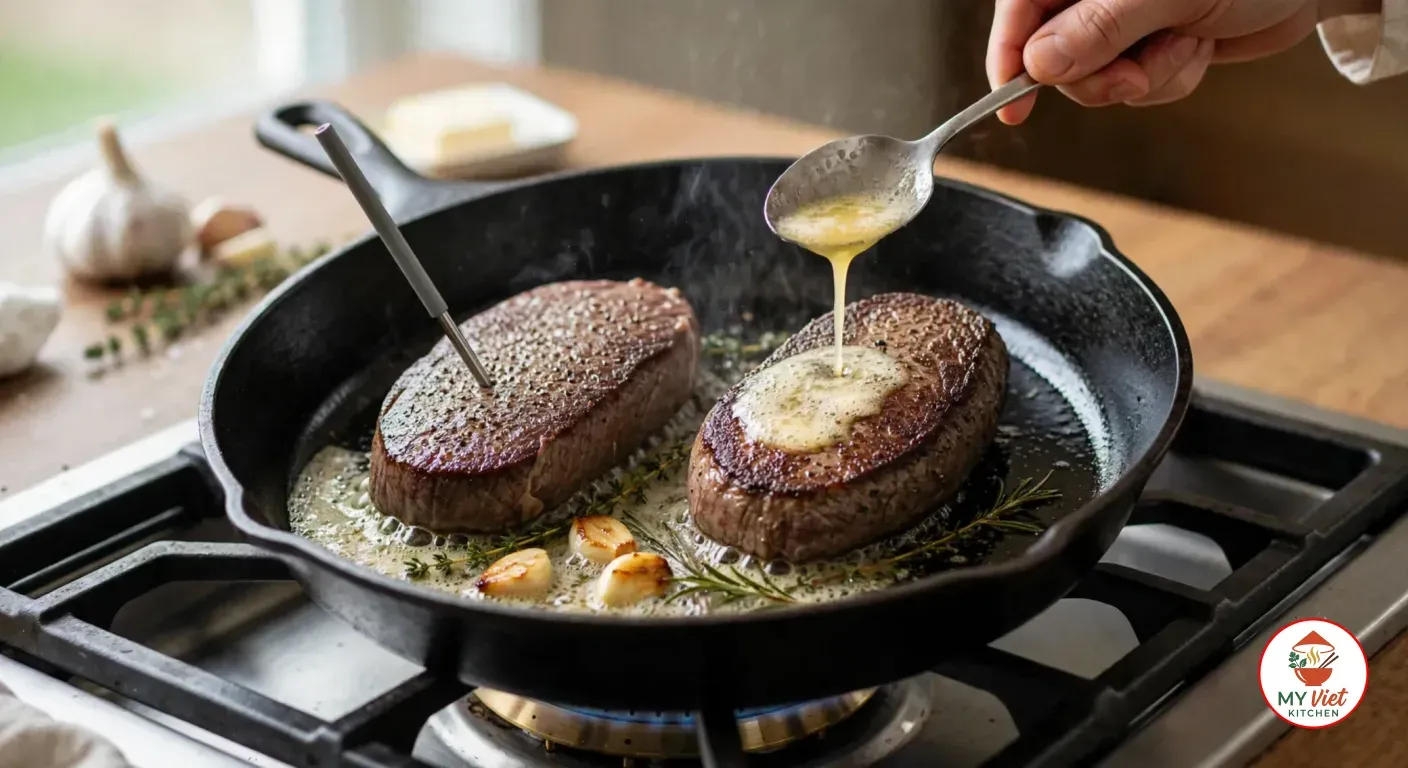
3Turn the heat down to medium and add the butter, garlic, thyme and rosemary around the steaks. When the butter foams, tilt the pan toward you and spoon it over the meat for 1 to 2 minutes. Pour in the Worcestershire sauce and baste once more. Push a thermometer into the thickest part from the side. Take the steaks off at 125 to 130°F (52 to 54°C) for medium-rare, or keep basting to 145°F (63°C), the USDA figure for ratite steaks.
Step 4: Rest and Slice
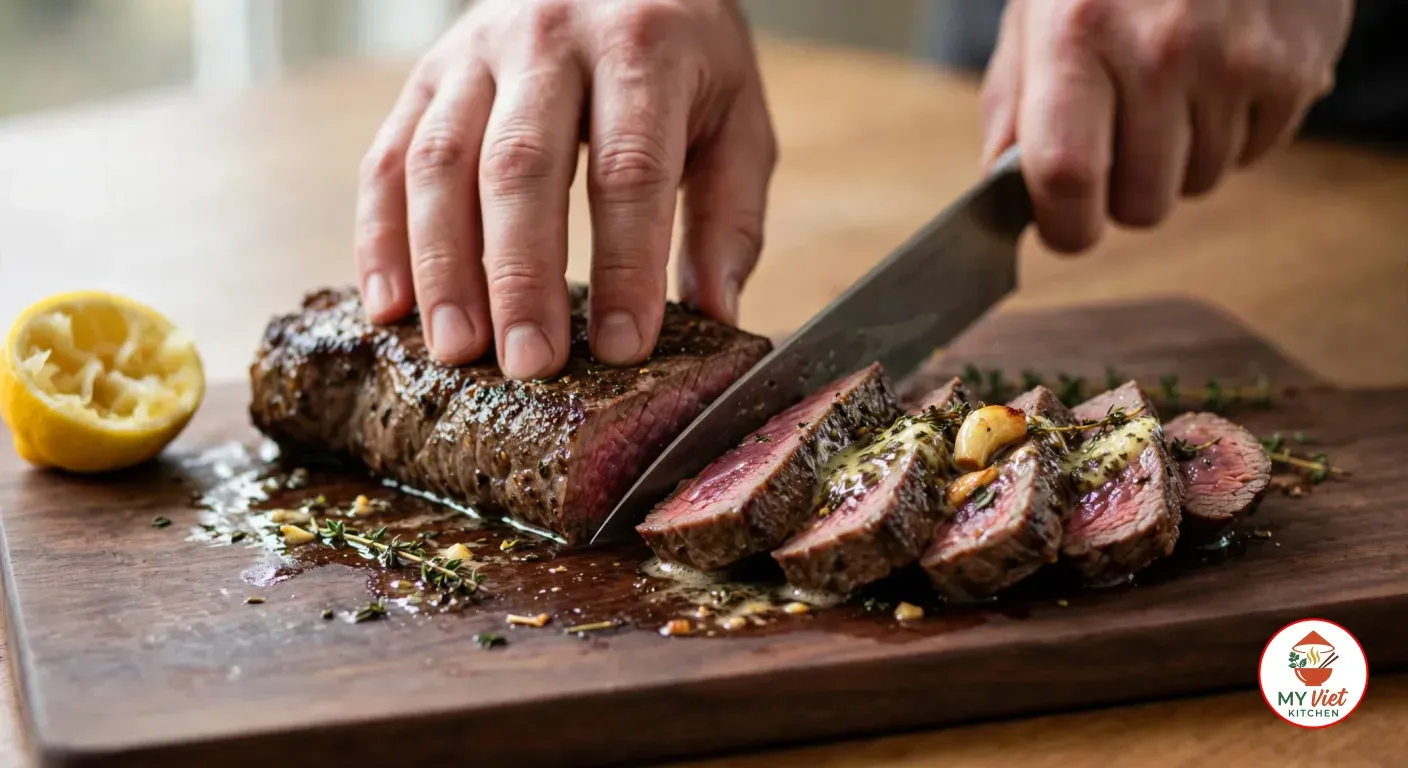
4Lift the steaks onto a warm board, spoon the pan butter over them and squeeze on the lemon juice. Rest them for 5 minutes. Slice across the grain into 1/4-inch (6 mm) slices with a sharp knife, and serve with the soft garlic cloves and the rest of the pan juices poured over.
Frequently Asked Questions
What does emu steak taste like?
Like beef, say the people who farm it. Amaroo Hills writes that emu meat tastes similar to beef, and that cattle farmers it served could not tell the difference in taste or texture (Amaroo Hills). The USDA sheet adds that the cooked meat looks like beef and tastes similar but a little sweeter (The Poultry Site).
Can people with alpha-gal syndrome eat emu?
Emu is a bird, and the CDC lists poultry among foods that don’t contain alpha-gal, though its list does not name emu (CDC). Amaroo Hills co-founder Ngon Nguyen developed the alpha-gal meat allergy after tick bites in 2003. He found emu safe for it and started the farm to share a safe red meat with others who have the allergy (Amaroo Hills). The CDC also says some patients must avoid dairy, so swap the butter here for more olive oil if you need to, and check with your doctor first (CDC).
Can you finish a thick emu fillet in the oven?
Yes, and two sellers do. Gamekeepers sears its fan fillet briefly in a hot pan, roasts it at 215°C for around 12 minutes and rests it well (Gamekeepers). Amaroo Hills reverse-sears a flat fillet. It starts in a 250°F oven, comes out at 95 to 100°F for rare or 105°F for medium to medium-rare, then gets 60 to 90 seconds a side in cast iron (Amaroo Hills).
Is the video recipe the same as this one?
In method, yes. AlphaChef also pan-sears the steaks. Its description says it uses emu round steaks rather than fan fillet and calls the recipe alpha-gal friendly (AlphaChef). If you buy round steaks, cook them to the same temperatures and slice across the grain.
Sources
- Australian Food Composition Database – Release 3 (Food details and Nutrient profiles files: F003779 Emu, steak, as purchased, raw; F003776 Emu, fan fillet, raw; F000739 Beef, rump steak, lean, raw), Food Standards Australia New Zealand, December 2025
- 2019 Game meats analytical program, Food Standards Australia New Zealand, updated February 2025
- Supporting Document 3: Assessment of the microbiological hazards associated with the minor and wild game meat species (Proposal P1014), Food Standards Australia New Zealand, October 2013
- Ratites (Emu, Ostrich and Rhea), The Poultry Site, December 2008 (USDA Food Safety and Inspection Service report updated April 2006)
- Safe cooking temperatures, Food Safety Information Council
- Emu Fan Fillet (frozen) 1kg, Gamekeepers
- Frequently Asked Questions, Amaroo Hills
- About Amaroo Hills, Amaroo Hills
- Reverse Seared Emu Flat Filet, Sarah Terry, Amaroo Hills
- Seared Emu with an Illawarra Plum and Munthari Compote, cherikoff.net
- Fast Facts: Products That May Contain Alpha-gal, Centers for Disease Control and Prevention, January 2026
- About Alpha-gal Syndrome, Centers for Disease Control and Prevention, January 2026
- Alpha Gal Recipe #1: Pan Seared Emu Steaks, AlphaChef, YouTube, July 2020