My Viet KitchenMy Viet Kitchen
HomeVietAsianEuropeanAfricanAmericanAustralianAboutContact
More
FAQPrivacy Policy
HomeVietAsianEuropeanAfricanAmericanAustralianAboutContactFAQPrivacy PolicySearch

Follow us

Home › Asian Dishes › Khinkali: Georgian Dumplings with Broth Inside

My Viet Kitchenmyvietkitchen.com/khinkali/

Khinkali: Georgian Dumplings with Broth Inside

Asian DishesNovember 24, 20267 min read

Share
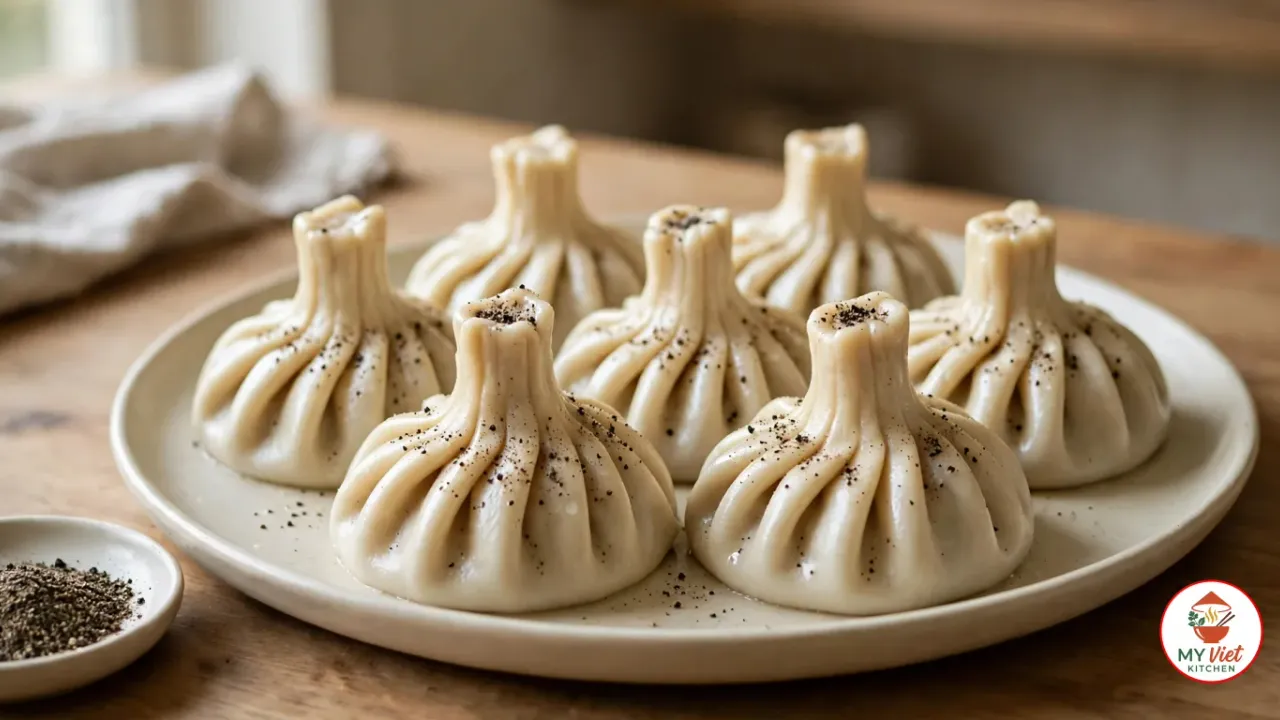
Platter of boiled Georgian khinkali with pleated bellies and twisted topknots, dusted with coarse black pepper, on a wooden table

Prep 1 hour 30 minutesCook 35 minutesTotal 2 hours 5 minutesYield 5 servings (20 khinkali)

Ingredients

  • 3 3/4 cups (500 g) all-purpose flour, plus more for rolling
  • 1 teaspoon kosher salt
  • 1 cup (240 ml) warm water
  • 420 g (15 oz) ground beef
  • 180 g (6 oz) ground pork
  • 2 small onions (about 230 g total), very finely minced
  • 1/2 cup (20 g) finely chopped cilantro
  • 1 teaspoon ground caraway or cumin
  • 1 teaspoon hot red pepper flakes
  • 1 teaspoon freshly ground black pepper
  • 1 1/2 teaspoons kosher salt
  • 1 cup (240 ml) cold water
  • Salt, for the cooking water
  • Coarsely ground black pepper

Method

  1. Knead a Stiff Dough. Whisk the flour with 1 teaspoon salt, then work in the warm water with a fork until no dry patches remain. Knead on a clean counter for 8 to 10 minutes; a finished dough is tight, smooth and leaves your palms clean. Wrap it and refrigerate for 30 minutes.
  2. Loosen the Filling. Combine the beef, pork, onions, caraway, red pepper flakes, black pepper and 1 1/2 teaspoons salt in a wide bowl. Stir in half the cold water, cover and refrigerate for 15 minutes. Stir in the remaining water and the cilantro, then chill for 10 minutes more. The mixture should look wet and slump off the spoon.
  3. Roll the Rounds. Portion the rested dough into 20 balls of roughly 37 g and keep them covered. On a lightly floured board, roll one piece into a 5-inch (13 cm) round, just under 1/8 inch (2 mm) thick. Roll only a few rounds ahead of your pleating so they stay supple.
  4. Pleat the Topknots. Lay a round on your cupped palm and spoon about 3 tablespoons of filling into the center. With the other hand, fold the edge into small pleats, turning the dumpling as you go, until they all meet at the top. Pinch and twist the neck hard to seal it, and trim any long tail of dough. Stand each khinkali on a floured tray under a damp towel.
  5. Boil in Batches. Salt a large pot of water generously and get it to a rolling boil. Lower in 6 to 8 khinkali and nudge them once with a spoon so none cling to the bottom. Boil for 10 to 12 minutes; they will rise to the surface along the way. Cut one from the first batch to check that the meat has lost all its pink and reaches 71°C (160°F). Lift the rest out gently with a slotted spoon.
  6. Pepper and Serve. Arrange the khinkali on a warm platter and grind plenty of black pepper over them. Serve right away, while the broth inside is hot. Pick one up by its knot, bite a small opening in the side, sip, then finish the dumpling and leave the knot on your plate.

Nutrition 690 calories per serving

In this recipe

  1. Where Did Khinkali Come From?
  2. How Wet Should the Filling Be?
  3. How Many Pleats Does a Khinkali Need?
  4. Ingredients for Khinkali
  5. Step-by-Step Instructions
  6. Frequently Asked Questions
  7. Sources

Khinkali (ხინკალი) is a Georgian dumpling closed with a twisted knob of dough and usually stuffed with spiced meat, and it comes from the mountains in the east of the country (Wikipedia). Raw filling goes in, so its juices stay trapped as it boils, leaving a puffy orb of broth almost the size of a tennis ball (BBC Travel). Beef, pork, caraway and a heavy hand with black pepper season this batch of 20.

Prep Time: 1 hour 30 minutes | Cook Time: 35 minutes | Total Time: 2 hours 5 minutes | Servings: 5

Difficulty: Hard | Calories: ~690 per serving

Where Did Khinkali Come From?

Two mountain regions north of Tbilisi, Tusheti and Pshavi, both claim to have invented it. For centuries it warmed Caucasus shepherds with a center of chopped lamb or mutton (BBC Travel). A legend told in those mountains credits the wife of a high priest named Khinda, who made the dish to honor a guest, so that khindali eventually became khinkali (Georgia Travel).

Another story starts much farther east. Chef Tekuna Gachechiladze told BBC Travel of a 13th-century arrival with the armies of Genghis Khan, and food historian Rachel Laudan called a Mongol route “extremely credible” while noting that the dumpling needs more study (BBC Travel). Georgia’s tourism site isn’t persuaded, stating that “khinkali is the child of Georgian cuisine” (Georgia Travel).

The recipe changed again when it reached the valleys. City cooks swapped mutton for a mix of pork and beef, replaced hard-to-find thyme with cumin and added herbs, creating kalakuri, or city-style, khinkali (Georgia Travel). Mountain styles such as mtiuluri and khevsuruli still use fewer herbs and put the emphasis on meat and broth (Advantour).

How Wet Should the Filling Be?

Wetter than feels sensible. Cooks usually add water or broth to the minced meat to make the dumplings juicier (Wikipedia), but the amount swings widely. Olia Hercules, in her book Kaukasis, works 6 tablespoons of cold water into 250 g of meat in two additions, resting the mixture after each (VICE). The Georgian cook behind Tamada’s Table goes much further, with 400 ml for 600 g (Tamada’s Table).

This batch borrows Hercules’ two-stage method and lands near her ratio, at 240 ml for 600 g. She advises first-timers to hold back because a looser filling is harder to shape (VICE). Once your seams stop leaking, raise the water a few tablespoons at a time toward the Tamada’s Table amount.

The meat follows a Tushetian formula that BBC Travel reported from Tbilisi’s Fantastic Douqan, where chef Lena Ezieshvili used seven parts beef to three parts pork (BBC Travel). Fatty cuts help, and Hercules asks for them specifically (VICE).

How Many Pleats Does a Khinkali Need?

Ask three Georgians and you may get three numbers. Mountain tradition calls for 28 folds, one for each year of the solar cycle, with every crease standing for a ray of the sun in the borjghali symbol (Georgia Travel). Hercules repeats the saying that 19 pleats make a perfect dumpling, then admits she manages about 12 and that this works fine (VICE). The count also varies by region (Advantour), so judge a first batch by its seal: a dozen tight folds beat 20 loose ones.

Ingredients for Khinkali

For the Dough:

  • 3 3/4 cups (500 g) all-purpose flour, plus more for rolling
  • 1 teaspoon kosher salt
  • 1 cup (240 ml) warm water

For the Filling:

  • 420 g (15 oz) ground beef
  • 180 g (6 oz) ground pork
  • 2 small onions (about 230 g total), very finely minced
  • 1/2 cup (20 g) finely chopped cilantro
  • 1 teaspoon ground caraway or cumin
  • 1 teaspoon hot red pepper flakes
  • 1 teaspoon freshly ground black pepper
  • 1 1/2 teaspoons kosher salt
  • 1 cup (240 ml) cold water

To Cook and Serve:

  • Salt, for the cooking water
  • Coarsely ground black pepper

You also need a rolling pin, a kitchen scale, a large pot, a slotted spoon and an instant-read thermometer.

Step-by-Step Instructions


Step 1: Knead a Stiff Dough

1Whisk the flour with 1 teaspoon salt, then work in the warm water with a fork until no dry patches remain. Knead on a clean counter for 8 to 10 minutes; a finished dough is tight, smooth and leaves your palms clean. Wrap it and refrigerate for 30 minutes.
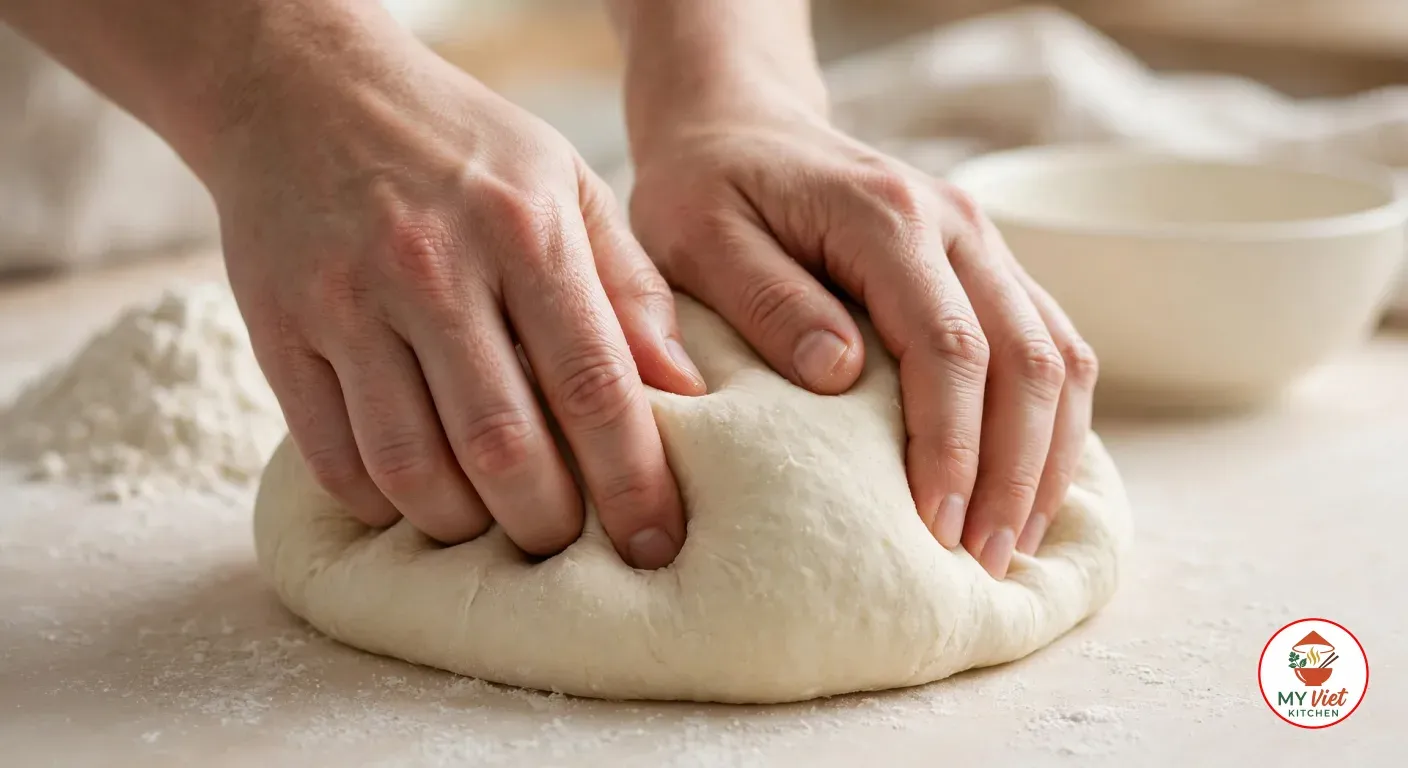
Hands kneading a smooth ball of pale khinkali dough on a floured board
Step 1- Knead a Stiff Dough

Step 2: Loosen the Filling

2Combine the beef, pork, onions, caraway, red pepper flakes, black pepper and 1 1/2 teaspoons salt in a wide bowl. Stir in half the cold water, cover and refrigerate for 15 minutes. Stir in the remaining water and the cilantro, then chill for 10 minutes more. The mixture should look wet and slump off the spoon.
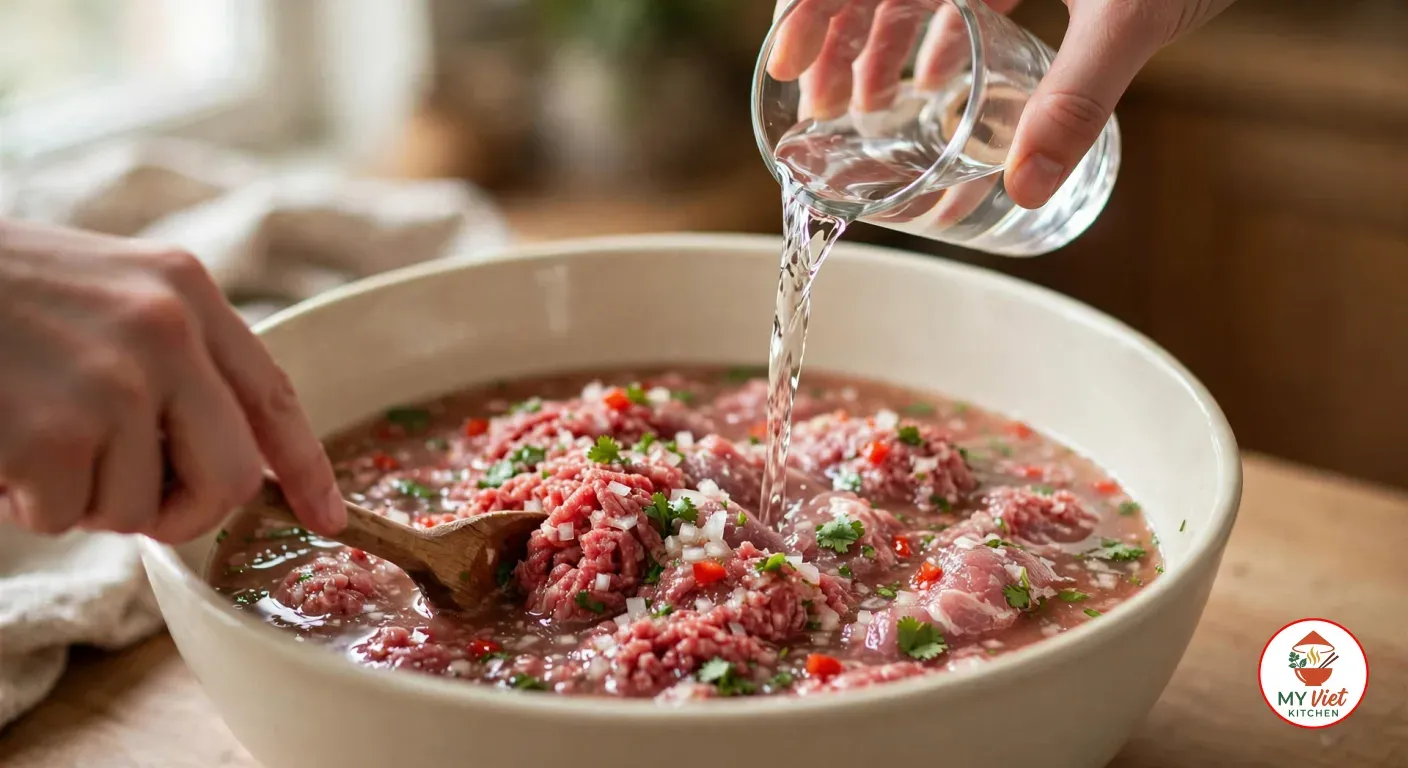
Cold water poured into a cream bowl of loose ground meat filling with onion, cilantro and red chili
Step 2- Loosen the Filling

Step 3: Roll the Rounds

3Portion the rested dough into 20 balls of roughly 37 g and keep them covered. On a lightly floured board, roll one piece into a 5-inch (13 cm) round, just under 1/8 inch (2 mm) thick. Roll only a few rounds ahead of your pleating so they stay supple.
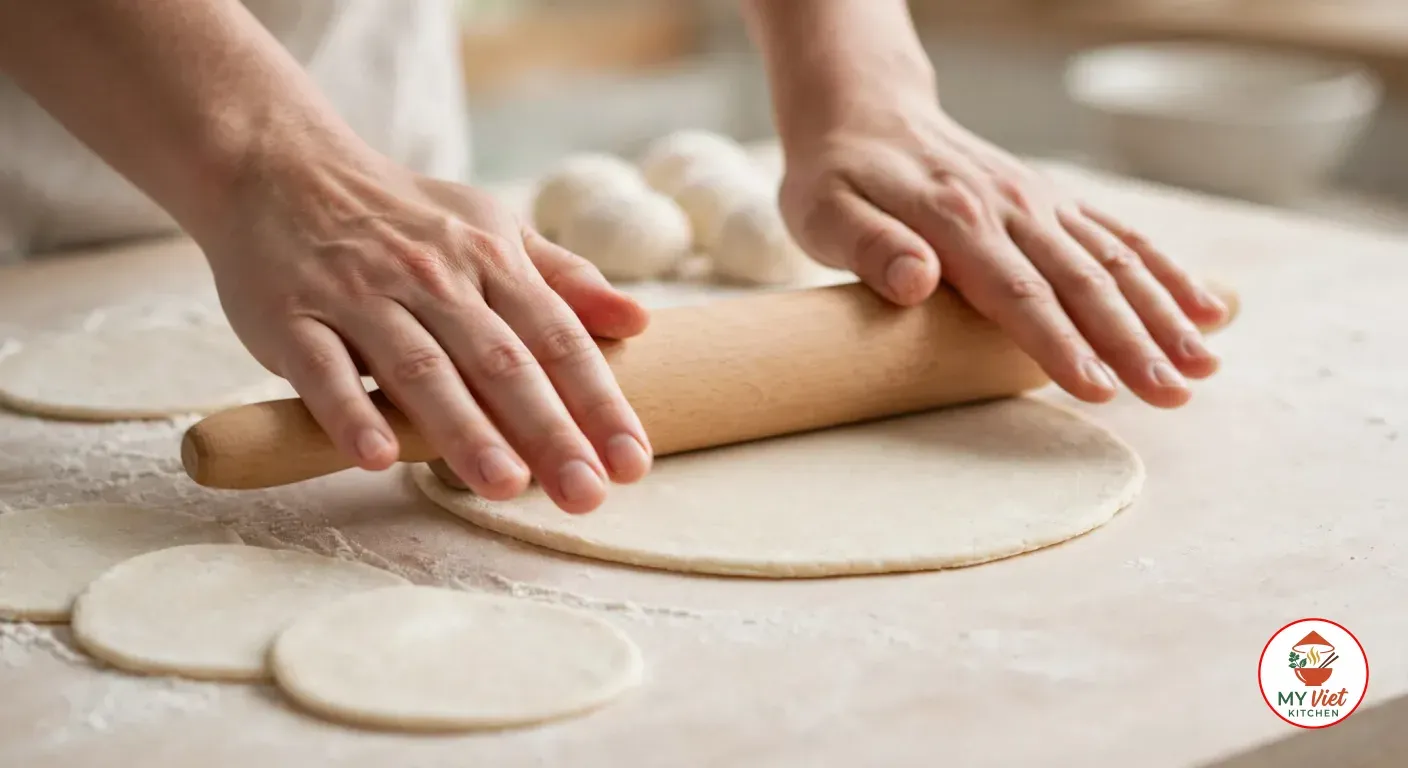
Hands rolling a thin round of dough with a wooden rolling pin beside finished dough circles
Step 3- Roll the Rounds

Step 4: Pleat the Topknots

4Lay a round on your cupped palm and spoon about 3 tablespoons of filling into the center. With the other hand, fold the edge into small pleats, turning the dumpling as you go, until they all meet at the top. Pinch and twist the neck hard to seal it, and trim any long tail of dough. Stand each khinkali on a floured tray under a damp towel.
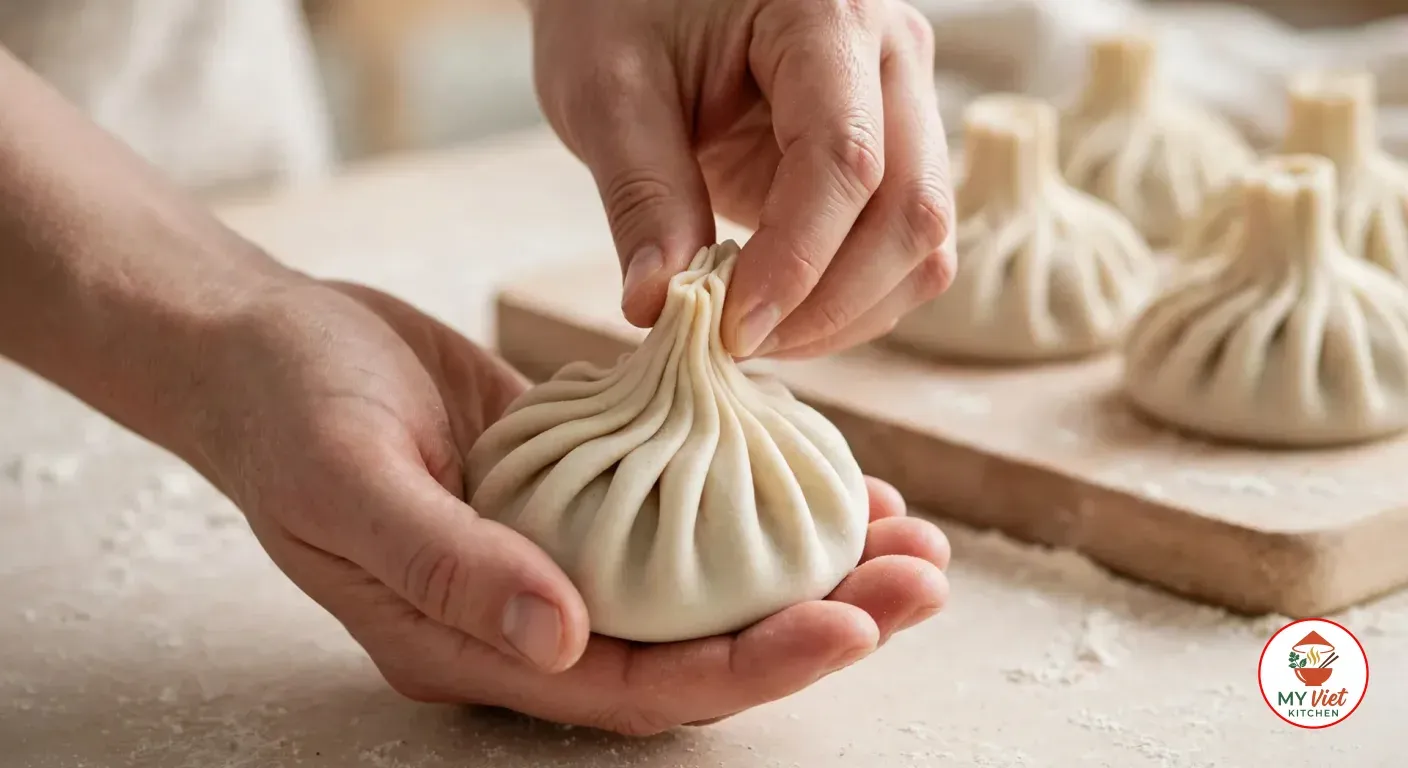
Hand pinching the pleats of a raw khinkali closed while it rests in the other palm, with finished dumplings on a board behind
Step 4- Pleat the Topknots

Step 5: Boil in Batches

5Salt a large pot of water generously and get it to a rolling boil. Lower in 6 to 8 khinkali and nudge them once with a spoon so none cling to the bottom. Boil for 10 to 12 minutes; they will rise to the surface along the way. Cut one from the first batch to check that the meat has lost all its pink and reaches 71°C (160°F) (Health Canada). Lift the rest out gently with a slotted spoon.
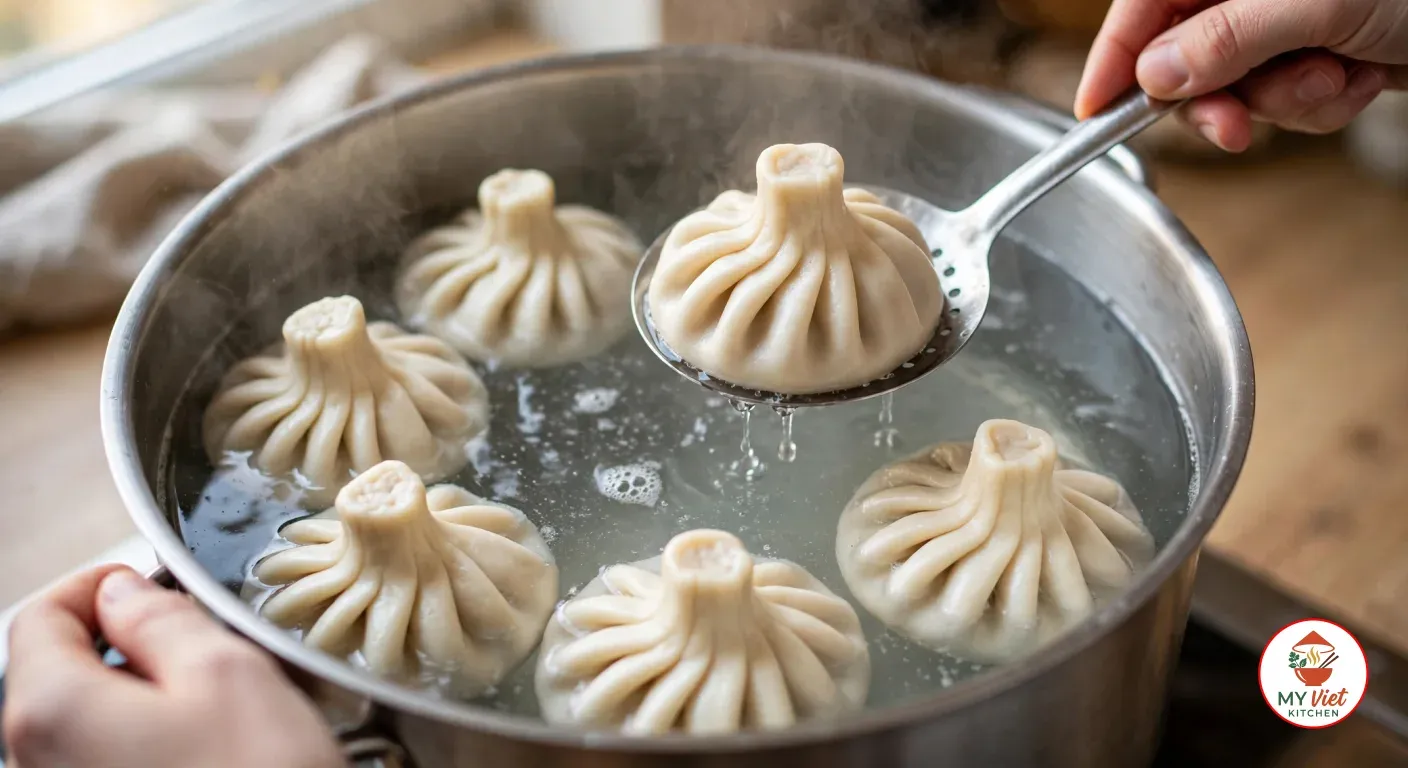
Slotted spoon lifting a boiled khinkali from a stainless steel pot with more dumplings floating in the water
Step 5- Boil in Batches

Step 6: Pepper and Serve

6Arrange the khinkali on a warm platter and grind plenty of black pepper over them. Serve right away, while the broth inside is hot. Pick one up by its knot, bite a small opening in the side, sip, then finish the dumpling and leave the knot on your plate.
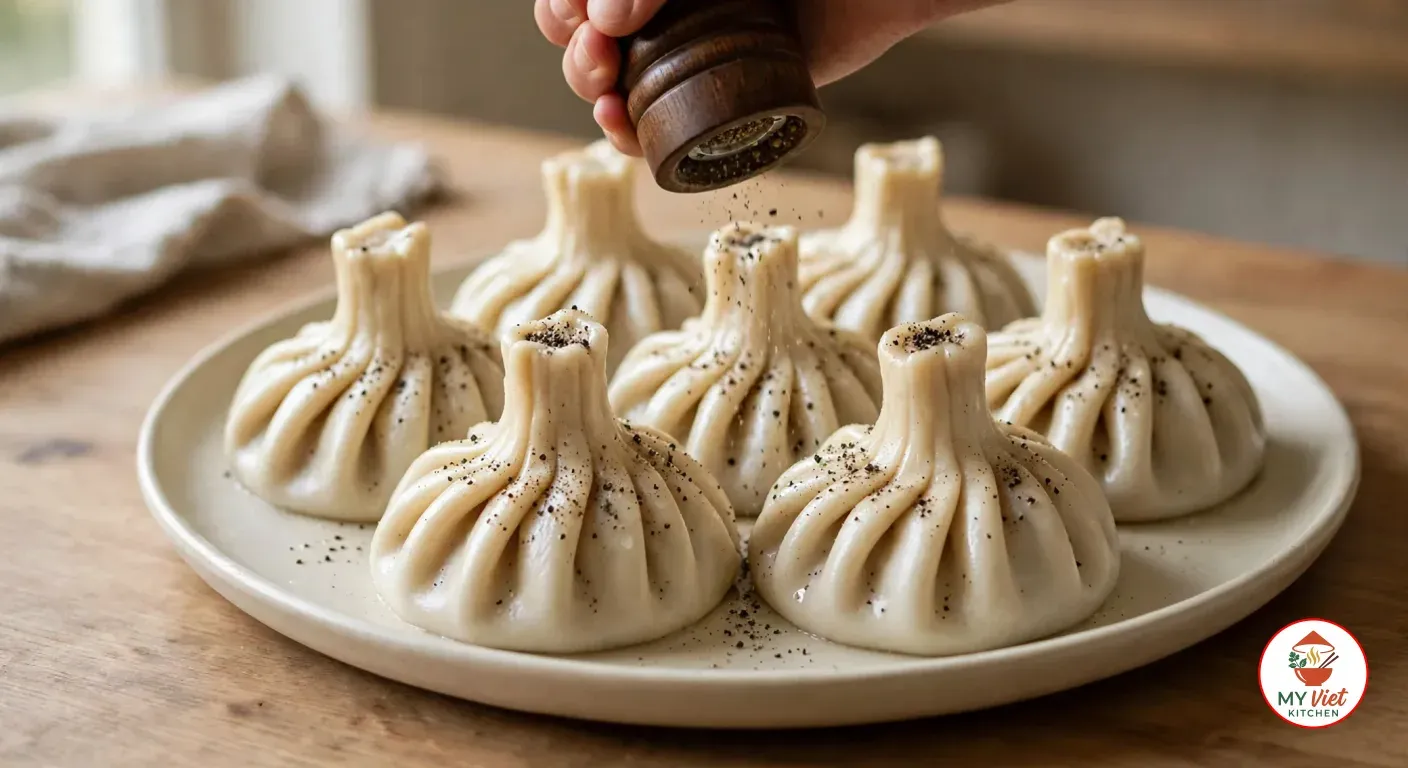
Hand grinding black pepper from a wooden mill over a platter of boiled khinkali
Step 6- Pepper and Serve

Frequently Asked Questions

How do you eat khinkali?

With your hands. Hold it by the knot over the plate, take a small bite from the side and sip the broth before eating the rest (Advantour). A fork tears the dough and spills the juice, which is why using one is considered incorrect or childish in Georgia (Wikipedia).

Do you eat the knot?

No. The top, where the pleats meet, is tough, so it stays on the plate and shows how many each person has eaten (Wikipedia). Georgia Today adds that some Georgians laugh off the tally as a tourist trick to sell more dumplings (Georgia Today).

Are there meatless khinkali?

Yes. Mushroom, potato and cheese fillings all replace the meat, and the mushroom and potato kinds are commonly eaten on Orthodox fasting days in Georgia (Wikipedia).

Can you freeze khinkali?

Yes, before boiling. Freeze them apart on a floured tray, bag them once solid, then boil from frozen with a couple of extra minutes (Venturists).

What should you do with leftovers?

Fry them. Tamada’s Table calls khinkali excellent the next day, fried lightly in oil or butter (Tamada’s Table).

Sources

  • Khinkali, Wikipedia
  • Georgia’s giant dumpling born from conquest, Matthew Ponsford, BBC Travel, December 2019
  • Khinkali - Traditional Georgian Dumplings, Georgia Travel
  • Khinkali: A Primer for the Uninitiated and the Curious, Georgia Today
  • Khinkali (Georgian Dumplings) Recipe, Olia Hercules, VICE
  • Georgian Khinkali Guide, Advantour
  • Khinkali - Georgian Beef and Pork Soup Dumplings, Venturists
  • Safe internal cooking temperatures, Health Canada
  • How to Make Dumplings | Georgian Khinkali Recipe, Georgian Cuisine at Tamada’s Table, YouTube, October 2021
Love This Recipe?

Click on a star to rate it!

☆☆☆☆☆No votes so far! Be the first to rate this recipe.

Share

Tags: khinkaliGeorgian foodGeorgian dumplingssoup dumplingsmeat dumplings

Bowl of khao soi with a chicken drumstick and egg noodles in golden coconut curry, crowned with crispy fried noodles and cilantro, with pickled greens, shallots and lime on the side← PreviousKhao Soi: Northern Thai Coconut Curry Noodles

More Asian Dishes

Bowl of khao soi with a chicken drumstick and egg noodles in golden coconut curry, crowned with crispy fried noodles and cilantro, with pickled greens, shallots and lime on the side
Asian Dishes

Khao Soi: Northern Thai Coconut Curry Noodles

November 23, 2026

Bowl of khao piak sen with thick white noodles in silky chicken broth, topped with shredded chicken, green onion, cilantro and fried garlic
Asian Dishes

Khao Piak Sen: Lao Chicken Soup with Hand-Cut Noodles

November 22, 2026

Adjarian khachapuri on a round wooden board, a golden bread boat holding melted cheese, a sunny-side-up egg and a pat of butter
Asian Dishes

Adjarian Khachapuri: Georgian Cheese Bread Boats

November 21, 2026

Recent recipes

  • Bowl of khao soi with a chicken drumstick and egg noodles in golden coconut curry, crowned with crispy fried noodles and cilantro, with pickled greens, shallots and lime on the sideKhao Soi: Northern Thai Coconut Curry NoodlesNovember 23, 2026
  • Bowl of khao piak sen with thick white noodles in silky chicken broth, topped with shredded chicken, green onion, cilantro and fried garlicKhao Piak Sen: Lao Chicken Soup with Hand-Cut NoodlesNovember 22, 2026
  • Adjarian khachapuri on a round wooden board, a golden bread boat holding melted cheese, a sunny-side-up egg and a pat of butterAdjarian Khachapuri: Georgian Cheese Bread BoatsNovember 21, 2026
  • Kelewele on a speckled cream stoneware plate on a wooden table: small half-moon pieces of fried ripe plantain, deep golden brown with dark caramelized edges and flecks of chili, scattered with roasted peanuts, with a small dish of peanuts and a whole black-spotted plantain behindKelewele Recipe: Ghanaian Spiced Fried PlantainsNovember 20, 2026

Follow us

Where shall we eat today?

  • Vietnamese
  • Asian
  • European
  • African
  • Americas
  • Australia
  • Drinks
  • Surprise me

Recently updated

  • Khinkali: Georgian Dumplings with Broth Inside
  • Khao Soi: Northern Thai Coconut Curry Noodles
  • Khao Piak Sen: Lao Chicken Soup with Hand-Cut Noodles
  • Adjarian Khachapuri: Georgian Cheese Bread Boats
  • Kelewele Recipe: Ghanaian Spiced Fried Plantains

Categories

  • Vietnamese Dishes
  • Asian Dishes
  • European Dishes
  • African Dishes
  • American Dishes
  • Australian Dishes
  • Beverages

Pages

  • About Us
  • Contact Us
  • FAQ
  • Privacy Policy
  • RSS

Tags

European dishescomfort foodAfrican recipesLatin American foodAsian recipesWest African recipesAustralian cuisineEast African foodSouth American foodCaribbean cuisineAfrican dishesEastern European foodMexican foodSouth African foodvietnamese cuisineFrench cuisineBalkan foodCaribbean foodeasy dinner recipeItalian cookingMexican cuisinePeruvian foodBalkan cuisinefamily dinnerisland foodLatin American recipesNigerian cuisineNorth African recipessummer grillingAuthentic Vietnamese

All tags

Follow us
© 2026 My Viet KitchenAuthentic Vietnamese flavors, made simple