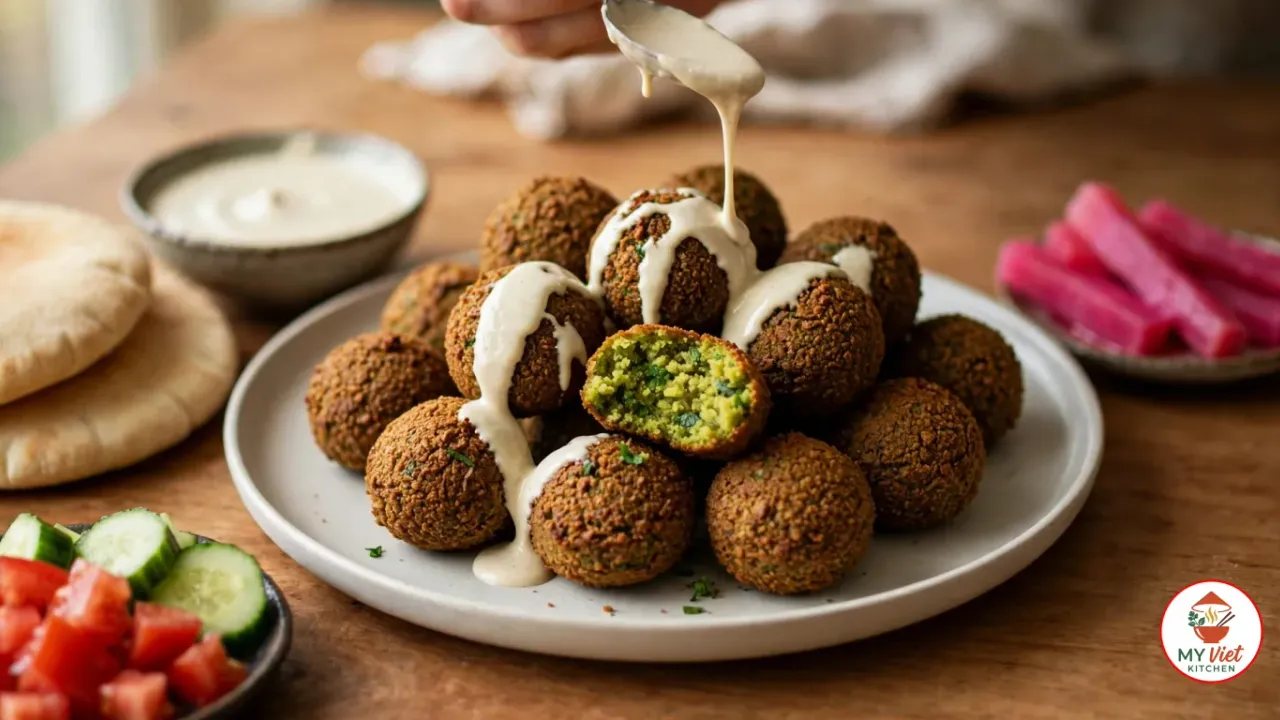
Falafel is a deep-fried fritter, shaped into balls or patties, made from ground fava beans, chickpeas or both and mixed with herbs and spices (Wikipedia). This recipe makes the chickpea kind. Dried chickpeas soak overnight, then go into the food processor raw with parsley, cilantro, onion, garlic and cumin. After an hour in the fridge, the mixture becomes about 30 small discs that fry at 350°F (175°C). Serve them in pita with lemony tahini sauce.
Prep Time: 30 minutes | Cook Time: 30 minutes | Total Time: 14 hours (includes 12 hours soaking and 1 hour chilling) | Servings: 6
Difficulty: Medium | Calories: ~710 per serving

Why Dried Chickpeas, and Never Canned?
Falafel starts from raw beans. Nagi Maehashi of RecipeTin Eats puts it plainly: falafels are made with dried chickpeas that are soaked but not cooked before the balls are formed, and canned chickpeas don’t work (RecipeTin Eats). The soak only softens them enough to grind. The frying oil is where they cook.
Other cooks give the same warning in different words. Jennifer Segal of Once Upon a Chef says canned chickpeas are too soft and hold too much moisture. That can keep the falafel from getting the proper texture and make them fall apart during frying (Once Upon a Chef). Suzy Karadsheh of The Mediterranean Dish writes that canned chickpeas will make the patties disintegrate in the hot oil (The Mediterranean Dish). America’s Test Kitchen says canned chickpeas make stodgy falafel (America’s Test Kitchen).
Soaking times vary. America’s Test Kitchen asks for at least 8 hours and up to 24 at room temperature (America’s Test Kitchen). Karadsheh soaks hers for 24 hours with about 1/2 teaspoon of baking soda in the water to help soften them. She says they will grow to at least twice their size (The Mediterranean Dish). Step 1 asks for 12 to 24 hours under 4 inches (10 cm) of water. Segal says that after soaking they are noticeably plumper and softer but still raw inside (Once Upon a Chef).
How Fine Should You Grind Falafel?
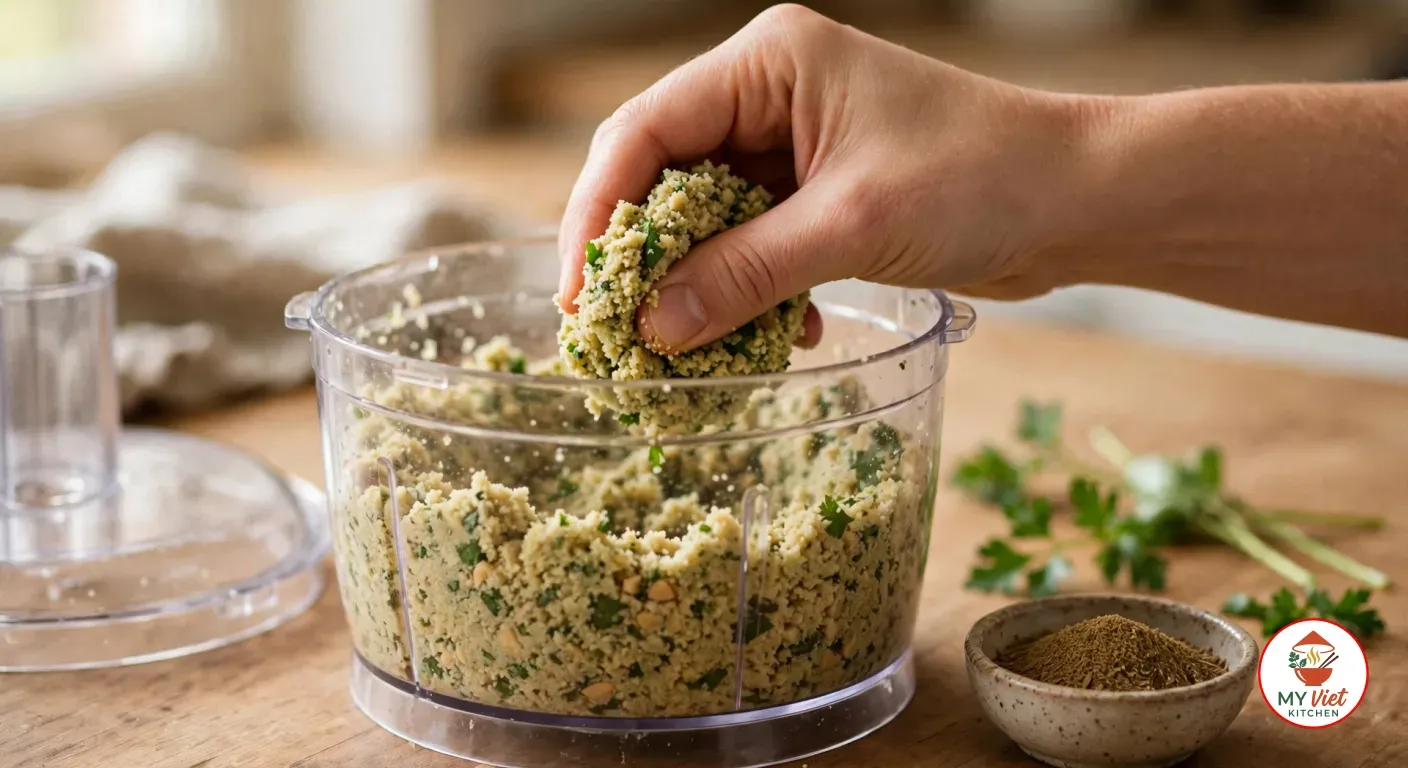
Somewhere between sand and paste. America’s Test Kitchen pulses until the chickpeas are coarsely chopped and resemble sesame seeds (America’s Test Kitchen). Karadsheh stops when the texture is more like coarse meal (The Mediterranean Dish). Segal wants it moist and crumbly rather than smooth or puréed, yet holding together easily when squeezed. If it falls apart, she keeps processing for another minute or so (Once Upon a Chef).
Step 2 uses that squeeze test. Pulse in short bursts, scrape the bowl down, and squeeze a tablespoon of the mixture every 10 pulses. Stop as soon as it holds. An under-ground batch only needs a few more pulses; a purée can’t be taken back. If your processor is small, grind in two batches.
Baking powder divides cooks. Maehashi notes that it isn’t in every recipe and isn’t endorsed by Kenji at Serious Eats, one of her references. She picked it up from Hijazi’s Falafel in Earlwood, Sydney, then made batches with and without it side by side. The baking powder version was noticeably more fluffy and moist (RecipeTin Eats). Karadsheh adds it too, saying it gives falafel an airy, fluffy texture (The Mediterranean Dish).
Karadsheh also calls chilling important. She refrigerates the mixture for at least 1 hour or overnight, since the chilled mixture holds together better and is easier to shape. She stirs in the baking powder only after that (The Mediterranean Dish). Step 3 follows the same order.
Chickpeas or Fava Beans?
Both, depending on where you eat it. Wikipedia says that in Egypt and the Arabian Peninsula falafel is most often made with fava beans. In the Levant it is typically made with chickpeas, or sometimes a blend of both. In Egypt and Sudan it is called ṭaʿmiyya (Wikipedia).
Where it began is less settled. The same article calls the origin uncertain and says the dish most likely originated in Egypt. Some have speculated that it goes back to Pharaonic Egypt, but the earliest written references from Egyptian sources date to the 19th century (Wikipedia). Karadsheh, who grew up in Port Said, Egypt, writes that it’s thought falafel originated there as Coptic Christians looked for a replacement for meat during long seasons of fasting or Lent (The Mediterranean Dish). Her own recipe uses chickpeas, as this one does.
Ingredients for Falafel
For the Falafel:
- 2 cups (400 g) dried chickpeas (not canned)
- 1 medium yellow onion, roughly chopped
- 4 cloves garlic
- 1 cup (30 g) packed fresh flat-leaf parsley, leaves and tender stems
- 1/2 cup (15 g) packed fresh cilantro, leaves and tender stems
- 2 teaspoons ground cumin
- 2 teaspoons ground coriander
- 1/2 teaspoon cayenne pepper
- 1 1/2 teaspoons salt
- 1 teaspoon ground black pepper
- 1 teaspoon baking powder
- 3 tablespoons (25 g) all-purpose flour or chickpea flour
- 2 tablespoons sesame seeds (optional)
- About 2 quarts (2 liters) vegetable oil, for frying
For the Tahini Sauce:
- 1/2 cup (120 g) tahini
- 3 tablespoons lemon juice
- 1/3 cup (80 ml) cold water, plus more as needed
- 1 small clove garlic, finely grated
- 1/4 teaspoon salt
For Serving:
- 6 pita breads
- 2 tomatoes, diced
- 1 cucumber, sliced
- 2 cups shredded lettuce
- Pickled turnips
- Hot sauce (optional)
Step-by-Step Instructions
Step 1: Soak the Chickpeas
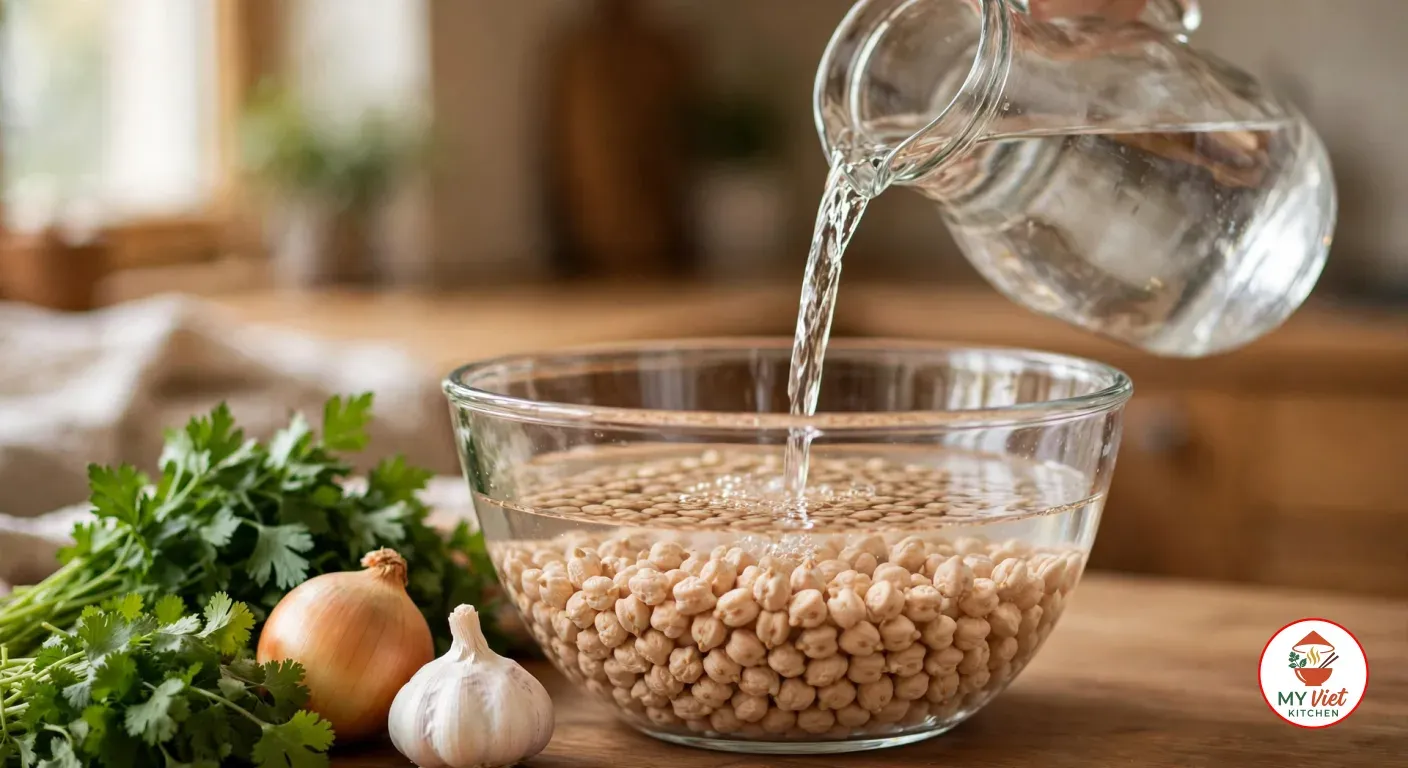
1Pick over the chickpeas for small stones and rinse them. Tip them into a big bowl with enough cold water to sit 4 inches (10 cm) above them. Leave them on the counter 12 to 24 hours, topping up the water if the swelling chickpeas poke through. Drain, then tip them onto a clean kitchen towel and blot off the surface water. Do not cook them: they go into the processor raw.
Step 2: Grind the Falafel Mixture
2Put the chickpeas, onion, garlic, parsley, cilantro, cumin, coriander, cayenne, salt and black pepper in a food processor. Pulse in short bursts, about 30 to 40 times, scraping down the bowl now and then, until the chickpeas look like coarse meal and a tablespoon of the mixture holds together when squeezed. Don’t run it to a smooth paste; a few chickpea bits the size of sesame seeds are fine.
Step 3: Chill and Shape the Falafel
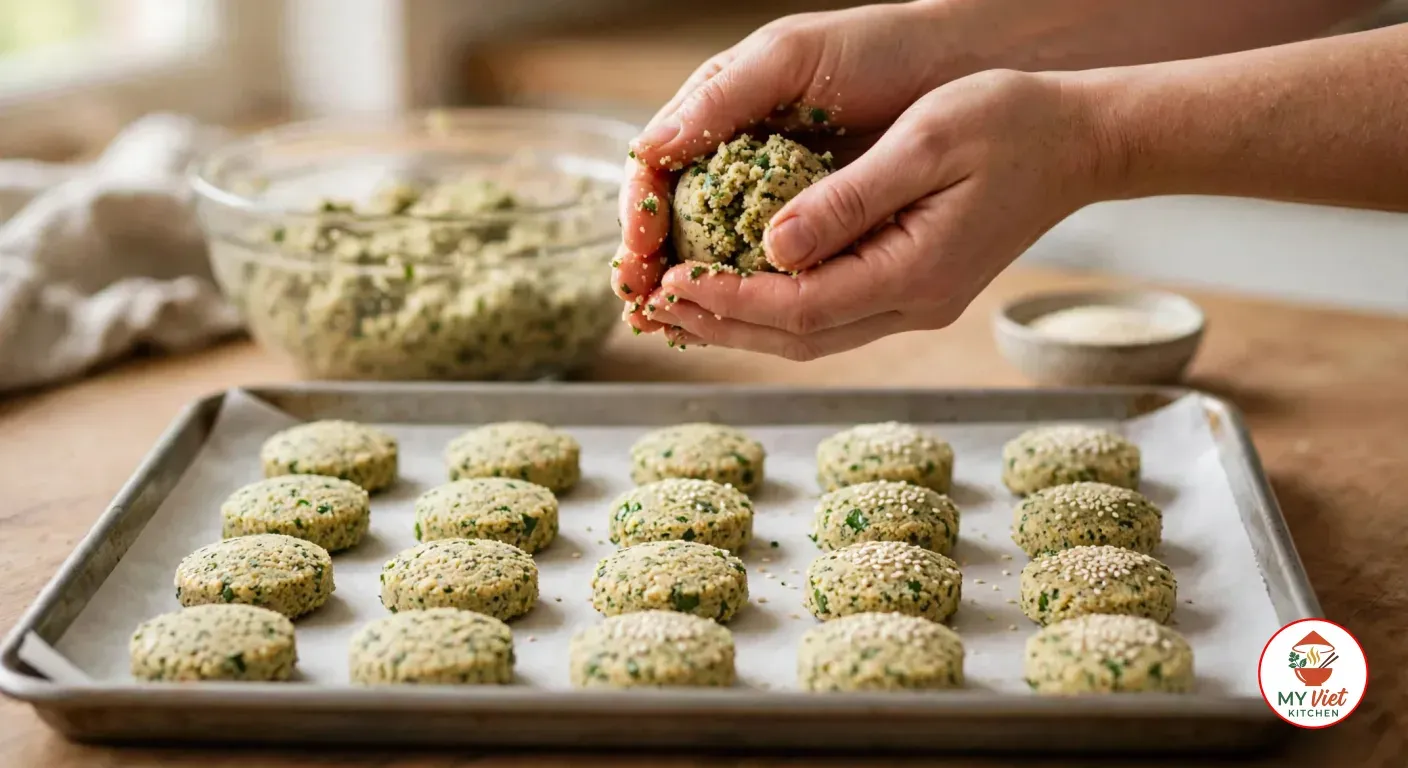
3Scrape the mixture into a bowl, cover and refrigerate for 1 hour. Sprinkle the baking powder and flour over it and fold them in until no white streaks show. Scoop 2 tablespoons at a time, press firmly between your palms into a ball, then flatten it slightly into a thick disc about 1 1/2 inches (4 cm) wide; pinch any cracked edges closed. Press sesame seeds onto the tops if you like and set the discs on a parchment-lined tray. You should get about 30.
Step 4: Fry the Falafel
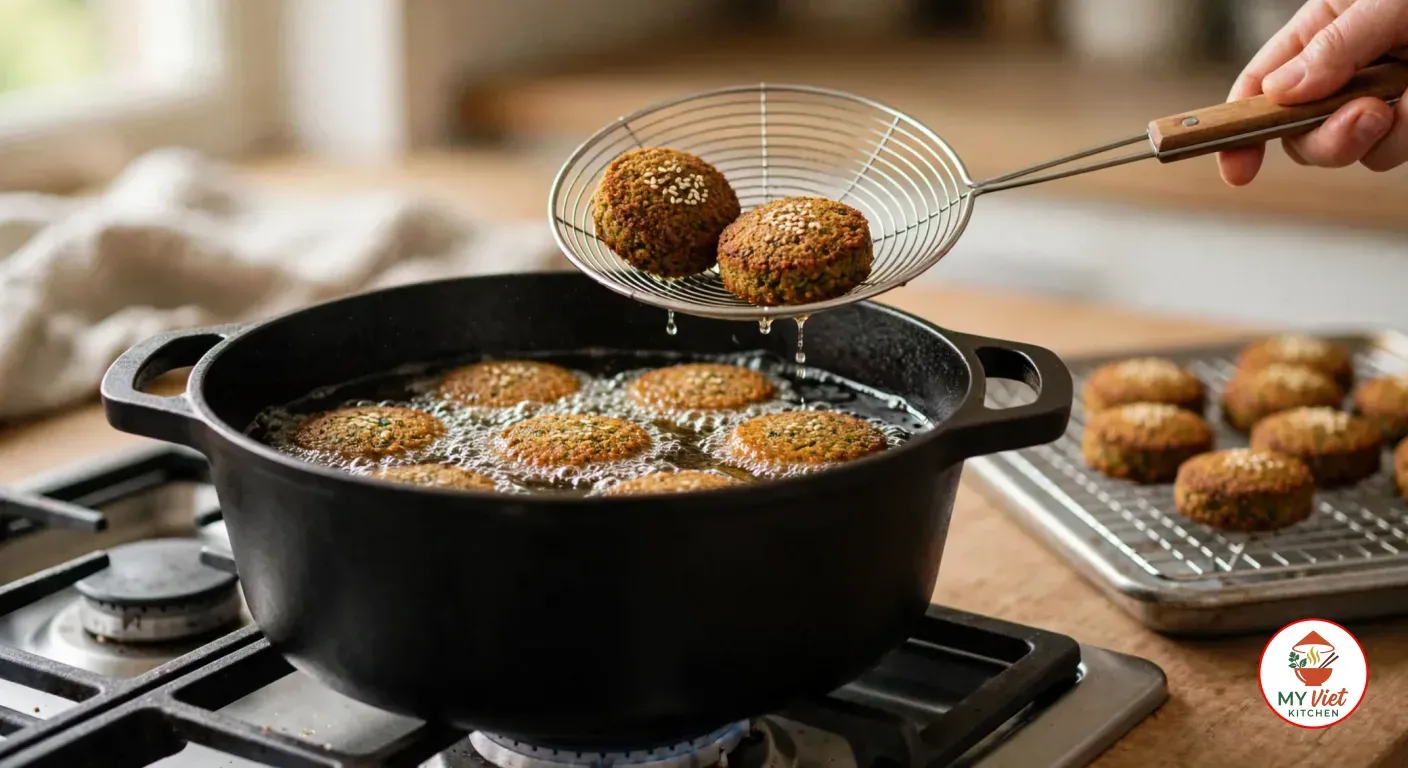
4Heat 2 inches (5 cm) of oil in a heavy pot or Dutch oven to 350°F (175°C). Fry one falafel first as a test: it should hold together and brown in 3 to 4 minutes. Then cook the rest in batches of 5 or 6. Each batch needs 3 to 4 minutes, turned once, to reach a deep golden-brown crust. Move the cooked falafel to a wire rack over a sheet pan with a spider or slotted spoon. Let the oil come back to 350°F (175°C) between batches.
Step 5: Make the Tahini Sauce and Serve
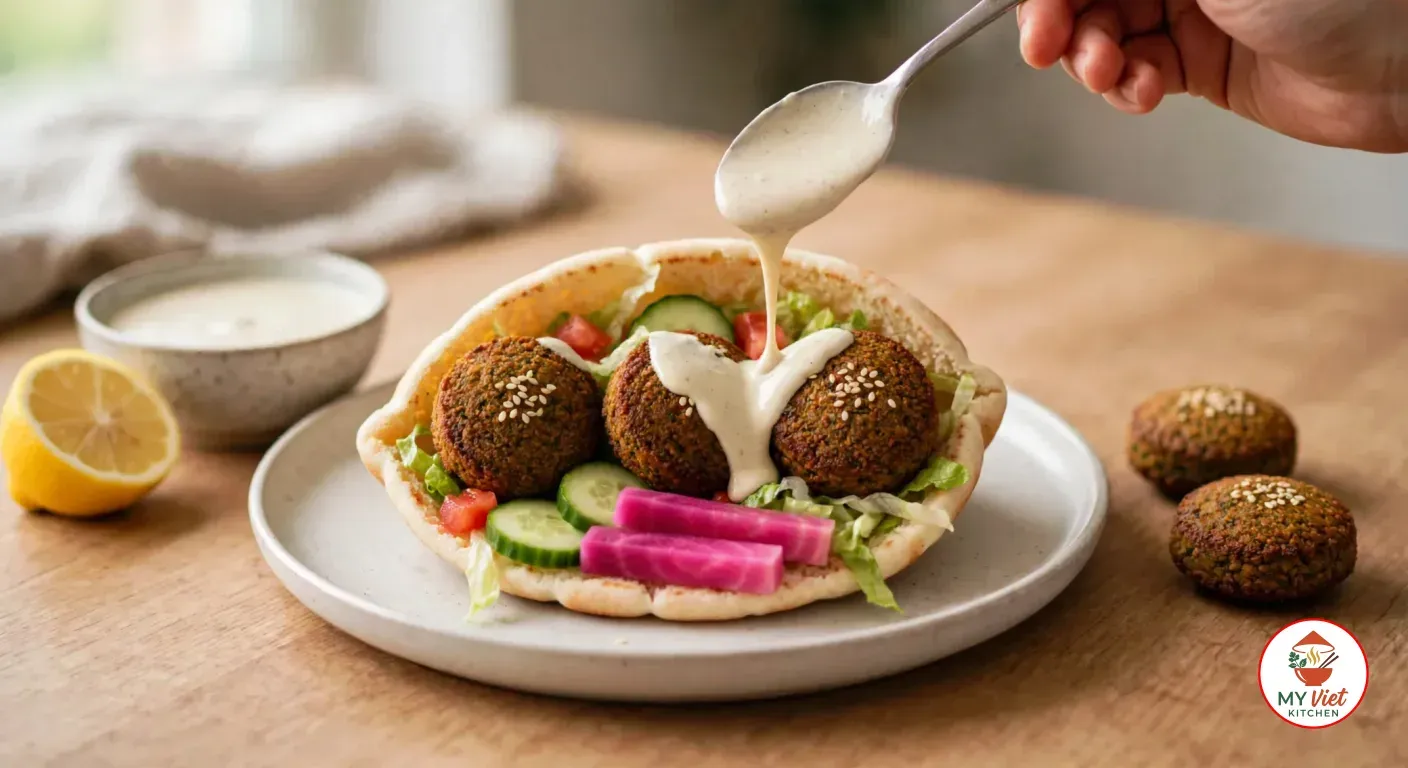
5You can make the sauce while the mixture chills. Whisk the tahini, lemon juice, grated garlic and 1/4 teaspoon of salt in a bowl. Whisk in the cold water a tablespoon at a time until the sauce is smooth and pourable. Warm the pitas, open them and fill each with lettuce, tomato, cucumber, pickled turnips and 4 or 5 falafel. Spoon tahini sauce over the top and add hot sauce if you like.
Frequently Asked Questions
Can you quick-soak the chickpeas?
Cooks disagree, and this recipe sticks with the long soak. Jennifer Segal says her quick-soak method works well too. It boils the chickpeas for 5 minutes, then leaves them to stand off the heat for 1 hour (Once Upon a Chef). America’s Test Kitchen says not to substitute quick-soaked chickpeas, because they make stodgy falafel (America’s Test Kitchen). If you try the quick soak, drain and dry the chickpeas well before grinding.
Why did my falafel fall apart in the oil?
Usually the mixture wasn’t ground enough or the oil was too hot. Segal says falafel can fall apart if the mixture is too dry or hasn’t been processed enough to bind, and that pressing the patties compact helps (Once Upon a Chef). Suzy Karadsheh keeps her oil around 375°F but not so hot that the falafel fall apart, and fries one first to check (The Mediterranean Dish). America’s Test Kitchen fries at 325°F (America’s Test Kitchen). Step 4 sits between them at 350°F (175°C), with a test falafel first.
Can you make falafel ahead or freeze it?
Yes, raw or cooked. Segal says you can shape the patties up to a day ahead, chill them on a parchment-lined sheet and fry them straight from the fridge. Uncooked patties also freeze for up to three months and fry from frozen with a little extra time (Once Upon a Chef). Nagi Maehashi gives cooked ones up to 5 days sealed in the fridge. To reheat, she microwaves them first, then sprays them with plenty of oil and gives them 5 minutes in a 200°C (390°F) oven to crisp the surface (RecipeTin Eats).
Can you bake falafel instead of frying?
You can, but the crust won’t be the same. Maehashi calls frying mandatory for falafel. She says it is the only way to get the crispy dark crust and keep the inside moist (RecipeTin Eats). Segal says baking or air-frying won’t give the same results (Once Upon a Chef). To bake instead, Karadsheh gives each patty a quick brush of olive oil and bakes them at 350°F for about 15 to 20 minutes, flipping them halfway (The Mediterranean Dish).
Is the video recipe the same as this one?
Close, with more spice and one more herb. Karadsheh’s video lists the same 2 cups of dried chickpeas, plus 1/2 cup of dill, 7 to 8 garlic cloves and 1 tablespoon each of black pepper, cumin and coriander. It also lists 1/2 teaspoon of baking soda, 1 teaspoon of baking powder and 2 tablespoons of sesame seeds, toasted (The Mediterranean Dish). This page leaves out the dill, uses 4 garlic cloves and 2 teaspoons each of cumin and coriander, and adds 3 tablespoons of flour.
Sources
- Falafel, Wikipedia
- Falafel Recipe, Nagi Maehashi, RecipeTin Eats, September 2018 (updated June 2025)
- Falafel, Jennifer Segal, Once Upon a Chef, updated August 2026
- Easy Authentic Falafel Recipe: Step-by-Step, Suzy Karadsheh, The Mediterranean Dish, February 2020
- Falafel, Steve Dunn, America’s Test Kitchen, June 2018
- How to Make Authentic Falafel from The Mediterranean Dish, The Mediterranean Dish, YouTube, December 2019